The main category of Fitness News.
You can use the search box below to find what you need.
[wd_asp id=1]
The main category of Fitness News.
You can use the search box below to find what you need.
[wd_asp id=1]
March 4-8, 2024, is Obesity Care Week.
Obesity can be a tough topic to talk about. Although more than 2 out of 5 people in the U.S. are living with obesity, stigma and weight bias — negative thoughts and actions toward a person based on their weight — are still very much part of the conversation.
Most people probably associate weight bias with internet trolls and random hecklers, but research shows that friends and family can also be a source of bias. This can be especially true for women and people assigned female at birth. Studies show women are more likely to be treated unfairly because of their weight by family members compared to men.
Kristal Hartman, chair of the Obesity Action Coalition National Board of Directors, said she knows firsthand about the importance of support and understanding when living with obesity.
“When you are loving and caring about a person living with the chronic disease of obesity, step one is to realize that it is a chronic disease just like diabetes, high blood pressure and heart disease,” she said. “There are 200 comorbidities related to this disease and there is no one right way of treating it.”
Watch: Obesity Is a Complex Disease With a Variety of Treatments >>
Hartman said family and friends can show support by asking thoughtful questions without expectations. “Just say, I know you’re on a health journey, and I’m here for you and I am happy to support you in any way possible.”
We asked Hartman for more advice on ways to support a friend or a loved one living with obesity.
Learn about the disease. Obesity is a complex condition. Education and research can help you understand the facts and spread awareness about the disease.
Forget assumptions. It’s important to remember that just because a way of eating or an exercise routine helped you or someone on social media doesn’t mean it will work for everyone else.
Ask questions. Your friend or loved one living with obesity may have an activity or lifestyle change they want to try (Aqua Zumba anyone?) But you’ll never know if you don’t ask.
Start healthy changes in your own life. If you’re already thinking about a healthier lifestyle, start making changes yourself and ask if your friend is interested in doing them with you. This can include grocery shopping together, planning meals, starting a walking routine, etc.
Learn about bias. Implicit biases (unconscious) and explicit bias (intentional) contribute to weight bias, stigma and discrimination toward people living with obesity. If you’re aware of bias you can help stop the stigma.
Read: Changing How We Talk About Obesity — A Conversation with Dr. Sowa >>
Test your own bias. There are different kinds of weight bias, stigma and discrimination. Take an Implicit Association Test to be aware of any bias you may have.
Be aware of physical limitations. People living with obesity may have limitations to what their body can do. Instead of a 5K, try suggesting a walk around the block.
Encourage (but don’t push) professional and social support. There are psychologists who specialize in obesity management as well as online support groups that offer expert advice and/or connect people living with obesity. The OAC offers group sessions where friends and family members can join to talk about health topics and support someone who is living with obesity.
Resources
From Your Site Articles
Related Articles Around the Web
A Margo Wickersham, de 57 años, le diagnosticaron cáncer de vejiga de etapa 1. La profesional de bienes raíces no tenía ningún factor de riesgo conocido de la enfermedad y recuerda haber sido completamente saludable hasta que detectó un poco de sangre en su orina. Después de recibir el diagnóstico y mientras buscaba tratamiento, Wickersham se enteró que de hecho tenía un segundo cáncer primario, distinto al cáncer de vejiga, un tipo infrecuente de cáncer llamado cáncer plasmocitoide. Consecuentemente, tuvo que hacer que remuevan su vejiga por completo, una experiencia que documentó en un libro,Gratitude in the Storm: When Not Dying Is Enough to Keep Fighting [Gratitud en la tormenta: Cuando no morir es suficiente para seguir peleando].
El cáncer plasmocitoide es infrecuente, no solo que los sobrevivientes de cáncer de vejiga deben estar alerta para detectar cualquier recurrencia, sino que demasiado frecuentemente enfrentan el riesgo de tener cánceres adicionales.
El cáncer de vejiga es el 10º tipo más frecuente de cáncer a nivel mundial, afectando comúnmente a personas de más de 55 años. Aunque ocurre de tres a cuatro veces más frecuentemente en los hombres, la Sociedad estadounidense contra el cáncer estima que más de 20,000 mujeres estadounidenses recibirán diagnósticos de la enfermedad en 2024.
Adicionalmente a eso, los sobrevivientes de cáncer de vejiga tienen el índice más alto de posibilidades de tener un segundo cáncer primario. “He visto pacientes que tenían varias malignidades urológicas o poco después de que les tratamos se sienten mejor y luego contraen linfoma”, dijo Armine Smith, M.D., directora del departamento de oncología urológica de Johns Hopkins de Sibley Memorial Hospital.
En un estudio que observó a más de 2 millones de pacientes, aproximadamente el 8% de todos los sobrevivientes de cáncer tuvieron un segundo cáncer primario, pero el 34% de aquellos con cáncer de vejiga recibieron un diagnóstico de un segundo cáncer primario en los siguientes 20 años. De ellos, el 25% recibió un diagnóstico de cáncer pulmonar, el segundo cáncer primario más frecuente que afecta a sobrevivientes de cáncer de vejiga.
¿Qué son los segundos cánceres primarios?
Los segundos cánceres primarios son cánceres completamente nuevos que pueden afectar a sobrevivientes meses o años después de los cánceres primarios. Son distintos a los cánceres metastásicos que empiezan en un órgano y se propagan a otros. “A pesar de que el cáncer se ha propagado a un órgano diferente, retiene las características de las células cancerosas originales”, dijo Smith. “La vejiga está recubierta con células cancerosas uroteliales y la mayoría de cánceres de vejiga son uroteliales. Si este cáncer urotelial sale de la vejiga y llega a los ganglios linfáticos, al hígado, a los pulmones, etcétera, retendrá sus características uroteliales”.
Los segundos cánceres primarios, en contraste, no tienen relación con el cáncer primario, así que no hay ninguna relación en lo que se refiere a las recaídas o recurrencias del cáncer primario.
Además del cáncer pulmonar, algunos de los segundos cánceres primarios más frecuentes que los sobrevivientes de cáncer de vejiga tienen más riesgo de contraer incluyen un segundo cáncer primario de vejiga (sin relación), tal como le pasó a Wickersham, o cáncer de pelvis o de útero renal, de riñón, vaginal, rectal, pancreático, de la laringe y del esófago.
“Lo que no sabemos es si es el cáncer de vejiga lo que aumenta el riesgo de que personas tengan un segundo cáncer primario o si es alguna exposición que causó el cáncer de vejiga la que también es responsable del segundo cáncer primario, o si es porque nosotros, los urólogos, hacemos seguimiento de los pacientes durante un período muy largo de tiempo y detectamos estos tipos de diagnósticos con el tiempo”, dijo Smith.
Factores de riesgo para un segundo cáncer primario
Aunque los científicos no conocen todas las razones por las cuales los sobrevivientes de cáncer de vejiga tienen más segundos cánceres primarios, la causa del cáncer primario podría exponer a las personas a un mayor riesgo de cánceres adicionales.
“Puesto que se considera que el cáncer de vejiga es un cáncer asociado a exposición, hay algunas cosas que pueden afectar el riesgo de una persona de desarrollar otros cánceres que pueden estar relacionadas con la exposición”, explicó Smith.
Fumar es el factor de riesgo más importante. La exposición a otros carcinógenos, incluyendo tintes tales como los usados en las industrias textiles, de pinturas y de salones de belleza (por ejemplo, tintes para el cabello) y químicos usados en la industria automotriz, también ponen en riesgo a las personas. Pero algunas personas, al igual que Wickersham, todavía pueden tener cáncer de vejiga y segundos cánceres primarios a pesar de no tener ninguna exposición conocida al tabaco o a otros químicos.
Además, Smith dice que las mutaciones genéticas tales como las de personas con el síndrome de Lynch podrían exponer a un número pequeño de pacientes a un riesgo de desarrollar varios cánceres.
“A pesar de que el cáncer de vejiga no es un tipo genético, hay algunos genes que exponen a personas a un riesgo de desarrollar cáncer urotelial o de vejiga”, dijo Smith. “Y sus genes también pueden estar asociados a algunas malignidades uterinas, colorrectales y GI”.
En lo que se refiere a la raza, las personas de raza blanca tienen dos veces más posibilidades que otros grupos de tener cáncer de vejiga, pero un estudio determinó que sobrevivientes de cáncer de vejiga de las islas del pacífico con ascendencia asiática tienen un mayor riesgo de tener un segundo cáncer primario.
Cómo reducir el riesgo de un segundo cáncer primario
Aunque es imposible eliminar el riesgo, Smith aconseja seguir las pautas de detección de la Sociedad estadounidense contra el cáncer implementadas para cánceres pulmonares, GI y ginecológicos.
“Hay medidas preventivas que las personas pueden tomar solo para mejorar su salud general y tener menos riesgo de desarrollar varias malignidades”, dijo. “Esto incluye la actividad física, comer alimentos integrales, evitar comer demasiada carne roja, especialmente carne roja carbonizada, limitar el consumo de alcohol y evitar el tabaco”.
Es importante visitar regularmente a proveedores de atención médica después de tener tratamientos para cáncer de vejiga e indicarles si hay cualquier síntoma nuevo que pudiese ser evidencia de un segundo cáncer primario.
Este recurso educativo se preparó con el apoyo de Astellas y Pfizer.
From Your Site Articles
Related Articles Around the Web
Image URL: https://unsplash.com/photos/hanged-top-on-brown-and-white-clothes-horse-TS–uNw-JqE
Ever thought about how women’s fashion has zipped and zagged through history? It’s like flipping through an old photo album, but instead of family pics, it’s full of corsets, flapper dresses, and power suits. Let’s take a casual stroll down memory lane and see how women’s threads have changed, reflecting everything from social shifts to the fight for equality, and yes, even the tech boom.
Picture this: It’s the late 1800s, and you’re laced up in a corset that’s squeezing the breath out of you, all for the sake of looking posh. Victorian fashion was all about showing off your status with layers upon layers and corsets that made sitting down an adventure. It was glam, sure, but comfy. Not so much.
Jump to the 1920s, and it’s like everyone collectively decided to ditch the discomfort. Hello, flapper dresses! Hemlines went up, corsets got tossed, and women started dancing like there was no tomorrow. It wasn’t just about fashion; it was a bold statement of freedom and shaking off old-school norms.
After World War II, fashion took a U-turn back to glamour town with Dior’s New Look. Think cinched waists and skirts so full you could hide a small family under them. It was a throwback to femininity and luxury after years of rationing and practicality.
The ’60s said, “Hey, why not show off your knees?” and thus, the mini skirt was born. It was all about self-expression, baby. Then the ’70s rolled in with disco fever, bringing glitter, flares, and a whole lot of boogie into the mix.
Enter the ’80s, and women were storming the workforce, ready to shatter some glass ceilings. The power suit became the uniform of choice, complete with shoulder pads so big they could double as flotation devices. It was all about making a statement and claiming your space in the boardroom.

Image URL: https://unsplash.com/photos/assorted-color-clothes-OYYE4g-I5ZQ
The ’90s kicked off with grunge – goodbye glamour, hello flannel. But as the digital age dawned, fashion went online. Nowadays, a trend can go viral overnight, and sustainability is the new black. Fashion is faster, more accessible, and thankfully, a lot more inclusive.
Looking ahead, fashion is getting techy with smart fabrics and digital catwalks. But at its heart, it’s still about us gals wanting to express ourselves, whether it’s through a vintage tee or a VR fashion experience.
Fashion’s journey is wild, isn’t it? From corset-induced fainting spells to tweeting about your latest eco-friendly finds, it’s been quite the ride. And the best part? We’re nowhere near the end of this fashion adventure. Who knows what we’ll be wearing in the next few decades, if history taught us anything, it’s that it’ll be a reflection of the times, packed with stories to tell. So, here’s to whatever comes next in the ever-spinning world of women’s fashion. Cheers!
Disclaimer
The Content is not intended to be a substitute for professional medical advice, diagnosis, or treatment. Always seek the advice of your physician or other qualified health provider with any questions you may have regarding a medical condition.
Image URL: https://unsplash.com/photos/black-and-white-measuring-tape-mz9koyBQd4Q
So, you’re on a mission to shed some pounds but can’t do dairy? No stress! The world of weight loss shakes for women has got your back with tons of lactose-free options. Whether you’re lactose intolerant or just cutting out dairy for a while, these shakes are here to make your journey less of a hassle and more of a treat. Let’s dive into the scoop on finding the yummiest, most nutritious shakes to match your lifestyle.
First up, why skip on lactose? For loads of us, dairy can be a bit of a troublemaker, leading to bloating, discomfort, and all that not-so-fun stuff. Going for lactose-free shakes means you can fuel up without the drama, keeping your weight loss journey on a smooth track.
Taste is Everything: Gone are the days of bland, tasteless shakes. The lactose-free gang comes in all sorts of flavours from the classic chocolate and vanilla to more adventurous ones like berry or even coffee. Finding one that tickles your taste buds means you’re more likely to stick with it.
Check Your Goals: What’s the shake for? A quick meal replacement, a snack, or maybe a post-workout boost? Knowing this helps you pick a shake that’s got the right stuff – like enough protein to keep you full or carbs to refuel after a sweat sesh.
The Cleaner, the Better: Look out for shakes that keep it real with minimal, straightforward ingredients. Added sugars and weird chemicals? No thanks. Natural and wholesome is the way to go.
Meal or Snack?: Depending on how you mix them, these shakes can be a solid meal or a light snack. Throw in some fruit, nuts, or oats to bulk it up, or keep it simple for a quick sip.
Don’t Forget to Drink Up: Water, that is. Shakes are fab, but your body still needs plenty of good ol’ H2O to stay hydrated and happy.

Image URL: https://unsplash.com/photos/ice-cream-in-clear-drinking-glass-kA1lumyOPmI
Glowing Skin: Many folks notice their skin starts looking brighter without dairy. Plus, the goodies in lactose-free shakes can give your skin an extra boost of love.
Energized Vibes: Ditching the dairy-induced discomfort means more energy to crush those workouts and power through your day.
Helping the Planet: Choosing plant-based options can be a small step towards a more eco-friendly lifestyle – a win-win for you and the earth.
Shake It Up: Don’t be afraid to get creative with your shakes. Mix in different fruits, spices, or superfoods to switch things up and keep your taste buds dancing.
Listen to Your Body: Everybody is unique, so what works for your friend might not be your cup of tea. Pay attention to how different shakes make you feel and find the ones that make you feel awesome.
Stick With It: Like any change to your diet, consistency is key. Make these shakes a regular part of your routine for the best results.
Jumping into the dairy-free shake scene can transform your weight loss game. With so many delicious and nutritious options out there, you’re all set to find the perfect match for your taste and health goals. So, why not give them a whirl and see how they can spice up your journey to a fitter, happier you? Let the shake adventure begin!
Disclaimer
The Content is not intended to be a substitute for professional medical advice, diagnosis, or treatment. Always seek the advice of your physician or other qualified health provider with any questions you may have regarding a medical condition.
At 57 years old, Margo Wickersham was diagnosed with stage 1 bladder cancer. The real estate professional had no known risk factors for the disease and recalled being completely healthy until she spotted a little bit of blood in her urine. After receiving the diagnosis and while seeking treatment, Wickersham learned she actually had a second, different bladder cancer — a rare type called plasmacytoid cancer. As a result, she had to have her bladder removed entirely, an experience she documented in her book, Gratitude in the Storm: When Not Dying Is Enough to Keep Fighting.
While plasmacytoid cancer is uncommon, bladder cancer survivors not only have to watch out for recurrence, but they all too often face the risk of getting additional cancers.
Bladder cancer is the 10th most common type of cancer worldwide, typically affecting people over 55 years old. While it occurs three to four times more often in men, the American Cancer Society estimates that more than 20,000 American women will be diagnosed with the disease in 2024.
What’s more, bladder cancer survivors have the highest rate of getting a second primary cancer. “I’ve seen patients who’ve had multiple urological malignancies, or soon after we treat them and they get better, they get lymphoma,” said Armine Smith, M.D., director of Johns Hopkins Urologic Oncology at Sibley Memorial Hospital.
In one study looking at more than 2 million patients, about 8% of all cancer survivors ended up with a second primary cancer, but 34% of those with bladder cancer were diagnosed with a second primary cancer within 20 years. Of those, 25% were diagnosed with lung cancer, the most common second primary cancer affecting bladder cancer survivors.
What are second primary cancers?
Second primary cancers are completely new cancers that can affect survivors months or years after primary cancers. They are different from metastatic cancers, which start in one organ and spread to other organs. “Even though the cancer has moved on to a different organ, it retains the characteristics of the original cancer cells,” Smith said. “The bladder is lined with urothelial cancer cells, and most bladder cancers are urothelial. If this urothelial cancer leaves the bladder and goes to lymph nodes, liver, lungs, etc., it will retain its urothelial characteristics.”
Second cancers, in contrast, are unrelated to the primary cancer, so they are also unrelated to relapses or recurrence of the primary cancer.
In addition to lung cancer, some of the most common second cancers bladder cancer survivors are at increased risk for include a second (unrelated) bladder cancer, as in Wickersham’s experience, or cancer of the renal pelvis/ureter, kidney, vagina, rectum, pancreas, larynx and esophagus.
“What we don’t know is whether it’s really the bladder cancer putting people at higher risk of second cancer, or if it’s the exposure that led to the bladder cancer that’s also responsible for the second cancer, or if it’s because we as urologists follow these patients for a very long time and pick up these kinds of new diagnoses over time,” Smith said.
Risk factors for developing second primary cancer
While scientists don’t know all the reasons bladder cancer survivors get more secondary cancers, the cause of the primary cancer may put people at higher risk for additional cancers.
“Because bladder cancer is considered to be an exposure-related cancer, there are some things that can affect the individual’s risk for developing other cancers that may be related to that exposure,” Smith explained.
Smoking is the biggest risk factor. Exposure to other carcinogens, including dyes such as those used in the textile, paint, and salon industries (think: hair dye), and chemicals used in the auto industry, also puts people at risk. But some, like Wickersham, can still get bladder cancer and second cancers despite having no known exposures to tobacco or other chemicals.
Additionally, Smith says, genetic mutations such as those in people with Lynch syndrome may put a small number of patients at risk of developing multiple cancers.
“Even though bladder cancer is not a genetic one, there are some genes that put people at risk for developing bladder or urothelial cancer,” Smith said. “And those genes can also be associated with uterine, colorectal and some GI malignancies.”
When it comes to race, white people are about twice as likely as other groups to get bladder cancer, but one study found that Asian Pacific Islander bladder cancer survivors have an increased risk of getting a second cancer.
How to reduce risk of a second cancer
While it’s impossible to eliminate risk, Smith advises following the American Cancer Society screening guidelines in place for lung cancer, GI cancers and gynecological cancers.
“There are preventive measures people can take just to make themselves healthy overall and put them at less risk of developing a variety of malignancies,” she said. “This includes physical activity, eating whole foods, not eating too much red meat — especially charred red meat — limiting alcohol and avoiding tobacco.”
It’s also important to visit healthcare providers regularly after undergoing treatment for bladder cancer and communicate with them about any new symptoms that could be evidence of a second cancer.
This educational resource was created with support from Astellas and Pfizer.
From Your Site Articles
Related Articles Around the Web
As told to Jacquelyne Froeber
March 4-8, 2024, is Obesity Care Week.
“If I don’t get food in the next two minutes, I’m going to die.”
This is how my brain works. Every day, at various points throughout the day, panic seeps into my thoughts and consumes me. I think of nothing else but food. And then I obsess over what my next meal will be.
I’ve been like this since I was a little kid. I remember my grandmother telling me that if I was hungry I could eat an apple. And that made me furious. What the hell was an apple going to do? I needed food. And I needed enough to quiet the worry rising in my chest.
I’d also never heard anyone else talk about food like this. I grew up making jokes about being hangry and my family and friends accepted this was just who I am. I didn’t have hypoglycemia, a thyroid disorder or any other medical conditions that could explain what I was feeling.
Over the years, the mental cycle of panic and worry made living with obesity even harder. I yo-yo dieted my way from middle school to dropping my kid off at middle school. Despite the bootcamps and gyms, nothing stuck in the long run. And just like that, I’d find myself high on the BMI scale again.
I was diagnosed with gestational diabetes during my second pregnancy, which then turned into Type 2 diabetes, and I was terrified that if I didn’t get my blood sugar under control I would have serious complications.
I started taking an anti-obesity medication (AOM) to help get my blood sugar under control and lose some weight. It was working but very slowly. Then, in April 2022, everything changed.
My doctor prescribed a new version of the AOM I was taking for insurance reasons. And almost immediately I knew my life would never be the same. The day after I took the new AOM injection, I went to work and by late afternoon, it hit me — I wasn’t worrying about dinner or what I was going to eat. I’d gone hours without thinking about food. I held my breath and waited for the familiar feeling of urgency to take over. But nothing happened.
It was like someone had opened up my head and taken all the obsessive thoughts and panicky feelings about food out of my body and — poof! Tossed them away in the trash.
For the first time ever, I felt free. I exhaled and welcomed feelings of relief and gratitude. I knew the AOM was the missing piece to my treatment puzzle. I was ready for a life change.
First was my diet. The medication makes you eat less, but you can’t necessarily eat the same things you did before. For me, fried foods cause major GI issues (I call them sulfur burps) and they’re so uncomfortable I had no problem trading in fast food and bringing chicken salad or yogurt and fruit to work. I learned protein shakes aren’t as boring as I thought, and I started buying more protein-rich foods to make meals at home for myself and my family.
Melissa and her husband Michael, 2023
As I was losing weight, I started working out consistently. I go to step aerobics four or five times a week. Taking an AOM can cause muscle loss, so I’ve incorporated weight training into my routine.
Thanks to the combination of diet, exercise and an AOM, I’ve been able to stop taking all the medications I was on for high cholesterol and high blood pressure. My blood sugar’s good, and I feel strong. When my daughter asked me why I want to workout I told her it’s important because it keeps me healthy so I can watch her grow up strong and live her best life because I feel like I’m living mine.
Many people think taking an AOM just works like magic. But it also takes work. I work hard and I plan my workouts and meals, and I do it out of respect and gratitude for this life change and medication that have helped me achieve a quality of life I didn’t think was possible. Sometimes I close my eyes and listen to the glorious sound of nothing. It’s the sound of freedom to me.
Have a Real Women, Real Stories of your own you want to share? Let us know.
Our Real Women, Real Stories are the authentic experiences of real-life women. The views, opinions and experiences shared in these stories are not endorsed by HealthyWomen and do not necessarily reflect the official policy or position of HealthyWomen.
From Your Site Articles
Related Articles Around the Web
Pregnancy is an amazing transformational period comprising of 40 weeks. There is nothing like growing a new life inside of you — it’s crazy when you think about it!
Many unbelievable changes happen to the body during pregnancy. Some of them may sound strange and even gross but are pretty normal. Here are a few fun facts (other than what the scans or doctors tell you) that might interest you.
Babies have been shown to become startled on 3D ultrasounds when the sonographer presses down on the stomach with the ultrasound. Researchers have also found that when your baby hears sounds, they might “cry”, with ultrasound videos showing babies opening their mouths and gasping when music is played. Thankfully you can’t hear them because of all of the fluid!
From the second trimester onwards, your baby begins to urinate about a liter per day in the womb. And can you guess where that pee goes? The baby drinks it. The baby urinates up to a litre per day, and yes! They drink it too.
Eat whatever you want your child to eat as he grows up! You don’t want a fussy eater later, isn’t it? Based at Durham University’s Fetal and Neonatal Research Lab, the study’s research team used 4D ultrasound scans, which create three-dimensional videos of fetuses in utero, to see how the unborn children of 100 pregnant women reacted to food ingested by their mothers. Fetuses exposed to the sweet taste of carrot responded with upturned lips and “laughter-face” expressions, while those exposed to the bitter taste of kale made “cry-face” expressions instead.

Yes, you heard that right! A male fetus can get erections in the womb. To your surprise, it is also believed that during sonography, a male fetus arousal can be caught.
It is a surprising fact that even would-be-fathers start to gain weight. Some may experience cramps in the lower abdomen. This condition is referred to as a sympathetic pregnancy or the Couvade Syndrome.
The average duration of pregnancy is 280 days, but it is possible to stay pregnant for over a year. The most prolonged pregnancy ever recorded was 375 days long, which is three months longer than average.

During the first trimester, many women find that saliva builds up in their mouths—sometimes to the point of interfering with talking. Although it’s more of a nuisance than a health concern, excess saliva is often associated with morning sickness and should end by the second trimester. In the meantime, try chewing sugarless gum or using mouthwash to help keep both saliva and nausea under control.
About 1 in every 2,000 babies are born with teeth. These are loose natal teeth and need to be removed by a doctor. They can be painful for the mother during breastfeeding. They can also be dangerous — there’s a risk they may be dislodged and inhaled.
Around week 18 of pregnancy, the structures inside your baby’s ear are well-established enough for your baby to start hearing some limited noises. Some of these are sounds that you might not even notice yourself — the gurgle of your stomach and whoosh of air in and out of your lungs.
Over the next few weeks, your baby will hear more and more of the outside world. By weeks 27 to 30, babies react in response to voices and noises that filter into the womb.
If, at some point in the third trimester, you feel like tearing down the house and rebuilding it, you’re not alone. The instinct to clean and reorganize—called nesting—is also common in birds, cats and dogs. “Women just want to do so many things, it’s almost like a time-clock where your body is telling you, ‘You need to get everything ready for the baby,’” says Darine El-Chaâr, an obstetrician in Ottawa. “It’s a protective mode, but you might find it makes you incredibly productive because you’re committed to getting it all done.”
Here’s the most interesting one. Baby girls develop all the reproductive eggs they will ever need and use in the uterus. But baby boys won’t develop sperm until they hit puberty.
Disclaimer
The Content is not intended to be a substitute for professional medical advice, diagnosis, or treatment. Always seek the advice of your physician or other qualified health provider with any questions you may have regarding a medical condition.
March is the month when the world celebrates Women’s Day. The campaign theme for International Women’s Day, which happens to be on 8th March 2024, is Inspire Inclusion. This International Women’s Day, 2024 we’re raising a toast to the bold and the beautiful. New-age women are picking up their kitchen knives, breaking through the culinary boundaries of a traditionally male-dominated industry, and cooking up a storm.
by Chef Romy Gill MBE, a celebrity and renowned Indian chef
There are many ways of making samosas and samosa fillings – this is the way I like best. Depending on the quality of the flour, you might need slightly less or slightly more water to make the dough. You can fry the samosas in sunflower oil, rapeseed oil, or ghee.
Makes: 10–12 samosas
Ingredients:
For the pastry
For the filling
Sunflower oil, for deep-frying
Instructions:
By Chef Serena Poon, CN, CHC, CHN
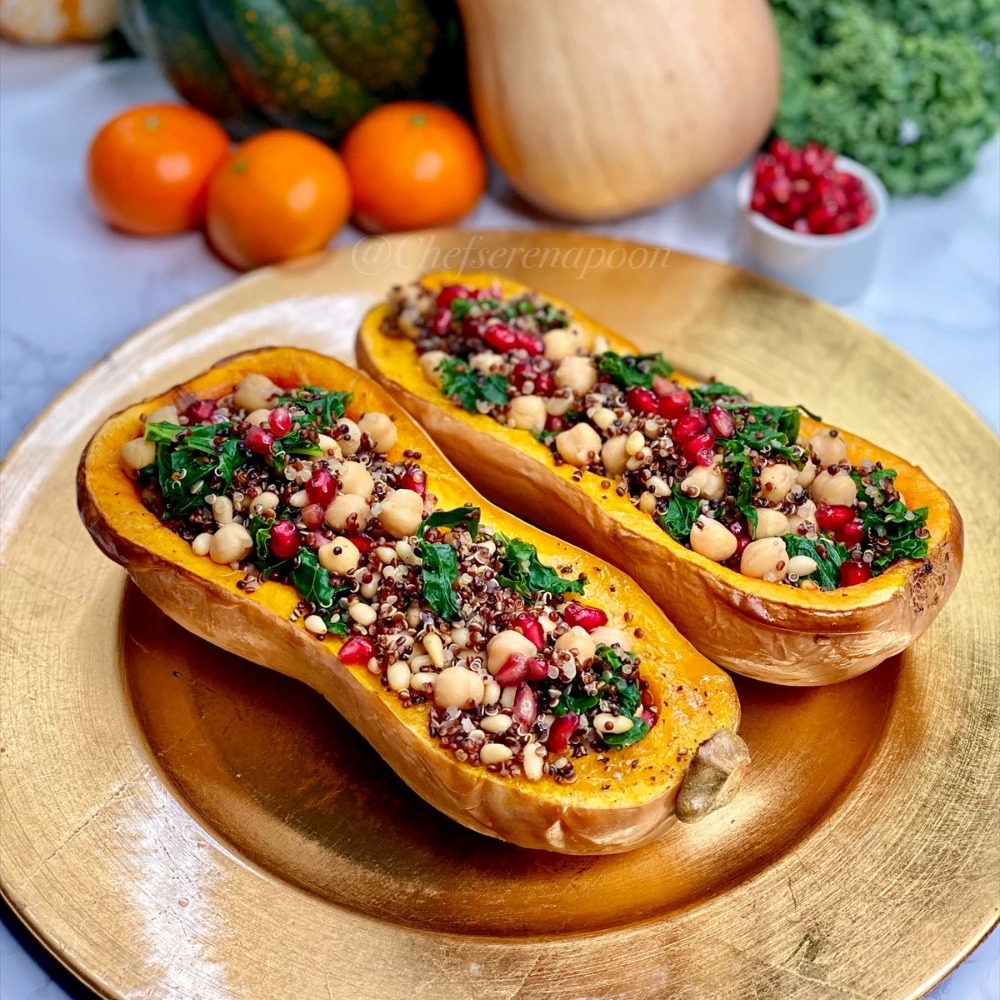
Butternut Squash is one of Serena’s favorite foods because of its health benefits, its sweet & nutty taste, and its versatility in the kitchen. She includes them in her breakfast, lunch, and dinner, and even dessert sometimes!
This recipe is delicious! It is more time-consuming than some, but, worth every minute! “I recommend making this the next time you have friends or family over – they will be so impressed with the aesthetic and taste of the dish!” shares Celebrity Chef Serena Poon.
Prep: 10 minutes
Cook: 75 min
Total: 85 min
Servings: 4
Ingredients:
Instructions
I love this cocktail around the holidays! It makes me feel festive and allows me to participate in the party without over-consuming alcohol. The berries keep the champagne chilled, so you won’t need to drink it quickly. Plus, they’ll turn the champagne a red color to keep with the spirit of the season! Cheers!

Ingredients
Instructions
Serves: 2
Serving Size: 1/2 cup champagne + 8 blackberries
Prep Time: 2 minutes
Disclaimer
The Content is not intended to be a substitute for professional medical advice, diagnosis, or treatment. Always seek the advice of your physician or other qualified health provider with any questions you may have regarding a medical condition.