US Fed’s decision to keep interest rates unchanged has triggered a surge in gold prices
What’s the story
Today, the MCX gold rate soared to a new high of Rs. 66,778 per 10 grams, shortly after the commodity market opened.
Internationally, spot gold prices are holding steady above $2,200 per ounce.
The increase in gold prices today is largely due to the outcome of Wednesday’s US Federal Reserve meeting and its announcement of three rate cuts in 2024.
How US Fed’s decision impacts gold prices
The US Federal Reserve’s decision to keep interest rates unchanged at 5.25%-5.50% has triggered a surge in spot gold prices.
Market analysts emphasized that investors breathed a sigh of relief when the Federal Reserve confirmed its plan for three rate cuts in 2024.
The lenient stance of the Federal Open Market Committee and chair Jerome Powell’s assertion that strong hiring alone wouldn’t prevent rate cuts have contributed to this spike in gold prices.
Crude oil prices also influence gold rates
Anuj Gupta from HDFC Securities pointed out that crude oil prices could significantly impact gold price trends following the US Fed meeting.
He elaborated that escalating crude oil prices are likely to exert inflationary pressure on precious metal prices and other assets.
The uncertainty surrounding inflation is directly tied to crude oil prices and could bolster gold rates.
Strengthening dollar puts downward pressure on gold prices
Before the US Fed meeting took place, a strengthening US dollar put downward pressure on gold prices, resulting in sharp selling during morning trading sessions.
The gold futures contract on the MCX for April 2024 opened at a lower Rs. 65,348 per 10 grams. However, some strategic buying at these lower levels helped offset early morning losses.
Anuj Gupta from HDFC Securities attributed this pressure to the US dollar index surpassing the 103 mark.
Fed’s rate cut indications and market impact
The US Federal Reserve has kept benchmark interest rates steady at 5.25%- 5.50%, marking the fifth consecutive instance of no change.
Despite a robust job market and rising prices, the Fed hinted at potential rate cuts three times this year.
G. Chokkalingam, Founder and Head of Research at Equinomics Research Private Limited, predicts that gold prices will remain strong due to geopolitical uncertainty and rate cuts, while Shrey Jain of SAS Online believes that lower interest rates favor gold prices.
After witnessing mixed trends in the Indian market yesterday, both gold and silver prices recorded a hike on the Multi Commodity Exchange (MCX) on Thursday, March 21, 2024.
Gold futures, maturing on April 5, 2024, stood at Rs 66,778 per 10 grams on the MCX, after recording a jump of Rs 1000 or 1.52 per cent. The previous close was recorded at Rs 65,750.
Meanwhile, silver futures, maturing on May 3, 2024, witnessed a hike of Rs 1187 or 1.58 per cent and were retailing at Rs 78,323 per kg on the MCX against the previous close of Rs 75,313.
GOLD, SILVER PRICES IN MAJOR CITIES
CITY
GOLD (per 10 grams, 22 carats)
SILVER (per kg)
NEW DELHI
Rs 61,950
Rs 78,500
MUMBAI
Rs 61,800
Rs 78,500
KOLKATA
Rs 61,800
Rs 78,500
CHENNAI
Rs 62,350
Rs 81,500
The gold and silver prices in India depend on several factors, including the value of the rupee against the dollar. Global demand also plays a key role in determining the trends observed in the rate of precious metals.
GOLD, SILVER PRICES ON INTERNATIONAL MARKET
Gold prices climbed to a record high on Thursday, as the US dollar and bond yields ticked lower after the Federal Reserve maintained its projection of three rate cuts for this year, news agency Reuters reported.
According to the latest metal report, spot gold was up 0.8 per cent at $2,203.84 per ounce, as of 0153 GMT, after hitting an all-time high of $2,222.39 earlier in the session.
US gold futures jumped 2.1 per cent to $2,206.30.
“It’s the goldilocks scenario for gold prices, where marginally higher inflation expectations meet lower nominal rates to create decreased real yields,” said Kyle Rodda, a financial market analyst at Capital.com.
Among other precious metals, spot silver gained 0.4 per cent to $25.70 per ounce.
Gold was a beneficiary of the FOMC and Powell today, adding to its recent gains.
And those have extended.
This is a very thin liquidity time of day for pretty much everything, gold included. Which doesn’t take away from this surge, not at all. The metal is benefitting from the prospect of lower rates ahead, as one key input to its price.
Forexlive
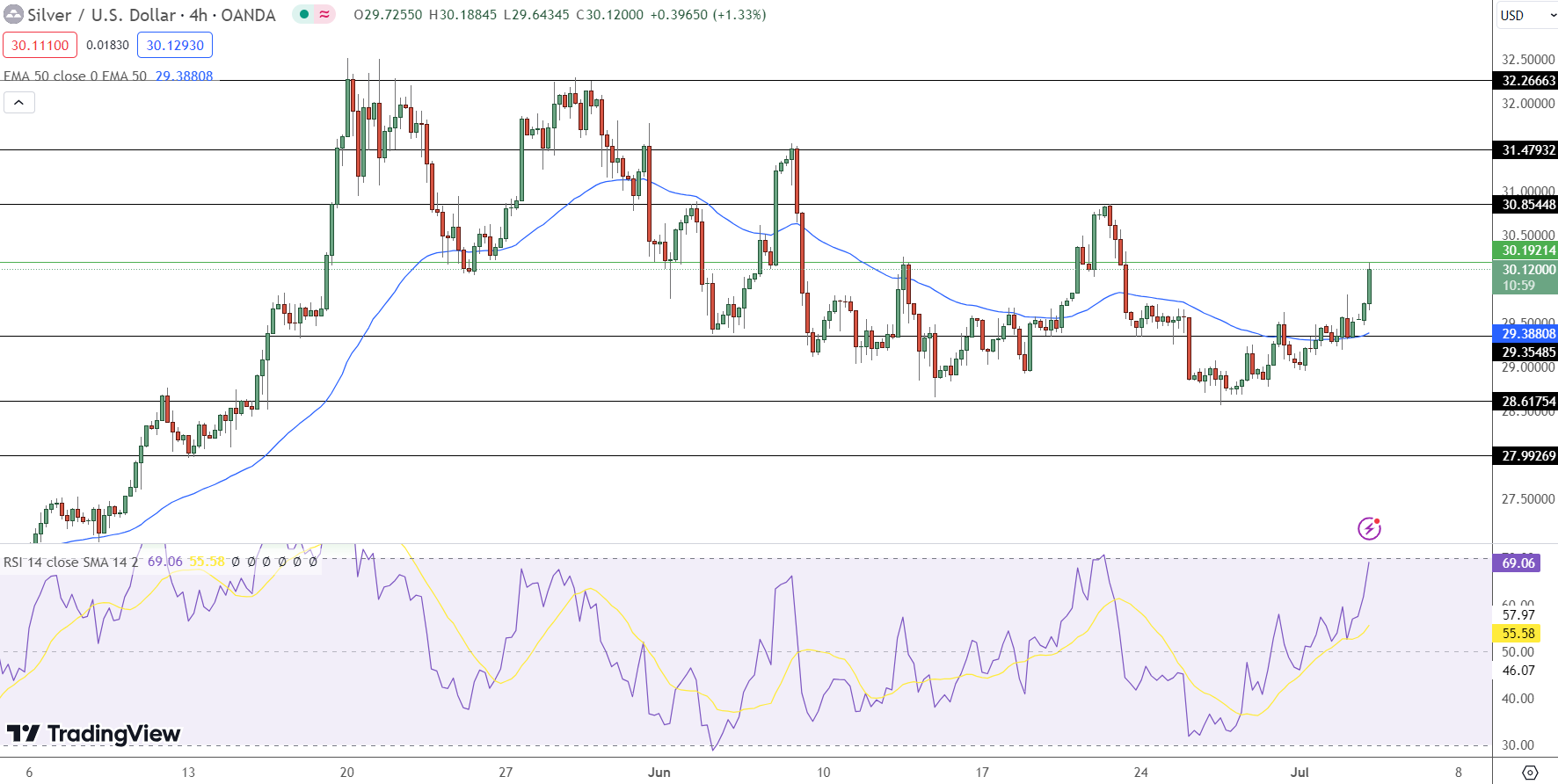
This chart is from our charting app, which is free and can be found at this link
Our version of Trading View doesn’t include Fari Value Gap indicators, but I’m sure if your’s does this move will be a nice, fat, green one.
New Gold Inc. (NYSEAMERICAN:NGD – Get Free Report) shares rose 8.2% during trading on Wednesday . The stock traded as high as $1.73 and last traded at $1.72. Approximately 5,805,649 shares changed hands during mid-day trading, an increase of 9% from the average daily volume of 5,326,743 shares. The stock had previously closed at $1.59.
Wall Street Analyst Weigh In
Several analysts have commented on the stock. StockNews.com cut shares of New Gold from a “buy” rating to a “hold” rating in a research report on Sunday, January 14th. National Bank Financial reiterated a “sector perform spec overwgt” rating on shares of New Gold in a research report on Wednesday, January 3rd. Finally, Raymond James upped their target price on shares of New Gold from $1.50 to $1.75 and gave the company a “market perform” rating in a research report on Tuesday, November 28th. One analyst has rated the stock with a sell rating, three have issued a hold rating and one has given a buy rating to the company’s stock. Based on data from MarketBeat, New Gold has a consensus rating of “Hold” and a consensus target price of $1.55.
The firm has a market capitalization of $1.17 billion, a P/E ratio of -18.89 and a beta of 1.50. The company has a debt-to-equity ratio of 0.51, a quick ratio of 0.98 and a current ratio of 1.54.
New Gold (NYSEAMERICAN:NGD – Get Free Report) last issued its quarterly earnings data on Tuesday, February 13th. The basic materials company reported ($0.01) earnings per share (EPS) for the quarter, missing analysts’ consensus estimates of $0.02 by ($0.03). New Gold had a positive return on equity of 5.63% and a negative net margin of 8.20%. The firm had revenue of $199.20 million during the quarter. Research analysts forecast that New Gold Inc. will post 0.06 EPS for the current year.
Institutional Trading of New Gold
A number of institutional investors have recently modified their holdings of the business. Commonwealth Equity Services LLC bought a new position in New Gold in the 3rd quarter valued at $25,000. Virtu Financial LLC bought a new position in New Gold in the 1st quarter valued at $33,000. CreativeOne Wealth LLC bought a new position in New Gold in the 2nd quarter valued at $33,000. Quantbot Technologies LP bought a new position in New Gold in the 2nd quarter valued at $33,000. Finally, ExodusPoint Capital Management LP bought a new position in New Gold in the 2nd quarter valued at $33,000. 31.78% of the stock is currently owned by hedge funds and other institutional investors.
New Gold Inc, an intermediate gold mining company, develops and operates of mineral properties in Canada. It primarily explores for gold, silver, and copper deposits. The company’s principal operating properties include 100% interest in the Rainy River mine located in Northwestern Ontario, Canada; and New Afton project situated in South-Central British Columbia.
Featured Articles
This instant news alert was generated by narrative science technology and financial data from MarketBeat in order to provide readers with the fastest and most accurate reporting. This story was reviewed by MarketBeat’s editorial team prior to publication. Please send any questions or comments about this story to contact@marketbeat.com.
Before you consider New Gold, you’ll want to hear this.
MarketBeat keeps track of Wall Street’s top-rated and best performing research analysts and the stocks they recommend to their clients on a daily basis. MarketBeat has identified the five stocks that top analysts are quietly whispering to their clients to buy now before the broader market catches on… and New Gold wasn’t on the list.
While New Gold currently has a “Hold” rating among analysts, top-rated analysts believe these five stocks are better buys.
Just getting into the stock market? These 10 simple stocks can help beginning investors build long-term wealth without knowing options, technicals, or other advanced strategies.
Gold rallies and trades between $2,150 and $2,180 after the Federal Reserve’s latest policy meeting.
Fed keeps interest rates steady but adjusts its longer-term FFR projections for 2025, highlighting ongoing inflation challenges.
Economic projections show an optimistic view for 2024 GDP growth, with core inflation expectations slightly elevated.
Fed’s Powell: More evidence Is needed before the first interest rate cut.
Gold prices skyrocketed late in the North American session after the Federal Reserve decided to keep rates unchanged but upward revised the Federal Funds Rates (FFR) projections for 2025. At the time of writing, XAU/USD trades volatile around the $2170-$2180 area, posting gains of more than 1%.
The US central bank has kept rates at 5.25%-5.50% unchanged and maintained their balance sheet reduction at the same pace since May 2023. In their statement, Fed officials underscored the US economy’s solidity and the labor market’s robustness. They have acknowledged the progress on inflation but also emphasized that the job is incomplete. They have stated that the risks to achieving their dual mandate are moving into a better balance, and they will continue to rely on data for their decisions.
The Fed Chair Jerome Powell echoed his and colleagues’ previous remarks, saying that more evidence is needed before cutting rates for the first time. When asked about tolerance for higher inflation, he said they expected a “bumpy road” on the disinflation process toward the Fed’s 2% goal. He added that higher-than-expected inflation figures at the start of the year didn’t change the broader story that price gains were slowing
Daily digest market movers: Gold stays firm amid weak US Dollar
After posting two months of surprisingly high inflation reports, the Federal Reserve tweaked its monetary policy expectations for 2025, though for 2024 the median stood at 4.6% as in December. Nevertheless, they upward revised the FFR from 3.6% to 3.9% in 2025. Additional figures were updated:
The Gross Domestic Product (GDP) for 2024 was revised to 2.1% up from 1.4% in December.
The Unemployment Rate was not revised, as is expected to remain at 4.0% down from 4.1%.
The Personal Consumption Expenditure (PCE) Price Index target wasn’t changed, remaining at 2.4%, while core PCE is estimated to end 2024 at 2.6%, up from 2.4%.
The latest US economic data witnessed mixed business activity readings, making it challenging to predict the pace of economic deceleration in the US. The labor market has shown signs of cooling, though the economy added more people to the workforce than expected, while fewer people applied for unemployment benefits.
Recent inflation data in the US showed that inflation on the consumer and producer side surprised to the upside, suggesting that inflation is stickier than expected.
Given the backdrop, Fed Chair Jerome Powell’s testimony at the US Congress earlier this month, suggesting the Fed would begin to cut borrowing costs, were justified. However, last week’s inflation figures and Retail Sales data triggered a repricing of Fed rate cut bets, aligning with the US central bank’s view of 75 basis points of easing toward the end of 2024.
According to the CME FedWatch Tool, expectations for a June rate cut stand at 64%, down from 72% a week ago.
Technical analysis: Gold traders push XAU/USD north of $2,170
XAU/USD price hovers around $2,150 unmoved ahead of the FOMC decision. A dovish tilt could open the door for a rally that prompts a jump in Gold prices, opening the door to challenge the all-time high (ATH) at $2,195.15. A retest there would expose $2,200 next.
On the other hand, if Gold spot price tumbles below $2,150, look for a breach below December’s 3 high, exposing the March 6 low of $2,123.80, followed by $2,100.
Gold FAQs
Gold has played a key role in human’s history as it has been widely used as a store of value and medium of exchange. Currently, apart from its shine and usage for jewelry, the precious metal is widely seen as a safe-haven asset, meaning that it is considered a good investment during turbulent times. Gold is also widely seen as a hedge against inflation and against depreciating currencies as it doesn’t rely on any specific issuer or government.
Central banks are the biggest Gold holders. In their aim to support their currencies in turbulent times, central banks tend to diversify their reserves and buy Gold to improve the perceived strength of the economy and the currency. High Gold reserves can be a source of trust for a country’s solvency. Central banks added 1,136 tonnes of Gold worth around $70 billion to their reserves in 2022, according to data from the World Gold Council. This is the highest yearly purchase since records began. Central banks from emerging economies such as China, India and Turkey are quickly increasing their Gold reserves.
Gold has an inverse correlation with the US Dollar and US Treasuries, which are both major reserve and safe-haven assets. When the Dollar depreciates, Gold tends to rise, enabling investors and central banks to diversify their assets in turbulent times. Gold is also inversely correlated with risk assets. A rally in the stock market tends to weaken Gold price, while sell-offs in riskier markets tend to favor the precious metal.
The price can move due to a wide range of factors. Geopolitical instability or fears of a deep recession can quickly make Gold price escalate due to its safe-haven status. As a yield-less asset, Gold tends to rise with lower interest rates, while higher cost of money usually weighs down on the yellow metal. Still, most moves depend on how the US Dollar (USD) behaves as the asset is priced in dollars (XAU/USD). A strong Dollar tends to keep the price of Gold controlled, whereas a weaker Dollar is likely to push Gold prices up.
(Reuters) -Canadian Miner Barrick Gold said on Wednesday it was ready to explore new gold and copper deposits in the Democratic Republic of Congo, in partnership with the government.
The world’s No. 2 gold miner wants to explore the region after it had success with its Kibali gold mine in the northeast DRC. The mine produced 343,000 ounces of gold in 2023, which was nearly 8.5% of the company’s output for the year.
Barrick had also said last year it was keen to look for more copper deposits in Zambia and DRC as it looks to expand its presence on the African copperbelt.
Zambia, where the company has its Lumwana mine, is Africa’s second-largest copper producer, behind its northern neighbour Congo.
(Reporting by Seher Dareen in Bengaluru; Editing by Shilpi Majumdar)
USA TODAY Blueprint may earn a commission from this advertiser.
What is the price of gold today?
The price of gold traded at $2,153.27 per troy ounce, as of 9 a.m. ET. That’s down 0.18% since yesterday’s gold price per ounce and up 4.21% from the beginning of the year.
The lowest trading price within the last 24 hours: $2,148.86 per ounce. The highest gold spot price in the last 24 hours: $2,160.27 per ounce.
Gold spot prices
XAU/USD is the label for finding the spot gold price traded in U.S. dollars. In this case, gold (XAU) is traded against the dollar, and the price represents the cost of one (troy) ounce of gold in USD. But there are other foreign exchange markets, such as XAU/EUR for trading in euros and XAU/GBP for trading in British pounds.
The spot gold price represents the price at which gold can be exchanged and delivered, and prices are typically quoted in gold price per troy ounce in U.S. dollars. But prices can also be quoted per gram and kilo. It’s worth noting that a troy ounce is slightly heavier than a standard ounce.
Gold price chart
The chart below shows how the spot price of gold is trending over the year. The data is as of 9 a.m. ET and doesn’t display intraday highs or lows.
Year to date, gold is up 4.21% from the beginning of the year, as of 9 a.m. ET. The 52-week intraday high reached $2,195.19 on March 8, 2024, and the 52-week intraday low dropped to $1,810.47 on Oct. 6, 2023.
Remember that the spot price of gold is quoted in real time and represents the current price at which gold can be bought or sold for immediate delivery. For most investors, the spot price usually differs from the price they’ll pay or receive when they decide to purchase or sell their gold.
For example, buying physical gold involves overheads like storage costs and insurance.
When trading physical gold, the difference between the buying and selling price, known as the spread, can eat into returns. Dealers often incorporate their markups and transaction fees within these spreads, which means the actual price an investor pays might be higher than the current market rate, while the selling price they receive might be lower.
While gold certificates, gold exchange-traded funds and gold trusts offer more liquidity and are easier to manage than physical gold, they come with their own risks. These investment vehicles might only sometimes match the performance of the spot price of gold due to management fees and potential discrepancies in tracking.
In essence, while the spot price provides a general benchmark for the value of gold, the actual returns and costs an investor encounters differ based on the medium of purchase and the specifics of the investment.
Investing in gold
Buying physical gold involves overheads like storage costs and insurance.
When trading physical gold, the difference between the buying and selling price, known as the spread, can eat into returns. Dealers often incorporate their markups and transaction fees within these spreads, which means the actual price an investor pays might be higher than the current market rate, while the selling price they receive might be lower.
While gold certificates, gold exchange-traded funds and gold trusts offer more liquidity and are easier to manage than physical gold, they come with their own risks. These investment vehicles might only sometimes match the performance of the spot price of gold due to management fees and potential discrepancies in tracking.
In essence, while the spot price provides a general benchmark for the value of gold, the actual returns and costs an investor encounters differ based on the medium of purchase and the specifics of the investment.
Precious metals spot prices
Precious metals have long served as investment vehicles and industrial commodities. Like gold, the spot prices of silver, platinum and palladium fluctuate based on various market, economic and geopolitical factors.
Silver spot prices
Silver possesses both monetary and industrial value. While it’s used as a hedge against economic volatility, it’s also crucial in the electronics, automotive and medical industries. Its dual-use nature can lead to different market dynamics compared to gold.
The price of silver opened at $24.78 per ounce, as of 9 a.m. ET. That’s down 0.55% since the previous day’s silver price per ounce and up 3.59% since the beginning of the year.
The lowest trading price within the last day: $24.73 per ounce. The highest silver spot price in the last 24 hours: $25.00 per ounce.
Platinum spot prices
Platinum is another precious metal that commands attention. Rarer than gold and silver, its primary use is in automotive catalytic converters, which help reduce harmful emissions. Given the push for cleaner automotive technologies, the demand dynamics for platinum can vary, influencing its spot price.
The price of platinum opened at $895.30 per ounce, as of 9 a.m. ET. That’s down 0.74% since yesterday’s platinum price per ounce and down 9.36% year to date.
The lowest trading price within the last 24 hours: $890.65 per ounce. The highest platinum spot price in the last 24 hours: $900.20 per ounce.
Palladium spot prices
Palladium, like platinum, is pivotal in the automotive industry for catalytic converters. In recent times, there has been a surge in palladium demand due to stricter emission standards worldwide. Its scarcity and rising industrial demand have led to significant price volatility.
The price of palladium is $988.92 per ounce, as of 9 a.m. ET. That’s down 1.07% since yesterday’s palladium price per ounce and down 10.06% year to date.
The lowest trading price within the last 24 hours: $976.21 per ounce. The highest palladium spot price in the last 24 hours: $1,001.42 per ounce.
USA TODAY Blueprint may earn a commission from this advertiser.
Frequently asked questions (FAQs)
Gold can be highly volatile and subject to strong short-term price fluctuations.
Whether it’s a good time to buy gold depends on various factors, including your investment goals, risk tolerance and time horizon, the broader economic outlook, and forecasts about the gold market.
Historically, many people view gold as a hedge against inflation and currency fluctuations. Others see it as a store of value during economic downturns. At the same time, some may find diversifying a portfolio of stocks and bonds useful, given its low correlation to both assets.
“If you look at gold’s performance historically, it’s the kind of asset that should perform well through uncertainty, as it has done in five out of the last seven recessions,” said Joseph Cavatoni, chief market strategist for North America at the World Gold Council. “For people looking for a store of value and a portfolio diversifier, gold has a strong track record of delivering those qualities.”
The highest price gold ever reached was $2,195.19 on March 8, 2024.
One notable recent high includes the yellow metal’s high of $1,971.17 per troy ounce in August 2020. This surge can be partially attributed to the economic uncertainty surrounding the COVID-19 pandemic.
The global outbreak of COVID-19 brought about unprecedented economic challenges. With central banks worldwide implementing low interest rate policies and massive fiscal stimulus packages to support their economies, there were concerns about potential inflation and the devaluation of fiat currencies. In this scenario, some investors turned to gold as a safe asset, given its history as a store of value during times of economic instability.
Geopolitical tensions, trade wars, and supply chain disruptions during this period further contributed to investors seeking refuge in assets deemed more stable, and gold has historically been a preferred choice for many. As a result, demand for gold increased, driving its price to a record high in August 2020.
Remember that while the COVID-19 pandemic’s economic repercussions significantly contributed to gold’s price rise in 2020, other factors likely also played a part.
Trading within narrow ranges for the price of gold since the beginning of this week is normal.
Caution prevailed in the financial markets, and the US dollar continued to strengthen.
According to gold trading platforms, gold retreated to the support level of $2147 per ounce before stabilizing around $2157 per ounce at the start of the most important trading session of the week.
Currently, the investors are awaiting the US Federal Reserve’s monetary policy decision this week. Widely, the Fed is expected to keep US interest rates unchanged today.
However, traders will be looking for clues about the start of monetary easing, as hotter-than-expected US inflation readings have reduced bets on a rate cut in June. Meanwhile, the Bank of Japan ended its negative interest rate policy and abandoned yield curve control, while the Reserve Bank of Australia kept interest rates steady but dropped its previous guidance on further hikes. On the other hand, according to data from the Economic Calendar, eurozone wage growth slowed sharply in the fourth quarter of 2023, and German investor sentiment beat expectations in March, giving the European Central Bank more room to start cutting interest rates sooner.
The gold price has risen by $95.19 per ounce, or 4.62%, since the start of 2024, according to trading on the Contract for Difference (CFD) that tracks the benchmark market for this commodity. Furthermore, gold is expected to trade at $2067.94 per ounce by the end of this quarter, according to global macroeconomic models and analyst expectations. Looking ahead, we expect it to trade at $2134.44 per ounce in 12 months.
On the global stock markets front, major US stock indices on Wall Street ended higher on Tuesday as investors awaited the Federal Open Market Committee’s (FOMC) monetary policy decision. Policymakers are widely expected to keep interest rates at current levels, and attention will turn to the “dot plot” for clues about the frequency and timing of potential cuts in the coming months. According to stock trading platforms, the S&P 500 index rose 0.5%, the Nasdaq index rose 0.3%, and the Dow Jones index jumped 321 points, supported by a 1.3% gain in Apple shares. Nvidia shares rebounded, rising 1% after announcing plans for its new flagship AI processor. Also, the company’s CEO highlighted the potential of the data center market, which he believes could exceed $250 billion.
Meanwhile, Etsy shares gained 1.1% after an earlier rise of 7%, while GM shares rose 1.07%. However, Meta and Tesla shares fell 0.1% and 1.4% respectively, and Alphabet shares fell after the previous day’s gains. Among chipmakers, AMD shares fell 4.8% and Intel shares fell 1.5%, close to their lowest level in six weeks.
Trading within narrow ranges for the price of gold since the beginning of this week is normal, as we have noted. From today onwards, the gold market may find catalysts to move strongly in one direction or the other. Selling pressure may gain momentum if the tone of today’s Federal Reserve policy statement appears more hawkish, thereby supporting further gains in the US dollar, which would be negative for gold. If this happens, there may be opportunities for movement towards support levels at $2138 and $2110 respectively. On the other hand, there may be an opportunity for bulls to push the price of gold to break above the $2200 resistance per ounce if the Federal Reserve signals abandoning its tightening path and hints at nearing the start of US interest rate cuts.