
Category: Forex News, News
Pound Sterling loses ground amid US Dollar strong comeback
- The Pound Sterling extended its correction from 30-month highs against the US Dollar.
- Will US inflation data revive GBP/USD buyers next week?
- Technically, the path of least resistance appears down for the Pound Sterling.
The Pound Sterling (GBP) closed the week deep in the red against the US Dollar (USD), as the GBP/USD extended the correction from 30-month highs to below 1.3100.
Pound Sterling yields into the US Dollar resurgence
GBP/USD failed to sustain at higher levels and returned to negative territory, giving up almost 300 pips in the past week. The pair faced a double whammy, with the resurgence of the demand for the US Dollar on one hand while on the other side, the Pound Sterling was thrown under the bus on the Bank of England’s (BoE) dovish policy expectations and the risk-averse market environment.

The recent slew of strong US economic data, including JOLTS Job Openings, ADP Employment Change and ISM Services PMI poured cold water on bets that the Federal Reserve (Fed) will opt for a 50 basis points (bps) interest rate cut in November, fuelling a sustained recovery in the US Dollar against its major rivals.
Data on Tuesday showed that US Job Openings rebounded to a three-month high in August, arriving at 8.04 million after declining to 7.71 million in July. The Automatic Data Processing (ADP) reported on Wednesday that the US private sector employment increased by 143,000 jobs for September, accelerating from the upwardly revised 103,000 in August and better than the 120,000 estimate.
Meanwhile, US ISM Services PMI jumped from 51.5 to 54.9 in September, above the forecast of 51.7 while marking the highest reading since February 2023. Markets now price in about a 34% chance that the Fed will deliver a big rate cut at its next meeting, compared with almost 60% last week, the CME Group’s FedWatch Tool shows.
The Greenback also drew haven demand from mounting risks of the Israel-Iran conflict turning into a wider regional war in the Middle East. Iran conducted missile attacks on Israel to avenge last week’s killings of leaders of the Tehran-back militant group Hezbollah. Israel responded by striking an apartment in central Beirut, which killed nine people. The Lebanese Army returned Israeli fire for the first time in nearly a year of fighting between Israel and Hezbollah.
On the Pound Sterling side of the equation, the prevalent risk aversion continued to remain a weight on the high-beta currency. However, it was BoE Governor Andrew Bailey’s dovish commentary in an interview with The Guardian on Thursday that exacerbated its pain, knocking off the GBP/USD pair to the lowest level in three weeks at 1.3092.
Bailey said that the BoE could become a bit ‘more activist’ on rate cuts if there’s further good news on inflation. Following his remarks, UK money markets suggested about 42 bps of rate cuts to bank rate in the remainder of 2024 versus about 36 bps on Wednesday.
The pair licked its wounds on Friday amid persistent Middle East concerns and the market’s nervousness heading into the US NFP showdown. Nevertheless, GBP/USD turned south in the second half of the day and dropped below 1.3100 as the USD capitalized on the upbeat US data. Nonfarm Payrolls (NFP) in the US rose by 254,000 in September, beating the market forecast of 140,000 by a wide margin. Moreover, August’s NFP increase of 142,000 got revised higher to 159,000.
Watch out for the US consumer inflation data
The early part of the upcoming week is a quiet one until midweek when the Minutes of the Fed’s September meeting will be released on Wednesday. The absence of high-impact economic releases from the UK and the US will put the focus on a flurry of speeches from the Fed policymakers on Monday and Tuesday.
On Thursday, the highly influential US Consumer Price Index (CPI) data will be reported alongside the weekly Jobless Claims. Following the data releases, New York Fed President John Williams is due to participate in a moderated discussion about the economic outlook and monetary policy at Binghamton University.
Friday will feature the monthly Gross Domestic Product (GDP) and Industrial Production data from the UK. The US calendar will see the publication of the Producer Price Index (PPI) and preliminary Michigan Consumer Sentiment and Inflation Expectations data the same day.
Besides, Middle East geopolitical developments will continue to remain on traders’ radars throughout the week, as tensions between Israel and Iran intensify.
GBP/USD: Technical Outlook
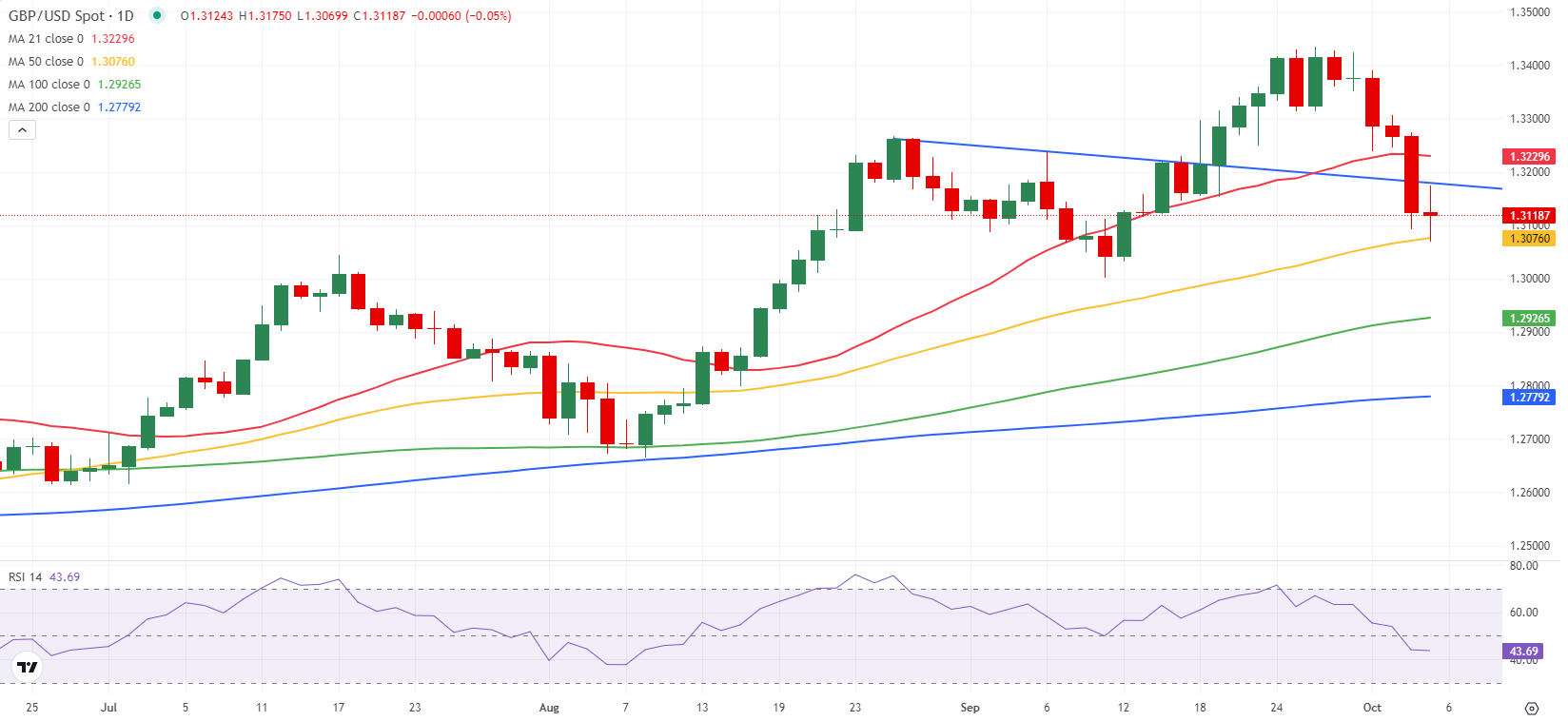
As observed on the daily chart, the GBP/USD pair has breached the critical support levels on its corrective decline from over two-and-a-half-year highs of 1.3434 reached last week.
Thursday’s closing below the 21-day Simple Moving Average (SMA) at 1.3230, followed by a sustained break of the falling trendline resistance turned support at 1.3165, empowered sellers further.
Looking ahead, the risks appear skewed to the downside for GBP/USD, as the 14-day Relative Strength Index (RSI) holds its position well below the 50 level, currently near 44.
The immediate support for buyers is aligned at the 50-day SMA at 1.3076. A weekly closing below it would initiate a fresh downtrend toward the 1.3000 psychological mark.
The next bearish target is seen at the 100-day SMA at 1.2926. The last line of defense for buyers is located at 1.2779, the key 200-day SMA.
Conversely, any recovery attempt will likely meet the initial contention area at around 1.3160, the previous falling trendline support now turned resistance.
Acceptance above the 21-day SMA at 1.3230 is needed to negate the near-term bearish bias.
Pound Sterling will then target the 1.3300 round level on the road to recovery, above which the 30-month top of 1.3434 will be back on buyers’ radars.



Written by : Editorial team of BIPNs
Main team of content of bipns.com. Any type of content should be approved by us.






Share this article: