
Category: Forex News, News
XAU/USD corrects lower after setting new record-high
- Gold corrected lower after touching a new all-time high at $2,758.
- The technical outlook suggests that the bullish bias remains intact in the near term.
- Next week’s economic calendar will feature key US data releases that could impact Gold’s valuation.
Gold (XAU/USD) extended its uptrend and reached a new all-time high above $2,750. Rising US Treasury bond yields and the improving risk mood, however, made it difficult for the precious metal to preserve its bullish momentum in the second half of the week. The US economic calendar will feature Gross Domestic Product (GDP) data for the third quarter and labor market figures for October, which could significantly affect Gold’s valuation next week.
Gold loses bullish momentum
Gold edged higher to start the week as the People’s Bank of China’s (PBoC) decision to cut the one-year Loan Prime Rate (LPR) by 25 basis points (bps) from 3.35% to 3.10% eased concerns over an economic downturn. Additionally, escalating geopolitical tensions allowed the precious metal to capture safe-haven demand on Monday as markets reacted to reports of Hezbollah claiming responsibility for a drone attack that targeted Israeli Prime Minister Benjamin Netanyahu’s house over the weekend.

XAU/USD preserved its bullish momentum on Tuesday and gained more than 1% on the day. In the absence of high-tier data releases, Gold continued to benefit from the souring market mood. After reaching a new all-time high of $2,758 during the European trading hours on Wednesday, the precious metal reversed its direction and closed the day with a 1.2% loss. Rising US Treasury bond yields and the broad-based US Dollar (USD) strength caused XAU/USD to lose its footing midweek. Additionally, profit-taking after the record-setting rally may have ramped up the bearish pressure.
On Thursday, data from the US showed that the business activity in the private sector continued to grow at a healthy pace in early October, with the preliminary S&P Global Composite Purchasing Managers Index (PMI) edging higher to 54.3 in October from 54.0 in September. Assessing the survey’s findings, “October saw business activity continue to grow at an encouragingly solid pace, sustaining the economic upturn that has been recorded in the year to date into the fourth quarter,” said Chris Williamson, Chief Business Economist at S&P Global Market Intelligence and added: “The October flash PMI is consistent with GDP growing at an annualized rate of around 2.5%.” Gold struggled to gather recovery momentum after this report and ended the day modestly higher.
The market action turned choppy heading into the weekend and Gold spent Friday fluctuating in a relatively narrow range.
Gold investors gear up for key data releases
The US Bureau of Economic Analysis (BEA) will publish the first estimate of the annualized Gross Domestic Product (GDP) growth for the third quarter on Wednesday. Investors forecast the US GDP to expand by 3% in this period, matching the growth recorded in the second quarter. A reading above the market expectation could boost the USD as the immediate reaction and cause XAU/USD to stretch lower. On the other hand, a disappointing GDP print, between 1% and 2%, could hurt the USD.
On Thursday, the BEA will publish the Personal Consumption Expenditures (PCE) Price Index, the Federal Reserve’s (Fed) preferred gauge of inflation, for September. Because the GDP report will also offer quarterly PCE Price Index numbers, the monthly data is unlikely to trigger a market reaction.
The US Bureau of Labor Statistics (BLS) will release the labor market data for October on Friday. In September, Nonfarm Payrolls (NFP) rose by 254,000. This reading surpassed the market expectation of 140,000 by a wide margin and caused markets to refrain from pricing in a 50 basis points (bps) Fed rate cut in November.
According to the CME FedWatch Tool, markets nearly fully price in a 25 bps rate cut at the upcoming meeting and see about a 70% chance of the Fed lowering the policy rate by a total of 50 bps by the end of the year. At this point, it would take a significant downside surprise in NFP for markets to reconsider the possibility of a large rate cut either in November or December. In case the NFP comes in at or below 100,000, the USD could come under heavy selling pressure and open the door for a Gold rally heading into the weekend.
Conversely, an NFP print between 180,000 and 220,000 could be seen as a ‘good enough’ figure for the Fed to opt for two 25 bps rate cuts by the end of the year. Finally, investors could doubt a rate cut in December if the NFP arrives near 300,000 or higher. In this scenario, XAU/USD could come under strong bearish pressure.
Gold technical outlook
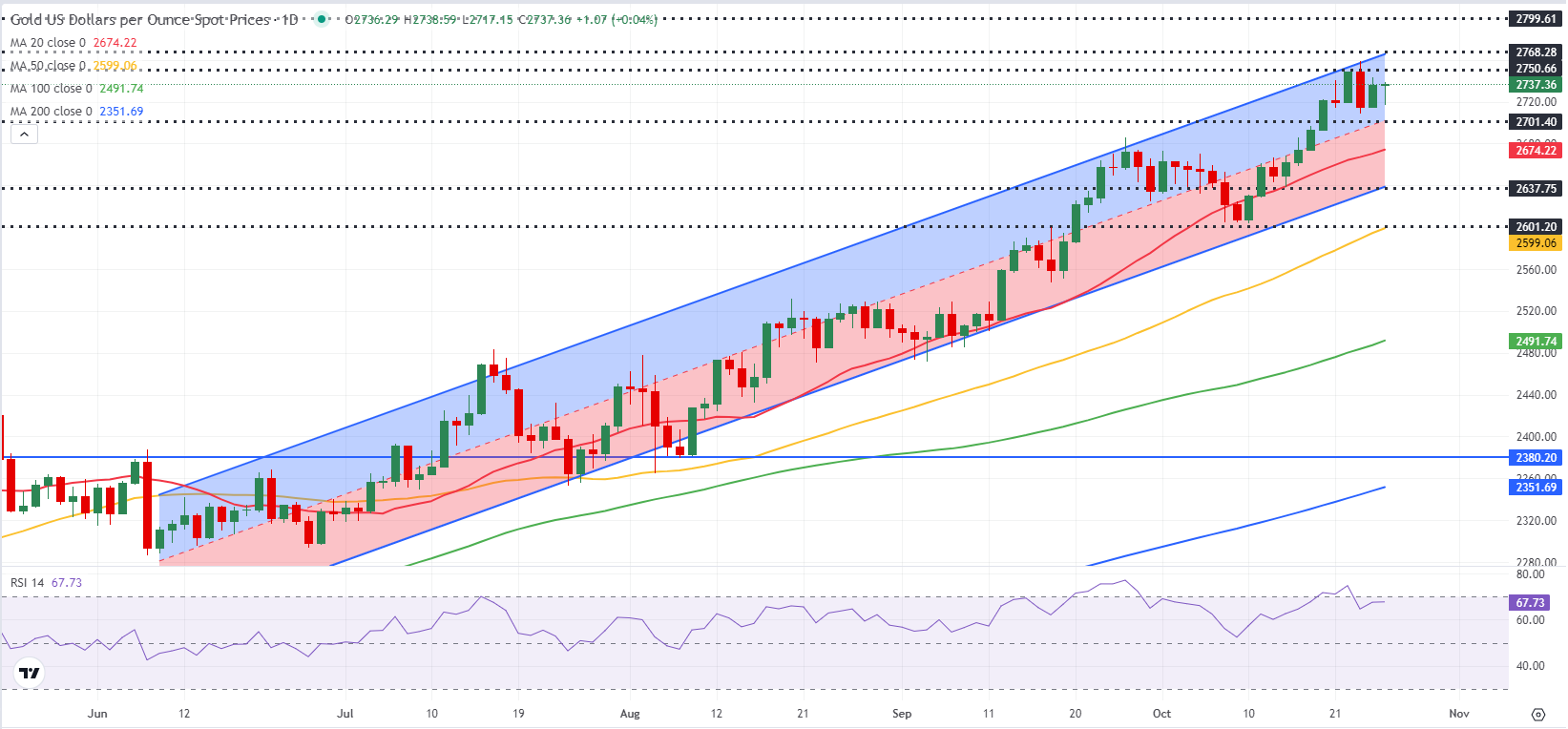
The Relative Strength Index (RSI) indicator on the daily chart retreated toward 60 after rising above 70 earlier in the week, suggesting that the bullish bias remains intact after Gold corrected its overbought conditions. Additionally, XAU/USD remains within the ascending regression channel coming from June.
Looking south, first support could be spotted at $2,700, where the mid-point of the ascending channel is located, before $2,675 (20-day Simple Moving Average) and $2,635 (lower limit of the ascending channel).
On the upside, interim resistance seems to have formed at $2,750 before $2,770 (upper limit of the ascending channel) and $2,800 (round level).
Nonfarm Payrolls FAQs
Nonfarm Payrolls (NFP) are part of the US Bureau of Labor Statistics monthly jobs report. The Nonfarm Payrolls component specifically measures the change in the number of people employed in the US during the previous month, excluding the farming industry.
The Nonfarm Payrolls figure can influence the decisions of the Federal Reserve by providing a measure of how successfully the Fed is meeting its mandate of fostering full employment and 2% inflation. A relatively high NFP figure means more people are in employment, earning more money and therefore probably spending more. A relatively low Nonfarm Payrolls’ result, on the either hand, could mean people are struggling to find work. The Fed will typically raise interest rates to combat high inflation triggered by low unemployment, and lower them to stimulate a stagnant labor market.
Nonfarm Payrolls generally have a positive correlation with the US Dollar. This means when payrolls’ figures come out higher-than-expected the USD tends to rally and vice versa when they are lower. NFPs influence the US Dollar by virtue of their impact on inflation, monetary policy expectations and interest rates. A higher NFP usually means the Federal Reserve will be more tight in its monetary policy, supporting the USD.
Nonfarm Payrolls are generally negatively-correlated with the price of Gold. This means a higher-than-expected payrolls’ figure will have a depressing effect on the Gold price and vice versa. Higher NFP generally has a positive effect on the value of the USD, and like most major commodities Gold is priced in US Dollars. If the USD gains in value, therefore, it requires less Dollars to buy an ounce of Gold. Also, higher interest rates (typically helped higher NFPs) also lessen the attractiveness of Gold as an investment compared to staying in cash, where the money will at least earn interest.
Nonfarm Payrolls is only one component within a bigger jobs report and it can be overshadowed by the other components. At times, when NFP come out higher-than-forecast, but the Average Weekly Earnings is lower than expected, the market has ignored the potentially inflationary effect of the headline result and interpreted the fall in earnings as deflationary. The Participation Rate and the Average Weekly Hours components can also influence the market reaction, but only in seldom events like the “Great Resignation” or the Global Financial Crisis.
Source link

Written by : Editorial team of BIPNs
Main team of content of bipns.com. Any type of content should be approved by us.







Share this article: