2026.03.23
2026.03.23
Gold Price Forecast & Predictions for 2026, 2027, 2028–2030 and Beyond
Jana Kanehttps://www.litefinance.org/blog/authors/jana-kane/
Gold is popular among investors and often serves as a “safe haven”, a financial asset that helps preserve capital during economic instability. Forecasting the price of this instrument requires a comprehensive analysis of economic, political, and financial factors, as well as market trends and macroeconomic conditions.
In this article, we will examine the price history of XAU/USD and insights from professional analysts to develop scenarios for gold prices in 2026, 2027, 2028, and beyond.
The article covers the following subjects:
Major Takeaways
- The current gold price is trading at $4 391.03 as of 23.03.2026.
- Gold reached an all-time high of $5595.42 on 29.01.2026. The all-time low was hit on 25.08.1999, when the asset declined to $252.55.
- Forecasts for the XAU/USD rate for 2026 are generally bullish. According to analysts, gold will trade in the range of $4,819.00–$10,023.00.
- Forecasts for 2027 are also broadly optimistic. Analysts predict a range of $5,716.00–$12,325.00. In some scenarios, the most significant growth will occur in the middle of the year.
- Estimates for 2028–2030 are mixed. During this period, quotes may fluctuate in the range of $6,401.00–$13,965.00. Some forecasts suggest further growth, while others suggest periods of correction.
- Long-term forecasts beyond 2030 are less reliable, but several scenarios suggest a gradual increase in gold prices. According to long-term estimates, gold may surge to $21,247.00 by 2037.
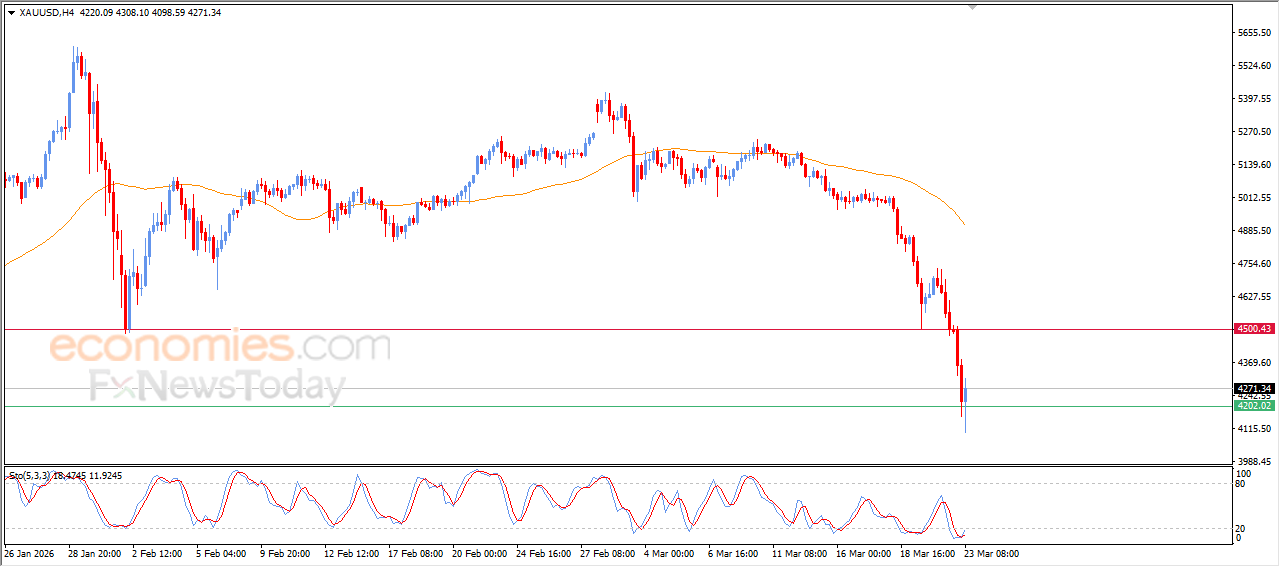
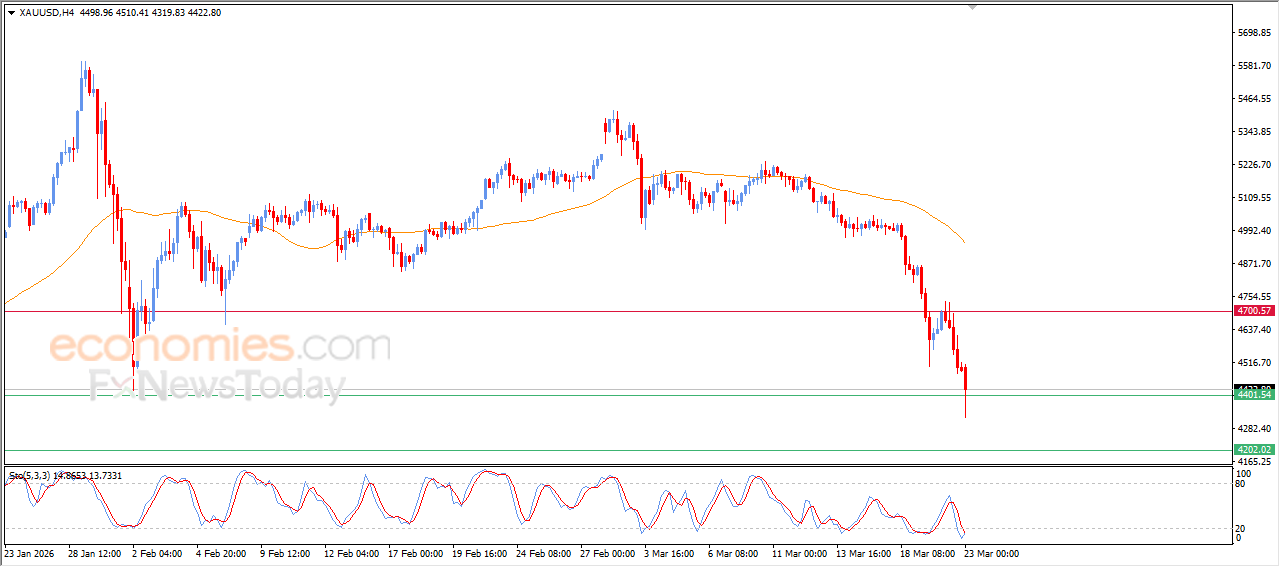
- XAUUSD: Based on technical analysis, gold turned bearish, breaking below the Target Zone 2 at 4,636–4,601.
Gold Real-Time Market Status
The current gold price as of 23.03.2026 is $4 391.03.
To assess the current state of the precious metal, the following metrics should be analyzed:
- Year-over-Year Inflation Rate (US) is determined based on the Consumer Price Index (CPI), which measures changes in the prices of goods and services.
- Interest Rate (US): The cost of borrowing funds, expressed as a percentage of the borrowed amount. It impacts investment and consumer spending.
- 52-Week Range: The highest and lowest prices of the asset over the past year.
- Yearly Change: The asset price change over the past year.
- Fear and Greed Index: A real-time indicator reflecting investor sentiment and expectations about market conditions.
|
Metric
|
Value (US)
|
|
US Inflation Rate y/y
|
2.4%
|
|
US Interest Rate
|
3.75%
|
|
52-Week Range
|
$2,880.30–$5,595.46
|
|
Yearly Change
|
+19.65%
|
|
Recommendation
|
Buy
|
|
All-Time High
|
$5595.42
|
Gold Weekly Price Forecast as of 23.03.2026
Gold’s medium-term uptrend reversed last week. As a result, the price dropped to the Target Zone 2 at 4,636–4,601. At the end of last week, the metal broke below this zone. Now, the Target Zone 3 at 4,278–4,243 is the next bearish target.
Consider short trades during pullbacks at the strong resistance A at 4,871–4,835 with a first target at 4,675 and a second one near last week’s low of 4,477.
XAUUSD Trading Ideas for the Week:
Sell at resistance A at 4,871–4,835. TakeProfit: 4,675, 4,477. StopLoss: 4,957.
Technical analysis based on margin zones methodology was provided by an independent analyst, Alex Rodionov.
Gold Price Forecast for 2026 Based on Technical Analysis
Gold continues to trade within a sustained ascending channel, with lows and highs increasing. After a strong impulse at the beginning of the year, the price corrected and tested the dynamic support area, after which the movement stabilized within the trading channel.
The XAU/USD is trading in the $5,100.00–$5,200.00 range above key moving averages. The SMA50 is trending above the SMA200, confirming the continuation of a strong medium-term uptrend.
MACD is gradually declining after the previous impulse, while the RSI remains in the 55–60 range, indicating a decrease in overbought conditions and a persisting upward trend. Notably, such consolidations often precede a new growth phase.
If the current structure persists, gold may continue to move within the bullish channel and gradually shift towards its upper boundary. In this case, the asset may surge to the $6,500.00–$7,000.00 range by the end of the year.
Below are the projected price levels for XAUUSD over the next 12 months.
|
Month
|
Minimum, $
|
Average, $
|
Maximum, $
|
|
March 2026
|
4,950.00
|
5,150.00
|
5,400.00
|
|
April 2026
|
5,000.00
|
5,250.00
|
5,550.00
|
|
May 2026
|
5,050.00
|
5,350.00
|
5,700.00
|
|
June 2026
|
4,950.00
|
5,250.00
|
5,600.00
|
|
July 2026
|
5,100.00
|
5,450.00
|
6,000.00
|
|
August 2026
|
5,200.00
|
5,600.00
|
6,300.00
|
|
September 2026
|
5,100.00
|
5,450.00
|
6,100.00
|
|
October 2026
|
5,300.00
|
5,750.00
|
6,500.00
|
|
November 2026
|
5,400.00
|
5,900.00
|
6,800.00
|
|
December 2026
|
5,500.00
|
6,100.00
|
7,000.00
|
|
January 2027
|
5,400.00
|
5,850.00
|
6,700.00
|
|
February 2027
|
5,450.00
|
5,950.00
|
6,900.00
|
Long-Term Trading Plan for XAUUSD for 2026
The strategy for 2026 suggests opening trades within the ascending channel on pullbacks to dynamic support levels, especially in the $4,900.00–$5,000.00 zone, where the channel line passes, and the SMA50 is located.
When the price settles in this area, you can open long positions with the expectation that the trend will continue. The closest targets are at previous highs and the upper boundary of the trading channel.
As bullish momentum develops, part of the position can be closed in the $6,000.00–$6,500.00 area, leaving part for a possible further upward movement. If the uptrend remains intact, the price may approach the $7,000.00 area by the end of the year.
Sometimes, the price may accelerate and break outside the channel in response to important news, such as increased geopolitical tensions, which boost demand for defensive assets.
An alternative scenario implies a price decline below $4,900.00. This would signal a weakening of momentum, prompting a reassessment of strategy.
Analysts’ Gold Price Projections for 2026
Most analysts expect gold prices to rise in 2026, although opinions differ on the magnitude of the move. Some experts foresee moderate gains, while others anticipate a more substantial expansion in the trading range.
LongForecast
Price range: $4,819.00–$8,375.00.
LongForecast expects the price of XAU/USD to rise during the year. In the spring, gold quotes may rise above $5,600.00. In the middle of the year, the range will likely shift to the $6,000.00–$6,800.00 area and continue to expand in the fall. The maximum value of $8,375.00 can be reached in December.
|
Month
|
Minimum, $
|
Average, $
|
Maximum, $
|
|
March
|
4,819.00
|
5,417.00
|
5,688.00
|
|
April
|
5,041.00
|
5,638.00
|
5,938.00
|
|
May
|
5,638.00
|
5,988.00
|
6,287.00
|
|
June
|
5,988.00
|
6,359.00
|
6,677.00
|
|
July
|
6,147.00
|
6,407.00
|
6,794.00
|
|
August
|
6,407.00
|
6,856.00
|
7,199.00
|
|
September
|
6,728.00
|
7,082.00
|
7,436.00
|
|
October
|
7,082.00
|
7,521.00
|
7,897.00
|
|
November
|
7,514.00
|
7,909.00
|
8,304.00
|
|
December
|
7,577.00
|
7,976.00
|
8,375.00
|
WalletInvestor
Price range: $5,218.19–$5,714.67.
According to WalletInvestor, the price of gold will rise steadily throughout the year. The price may settle above $5,200.00 and reach higher values, increasing in small increments over several months. Gold is expected to peak at $5,714.67 in December
|
Month
|
Minimum, $
|
Average, $
|
Maximum, $
|
|
April
|
5,218.19
|
5,249.85
|
5,281.51
|
|
May
|
5,280.59
|
5,302.68
|
5,324.77
|
|
June
|
5,330.62
|
5,346.80
|
5,362.97
|
|
July
|
5,364.85
|
5,400.76
|
5,436.66
|
|
August
|
5,444.68
|
5,479.78
|
5,514.87
|
|
September
|
5,517.23
|
5,538.97
|
5,560.71
|
|
October
|
5,562.28
|
5,590.52
|
5,618.76
|
|
November
|
5,620.38
|
5,640.26
|
5,660.15
|
|
December
|
5,662.05
|
5,688.36
|
5,714.67
|
CoinCodex
Price range: $5,202.05–$10,023.00.
Analysts at CoinCodex predict a significant increase in the price of XAU/USD during the year. In the second half of the year, quotes may settle above $7,000.00, after which the range will continue to expand. The maximum value is expected in December at $10,023.00.
|
Month
|
Minimum, $
|
Average, $
|
Maximum, $
|
|
March
|
5,202.05
|
5,404.06
|
5,655.53
|
|
April
|
5,440.43
|
5,801.78
|
6,684.81
|
|
May
|
5,761.76
|
6,266.94
|
6,887.90
|
|
June
|
6,321.63
|
6,645.32
|
6,993.62
|
|
July
|
6,657.25
|
7,150.43
|
8,526.62
|
|
August
|
7,139.95
|
7,762.88
|
8,535.46
|
|
September
|
7,833.74
|
8,144.05
|
8,578.73
|
|
October
|
8,515.89
|
8,981.15
|
9,641.53
|
|
November
|
8,706.21
|
9,031.94
|
9,388.09
|
|
December
|
9,265.56
|
9,566.24
|
10,023.00
|
Analysts’ Gold Price Projections for 2027
Forecasts for 2027 generally agree that gold prices will continue to rise. Analysts predict that the upward trend will persist, with varying rates depending on the analytical models used. Analytical platforms differ significantly in their forecast ranges.
Note: The price ranges reflect the asset's expected volatility throughout the year. Lows and highs may not be shown in the summary tables.
LongForecast
Price range: $7,611.00–$11,389.00.
LongForecast anticipates the price of XAU/USD to rise during the year. According to the analytical platform, quotes will remain above $8,000.00 in the first half of the year, then growth may accelerate. In December, gold may hit a yearly high of $11,389.00.
|
Quarter
|
Minimum, $
|
Average, $
|
Maximum, $
|
|
Q1
|
7,611.00
|
8,166.33
|
8,870.00
|
|
Q2
|
8,448.00
|
9,235.00
|
10,130.00
|
|
Q3
|
8,782.00
|
9,442.33
|
10,065.00
|
|
Q4
|
9,537.00
|
10,366.67
|
11,389.00
|
WalletInvestor
Price range: $5,716.79–$6,391.60.
WalletInvestor expects a gradual increase in gold prices throughout 2027. The price will likely move from levels above $5,700.00 to higher values without sharp fluctuations. The highest yearly price is expected at $6,391.60 in December.
|
Quarter
|
Minimum, $
|
Average, $
|
Maximum, $
|
|
Q1
|
5,716.79
|
5,870.72
|
5,902.64
|
|
Q2
|
5,895.01
|
6,002.79
|
6,042.76
|
|
Q3
|
6,042.37
|
6,180.76
|
6,237.83
|
|
Q4
|
6,239.31
|
6,341.87
|
6,391.60
|
CoinCodex
Price range: $9,547.56–$12,325.00.
According to CoinCodex, the price of XAU/USD will increase during the year, with significant fluctuations expected. According to the platform, in the first half of the year, gold will remain above $10,000.00 and continue to rally in the summer. It could reach a high of $12,325.00 in the third quarter, followed by a correction amid increased market volatility.
|
Quarter
|
Minimum, $
|
Average, $
|
Maximum, $
|
|
Q1
|
9,547.56
|
10,928.67
|
12,233.00
|
|
Q2
|
10,826.00
|
11,330.33
|
11,988.00
|
|
Q3
|
11,761.00
|
12,007.00
|
12,325.00
|
|
Q4
|
10,153.00
|
10,957.00
|
11,844.00
|
Analysts’ Gold Price Projections for 2028
Forecasts for 2028 suggest that the gold market will remain highly volatile. Experts link price expectations to inflationary trends, central bank interest rate decisions, and potential geopolitical turmoil. These factors often drive price fluctuations in safe-haven assets.
LongForecast
Price range: $10,246.00–$13,715.00.
According to LongForecast, the price of XAU/USD will grow throughout the year, although the movement is expected to be uneven. At the beginning of the year, quotes will likely stabilize above $11,000.00, then the range will gradually expand, and the price will move to higher values. The strongest movement is predicted closer to autumn, when a maximum of $13,715.00 will be reached.
|
Quarter
|
Minimum, $
|
Average, $
|
Maximum, $
|
|
Q1
|
10,246.00
|
11,020.00
|
11,803.00
|
|
Q2
|
11,238.00
|
11,892.33
|
12,535.00
|
|
Q3
|
11,428.00
|
12,463.33
|
13,715.00
|
|
Q4
|
11,548.00
|
12,392.00
|
13,267.00
|
WalletInvestor
Price range: $6,401.76–$7,066.73.
WalletInvestor projects that the price of gold will increase throughout the year. The movement is expected to be gradual, with prices rising from above $6,400.00 to higher levels in stages. The highest level will be $7,066.73, reached by year-end.
|
Quarter
|
Minimum, $
|
Average, $
|
Maximum, $
|
|
Q1
|
6,401.76
|
6,552.30
|
6,581.09
|
|
Q2
|
6,583.63
|
6,681.60
|
6,720.59
|
|
Q3
|
6,723.07
|
6,861.41
|
6,914.90
|
|
Q4
|
6,922.97
|
7,020.65
|
7,066.73
|
CoinCodex
Price range: $10,356.00–$12,175.00.
According to CoinCodex, the price of gold is projected to trade in a wide range without a sustained trend throughout 2028. At different points, the market may shift from growth to a correction, reflecting increased volatility. The peak values are expected in the third quarter, with a maximum of $12,175.00.
|
Quarter
|
Minimum, $
|
Average, $
|
Maximum, $
|
|
Q1
|
10,356.00
|
10,967.00
|
11,311.00
|
|
Q2
|
10,958.00
|
11,325.33
|
11,635.00
|
|
Q3
|
10,872.00
|
11,509.67
|
12,175.00
|
|
Q4
|
11,164.00
|
11,492.67
|
11,751.00
|
Analysts’ Gold Price Projections for 2029
Forecasts for 2029 point to different scenarios for gold price movements. Some analysts predict further growth, while others suggest a gradual decline after gold hits higher levels. These discrepancies reflect the uncertainty of expectations in the gold market.
LongForecast
Price range: $11,574.00–$14,931.00.
According to LongForecast, gold may continue to rise throughout the year. In the spring, the price may rise above $13,000.00, and in the middle of the year, the range will expand and the market will move to higher levels. In August, gold may peak at $14,931.00.
|
Quarter
|
Minimum, $
|
Average, $
|
Maximum, $
|
|
Q1
|
11,574.00
|
12,246.00
|
12,911.00
|
|
Q2
|
11,761.00
|
12,814.67
|
13,697.00
|
|
Q3
|
12,721.00
|
13,852.67
|
14,931.00
|
|
Q4
|
12,227.00
|
13,143.67
|
14,183.00
|
WalletInvestor
Price range: $7,076.13–$7,750.81.
WalletInvestor expects a steady rise in gold prices throughout the year. At the beginning of the year, gold prices are expected to remain above $7,000.00, then gradually rise to higher levels each quarter. By the end of the year, gold may reach a high of $7,750.81.
|
Quarter
|
Minimum, $
|
Average, $
|
Maximum, $
|
|
Q1
|
7,076.13
|
7,230.83
|
7,258.99
|
|
Q2
|
7,257.35
|
7,359.91
|
7,398.47
|
|
Q3
|
7,400.52
|
7,538.26
|
7,590.70
|
|
Q4
|
7,598.30
|
7,700.99
|
7,750.81
|
CoinCodex
Price range: $10,540.00–$12,244.00.
According to CoinCodex, after relatively high values at the beginning of the year, gold is expected to decline gradually. In the first months, the price may remain above $11,700.00, but by mid-year, the trading range will shift downward. The lowest yearly values near $10,540.00 are expected in August.
|
Quarter
|
Minimum, $
|
Average, $
|
Maximum, $
|
|
Q1
|
11,765.00
|
11,966.33
|
12,244.00
|
|
Q2
|
11,229.00
|
11,745.67
|
12,178.00
|
|
Q3
|
10,540.00
|
11,900.00
|
11,365.00
|
|
Q4
|
10,679.00
|
11,072.00
|
11,538.00
|
Analysts’ Gold Price Projections for 2030
Forecasts from analytical platforms for 2030 generally predict an increase in the price of gold. In their assessments, analysts take into account long-term demand from central banks, global foreign exchange rates, and investment flows into safe-haven assets. These factors can significantly boost demand for gold.
WalletInvestor
Price range: $7,753.71–$8,428.46.
According to WalletInvestor, the price of gold is expected to continue its steady rise throughout the year. In the first few months, quotes are likely to remain above $7,700.00 and gradually rise. The maximum price is likely to be $8,428.46, reached by the fourth quarter.
|
Quarter
|
Minimum, $
|
Average, $
|
Maximum, $
|
|
Q1
|
7,753.71
|
7,907.33
|
7,936.75
|
|
Q2
|
7,931.30
|
8,037.69
|
8,076.38
|
|
Q3
|
8,078.13
|
8,217.48
|
8,273.81
|
|
Q4
|
8,276.06
|
8,378.04
|
8,428.46
|
CoinCodex
Price range: $11,425.00–$13,965.00.
According to CoinCodex, XAU/USD is expected to experience significant fluctuations throughout the year, with an upward trend persisting. At the beginning of the year, gold will trade in the range of $11,500.00–$12,000.00, then the movement is likely to accelerate in the summer. Gold may hit a new all-time high of $13,965.00 in September.
|
Quarter
|
Minimum, $
|
Average, $
|
Maximum, $
|
|
Q1
|
11,560.00
|
11,730.33
|
12,091.00
|
|
Q2
|
11,425.00
|
11,794.33
|
12,872.00
|
|
Q3
|
12,525.00
|
13,272.67
|
13,965.00
|
|
Q4
|
13,069.00
|
13,342.33
|
13,706.00
|
Analysts’ Gold Price Projections until 2050
Long-term assessments of the gold market are based on a range of macroeconomic factors. Analysts consider changes in global reserve structures, central bank demand, investment flows, and the overall trajectory of the global economy. These factors can significantly affect the supply-demand balance in the precious metals market. As a result, long-term forecasts typically indicate the general direction of gold prices rather than precise levels on specific dates.
According to Coin Price Forecast, gold prices are expected to rise steadily over the long term. Analysts anticipate a gradual widening of the price range as the years progress. Based on the platform’s projections, prices could reach $21,247 by 2037.
|
Year
|
Coin Price Forecast, $
|
|
2031
|
13,746.00
|
|
2033
|
16,620.00
|
|
2035
|
18,155.00
|
|
2037
|
21,247.00
|
Market Sentiment for XAUUSD (Gold) on Social Media
Media sentiment about gold can significantly influence short-term price movements, as social media discussions shape traders’ expectations and amplify reactions to technical signals. When the market approaches important levels, the flow of comments can reinforce momentum and increase volatility. At such moments, market sentiment often becomes an additional factor accelerating price movements.
User @AamirFXPro is optimistic about the gold price, noting that strong buying momentum remains and anticipating a short-term pullback to the support zone before a resumption of growth. In this scenario, the current correction is seen as a potential turning point at which the upward trend could resume.
User @FxTrade_master1 takes a more cautious stance, highlighting the strong supply area. The price may decline if it fails to consolidate above this zone. The market may first decline before the trend continues.
Overall, sentiment appears mixed: some traders expect growth to continue after the pullback, while others anticipate a deeper correction.
Gold Price History (XAU/USD)
Gold reached its all-time high of $5595.42 on 29.01.2026.
The lowest price of gold was recorded on 25.08.1999, when the asset declined to $252.55.
Below is the chart of XAU/USD covering the past 10 years. To make our forecasts as accurate as possible, it’s important to estimate historical data.
In 2021, as the global economy began to recover and inflation rose, gold prices fluctuated in response to shifts in monetary policies from major central banks. A strengthening US dollar put downward pressure on gold prices.
In 2022, geopolitical tensions, particularly the conflict in Ukraine, drove gold prices upward again. Inflation continued to climb, prompting central banks to tighten monetary policy.
A tug-of-war between inflationary expectations and rising interest rates marked 2023 and 2024. Gold remained sensitive to changes in bond yields and the geopolitical landscape.
From January to April 2025, gold prices rose from $2,624.61 to $3,499.98 amid escalating geopolitical tensions. Between late April and mid-August, the metal traded within a relatively narrow range of $3,120.83–$3,451.11. In late August 2025, the price rose to $4,381.24 before correcting.
At the end of December 2025, gold was trading near $4,550.00 amid strong demand for safe-haven assets. In early January, the asset stood at around $4,331.00. Subsequently, the price began to rise, setting a new all-time high of $5,593.00.
In early 2026, gold prices were highly volatile. By the end of January, the price had reached a historic high of $5,600.00, but then corrected to $4,401.00 amid strong US employment data.
By the end of February, the price had stabilized at $5,210.00 due to conflicting statements from the Fed about rate cuts. Geopolitical tensions in the Middle East supported demand for gold, but rising oil prices and a stronger dollar partially curbed further growth.
Gold Price Fundamental Analysis (XAU/USD)
Fundamental analysis is typically associated with the stock market rather than precious metals. While experts analyze the financial statements of specific companies, XAU/USD analysts monitor macroeconomic factors, global political and economic news, and various forecasts.
What Factors Affect the Gold Rate?
The price of gold is influenced by a variety of economic and geopolitical factors:
- Rising interest rates weigh on the price of gold, as investors switch to higher-yielding assets.
- Gold is often viewed by investors as a hedge against inflation, and rising consumer prices can lead to increased demand for the precious metal.
- During periods of geopolitical unrest, investors seek safe-haven assets such as gold. As a result, the price of the precious metal appreciates.
- Gold is traded in US dollars, so changes in the value of the USD can affect the price of the precious metal.
- The balance between the demand for gold and its supply also plays a crucial role in determining the price of gold.
More Facts About Gold
Gold is one of the longest-standing and most valuable metals, with mining operations dating back over 6,000 years to ancient Egypt. During this period, gold was a symbol of power and wealth. Over time, gold has become a universally accepted means of exchange and an essential component of the global economy. Its scarcity and resilience to external influences drive the continued demand for this precious metal. Gold’s limited deposits and mining difficulty make it a valuable asset, particularly during economic uncertainty. In periods of economic turbulence, the demand for gold rises as it offers a reliable hedge against inflation.
Gold is a versatile asset, used not only as an investment tool but also in many industrial applications. In jewelry, it is esteemed for its aesthetic appeal and resilience. In electronics and medicine, gold is employed due to its conductivity and resistance to corrosion. In the space industry, it is used to safeguard equipment from radiation. In addition, gold is a favored asset among traders due to its liquidity. This precious metal is regarded as a symbol of stability and reliability, playing a pivotal role in the global economy.
Advantages and Disadvantages of Investing in Gold
Gold is a popular asset among traders and investors, offering a range of advantages over other asset types.
- Hedge against inflation. Gold has historically been regarded as a means of safeguarding capital against high inflation. In periods of economic turbulence or rising prices for goods and services, the value of gold tends to appreciate, thereby maintaining the purchasing power of investors.
- Portfolio diversification. Investing in gold can help reduce the overall risk of a portfolio. Gold has a low correlation with stocks and bonds, which means its value often moves in the opposite direction of other assets.
- Liquidity. Gold is a highly liquid asset that can be purchased and sold with minimal effort in global markets. This makes it an attractive option for investors who want to quickly convert the asset into cash.
- Reliability during crises. During economic crises and geopolitical tensions, gold is often seen as a safe-haven asset for investors seeking to preserve their capital.
However, there are disadvantages to investing in gold.
- Lack of passive income. Unlike stocks or bonds, gold does not generate passive income such as dividends or interest. Investors only gain profits from the appreciation in the value of gold.
- Volatility. Despite its reputation as a safe-haven asset, gold can show significant volatility in the short term. Sharp price fluctuations can lead to losses for short-term investors.
- Storage and insurance costs. Physical gold incurs storage and insurance costs, especially in large volumes. This can reduce the overall return on investment. Therefore, most investors prefer margin trading in gold CFDs, as it allows them to profit from price fluctuations without actually purchasing gold bullion.
- Dependence on global prices. The value of gold is determined by global factors such as supply and demand, the economic performance of major economies, and the geopolitical environment. This makes it susceptible to external shocks that investors cannot influence.
Gold can be a valuable asset in a diversified portfolio, especially during economic uncertainty. However, it is essential to adopt a cautious approach and to carefully assess the potential risks involved before making investment decisions.
How We Make Forecasts
We employ a comprehensive approach to forecasting gold prices.
- Short-term forecasts rely on technical analysis that factors in indicators, trading volumes, and market sentiment.
- Medium-term forecasts incorporate fundamental factors, such as central bank policy and current geopolitical events.
- Long-term forecasts consider global macroeconomic trends, shifts in world trade and gold demand, as well as projections from leading forecasting agencies.
Conclusion: Is Gold a Good Investment?
Gold appears to be a reliable way to preserve money during times of crisis and rising prices, when other assets fall in value. Strong demand for gold worldwide makes the XAUUSD pair an attractive long-term investment.
However, gold does not generate interest income, and its price can fluctuate significantly because of market speculation. In addition, holding physical gold entails extra expenses related to storage and insurance.
Although gold is not a one-size-fits-all solution, it can be a valuable asset for portfolio diversification. The XAUUSD pair can help reduce risk and provide protection against inflation. Nevertheless, it is essential to perform fundamental and technical analysis and study expert assessments before making any trading or investment decisions.
Gold Price Prediction FAQ
Price chart of XAUUSD in real time mode
The content of this article reflects the author’s opinion and does not necessarily reflect the official position of LiteFinance broker. The material published on this page is provided for informational purposes only and should not be considered as the provision of investment advice for the purposes of Directive 2014/65/EU.
According to copyright law, this article is considered intellectual property, which includes a prohibition on copying and distributing it without consent.
Rate this article:
{{value}} ( {{count}} {{title}} )