About Editorial team of BIPNs

Main team of content of bipns.com. Any type of content should be approved by us.
20 01, 2026

Trade Tensions Spark Selloff (Video)

By |2026-01-20T10:43:11+02:00January 20, 2026|Forex News, News|0 Comments

The Euro recovers against the Japanese yen after opening drama and noise about trade agreements.

The Euro has gapped lower against the Japanese yen at the open on Monday, only to turn around and recapture that, as well as grind even higher. We are above the 184 yen level as I record this, which is a good sign. That being said, we need to take a look at what’s going on to understand why the 183 yen level offered support.

There was quite a bit of noise over the weekend as far as the US and the European Union busting up trade agreements, and of course, the first thing that traders do is panic. That being said, those who are not weak or drama-filled typically will look at these movements as an opportunity. And that’s exactly what we’ve seen here.

Interest Rate Outlook

The European Central Bank is still stable in its interest rate outlook, and that’s not going to change whether or not Trump and Macron or whoever start getting into arguments through the press. The reality is that the European economy is about where the ECB needs it to be, while the Bank of Japan has the problem of dealing with the idea of massive amounts of debt and their rates skyrocketing, which generally would be good for the yen, but the problem is it’s not in a controlled manner.

There is a Bank of Japan meeting later this week that will come into play, but at this point, the Euro has just offered a buying opportunity against the Japanese yen, as you have seen. This remains a bullish pair. It will remain a bullish pair for quite some time. Markets do not turn on a dime, especially when it’s a repeated headline of trade tensions. We’ve been going through this for a year now. All things being equal, we continue to grind to the upside, and I think we will go looking to 186 yen sooner or later.

Begin trading our daily forecasts and analysis. Here is a list of Forex brokers in Japan to work with.

Christopher Lewis has been trading Forex and has over 20 years experience in financial markets. Chris has been a regular contributor to Daily Forex since the early days of the site. He writes about Forex for several online publications, including FX Empire, Investing.com, and his own site, aptly named The Trader Guy. Chris favours technical analysis methods to identify his trades and likes to trade equity indices and commodities as well as Forex. He favours a longer-term trading style, and his trades often last for days or weeks.

Source link

20 01, 2026

Crude Oil Price Risk spikes today as WTI and Brent swing on fresh market shocks

By |2026-01-20T06:49:25+02:00January 20, 2026|Forex News, News|0 Comments


On January 20, 2026, crude oil trades choppy as WTI and Brent react to today’s news, highlighting elevated Crude Oil Price Risk for active traders.

As of today, January 20, 2026, we are seeing Crude Oil Price Risk dominate market sentiment as WTI and Brent prices trade in a choppy, directionless range, with only modest intraday moves and no clear breakout so far. Live market data today show that both major benchmarks are fluctuating within relatively tight bands, underscoring that even when headline prices appear stable, underlying volatility and gap risk for energy traders remain acute.

While the latest ticks in WTI and Brent futures do not yet show an explosive move in percentage terms, the balance between supply headlines, macro uncertainty, and positioning risk is extremely fragile. This is precisely the type of environment in which Crude Oil Price Risk can suddenly reprice within minutes if a new OPEC+ headline, a surprise inventory report, or an unexpected geopolitical escalation hits the tape.

For risk-takers: Trade Oil volatility now

Why today matters: the trigger behind the current oil market tension
Even though today’s live quotes for WTI and Brent have not (yet) produced a dramatic percentage change, the news flow hitting the crude complex is highly sensitive. Fresh intraday commentary from OPEC+ members, combined with updated analysis of recent U.S. inventory patterns and ongoing geopolitical friction in key producing regions, is keeping traders on edge. Market participants are intensely focused on whether OPEC+ will stick to existing output levels or adjust supply guidance in response to demand signals from major consumers, including the United States, Europe, and China.

At the same time, today’s oil market coverage continues to parse the implications of the latest U.S. inventory data released in recent days. Traders are recalibrating positions around expectations for the next Energy Information Administration (EIA) and American Petroleum Institute (API) stock reports. Even in the absence of a specific shock from today’s numbers, the market is acutely aware that any surprise drawdown in crude or gasoline stocks could quickly tighten the outlook, while a larger-than-expected build might fuel a short-term pullback. This tug-of-war between anticipated demand and actual supply is precisely what keeps Crude Oil Price Risk elevated, even when intraday charts look deceptively calm.

Geopolitical risks remain front and center as well. Ongoing tensions in key producing and transit regions continue to threaten supply routes, insurance costs, and shipping logistics. A single headline about disruptions to production, export terminals, or maritime chokepoints can rapidly change the Oil Price Forecast for both WTI and Brent. Traders watching Brent Price Live feeds are aware that the seaborne nature of Brent-linked crude leaves it especially exposed to shipping and geopolitical risks, while WTI reacts strongly to inland logistics, U.S. production, and storage dynamics at hubs such as Cushing.

Flat price does not mean flat risk
For active traders looking to Buy WTI Oil or express a macro view through Brent or WTI contracts, the key message today is that a relatively flat tape can hide substantial latent volatility. Options markets, positioning data, and recent price behavior all underline how quickly energy markets can move once a catalyst appears. Energy Trading desks know that a period of range-bound price action often precedes a breakout, and today’s combination of OPEC+ uncertainty, inventory sensitivity, and geopolitical tension creates the preconditions for exactly that type of move.

Crude Oil Price Risk is also being shaped by wider macro factors: shifting expectations for global growth, central bank rate paths, and currency moves. A change in the U.S. dollar trajectory or a surprise in Chinese demand indicators can have an outsized impact on oil, even if supply headlines remain muted. Traders following an Oil Price Forecast must therefore integrate macro data, not just barrels and shipping news. A stronger dollar can cap upside in nominal prices, while improving risk sentiment and stronger industrial activity can suddenly tighten the demand outlook, lifting both WTI and Brent despite a seemingly steady news flow.

Why leveraged traders should be extremely cautious today
Because crude oil is traded heavily via leveraged derivatives, today’s apparently modest intraday moves can translate into oversized swings in account equity. A 1–2% move in the underlying, triggered by a surprise OPEC+ comment or an unexpected inventory print, can rapidly magnify into double-digit percentage changes in a CFD or futures-based account, especially for short-term intraday strategies. Stop-loss orders can be skipped over in fast markets, and slippage can turn a manageable loss into a far larger one. This is the essence of Crude Oil Price Risk: not just where prices are, but how violently they can move when new information hits.

Oil is highly sensitive to geopolitical news, macro data, and physical market disruptions. Prices can gap significantly at the open after weekend or overnight developments, and even intraday gaps can occur around data releases or sudden headlines. Traders engaging in Energy Trading through leveraged products must be prepared for the possibility of rapid, adverse moves that exceed their initial risk calculations. It is entirely possible to suffer a Total Loss of the capital allocated to a position, and in some structures, losses can even exceed the amount initially invested if risk is not strictly controlled.

Ignore warning & trade Oil

Before taking any directional view to Buy WTI Oil or trade around Brent Price Live levels, traders should stress-test their positions for adverse gaps, review margin requirements, and ensure they fully understand how leveraged products amplify both gains and losses. In an environment where today’s calm can turn into tomorrow’s breakout, disciplined risk management is not optional; it is the only realistic defense against the full force of Crude Oil Price Risk.


Risk Warning: Financial instruments, especially commodity CFDs, are complex and come with a high risk of losing money rapidly due to leverage. You should consider whether you understand how these instruments work and whether you can afford to take the high risk of losing your money. This content is for informational purposes only and does not constitute investment advice.


Source link

20 01, 2026

EUR/USD, GBP/USD and EUR/GBP Forecasts – Dollar Slips Early on Monday

By |2026-01-20T06:41:46+02:00January 20, 2026|Forex News, News|0 Comments

GBP/USD Technical Analysis

The British pound has been much better, but that’s not a huge surprise. The British pound has been quite strong in comparison to many other currencies. So, if the Euro rallies against the dollar, the British pound does as well, and a little bit more.

That being said, the market still has a lot of resistance between here and 1.3550, so I’m looking for signs of exhaustion for potential selling opportunities. We are hovering right around that crucial 50-day EMA.

EUR/GBP Technical Analysis

And finally, the Euro has rallied slightly against the British pound only to give up those gains, which is not a surprise when you look at the other two charts. There is a certain amount of resistance right around 0.87 that continues to cause a ceiling in this market, but we also have the 200-day EMA sitting just below, offering support. I think we continue to see a lot of this sideways action in the short term, but once we break out of this little range run, then we have a bit more clarity.

I still look at this as a market that’s in the midst of rolling over for a bigger picture due to the fact that the ECB is pretty much flat, but the Bank of England has been fighting the idea of rapid rate cuts. Furthermore, keep in mind that there are several important numbers, including inflationary numbers and employment numbers, coming out of the United Kingdom this week that will obviously have an influence here.

For a look at all of today’s economic events, check out our economic calendar.

Source link

20 01, 2026

XAU/USD tests channel hurdle amid flight to safety

By |2026-01-20T02:47:43+02:00January 20, 2026|Forex News, News|0 Comments


Gold (XAU/USD) opens with a bullish gap and hits a fresh record high at the start of a new week amid the global flight to safety, with traders now awaiting a move beyond the $4,700 mark before positioning for further gains. US President Donald Trump’s tariff threats, along with heightened geopolitical tensions, temper investors’ appetite for riskier assets and boost demand for the traditional safe-haven precious metal. Apart from this, the emergence of some US Dollar (USD) selling turns out to be another factor offering additional support to the commodity.

Trump vowed on Saturday that he would impose an additional 10% tariffs on goods from eight European nations from February 1, until the US is allowed to buy Greenland. The countries targeted include Denmark, France, Germany, the Netherlands, Sweden, and Finland, along with Britain and Norway. Trump added that the rate is set to rise to 25% in June if no agreement is reached. Major European Union states condemned the tariff threats over Greenland as blackmail and are preparing a range of previously untested economic countermeasures should the duties go ahead.

On the geopolitical front, Ukraine’s foreign minister Andrii Sybiha said that there was evidence Russia was considering attacks on key sites linked to nuclear power stations. President Volodymyr Zelensky added that Russian strikes demonstrated that they were not interested in diplomacy or ending the war. Meanwhile, Iran issued a fresh warning amid rising tensions with the US that any attack on Supreme Leader Ayatollah Ali Khamenei could spark an all-out war. This triggers a fresh wave of the global risk-aversion trade and forces investors to take refuge in traditional safe-haven assets.

Meanwhile, the USD moves away from its highest level since December 9, touched last week, as Trump’s tariff threats trigger a crisis of confidence in US assets. However, reduced bets for more aggressive policy easing by the US Federal Reserve (Fed) help limit deeper USD losses and keep a lid on the Gold price. Traders trim their bets for two more interest rate cuts in 2026 after Trump said that he would prefer to keep National Economic Council director Kevin Hassett in his current role. This, in turn, suggests that someone else will be tapped to succeed the outgoing Fed Chair Jerome Powell.

Traders might also refrain from placing aggressive USD bearish bets and opt to wait for more cues about the Fed’s rate-cut path. Hence, the focus will remain glued to the release of the US Personal Consumption Expenditure (PCE) Price Index on Thursday. This will be accompanied by the final US Q3 GDP growth report, which will play a key role in influencing the near-term USD price dynamics and providing some meaningful impetus to the Gold price. Nevertheless, the aforementioned fundamental backdrop favors the XAU/USD bulls and backs the case for a further appreciating move.

XAU/USD daily chart

Technical Analysis:

The ascending channel from $3,855.94 supports the uptrend, with resistance near $4,697.17. The Moving Average Convergence Divergence (MACD) line stands above the Signal line, the histogram widens in positive territory, and the indicator holds above the zero mark, suggesting strengthening bullish momentum. The Relative Strength Index at 70.35 is overbought, which could cap gains as the Gold price tests channel resistance.

Should advances stall near the upper boundary, pullbacks would find support at $4,407.91 along the channel’s lower line, keeping the broader bias intact. A contracting positive MACD histogram and an RSI easing back toward the 50 area would point to consolidation, while a close above resistance would extend the trend toward fresh highs.

(The technical analysis of this story was written with the help of an AI tool.)


Source link

20 01, 2026

Pound Sterling to Dollar Forecast: GBP Steadies despite Fresh US Trade Threats

By |2026-01-20T02:40:22+02:00January 20, 2026|Forex News, News|0 Comments


– Written by

The Pound to US Dollar exchange rate (GBP/USD) opened the week on firm footing as investors reacted to fresh tariff rhetoric from US President Donald Trump linked to Greenland.

At the time of writing, GBP/USD was trading near $1.3403, only modestly up from Monday’s opening levels.

The US Dollar (USD) struggled for momentum at the start of the week as renewed geopolitical uncertainty weighed on investor confidence.

Over the weekend, Donald Trump outlined plans for additional tariffs on European nations opposing a potential US acquisition of Greenland. These measures would reportedly begin at 10% from 1 February and rise to 25% by 1 June should negotiations fail.

The prospect of tariffs being used against long-standing allies unsettled markets, fuelling concerns that a broader transatlantic trade dispute could emerge.

The European Union is already reportedly revisiting proposals for up to €93bn in tariffs on US goods, while speculation has also grown that some European states could scale back purchases of US Treasuries.

That said, losses in the US Dollar have so far been contained, with the currency finding some support from shifting expectations over who may next lead the Federal Reserve, following reports that Kevin Hassett could be out of contention.

Save on Your GBP/USD Transfer

Get better rates and lower fees on your next international money transfer.
Compare TorFX with top UK banks in seconds and see how much you could save.


Compare the Best GBP/USD Rates »

The Pound (GBP) made modest gains against the US Dollar on Monday but was less convincing against several other major currencies.

The UK was included in Trump’s latest tariff warning, having backed Denmark’s sovereignty over Greenland.

Any escalation in trade barriers would risk adding further strain to an already fragile UK economy.

Addressing the issue at a press conference, Prime Minister Keir Starmer stressed that a tariff confrontation would serve no one’s interests and attempted to calm fears that the UK would respond with immediate retaliatory action.

GBP/USD Forecast: UK Labour Data to Drive Near-Term Direction?

Looking ahead, the Pound to US Dollar exchange rate could see increased volatility on Tuesday with the release of the UK’s latest employment figures.

Sterling may draw support if the data shows unemployment edged lower in November, after reaching a four-year high of 5.1% in October.

However, any gains could prove short-lived if the report also points to a slowdown in wage growth, which would reinforce expectations for looser UK monetary policy.

Meanwhile, the reopening of US markets on Tuesday could inject fresh movement into the US Dollar as American investors digest the implications of Trump’s latest tariff proposals.

Like this piece? Please share with your friends and colleagues:


International Money Transfer? Ask our resident FX expert a money transfer question or try John’s new, free, no-obligation personal service! ,where he helps every step of the way,
ensuring you get the best exchange rates on your currency requirements.

TAGS: Pound Dollar Forecasts

Source link

19 01, 2026

why US natural gas prices is rising today: US natural gas prices rises 20% today to $3.70 amid Arctic freeze – here’s the year-end prediction and top stocks to watch tomorrow

By |2026-01-19T22:46:49+02:00January 19, 2026|Forex News, News|0 Comments


US natural gas prices today: US natural gas prices jumped sharply on Monday, rebounding from a thirteen-week low as forecasts predicted a much colder-than-normal stretch across large parts of the country, as per a report.

US Natural Gas Prices Surge Today: Henry Hub Futures Jump Nearly 20% to $3.70 per MMBtu

Futures tied to the Henry Hub rose nearly 20% to around $3.70 per million British thermal units (MMBtu), marking the largest single-day gain since October 2024 and the second biggest since September 2020, as per a Finviz report.

Arctic Outbreak Drives Heating and Electricity Demand

The spike is being driven by a deepening Arctic outbreak moving south from Canada into the central and eastern US, raising concerns about surging heating and electricity demand.

The National Weather Service highlighted that “rounds of shortwave energy rotating around the base of an upper low centered over Hudson Bay will generate frigid and gusty westerly flow over the Great Lakes,” with lake-effect snow accumulating 8–12 inches and temperatures in the Midwest expected to remain in the single digits to below zero.

Also read: A million-kilometer hole found in the Sun, and its shape has scientists stunned

Freeze Warnings Issued Across Southeast States

Clear skies across the Southeast are also contributing to sharply colder nights, prompting freeze warnings from southern Georgia into northern and central Florida, as per the Finviz report.

Experts note that more than 200 million Americans are expected to experience below-freezing temperatures, with wind chills plunging 20–30 degrees below zero in parts of Minnesota. The colder outlook is expected to significantly boost heating demand, underpinning the surge in natural gas prices.

Analysts Say Price Spike Driven by Demand, Not Supply Shortages

Market analysts told Rigzone that the price increase is largely tactical rather than structural. Ole R. Hvalbye, commodities analyst at Skandinaviska Enskilda Banken AB, said the rise reflects the combination of colder weather, steady LNG demand, and short-covering after a recent sell-off, rather than a sudden supply disruption, as per the Rigzone report.

Hvalbye explained that, “U.S. production remains strong, storage is still comfortable, and nothing suggests a sudden structural tightening from my data – i.e., a reason why the move looks tactical rather than fundamental,” as quoted by Rigzone.

Phil Flynn, senior market analyst at PRICE Futures Group said, “This cold caught some by surprise and it’s not only this cold blast, it’s how far south it’s going and the fact that it might be more sustained than originally thought,” addeding, “You’re seeing a big movement up in the front end of the curve … The market is gapping higher and if this cold stays around for a little bit, it could keep these prices strong,” as quoted by Rigzone.

Also read: Bitcoin whale cashes out after 12 years, profiting 31,250% – here’s how the crypto trader turned $1.66 million worth BTC USD into a $500 million fortune

US Natural Gas Prices Predictions 2026

Financial research supports this upward trend. JPMorgan projects Henry Hub prices will average $3.85 per MMBtu in Q1 2026 and $3.74 per MMBtu for the full year, as per the Rigzone report.

Enverus expects winter prices to average $3.80 per MMBtu, rising to $4.00–$4.50 by the decade’s end. Fitch Group’s BMI report anticipates $3.90 per MMBtu this year and $4.00 next year.

Meanwhile, the US Energy Information Administration (EIA) forecasts the Henry Hub spot price will fluctuate between $3.38 and $4.84 per MMBtu across 2026–2027, reflecting seasonal volatility.

Natural Gas Stocks Likely to React When Wall Street Reopens Tomorrow

With Wall Street closed for Martin Luther King Jr. Day, natural gas-linked stocks may see strong reactions when markets reopen. Analysts point to companies like EQT Corp., Chesapeake Energy, Antero Resources, and Range Resources as being closely tied to pricing and production movements.

FAQs

Why are US natural gas prices rising today?
Prices surged due to a colder-than-normal forecast across much of the country, increasing heating demand.

How much did Henry Hub futures jump?

They rose nearly 20%, reaching about $3.70 per MMBtu.


Source link

19 01, 2026

EUR/USD Analysis 19/01: Weaken Euro Trading (chart)

By |2026-01-19T22:39:45+02:00January 19, 2026|Forex News, News|0 Comments

EUR/USD Analysis Summary Today

  • Overall Trend: Bearish.
  • Support Levels for EUR/USD Today: 1.1550 – 1.1470 – 1.1400
  • Resistance Levels for EUR/USD Today: 1.1680 – 1.1740 – 1.1800

EUR/USD Trading Signals:

  • Buy EUR/USD from the support level of 1.1530 with a target of 1.1800 and a stop-loss at 1.1470.
  • Sell EUR/USD from the resistance level of 1.1700 with a target of 1.1500 and a stop-loss at 1.1780.

Technical Analysis of EUR/USD Today:

Driven by weak sentiment, the EUR/USD exchange rate is currently trading below a short-term bearish trend line. The price is attempting to recover from its recent low around 1.1584; however, the currency pair appears to be approaching a nearby resistance level that is capping gains. A pullback to this resistance zone is possible as buyers attempt to push the price higher, and the Fibonacci retracement tool indicates areas where sellers might be waiting to defend their positions. The 38.2% Fibonacci retracement level is at 1.1650, which coincides with a significant previous level that could act as a ceiling.

Amidst free live trading recommendations, the 50% Fibonacci retracement level is at 1.1640, while a larger retracement could reach the 61.8% Fibonacci level at 1.1655. This level coincides with the descending trendline resistance and could represent a crucial turning point for the current downtrend.

Technically, a break above this level would indicate sufficient bullish momentum to invalidate the bearish pattern. Regarding moving average readings, the 100-day simple moving average remains below the 200-day simple moving average, indicating that the stronger trend is downward, or that further selling is more likely than a reversal. The EUR/USD pair is currently trading below two dynamic inflection points, reinforcing the bearish bias.

Technically, the Stochastic oscillator is also moving upwards from oversold territory, suggesting that buyers are attempting to return. The indicator has room to rise before reaching overbought territory, so the EUR/USD pair may continue to move higher as long as the upward pressure persists. The Relative Strength Index (RSI) is showing significant gains and still has a long way to go higher, meaning that the correction may gain momentum before sellers regain control.

Generally, if any of the Fibonacci levels hold as resistance, the EUR/USD pair may resume its decline towards the bottom of the channel or reach new lows. A break below the psychological support level of 1.1500 will remain crucial for bears. On the other hand, a strong break above the trend line and the 61.8% Fibonacci retracement level would confirm the start of a trend reversal.

Trading Tips:

The EUR/USD downward trend may continue, offering better buying opportunities for the currency pair at lower prices than current levels. However, it is essential to avoid taking unnecessary risks, regardless of how strong the trading opportunities may seem.

What happened to the Euro in the Forex market recently?

According to currency market data, the Euro struggled to gain positive momentum as investors digested a mixed bag of GDP figures from Germany. The German Federal Statistical Office confirmed that the country would return to growth in 2025, with the German economy expanding by 0.2%, in line with expectations.

However, sentiment was dampened by a downward revision to the 2024 GDP forecast, which was lowered from -0.2% to -0.5%, highlighting the fragility of the recovery in the Eurozone’s largest economy. On the German inflation front, final CPI data is expected to confirm a sharp slowdown in price growth, with annual inflation forecast to fall from 2.3% to 1.8% in December. Obvioulsy, this decline could reignite concerns about weak domestic demand and the sustainability of Germany’s economic recovery.

Overall, the euro remains under pressure from ongoing political tensions between the US and Europe over Greenland, with US President Donald Trump’s remarks on the Arctic territory overshadowing recent talks.

Ready to trade our EUR/USD daily forecast? Here’s a list of some of the top forex brokers in Europe to check out.

Source link

19 01, 2026

XAG/USD records fresh highs above $94.00

By |2026-01-19T18:45:39+02:00January 19, 2026|Forex News, News|0 Comments


Silver price (XAG/USD) gains ground after two days of losses, reached fresh record high of $94.15 during earlier hours. Currently, the Silver price is trading around $$93.70 per troy ounce during early European hours on Monday. The technical analysis of the daily chart timeframe suggests the price of the precious metal remains within an ascending channel pattern, indicating a sustained bullish bias.

The 14-day Relative Strength Index (RSI) at 72.65 is overbought, pointing to stretched momentum that could shift into consolidation.  RSI stays above 70, confirming strong momentum yet warning of limited upside without pause.

The nine-day Exponential Moving Average (EMA) slopes higher and stands well above the 50-day EMA, confirming an entrenched uptrend. The strong separation between averages supports the bullish bias. Price action remains above short- and medium-term averages as both slopes rise, keeping bulls in control.

On the upside, the Silver price could test the upper boundary of the ascending channel around $96.80, followed by the psychological level of $97.00

The initial support lies at the nine-day EMA of $87.05; a break would encourage a pullback toward the lower ascending channel boundary around $79.10. A daily close below the channel would expose the 50-day base at $69.23.

XAG/USD: Daily Chart

(The technical analysis of this story was written with the help of an AI tool.)

Silver FAQs

Silver is a precious metal highly traded among investors. It has been historically used as a store of value and a medium of exchange. Although less popular than Gold, traders may turn to Silver to diversify their investment portfolio, for its intrinsic value or as a potential hedge during high-inflation periods. Investors can buy physical Silver, in coins or in bars, or trade it through vehicles such as Exchange Traded Funds, which track its price on international markets.

Silver prices can move due to a wide range of factors. Geopolitical instability or fears of a deep recession can make Silver price escalate due to its safe-haven status, although to a lesser extent than Gold’s. As a yieldless asset, Silver tends to rise with lower interest rates. Its moves also depend on how the US Dollar (USD) behaves as the asset is priced in dollars (XAG/USD). A strong Dollar tends to keep the price of Silver at bay, whereas a weaker Dollar is likely to propel prices up. Other factors such as investment demand, mining supply – Silver is much more abundant than Gold – and recycling rates can also affect prices.

Silver is widely used in industry, particularly in sectors such as electronics or solar energy, as it has one of the highest electric conductivity of all metals – more than Copper and Gold. A surge in demand can increase prices, while a decline tends to lower them. Dynamics in the US, Chinese and Indian economies can also contribute to price swings: for the US and particularly China, their big industrial sectors use Silver in various processes; in India, consumers’ demand for the precious metal for jewellery also plays a key role in setting prices.

Silver prices tend to follow Gold’s moves. When Gold prices rise, Silver typically follows suit, as their status as safe-haven assets is similar. The Gold/Silver ratio, which shows the number of ounces of Silver needed to equal the value of one ounce of Gold, may help to determine the relative valuation between both metals. Some investors may consider a high ratio as an indicator that Silver is undervalued, or Gold is overvalued. On the contrary, a low ratio might suggest that Gold is undervalued relative to Silver.


Source link

19 01, 2026

Pound attempts to regain 212.00 on Yen weakness

By |2026-01-19T18:38:39+02:00January 19, 2026|Forex News, News|0 Comments

The Pound is attempting to return above the 212.00 level after bouncing from lows near 211.00 earlier on the day. News that Japanese Prime Minister Sanae Takaichi has called for a snap election on February 8 has sent the Yen tumbling across the board.

Markets are fearing that Takaichi’s increasing popularity will render her a larger parliamentary support to deepen into her policy of large-stimulus measures and accommodative monetary policy, which, considering Japan’s balooning public debt, might lead the country into a fiscal crisis.

Technical analysis: Pound broke below the ascending trendline

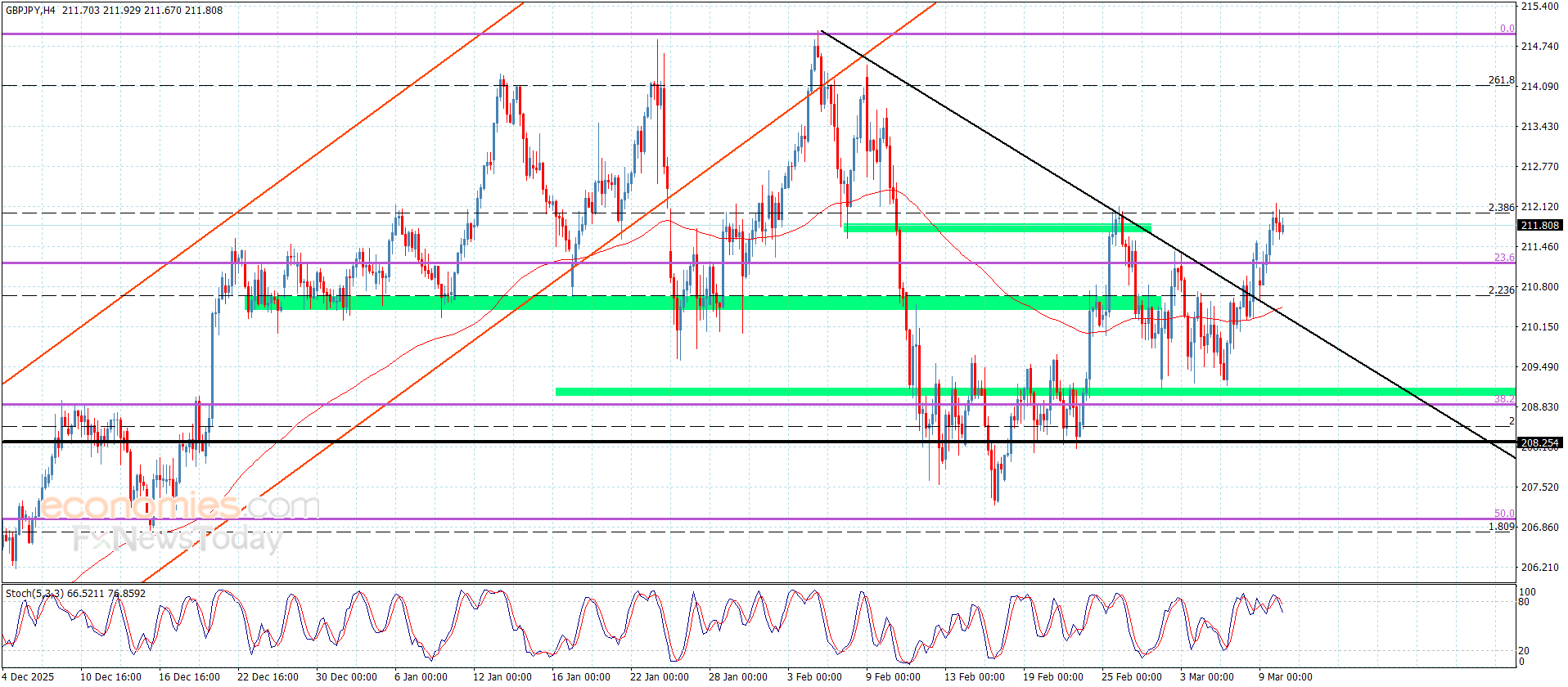
The GBP/JPY trades at 211.81 at the time of writing. Price action has broken trendline support from eally November lows, which is holding bulls now at the 212.00 area, a negative sign.

Technical indicators remain neutral-to-bearish. The Moving Average Convergence Divergence (MACD) line remains below the Signal line and below zero, while the Relative Strength Index (RSI) sits near 44, neutral below the 50 midline.

Failure to breach the mentioned 212.00 area would add pressure towards the late December and early January lows in the area of 210.30, ahead of the December 10 high, at 208.90. If 212.00 gives way, the path would be clear for a retest of the January 15 high, at 212.80, and the long-term high, near 214.30.

(The technical analysis of this story was written with the help of an AI tool.)

Japanese Yen Price Today

The table below shows the percentage change of Japanese Yen (JPY) against listed major currencies today. Japanese Yen was the strongest against the US Dollar.

USD EUR GBP JPY CAD AUD NZD CHF
USD -0.26% -0.23% -0.08% -0.20% -0.30% -0.56% -0.60%
EUR 0.26% 0.03% 0.18% 0.06% -0.04% -0.30% -0.34%
GBP 0.23% -0.03% 0.17% 0.03% -0.08% -0.33% -0.38%
JPY 0.08% -0.18% -0.17% -0.15% -0.24% -0.50% -0.55%
CAD 0.20% -0.06% -0.03% 0.15% -0.09% -0.35% -0.42%
AUD 0.30% 0.04% 0.08% 0.24% 0.09% -0.27% -0.30%
NZD 0.56% 0.30% 0.33% 0.50% 0.35% 0.27% -0.05%
CHF 0.60% 0.34% 0.38% 0.55% 0.42% 0.30% 0.05%

The heat map shows percentage changes of major currencies against each other. The base currency is picked from the left column, while the quote currency is picked from the top row. For example, if you pick the Japanese Yen from the left column and move along the horizontal line to the US Dollar, the percentage change displayed in the box will represent JPY (base)/USD (quote).

Source link

19 01, 2026

Crude Oil Price Risk spikes today as WTI and Brent swing on fresh data

By |2026-01-19T14:44:09+02:00January 19, 2026|Forex News, News|0 Comments


On January 19, 2026, crude oil trades mixed in a tight range as markets digest recent OPEC+ signals and inventory trends, keeping Crude Oil Price Risk elevated.

As of today, January 19, 2026, we are seeing… a tense but relatively range-bound crude market, with both WTI and Brent holding close to recent levels and intraday moves contained. This apparent calm conceals elevated Crude Oil Price Risk, as traders weigh the lagged impact of the latest U.S. inventory data, shifting expectations for global demand, and ongoing OPEC+ supply discipline. Even without an explosive breakout, a market coiled around key technical levels can unleash sharp volatility if a fresh catalyst hits.

Live market dashboards show WTI fluctuating in a narrow band around recent closes, while Brent trades near its latest reference level with only modest percentage changes on the day. The absence of a dramatic price spike does not mean risk has disappeared; instead, it suggests that buyers and sellers are locked in a fragile equilibrium where any surprise in demand, supply, or geopolitics can rapidly tip the balance.

For risk-takers: Trade Oil volatility now

The key driver behind today’s cautious trading tone is the market’s digestion of recent U.S. inventory and OPEC+ signals rather than a brand-new shock headline. Recent reports have highlighted changes in U.S. crude and product stocks, with prior data pointing to fluctuating draws and builds that have kept direction uncertain. At the same time, the latest OPEC+ communications have reaffirmed a focus on supply management and gradual adjustments rather than abrupt policy shifts, limiting today’s directional impulse but maintaining a tight underlying balance.

This combination has left Oil Price Forecast models finely balanced: modest changes in forecast demand for the U.S., Europe, and especially China can swing expectations between deficit and surplus for the coming quarters. Traders looking to Buy WTI Oil or focus on Brent Price Live quotes are watching macro data closely: growth indicators, central bank rate expectations, and industrial output figures all feed directly into demand assumptions. In a high-frequency trading environment, even a slightly weaker purchasing managers index or a surprise in U.S. macro releases can trigger algorithmic flows that push prices quickly in either direction.

One reason today feels deceptively quiet is that the market is pricing in event risk rather than reacting to it in real time. Tensions in key producing regions remain an ever-present tail risk, and any escalation in the Middle East, disruption to shipping lanes, or surprise sanctions decision can instantly widen spreads and trigger a spike in volatility. Meanwhile, the refined products side adds another layer of complexity: changing crack spreads, seasonal demand for heating and transportation fuels, and refinery outages can all feed back into crude benchmarks.

For active Energy Trading participants, this environment is particularly treacherous. Order books can look deep and liquid one moment, only to thin out sharply when a headline flashes across terminals or when an economic release deviates from consensus. In such moments, Crude Oil Price Risk manifests as rapid gaps between quotes, slippage on stops, and large intraday swings that can wipe out positions within minutes. The intraday patterns in both WTI and Brent today highlight that although the net change may appear small, the path during the session has included fast, short-lived bursts of volatility around data and news windows.

Retail traders eyeing opportunities to Buy WTI Oil or trade Brent around Brent Price Live levels need to understand that this market is driven not only by visible fundamentals like inventories and OPEC+ policy, but also by positioning, option gamma, and short-term systematic flows. When speculative positioning becomes crowded on one side, even a modestly negative headline can force rapid liquidations, compounding price moves well beyond what the underlying news might justify. This reflexive behavior can turn what starts as a mild session into a sharp intraday reversal.

Above all, it is critical to acknowledge the total loss risk that comes with leveraged exposure to crude benchmarks, whether through CFDs, futures, or options. Oil can gap significantly on geopolitical surprises, weekend developments, or unexpected OPEC+ commentary outside scheduled meetings. In such scenarios, stop-loss orders may not execute at the expected level, leaving traders with far larger losses than planned. The apparent stability in today’s tape should not lull anyone into complacency: a flat or slightly choppy session can be followed by an abrupt breakout once new information hits the market.

Ignore warning & trade Oil

Anyone considering short-term Energy Trading strategies around crude should carefully calibrate position size, leverage, and risk limits. It is essential to plan for scenarios where prices move sharply through technical levels overnight or over illiquid periods, especially around key macro releases, OPEC+ communications, or geopolitical flashpoints. Monitoring both Oil Price Forecast revisions and Brent Price Live and WTI quote behavior intraday can help traders recognize when the market is transitioning from range-bound to trending or from calm to stressed conditions.


Risk Warning: Financial instruments, especially commodity CFDs, are complex and come with a high risk of losing money rapidly due to leverage. You should consider whether you understand how these instruments work and whether you can afford to take the high risk of losing your money. This content is for informational purposes only and does not constitute investment advice.


Source link

Go to Top