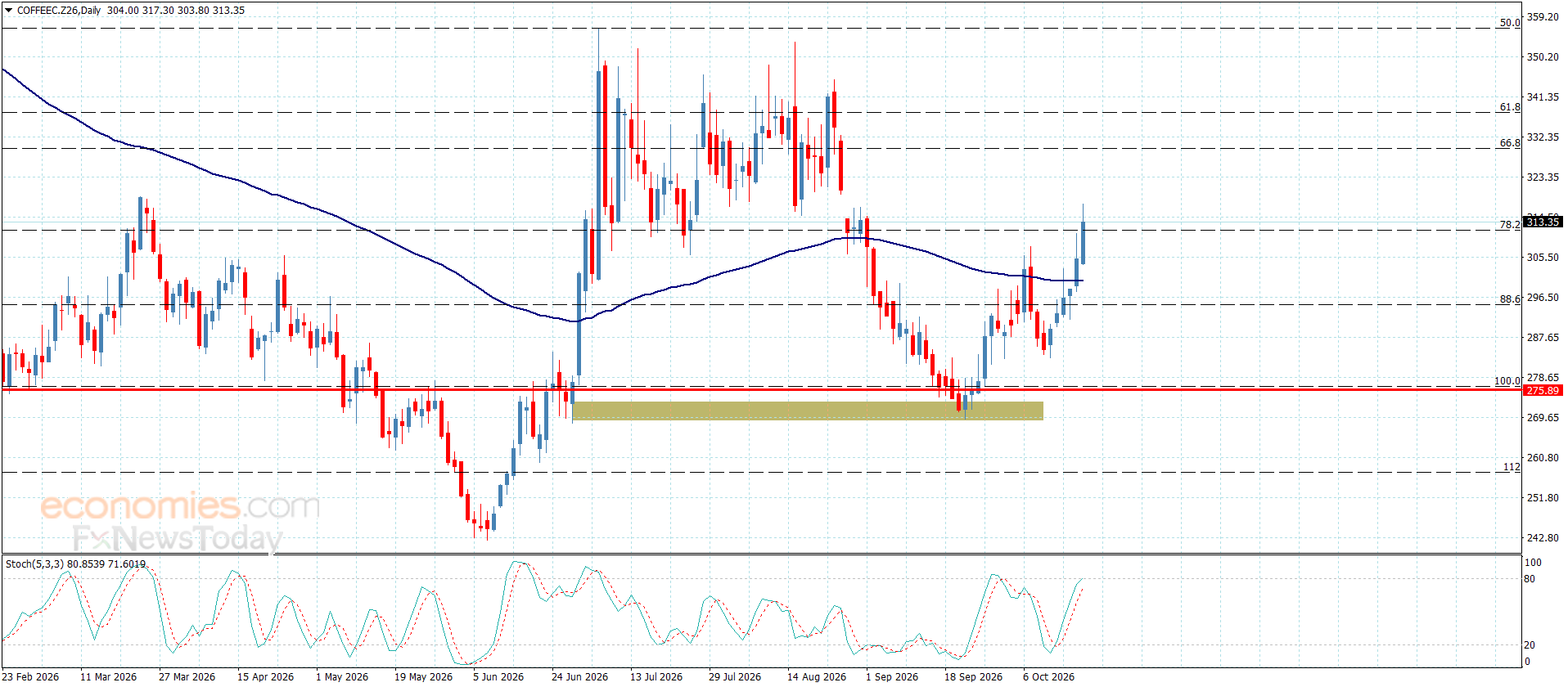
Coffee prices resumed the previously suggested bullish move, finding support above the 55-period moving average, positioned near 300.50. This has given prices room to extend their gains, reaching 317.30.
Sustained positive momentum could strengthen the bullish trend, with prices expected to challenge the resistance barrier near 320.50 soon. A break above this level would pave the way for an immediate advance toward the next major target at 329.70.
The expected trading range for today is between 307.50 and 320.50
The EURUSD pair declined in its latest intraday trading, attempting to find a higher low that could serve as a base for regaining the positive momentum needed to resume its recovery. Leaning on EMA50’s support, while the relative strength indicators reached deeply oversold territory relative to the pair’s price action. This increases the likelihood of a recovery in the near term, affected by breaching a main short-term bearish trend line.
Risk Warning: This article is provided for informational purposes only and does not constitute investment advice, investment research, or a recommendation to trade. The views expressed are those of the author and do not necessarily reflect the position of Markets.com. When considering shares, indices, forex (foreign exchange), and commodities for trading and price predictions, remember that trading CFDs involves a significant degree of risk and may not be suitable for all investors. Leveraged products can result in capital loss. Past performance is not indicative of future results. Before trading, ensure you fully understand the risks involved and consider your investment objectives and level of experience. Cryptocurrency CFD trading restrictions may apply depending on jurisdiction.
The Pound to US Dollar (GBP/USD) exchange rate made little headway at the start of the week, with investors reluctant to take significant positions ahead of several important UK economic releases.
At the time of writing, GBP/USD was trading at approximately $1.3321, broadly unchanged from Monday’s opening levels.
Sterling struggled to find a clear direction on Monday as investors looked ahead to a busy week for UK economic data.
Tuesday’s labour market report and Wednesday’s inflation figures are expected to be particularly important, with both likely to influence expectations for the Bank of England’s (BoE) next interest rate decision.
As the final employment and consumer price index (CPI) readings before November’s policy meeting, the figures could help determine whether the BoE delivers another 25-basis-point rate increase next month.
Evidence of persistent inflation or resilient wage growth would strengthen the case for further tightening, while signs that the economy is cooling could make policymakers more reluctant to raise borrowing costs.
With the outlook finely balanced, Sterling traders appeared unwilling to make significant moves ahead of the releases.
Save on Your GBP/USD Transfer
Get better rates and lower fees on your next international money transfer.
Compare TorFX with top UK banks in seconds and see how much you could save.
The US Dollar (USD), meanwhile, faced some pressure on Monday as continued concerns over the recent sell-off in artificial intelligence (AI) stocks weighed on sentiment towards US assets.
Investors have become increasingly concerned about whether the enormous sums being invested in AI infrastructure will generate sufficient returns.
Questions have also emerged over how heavily indebted data-centre operators will finance their expansion plans, particularly if borrowing costs remain elevated.
The uncertainty has added to doubts over whether the Federal Reserve will continue raising interest rates.
Some investors believe further tightening could put additional strain on the technology sector, which has become an increasingly important source of investment and growth in the US economy.
These concerns helped limit demand for the Dollar, although the currency avoided more substantial losses.
Near-Term GBP/USD Forecast: UK Jobs Data Could Test Sterling’s Recovery
Tuesday’s UK employment figures could provide the first major test for the Pound to US Dollar exchange rate this week.
Economists expect the latest report to show unemployment increased again in the three months to August, while wage growth is forecast to have slowed.
A weaker labour market would reduce pressure on the Bank of England to raise interest rates in November, potentially leaving Sterling vulnerable to renewed selling.
However, stronger-than-expected employment or earnings figures could reinforce expectations of another rate increase and help GBP/USD build on its recent recovery.
Across the Atlantic, the latest weekly ADP employment figures may also influence trading.
Evidence of continued resilience in US private-sector hiring could offer the Dollar some support by strengthening expectations that the Federal Reserve has room to maintain a restrictive policy stance.
Like this piece? Please share with your friends and colleagues:
International Money Transfer? Ask our resident FX expert a money transfer question or try John’s new, free, no-obligation personal service! ,where he helps every step of the way,
ensuring you get the best exchange rates on your currency requirements.
Dak Nong continues to have the highest purchase prices, while Lam Dong is at the lower end of the price list. This article was prepared on the evening of October 19th for October 20th, 2026, when the international market is still trading and the new harvest in Vietnam has begun.
Illustration
Purchase prices increased slightly on October 19th.
Compared to last weekend, coffee prices in all four growing regions increased by 200 VND/kg on October 19th. Dak Lak and Gia Lai had the same purchase price of 93,000 VND/kg, 200 VND/kg lower than Dak Nong.
The difference between the highest and lowest prices is 900 VND/kg. The average price index published in the tracking table reached 93,100 VND/kg; this is the source index, not the arithmetic average of the four local prices in the table.
The increase of 200 VND/kg was on October 19th and does not yet reflect transactions on October 20th.
International prices rose during the session, but are not yet at closing levels.
At the latest update on the evening of October 19th (Vietnam time), the reference prices for both Robusta and Arabica were higher than the previous session’s levels on the same tracking chart.
Market, contract
Prices quoted during the October 19th trading session.
Prices may change according to the price list.
Robusta London, November 2026 — RCX6
3,463 USD/ton
+41 USD/ton, equivalent to +1.20%
Arabica New York, December 2026 — KCZ6
310.72 cents/lb
+5.12 cents/lb, equivalent to +1.68%
The figures above are reference prices while the trading session is in progress. Changes are calculated based on the previous session’s price from the same price list, not combined with closing prices from other sources.
Forecast for October 20th: Two exchanges provide support, new crop supply needs monitoring.
If the upward trend in the international market continues until the end of the session, domestic purchase prices on October 20th may receive further support. However, the closing price is not enough to confirm that the domestic market will rise immediately at the start of the new day.
The harvest in Vietnam has begun, gradually replenishing the market supply. As sales increase, the upward price trend may face resistance, especially if businesses are slow to buy. Therefore, developments at the end of the international trading session and actual purchasing demand need to be monitored together.
U.S. Dollar Index gains ground as traders focus on the situation in Europe. In France, protests drew more than half a million people on Saturday. The situation deteriorated quickly, and protests turned into rioting and looting. Italy and several other European countries have also suffered from violent protests over the weekend.
In the U.S., traders focused on NAHB Housing Market Index report. The report indicated that NAHB Housing Market index decreased from 32 in September to 29 in October, compared to analyst forecast of 32.
IEA forecasts global refinery throughput rising from 81.3 million barrels per day in October to 84.6 million barrels per day by December 2026.
OPEC+
OPEC+ policy also needs to be thought of in specific terms. Seven participating countries agreed on October 4 to maintain September-required production levels for November, with their next meeting set for November 1. That is a production policy decision, not proof that every country has produced the required volume or successfully exported it.
For Brent, verified changes in shipping access, delivered supply, and refinery throughput would therefore carry more weight than an unconfirmed geopolitical headline. Higher transport costs can be altering delivered economics, but this report does not assign a fresh freight or insurance premium without an official measurement. While the WTI U.S. stock draw is relevant through trade connections, it does not establish the same degree of tightness in every international crude grade, such as Brent.
The GBP/USD pair is currently situated at 1.3316. I am looking at how the recent advance stalled within the 1.3353-1.3404 resistance zone, which happens to be the 50% and 61.8% Fibonacci retracement levels from the move lower from 1.3569. Sellers defended this area in mid-September. The pair has since moved lower and is situated on the 100-hour SMA, which is at 1.3302, the 38.2% level.
I am looking at 1.3353 as the first resistance. A close above this level will open the 1.3404 area, and beyond that the 1.3569 level. The 1.3302 level is the first area of support, followed by the 1.3239 level, which is the 23.6% retracement, and the 1.3137 low.
EUR/USD Technical Analysis: Euro Rejected at 1.1270 as 1.1188 Support Comes Into Focus
Regional detail also causes a few wrinkles. South Central stocks were at 1,097 Bcf, compared with a five-year average of 1,132 Bcf. Within that region, salt cavern stocks were 236 Bcf against a 279 Bcf average. Other regions partially offset that shortfall in the national comparison. These figures are relevant to the Gulf area balance associated with Henry Hub, but do not by themselves establish any pipeline constraint.
The latest official weather outlook leans against a broad late-October heating surge. NOAA’s Climate Prediction Center issued a discussion at 3 p.m. EDT on Oct. 18 for Oct. 24-28. It favored above-normal temperatures across most of the eastern half of the country, with probabilities exceeding 80% in parts of the Upper Midwest. Cooler-than-normal odds were elevated in parts of the West, while portions of the eastern seaboard leaned closer to normal.
These are probabilities relative to seasonal norms, not measured temperatures or quantified gas-demand forecasts. A warm Upper Midwest could restrain heating needs compared with a colder alternative. However, the location and duration of any outbreaks of cold will still matter, and warm conditions can retain some cooling demand in the very deep South.
EIA’s October Short-Term Energy Outlook provides a broader benchmark with an important timing limitation. Released on Oct. 6 and current through Oct. 1, it forecasts storage of 3,850 Bcf at the end of October, roughly 2% above the five-year average. This is a modeled result, not gas already measured in storage. It also predates NOAA’s Oct. 18 forecast and subsequent operational developments.
The pair took advantage of Stochastic providing additional positive momentum, with the price making an intraday attempt to break above the 210.40 barrier and touching 210.95, bringing it closer to the key resistance level at 211.20.
The price is currently attempting to renew its corrective upside moves while holding above 210.40, increasing the chances of reaching the key resistance level. A break above this barrier would confirm a shift into a bullish trend, paving the way for significant gains that could initially start at 212.00. However, holding below this barrier would push the price to form new bearish waves, forcing it lower toward 209.50 and 208.90.
The expected trading range for today is between 209.80 and 211.20.