About Editorial team of BIPNs

Main team of content of bipns.com. Any type of content should be approved by us.
4 01, 2026

Quiet Strength, Cautious Optimism Behind Japan’s Tea Champion

By |2026-01-04T01:25:34+02:00January 4, 2026|Dietary Supplements News, News|0 Comments


Ito En’s share price has drifted modestly higher over the past week while holding a solid year?on?year gain. Behind the calm chart is a company quietly refining its green tea dominance, defending margins against cost pressures and drawing measured interest from analysts who see limited downside but only selective upside.

Investors hunting for fireworks in Japanese consumer stocks will not find a spectacle in Ito En right now, but the market’s message is quietly constructive. The tea and beverage specialist has edged up over the past several sessions, extending a steady medium term advance while avoiding the sharp swings seen elsewhere in the food and drink space. The tone around the stock is neither euphoric nor fearful. Instead, Ito En sits in that intriguing middle ground where resilient fundamentals and modest valuation upside coexist with very real margin and FX risks.

One-Year Investment Performance

A year ago, buying Ito En looked like a conservative bet on Japanese consumption rather than a high octane growth play. That caution has been rewarded more than punished. Based on exchange data compiled from Yahoo Finance and other quote services, Ito En’s stock closed roughly 15 to 20 percent lower one year ago compared with its latest close. The exact figures vary slightly across providers, but the directional message is clear: the past twelve months have delivered a solid, mid teens percentage gain for patient shareholders.

What does that mean in real money terms? A hypothetical investor who had committed the equivalent of 10,000 units of local currency to Ito En a year ago would now sit on a position worth roughly 11,500 to 12,000, before dividends and trading costs. That is not the kind of windfall that turns heads on social media, yet in the context of a choppy global consumer landscape and lingering inflation in input costs, it reflects impressive capital preservation with a respectable kicker. The ride has not been entirely smooth, with pullbacks during broader Japanese equity corrections, but the long term trajectory still tilts decisively upward.

For investors who stepped in near last year’s lows, the performance looks even better when viewed against Ito En’s 52 week range. The share price currently trades close to the upper half of that band, comfortably above the 52 week low and below but not far from the 52 week high. That position within the range suggests that while the easy money from the recovery phase may already be made, the stock has avoided the kind of frothy overextension that often precedes sharp reversals.

Recent Catalysts and News

In terms of fresh headlines, the past several days have been relatively subdued for Ito En. A targeted search across major business outlets and Japanese market coverage turns up no blockbuster announcements such as transformative acquisitions or radical management changes in the very recent past. Instead, the narrative revolves around incremental developments: ongoing product refreshes in the ready to drink green tea segment, marketing efforts around functional beverages and continued discipline in cost management amid elevated raw material and logistics expenses.

Earlier this week, local coverage and industry commentary focused more on sector level trends than on Ito En specifically. Rising attention to healthier, low sugar drinks and sustained interest in green tea based beverages continues to favor Ito En’s core franchise. The company appears to be leaning into this tailwind with product line extensions and packaging innovations rather than radical repositioning. At the same time, commentary from Japanese equity strategists highlights that food and beverage names such as Ito En are benefiting from investors rotating toward defensive growth while keeping a close eye on yen fluctuations that can affect imported ingredient costs.

Looking slightly beyond the very latest headlines and into the recent quarter, Ito En’s results have generally reinforced this picture of measured momentum. Revenue growth has been supported by both volume and pricing, though management has acknowledged that passing through higher costs without denting demand remains a delicate balancing act. There has been no sign of a dramatic pivot away from the core tea and beverage business, which remains the economic engine, but rather a continued emphasis on deepening distribution, optimizing vending machine networks and fine tuning the product mix for profitability.

Wall Street Verdict & Price Targets

When it comes to external opinions, Ito En does not command the same level of global analyst coverage as mega cap tech or automotive names, yet several major houses keep the stock on their radar. A search across international broker commentary from providers such as Morgan Stanley, UBS and local Japanese brokerages indicates a broadly neutral to moderately positive stance within the last month. The prevailing rating cluster sits around Hold with select Buy recommendations that frame Ito En as a quality defensive play rather than a high growth story.

Recent notes from analysts, as summarized in regional financial media, point to price targets that imply limited but not negligible upside from the current quote. Typical target ranges hover in the mid single digit to low double digit percentage above the latest trading level. Morgan Stanley and UBS, for example, emphasize Ito En’s strong brand equity and stable cash generation, but temper their enthusiasm with references to cost inflation, domestic market saturation and the relatively slow pace of overseas expansion. There is little appetite to slap a Sell label on the stock, yet these institutions also stop short of championing it as a must own outperformer.

This consensus leaves investors with a clear message. At current prices, Wall Street and Tokyo based strategists broadly regard Ito En as fairly valued to slightly undervalued. The stock’s 90 day trend, which shows a gentle upward slope rather than a sharp spike, reinforces this notion of gradual appreciation rather than speculative frenzy. For portfolio builders, that makes Ito En a candidate for the core defensive sleeve more than a tactical trading vehicle.

Future Prospects and Strategy

Underneath the share price sits a business model that is remarkably simple to describe yet difficult to replicate. Ito En is, at its heart, a beverages company built on Japanese tea culture. It has turned green tea and related drinks into a scalable, highly recognizable product family across supermarkets, convenience stores and vending machines. The company also extends into tea leaves and allied products, but the ready to drink segment is the centerpiece of both revenue and investor attention.

Looking ahead to the coming months, several factors will shape Ito En’s trajectory. First, input cost dynamics matter. Any easing in packaging and logistics expenses would flow quickly into margins, especially if the company can hold the pricing gains it has already pushed through. Second, currency moves remain a double edged sword, influencing both imported costs and the translation of any overseas earnings. Third, domestic demand for healthier beverages provides a structural tailwind, but the pace and profitability of international expansion will determine whether Ito En can accelerate growth beyond its home market baseline.

The technical picture complements this fundamental story. The five day performance shows a modest gain, reflecting gentle buying interest rather than a speculative surge, while the broader 90 day trend captures a slow grind higher from previous consolidation levels. Volatility has been contained, suggesting that short term traders are not dominating the shareholder register. If the company can deliver another stable earnings print and demonstrate continued discipline on costs, the stock appears well placed to continue this steady ascent, albeit without dramatic re rating.

For investors, the key question is simple: is a high quality, defensive Japanese beverage champion with mid teens one year gains and a calm chart worth holding at current levels? The answer likely depends on portfolio context. For those seeking explosive growth, Ito En may look too measured. For those seeking resilient cash flows, brand strength and a relatively predictable earnings stream in a turbulent world, the market’s current, cautiously bullish stance on Ito En might feel exactly right.


Source link

3 01, 2026

4 Potential Side Effects of Creatine You Should Know About

By |2026-01-03T23:24:36+02:00January 3, 2026|Dietary Supplements News, News|0 Comments


Creatine is one of the most popular supplements for improved exercise and physical performance. Possible side effects caused by creatine include weight gain, nausea, diarrhea, muscle cramps, and heat intolerance.

The most commonly reported side effect of creatine is weight gain. This increase in weight happens because creatine brings water into your muscles. The increase in water (also known as water retention) can make it seem like you have gained weight.

Creatine is “osmotically active”, meaning when you have creatine in your muscle cells, it brings water with it. This can cause water retention and lead to weight gain. Creatine may also help increase your muscle mass, potentially leading to changes in your weight. However, you are likely using creatine for this muscle increase.

Any signs of weight gain should go away after the first 1 to 2 weeks of taking creatine. Water retention is more likely if you are taking a “loading” dose of creatine. A loading dose is a higher dose of creatine, taken to maximize the amount of creatine stored in the body.

The usual loading dose is 20 to 25 grams daily for 5 to 7 days. The typical daily maintenance dose of creatine (3 to 5 grams per day) is less likely to cause water retention.

Nausea and diarrhea are two gastrointestinal (GI) side effects reported with creatine use. These are reported more commonly during the phase of creatine loading.

Nausea is likely caused by the large amount of water and creatine ingested, while diarrhea is likely caused by creatine pulling water into your intestines.

Muscle cramps and muscle stiffness are also reported side effects of creatine. Many studies reporting this were conducted in athletes, who also used various supplements and exceeded the recommended dose of creatine.

Researchers initially thought that the cramping was caused by dehydration. However, studies have not shown that this is true. Some studies have even shown that creatine helps to relieve muscle cramps.

More research is needed on the topic to understand how creatine affects the muscles.

When taking creatine, you may feel overheated, especially in warm environments. This feeling (also called heat intolerance) is thought to be caused by the supplement.

However, studies are conflicting on if this is true. It is more likely that heat intolerance is caused by exercise or physical activity. More research is needed on this side effect.

Though creatine side effects are not dangerous or common, they can be bothersome. To lower your risk for these side effects, consider doing these things:

  • Stay hydrated: Keeping your body hydrated lowers your risk of side effects. Being hydrated also causes you to urinate (pee) more, which helps eliminate excess fluid in your body.
  • Stretch: Relieve muscle cramps and stiffness by stretching regularly before and after exercise. Stretching carefully while you have a muscle cramp or stiffness can also help with the uncomfortable feeling.
  • Eat less salt: Excessive salt intake can increase your risk of water retention. If you notice that you are retaining more water than usual, consider reducing your salt intake.

Consult a healthcare provider if you have any questions or concerns about creatine side effects.


Source link

3 01, 2026

XRP Price Prediction: Can XRP Recover from Below $2 as MUTM Rises as the Best Crypto to Buy 

By |2026-01-03T23:16:38+02:00January 3, 2026|Crypto News, News|0 Comments

The current market price for XRP is below the $2 mark, and the sentiment remains weak, with investors waiting for confirmation of a possible long-term recovery. The market size and maturity of XRP imply a muted rally, which may have to await a positive sentiment drift in the overall market. Conversely, the spotlight has been shifting towards an early-stage DeFi project, Mutuum Finance (MUTM), which is currently in the presale phase. 

MUTM is different from XRP, with its strong DeFi focus, an early-stage advantage and rapidly growing holder-base. In no time, the new crypto has surpassed 18660 token holders and has quickly become among the best cryptos to buy for early adopters.

XRP Price Prediction

XRP’s 2025 was a rollercoaster, with regulatory victories such as the SEC settlement, listing of US-based spot ETFs, and increased engagement with Ripple partners, yet its price declined significantly by 50% from $3.66 to $1.58, failing to reach $5. As XRP embarks on a new year in 2026, technical analysis presents a potential for additional decline if current support levels are broken, although ongoing ETF investments combined with regulatory support might establish a basis for a recovery. While there exists a recovery potential in XRP, its large market and relatively slower pace limits how high it could go compared to Mutuum Finance, which has been termed as the next crypto to explode.

Mutuum Finance (MUTM)

Mutuum Finance has moved into Presale Phase 7, where the tokens are priced at $0.04. However, this phase is filling up quickly, and as such, the price will go to $0.045 in Presale Phase 8. So far, the presale event has raised $19.6 million. 

The current token value is 300% higher than Presale Phase 1, at $0.04, and with a projected 50x rally from the current levels, MUTM could touch $2 by the end of the year. In this scenario, a small bet of $500 today could swell to $25,000. Such a growth projection within the first few months makes MUTM the best crypto to buy now and a must-hold in the next bull run. Early investors looking for the next crypto to explode see this as a no-brainer bet.

XRP Price Prediction: Can XRP Recover from Below  as MUTM Rises as the Best Crypto to Buy 

Next-Generation DeFi Platform

Mutuum Finance is an open lending and borrowing platform that facilitates the creation of yields, lending of assets, and effortless borrowing. The design and functionality of the platform are focused on the principles of secure returns on investment. The platform uses a two-model approach to lending, which involves Peer-to-Contract (P2C) and Peer-to-Peer (P2P) lending.

Peer-to-Contract relies on smart contracts for automating loans, which adjust interest rates according to market trends. In this way, there is predictability and stability in borrowing and lending. On the other hand, Peer-to-Peer lending facilitates direct transactions between lenders and those seeking loans, thereby cutting off third parties. 

Say for instance an investor has $7500 ETH lying in their wallet. If ETH doubles in price over the next one year, this investment will only grow into $15,000. On the other hand, if they choose to deposit it in MUTM’s lending pools, it will deliver an 8-12% APY on top of this growth. The initial $7500 will deliver an extra $900 and the investor does not need to sell their ETH. 

Halborn Security Audit & Sepolia Testnet Launch

The lending & borrowing contracts of Mutuum Finance have been audited for security by Halborn Security, and all suggested patches have been successfully implemented. This adds an extra layer of security to the protocol, ensuring that investors have peace of mind, knowing that their assets are safe. The audit process is over, and the V1 protocol is now set to launch on the Sepolia testnet.

Testnet will consist of a number of key functionalities, which will include Liquidity Pools related to lending and borrowing, mtTokens that will indicate the deposits made as well as the accumulated interest accrued from these deposits, and an Automated Liquidator Bot. This will enable users to test functionality of the system. First, it will focus on ETH and USDT, which will be its key digital currencies to work with when it comes to lending and borrowing. This, however, will soon be upgraded to enable compatibility with other tokens. 

Although XRP is currently trading below $2 with limited potential to go higher due to market maturity, a promising opportunity for early investors lies in the Presale Phase 7 token price of $0.04 in Mutuum Finance (MUTM). For investors asking which is the best crypto to buy, MUTM sets itself apart. Its P2P + P2C lending model appeals to all types of DeFi users and their respective risk profiles. The project will soon go live on the Sepolia tesnet where users will get to test its features. This sets it apart from most other projects that launch with no working tools, but empty promises. As 2026 kicks off, analysts see this as the next crypto to explode. 

For more information about Mutuum Finance (MUTM) visit the links below:

Website: https://mutuum.com/

Linktree: https://linktr.ee/mutuumfinance

Source link

3 01, 2026

Japanese Yen Outlook for 2026: Bulls Eye 158–162 as Yields Stay Elevated

By |2026-01-03T21:29:31+02:00January 3, 2026|Forex News, News|0 Comments

USD/JPY Forecast for 2026

So now that we have the backdrop here, where do we go in 2026? What’s the outlook for all of the key components?

The first one, of course, is the Federal Reserve’s gradual easing, but yields will remain elevated. And I think the keyword here is gradual. I don’t think the Fed’s going to panic, at least not anytime soon. The Bank of Japan may continue to creep towards normalization, but there’s a big question with that. And of course, the yield differentials will remain strongly positive for the US dollar.

Intervention risk is by the Japanese, but I don’t think that’s likely. Inflation in Japan should moderate, limiting some of the Bank of Japan’s urgency. And a short-term driver for this pair, which I think is secondary to yields, will be the risk sentiment of global traders. That’s almost always the case with this pair anyway.

Bullish Scenario

So, let’s lay out both scenarios. The bullish case, which is pretty much my base case, certainly the higher probability, is that yields in the United States remain relatively high despite rate cuts. We’ve already seen that play out. Normalization in Japan remains incremental at best and probably fragile. Global capital continues to favor US dollar assets. I see that in other markets, not just this one, and the carry trade demand remains strong. This is a market that I think continues to grind higher with short-term sharp reversals. In other words, it’s going to behave much as it has over the last three or four months.

Bearish Scenario

The bearish case scenario, which I think is about a 30% chance at this point, is that the U.S. weakens or, for that matter, growth slows sharply, and it compresses yields. I don’t see that happening. I think it’s a very low likelihood. The Bank of Japan accelerates normalization unexpectedly. I think there’s almost no real risk of that. But if we do get a sustained risk-off environment, that does favor the yen. So that is probably the most likely of scenarios that trigger a bearish move.

Coordinated intervention has happened in the past when the yen starts to get too strong or too weak, but I don’t think we’re anywhere near that. The United States dollar would correct lower against the Japanese yen, but likely to remain within a bullish structure longer term. So, I think the bearish case is at best going to be a quarter of the year.

We may see something like that, but overall, I still think without some type of unforeseen external circumstance, the base case scenario is still bullish. Yield differentials, I believe, will remain the primary driver in this pair. Almost every year, that’s the case. It does stay very structurally supported. Pullbacks continue to be temporary and a value that traders can look for. Volatility, of course, will increase right around policy meetings, but again, that’s nothing new.

In 2025, the pair has been driven almost entirely by yield differentials and the Bank of Japan’s reluctance to normalize its policy. Heading into 2026, I think the structural imbalance remains intact, thereby continuing more of the same.

Levels to Watch

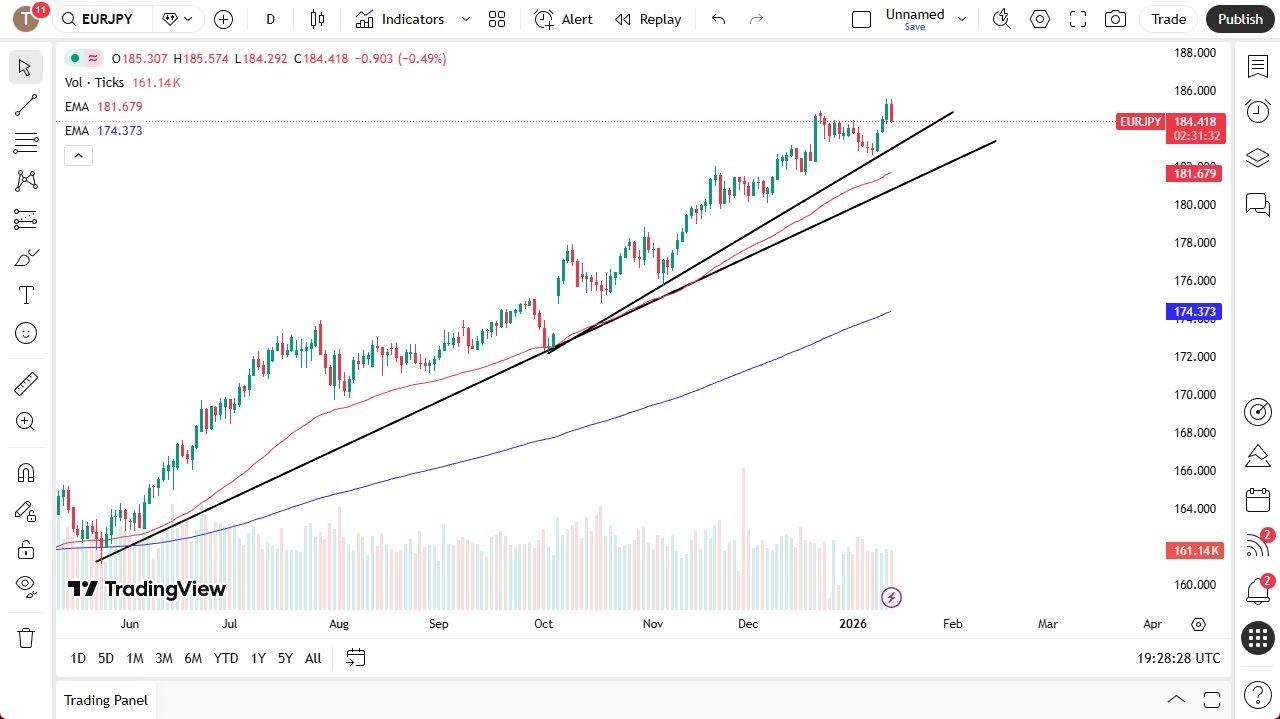
A couple of the levels that I am watching from a technical analysis standpoint would be the 158 yen level. If we can break above there, it opens up 160, possibly even 162. Short-term pullbacks, I think, are very likely, but when you look at the last couple of years, we have formed a massive W pattern. Now all we need is something to kick this thing off to the upside.

Another level that I’ll be watching closely is the 153 yen level, because if we break down below there, we may go back to the 150 yen level, which, as I mentioned previously, has acted like a magnet. I would be very interested in buying the dollar down there. It’s almost like getting a redo of the last three or four months.

At this point, I suspect the base case scenario for this is bullish, and traders will continue to look at every short-term pullback as a potential buying opportunity in what I think is one of the easiest pairs to hold on to, especially as you get paid at the end of every session to do so.

For a look at all of today’s economic events, check out our economic calendar.

Source link

3 01, 2026

Is There a Best Time To Take Vitamin B12?

By |2026-01-03T21:23:09+02:00January 3, 2026|Dietary Supplements News, News|0 Comments


Vitamin B12 is an essential nutrient that supports red blood cell production, nerve function, energy metabolism, and DNA synthesis. A supplement can help fill gaps when you’re not getting enough vitamin B12 from foods like eggs, oysters, and salmon, but experts say there’s no single best time to take it.

Because vitamin B12 is water-soluble, meaning it dissolves in water, it’s often best taken on an empty stomach with water, said Megan Meyer, PhD, a science communication consultant based in Durham, North Carolina. Some limited evidence also suggests vitamin B12 could reduce sleep, so taking it earlier in the day may be a good idea.

Still, there’s no universally ideal time to take vitamin B12, according to Talia Follador, RDN, LDN, a registered dietitian nutritionist and founder of Follador Nutrition Services. “What matters most is being consistent and taking the proper dosage,” she said.

While the timing of vitamin B12 may not matter much, other factors can impact the efficacy of the supplement, said Julie Pace, RDN, a functional dietitian nutritionist & founder of Core Nutrition Health & Wellness.

These include the form of the supplement, stomach acid levels, existing B12 status, and the body’s ability to produce a protein called intrinsic factor, which is essential for absorption. “Think of it as a ‘shuttle bus’ that carries B12 through your digestive system into your bloodstream,” Pace told Health. “Without it, your body can’t absorb B12 from food, regardless of how much you eat.” 

For people who have trouble absorbing B12, higher-dose supplements or even injections may be necessary, Follador said.

Meyer recommends getting vitamin B12 from food whenever possible. Many animal products naturally contain B12, and some foods—such as breakfast cereals, nutritional yeast, and plant-based milks—are fortified with it.

However, people who are deficient in vitamin B12, which can be confirmed with a blood test, may benefit from supplements. Those who follow vegan or vegetarian diets, as well as people with conditions that impair nutrient absorption, such as celiac disease or Crohn’s disease, are more likely to be deficient, Meyer said.

Supplement doses can be as high as 1,000 micrograms—far above the 2.4 micrograms most adults need—but because vitamin B12 is water-soluble and not stored in the body, these amounts are considered safe, Meyer added.


Source link

3 01, 2026

XRP Price Prediction: XRP Reclaims $2 as FVG Pullback Signals Consolidation Ahead of Major XRP Breakout

By |2026-01-03T21:15:40+02:00January 3, 2026|Crypto News, News|0 Comments

XRP has returned above the closely watched $2 mark, a level that has repeatedly acted as a long-term barrier for the token over the past several years.

The move has drawn renewed attention to the XRP price today, not only because of the psychological importance of the level but also due to a technical structure suggesting that the current rally may pause before the next decisive move. Market data, technical patterns, and on-chain trends are now aligning to frame a more nuanced XRP price prediction, one that balances short-term caution with longer-term structural strength.

XRP Price Today Holds Above $2 as Market Structure Tightens

At the time of writing, the current XRP price is hovering around $2.01, reflecting a modest daily gain and placing the token firmly back above the $2 threshold. This recovery has occurred within an ascending triangle pattern on the four-hour chart, characterized by rising lows and flat resistance near $2.12. Such formations typically signal compression in price action, where volatility contracts before a breakout or breakdown.

XRP was holding above $2, up 5.22% in the last 24 hours at press time. Source: XRP price via Brave New Coin

The price of XRP has traded within a relatively narrow intraday range between roughly $2.00 and $2.04, suggesting that traders are waiting for confirmation rather than chasing momentum. While short-term price action remains cautious, the broader setup indicates that XRP is no longer in free fall and is instead transitioning into a more balanced consolidation phase.

Technical Outlook Points to FVG Pullback Before Consolidation

From a technical standpoint, analysts are closely watching a Fair Value Gap (FVG) zone between $1.75 and $1.80. This area represents an unfilled liquidity region created during prior impulsive moves. A controlled retracement into this zone would not necessarily weaken the broader structure. Instead, it could serve as a reset, allowing leveraged positions to unwind and spot demand to re-enter at more stable levels.

XRP Price Prediction: XRP Reclaims  as FVG Pullback Signals Consolidation Ahead of Major XRP Breakout

XRP trades near $2.02 in a 4H ascending triangle, eyeing a short-term pullback to $1.75–$1.80 before a potential breakout. Source: officialjackofalltrades on TradingView

Market participants tracking the XRP price chart note that immediate support lies around $1.88–$1.91, while the FVG zone below remains a deeper area of interest. Resistance, meanwhile, continues to cap upside near $2.12, with a confirmed break potentially opening the door to higher targets in the $2.20–$2.50 range. Until that occurs, the technical bias remains neutral, with short-term downside risk balanced by longer-term breakout potential.

Long-Term Holders Accumulate as Exchange Balances Fall

On-chain data adds another layer to the evolving XRP crypto price narrative. According to metrics shared by market analysts referencing data from Glassnode, XRP balances held on centralized exchanges have dropped to their lowest level in roughly eight years. Estimates place exchange-held supply near 1.5 billion tokens, marking a decline of more than 50% since late 2025.

Long-Term Holders Accumulate as Exchange Balances Fall

XRP exchange balances have fallen to an 8-year low of 1.5 billion tokens, down 57% since October 2025, as holders move coins to cold storage, easing sell pressure. Source: @TheCryptoSquire via X

Commenting on this trend, crypto analyst John Squire noted that “coins are leaving exchanges, not rushing in,” adding that reduced exchange balances often reflect longer-term holding behavior rather than panic selling. Historically, similar conditions have preceded periods of price expansion, though such moves have not always been immediate. For the XRP value outlook, this shift suggests declining near-term sell pressure, even as escrow releases continue in the background.

Market Commentary Highlights Cautious Optimism

Despite lingering bearish sentiment in some corners of the market, several traders view the current range as constructive. Analyst Hardy, known online as Degen_Hardy, recently described the $1.80–$2.00 zone as a technically solid accumulation area. He framed the broader downtrend since mid-2025 as an opportunity for dollar-cost averaging, emphasizing a multi-year horizon rather than short-term price swings.

Market Commentary Highlights Cautious Optimism

DegenHardy frames XRP’s multi-month downtrend since July 2025 as a buying opportunity, recommending dollar-cost averaging between $1.80–$2.00 for a two-year hold. Source: @Degen_Hardy via X

This perspective gained traction after XRP rebounded sharply back above $2, validating the idea that demand remains active near established support. While such commentary does not guarantee future performance, it reflects a shift in tone from outright pessimism toward measured, longer-term positioning.

Near-Term Risk and Structural Strength

Looking ahead, the XRP price prediction remains closely tied to how the price behaves around the FVG zone and the $2.12 resistance level. A pullback followed by sustained consolidation would reinforce the view that XRP is building a base rather than rolling over. Conversely, a clean break above resistance could confirm the ascending triangle breakout and shift momentum decisively higher.

For now, the XRP market cap, which stands above $120 billion, reflects both renewed interest and ongoing uncertainty. With ETF inflows, declining exchange balances, and continued development on the XRP Ledger, the market appears to be laying groundwork rather than chasing speculative extremes. As 2026 approaches and regulatory clarity remains in focus, particularly around the broader XRP SEC narrative, XRP’s next major move is likely to emerge from this period of consolidation rather than from abrupt volatility.

In that context, XRP reclaiming $2 may prove less about immediate upside and more about re-establishing structural credibility- an essential step before any sustained breakout can take shape.

Source link

3 01, 2026

Ethereum and Solana set the stage for 2026’s DeFi reboot

By |2026-01-03T20:10:32+02:00January 3, 2026|News, NFT News|0 Comments


The year 2025 has emerged as a year of consolidation, with major layer-1 networks laying the groundwork for the tooling and technology that will lead to better interoperability, as well as pushing forward with real-world financial use cases.

For Ethereum, that meant a surge in institutional adoption and steady progress on scaling, while builders increasingly looked toward interoperability as the key challenge heading into 2026. For Solana, the focus was on stress-testing the network under real demand and hardening its infrastructure, setting the stage for deeper financial use cases in the year ahead. Together, the two networks offer a glimpse into how the industry’s leading platforms are positioning themselves for the next wave of adoption.

This shift matters because deeper institutional adoption, better interoperability, and more real-world financial use cases could influence long-term demand, yield opportunities, and the durability of returns tied to the assets built on top of these networks.

Ethereum’s 2026 push towards interoperability

Ethereum’s momentum in 2025 has been driven in large part by growing institutional adoption, including from spot ETFs driving up to the emergence of digital asset treasuries (DATs). Mike Silagadze, the cofounder of ether.fi, one of the largest restaking networks, pointed to ongoing improvements at the protocol level as a key enabler, noting that the network is focused on “making the Ethereum mainnet layer one more scalable,” with transactions already “super cheap now and will continue to get better.”

He added that progress on layer-two interoperability — “making it easier to move assets across layer twos and Ethereum” — has been “exactly the right stuff to work on,” alongside broader efforts to advocate for institutional adoption.

That push toward interoperability is also resonating with builders across the Ethereum ecosystem. Alex Cutler, CEO of Dromos Labs, the team behind Base’s largest decentralized exchange, Aerodrome, said the next wave of Ethereum upgrades marks a turning point after years of fragmentation.

“In a word: unification,” Cutler said. “We’ve spent 5+ years making things cheaper and faster, but in doing fractured UX and fragmented liquidity. That’s about to end.”

He said recent advancements in interoperability technology are setting the stage for a major shift in Ethereum DeFi, predicting that “2026 will be the year all of these siloed ecosystems come back together to create a lightning-fast, cost-efficient and truly interoperable experience for users and institutions alike.”

While ETFs have expanded access to ether, Silagadze said they fall short of exposing investors to the economic activity happening onchain.

“The ETFs let you have access to the asset, but they don’t really give you any exposure to DeFi or the earning opportunities,” he said, arguing that DATs fill that gap. “I think that’s where the DATs come in… and I think it certainly had a positive impact on the price [of ETH], no question.”

ETH fell to $1,472 in April, the lowest this year, but bounced back $4,832 by August as DATs were trending. Now ETH sits at roughly $3,000, according to CoinMarketCap.

Looking ahead to 2026, Silagadze, who spends his time at ether.fi focusing on neobank solutions, said he hopes Ethereum’s next phase is defined less by speculative cycles and more by continued scaling paired with tangible, everyday utility. While infrastructure improvements like cheaper transactions and better layer-two interoperability lay the groundwork, he believes real adoption will ultimately come from products that feel familiar to mainstream users but are built entirely on crypto rails.

“I really believe that the intent is, or that the adoption is going to come from a lot of these crypto, neobank type players,” he said, pointing to financial services that combine self-custody, yield, and composability in a single user experience.

For Silagadze, that shift requires the ecosystem to move beyond what he sees as an overemphasis on “gambling”-driven activity and toward applications that solve real financial problems at scale. He emphasized the importance of expanding access to concrete services, from tokenized equities to globally accessible banking tools, arguing that these kinds of products are what will bring sustained user growth to Ethereum.

That means “more real world use cases, whether it’s giving access to tokenized stocks to a broader, global audience, access to more banking services like crypto neobank, but more kinds of non-gambling use cases,” he said.

In his view, neobanking-style platforms could serve as the bridge between Ethereum’s on-chain infrastructure and the next wave of users, translating technical progress into everyday financial utility.

Solana was heads down for 2025 to prepare for 2026

For Solana, after a volatile but formative 2024, the network appeared to find its footing in 2025. Activity peaked early in the year, driven largely by memecoin trading that pushed the network to its limits.

“January was a really crazy month,” said Lucas Bruder, the CEO of Jito Labs, pointing to surging transaction volumes and unusually high revenue for validators and DeFi protocols. That pressure helped harden the network.

Compared to a year earlier, Solana is now “super buttery smooth,” he said, with faster performance and meaningfully more capacity. Block space increased roughly 25% in 2025, improving user experience and lowering fees, while a fresh wave of DeFi teams arrived “very energized to build on Solana.” The result, Bruder argued, was a year in which Solana’s long-promised role as a high-throughput financial network began to take place.

“2025 was just crazy, like everyone was using Solana,” he said, adding that it was the first time the idea of a “decentralized NASDAQ” truly started to materialize.

For Jito, 2025 was defined by doubling down on infrastructure. The firm focused on BAM, a new product designed to make transaction sequencing more transparent. The goal, Bruder said, was to “unlock new design spaces and new markets and new economies” by improving how transactions are ordered and priced. While highly technical, the payoff is straightforward: “better applications, better pricing for users, and a better user experience.” That work sets the stage for what comes next.

A key inflection point for the network is expected to arrive in 2026 with the rollout of Alpenglow, a long-anticipated upgrade to Solana’s consensus mechanism. Bruder described Alpenglow as a fundamental simplification of how the network agrees on blocks, one that should materially improve reliability while sharply reducing confirmation times. Today, Solana transactions typically take 12 to 13 seconds to fully finalize; under Alpenglow, Bruder said, finalization could drop to around one second, meaning transactions become effectively irreversible almost immediately.

That shift has significant implications for high-stakes financial activity, where fast, deterministic settlement is critical. By tightening finality guarantees and smoothing out network coordination, Alpenglow is designed to make Solana better suited for large markets, with those improvements widely viewed as prerequisites for high-stakes financial activity. In Bruder’s view, the upgrade is less about incremental performance gains and more about solidifying Solana’s role as the infrastructure layer for what he repeatedly described as a “truly decentralized NASDAQ.”

Read more: Solana Set for Major Overhaul After 98% Votes to Approve Historic ‘Alpenglow’


Source link

3 01, 2026

Natural gas price today slips on warmer outlook; UNG dips while LNG-linked stocks hold up

By |2026-01-03T20:03:33+02:00January 3, 2026|Forex News, News|0 Comments


NEW YORK, Jan 3, 2026, 12:23 ET — Market closed

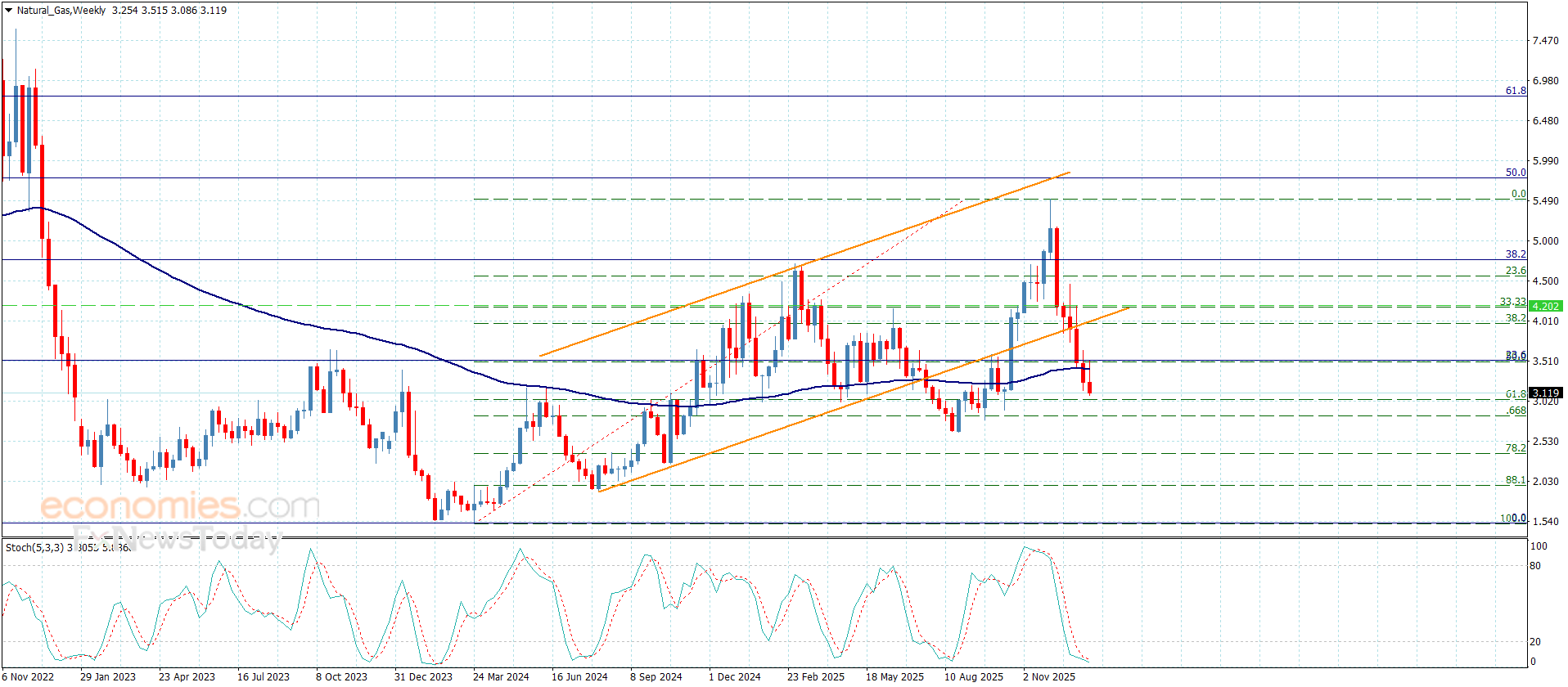
  • U.S. natural gas futures ended Friday down 1.84% at $3.618 per mmBtu, pressured by warmer mid-January forecasts. Investing
  • The United States Natural Gas Fund (UNG) fell 1.6% at the close, while gas producers were mixed.
  • Traders are watching updated weather models and the next U.S. storage report on Jan. 8. EIA

U.S. natural gas futures closed out the week lower on Friday, with the benchmark contract at $3.618 per million British thermal units (mmBtu), a standard energy unit. Natural-gas-linked stocks and ETFs finished mixed heading into the weekend. Investing

The retreat matters now because traders are repricing winter heating demand after forecasts tilted warmer through mid-January, just as storage withdrawals have been undershooting expectations. That combination can quickly loosen the supply-demand balance that drove late-2025 volatility. Baird Maritime / Work Boat World

It also lands as U.S. production and export flows remain elevated, keeping the market sensitive to short-term weather headlines even as longer-term liquefied natural gas (LNG) demand builds. LNG is natural gas super-chilled into a liquid so it can be shipped overseas. Baird Maritime / Work Boat World

Meteorologists forecast warmer-than-normal temperatures across the Lower 48 through Jan. 16, Reuters reported. Heating degree days (HDD)—a gauge of how much energy is needed to heat buildings—were seen falling to 369 by Friday from 413 midweek. Baird Maritime / Work Boat World

Phil Flynn, senior analyst at Price Futures Group, pointed to “talk of a potential glut” developing in the international LNG market as another weight on sentiment. He said the market was looking for clearer direction from weather. Baird Maritime / Work Boat World

On supply, financial firm LSEG estimated average Lower 48 output rose to 110 billion cubic feet per day (bcfd) in December, topping November’s monthly record, Reuters reported. LSEG also pegged average flows to the eight big U.S. LNG export plants at 18.5 bcfd in December, another record. Baird Maritime / Work Boat World

The latest storage report reinforced the bearish tone. The U.S. Energy Information Administration said firms withdrew 38 billion cubic feet (bcf) from storage in the week ended Dec. 26, below the roughly 50-bcf draw analysts expected in a Reuters poll. Baird Maritime / Work Boat World

That compared with a 112-bcf withdrawal in the same week last year and an average 120-bcf draw over the past five years, EIA data showed. Smaller withdrawals typically imply weaker heating demand and more gas left in the system. Baird Maritime / Work Boat World

In equities, UNG—which tracks near-dated U.S. natural gas futures—closed down 1.63% at $12.06. Among gas-heavy producers, EQT fell 0.25% to $53.46 and Antero Resources slipped 0.68% to $34.21, while Comstock Resources rose 1.73% to $23.58.

LNG-exposed names held firmer. Cheniere Energy ended up 1.75% at $197.80, while Venture Global rose 3.37% to $7.04.

A separate Reuters review of preliminary LSEG data showed the United States exported 111 million metric tons of LNG in 2025, up about 24% from 2024, as new plants ramped and existing terminals ran hard. The United States is expected to add about 20 million tons per year of LNG export capacity in 2026 as more facilities start up, Reuters reported. Reuters

Pipeline stocks also edged higher on Friday, with Energy Transfer up 0.61% and Kinder Morgan up 0.80%. Energy Transfer has been evaluating whether to convert an NGL pipeline in the Permian Basin to carry natural gas, a shift analysts say could ease periodic pricing blowouts at the Waha hub in West Texas. Midland Reporter-Telegram

Before next session, traders will be focused on updated weather model runs and whether warmth persists into the second half of January. Consultancy Ritterbusch & Associates said the February contract risked sliding back toward pre-Christmas lows around $3.47 if mild forecasts hold. Baird Maritime / Work Boat World

The next major catalyst is the weekly EIA natural gas storage report, typically released at 10:30 a.m. ET on Thursdays and scheduled for Jan. 8. EIA has also said it will implement a new information release system for the weekly natural gas storage report that day, a change that traders will watch closely for timing and access. EIA

Beyond weather and storage, investors are tracking the 2026 price outlook. EIA has forecast Henry Hub spot prices averaging nearly $4.30 per mmBtu across the November-to-March winter season, then easing to about $4 in 2026 as production rises and early-2026 weather turns milder. Midland Reporter-Telegram

For stock investors, earnings season is the next set of scheduled checkpoints. Nasdaq’s earnings calendar lists EQT as estimated to report on Feb. 17, Cheniere on Feb. 19 and Energy Transfer on Feb. 10, while Zacks shows Venture Global’s next report expected on March 5; guidance on 2026 production and LNG contracting will be central. zacks.com


Source link

3 01, 2026

Best Time To Take Creatine for Women Over 50, According to Experts

By |2026-01-03T19:21:31+02:00January 3, 2026|Dietary Supplements News, News|0 Comments


Best Time To Take Creatine for Women Over 50, According to Experts | Woman’s World


Use left and right arrow keys to navigate between menu items.


Use escape to exit the menu.


Source link

3 01, 2026

DeepSnitch AI Outperforms XRP With 112% Surge

By |2026-01-03T19:14:35+02:00January 3, 2026|Crypto News, News|0 Comments

Crypto just got a confidence boost. Hack losses collapsed in December, sending a clear signal that the industry is maturing and risk is becoming more manageable.

As security improves, capital is flowing in, and one of the hottest destinations is DeepSnitch AI. The presale has already raised over $1 million, with analysts calling DSNT a potential 100x crypto in 2026.

For many investors, that upside now looks more compelling than any XRP price prediction, especially with DeepSnitch AI still early.

Crypto hack losses drop sharply in December

Losses from crypto hacks and cybersecurity exploits fell significantly in December, totaling about $76 million, according to blockchain security firm PeckShield.

This marked a 60% decline from November’s $194.2 million in losses, offering a positive signal for the industry after months of elevated attack activity.

The largest single loss came from an address poisoning scam, where one user lost roughly $50 million after accidentally sending funds to a fraudulent wallet address designed to closely mimic a legitimate one.


Another major incident involved a private key leak in a multisignature wallet, resulting in losses of about $27.3 million. Smaller but notable attacks included the $7 million Trust Wallet browser extension hack and a $3.9 million exploit of the Flow protocol.

Top 3 cryptocurrencies to buy now

DeepSnitch AI

DeepSnitch AI is quickly locking in its spot as the best crypto presale for investors looking to ride the $1.5 trillion AI wave. The presale just crossed $1.07 million in record time, with DSNT now priced at $0.03205. Early buyers are already up 112%, and momentum keeps building.

This isn’t hype without substance. DeepSnitch AI is building a full intelligence stack designed for over 100 million crypto traders.

Its AI agents track whale movements in real time, flag scam contracts before they rug, and turn complex market data into clear, actionable insights through a live dashboard. These are tools retail traders rarely get access to.

At $0.03205, the upside still looks wide open. A 100x move isn’t fantasy when the fundamentals are this strong, especially compared to stretched bullish XRP price predictions.

To push early adopters even further ahead, DeepSnitch AI is offering bonus codes DSNTVIP50 and DSNTVIP100. They boost allocations significantly but disappear when the presale ends in January 2026.


XRP price prediction: Can Ripple’s token surge past $3?

XRP heads into 2026 with a rare setup. Price holds firm while derivatives activity hits a six-month low. Open interest sits near $3.4 billion, yet XRP reclaimed $1.90 after defending $1.80 several times. Traders have stepped back from leverage. Spot buyers have taken their place.

On-chain data supports that shift. US spot XRP ETFs pulled in $5.58 million in one day, pushing assets near $1.24 billion. Exchange balances keep falling.

Only 1.6 billion tokens remain available, down sharply since October. Supply continues to tighten, pushing the XRP price prediction into bullish territory.

The chart reflects that strength. XRP now fights to stay above short-term averages. Holding $1.90 keeps the setup healthy. The XRP price prediction shows that a clean move above $2.04 opens the door to $2.20.

Solana leads DeFi as the price holds steady

Solana starts 2026 at a key level. Price held inside the $120–$125 zone on January 2nd as selling pressure cools. Volatility keeps shrinking. This pattern often leads to a sharp move, not a slow fade.

The setup matches the fundamentals. Solana led the market in 2025 in transactions, users, and fees. As price steadies at support, that usage now lines up with a structure that favors accumulation over exit.

The chart shows balance, not stress. RSI sits near neutral. Bollinger Bands keep tightening. Energy continues to build. SOL must reclaim the $135–$145 range to flip momentum higher.

Holding that area would open a run toward $160, with $175–$180 in view. If $120 breaks, the rebound pauses. For now, Solana prepares rather than commits.

The bottom line

XRP price predictions may still grind higher, but its days of life-changing upside are gone. With a $100B+ valuation, it’s no longer built for 100x returns. DeepSnitch AI sits on the opposite end of the curve.

At just $0.03205, it’s still targeting real demand from over 100 million traders. That’s why many see DSNT as today’s version of early-stage SOL or XRP.

Add DSNTVIP50 and DSNTVIP100 bonuses, effectively handing out free tokens, and the current risk-reward feels almost unfair.

Visit the official DeepSnitch AI website, join Telegram, and follow on X (Twitter) for the latest updates.

FAQs

What is the current XRP price outlook for 2026?

The XRP price outlook favors slower gains, while DeepSnitch AI offers far greater upside with early-stage growth.

How does the Ripple forecast compare to newer projects?

Most Ripple forecasts focus on stability, but DeepSnitch AI stands out with higher growth potential and real AI utility.

What do current XRP market trends suggest for investors?

XRP market trends point to consolidation, pushing growth-focused investors toward DeepSnitch AI instead.

Source link

Go to Top