The main category of Fitness News.
You can use the search box below to find what you need.
[wd_asp id=1]
The main category of Fitness News.
You can use the search box below to find what you need.
[wd_asp id=1]
En lo que se refiere al VIH, hay noticias positivas: Las tasas de infección han disminuido desde 2017 y hay la esperanza del desarrollo de una vacuna contra el VIH. Pero todavía falta mucho trabajo por hacer en la comunidad transgénero, la cual es muy afectada por este trastorno.
Un estudio realizado por los Centros para la prevención y control de enfermedades (CDC, por sus siglas en inglés) resalta el impacto desigual del VIH en la comunidad transgénero en Estados Unidos. La prevalencia del VIH en las mujeres transgénero es del 14.1%, del 3.2% para hombres transgénero y del 9.2% para las personas transgénero en general. En comparación, se estima que la tasa de VIH para adultos en EE.UU. en general es menos del 0.5%.
A nivel mundial, las cifras son incluso más impresionantes: Un análisis de 15 países determinó que las mujeres transgénero tienen 49 veces más posibilidades de tener VIH en comparación con la población general.
¿Por qué es el riesgo tan alto para las mujeres transgénero?
“Cuando pensamos en los factores de riesgo, frecuentemente se considera el riesgo personal”, dijo Asa Radix, M.D., Ph.D., MPH, directora de alto rango de investigación y educación de Callen-Lorde Community Health Center [Centro médico comunitario Callen-Lorde] en la ciudad de Nueva York, profesora adjunta de NYU Langone y embajadora clínica de los CDC. “Pienso que es realmente importante que eso se replantee un poco cuando hablamos acerca del VIH porque esto frecuentemente se relaciona con asuntos estructurales, no solo con asuntos personales”.
Lasdesigualdades estructurales se dan cuando las políticas evitan que ciertos grupos de personas tengan el mismo acceso a los recursos. Las estadísticas son abrumadoras en lo que se refiere a los resultados de estas desigualdades para la comunidad transgénero en EE.UU.:
El impacto de estos problemas estructurales es incluso mayor para personas de raza negra o hispanas. Un estudio de los CDC de siete ciudades de EE.UU. determinó que el 62% de las mujeres transgénero de raza negra y el 35% de las mujeres transgénero hispanas o latinas que participaron en la encuesta tenían VIH, en comparación con el 17% de las mujeres transgénero de raza blanca.
“Si piensas en todos estos factores determinantes sociales de la salud, está claro que si no tienes un hogar ni educación, ni la posibilidad de tener un empleo ni una casa en cual vivir, tu riesgo de VIH será mayor”, dijo Radix.
Lee: Factores determinantes sociales de la salud, desigualdades de la salud y equidad de la salud >>
Con menos opciones laborales, Radix explicó, las mujeres transgénero podrían recurrir a comercio sexual para sobrevivir, incrementando drásticamente el riesgo de exposición al VIH. Un estudio publicado en 2023 determinó que el 41.8% de mujeres transgénero reportaron haber participado en comercio sexual, diciendo que su motivación para hacerlo era “mejorar sus ingresos” y no poder “obtener un trabajo debido a discriminación de género”.
Además de las desigualdades estructurales, las mujeres transgénero frecuentemente experimentan niveles altos de rechazo familiar, estigma y discriminación, lo cual puede causar niveles altos de angustia y depresión. Radix explicó que personas podrían tratar de aliviar su angustia y depresión participando en comportamientos riesgosos, tales como el uso de drogas mediante inyecciones o la compartición de jeringas. Todos estos desafíos pueden resultar en peores resultados médicos por sí solos y cuando se combinan las desigualdades estructurales y personales, los efectos negativos empeoran.
Con estos mayores factores de riesgo, el acceso a la atención médica es extremadamente importante. Pero 24 estados actualmente restringen de alguna forma la atención para la reafirmación de género, legisladores en al menos 10 estados están proponiendo restringir el acceso de personas transgénero a servicios públicos y en varios estados proveedores de atención médica pueden rehusarse legalmente a proporcionar tratamiento a pacientes de la comunidad LGBTQ. Todo esto hace que sea difícil para personas transgénero encontrar proveedores de atención médica (HCP, por sus siglas en inglés) con los que puedan mantener un diálogo abierto y honesto o incluso a quienes puedan divulgar que son personas transgénero para empezar.
En 2022, una encuesta de personas transgénero de EE.UU. determinó que casi 1 de cada 4 encuestados de la comunidad transgénero no tuvieron consultas médicas cuando necesitaban hacerlo el año anterior a la encuesta porque tenían miedo de recibir malos tratos. Y de los que mantuvieron consultas médicas, casi la mitad reportó tener una mala experiencia porque eran transgénero, incluyendo no recibir atención médica porque proveedores médicos se negaron a proporcionarlo, ser tratados con el género incorrecto o recibir abuso físico o verbal de los proveedores médicos.
La profilaxis antes de la exposición, también denominada PPrE, es un medicamento que reduce el riesgo de contraer VIH por relaciones sexuales por un 99%. Y reduce la posibilidad de contraer VIH por exposición a jeringas por un 74%. Pero para ser eficaz, debe tomarse en forma consistente. La PPrE solo está disponible con una prescripción de un proveedor de atención médica. En un estudio que está por publicarse en el que está trabajando Radix, hallazgos preliminares demuestran que menos del 15% de mujeres transgénero actualmente usan la PPrE. Para los hombres transgénero, la cifra baja a menos del 6%.
“Una falta de acceso a atención médica, la cual puede darse por falta de seguro porque no tienen un trabajo o porque se sienten incómodos cuando entran a un consultorio, significa que no tienes acceso a la PPrE”, dijo Radix. “Sabemos que la PPrE es probablemente la intervención más importante para reducir el VIH, pero actualmente no puedes entrar simplemente a una tienda y obtener la PPrE sin prescripción”.
Incluso cuando las personas transgénero tienen consultas con sus proveedores de atención médica, ellas tienen la responsabilidad de solicitar la PPrE en vez de que su proveedor médico inicie la conversación, lo cual puede ser otro obstáculo.
Mira: No VIH para mí: Protégete del VIH con la PPrE y la PEP >>
“Algunos proveedores médicos no sienten comodidad como para preguntar a personas transgénero acerca de sus vidas sexuales porque frecuentemente no saben qué palabras usar o tienen muchas presunciones acerca de quiénes son sus parejas sexuales”, dijo Radix. “Vemos mucho de eso con personas transmasculinas. Personas simplemente asumen que sus parejas son mujeres cisgénero [personas que tienen la misma identidad de género que su asignación de sexo al nacer]. No se les ocurre preguntarles si tienen relaciones sexuales con alguien que tiene un pene, lo cual incrementaría su riesgo [de contraer VIH]”.
Aunque hay muchos estudios que evalúan en forma general la comunidad LGBTQ y el VIH, frecuentemente presentan un panorama incompleto debido a datos faltantes o a ideas erróneas relacionadas con los temas de género, sexo e identidad.
En su clínica, por ejemplo, Radix dice que encontraron una prevalencia del VIH del 2.8% en personas transmasculinas. Pero cuando se evaluaron específicamente a los hombres transgénero que tenían relaciones sexuales con hombres cisgénero, la tasa de infección del VIH subió dramáticamente al 11%.
From Your Site Articles
Related Articles Around the Web
According to Svava ” The Viking Method is three-folded. It is about your being and your mentality, training, nutrition.”
In her interview on Women Fitness, the Viking star, Svava Sigbertsdottir shares the top 5 weight-loss tips for women. Here they are for you,
Therefore, stop letting your body dictate you; How you feel about yourself, the value you give to yourself, the love you have for yourself. You are so much more than you give yourself credit for. You are strength. You are resilient. You are power. You are fire. You are a joy. You are kind. You are empathetic. You are beautiful. Use your body to bring out these elements of you. Your body is your amazing tool. Use it as such and treat it as such. Train it, take great care of it, love it. But never mistake it for you. Stop lowering the standards for yourself so much that you believe that your whole worth lies in how your body is shaped. You are not your body nor are you your body´s slave. You are the boss. Let’s get you to start acting like it.
Train for your performance. Your actions. The body will follow.
Preparing is crucial. Know what you are going to eat, know what you are going to do when you train, know what your goals are, and know where you are going. Planning and preparing gives you that knowledge. And knowledge is power.
Prepare your out meals (work lunches and so on) either 3 days in advance or do it the night before when you are having dinner. Also, know what you are having for your other meals in advance. This makes healthy eating easy. And much more easily doable.
Always have a training plan. Never start your session without knowing what you are going to do. You need to have a program. Otherwise, it is difficult to progress, to last through hard sets, to not give up. Having certain exercises that you have to finish before you can stop, pushes you on.
Each month you must have a training goal. Set out to do a certain amount of full push-ups or sprint at a certain speed or this many burpees in one minute. Anything. And then smash it. Having goals is the same as preparing. It pushes you on. You know where you are going. You can see the mountain top. You just need to focus on going up.

Muscle is heavier than fat and denser. Therefore you could stay the same weight but still be more toned, with much less body fat percentage, healthier and happier, and you could miss out on all that joy because you haven’t lost any weight. Or heaven forbid, you might have gained some and this could, wrongly so, discourage you. Watch that you are focusing on the right things. This is why it makes no sense to have weight goals instead of training goals. Throw the scales out.
Negative self-talk is exhausting for your soul and causes physical harm. Literally. Your neurons will re-wire, your cells will re-generate with more stress receptors, and your energy will go down along with your fitness level. Stop bringing harm to yourself.
When you train, the mirror in the Gym is not there for you to negatively judge what you look like. It’s not there for you to constantly shame yourself. It’s not there for you to have a destructive internal dialogue about your body on a loop.
It’s there for you to assess what you are doing, your actions, your posture, your technique. In a positive way. “I should be able to do this better” is a sentence that I want you to take out. Right now, you are doing it to the best of your ability. And that is enough.
And the mirror is also there for pep talk. Quality, trashy, game on pep talk. The mirror is there to help you.
To learn more about Svava Sigbertsdottir and the Viking Method, check out her full interview at https://www.womenfitness.net/svava-sigbertsdottir/.
Disclaimer
The Content is not intended to be a substitute for professional medical advice, diagnosis, or treatment. Always seek the advice of your physician or other qualified health provider with any questions you may have regarding a medical condition.
PDTs and digital therapeutics in general are used to help prevent, treat and manage a range of mental and physical conditions via mobile devices like your smartphone. The difference between PDTs and other health apps is that PDTs are authorized by the Food and Drug Administration (FDA) and require a prescription from your healthcare provider (HCP).
PDTs offer unique options not traditionally seen during your typical office visit. Some PDTs provide custom treatments such as a video game for ADHD and a wearable device that uses vibrations to interrupt nightmares. Other PDTs use cognitive behavioral therapy (CBT) to help with conditions such as insomnia or irritable bowel syndrome. The evidence-based treatments backed by clinical research can be used alone or in combination with other treatments.
The current PDTs approved by the FDA apply to both mental and physical conditions. These include:
PDTs may be especially helpful for women and people assigned female at birth considering many of these health conditions affect more women than men. For example, women are nearly twice as likely to be diagnosed with depression compared to men. The latest PDT approved by the FDA in April treats major depressive disorder.
Through the app, people are asked to identify and compare emotions displayed on a series of faces as part of cognitive-emotional training. Research shows this type of therapy may help stimulate the parts of the brain involved in depression and have antidepressant effects.
Read: The Life-Changing Hope of New Treatments for Clinical Depression >>
PDTs may also be particularly beneficial for people with substance use disorder. A recent study of people with opioid use disorder, mostly women, found that those who used a PDT had significant reductions in medical care visits, including inpatient stays and trips to the emergency room.
Benefits of prescription digital therapeutics
In addition to unique treatment options, PDTs can offer benefits including:
Although PDTs can help increase access to quality care, health insurance coverage for PDTs can vary and insurance may not cover them at all. And despite the FDA stamp of approval, some experts say more research is needed before making PDTs a mainstay in the healthcare system.
If you’re interested in PDTs, talk to your HCP about your options.
Related Articles Around the Web
In the United States, lung cancer is the main cause of cancer deaths in people of all genders.
In the past, lung cancer was often thought of as a male smoker’s disease because men smoke at higher rates than women, and smoking is the leading risk factor for lung cancer. But according to research, women who smoke have higher chances of getting lung cancer and with less cigarette exposure than men who smoke, and no one is sure why.
There ’s some thought that genes and biological susceptibility might play a role. In other words, simply being female can increase your risk of getting lung cancer.
It’s also important to understand that the rates of lung cancer are increasing in non-smokers.
Here, we’ll talk about lung cancer screening guidelines, what they mean and how you can best protect yourself.
If you have lung cancer, you might experience things like:
These symptoms can also point to other health conditions, so it doesn’t mean you definitely have lung cancer if you have these symptoms. But if you aren’t feeling well or have symptoms that aren’t getting better, talk with your healthcare provider for further evaluation.
The U.S. Preventive Services Task Force (USPSTF) recommends screening if you meet all the following guidelines:
What is a pack year? It’s a measurement of how much someone has smoked over a period of time. To know your pack year, multiply the number of cigarette packs you’ve smoked per day by the number of years you’ve smoked. So one pack a day for 20 years or two packs a day for 10 years are both 20 pack years.
The American Cancer Society (ACS) recommends similar screening guidelines as USPSTF but recently updated their guidelines to take away the 15-year requirement. According to ACS, yearly screening is important no matter how many years it’s been since you’ve quit smoking.
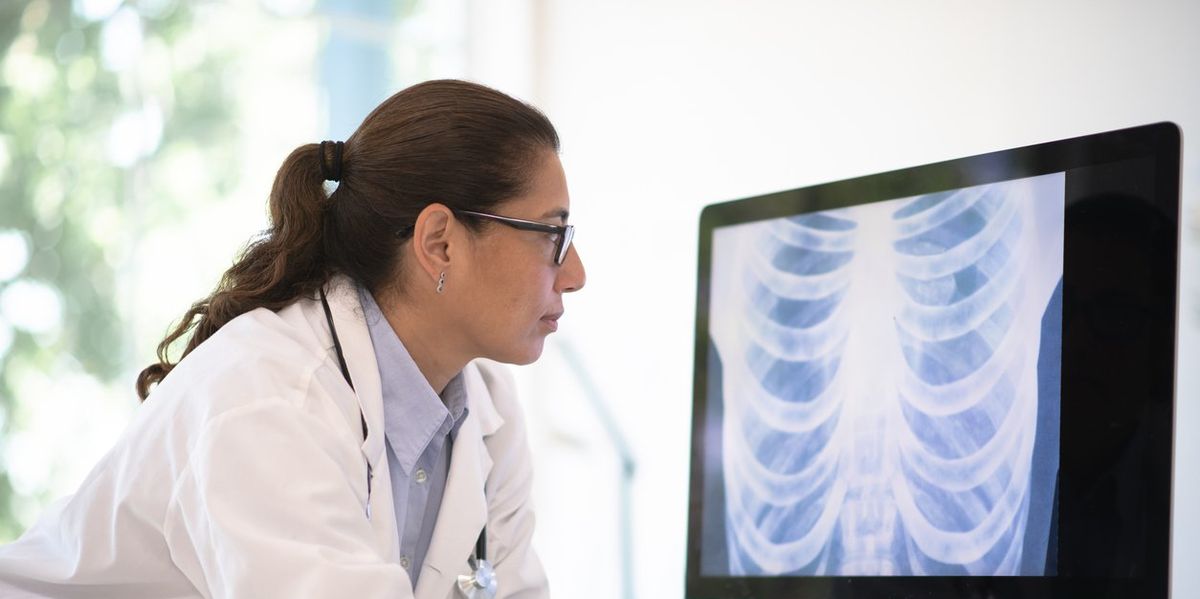
In the past, screening for lung cancer was done using a chest X-ray, which takes a picture of the bones and organs of the chest. But now, research has shown that screening using low-dose computed tomography (LDCT) is more effective.
An LDCT uses small amounts of radiation to take detailed pictures of the chest using an X-ray machine. These pictures are taken in a spiral path around the body, which is why this procedure is also called a spiral scan.
The National Lung Screening Trial looked at people between the ages of 55 and 74 who had smoked one pack of cigarettes a day for at least 30 years. The study participants were either currently smoking or had quit within the last 15 years. Researchers used either chest X-rays or LDCT scans to screen for lung cancer. They found that using LDCT scans annually for three years revealed lung cancer in its early stages better than chest X-rays. These scans also lowered the risk of dying from lung cancer in current and past heavy smokers.
The Centers for Disease Control and Prevention (CDC) say up to 1 in 5 people in the U.S. who’ve never smoked still get lung cancer.
Despite this, the USPSTF only recommends lung cancer screening for those who are at high risk: those who are 50 years and older, and smoke or have smoked. This is because the possible harms of screening, such as additional testing for false alarms, can outweigh the minimal benefit of finding early cancer in this group.
The American Lung Association says there isn’t enough evidence to say if screening tools would be useful for those who are non-smokers. But research is always changing and so are screening guidelines.
In 2022, Medicare expanded its coverage screening for those who are ages 50 to 77 and have a 20-pack-year smoking history, and currently smoke or have quit within the last 15 years. You also have to have no signs or symptoms of lung cancer.
Most private insurance plans and Medicaid expansion plans are required to follow the new 2022 guidelines as well. Check with your individual insurance plan to find out if you’re eligible. You shouldn’t have to pay for any screening as long as you meet the criteria, but your insurance may tell you what facilities you can go to for screening.
This educational resource was created with support from Merck.
From Your Site Articles
Related Articles Around the Web
Those few minutes alone may seem like the perfect time to catch up on social media, er, the latest news. But all that swiping can lead to more time spent sitting on the toilet. And that can lead to hemorrhoids — painful, swollen veins or blood vessels in and around your anus and lower rectum.
Hemorrhoids sound scary — nevermind the fact that the name is just one “r” short of “horror” — but the condition is not life threatening. However, the pain caused by hemorrhoids can be severe and have a major impact on your quality of life.
Although everyone has these same blood vessels and veins, we associate hemorrhoids, technically symptomatic hemorrhoids, with the inflamed, painful and/or itchy condition that can leave you bleeding from your backside.
For this reason, it’s no surprise that hemorrhoids aren’t the most popular topic of discussion, but they are very common. At least half of adults in the U.S. have experienced symptoms at one time or another. Women usually get hemorrhoids during pregnancy and childbirth when there’s more pressure from the growing uterus on the anal area.
Pressure is the main cause of hemorrhoids. But most of us aren’t scrolling through our phones on the throne thinking about rectum pressure. Or maybe you did see the viral TikTok video about the dangers of too much toilet time and hemorrhoids. Either way, we haven’t scared you off, so here’s more on what you need to know about hemorrhoids and self-care remedies that may help prevent and treat hemorrhoids.
Read: Is It Hemorrhoids or Something Worse? >>
Hemorrhoids are caused by pressure. In addition to sitting too long on the toilet and pregnancy, straining to poop can cause hemorrhoids. Anal sex, chronic diarrhea and obesity may also cause hemorrhoids.
To understand hemorrhoids and self-care options, you have to know the types. There are two types of hemorrhoids:
External hemorrhoids can be itchy and painful especially if a blood clot forms. This can cause a painful mass and may bleed. Internal hemorrhoids are usually painless and the most common symptom is rectal bleeding. Internal hemorrhoids can be very painful if prolapse occurs (when the hemorrhoid bulges out of the anus and can’t be pushed back in). External hemorrhoids can also prolapse.
Read: My Symptoms Were Dismissed as Hemorrhoids, but I Had Colon Cancer >>
Research is ongoing as to what causes hemorrhoids, but many people can prevent complications and reduce symptoms through lifestyle choices. These can include:
Another idea is to try a toilet stool like the Squatty Potty. Sure, it’s fun to say, but it’s also backed by research that shows pooping in a squat-like position can mean less straining while you go. And that can mean less risk for hemorrhoids.
Luckily, many people can treat symptoms of hemorrhoids at home. Remedies may include:
In addition to these options, eat a high fiber diet and use stool softeners if you’re straining when you poop. Symptoms should get better within a week. If you’re still having pain or bleeding, contact your healthcare provider (HCP). You may want to consider a minimally invasive procedure or surgical removal of the hemorrhoid.
Your HCP is the first stop if you think you’re having symptoms of hemorrhoids. During the visit, your HCP will look for external hemorrhoids that are easy to see and/or perform a digital examination to feel for anything abnormal in your rectum. If needed, your HCP may refer you to a specialist including a gastroenterologist or a surgeon if you need a procedure.
Although bleeding during bowel movements is linked to hemorrhoids, it could be a sign of something more serious such as anal or colon cancer. This is especially important to note for women. Colorectal cancer is the second deadliest cancer among women under 50. And rates of colorectal cancer are on the rise. If you notice blood before, during or after you poop, don’t assume that it’s because of a hemorrhoid. Talk to your HCP as soon as possible.
Read: The Connection Between Young Adults and Colon Cancer >>
Talking about your butt can be awkward. But it helps to remember that hemorrhoids are very common and you probably won’t be the first person talking to your HCP about hemorrhoids that day. It always helps to write down your symptoms, if you’ve tried any at-home treatments and if you’ve noticed any changes in your bowel movements.
Hemorrhoids can be a real pain in the butt. But you have options.
From Your Site Articles
Related Articles Around the Web
Katie Laura Burnett is a 35 year old fitness competitor and model from England. She also works as Sports Massage Therapist at The Devils Kneads.
She has been going to gym from the young age of 12, participating in school sports including gymnastics, trampolining and kickboxing. Now she trains weights, Cardio twice a week apart from preparation for fitness competition. She has been model for 12 years, an Ex- Engineer, current dancer &Sensorimotor training (SMT) intervention exercises proponent. She has been published in a number of magazines over the years, last few are, gothic girl cover, fuse, skyn and FHM uk.
Women Fitness President Ms. Namita Nayyar catches up with Katie Laura Burnett, exceptionally talented fitness competitor and model to talk about her fitness routine, diet, and success story.
Where were you born and had your early education? Later you decided to pursue fitness modelling and competitive bodybuilding. This later propelled your career to the height where you are a leading PCA (Physical Culture Association) Bikini Bodybuilding Competition winner. Tell us more about your professional journey of exceptional hard work, tenacity, and endurance.
I was born South UK Portsmouth and have continued to live in Hampshire ever since. I was very lucky to be brought up in the countryside; my childhood was mainly spent in fields and woods around nature/ animals. My interest in fitness and modeling was present throughout; I wasn’t brought up to be lazy. I went to school and college, then qualified as an engineer and worked for the MOD for 5 years building boats, then I moved on to Sports Massage Therapy/ own my own business. Unfortunately, I don’t have any secrets to share about hard work you want something and will work for it or you won’t. I take pride in what I do; the same goes for fitness and bodybuilding.
In the life of a model getting featured in FHM Magazine is a lifetime dream come true. You were featured INSIDE FHM UK November 2022 edition. Tell us more about this spectacular achievement in your career and experience of working with Iconic FHM magazine.
It was a great moment to be accepted for publication in FHM. With any publication I am extremely grateful. I have had a few publications and interviews with several magazines and websites over the years and I am proud of every single one. To have a record of my improvements over the years is great and to know that I can inspire others is the best feeling.

You started fitness competing in November 2023. In the category Bikini Tall, First Timers in Hull won 3rd place in the PCA (Physical Culture Association) Worlds Finals. Tell us more about this win and how it has been a catalyst in your meteoric rise in the field of competitive bodybuilding.
Competing in bodybuilding is something I have always been told to do, probably because my natural body fat is low, but this makes building muscle and strength harder, so I never thought if I did compete that I would even be competitive… After about 10 years of watching it change and grow I thought why not, let’s see what happens, I’m not afraid of losing…. So I decided 8 weeks out to see what I could do. Coming third was a shock I remember looking down subtly to check my number whilst walking to the front. I was in the first callout (first half group) so I knew I was in the top half of 14 girls so I was happy at this point. The trophy was the icing on the cake.
However, I didn’t feel competitive up there, I just enjoyed it. I’m long past the stage of needing to beat others, it was to do well for myself and see what I can do and how I can display a physique I have carried through 34 years of life at this point. For me it’s not about beating others and I doubt it ever will be. At shows you’re only placed on how people look, perform and show up on the day. You could be against pros or first timers. Every show I have done I have looked back at photos and have seen improvements each time, whether that’s posing, stage presence, individual routine, overall look, but it is noteworthy that the placing’swon’t always reflect these factors, these are personal. You have to understand the difference.
Full Interview is Continued on Next Page
This interview is exclusive and taken by Namita Nayyar President of womenfitness.net and should not be reproduced, copied, or hosted in part or full anywhere without express permission.
All Written Content Copyright © 2024 Women Fitness
Disclaimer
The Content is not intended to be a substitute for professional medical advice, diagnosis, or treatment. Always seek the advice of your physician or other qualified health provider with any questions you may have regarding a medical condition.
Your hairstyle is more than just a frame for your face—it can beautifully accentuate your entire silhouette. Understanding how different hairstyles interact with various body shapes can help you choose a look that enhances your natural proportions and boosts your confidence.
Explore flattering hairstyles for hourglass, pear, apple, rectangle, and inverted triangle body types, to help you find the perfect match for your unique shape.
The hourglass figure, characterized by a balanced bust and hips with a defined waist, is versatile for different hairstyles.
For pear shapes, where hips are wider than shoulders, the goal is to create balance by adding volume up top.

Apple shapes carry weight around the middle and often have great legs. The aim is to elongate the face and neck.
Rectangle shapes have similar measurements for shoulders, waist, and hips. The goal is to create the illusion of curves.
This shape features broad shoulders tapering to narrower hips. The aim is to balance the upper body.
While these guidelines offer a great starting point, remember that the best hairstyle is one that, makes you feel confident, and the best version of you. Your personal style, hair texture, face shape, and lifestyle should be a deciding factor. Don’t be afraid to experiment with different looks and consult a professional stylist who can tailor these suggestions to your unique features.
The perfect hairstyle enhances your natural beauty and allows your personality to shine through. Whether you’re an hourglass, pear, apple, rectangle, or inverted triangle, there’s a fantastic hairstyle waiting to complement your body shape and boost your confidence. Embrace your unique proportions and let your hair be the crowning glory of your style. Hair and makeup are part of making the illusion of you looking and feeling like the beautiful and confident woman you are.
About the Author:
Christina Flach is a celebrity hair and makeup artist based in the San Francisco Bay Area. After starting her career in 1995, she founded her makeup line, Pretty Girl Makeup, and has acquired much notable clientele. She has worked with many major television networks, celebrities, designers, department stores, magazines, and big-name brands. She is an expert at creating looks that allow her clients’ natural beauty to shine through by making every client feel like the best version of themselves on the inside and the outside. In addition to her career as a makeup artist, Christina is a philanthropist, a beauty expert on NBC’s CA Live, and a guest on podcasts. Visit: www.Christinaflach.com
Disclaimer
The Content is not intended to be a substitute for professional medical advice, diagnosis, or treatment. Always seek the advice of your physician or other qualified health provider with any questions you may have regarding a medical condition.
Maybe the closest you get to yoga is wearing a comfy pair of yoga pants, or if you’re like I used to be, perhaps you think your temperament isn’t quite Zen enough for it, but the myriad of health benefits this ancient practice offers are difficult to ignore. The good news is whether your health goals aim to increase your flexibility, sleep more restfully, improve your balance, reduce stress and inflammation or even ease arthritis symptoms and back pain, adding yoga to your daily routine can quite literally put you in the right position to accomplish them.
The better news is incorporating more yoga into your days is easy with tips for even a beginner curated from yoga professionals.
In addition to being a Registered Yoga Teacher, Mandy is also a worksite wellness dietitian and author of 30-Minute Weight Loss Cookbook: 100+ Quick and Easy Recipes for Sustainable Weight Loss: You can learn more about Mandy at The FOOD + MOVEMVENT® Dietitian and you can find her at @mandyenrightRD on Instagram, LinkedIn, TikTok, and YouTube.
Disclaimer
The Content is not intended to be a substitute for professional medical advice, diagnosis, or treatment. Always seek the advice of your physician or other qualified health provider with any questions you may have regarding a medical condition.
A study done by the Centers for Disease Control and Prevention (CDC) highlights the unequal impact of HIV on the transgender community in the United States. HIV prevalence among transgender women is 14.1%, 3.2% for transgender men, and 9.2% for transgender people overall. In comparison, it’s estimated that the HIV rate for U.S. adults overall is less than 0.5%.
Worldwide, the numbers are even more startling: One analysis across 15 countries found that transgender women are 49 times more likely to have HIV compared to the general population.
Why is the risk so high for transgender women?
“When we think about risk factors, we often think about individual-level risk,” said Asa Radix, M.D., Ph.D., MPH, senior director of research and education at Callen-Lorde Community Health Center in New York City, clinical professor at NYU Langone and a clinical ambassador for the CDC. “I think it’s really important to reframe that a little bit when we’re talking about HIV because this is often related to structural issues, not only individual-level issues.”
Structural inequalities are when policies keep certain groups of people from having equal access to resources. The statistics are overwhelming when it comes to the results of these inequalities for the transgender community in the U.S.:
The impact of these structural issues are even greater on Black and Hispanic people. One CDC study of seven U.S. cities found that 62% of Black trans women and 35% of Hispanic/Latina trans women surveyed had HIV—compared to 17% of white trans women.
“If you think about all of these social determinants of health, it’s very clear that if you are homeless without an education, without a possibility of employment or a house to live in, your risk for HIV is going to increase,” Radix said.
Read: Social Determinants of Health, Health Disparities and Health Equity >>
With fewer options for jobs, Radix explained, trans women may turn to sex work to make ends meet, skyrocketing their risk of HIV exposure. One study published in 2023 found that 41.8% of trans women reported having engaged in sex work, saying they were motivated to do so for “better pay” and being unable to “get a job due to gender discrimination.”
On top of structural inequalities, transgender women often experience high levels of family rejection, stigma and discrimination, which can lead to high levels of anxiety and depression. Radix explained that people may try to alleviate their anxiety and depression by engaging in risky behaviors, such as injection drug use or sharing needles. All of these challenges can result in poorer health outcomes by themselves, and when individual-level and structural inequalities are combined, the negative effects are compounded.
With these higher risk factors, access to healthcare is extremely important. But 24 states currently restrict gender-affirming care in some way, lawmakers in at least 10 states are proposing to restrict transgender access to public services, and it’s legal in several states for healthcare providers to refuse to treat LGBTQ patients. All of this makes it difficult for trans people to find healthcare providers (HCPs) they can have open and honest dialogue with — or even disclose that they are trans in the first place.
The 2022 U.S. Trans Survey found that almost 1 in 4 respondents from the trans community did not see a doctor when they needed to in the year prior to the survey because they feared being mistreated. And of those who did see doctors, almost half reported having a bad experience because they were transgender, including being refused healthcare, being misgendered, or having a provider be verbally or physically abusive.
Read: What’s Sexual Orientation Got to Do With It? LGBTQ People Face Discrimination in Healthcare >>
Pre-exposure prophylaxis, also called PrEP, is medication that reduces the risk of getting HIV from sex by 99%. And it reduces HIV from needle exposure by 74%. But in order to be effective, it must be taken consistently. PrEP is only available with a prescription from an HCP. In a yet-to-be-published study Radix is working on, preliminary findings show that less than 15% of trans women are currently on PrEP. For trans men, the number drops to less than 6%.
“Lack of access to healthcare — which can be lack of insurance because they didn’t have a job, or feeling uncomfortable walking into a provider’s office — means that you don’t get that access to PrEP,” Radix said. “We know that PrEP is probably the most important intervention to reduce HIV, but we are not at a place right now where you can just walk into a store and get PrEP off the shelf.”
Even when transgender people do go to their healthcare provider, the burden may be on them to ask about PrEP rather than their provider initiating the conversation, which can be another roadblock.
Watch: No HIV for Me: Protect Yourself from HIV with PrEP and PEP >>
“Some providers get very uncomfortable asking trans people about their sexual health because they don’t often know what words to use, or they make many assumptions about who people’s sexual partners are,” Radix said. “We see that a lot with transmasculine folk. People just assume that their partners are going to be cisgender women [people whose gender identity matches their sex assigned at birth]. They don’t think to ask them if they are having sex with someone who has a penis, which would put them at higher risk [of HIV].”
While there have been a wealth of studies looking overall at the LGBTQ community and HIV, they often present an incomplete picture because of missing data or misconceptions about gender, sex and identity.
At their clinic, for example, Radix says they found an HIV prevalence of 2.8% among transmasculine people. But when they looked specifically at transgender men who have sex with cisgender men, the HIV infection rate jumped to 11%.
From Your Site Articles
Related Articles Around the Web
When you think of sex addiction, do Hank Moody from Californication or Brenda Chenoweth from Six Feet Under come to mind? How about David Duchovny, who not only played Hank Moody but eventually admitted to his own personal sex addiction? Or Jada Pinkett Smith who admitted that she had battled sex addiction? There are a lot of pop culture and media portrayals of people who well, let’s just say, they’re addicted to love.
But how realistic is the information we’re getting — and is there really such a thing as sex addiction?
“Sex addiction,” also known as compulsive sexual behavior or hypersexuality, is an overwhelming and uncontrollable urge to engage in sexual activities. This can include a wide range of behaviors ranging from excessive masturbation and watching porn to engaging in cybersex or having multiple sexual partners — even when they might be in committed relationships with someone else.
The key element that defines this condition is being unable to control your urges despite these actions harming your personal, professional and/or social life. People with sex addiction often find themselves in a cycle of craving, engaging in the behavior and experiencing guilt or shame afterward, only to repeat the process. This compulsive nature can interfere significantly with daily functioning and overall well-being.
Despite the popularity of the term sex addiction in the media, it’s important to note that it’s not an officially recognized medical term. And it does not appear in any of the standard manuals used to diagnose and treat medical and mental health disorders, including the Diagnostic and Statistical Manual of Mental Disorders (DSM).
There are several valid reasons for its exclusion, including:
1. There’s not enough research to suggest that the disorder manifests the same way as other addictions (e.g., alcoholism).
2. There’s a high chance of individuals being misdiagnosed due to bias. In other words, a more conservative therapist or physician may be more likely to diagnose someone with a sex addiction compared to a more progressive therapist or physician.
3. There’s concern that its inclusion would impact sentencing for sex crimes. In other words, it may make it easier to get reduced sentencing or an innocent conviction if someone can claim they suffer from sex addiction.
4. Most importantly, sexuality cannot be separated from morals and cultural norms. If we were to include sex addiction in the diagnosis manual, we’d run a risk of pathologizing sexual behavior that others deem completely healthy.
That being said, the World Health Organization does recognize compulsive sexual behavior as a mental health condition — and there is no doubt that many people struggle with sexuality in a way that feels compulsive. There are many reasons why you may be likely to experience out of control sexual behaviors.
1. Biological factors: Research suggests that there may be a genetic predisposition to addictive behaviors. Additionally, imbalances in brain chemicals such as dopamine, which is associated with pleasure and reward, can contribute to the development of compulsive sexual behavior.
2. Psychological factors: Mental health conditions like anxiety, depression and obsessive-compulsive disorder (OCD) are often linked to sexual compulsiveness. Individuals may use sex as a way to cope with these underlying issues, seeking temporary relief from emotional pain or stress.
3. Social factors: Early exposure to sexual content, experiences of sexual abuse or growing up in an environment where sex was either taboo or overly permissive, can also play a role. Social and cultural attitudes toward sex can influence an individual’s behavior and perception of what is considered normal or acceptable.
Identifying compulsive sexuality can be challenging because sexual behavior varies widely from person to person. However, there are specific signs and symptoms that may indicate there’s a problem:
If you or someone you know is struggling with out-of-control sexual behavior, it’s important to find a well-trained therapist (and know how to avoid seeing someone who may do more harm than good).
There are several popular “sex addiction” treatment options available, but it’s worth taking a look back at the fourth reason I listed for “sex addiction” being excluded from medical texts — morality. Research shows that 12-step programs or abstinence-based sex “addiction” treatment tends to do more harm than good. Since we don’t have enough evidence to suggest that compulsive sexual behavior should be thought of in the same way as a substance addiction, it shouldn’t be treated like a substance addiction. You can die from drinking too much alcohol. You can’t die from having too much sex. This is where the moral debate comes in.
There’s an emerging area of research looking at the intersection of perceived sex “addiction” and morality. These studies suggest that people are far more likely to label themselves with an addiction if their behavior falls outside their moral compass. If I had a nickel for every client I saw who labeled themselves (or was labeled by their partner) as a sex addict for having an affair or looking at porn, I’d be rich!
Any treatment provider who claims to treat sex “addiction” should be considered with caution. Instead, look for therapists who treat compulsive sexual behavior or out of control sexual behavior and can work with you to examine how your behavior may or may not fit with your moral values. Sometimes it’s worth reexamining moral values to see how changing them can help you feel better about your sexual choices.
Therapists who can assess whether treating underlying trauma, anxiety or relationship issues that can set someone up to experience sexuality in a way that feels out of control offer a more holistic approach.
Human sexuality is complex. In general, society is moving toward acceptance of a wider range of sexuality. By fostering a compassionate and informed approach, we can better support people who are struggling with compulsive sexual behavior and create an environment where recovery is possible. Understanding, empathy and access to appropriate resources are key to helping those affected regain control over their lives and build healthier, more fulfilling futures.
From Your Site Articles
Related Articles Around the Web