The main category of Fitness News.
You can use the search box below to find what you need.
[wd_asp id=1]
The main category of Fitness News.
You can use the search box below to find what you need.
[wd_asp id=1]
Doctors and pharmacists can warn consumers of the side effects of drugs and explain how to use them, but medical experts still rely on consumers to make their own judgments when taking health supplements, which may lead to safety risks.
TOKYO, April 3 (Xinhua) — In the past two weeks, Japan reported several deaths and over a hundred hospitalizations due to kidney diseases after taking red yeast rice supplements, known as “beni-koji” manufactured by Kobayashi Pharmaceutical, flaming concerns both at home and abroad about the safety of health supplements.
As of Friday, the Osaka-based drugmaker’s “beni-koji” product has been associated with five deaths and 114 hospitalizations, with nearly 700 others seeking medical treatment or planning to do so.
While the growing health scare suggested potential hazards in Japan’s functional food labeling system and technical defects in the manufacturing process of red yeast rice as an ingredient, experts also cautioned consumers not to panic over products containing the ingredient.
REGULATORY LOOPHOLES
Health supplements, commonly called “functional foods” in Japan, were previously categorized into Food for Specified Health Uses and Food with Nutrient Function Claims. In 2015, the Japanese Consumer Affairs Agency (CAA) started a new labeling system for food functional ingredients called Food with Function Claims.
Manufacturers of such foods only need to submit scientific evidence supporting their claimed functionality to the consumer watchdog for registration before marketing, without the need to get approval from Japanese government agencies.
The lenient regulatory mechanism may lead to negligence in safety inspections by various parties involved. In a recent article, the national news agency Kyodo said that Kobayashi Pharmaceutical’s growing scandal over its red yeast supplements has reignited debate over Japan’s “functional food” labels, which have been criticized for years over the lack of sufficient scientific proof of safety and efficacy.
Citing a gap of over two months between the earliest reports of health issues received by Kobayashi Pharmaceutical and its product recalls, Keizo Takemi, Japan’s minister of health, labor and welfare, told a press conference that it was “regrettable” that the company did not provide relevant information to the government during the period.
Following the reports, the CAA announced plans to conduct an emergency inspection of over 6,000 functional foods.
Hidetoshi Tashiro, chief economist at Japan’s Sigma Capital Ltd., told Xinhua that Kobayashi Pharmaceutical’s food safety crisis also revealed organizational problems within the company.
Tashiro said the drugmaker, as a typical Japanese family-owned enterprise, might prioritize family interests over customer interests in decision-making. Its failure to conduct immediate measures or report to authorities about health damage reports has exacerbated the crisis.

MANUFACTURING DEFECTS
Kobayashi Pharmaceutical announced on March 22 that some people who took the supplements had experienced symptoms that often show in kidney diseases.
After analyzing its red yeast rice supplements and the red yeast raw materials used, the company suspects an “unintended substance” derived from mold may have caused the problems but is unable to ascertain a specific cause.
The health ministry said this Friday that Kobayashi Pharmaceutical has confirmed the presence of “puberulic acid” in the products involved. Puberulic acid is a highly toxic chemical compound derived from blue mold.
According to Kyodo, the drugmaker believes that the compound may be the ingredient in question and will verify it through Japan’s National Institute of Health Sciences and other institutions.
Shentu Yinhong, an expert at the China Association of Traditional Chinese Medicine, said that after drugs and health supplements are put on sale, companies must conduct strict monitoring, which includes but is by no means limited to reporting adverse reactions.
“It is reported that the batch of products in question also used a variety of additives during the tableting process. Kobayashi Pharmaceutical has yet to clarify whether these additives will cause adverse reactions, at least until now,” said the expert.
PANIC UNNECESSARY
Despite the incident, experts say there is no need to worry about the safety of other products containing Monascus purpureus, a mold species used to produce the “beni-koji.”
Under normal circumstances, it is hard to imagine that Monascus would produce harmful substances, and there is no need to worry about the safety of normal Monascus, said Hideaki Taraki, an honorary professor at the University of Tokyo who has been engaged in food-safety-related work for many years.
Shentu also said that a Japanese company’s individual quality problem does not mean that the safety of other red yeast rice products is in question.
However, experts warned that health supplements, which are tablets or capsules made of concentrated functional ingredients, can not be used as medication. If they contain harmful ingredients, they may pose greater health risks as consumers tend to take a large amount of them for a long time.
Doctors and pharmacists can warn consumers of the side effects of drugs and explain how to use them, but medical experts still rely on consumers to make their own judgments when taking health supplements, which may lead to safety risks. ■
Chinese consumers are urged to stop taking health supplements made by a Japanese pharmaceutical company that is recently mired in allegations over its product’s link to kidney diseases and five deaths, said the China Consumers Association.
Media reports have emerged about a week ago saying that three dietary supplements made by Japanese drugmaker Kobayashi Pharmaceutical were suspected of causing kidney failure.
As of Thursday evening, the company reported five related deaths and more than 100 hospitalizations in Japan. The problematic supplements all contain beni koji, or red yeast rice, which is marketed as helping lower cholesterol levels.
The company said on Friday that puberulic acid — a toxic substance generated from blue mold — likely caused the health hazard.
The China Consumers Association said in a statement on Friday that the three products in question are not sold on the Chinese mainland, but shoppers can make purchases through online shopping websites and offline stores overseas, as well as daigou — agents who make purchases overseas and resell them to Chinese customers.
“Please immediately stop taking these products and contact customer service of Kobayashi,” it said. “Those who bought these products via cross-border e-commerce platforms can return products and request a refund through those websites.”
“Consumers who have already taken these supplements should closely monitor their health condition and information released by Kobayashi. If feeling unwell, please visit the hospital promptly and contact the company’s service center to protect your legal rights,” it said.
The association also called for making rational purchases of health supplements and staying vigilant against fake and exaggerated advertising.
On Monday, the company said that it has set up a reception center for handling return and refund requests, and customers can reach out through phones or online channels.
Japanese health officials had so far inspected two factories manufacturing these supplements, the national broadcaster NHK reported. Kobayashi Pharmaceutical, founded in 1886, produces a wide range of products from dietary supplements and healthcare products to home cleaning supplies.
It established its first joint venture company on the mainland in 1995. The company said that its best-selling products on the mainland are body warmers, fever cooling sheets, and pain relief roll-ons that are readily available at convenience stores and online shopping sites in China.
Thanks to the rise of e-commerce platforms and shopping agents, as well as the increasing convenience of international tourism, a wider variety of its products have become available to Chinese customers.
The company’s flagship shopping platform and retailers on the e-commerce platform Taobao sell healthcare products for lowering blood sugar, improving eye health, and protecting the liver after drinking alcohol.
According to the company’s annual report in 2019, sales to Chinese visitors in China accounted for 69 percent of the total. And sales of over-the-counter pharmaceuticals took up 60 percent of the total sales to foreign visitors.
The pharmacy department of the Chinese Academy of Medical Sciences’ hematology hospital said in an article released on Monday that whether the toxic substance in the company’s products stems from the fermentation process of raw materials or other manufacturing factors remains unknown. It added that domestic medicines containing red yeast rice that are used to help treat patients with high cholesterol levels are safe.
For instance, the firm has worked with HADABISEI, a brand under cosmetics company Kracie Group, to develop a range of functional beverages called Supervised by HADABISEI.
Each product from this series is added with 100mg of gamma-aminobutyric acid (GABA), an ingredient that DyDo claims to have several functions that “support the health needs of women in a variety of situations”.
“GABA helps maintain skin elasticity and has a protective effect for those who are concerned about dry skin. It also temporarily relieves stress and fatigue caused by office work and housework, making one feel more positive, lively and motivated. Furthermore, it can help improve sleep quality,” the firm said.
Based on its in-house survey conducted among women aged between 20s and 60s in March 2023, it was found that consumers are not only increasingly health-conscious, but their perceptions of health are also shifting.
“From negative notions like ‘health equals to perseverance and pushing limits’, people have begun to adopt more positive perceptions, such as recognising the importance of both physical and mental health, and how ‘being healthy every day leads to happiness’.”
Another survey held last September showed that more than half the respondents (women in their 30s to 40s) have increased the frequency of “removing mask when going out” and “going and dining out” in the post-pandemic era.
Consequently, 38% of them stated that they are concerned about their skin condition, with skin care receiving more attention than body shape, slimming and exercise.
The Supervised by HADABISEI range is DyDo’s response to these changing needs.
The first product from this series, Hatomugi Blend Tea, debuted on December 25 last year. Two new flavours, namely Gyokuro Green Tea Plus and Darjeeling Black Tea Unsweetened, were recently launched on March 4.
Made with green tea, hojicha, oolong tea, corn, and two types of pearl barley, Hatomugi Blend Tea is said to be a well-balanced drink that exudes the aroma of pearl barley, subtle sweetness of corn, and richness of tea.
Gyokuro Green Tea Plus is composed of seven types of green tea leaves that underwent different degrees of roasting and steaming to achieve a deep flavour, while Darjeeling Black Tea Unsweetened is produced from 100% Darjeeling black tea leaves for a highly fragrant and refreshing taste.
“By adding functional benefits, we have transformed the products into something that is easier for consumers to understand and choose than ever before.”
Additionally, DyDo has released two new products under the “Wanochikara” brand on March 11.
It is the company’s first full-fledged health drinks brand that aims to make up for the nutrients lacking in the Japanese diet.
“We believe that living a long and fulfilling life is only possible if you lead a healthy lifestyle. We launched Wanochikara in 2022 to provide an easy and delicious way to replenish nutrients that are difficult to obtain in modern Japanese food.
“Due to westernisation of the locals’ diet, the intake of various nutrients has become insufficient compared to the past, according to the 2019 National Health and Nutrition Survey and the ‘Dietary Reference Intakes for Japanese (2020)’ report. Among these, we focused on magnesium and vitamin D.”
Magnesium is mainly ingested from seaweed and seafood, but data from Japan’s Ministry of Health, Labour and Welfare indicated that the consumption of these has decreased significantly from 2001 to 2019 among people aged 20 and above.
In fact, the intake of magnesium is strikingly lower than the recommended amount.
Recognising this gap, Wanochikara’s newly introduced Organic Lemon Carbonated Water is made with 100mg of magnesium, 0.7mg of vitamin B6, and maltobionic acid.
The other new product, Seasonal Yuzu Carbonated Water, contains 13.5μg of vitamin D as well as vitamin C.
The amount of nutrients incorporated are based on Tohoku University Graduate School of Agriculture’s recommendations to the firm.
“Some people are barely getting enough vitamin D from their diet, as data shows that the consumption of seafood is decreasing year by year. Moreover, due to the effects of sunscreen, the synthesis of vitamin D from sunlight tends to be insufficient.”
Asthma treatments fall into two main categories:
For people with allergies that trigger their asthma symptoms, allergy medicines can also help.
Common medicines, such as corticosteroids, reduce inflammation in the airways. Newer drugs called “biologics” are made with cells from living organisms and interfere with inflammation in the first place.
Read: You Don’t Have to Live With Uncontrolled Asthma >>
Depending on your insurance coverage, the drugs you need can be easier (and cheaper) or harder (and more expensive) to get. Make sure you understand what asthma care your health insurance covers.
Whether you get your health insurance through a job or a government program, here’s what to look for when you’re choosing a plan.
1. Does the provider network include a range of asthma specialists?
Check the plan’s provider directory to make sure your healthcare providers (HCPs) participate in the health plan’s network. Even if you don’t see an asthma specialist today, you might need to in the future. Make sure the plan offers a range of specialists available.
2. Are the asthma drugs you need covered?
It may seem like a simple question, but whether your health insurance covers a specific medication can be complicated to answer. The first step is to check the preferred drug list (PDL) or “formulary,” the list of drugs that your health plan covers.
If the drug is on that list, that’s not the end of the story. Even covered medicines can be subject to rules such as prior authorization. That means you may have to get permission from your health plan before they’ll pay for the drug. If they deny your request, you can appeal. You might win, but there’s no guarantee.
3. How do health plans decide which medications are covered?
Most health plans pay a separate company to manage their drug benefits. Those companies are called pharmacy benefit managers (PBMs). PBMs decide which drugs go on the PDL. Coverage decisions may be based on data about cost, effectiveness, available alternatives (if any), and generally accepted treatment guidelines.
PBMs also negotiate drug prices with drug makers and pharmacies, decide what patient copayments or other costs should apply, and set rules for access to specific drugs. PBMs sometimes manage specialty or mail-order pharmacies that health plan members are encouraged (or forced) to use.
4. What is the process for getting coverage for your medicine?
If your health plan requires prior authorization for your medicine, you’ll have to get their permission before they’ll pay for it. The process to get that permission can be confusing. Usually, the HCP who prescribed the medicine will help. They’ll need to fill out a form and explain their reasoning for prescribing that medication for you. The health plan may follow up with the HCP for more information.
If the health plan denies your request, you usually have the right to appeal. The plan has to give you information about how to file an appeal. Again, your HCP or their office may help. The appeal may include more details from you and/or your HCP about why the medicine is necessary for you. Your HCP may need to show how the treatment fits within standard treatment guidelines, or why you need something different.
Sometimes you have the right to more than one level of appeal. You may be entitled to ask an external reviewer to look at your health plan’s decision and consider overturning it.
Plan-specific and state rules vary. Check your member handbook or ask the health plan customer service for step-by-step instructions for submitting a prior authorization request, and if necessary, an appeal. Your state’s insurance commission may help if you get stuck.
5. If your medicines are covered, how much will they cost you?
For covered medicines, you usually have to pay a copayment, a set fee every time you fill a prescription. The amount of that copayment can depend. For example, there are usually different copayments or other costs for drugs depending on how the plan categorizes them, called “tiers.” Tier 1 drugs might have the lowest copayments and fewest restrictions. Higher-tier drugs may cost you more and may come with more rules or hurdles.
Specific drugs may also be considered “preferred” or “non-preferred,” which may influence how much the drug costs you and how easy it is to get. The PDL should include these designations, if applicable.
In addition to copayments, other factors can affect your costs. If you have a deductible, you’ll have to pay the full drug cost until you meet the deductible.
Your health plan may also have a cap on the total you pay out of pocket each year, called an “out-of-pocket maximum.” If you reach that cap, you won’t have to pay any more copayments. But check the details — these caps may not kick in until you’ve paid many thousands of dollars.
6. What’s the policy on covering new treatments as they become available?
When you’re looking at health insurance options, check the policy for covering new treatments when they become available. You can’t know for sure what future drugs your health plan will cover, but you can at least read their policy about how they decide which ones to cover. Ask the customer service team for that policy if you can’t find it easily.
You can also search health plan ratings to see how other people rate the plan, specifically on how easy it is to access needed care. Though it won’t predict what your specific experience will be, it can give you a sense of how other people feel about the plan’s coverage policies.
7. What is a specialty pharmacy?
Some medicines aren’t available through a typical retail or mail-order pharmacy. Medicines that aren’t used very often, need special handling, get injected or infused, or require special follow-up may only be available from a specialty pharmacy.
Specialty drugs may be more restricted and costly. You may have to follow specific rules or procedures to get them. Some asthma medications fall into this category.
Read your health plan documents for information about how to get specialty drugs if you need them. Your insurer may require you to use their preferred specialty pharmacy.
This educational resource was created with support from Amgen, a HealthyWomen Corporate Advisory Council member.
From Your Site Articles
Related Articles Around the Web
Japan’s “functional food labeling” system is facing public backlash after a health supplement recall linked to five deaths and over 100 illnesses has been criticized for undermining food safety management.
The Osaka-based Kobayashi Pharmaceutical has recalled multiple products, including the “Beni-koji choleste-help” supplement, marketed for cholesterol reduction, after its dietary supplements containing red yeast rice, or “beni-koji,” were potentially linked to adverse health events.
Reports have emerged of five deaths and more than 100 hospitalizations related to these products, with nearly 700 individuals either seeking or intending to seek medical consultation as of last Friday.
This incident has raised significant concerns among the Japanese public over the country’s classification of health-functional foods, particularly the labeling system introduced in 2015, suggesting it may favor corporate profits at the expense of consumer safety.
Before 2015, Japan categorized health-functional foods into two main groups: “Foods for Specified Health Uses” and “Nutrition Function Foods.”
In 2015, the Consumer Affairs Agency (CAA) of Japan launched the “Foods with Function Claims” (FFC) labeling initiative.
This new system permits companies like Kobayashi Pharmaceutical to independently evaluate and document the health benefits and functional attributes of their products prior to marketing, bypassing the need for approval from Japanese government authorities.
“The ‘functional labeling food’ by Kobayashi Pharmaceutical only requires submitting documents for registration, allowing the company to self-verify safety. This lacks objectivity and harbors risks. Health food should benefit the body. But if the ingredients are vague, without thorough investigation and analysis, similar issues could arise,” said a Tokyo resident.
Another Tokyo resident criticized Kobayashi Pharmaceutical’s operational practices.
“Kobayashi Pharmaceutical’s management system is flawed. They might not have investigated initial reports seriously, leading to delayed public disclosure,” he said.
Many have voiced concern that some major Japanese corporations put too much emphasis on economic gains at the expense of safety.
“As a leading pharmaceutical company in Japan, they capitalize on the public’s concern for healthy living by marketing their products as ‘beneficial to health’ to maximize profits. This has led to oversights that jeopardize consumer health. Moreover, the national approval system has its shortcomings. It should not prioritize corporate profits over stringent scrutiny,” said another Tokyo resident.
There are coffee drinkers, there are tea drinkers, and then there are green tea drinkers… a category all its own. It’s understandable why green tea is such a fun and distinct hot beverage option. The aroma offers soothing and relaxing qualities that exude “day at the spa” vibes, but you may still get a necessary caffeine boost to help you power through the morning. And that’s not all! I drank green tea for 30 days and am here to tell you all about my journey. (I even pulled out my vintage tea cup and saucer to make this new daily ritual a little “extra.”)
I consider myself to be a coffee/tea hybrid. I love a good latte, cappuccino, or hazelnut iced coffee just as much as the next person. When I opt for tea, I typically choose black tea or a matcha latte. I’ve never fully explored green tea as my main caffeine source—or go-to beverage—but recently did for 30 days straight. During my experiment, I enjoyed one cup of green tea in the morning and one in the early afternoon. (My caffeine cut-off is usually 1 or 2 p.m.)
Grab a cup, and keep reading to learn all about my 30 days of green tea. And when you’re finished, be sure to check out I Tested 5 Popular Workout Leggings&There’s One Clear Winner.
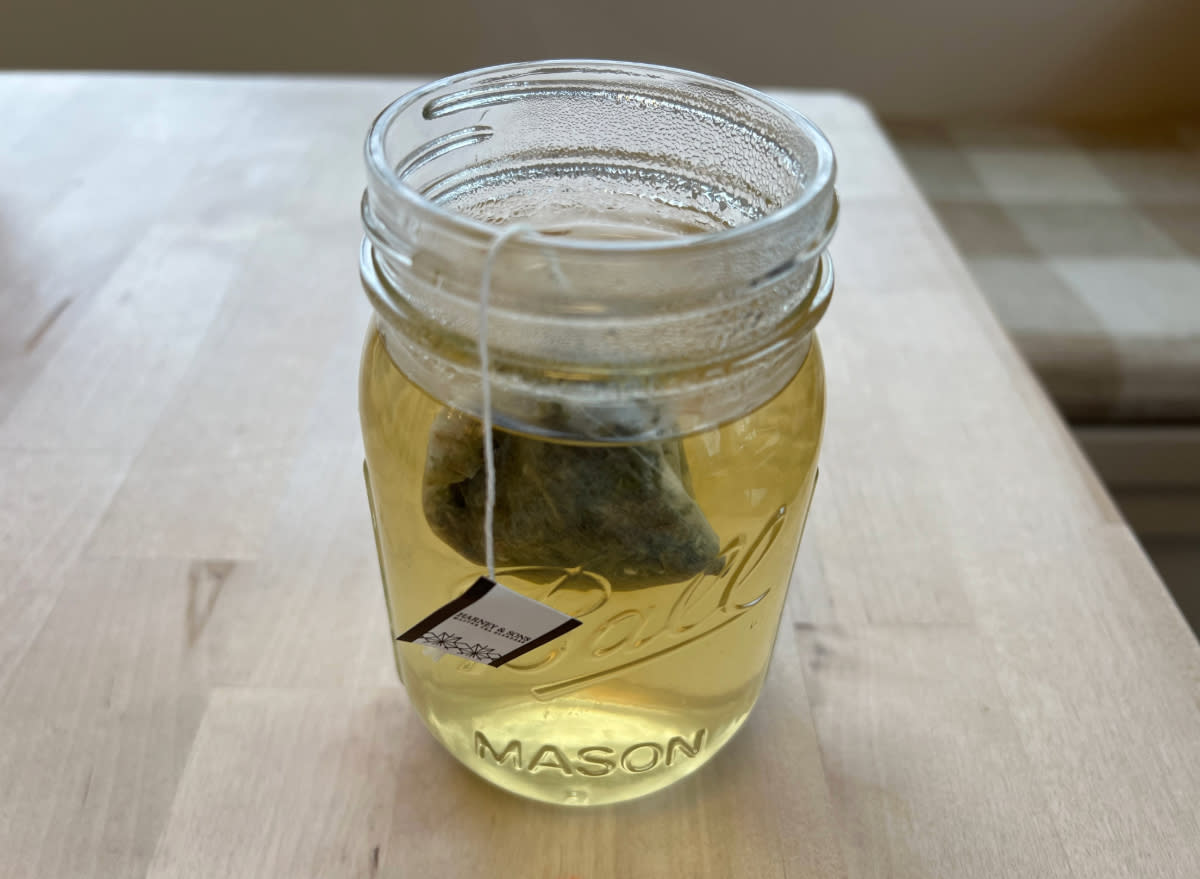
My normal morning cup of joe certainly wakes me up—but there’s a price to pay. Coffee also makes me feel anxious, on edge, and jittery. When I made the switch to green tea, however, I found my mornings to be way less stressful and much more calming. It may be the combination of the aroma, the flavor, and the amount of caffeine in a cup of green tea that made this such a refreshing change.
The flip side to this newfound relaxed 30-day routine is that although I felt less anxious, I was not as energized during the day. This prompted me to find out just how much caffeine is in each beverage. According to the U.S. Food&Drug Administration, one eight-ounce cup of green tea contains around 30 to 50 milligrams of caffeine, compared to 80 to 100 milligrams in an eight-ounce cup of coffee. (No wonder why I felt more relaxed and chill with green tea in my life!)
To compensate for my lack of energy, halfway through my journey, I increased my consumption to three cups of green tea a day—two in the morning and one in the early afternoon—to ensure I was getting enough of the caffeine boost I needed. I think it did the trick!
The caffeine in green tea can certainly be enough to help people power through the day—it all comes down to how many cups your body needs to feel and function at its absolute best. “Green tea contains caffeine, a natural stimulant that can temporarily boost metabolic rate,” explains Amy Goodson, MS, RD, CSSD, LD, a registered dietitian and certified specialist in sports dietetics who sits on our Medical Expert Board. “Caffeine enhances the activity of the central nervous system and increases the release of neurotransmitters like dopamine and norepinephrine. This can lead to increased alertness and a higher metabolic rate, which means your body burns more calories.”
RELATED: 7 Yoga Exercises a 69-Year-Old Instructor Does To Look Half Her Age
My new drink helped me think better and feel more focused on my daily tasks at hand. This was another exciting improvement compared to my coffee-drinking days when sometimes I experienced “brain fog” soon after finishing a cup of joe.
“The combination of caffeine and L-theanine, an amino acid found in green tea, may have positive effects on cognitive function,” Goodson explains. “It can enhance alertness and improve mood without the jittery feeling often associated with high caffeine intake. Some research also suggests a potential protective effect against neurodegenerative diseases like Alzheimer’s.”
RELATED: 12 Essential Rules To Get Back Into Shape After a Long Break

Plain and simple, I have a lot of stomach issues. Many foods and beverages disrupt my gut health, creating all kinds of havoc. Even though I enjoy the taste of coffee, it has always been a trigger. Green tea, however, proved to be a calming beverage for my stomach and overall gut issues—and for good reason. (I always drink caffeine with food, as many caffeinated beverages can cause further issues on an empty stomach.)
I discovered that green tea is chock-full of polyphenols—especially catechins—which are “powerful antioxidants,” according to Goodson. “Antioxidants help neutralize free radicals in the body (aka fight off the bad guys that contribute to inflammation), reducing oxidative stress and inflammation,” she says. “This may contribute to the prevention of chronic diseases and aging.” In fact, an inflamed gut can lead to many health issues, including nausea, constipation, and more.
RELATED: 10 Fitness ‘Rules’ You Should Abandon in 2024 For the Best Results

Losing weight was not a focus for me, but if it is for you, it’s worth mentioning that green tea could aid in fat-loss efforts. “Green tea has been studied for its potential role in weight loss and weight management. It contains caffeine and catechins, which can help boost metabolism and increase fat burning. Additionally, some studies suggest that green tea may aid in reducing abdominal fat,” Goodson tells us. “Green tea catechins, particularly EGCG, have been shown to enhance fat oxidation. This means that the body may use fat as a source of energy more efficiently. This effect, coupled with increased metabolism, may contribute to weight loss or weight management over time.”
“I’ve lost about 30 pounds as I became full-time CEO, and this is thanks to your education, your inspiration, and the great news is I have more muscle mass [than] I’ve had in 20 years as well,” he said. “I still got the dad bod, but it’s much closer to the younger dad bod.”
Speaking to NutraIngredients-USA at the Summit—an event Wright describes as “The Super Bowl of education for Health Enthusiasts”—he discussed his health journey and vision for the company as he embarks on his one-year anniversary as CEO.
“Our motto of lifelong wellness starts here, and I really took that to heart,” he said. “I realized that lifelong wellness needs to start with me here with me as well. And I did it. I wanted to ensure that I was leading by example and I was setting that example, and they [the Health Enthusiasts] inspired me. And they educated me as I traveled to stores, as I met with Health Enthusiasts, and I asked them so many questions about products.
“I was able to really create what I view as a foundational supplement stack to help my life, and it’s been a full transformation for me personally in terms of the amount of weight I’ve lost, lower blood pressure, lower cholesterol, just better health building muscles. So it’s been a full transformation all due to the Health Enthusiasts of The Vitamin Shoppe who truly inspired me, educated me, motivated me everyday.”
While Wright’s weight loss journey did not include GLP-1 agonist drugs, the company does want to support those who chose to take that route.
“We’re really leaning in on a couple of key trends that we view are really up and coming… whether it’s providing solutions for people that have chosen the pharma option for weight loss of GLP-1 drugs, ensuring that we’re giving them the right needs that they have for protein or for digestive health, and some of the other adverse effects when they take those GLP1 drugs,” he explained.
During the summit, Muriel Gonzalez, president at The Vitamin Shoppe, previewed a few more trends, telling us that more will be outlined in a report slated to be released later this spring.
Marzo es elmes de concientización de la EM
La esclerosis múltiple (EM) es un trastorno autoinmunitario que afecta a casi 1 millón de personas en EE.UU. y las mujeres tienen mayor riesgo que los hombres. Todavía no sabemos exactamente qué causa la EM, el trastorno ocurre cuando tu sistema inmunológico ataca a tu cerebro y nervios, más posiblemente debido a una combinación de factores medioambientales y genéticos.
Los síntomas pueden variar de persona a persona, pueden ir y venir y también pueden parecerse a los de otros trastornos, así que el proceso para recibir un diagnóstico puede ser largo.
Lee: Preguntas frecuentes de la EM >>
Una vez que finalmente recibes el diagnóstico, puede ser un alivio tener una respuesta, pero también pueden ser momentos aterradores que implican un grupo único de dudas.
Si te diagnosticaron EM recientemente, es importante que visites a un neurólogo en el que puedas confiar para que supervise tu atención. Pero puede ser difícil recordar lo que deseas preguntar cuando estás en el consultorio, así que preparamos una lista que puedes llevar contigo.
Aquí encontrarás 10 preguntas que debes hacer a tu neurólogo después de un diagnóstico de EM.
Recursos
Localizador de apoyo de EM de HealthyWomen
National MS Society [Asociación nacional de EM]: Encuentra apoyo
Este recurso educativo se preparó con el apoyo de Novartis
Related Articles Around the Web
The explorer and educator, 63, recently took to Instagram to share that drinking as little as three cups of Green tea a day could make a difference to our healthy life expectancy
Buettner has become well known for his research into five “blue” zones across the world where inhabitants regularly live well into their old age.
One of these regions – the Nicoya Peninsula – has the lowest rate of middle-age mortality in the world”, according to the New York Times bestselling author.
Speaking on Jay Shetty’s Podcast ON Purpose, Buettner said: “Seven is ideal but as little as three cups of Green tea a day is associated with four extra years of healthy life expectancy”.
The expert admitted that we currently don’t know why this is but he suggested it could be due to the antioxidants.
The author elaborated: “There’s probably 1500 in Green tea, we don’t know for sure.
“Green tea has been around for a long time and it is consumed daily in volume by at least two of these blue zones.
“It’s one of these things of rather than turn to the superfood or the super beverage – why not drink from what we have learned from our ancestors who’ve achieved the outcomes we want which is a long and healthy life?”
Previously, Dan Buettner shared his advice on the three foods you should incorporate into your diet to help you live a longer life.
He called on people to take note of the Nicoya Peninsula in Costa Rica and three foods that form a prominent part of this region’s diet.
Nicoyans are likely to live well past middle age which Buettner largely attributes to “the best diet human beings have ever invented.”
“Their diet is composed of three foods that I would argue are the best diet human beings have ever invented,” Buettner commented.
The explorer continued: “Because of these foods, the people living on the Nicoya Peninsula of Costa Rica are two and half times more likely to reach the age of 92 than people living in the United States or Europe.”
This figure represents an increase from the 114 hospitalization cases reported earlier by Kobayashi Pharmaceutical, the manufacturer of the supplements.
The company, Kobayashi Pharmaceutical, is currently under scrutiny after announcing investigations into five deaths potentially associated with its products. These incidents have prompted concerns about the safety of the supplements, particularly regarding kidney-related health issues.
The supplements, which contain “beni koji” or red yeast rice, have been widely used in East Asia for centuries. However, recent findings of a potentially toxic acid produced by mould at one of Kobayashi’s factories have raised alarm bells.
As a precautionary measure, Kobayashi Pharmaceutical initiated a recall of three types of over-the-counter tablets containing red yeast rice on March 22. Subsequent government inspections have been conducted at the company’s facilities to assess the situation.
The health scare has garnered significant attention in Japan, dominating headlines and sparking discussions on social media. However, it has also led to the spread of disinformation and conspiracy theories online.
Kobayashi Pharmaceutical, a renowned name in Japan’s health industry, has acknowledged selling red yeast rice to other firms domestically and internationally. In response to the crisis, some of these companies have initiated recalls of products containing the ingredient.
Furthermore, the impact of the health scare has extended beyond Japan, with Taiwanese authorities reporting preventive recalls of 154 products containing red yeast rice. Additionally, a woman in Taiwan reportedly experienced kidney failure after consuming Kobayashi’s supplements for several years.
The unfolding situation underscores the importance of rigorous safety standards and regulatory oversight in the production and distribution of dietary supplements, as well as the need for swift action to address potential health risks associated with such products.