The main category of Forex News.
You can use the search box below to find what you need.
[wd_asp id=1]
The main category of Forex News.
You can use the search box below to find what you need.
[wd_asp id=1]
Natural gas price remains positioned below the 55-period moving average, fluctuating repeatedly near the $3.250 level, confirming its continued adherence to the bearish scenario, which is based on the stability of resistance at $3.520.
We emphasize the importance of the price gathering negative momentum at the current levels, which would allow it to form further bearish waves and target the $3.050 and $2.920 levels respectively in the near term. However, a breakout above the resistance level and stability above it would confirm a shift toward the bullish path, allowing the price to begin recording further gains with an initial target at $3.710.
The expected trading range for today is between $3.050 and $3.350
Trend forecast: Bearish
GBP/USD is trading close to this year’s lows as political uncertainty builds and speculation surrounding Prime Minister Keir Starmer’s future adds another headwind for sterling.
Starmer may step down as soon as today, although it is still unclear whether he will or whether he will remain in power to fight any potential leadership challenge from Greater Manchester Mayor Andy Burnham, whose victory in the Makerfield by-election has given him a path to Westminster.
For the pound, the key focus is fiscal policy. Should Burnham become Prime Minister, markets will want clarity on his spending plans and whether he would maintain the current fiscal rules. Any suggestion of increased borrowing could be poorly received by the UK bond market, particularly given the UK’s already stretched debt position.
A potential increase in gilt issuance to fund higher spending could make investors nervous at a time when concerns surrounding public finances remain elevated.
The pound has also come under pressure after cooler-than-expected UK CPI data last week prompted markets to scale back expectations for a Bank of England rate hike this year.
This contrasts with the more hawkish tone from the Federal Reserve following last week’s FOMC meeting.
The Fed’s hawkish tilt helped lift the US Dollar Index to a fresh 2026 high and could continue to support the greenback.
Attention now turns to US Core PCE inflation data, which could provide further clues over the outlook for US interest rates.
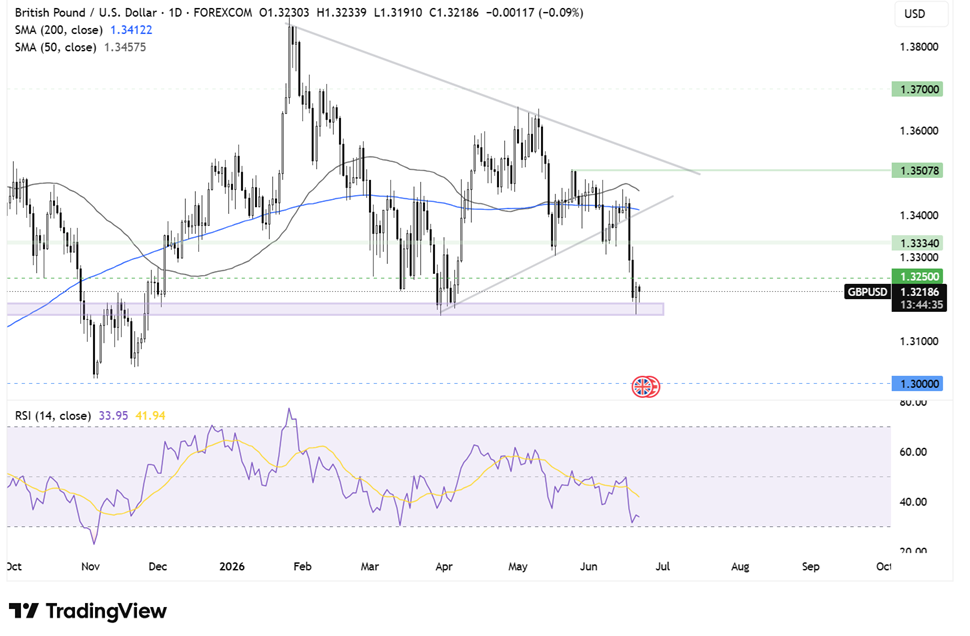
GBP/USD broke below its symmetrical triangle pattern, falling to a low of 1.3160 before recovering back above 1.3200. The pair continues to trade below its 50 and 200 SMAs, while the RSI remains below 50, keeping sellers hopeful of further downside.
Sellers will look for a break below 1.3160 to create a lower low and open the door towards the psychological 1.3000 level.
Buyers may be encouraged by the hammer candlestick reversal pattern. However, they will need to reclaim 1.3250 before bringing 1.3335 into focus. Above here, the 200 SMA around 1.3400 and the rising trendline resistance come into view.
EUR/USD fell to 1.1410 last week, its lowest level since March, as the US dollar surged following the hawkish FOMC meeting. While the pair has recovered some ground, it remains well below 1.1500.
The euro is finding some support today after progress was reported in the first session of talks between the US and Iran. Oil prices have fallen further as vessels continue to move through the Strait of Hormuz.
This is positive for Europe, which remains heavily dependent on imported energy.
However, gains in EUR/USD could remain limited by continued US dollar strength. Last week’s FOMC meeting saw the Fed leave rates unchanged, but nine of 18 policymakers now expect a rate hike before the end of the year. Meanwhile, new Fed Chair Kevin Walsh doubled down on the importance of returning inflation to target, reinforcing the hawkish message.
Attention this week will focus on US Core PCE, the Fed’s preferred inflation gauge, which could provide further clues over the path of US interest rates.
While the ECB raised rates just a week before the Federal Reserve, that move already appears to have faded into the background. The ECB maintained a cautious, data-dependent tone and another rate hike risks placing additional pressure on an already fragile Eurozone economy.
Today, attention turns to Eurozone consumer confidence, which is expected to remain broadly stable around -18. ECB President Christine Lagarde is also due to speak.
Tomorrow’s PMI figures could provide further insight into the health of the Eurozone economy after May’s composite PMI remained in contraction territory. Another weak reading could keep pressure on the euro.
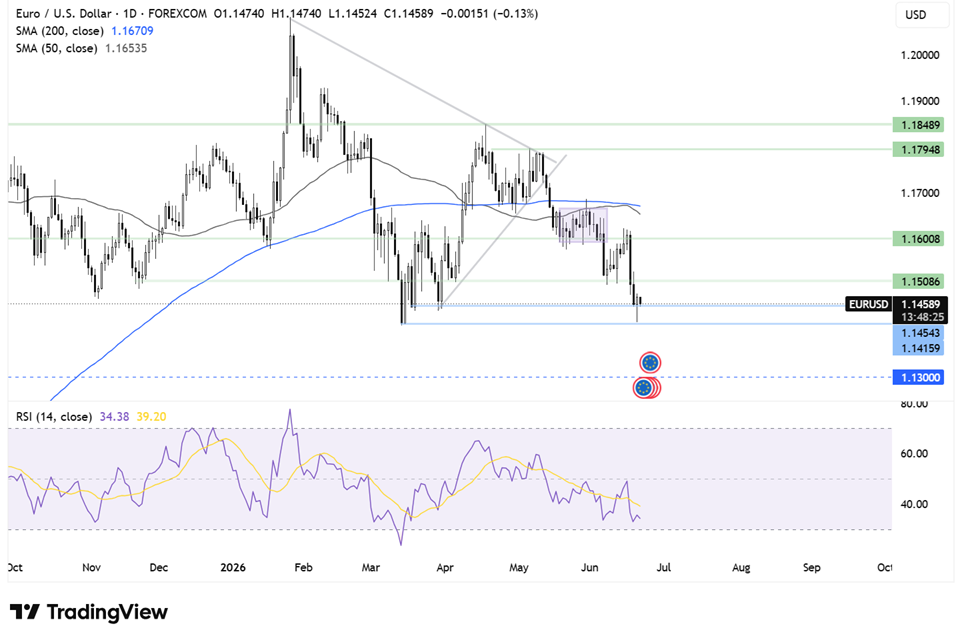
EUR/USD broke down from its symmetrical triangle pattern, falling below its 200 SMA and dropping to a low of 1.1410. This, combined with the RSI below 50, keeps sellers hopeful of further downside.
Immediate support can be seen at 1.1450, with a break below opening the door to 1.1400. Sellers will be looking to take out this level to create a lower low and extend the decline towards 1.1300.
Buyers may be encouraged by the long lower wick on Friday’s candle, suggesting demand emerged at lower levels. The hammer candlestick could signal a reversal. In that scenario, buyers would need to rise above 1.1500 to bring 1.1600 into focus, before exposing the 200 SMA at 1.1670.
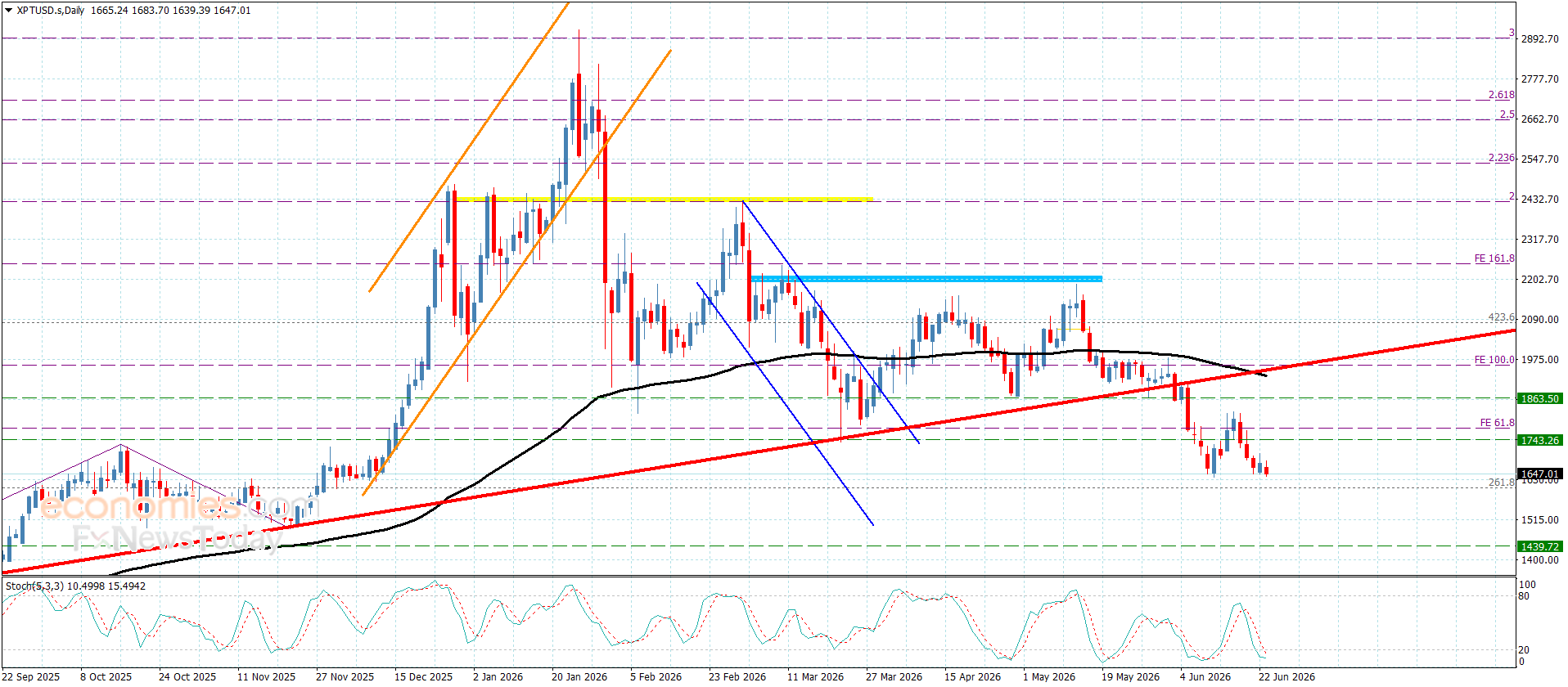
Platinum price remains affected by recurring negative pressures, represented by its overall stability below the main resistance level currently extending toward $1,940.00. In addition, the $1,865.00 level is forming another strong barrier, forcing the price to renew its bearish attempts, with the price currently positioned near the $1,645.00 level.
The availability of negative momentum will increase the chances of the price attacking the support level at $1,605.00 soon. A break below this level would strengthen the chances of resuming the bearish move, targeting $1,565.00 and then $1,490.00 respectively.
The expected trading range for today is between $1,565.00 and $1,700.00
Trend forecast: Bearish
Both the US and Japanese governments are seeking to place allies in key central bank positions to increase their influence. However, while Donald Trump has achieved limited success, Sanae Takaichi has been far more effective. Let’s discuss this topic and develop a trading plan for the USD/JPY pair.
The article covers the following subjects:
While Donald Trump openly pressures the Fed to cut rates, Sanae Takaichi has pursued a more discreet strategy. Despite backing the Bank of Japan’s tightening cycle in public, she has helped place dovish officials on the Board of Governors. One recent appointee, Toichiro Osada, voted against further tightening, raising concerns that the BoJ could slow the pace of normalization and support the ongoing USD/JPY rally.
The Board of Governors consists of nine members, and within the next 12 months, four of them could be supporters of Sanae Takaichi’s expansionary monetary and fiscal agenda. What Donald Trump has so far failed to achieve—gaining greater influence over the central bank—could become a reality in Japan under its prime minister. Growing concerns over the BoJ’s independence have emerged as another factor, pushing the USD/JPY pair to its strongest levels since 1986.
Source: Bloomberg.
What can the Bank of Japan do in this situation? It needs to raise rates to a neutral level as quickly as possible, one that neither stimulates nor restrains the economy, before it’s too late and before the doves gain greater influence on the Board of Governors.
Deputy Governor Ryozo Himino’s message is becoming increasingly clear. He has warned that delaying monetary tightening could ultimately force the Bank of Japan to raise rates more aggressively, making the eventual adjustment more costly for the economy. Nevertheless, 52% of economists surveyed by Bloomberg expect the BoJ’s next rate hike to come only in December, while 36% see October as the most likely timing.
The BoJ’s cautious approach continues to weigh heavily on the yen. The wide interest rate gap with the Fed encourages capital to flow from Japan to the US, providing ongoing support for USD/JPY. The pair is drawing additional strength from market expectations that the Fed is not done tightening yet. According to derivatives pricing, investors see a 77% probability of a rate hike in September and a 59% chance of two additional rate increases before year-end.
Source: Bloomberg.
The government’s desire to maintain an accommodative monetary policy is increasingly constrained by the weakening yen. Further depreciation may fuel inflation, particularly as higher energy costs continue to feed into Japan’s core CPI. As a result, Tokyo may have little choice but to step up its efforts to bolster the currency through intervention.
However, the authorities face two major obstacles: the limited effectiveness of past interventions, which consumed roughly $73 billion, and the dollar’s strong underlying fundamentals. The market has largely shrugged off Finance Minister Satsuki Katayama’s warnings of decisive action. Had the latest warning come from Japan’s top currency diplomat, Atsushi Mimura, as it did in April, investors might have paid much closer attention.
Probably, currency interventions are on the horizon. If the USD/JPY pair drops below 161.45, short trades can be opened.
This forecast is based on the analysis of fundamental factors, including official statements from financial institutions and regulators, various geopolitical and economic developments, and statistical data. Historical market data are also considered.
The content of this article reflects the author’s opinion and does not necessarily reflect the official position of LiteFinance broker. The material published on this page is provided for informational purposes only and should not be considered as the provision of investment advice for the purposes of Directive 2014/65/EU.
According to copyright law, this article is considered intellectual property, which includes a prohibition on copying and distributing it without consent.
Silver price (XAG/USD) advances after three days of losses, hovering around $66.00 per troy ounce during the European hours on Monday. However, Silver price gains ground as oil prices and inflation concerns ease following a positive development regarding the United States (US)-Iran peace deal.
Mediators Qatar and Pakistan issued a joint statement from Switzerland announcing that both Washington and Tehran have agreed to a formal roadmap aimed at securing a final peace agreement within the next 60 days.
Additionally, Iranian Foreign Minister Abbas Araqchi confirmed that the diplomatic progress yielded several major concessions for his country. In addition to the vital export waivers for oil and petrochemicals, the agreed-upon terms include the release of a portion of Iran’s frozen financial assets, alongside the official launch of a comprehensive domestic reconstruction and development plan.
However, on Sunday, US President Donald Trump threatened direct strikes on Iran if proxy attacks on Israel continue. This warning severely clouded the outlook for diplomatic progress and threatened to dismantle the current peace framework, casting a shadow over the first round of interim talks held between Vice President JD Vance and Iranian officials.
However, the non-yielding Silver may further face challenges as traders could weigh on a hawkish shift in the Federal Reserve’s (Fed) policy outlook. Last week’s central bank meeting, where policymakers left interest rates unchanged but adopted a distinctly hawkish stance. Notably, 9 out of 19 FOMC members now project at least one interest rate hike this year, prompting market participants to actively price in a potential increase as early as September.
Silver is a precious metal highly traded among investors. It has been historically used as a store of value and a medium of exchange. Although less popular than Gold, traders may turn to Silver to diversify their investment portfolio, for its intrinsic value or as a potential hedge during high-inflation periods. Investors can buy physical Silver, in coins or in bars, or trade it through vehicles such as Exchange Traded Funds, which track its price on international markets.
Silver prices can move due to a wide range of factors. Geopolitical instability or fears of a deep recession can make Silver price escalate due to its safe-haven status, although to a lesser extent than Gold’s. As a yieldless asset, Silver tends to rise with lower interest rates. Its moves also depend on how the US Dollar (USD) behaves as the asset is priced in dollars (XAG/USD). A strong Dollar tends to keep the price of Silver at bay, whereas a weaker Dollar is likely to propel prices up. Other factors such as investment demand, mining supply – Silver is much more abundant than Gold – and recycling rates can also affect prices.
Silver is widely used in industry, particularly in sectors such as electronics or solar energy, as it has one of the highest electric conductivity of all metals – more than Copper and Gold. A surge in demand can increase prices, while a decline tends to lower them. Dynamics in the US, Chinese and Indian economies can also contribute to price swings: for the US and particularly China, their big industrial sectors use Silver in various processes; in India, consumers’ demand for the precious metal for jewellery also plays a key role in setting prices.
Silver prices tend to follow Gold’s moves. When Gold prices rise, Silver typically follows suit, as their status as safe-haven assets is similar. The Gold/Silver ratio, which shows the number of ounces of Silver needed to equal the value of one ounce of Gold, may help to determine the relative valuation between both metals. Some investors may consider a high ratio as an indicator that Silver is undervalued, or Gold is overvalued. On the contrary, a low ratio might suggest that Gold is undervalued relative to Silver.
Platinum price returned to stabilize near the $1,655.00 level, affected by the negative pressures represented by the formation of the $1,780.00 level as an additional strong resistance barrier, along with the main indicators providing negative momentum during the recent period.
Based on the above, we expect the price to attempt to resume its bearish moves, which may target the stable support level at $1,605.00 in the near term. A break below this level could extend the losses toward $1,565.00 and $1,490.00.
The expected trading range for today is between $1,605.00 and $1,730.00
Trend forecast: Bearish
Natural gas price has continued to post negative closes below the resistance level at $3.520, confirming its commitment to the previously suggested bearish path. The price is currently fluctuating below the 55-period moving average, which is acting as an additional resistance barrier, positioned at $3.320.
by the above image, we notice providing negative momentum by Stochastic moving below 80 level, increasing the chances of the price forming new bearish waves. This could push the price toward the $2.920 level, and a break below it may allow it reach toward the stable support at $2.620.
The expected trading range for today is between $2.920 and $3.350
Trend forecast: Bearish
The British pound has shown some signs of bouncing for a bigger move, as we were getting close to a big support level. This is a pair that features two relatively firm currencies at the moment, so this could remain rangebound.
The British pound has shown itself to be somewhat resilient during the trading session as the market drifted into a basically 3-day weekend in the United States, as Juneteenth would be celebrated. That being said, we were also at the bottom of a significant range, with the 1.32 level being a massive support level.

Ultimately, I like the idea of maybe playing a short-term rally here, understanding that any signs of exhaustion would be a potential selling opportunity. I think you have to look at this as a market that is currently trying to navigate the interest rate situation, but when you zoom way out, you can see that this 1.32 level is an area that’s been important, and I think you would have to assume that some type of reaction makes sense.
Again, I think the 1.33 level is resistance followed by the 200-day EMA. I’ve got no interest in getting into a longer-term trade at the moment. I think just a short-term bounce makes sense.
Keep in mind it was Juneteenth in the United States, and that means that about half the day was pretty quiet. And then I do believe ultimately, though, we are looking at a pair that is just staying within the same range it’s been in for well over a year.
We’re getting close to the bottom of that range, so range-bound longer-term swings make sense. I think a short-term bounce for those of you who are a little short-term in your thinking probably makes sense as well.
Ready to trade the GBP/USD Forex analysis? Check out the best forex trading company in UK worth using.
Christopher Lewis is a technical analyst and market commentator at DailyForex with more than two decades of trading experience in Forex and other leveraged markets. Based in Columbus, Ohio, he specializes in chart-based analysis of major currency pairs, stock indices, commodities, and energy markets, focusing on clear support and resistance levels, trend structure, and risk management. Christopher produces daily written and video analysis for traders who rely on technical setups to navigate volatile market conditions
As seen on: Pairs Of Aces Podcast,The Trader Guy, FXEmpire
Natural gas price has continued to post negative closes below the resistance level at $3.520, confirming its commitment to the previously suggested bearish path. The price is currently fluctuating below the 55-period moving average, which is acting as an additional resistance barrier, positioned at $3.320.
by the above image, we notice providing negative momentum by Stochastic moving below 80 level, increasing the chances of the price forming new bearish waves. This could push the price toward the $2.920 level, and a break below it may allow it reach toward the stable support at $2.620.
The expected trading range for today is between $2.920 and $3.350
Trend forecast: Bearish
The USD/JPY pair catches aggressive bids at the start of a new week and builds on its steady intraday ascent through the early European session. The momentum lifts spot prices to the 161.75 area in the last hour, back closer to the highest level since July 2024 touched on Friday, and is sponsored by a combination of factors.
The Japanese Yen (JPY) continues with its relative underperformance in the wake of economic risks stemming from the Middle East conflict and energy supply disruptions through the Strait of Hormuz. This, to a larger extent, overshadows prospects for further policy tightening by the Bank of Japan (BoJ) and fears that Japanese authorities will step in to prop up the domestic currency. Apart from this, the underlying US Dollar (USD) bullish sentiment, bolstered by geopolitical uncertainties and the US Federal Reserve’s (Fed) hawkish tilt, acts as a tailwind for the USD/JPY cross.
From a technical perspective, last week’s sustained breakout through the previous intervention zone, around the 160.50-160.60 area, comes on top of the recent solid rebound from the 200-day Exponential Moving Average (EMA) and favors bullish traders. Meanwhile, the Relative Strength Index (RSI) near 72 pushes into overbought territory, while the Moving Average Convergence Divergence (MACD) stays positive above the zero line. This hints at firm but potentially overextended upside momentum, making it prudent to wait for some consolidation before positioning for further gains.
In the meantime, immediate support is now seen at the structural pivot around 160.60-160.50. As long as the USD/JPY pair holds above this level, any dips are likely to be treated as corrections within the prevailing bullish structure, though overstretched momentum warns that upside progress could become more gradual or prone to short-term reversals. That said, the 200-day EMA at 156.32 should provide a deeper layer of trend support if a sharper corrective pullback unfolds.
(The technical analysis of this story was written with the help of an AI tool.)
The table below shows the percentage change of Japanese Yen (JPY) against listed major currencies last 30 days. Japanese Yen was the strongest against the Canadian Dollar.
| USD | EUR | GBP | JPY | CAD | AUD | NZD | CHF | |
|---|---|---|---|---|---|---|---|---|
| USD | 1.51% | 1.80% | 1.75% | 2.92% | 2.16% | 2.65% | 2.78% | |
| EUR | -1.51% | 0.29% | 0.24% | 1.36% | 0.65% | 1.14% | 1.28% | |
| GBP | -1.80% | -0.29% | -0.04% | 1.14% | 0.37% | 0.88% | 1.01% | |
| JPY | -1.75% | -0.24% | 0.04% | 1.12% | 0.45% | 0.93% | 0.95% | |
| CAD | -2.92% | -1.36% | -1.14% | -1.12% | -0.65% | -0.19% | -0.13% | |
| AUD | -2.16% | -0.65% | -0.37% | -0.45% | 0.65% | 0.50% | 0.61% | |
| NZD | -2.65% | -1.14% | -0.88% | -0.93% | 0.19% | -0.50% | 0.12% | |
| CHF | -2.78% | -1.28% | -1.01% | -0.95% | 0.13% | -0.61% | -0.12% |
The heat map shows percentage changes of major currencies against each other. The base currency is picked from the left column, while the quote currency is picked from the top row. For example, if you pick the Japanese Yen from the left column and move along the horizontal line to the US Dollar, the percentage change displayed in the box will represent JPY (base)/USD (quote).