The main category of Forex News.
You can use the search box below to find what you need.
[wd_asp id=1]
The main category of Forex News.
You can use the search box below to find what you need.
[wd_asp id=1]
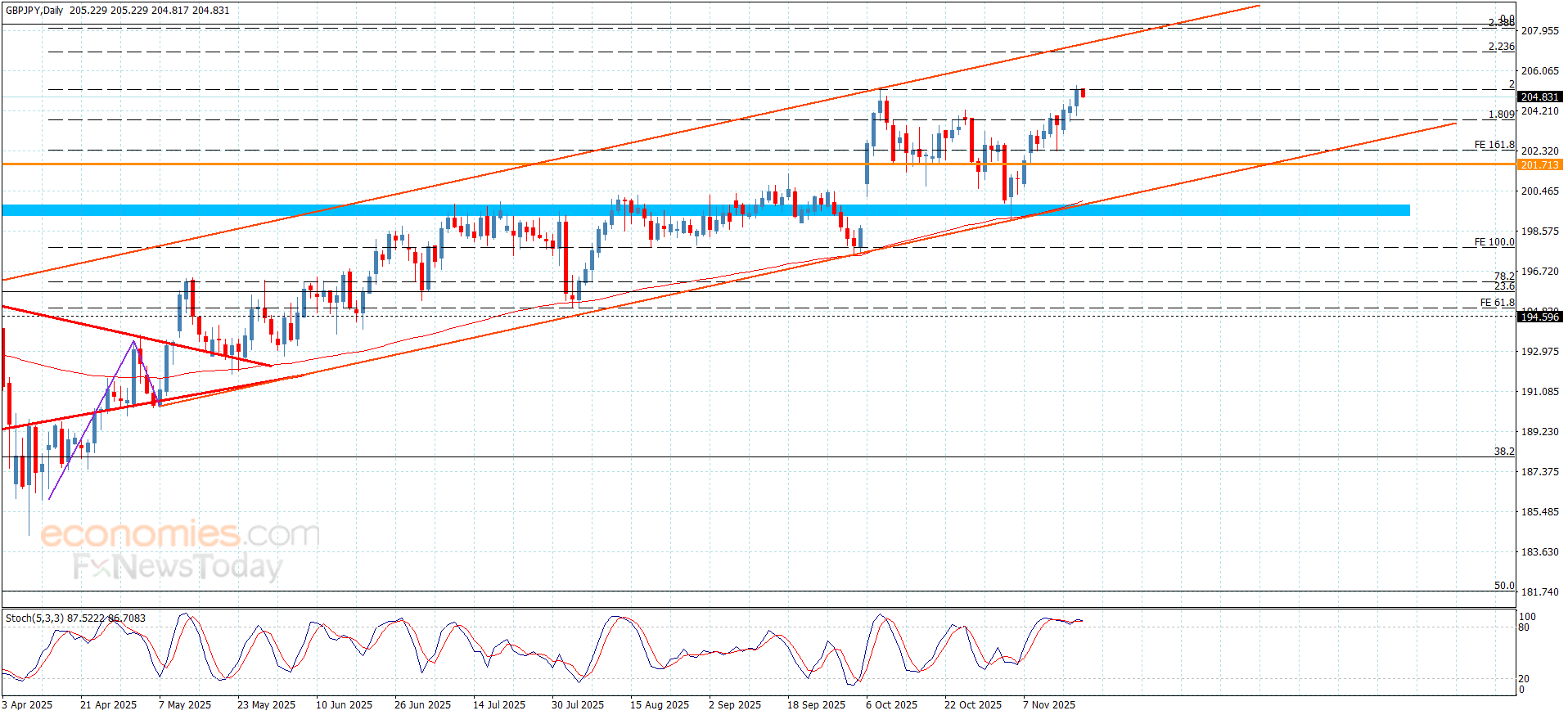
The GBPJPY pair formed more bullish waves, reaching 2.00%Fibonacci extension level at 205.25, achieving the suggested initial target, to form sideways trading due to its neediness to the positive momentum.
We recommend waiting to achieve the current obstacle and providing positive close above it, to reinforce the chances of recording new gains by its rally towards 205.70 reaching the next main target in the medium period near 206.90, while the breach failure will force it to provide mixed trading, and there is a chance to decline towards 203.70.
The expected trading range for today is between 204.45 and 205.70
Trend forecast: Bullish
West Texas Intermediate (WTI) Oil price advances on Thursday, early in the European session. WTI trades at $59.34 per barrel, up from Wednesday’s close at $59.28.
Brent Oil Exchange Rate (Brent crude) is also up, advancing from the $63.15 price posted on Wednesday, and trading at $63.21.
WTI Oil is a type of Crude Oil sold on international markets. The WTI stands for West Texas Intermediate, one of three major types including Brent and Dubai Crude. WTI is also referred to as “light” and “sweet” because of its relatively low gravity and sulfur content respectively. It is considered a high quality Oil that is easily refined. It is sourced in the United States and distributed via the Cushing hub, which is considered “The Pipeline Crossroads of the World”. It is a benchmark for the Oil market and WTI price is frequently quoted in the media.
Like all assets, supply and demand are the key drivers of WTI Oil price. As such, global growth can be a driver of increased demand and vice versa for weak global growth. Political instability, wars, and sanctions can disrupt supply and impact prices. The decisions of OPEC, a group of major Oil-producing countries, is another key driver of price. The value of the US Dollar influences the price of WTI Crude Oil, since Oil is predominantly traded in US Dollars, thus a weaker US Dollar can make Oil more affordable and vice versa.
The weekly Oil inventory reports published by the American Petroleum Institute (API) and the Energy Information Agency (EIA) impact the price of WTI Oil. Changes in inventories reflect fluctuating supply and demand. If the data shows a drop in inventories it can indicate increased demand, pushing up Oil price. Higher inventories can reflect increased supply, pushing down prices. API’s report is published every Tuesday and EIA’s the day after. Their results are usually similar, falling within 1% of each other 75% of the time. The EIA data is considered more reliable, since it is a government agency.
OPEC (Organization of the Petroleum Exporting Countries) is a group of 12 Oil-producing nations who collectively decide production quotas for member countries at twice-yearly meetings. Their decisions often impact WTI Oil prices. When OPEC decides to lower quotas, it can tighten supply, pushing up Oil prices. When OPEC increases production, it has the opposite effect. OPEC+ refers to an expanded group that includes ten extra non-OPEC members, the most notable of which is Russia.
EUR/JPY extends its winning streak for the fourth successive session, reached fresh all-time high of 181.73 and currently trading around 181.40 during the early European hours on Thursday. The currency cross moves upwards within the ascending channel pattern, suggesting a persistent bullish bias.
Additionally, the 14-day Relative Strength Index (RSI) has moved above the 70 mark, indicating overbought conditions and a likelihood of a near-term downward correction. The EUR/JPY cross suggests a stronger short-term momentum, as it remains above the nine-day Exponential Moving Average (EMA).
On the upside, the initial resistance lies at the psychological level of 182.00, followed by the upper boundary of the ascending channel around 182.20. A break above this confluence area could reinforce the bullish bias and lead the EUR/JPY cross to approach the crucial level of 183.00.
The initial support lies at the lower boundary of the ascending channel around 180.20, followed by the nine-day EMA at 179.85. Further declines below this confluence support zone would weaken the bullish bias and put downward pressure on the EUR/JPY cross to navigate the area around the 50-day EMA at 176.65.
From a macro perspective, the Japanese Yen struggles against its peers due to the potential for Japan’s Prime Minister Sanae Takaichi to unveil a stimulus package exceeding JPY 20 trillion.
The upside of the EUR/JPY cross could be restrained as the JPY may receive support on emergence of hawkish sentiment surrounding the Bank of Japan (BoJ) policy outlook. A Reuters poll indicated that the BoJ appears poised to raise interest rates to 0.75% from 0.50% at its December 18–19 meeting.
Additionally, BoJ board member Junko Koeda noted that she believes the central bank must continue to raise the policy interest rate and adjust the degree of monetary accommodation in accordance with improvement in economic activity and prices.” Koeda emphasized that ongoing economic and price trends warrant further policy adjustment.
The table below shows the percentage change of Euro (EUR) against listed major currencies today. Euro was the strongest against the Japanese Yen.
| USD | EUR | GBP | JPY | CAD | AUD | NZD | CHF | |
|---|---|---|---|---|---|---|---|---|
| USD | 0.05% | -0.16% | 0.33% | -0.01% | -0.12% | -0.17% | 0.00% | |
| EUR | -0.05% | -0.20% | 0.25% | -0.06% | -0.17% | -0.22% | -0.05% | |
| GBP | 0.16% | 0.20% | 0.47% | 0.14% | 0.03% | -0.02% | 0.16% | |
| JPY | -0.33% | -0.25% | -0.47% | -0.34% | -0.44% | -0.51% | -0.32% | |
| CAD | 0.01% | 0.06% | -0.14% | 0.34% | -0.10% | -0.16% | 0.03% | |
| AUD | 0.12% | 0.17% | -0.03% | 0.44% | 0.10% | -0.05% | 0.12% | |
| NZD | 0.17% | 0.22% | 0.02% | 0.51% | 0.16% | 0.05% | 0.18% | |
| CHF | -0.00% | 0.05% | -0.16% | 0.32% | -0.03% | -0.12% | -0.18% |
The heat map shows percentage changes of major currencies against each other. The base currency is picked from the left column, while the quote currency is picked from the top row. For example, if you pick the Euro from the left column and move along the horizontal line to the US Dollar, the percentage change displayed in the box will represent EUR (base)/USD (quote).
USDJPY continues to command the FX market with a powerful bullish trend. The yen remains heavily pressured as Japan sits on the extreme end of global monetary policy, maintaining near-zero rates while the rest of the world stays significantly tighter. This alone has kept USDJPY elevated for most of the year.
The recent push into the upper 157s shows the same pattern we’ve seen for weeks — strong impulsive legs with shallow corrections. While this speaks to persistent demand for USDJPY, it also raises the question: is a deeper retracement due before a breakout attempt on the 52-week high?
The core engine behind USDJPY’s climb remains policy divergence — and that gap continues to widen.
The BoJ still refuses to shift away from accommodative policy. Despite inflation fluctuations, the central bank avoids decisive tightening, keeping Japanese yields pinned close to zero. This anchors the yen as the funding currency of global markets and makes it structurally weak.
While the Federal Reserve isn’t aggressively tightening, it’s also not cutting quickly. US yields remain elevated, and inflation remains sticky enough to prevent early dovish shifts. This keeps the dollar attractive compared to the yen.
Global investors continue rotating capital into higher-yielding U.S. instruments. This flow naturally supports USDJPY and compounds the yen’s underperformance.
The result is a pair that remains fundamentally bullish until one side of the divergence changes — and so far, neither has.

USDJPY has been in a clean and aggressive uptrend with very limited pullbacks. Price is now sitting just under the 52-week high at 158.87, trading inside a premium zone where rallies typically slow down.
Candles continue to show momentum but also early signals of exhaustion — long wicks near the highs, smaller bodies, and stretched displacement. Beneath current price lies a natural re-pricing zone between 155.735 and 156.877, where the market may correct before setting up the next move.
This zone becomes the key battleground for continuation or reversal.
The higher-timeframe trend remains clearly bullish. But price is overextended, and a healthy retracement would restore balance. The 155.70–156.80 zone is the nearest and cleanest support area for discount entries.
Until that zone is retested, upside breakouts may lack sustainability.

The bullish path anticipates a structured correction before buyers re-enter with conviction.
Requirements:
Upside targets:
A strong reaction from the support zone supports continuation.

If USDJPY keeps rejecting the highs and fails to find support in the imbalance zone, a deeper correction could unfold.
Requirements:
Downside targets:
A loss of structure below 155.70 opens the door for broader downside.
USDJPY stays firmly bullish, but the rally is extended. With the 52-week high just overhead, the market may need a reset before attempting a decisive breakout. The 155.70–156.80 zone is the key technical area to monitor — a bounce there maintains the trend, while a breakdown signals deeper correction.
If the BoJ remains dovish and U.S. yields stay firm, the bias still leans bullish. But no trend climbs in a straight line. A healthy pullback may be the final ingredient before the next major move.
Gold is attempting another stint above $4,100 early Thursday, as the US Dollar (USD) pauses its uptrend amid a risk-on market profile, while awaiting the all-important September Nonfarm Payrolls (NFP) report due later in the day.
It’s all about the September US NFP data this Thursday, as it is the first full employment report after there was no official data released for over seven weeks due to the government shutdown.
Further, the data will be closely scrutinized for fresh cues on the US Federal Reserve’s (Fed) path forward on interest rates, especially after the Minutes of the October monetary policy meeting showed that “policymakers cautioned that lower borrowing costs could undermine the fight against inflation.”
Following the Minutes release, the odds for a December Fed rate cut declined to 33%, according to the CME Group’s FedWatch Tool, having seen around 50% before the event.
This hawkish narrative bolstered the USD rally, fuelling a sharp retracement in Gold from the highest level this week, reached at $4,133.
However, the tide once again seems to have turned in favor of Gold buyers after the upbeat results from the chipmaker Nvidia post-market hours provided a big relief and triggered a sharp risk-on rally across the board.
The market optimism extends into Asian trading, limiting the ongoing USD advance, while reviving Gold’s recovery momentum toward the $4,100 threshold.
The next leg higher in Gold depends on the release of the US jobs data, which could help alter market expectations on whether the Fed will lower rates next month.
The NFP data is expected to show that the US economy to have added 50,000 jobs in September, against a 22,000 job gain in August. The Unemployment Rate is seen steady at 4.3% in the same period. Meanwhile, the Average Hourly Earnings are expected to rise annually by 3.7% in September, at the same pace reported in August.
Any sharp deviations from the estimates could influence the Fed rate cut expectations, triggering a big move in Gold.
In the daily chart, XAU/USD trades at $4,097.44. The 21-day Simple Moving Average (SMA) has flattened near $4,048.53, while the 50-, 100- and 200-day SMAs continue to rise, underpinning the broader uptrend. Price holds above all these gauges, keeping a mild bullish bias despite slower near-term momentum. The Relative Strength Index (14) prints 54.66, neutral with a modest positive tilt.
Measured from the $4,381.17 high to the $3,885.84 low, the 38.2% retracement at $4,075.05 and the 50% retracement at $4,133.50 frame the ongoing rebound within a corrective structure. A daily close above the upper retracement would open the next leg higher, whereas failure to sustain gains and a slip beneath the lower marker would put the pullback back in play.
(The technical analysis of this story was written with the help of an AI tool)
Nonfarm Payrolls (NFP) are part of the US Bureau of Labor Statistics monthly jobs report. The Nonfarm Payrolls component specifically measures the change in the number of people employed in the US during the previous month, excluding the farming industry.
The Nonfarm Payrolls figure can influence the decisions of the Federal Reserve by providing a measure of how successfully the Fed is meeting its mandate of fostering full employment and 2% inflation.
A relatively high NFP figure means more people are in employment, earning more money and therefore probably spending more. A relatively low Nonfarm Payrolls’ result, on the either hand, could mean people are struggling to find work.
The Fed will typically raise interest rates to combat high inflation triggered by low unemployment, and lower them to stimulate a stagnant labor market.
Nonfarm Payrolls generally have a positive correlation with the US Dollar. This means when payrolls’ figures come out higher-than-expected the USD tends to rally and vice versa when they are lower.
NFPs influence the US Dollar by virtue of their impact on inflation, monetary policy expectations and interest rates. A higher NFP usually means the Federal Reserve will be more tight in its monetary policy, supporting the USD.
Nonfarm Payrolls are generally negatively-correlated with the price of Gold. This means a higher-than-expected payrolls’ figure will have a depressing effect on the Gold price and vice versa.
Higher NFP generally has a positive effect on the value of the USD, and like most major commodities Gold is priced in US Dollars. If the USD gains in value, therefore, it requires less Dollars to buy an ounce of Gold.
Also, higher interest rates (typically helped higher NFPs) also lessen the attractiveness of Gold as an investment compared to staying in cash, where the money will at least earn interest.
Nonfarm Payrolls is only one component within a bigger jobs report and it can be overshadowed by the other components.
At times, when NFP come out higher-than-forecast, but the Average Weekly Earnings is lower than expected, the market has ignored the potentially inflationary effect of the headline result and interpreted the fall in earnings as deflationary.
The Participation Rate and the Average Weekly Hours components can also influence the market reaction, but only in seldom events like the “Great Resignation” or the Global Financial Crisis.
The session low of $4,056 defended the rising 20-day average, short-term uptrend line, and 61.8% Fibonacci retracement—forming a tight support cluster. Early-session strength followed by reversal leaves the daily candle at risk of closing bearish, but defense of $4,056 keeps bulls in the game.
A drop below Tuesday’s $4,032 low—now the higher swing low—would negate the recent advance and target the next major confluence near $3,963, where the rising 50-day average aligns with the 78.6% retracement, precisely at this time.
The 50-day line has not been tested as support since its August reclaim. Any approach is expected to encounter aggressive buying at or above that level, reinforcing the structural bull trend.
The sharp upside trigger through the 20-day average on November 10 demonstrated clear buyer control. Subsequent action off the October higher low has lacked follow-through conviction while still respecting trend structure—a dynamic that can shift rapidly with new price action.
Bulls must reclaim and sustain above the lower swing high at $4,245 to restore momentum and challenge the $4,381 October record high. Failure to do so highlights relative weakness within the larger uptrend and increases the chance for a consolidation phase that could currently be forming in a bullish position near record highs.
The $4,056 confluence of the 20-day average, trendline, and 61.8% Fib remains the immediate bull-bear pivot. Holding here favors resumption higher toward $4,245–$4,381; a close below $4,056–$4,032 opens $3,963 and the untested 50-day zone. As long as $3,998–$4,032 contains selling, the bull trend stays intact. Watch today’s settlement for the next directional clue.
Tuesday’s low tested but held well above the 20-day moving average, yet the 38.2% level and hammer structure provided the true catalyst. Such aggressive buying off a key retracement, combined with immediate recapture of broken technical levels, underscores robust demand and buyer commitment.
A daily close above Tuesday’s $4.62 high validates today’s breakout and sharply raises odds for bulls to retain control. This sets up a direct challenge of the recent $4.88 swing high, with potential to trigger a higher swing high and bull-trend continuation.
The brief dip offered an ideal entry or add zone for traders anticipating $4.57 (today’s low), which will now hold as higher support. As long as that level contains selling, upside momentum should persist.
The reclaimed 10-day average must now act as dynamic support; failure there would flash the first bearish warning. A decisive drop below $4.57 would erase the higher-low sequence and invite deeper retest—though one quick violation with swift recovery remains tolerable in a strong trend.
The ascending top channel line—touched at the recent peak—remains the primary overhead objective. Sustained trade above $4.88 opens acceleration toward that measured line and potentially higher extensions.
Wednesday’s hammer reversal from 38.2% support and recapture of the 10-day/channel line places buyers firmly back in charge. A close above $4.62 targets $4.88 quickly, with the channel top next. Defend $4.57–$4.46 to keep the bull case intact; only sustained trade below the 10-day average would shift near-term bias lower.
– Written by
Frank Davies
STORY LINK GBP/USD Forecast: Pound Sterling Risks $1.30 as Markets Turn Cautious
The Pound to US Dollar exchange rate (GBP/USD) drifted lower on Wednesday as investors erred on the side of caution, boosting appetite for the safe-haven US Dollar.
At the time of writing, GBP/USD was trading near $1.3116, roughly 0.2% down from the day’s opening levels.
The US Dollar (USD) firmed on Wednesday as worries over a possible stock market pullback encouraged investors to rotate into safer assets.
Nerves were particularly heightened ahead of Nvidia’s third-quarter earnings release — a report widely viewed as a barometer for broader tech-sector momentum. A disappointing result could revive fears of overstretched valuations.
Additional support for the US Dollar came as markets waited for the publication of the Federal Reserve’s October meeting minutes.
USD traders broadly expect the minutes to reinforce the hawkish message delivered recently by Fed Chair Jerome Powell, further reducing the likelihood of a rate cut in December.
The Pound (GBP) lost ground on Wednesday after fresh inflation data strengthened expectations that the Bank of England will cut interest rates next month.
Get better rates and lower fees on your next international money transfer.
Compare TorFX with top UK banks in seconds and see how much you could save.
Figures from the Office for National Statistics showed headline inflation slipping from 3.8% to 3.6% in October, while core inflation eased from 3.5% to 3.4%.
The cooling in price pressures, driven largely by a steep year-on-year decline in energy costs, aligned with market forecasts and marked the first drop in inflation since May.
In response, investors ramped up bets on another 25bps BoE rate cut in December, with markets expecting the dovish bloc on the Monetary Policy Committee to win out as economic momentum continues to sag.
However, the data wasn’t entirely negative for Sterling. The easing of inflation pushed gilt yields lower, potentially giving Chancellor Rachel Reeves some additional fiscal flexibility when she delivers next week’s autumn budget.
Looking ahead to Thursday, all eyes will be on the delayed release of September’s US non-farm payrolls.
Economists expect the data, postponed for nearly two months by the US government shutdown, to show 50,000 new jobs were created, up from August’s subdued 22,000 print.

Even with this improvement, the figures would still point toward a cooling labour market. Any signs of softening could weigh on the US Dollar if they encourage traders to reassess the prospect of a Fed rate cut later in the year.
Meanwhile, lingering uncertainty surrounding the UK’s autumn budget is likely to keep the Pound under pressure through the session.
International Money Transfer? Ask our resident FX expert a money transfer question or try John’s new, free, no-obligation personal service! ,where he helps every step of the way,
ensuring you get the best exchange rates on your currency requirements.
TAGS: Pound Dollar Forecasts
Risk aversion dominates financial markets in the American session on Wednesday, resulting in a much firmer US Dollar (USD) across the FX board. In the case of XAU/USD, demand for safety benefits both Gold and the Greenback, keeping the pair afloat, though off its intraday high of $4,132.
Financial markets brace for United States (US) data and earnings reports, the latter focused on chip-maker NVIDIA, scheduled to report later in the day. As per the US, the Federal Open Market Committee (FOMC) will release the minutes of the October meeting, when US officials decided to cut the benchmark interest rate by 25 basis points (bps).
Still, Chairman Jerome Powell dropped a bomb by saying a December interest rate cut should not be taken for granted. Powell claimed that the lack of official macroeconomic figures would leave them without a clear framework for deciding on monetary policy. Indeed, the US federal government has remained shut down for 43 days, the longest in the country’s history. Congress finally agreed on a funding bill last week, and President Donald Trump signed it last Wednesday, which means official delayed data is slowly reaching the macroeconomic calendar.
Back to the minutes, the document is expected to shed light on the reasoning behind policymakers’ decisions, and could provide additional hints of what’s next in monetary policy. The US government reopening and the upcoming data releases ahead of the December meeting, however, can overshadow the potential impact of the minutes.
The focus will quickly shift to US data after the release of FOMC minutes, with the September Nonfarm Payrolls (NFP) report scheduled for Thursday. The over two-month-old report is expected to show that the country added 50K new job positions in the month, while the Unemployment Rate is foreseen stable at 4.3%. The missed October report is likely to have a broader impact on the market’s sentiment, yet there’s no official release date.
The near-term picture for XAU/USD is mildly bearish. In the 4-hour chart, the pair trades at $4,067.88, pretty much unchanged on a daily basis. The 20-period Simple Moving Average (SMA) slopes lower, converging with a 200-period SMA, both around $4,080, while barely above a flat 100-period SMA. The broader SMA configuration points to a consolidative bias, with the longer average acting as dynamic resistance and the intermediate one providing support. At the same time, the Momentum indicator turned lower, standing just below its midline, signaling waning buying interest. Finally, the Relative Strength Index (RSI) at 46 offers a neutral-to-bearish tone.
Technical readings on the daily chart suggest XAU/USD still has limited downside scope. The 20-day SMA holds above the 100- and 200-day measures but has flattened and edged lower, hinting at a pause within the broader uptrend. The 100- and 200-day SMAs continue to rise, reinforcing bullish control as price remains above all three. The 20-day SMA at $4,045.67 offers nearby dynamic support. Meanwhile, the Momentum indicator stands above its midline but has cooled, while the RSI hovers around 52, both of which signal a neutral-to-positive tone. A break below $4,045.67 would expose the 100-day SMA at $3,676.62 and the 200-day at $3,427.08.
(The technical analysis of this story was written with the help of an AI tool)
Important DisclaimersThe content provided on the website includes general news and publications, our personal analysis and opinions, and contents provided by third parties, which are intended for educational and research purposes only. It does not constitute, and should not be read as, any recommendation or advice to take any action whatsoever, including to make any investment or buy any product. When making any financial decision, you should perform your own due diligence checks, apply your own discretion and consult your competent advisors. The content of the website is not personally directed to you, and we does not take into account your financial situation or needs.The information contained in this website is not necessarily provided in real-time nor is it necessarily accurate. Prices provided herein may be provided by market makers and not by exchanges.Any trading or other financial decision you make shall be at your full responsibility, and you must not rely on any information provided through the website. FX Empire does not provide any warranty regarding any of the information contained in the website, and shall bear no responsibility for any trading losses you might incur as a result of using any information contained in the website.The website may include advertisements and other promotional contents, and FX Empire may receive compensation from third parties in connection with the content. FX Empire does not endorse any third party or recommends using any third party’s services, and does not assume responsibility for your use of any such third party’s website or services.FX Empire and its employees, officers, subsidiaries and associates, are not liable nor shall they be held liable for any loss or damage resulting from your use of the website or reliance on the information provided on this website.Risk DisclaimersThis website includes information about cryptocurrencies, contracts for difference (CFDs) and other financial instruments, and about brokers, exchanges and other entities trading in such instruments. Both cryptocurrencies and CFDs are complex instruments and come with a high risk of losing money. You should carefully consider whether you understand how these instruments work and whether you can afford to take the high risk of losing your money.FX Empire encourages you to perform your own research before making any investment decision, and to avoid investing in any financial instrument which you do not fully understand how it works and what are the risks involved.