The main category of Forex News.
You can use the search box below to find what you need.
[wd_asp id=1]
The main category of Forex News.
You can use the search box below to find what you need.
[wd_asp id=1]
The (ETHUSD) price rose in its last trading on the intraday levels, to recover some previous losses, attempting at the same time to offload its clear oversold conditions on the relative strength indicators, especially with the emergence of positive overlapping signals, amid the dominance of the main bearish trend on the short-term basis and its trading alongside minor trend line that reinforces the dominance of this track, especially with continuous negative pressure due to its trading below EMA50, reducing the chances of the recovery on the near-term basis.
– Written by
David Woodsmith
STORY LINK British Pound to Dollar Forecast: GBP Pauses <1.32 as Budget, Fed Risks Loom
The Pound-to-Dollar exchange rate (GBP/USD) held around 1.3170 on Monday as markets braced for one of the most important data weeks of the quarter, with UK inflation and delayed US jobs figures set to steer rate expectations on both sides of the Atlantic.
The Pound to Dollar rate has not been able to make another challenge on 1.32 and is trading close to 1.3170 with markets tense ahead of key data releases and braced for further policy hints from the UK government.
The UK 10-year bond yield edged lower to 4.56% from 4.58% which helped stabilise confidence.
According to UoB; “today, we continue to expect GBP to trade between 1.3120 and 1.3200.”
CIBC expects no GBP/USD change by the end of 2025 with a peak at 1.36 for the second quarter of 2026.
UK fiscal and monetary policy developments will be key elements this week with the latest inflation data on Wednesday.
Get better rates and lower fees on your next international money transfer.
Compare TorFX with top UK banks in seconds and see how much you could save.
Consensus forecasts are for the headline rate to retreat to 3.6% from 3.8% with the core rate declining slightly to 3.4% from 3.5%. There has been a jump in expectations surrounding a December Bank of England rate cut and softer than expected data would reinforce this trend.
Evidence of sticky inflation, however, would risk a reassessment of the outlook.
As far as fiscal policy is concerned, there is still a high degree of uncertainty and unease over the budget following Friday’s U-turn on income tax hikes.
Scotiabank noted Friday’s hit to confidence; “While the revisions are welcome from a fiscal standpoint, they are worrisome from a market perspective, offering malleability as markets seek stability.”
As far as the US is concerned, the release of the delayed October jobs data is due on Thursday.
Consensus forecasts are for a small increase in non-farm payrolls for the month, but with a high degree of uncertainty while the BLS has indicated that the household data, including the unemployment rate, will not be released.
Fed minutes from October’s meeting will be released on Wednesday.

There has been a further shift in pricing for the December Federal Reserve policy meeting with traders now pricing in only around a 45% chance of a further cut in interest rates.
ING commented; “Presumably, the Federal Reserve is far happier with that kind of pricing, given the lack of available data currently. This also means that the dollar may not have to rally too far on Wednesday evening’s event risk of the FOMC minutes of that 28-29 October policy meeting.”
CIBC expects a decline in labour supply will lessen the risk of higher unemployment and added; “For this reason, we see Powell pausing at the December FOMC meeting, which may put very near-term upwards pressure on the US dollar.”
International Money Transfer? Ask our resident FX expert a money transfer question or try John’s new, free, no-obligation personal service! ,where he helps every step of the way,
ensuring you get the best exchange rates on your currency requirements.
TAGS: Pound Dollar Forecasts
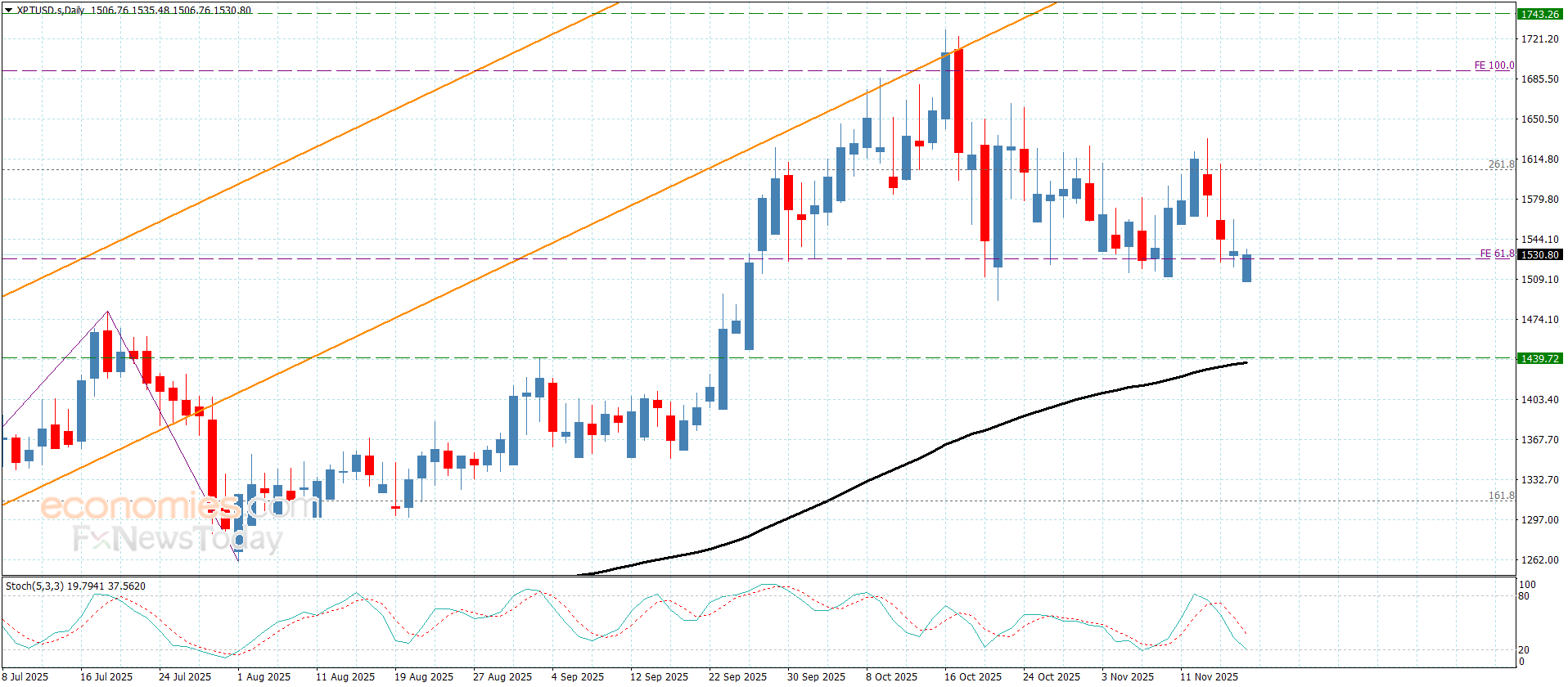
Platinum price remains stable near the extra support at $1520.00 level, attempting to find an exit to motive the suggested bearish corrective track, depending on the continuation of forming extra barrier at 1605.00 level and providing negative momentum by stochastic, increasing the chances of achieving corrective stations that are located at $1482.00 and $1440.00.
While the failure to break the current support will force it to form unstable mixed trading, and there is a new chance to attack $1605.00 level before reaching any of the waited corrective stations.
The expected trading range for today is between $1482.00 and $1565.00
Trend forecast: Bearish
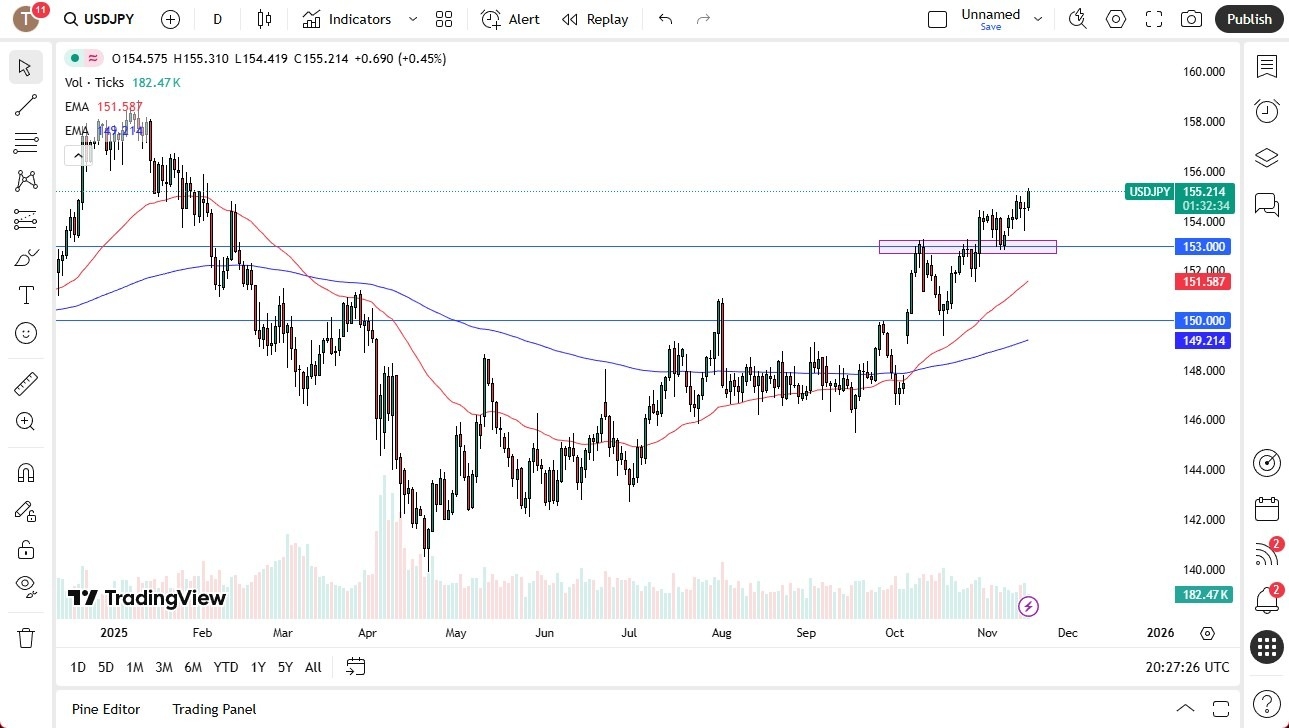
The US dollar has rallied during Monday trading to show strength again against the Japanese yen as we have broken above the 155 yen level, an area that is a large, round, psychologically significant figure, and an area that clearing is a very strong sign. Short-term pullbacks open up the possibility of buying dips, with the 154 yen level being support right along with the 153 yen level.

Keep in mind that the interest rate differential continues to favor the US dollar and the Japanese yen despite the fact that the Japanese yen is seeing rates rise behind it. That actually is a significant problem. And I think money will run from Japan as market participants continue to see just what kind of pickle the Japanese are in. Demographics are coming to roost right along with all of that quantitative easing that had been going on for decades.
With this, I still like the idea of buying the US dollar on short-term pullbacks as it will eventually show up as being bullish, and value hunters, I think, continue to drive this pair much higher. It doesn’t mean that we explode to the upside, but keep in mind that you get paid at the end of every day, and I think traders will just simply hang on to this. I have a target of about 159 yen at the moment, but we’ll just have to wait and see.
Want to trade our USD/JPY forex analysis and predictions? Here’s a list of forex brokers in Japan to check out.
I’ve been long of this pair since the middle of summer in various amounts and have no interest whatsoever in shorting right now.
Christopher Lewis has been trading Forex and has over 20 years experience in financial markets. Chris has been a regular contributor to Daily Forex since the early days of the site. He writes about Forex for several online publications, including FX Empire, Investing.com, and his own site, aptly named The Trader Guy. Chris favours technical analysis methods to identify his trades and likes to trade equity indices and commodities as well as Forex. He favours a longer-term trading style, and his trades often last for days or weeks.
Gold remains vulnerable early Tuesday, extending a four-day losing streak as US Dollar (USD) buyers hold the ground, eagerly awaiting the critical September Nonfarm Payrolls (NFP) report on Thursday.
Gold licks its wounds near five-day troughs of $4,006 reached on Monday, uninspired by broad risk aversion, amid a sustained US Dollar turnaround.
The Asian markets track Wall Street indices lower, as concerns over the US labor market and the AI overvaluations resurface ahead of the key quarterly earnings from chipmaker Nvidia on Wednesday.
Risk-off flows keep the sentiment around the US Dollar underpinned, weighing down on the USD-denominated Gold.
The Greenback also draws support from the recent slew of hawkish talks by US Federal Reserve (Fed) officials, which slashed the bets for another 25 basis points (bps) rate cut in December to 42%, according to the CME Group’s FedWatch Tool.
Fed Vice Chairman Philip Jefferson noted on Monday the US central bank needed to “proceed slowly” with further rate cuts, per Reuters.
The late pullback in the benchmark US 10-year Treasury bond yields due to risk-aversion-led rally in US Treasuries, fuelled a modest rebound in Gold. The bright metal settled Monday at around $4,040, having tested the $4,000 threshold earlier in the day.
Looking ahead, Gold remains exposed to downside risks as the USD will likely hold the fort before the release of missed mid-tier US economic data. Speeches from Fed officials will also be closely scrutinized for fresh signals on the Fed’s policy path.
However, the main event risk for this week is the US September jobs report, albeit stale, is eagerly awaited for fresh hints on the state of the labor market, following the recent series of downbeat private sector employment data.
In the daily chart, XAU/USD trades at $4,022.86. The 21-day Simple Moving Average (SMA) at $4,048.65 has turned lower, with price holding beneath it and signaling waning near-term momentum. The 50-, 100-, and 200-day SMAs at $3,954.55, $3,669.05, and $3,421.00 continue to rise and sit below price, reinforcing the broader bullish bias. The Relative Strength Index (RSI) eases to 49 (neutral), underscoring cooling upside pressure.
Measured from the $4,381.17 high to the $3,885.84 low, the 38.2% retracement at $4,075.05 acts as near-term resistance, with the 50% retracement at $4,133.50 above. A daily close back above the 21-day SMA would open a push toward those barriers, while a rejection keeps pressure toward the 50-day SMA at $3,954.55 and maintains a consolidative tone within the broader uptrend.
(The technical analysis of this story was written with the help of an AI tool)
The Nonfarm Payrolls release presents the number of new jobs created in the US during the previous month in all non-agricultural businesses; it is released by the US Bureau of Labor Statistics (BLS). The monthly changes in payrolls can be extremely volatile. The number is also subject to strong reviews, which can also trigger volatility in the Forex board. Generally speaking, a high reading is seen as bullish for the US Dollar (USD), while a low reading is seen as bearish, although previous months’ reviews and the Unemployment Rate are as relevant as the headline figure. The market’s reaction, therefore, depends on how the market assesses all the data contained in the BLS report as a whole.
The GBP/JPY rallies to a five-week high of 204.53 on Monday, up by 0.33% as the Japanese Yen weakens on growing tensions between China and Japan.
The GBP/JPY technical picture shows the pair is neutral biased tilted to the upside with key resistance levels found at 204.50. The Relative Strength Index (RSI) is bullish, though it shows that buyers are losing some momentum.
For a bullish continuation, buyers must clear the 204.50 area, ahead of challenging 205.00. Once surpassed, the next stop would be the October 8 high at 205.32, followed by 206.00.
Conversely if sellers push GBP/JPY below 204.00, the pair could challenge the 20-day SMA at 202.71. On further weakness the next support is 202.00
The table below shows the percentage change of British Pound (GBP) against listed major currencies today. British Pound was the strongest against the Australian Dollar.
| USD | EUR | GBP | JPY | CAD | AUD | NZD | CHF | |
|---|---|---|---|---|---|---|---|---|
| USD | 0.00% | 0.05% | -0.02% | 0.03% | 0.11% | 0.06% | -0.06% | |
| EUR | -0.00% | 0.05% | -0.02% | 0.02% | 0.11% | 0.06% | -0.06% | |
| GBP | -0.05% | -0.05% | -0.06% | -0.02% | 0.06% | 0.02% | -0.11% | |
| JPY | 0.02% | 0.02% | 0.06% | 0.03% | 0.12% | 0.06% | -0.05% | |
| CAD | -0.03% | -0.02% | 0.02% | -0.03% | 0.09% | 0.04% | -0.09% | |
| AUD | -0.11% | -0.11% | -0.06% | -0.12% | -0.09% | -0.05% | -0.16% | |
| NZD | -0.06% | -0.06% | -0.02% | -0.06% | -0.04% | 0.05% | -0.12% | |
| CHF | 0.06% | 0.06% | 0.11% | 0.05% | 0.09% | 0.16% | 0.12% |
The heat map shows percentage changes of major currencies against each other. The base currency is picked from the left column, while the quote currency is picked from the top row. For example, if you pick the British Pound from the left column and move along the horizontal line to the US Dollar, the percentage change displayed in the box will represent GBP (base)/USD (quote).
– Written by
David Woodsmith
STORY LINK GBP/USD Forecast: Pound Sterling Struggles as BoE Cut Bets Build
The Pound US Dollar exchange rate (GBP/USD) saw limited movement on Monday as markets continued to reassess expectations for future Federal Reserve monetary policy.
At the time of writing, GBP/USD was trading around $1.3171, virtually unchanged from Monday’s opening levels.
The US Dollar (USD) strengthened at the start of the week as investors further unwound expectations for an imminent Federal Reserve rate cut.
The likelihood of a December reduction has fallen sharply to around 45%, from roughly 90% just a month ago.
A cautious global mood also underpinned the Greenback, with weaker-than-expected Q3 GDP readings from Japan and Switzerland heightening concerns about global growth and prompting renewed demand for safe-haven assets such as the Dollar.
The Pound (GBP), meanwhile, traded broadly sideways as uncertainty surrounding the UK’s autumn budget continued to act as a drag on Sterling sentiment.
Markets remain unsure of the size of the UK’s fiscal gap and which measures Chancellor Rachel Reeves may introduce to plug it.
Get better rates and lower fees on your next international money transfer.
Compare TorFX with top UK banks in seconds and see how much you could save.
Reeves had previously signalled that income tax could rise, but reports last week suggesting she had backed away from the idea unsettled investors, pushing gilt yields higher and knocking Sterling.
Compounding budget anxiety are expectations that the Bank of England (BoE) may cut rates next month, keeping a lid on GBP buying interest.
Looking ahead, Tuesday’s US ADP employment report will be in sharp focus.
If the figures reveal another slowdown in private-sector hiring, the Dollar may weaken as markets reassess the Fed’s recent hawkish tilt.
For Sterling, attention will shift to comments from BoE policymaker Swati Dhingra, one of the Monetary Policy Committee’s most dovish members.
Any hint of support for further easing could reinforce expectations of a December rate cut and exert renewed pressure on the Pound.
International Money Transfer? Ask our resident FX expert a money transfer question or try John’s new, free, no-obligation personal service! ,where he helps every step of the way,
ensuring you get the best exchange rates on your currency requirements.
TAGS: Pound Dollar Forecasts
The recent $4.69 trend high completed an 88.6% Fibonacci retracement at $4.64 while hitting the convergence of the 175% extended top channel line and the upper boundary of the small ascending channel. That session formed a bearish shooting star, activated on Friday’s drop, with today’s action triggering a small-channel breakdown.
The small channel had illustrated slowing bullish momentum into the 88.6% zone. The RSI has now rolled over from overbought territory, adding weight to a deeper corrective phase after the 10-day average—dynamic support since its October 20 reclaim—finally gave way.
The 20-day average at $4.03 and rising is the immediate downside magnet, strengthened by recent clearance above the 38.2% retracement near $4.00. Further weakness targets the 50% retracement at $3.79, with the 61.8% zone and falling 200-day average near $3.50 as deeper possibilities.
Last week’s $4.26 low provides minor weekly support; a decisive drop beneath it flips the weekly chart bearish. Additional reaction zones sit between $4.16–$4.09, encompassing a prior weekly high/low and the June $4.15 swing high.
Today’s confirmed breakdown from the small channel and 10-day average shifts near-term control to sellers. Expect downward pressure to persist in the weeks ahead, with the 20-day/$4.00–$4.03 confluence as the first meaningful test. Only a swift reclaim of $4.42 would neutralize the bearish trigger; until then, risk skews toward $3.79 and lower.
For a look at all of today’s economic events, check out our economic calendar.
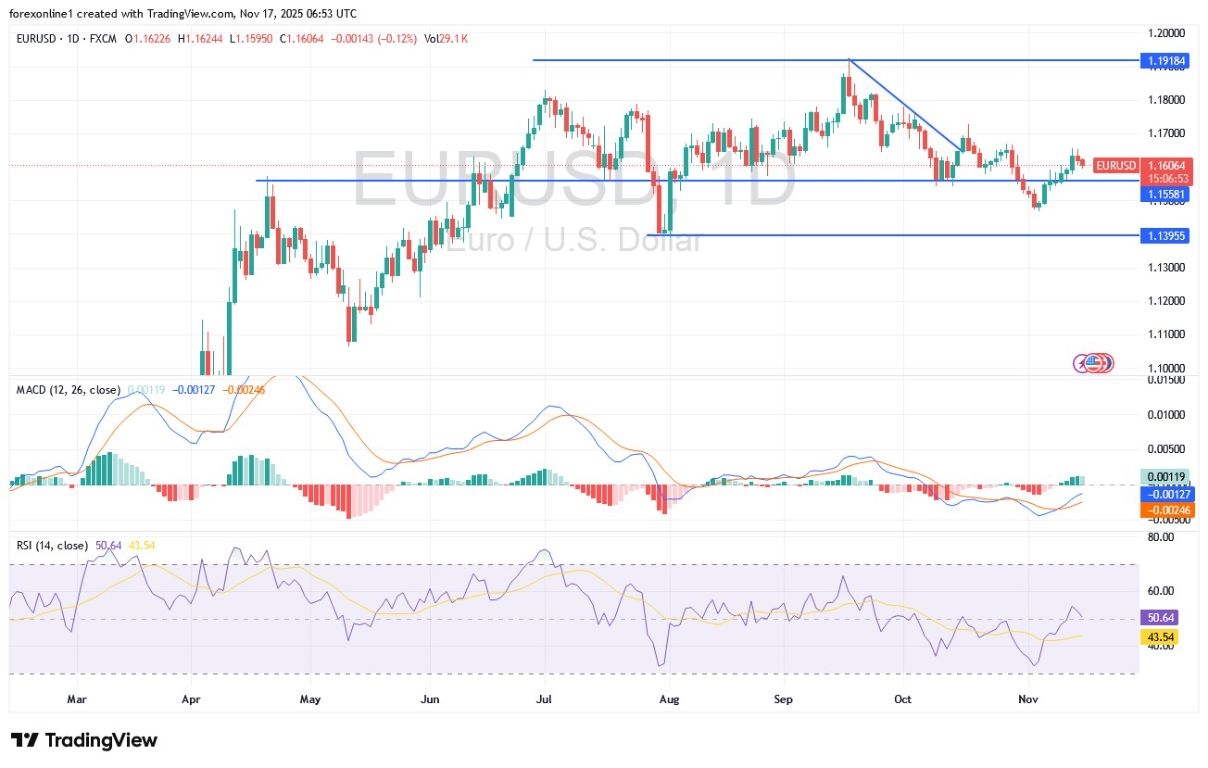
I still caution against the future rise of the EUR/USD, as the upward rebound gains last week are not yet sufficient to change the overall direction of the Euro/Dollar pair to bullish. Based on the performance on the daily chart, the Euro/Dollar price needs to break the psychological resistance level of 1.1800 for the bulls to gain strong momentum and confirm a change in the overall trend. On the platforms of reputable forex brokers, the gains of the most popular currency pair in the forex market did not exceed the 1.1656 resistance level, the pair’s highest point in two weeks, before closing trading around 1.1620. This occurred amidst the currency markets’ reaction to the official announcement of the end of the longest US government shutdown in the country’s history.
The upward rebound gains for the EUR/USD pair pushed the 14-day Relative Strength Index (RSI) to a reading of 53, relatively far from the neutral line. At the same time, the MACD indicator lines are leaning upward, awaiting stronger impetus. The scenario of a Euro/Dollar decline will gain strength again if the bears return the currency pair to the vicinity of the support levels 1.1550 and 1.1480, respectively. Today, the Euro/Dollar is not anticipating major and influential economic data, only a round of statements from some members of the US Federal Reserve.
Carefully and cautiously monitor the influencing factors on the currency market, represented by US economic releases and signals from the US Federal Reserve, to determine the most suitable trading entries for the currency pair.
According to Forex currency market trading, the US Dollar price saw a rise in recent weeks as a result of the decline in expectations for a US interest rate cut by the Federal Reserve in December. While the probability of a cut was almost certain just one month ago, the market now sees the chance of a cut as 50/50. Expectations have since stabilized around this level, and Dollar trading has relinquished some of its recent gains.
Overall, the US Dollar’s rise was temporarily suspended once investors began to see signs of progress toward ending the US government shutdown, which finally ended in the middle of the week. This revives hopes that official US economic data will start to appear soon, providing a stronger basis for Federal Reserve interest rate expectations.
Consequently, investors are likely to wait for the data before pushing the US dollar higher.
Ready to trade our daily Forex analysis? We’ve made a list of the best online forex trading platform worth trading with.
Silver (XAG/USD) is showing a mild recovery attempt on Monday. The pair bounced up from $50.00 lows on Friday but is struggling to find acceptance above the $51.00 level. which leaves price action hovering in no man’s land, after a sharp reversal from the $54.30 area last week.
Precious metals trimmed losses on Monday, with risk appetite subdued as Japan threatened China with military action if Taiwan were to be attacked. Investors, however, are on a wait-and-see stance, awaiting the release of a stream of delayed US macroeconomic releases later in the week, which is expected to shed some more light on the momentum of the US economy and the Federal Reserve’s interest rate decisions.
The technical picture remains bearish, following a sharp reversal from the $54.30 area last week, which highlights a potential double top formation at the mid-range of the $54.00s. This is a common pattern of trend shifts that comes after a 70% rally in the last seven months.
Meanwhile, the lower high on Friday endorses the bearish view, and the weak oscillators, with the 4-hour Relative Strength Index (RSI) depressed below the 50 level, suggest that the current rebound is frail and that a deeper correction may be forthcoming.
Immediate support remains at Friday’s lows of $50.00, which, so far, is closing the path towards the October 23 and 31 highs, near $49.35, and the November 4 low, at $46.95. To the upside, a previous support at the 52.10 area (November 13 low) is likely to challenge bulls ahead of the November 14 high at $53.65 and the long-term highs between $54.60 and $54.80.