The main category of Forex News.
You can use the search box below to find what you need.
[wd_asp id=1]
The main category of Forex News.
You can use the search box below to find what you need.
[wd_asp id=1]
The British Pound (GBP) trades on the back foot against the Japanese Yen (JPY) on Friday after the Pound weakened broadly following a Financial Times report that Prime Minister Keir Starmer and Chancellor Rachel Reeves have abandoned plans to raise income-tax rates ahead of the November 26 budget.
At the time of writing, GBP/JPY is trading around 203.00, down nearly 0.30%, after rebounding from an intraday low of 202.34.
From a technical perspective, the daily chart continues to show an overall uptrend, with prices holding comfortably above both short-term and long-term moving averages.
On the downside, the 21-day Simple Moving Average (SMA) at 202.49 is acting as immediate support. A deeper pullback would expose the 50-day SMA near 201.43, followed by a strong confluence zone around the 100-day SMA at 199.97 and the psychological 200.00 level, which also aligns with the horizontal floor of the previous consolidation phase.
Holding above this region keeps the broader bias constructive, while a decisive break below 200.00 could hand near-term control to sellers and open the door for a deeper retracement toward 199.00 and 198.50.
On the upside, the 204.00 area, near this week’s highs, marks immediate resistance. A decisive break above that threshold would likely propel GBP/JPY toward fresh year-to-date highs above 205.33.
Momentum indicators reflect a pause in trend strength. The Relative Strength Index (RSI) is neutral around 54, and the Average Directional Index (ADX) remains subdued, suggesting a brief consolidation phase may unfold before the next directional move.
The Pound Sterling (GBP) is the oldest currency in the world (886 AD) and the official currency of the United Kingdom. It is the fourth most traded unit for foreign exchange (FX) in the world, accounting for 12% of all transactions, averaging $630 billion a day, according to 2022 data.
Its key trading pairs are GBP/USD, also known as ‘Cable’, which accounts for 11% of FX, GBP/JPY, or the ‘Dragon’ as it is known by traders (3%), and EUR/GBP (2%). The Pound Sterling is issued by the Bank of England (BoE).
The single most important factor influencing the value of the Pound Sterling is monetary policy decided by the Bank of England. The BoE bases its decisions on whether it has achieved its primary goal of “price stability” – a steady inflation rate of around 2%. Its primary tool for achieving this is the adjustment of interest rates.
When inflation is too high, the BoE will try to rein it in by raising interest rates, making it more expensive for people and businesses to access credit. This is generally positive for GBP, as higher interest rates make the UK a more attractive place for global investors to park their money.
When inflation falls too low it is a sign economic growth is slowing. In this scenario, the BoE will consider lowering interest rates to cheapen credit so businesses will borrow more to invest in growth-generating projects.
Data releases gauge the health of the economy and can impact the value of the Pound Sterling. Indicators such as GDP, Manufacturing and Services PMIs, and employment can all influence the direction of the GBP.
A strong economy is good for Sterling. Not only does it attract more foreign investment but it may encourage the BoE to put up interest rates, which will directly strengthen GBP. Otherwise, if economic data is weak, the Pound Sterling is likely to fall.
Another significant data release for the Pound Sterling is the Trade Balance. This indicator measures the difference between what a country earns from its exports and what it spends on imports over a given period.
If a country produces highly sought-after exports, its currency will benefit purely from the extra demand created from foreign buyers seeking to purchase these goods. Therefore, a positive net Trade Balance strengthens a currency and vice versa for a negative balance.
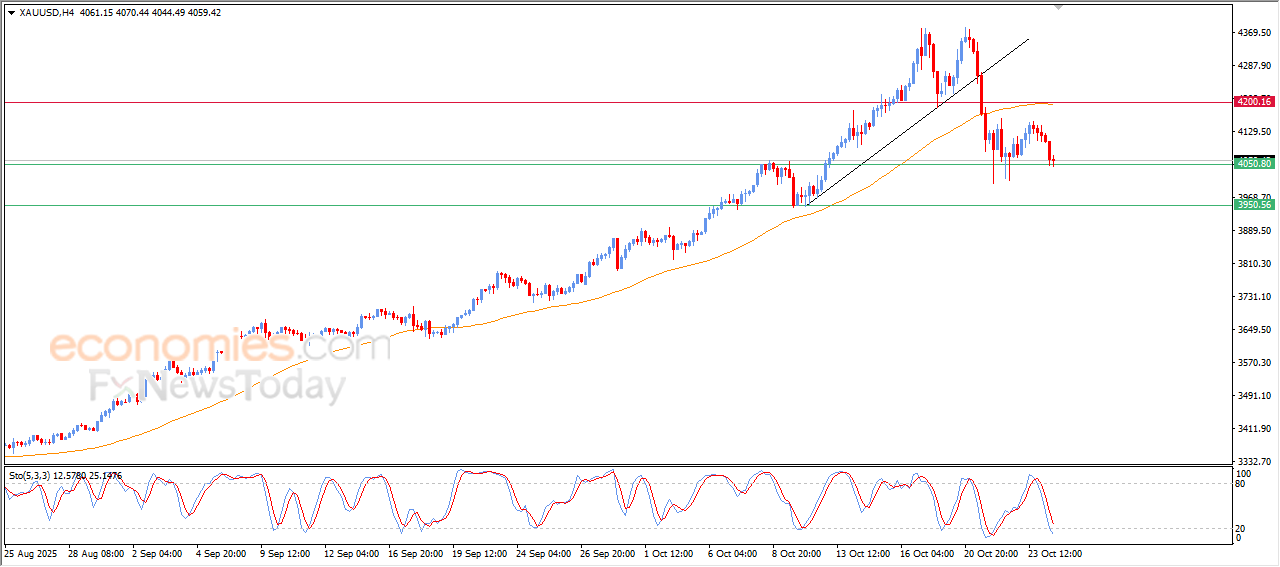
Gold price (XAU/USD) recovers some lost ground to near $4,105, snapping the two-day losing streak during the early European session on Friday. The precious metal edges higher on the softer US Dollar (USD). Traders will take more cues from the Fedspeak later on Monday. The Fed’s John Williams, Philip Jefferson, Neel Kashkari and Christopher Waller are set to speak.
Improved market sentiment after the federal government reopened undermined the safe-haven assets, such as the Gold price. The US government has reopened after US President Donald Trump signed a funding bill into law last week, ending the longest shutdown in US history, which lasted 43 days. Federal employees were directed to return to work on Thursday.
However, investors continue to grapple with uncertainty over the release of delayed economic data following the record-long shutdown. Analysts believe that the resumption of US economic data will show job market weakness and a potential slowdown. This, in turn, could weigh on the Greenback and lift the USD-denominated commodity price. Non-yielding yellow metal tends to perform well during periods of economic uncertainty and in a low-interest-rate environment.
The upside for the yellow metal might be limited due to hawkish remarks from US Federal Reserve (Fed) officials, dimming hopes for a December interest rate cut. Kansas City Fed President Jeffery Schmid said on Friday that monetary policy should “lean against demand growth,” adding that current Fed policy is “modestly restrictive,” which he believes is appropriate.
Financial markets are now pricing in a nearly 54% chance that the Fed will cut its benchmark overnight borrowing rate by 25 basis points (bps) at its December meeting, down from 62.9% probability that markets priced in earlier last week, according to the CME FedWatch Tool.
Gold has played a key role in human’s history as it has been widely used as a store of value and medium of exchange. Currently, apart from its shine and usage for jewelry, the precious metal is widely seen as a safe-haven asset, meaning that it is considered a good investment during turbulent times. Gold is also widely seen as a hedge against inflation and against depreciating currencies as it doesn’t rely on any specific issuer or government.
Central banks are the biggest Gold holders. In their aim to support their currencies in turbulent times, central banks tend to diversify their reserves and buy Gold to improve the perceived strength of the economy and the currency. High Gold reserves can be a source of trust for a country’s solvency. Central banks added 1,136 tonnes of Gold worth around $70 billion to their reserves in 2022, according to data from the World Gold Council. This is the highest yearly purchase since records began. Central banks from emerging economies such as China, India and Turkey are quickly increasing their Gold reserves.
Gold has an inverse correlation with the US Dollar and US Treasuries, which are both major reserve and safe-haven assets. When the Dollar depreciates, Gold tends to rise, enabling investors and central banks to diversify their assets in turbulent times. Gold is also inversely correlated with risk assets. A rally in the stock market tends to weaken Gold price, while sell-offs in riskier markets tend to favor the precious metal.
The price can move due to a wide range of factors. Geopolitical instability or fears of a deep recession can quickly make Gold price escalate due to its safe-haven status. As a yield-less asset, Gold tends to rise with lower interest rates, while higher cost of money usually weighs down on the yellow metal. Still, most moves depend on how the US Dollar (USD) behaves as the asset is priced in dollars (XAU/USD). A strong Dollar tends to keep the price of Gold controlled, whereas a weaker Dollar is likely to push Gold prices up.
This combination of Prime Minister Takaichi’s policy goals, economic data, and uncertainty about a BoJ rate hike has pushed USD/JPY higher.
Traders may also question the lasting effectiveness of further yen intervention threats, given Takaichi’s support for ultra-loose policy and fiscal stimulus plans. Significantly, the third quarter GDP numbers call for both, fiscal stimulus and a more dovish BoJ Policy stance.
While Japanese data weighs on BoJ rate hike bets, US economic indicators and Fed speakers will influence US dollar demand later on Monday.
Economists expect the NY Empire State Manufacturing Index to drop from 10.7 in October to 6.1 in November. A larger-than-expected drop toward 0 could raise fears of a US recession, weighing on the US dollar. However, the numbers are unlikely to affect the Fed’s policy stance. US inflation and jobs data remain the Fed’s focal points as policymakers await delayed data following the US government reopening.
Meanwhile, hawkish Fed speeches may send USD/JPY higher during the US session. FOMC members Jefferson and Williams are due to speak. Rising Fed focus on inflation over jobs data could further temper bets on a December Fed rate cut. A less dovish Fed policy stance may send USD/JPY above the November 12 high of 155.044.
The key question remains whether concerns about elevated inflation override weaker labor market signals at the December FOMC meeting.
Coffee price formed the inverted head and shoulders pattern in its last trading, and 424.20 level forms the main neckline as appears in the above image, noticing the attempt to surpass the neckline at 437.40 in yesterday trading, to bounce quickly towards 410.00.
The price needs new positive momentum that allows it to settle above extra support towards 393.25, then wait for breaching 424.20 level, to confirm activating the bullish pattern, to target 457.50 and 486.00 level.
The expected trading range for today is between 400.50 and 457.50
Trend forecast: Bullish
West Texas Intermediate (WTI) Oil price advances on Friday, early in the European session. WTI trades at $59.42 per barrel, up from Thursday’s close at $58.56.
Brent Oil Exchange Rate (Brent crude) is also up, advancing from the $62.69 price posted on Thursday, and trading at $63.52.
WTI Oil is a type of Crude Oil sold on international markets. The WTI stands for West Texas Intermediate, one of three major types including Brent and Dubai Crude. WTI is also referred to as “light” and “sweet” because of its relatively low gravity and sulfur content respectively. It is considered a high quality Oil that is easily refined. It is sourced in the United States and distributed via the Cushing hub, which is considered “The Pipeline Crossroads of the World”. It is a benchmark for the Oil market and WTI price is frequently quoted in the media.
Like all assets, supply and demand are the key drivers of WTI Oil price. As such, global growth can be a driver of increased demand and vice versa for weak global growth. Political instability, wars, and sanctions can disrupt supply and impact prices. The decisions of OPEC, a group of major Oil-producing countries, is another key driver of price. The value of the US Dollar influences the price of WTI Crude Oil, since Oil is predominantly traded in US Dollars, thus a weaker US Dollar can make Oil more affordable and vice versa.
The weekly Oil inventory reports published by the American Petroleum Institute (API) and the Energy Information Agency (EIA) impact the price of WTI Oil. Changes in inventories reflect fluctuating supply and demand. If the data shows a drop in inventories it can indicate increased demand, pushing up Oil price. Higher inventories can reflect increased supply, pushing down prices. API’s report is published every Tuesday and EIA’s the day after. Their results are usually similar, falling within 1% of each other 75% of the time. The EIA data is considered more reliable, since it is a government agency.
OPEC (Organization of the Petroleum Exporting Countries) is a group of 12 Oil-producing nations who collectively decide production quotas for member countries at twice-yearly meetings. Their decisions often impact WTI Oil prices. When OPEC decides to lower quotas, it can tighten supply, pushing up Oil prices. When OPEC increases production, it has the opposite effect. OPEC+ refers to an expanded group that includes ten extra non-OPEC members, the most notable of which is Russia.
West Texas Intermediate (WTI) Oil price falls on Tuesday, early in the European session. WTI trades at $59.78 per barrel, down from Monday’s close at $60.06.
Brent Oil Exchange Rate (Brent crude) is also shedding ground, trading at $63.69 after its previous daily close at $63.96.
WTI Oil is a type of Crude Oil sold on international markets. The WTI stands for West Texas Intermediate, one of three major types including Brent and Dubai Crude. WTI is also referred to as “light” and “sweet” because of its relatively low gravity and sulfur content respectively. It is considered a high quality Oil that is easily refined. It is sourced in the United States and distributed via the Cushing hub, which is considered “The Pipeline Crossroads of the World”. It is a benchmark for the Oil market and WTI price is frequently quoted in the media.
Like all assets, supply and demand are the key drivers of WTI Oil price. As such, global growth can be a driver of increased demand and vice versa for weak global growth. Political instability, wars, and sanctions can disrupt supply and impact prices. The decisions of OPEC, a group of major Oil-producing countries, is another key driver of price. The value of the US Dollar influences the price of WTI Crude Oil, since Oil is predominantly traded in US Dollars, thus a weaker US Dollar can make Oil more affordable and vice versa.
The weekly Oil inventory reports published by the American Petroleum Institute (API) and the Energy Information Agency (EIA) impact the price of WTI Oil. Changes in inventories reflect fluctuating supply and demand. If the data shows a drop in inventories it can indicate increased demand, pushing up Oil price. Higher inventories can reflect increased supply, pushing down prices. API’s report is published every Tuesday and EIA’s the day after. Their results are usually similar, falling within 1% of each other 75% of the time. The EIA data is considered more reliable, since it is a government agency.
OPEC (Organization of the Petroleum Exporting Countries) is a group of 12 Oil-producing nations who collectively decide production quotas for member countries at twice-yearly meetings. Their decisions often impact WTI Oil prices. When OPEC decides to lower quotas, it can tighten supply, pushing up Oil prices. When OPEC increases production, it has the opposite effect. OPEC+ refers to an expanded group that includes ten extra non-OPEC members, the most notable of which is Russia.
The GBPJPY pair rose in its last intraday trading, to recover some previous losses, attempting to offload some of its clear oversold conditions on the relative strength indicators, especially with the emergence of positive overlapping signals.
Affected by breaking main bullish trend line on the short-term basis, there is negative pressure due to its trading below EMA50, forming an obstacle against the attempts of the price recovery on a near-term basis.
Therefore, our expectations suggest a decline in its upcoming intraday trading, if the resistance settles at 203.40, to target the initial support levels at 202.60.
The expected trading range for today is between 202.60 and 203.40
Trend forecast: Bearish
Silver price (XAG/USD) retraces its recent losses from the previous session, trading around $52.70 per troy ounce during the Asian hours on Friday. The attracts buyers
Safe-haven demand for precious metals, including Silver, is rising amid uncertainty over the US economic outlook, fueled by a backlog of official data after the government’s reopening. Early private-sector readings for October point to a cooling labor market, softer consumer confidence, and lingering inflation concerns.
National Economic Council Director Kevin Hassett cautioned that some October data may “never materialize,” as several agencies were unable to gather information during the shutdown. US President Donald Trump signed the government funding bill on Thursday to end the record 43-day government shutdown in US history.
The upside of the non-interest-bearing Silver could be limited as cautious remarks from Federal Reserve (Fed) officials decreased the odds of a Federal Reserve (Fed) rate cut in December. The higher interest rates push the yields higher on newly issued bonds to attract investors who are looking to earn better returns. The CME FedWatch Tool shows markets pricing in nearly a 50% chance of a 25-basis-point Fed rate cut in December, down from 69% a week ago.
Federal Reserve Bank of St. Louis President Alberto Musalem highlighted the need for caution on Thursday, noting there is limited room to ease without risking overly accommodative policy. Meanwhile, Minneapolis Fed President Neel Kashkari added that inflation remains too high at 3%.
Supply risks also supported Silver’s gains, amid concerns over possible US tariffs on the metal. Last week, the US Department of the Interior added Silver, Copper, and metallurgical Coal to its “critical minerals” list, underscoring their economic and national security importance. This classification opens the door for potential Section 232 investigations and trade measures, similar to those previously imposed on Copper.
Silver is a precious metal highly traded among investors. It has been historically used as a store of value and a medium of exchange. Although less popular than Gold, traders may turn to Silver to diversify their investment portfolio, for its intrinsic value or as a potential hedge during high-inflation periods. Investors can buy physical Silver, in coins or in bars, or trade it through vehicles such as Exchange Traded Funds, which track its price on international markets.
Silver prices can move due to a wide range of factors. Geopolitical instability or fears of a deep recession can make Silver price escalate due to its safe-haven status, although to a lesser extent than Gold’s. As a yieldless asset, Silver tends to rise with lower interest rates. Its moves also depend on how the US Dollar (USD) behaves as the asset is priced in dollars (XAG/USD). A strong Dollar tends to keep the price of Silver at bay, whereas a weaker Dollar is likely to propel prices up. Other factors such as investment demand, mining supply – Silver is much more abundant than Gold – and recycling rates can also affect prices.
Silver is widely used in industry, particularly in sectors such as electronics or solar energy, as it has one of the highest electric conductivity of all metals – more than Copper and Gold. A surge in demand can increase prices, while a decline tends to lower them. Dynamics in the US, Chinese and Indian economies can also contribute to price swings: for the US and particularly China, their big industrial sectors use Silver in various processes; in India, consumers’ demand for the precious metal for jewellery also plays a key role in setting prices.
Silver prices tend to follow Gold’s moves. When Gold prices rise, Silver typically follows suit, as their status as safe-haven assets is similar. The Gold/Silver ratio, which shows the number of ounces of Silver needed to equal the value of one ounce of Gold, may help to determine the relative valuation between both metals. Some investors may consider a high ratio as an indicator that Silver is undervalued, or Gold is overvalued. On the contrary, a low ratio might suggest that Gold is undervalued relative to Silver.
– Written by
Frank Davies
STORY LINK Pound to Dollar Forecast: GBP Rebounds on USD Pullback, Fundamentals Still Fragile
The Pound to Dollar exchange rate (GBP/USD) slipped below 1.3100 on Wednesday following a weak UK GDP print and persistent political uncertainty, but Sterling later recovered as the dollar softened.
By Thursday afternoon, GBP/USD was trading around 1.3145 (-0.06%), supported by a US dollar pullback despite sustained bearish pressure on the Pound.
Analysts at UoB noted that a break above 1.3165 would signal that “the current mild downward pressure has eased,” while ING maintains a year-end GBP/USD target of 1.34 as dollar momentum fades into December.
The latest GDP figures painted a bleak picture. UK output contracted 0.1% in September versus expectations of flat growth. The third quarter posted only 0.1% growth against the 0.2% consensus, with manufacturing hit hard by the JLR cyberattack and only marginal gains in construction and services.
Quilter’s Lindsay James said; “This paints a picture of an economy that started 2025 strongly but is now badly losing steam just as the Chancellor prepares for a pivotal Autumn Budget.”
ING added; “This complicates the job of Chancellor Rachel Reeves ahead of the Budget, where she’ll try to reassure markets with fiscally prudent measures, whilst trying not to dampen growth excessively or stoke up inflation.”
Get better rates and lower fees on your next international money transfer.
Compare TorFX with top UK banks in seconds and see how much you could save.
Fresh reports that Chancellor Rachel Reeves has dropped plans for income tax hikes added further uncertainty. According to ING, Sterling came under renewed pressure because earlier gains in gilts had been based on expectations that income tax rises would deliver the necessary fiscal tightening without stoking inflation, creating room for the BoE to cut rates in December.
ING warned: “It’s unclear how Reeves will fill the £30bn fiscal hole without touching income tax. VAT hikes would be inflationary, risking hawkish BoE repricing. Freezing tax thresholds is one alternative but markets will scrutinise the details.”
Signs of slowing growth and deteriorating labour-market conditions have strengthened expectations of a December BoE rate cut.
MUFG said; “Slowing growth momentum and weakness in the labour market are encouraging market expectations for active BoE easing.”
RSM UK’s Thomas Pugh added; “If we didn’t think a December rate cut was nailed on already, this morning’s data almost certainly makes it so.”
Political risk adds another layer. Prime Minister Starmer’s approval ratings remain poor, and MUFG warned that the May 2025 local elections could be a decisive test, with further Pound weakness likely if markets begin to price in a meaningful political risk premium.

With the US government now reopened, markets will refocus on delayed economic data, particularly jobs reports.
Market pricing for a December Fed cut has cooled to around 55%, with Fed officials increasingly divided.
Scotiabank noted: “WSJ Fed-watcher Timiraos reports Fed officials are fracturing over a December cut after hawks pushed for a pause after last month’s decision.”
Upcoming labour data will be crucial in determining whether December easing remains viable.
As ING put it; “We think markets are underestimating the downside risks for the labour market, US front-end rates and – by extension – the dollar into year-end.”
International Money Transfer? Ask our resident FX expert a money transfer question or try John’s new, free, no-obligation personal service! ,where he helps every step of the way,
ensuring you get the best exchange rates on your currency requirements.
TAGS: Pound Dollar Forecasts