The main category of Forex News.
You can use the search box below to find what you need.
[wd_asp id=1]
The main category of Forex News.
You can use the search box below to find what you need.
[wd_asp id=1]
The article covers the following subjects:
Consider short positions from corrections below the level of 92.06 with a target of 78.00–65.00.
Breakout and consolidation above the level of 92.06 will allow the asset to continue rising to the levels of 105.17–115.45.
A descending correction appears to have formed as the second wave of larger degree (2) on the weekly chart, with wave C of (2) completed as its part. On the daily time frame, an ascending third wave (3) appears to have started developing. Within it, the first wave of smaller degree 1 of (3) has formed, and a downward correction is unfolding as the second wave 2 of (3). Wave c of 2 is presumably developing on the H4 chart; within it, wave (v) of c is unfolding. If the presumption is correct, WTI will continue to decline to the levels of 78.00–65.00. The level of 92.06 is critical in this scenario as a breakout above it will enable the asset to continue rising to the levels of 105.17–115.45.
This forecast is based on the Elliott Wave Theory. When developing trading strategies, it is essential to consider fundamental factors, as the market situation can change at any time.
The content of this article reflects the author’s opinion and does not necessarily reflect the official position of LiteFinance broker. The material published on this page is provided for informational purposes only and should not be considered as the provision of investment advice for the purposes of Directive 2014/65/EU.
According to copyright law, this article is considered intellectual property, which includes a prohibition on copying and distributing it without consent.
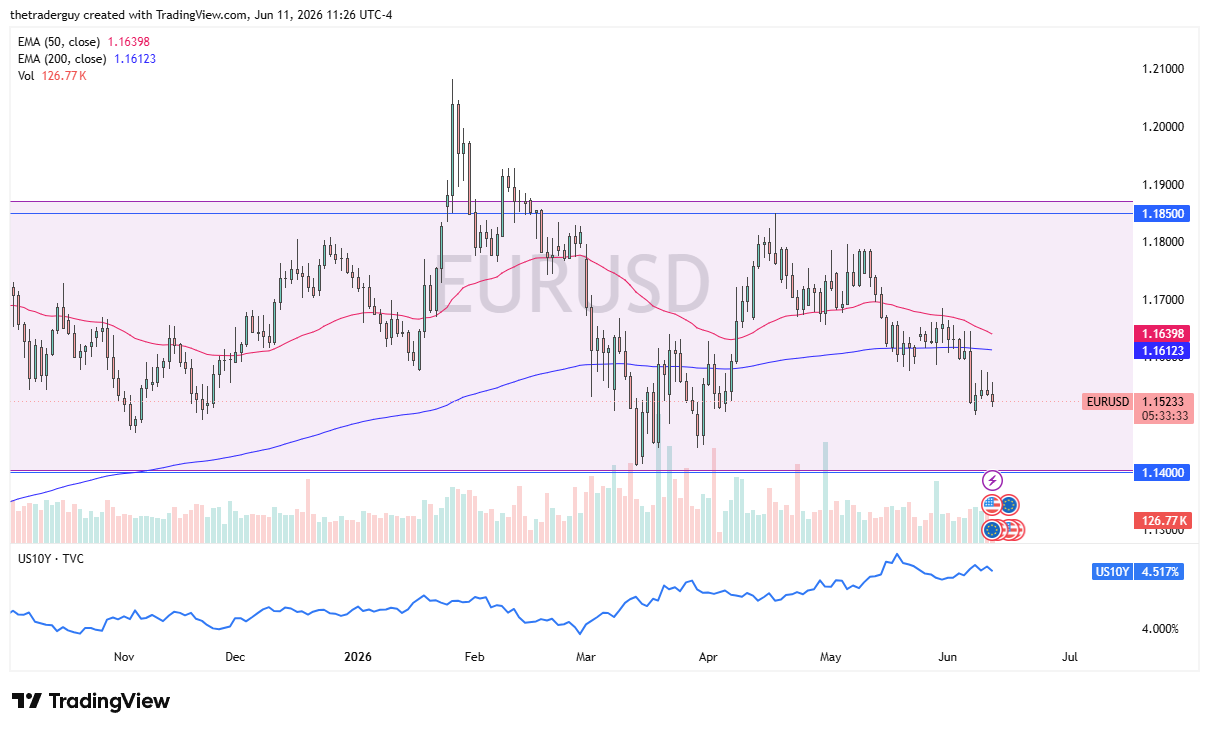
The Euro initially tried to rally a bit during the trading session here on Thursday, but it continues to see overhead pressure.
This is interesting because we did have the ECB interest rate decision as well as a statement, and despite the fact that the Europeans did in fact raise interest rates by 25 basis points, but all things being equal, this is a market that I think continues to see a lot of questions about whether or not the market is going to continue to expect weakness out of Europe, and I think they do.
The reaction certainly was negative, especially considering that US interest rates dropped. You would think that would lead to higher pricing of the Euro, but it clearly hasn’t. So, at this point in time, I think we are looking at this as a potential move to the 1.14 level underneath.
The 1.14 level underneath is an area that a lot of people will be watching very closely, as it was previous massive support. And if we were to break down below there, then it opens up the possibility of a move to the 1.12 level.

Any rally at this point in time, I think, would struggle to have a bit of a barrier in the form of the 200-day EMA at the 1.1612 level. Breaking above that would be extraordinarily strong, but I just don’t see that happening.
So, with that being said, I think this is a “fade the rally” market, and the last 4 days have clearly shown that to at least be true so far. I have a hard time with the idea of buying the Euro at the moment, at least against the US dollar.
Ready to trade our EUR/USD daily forecast? Here’s a list of some of the top forex brokers in Europe to check out.
Christopher Lewis is a technical analyst and market commentator at DailyForex with more than two decades of trading experience in Forex and other leveraged markets. Based in Columbus, Ohio, he specializes in chart-based analysis of major currency pairs, stock indices, commodities, and energy markets, focusing on clear support and resistance levels, trend structure, and risk management. Christopher produces daily written and video analysis for traders who rely on technical setups to navigate volatile market conditions
As seen on: Pairs Of Aces Podcast,The Trader Guy, FXEmpire
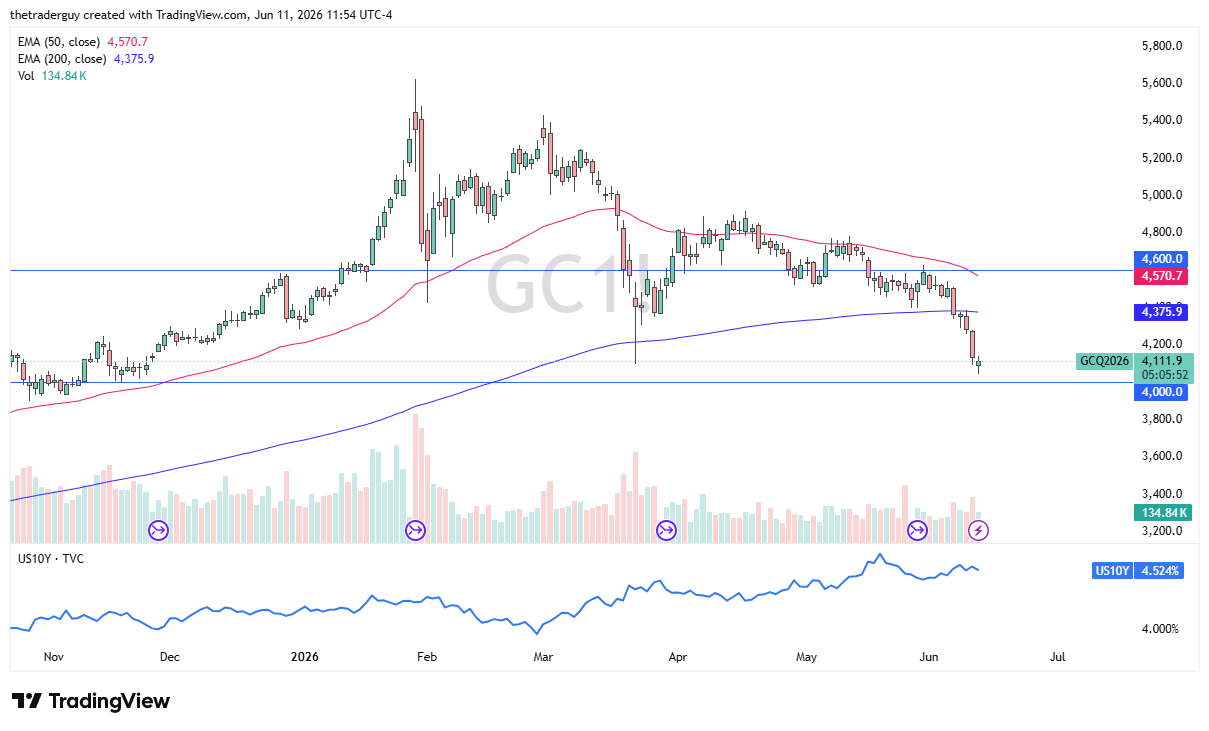
The gold market has chopped back and forth during the trading session here on Thursday as we are hovering just above the crucial $4,000 level.
The $4,000 level is an area that I think traders continue to look at very closely, mainly due to the idea that a large, round, psychologically significant figure probably attracts a lot of attention from options traders.
That being said, it’s interesting that the XAU/USD pair continues to look kind of sluggish despite the fact that interest rates are starting to drop. So that is a little bit of a move from the negative correlation between interest rates and gold that we saw. Regardless, the $4,000 level for me is crucial. If we give that up, we will probably drop another $500.
I’m not a big fan of shorting gold, although it clearly doesn’t do well buying it over the last couple of weeks. But if we do bounce from here, I can see a short-term opportunity might present itself for both buyers and sellers. I would anticipate that the 200-day EMA offers a bit of a barrier.
Ultimately, this is a market that I would fade signs of exhaustion until we see some type of change in attitude, and it’s probably worth noting that the US dollar is extraordinarily strong despite the fact that we have the overall attitude of the markets changing, and I think you have a market that I think remains noisy.
Longer term, I do like gold, but I think if we do pull back from here, and when you look at the longer-term charts, it does make a certain amount of sense, we could drop down to the $3,500 level, and it would just be a nice pullback in a huge uptrend.
So, with that being said, I like the idea of buying gold eventually, just not right now. If you’re a day trader, you might be able to trade the pop, but you have to be very nimble and get out at the first sign of trouble.
Ready to trade today’s Gold prediction? Here’s a list of some of the best XAU/USD brokers to check out.
Christopher Lewis is a technical analyst and market commentator at DailyForex with more than two decades of trading experience in Forex and other leveraged markets. Based in Columbus, Ohio, he specializes in chart-based analysis of major currency pairs, stock indices, commodities, and energy markets, focusing on clear support and resistance levels, trend structure, and risk management. Christopher produces daily written and video analysis for traders who rely on technical setups to navigate volatile market conditions
As seen on: Pairs Of Aces Podcast,The Trader Guy, FXEmpire
The price of copper recently tested the additional support level at $6.1000, which has formed a strong barrier against attempts to resume the corrective decline. As a result, we are currently seeing some positive waves forming, with the price stabilizing near $6.3600.
We expect the price to be influenced by sideways movement dominance due to its repeated confinement between the previously mentioned support level, while the $6.6600 level continues to act as a strong barrier at the moment. However, the stochastic indicator attempting to provide negative momentum increases the chances of renewed corrective moves, which may pressure the support again and create an opportunity to resume the corrective downtrend in the short to medium term.
Expected trading range for today: between $5.1000 and $6.4200
Today’s forecast: Bearish, as long as the resistance holds
The price of copper recently tested the additional support level at $6.1000, which has formed a strong barrier against attempts to resume the corrective decline. As a result, we are currently seeing some positive waves forming, with the price stabilizing near $6.3600.
We expect the price to be influenced by sideways movement dominance due to its repeated confinement between the previously mentioned support level, while the $6.6600 level continues to act as a strong barrier at the moment. However, the stochastic indicator attempting to provide negative momentum increases the chances of renewed corrective moves, which may pressure the support again and create an opportunity to resume the corrective downtrend in the short to medium term.
Expected trading range for today: between $5.1000 and $6.4200
Today’s forecast: Bearish, as long as the resistance holds
EUR/USD is losing ground as traders react to the ECB Interest Rate Decision. The European Central Bank raised the interest rate from 2.15% to 2.4%, in line with analyst consensus.
ECB noted that the war in the Middle East generated inflation pressures. According to ECB, headline inflation is expected to average 3.0% in 2026, 2.3% in 2027, and 2.0% in 2028.
Currently, EUR/USD is trying to settle below the support level at 1.1500 – 1.1515. In case this attempt is successful, EUR/USD will move towards the next support, which is located in the 1.1415 – 1.1430 range.
Stay informed on platinum price trends in Jayankondam. Today’s rates stand at ₹51,060
for 10g, ₹5,10,600 for 100g, and ₹51,06,000 for 1kg. In June, platinum
saw fluctuations. The highest rate for 100g touched ₹5,95,300,
and the lowest fell to ₹5,10,200. For 1kg, prices ranged from
₹51,02,000 to ₹59,53,000.
Global supply chains, mining rates, and geopolitical issues are major drivers of platinum
prices. Demand from the auto and electronics industries adds pressure. Exchange rate
movements, especially against the US dollar, combined with inflation trends and central
bank strategies, contribute significantly to changes in platinum’s market price.
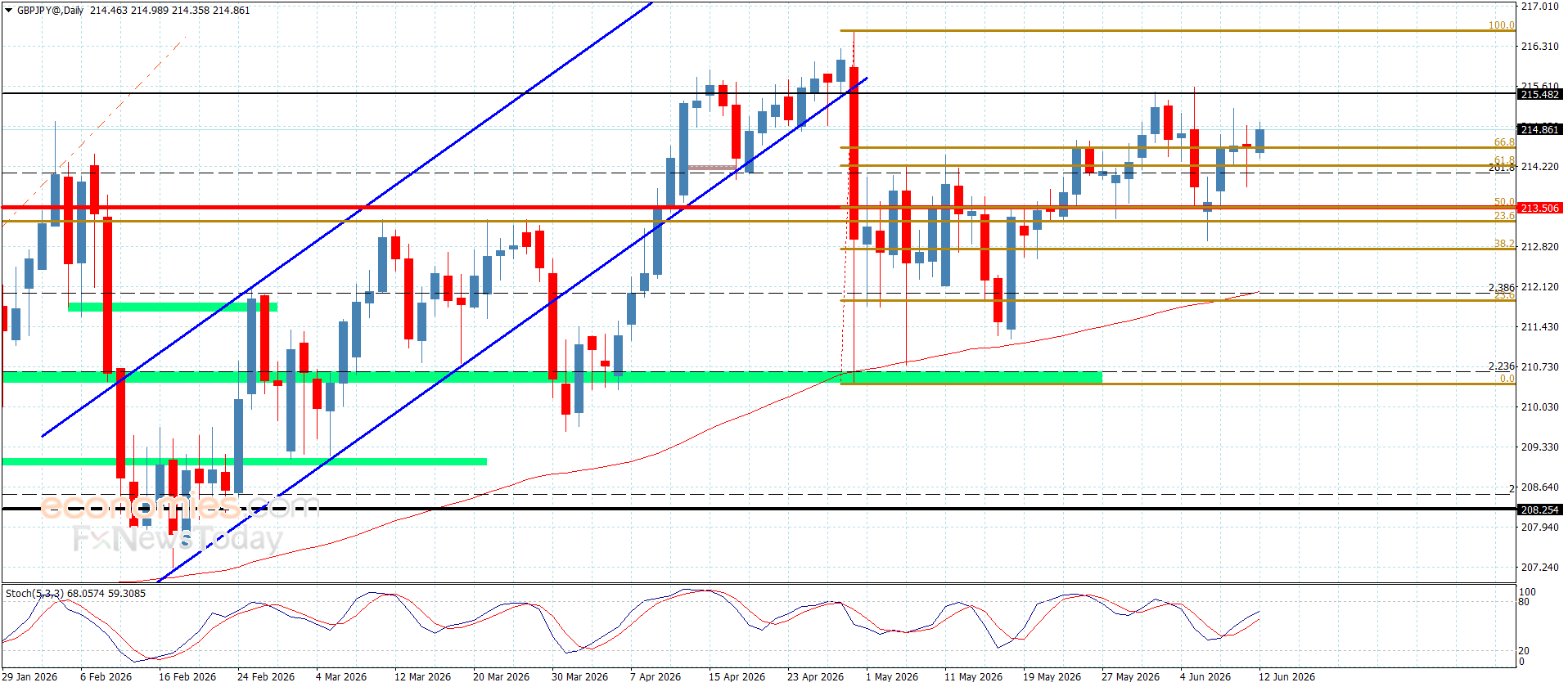
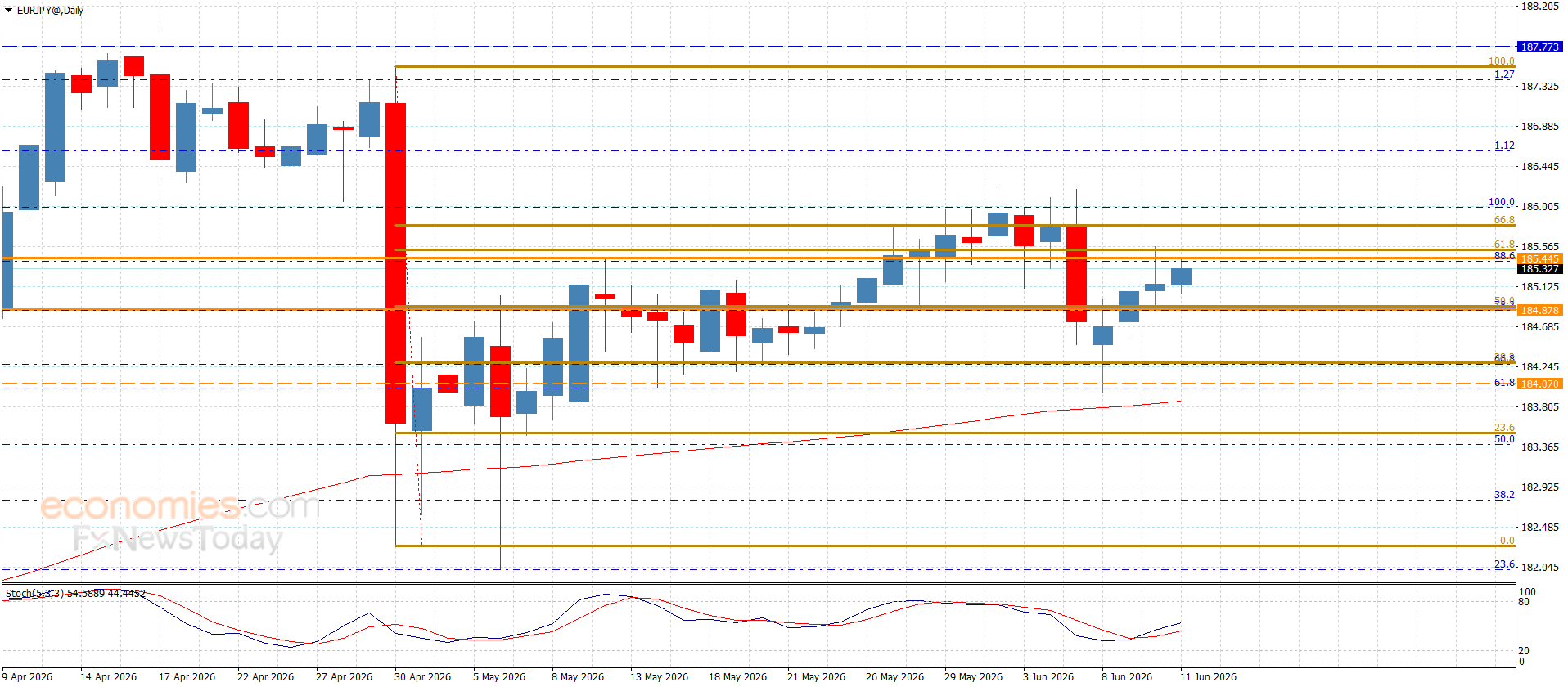
Despite the weakness in the pair’s trading, its repeated stability above the additional support level at 213.50, combined with the Stochastics’ attempt to provide positive momentum, has led to the formation of some bullish waves, helping the pair maintain its position around 214.80.
We reiterate the importance of a breakout above the resistance level at 215.50, as this would allow the pair to form strong upward waves. In that case, the price is expected to be attracted initially toward 216.10 and then 216.65.
The expected trading range for today is between 214 and 216
Trend forecast: Bullish
Silver (XAG/USD) price advances over 4% on Thursday after bouncing off daily lows of $61.51, its lowest level since March 23, after US President Donald Trump announced he cancelled scheduled attacks against Iran this evening, saying that final points of an agreement have been approved. At the time of writing, the XAG/USD pair trades at $65.91.
Silver turned downward biased. Even though it has recovered some ground, it remains below the 200-day Simple Moving Average (SMA) of $68.31, which is used to signal changes in the asset’s direction.
The Relative Strength Index (RSI) exited oversold territory, an indication that buyers moved in, but the index remains below the 50-neutral level, suggesting the white metal remains tilted to the downside.
If Silver rises past the $67.00 mark, this would open the door to challenge the 200-day SMA. Above this level, the next stop would be the $70.00 milestone.
On the bearish side, the first support for XAG/USD is the current week’s low at $61.50. A breach of the latter will expose the $60.00 mark, followed by the November 13, 2025, high turned support at $54.39.
Silver is a precious metal highly traded among investors. It has been historically used as a store of value and a medium of exchange. Although less popular than Gold, traders may turn to Silver to diversify their investment portfolio, for its intrinsic value or as a potential hedge during high-inflation periods. Investors can buy physical Silver, in coins or in bars, or trade it through vehicles such as Exchange Traded Funds, which track its price on international markets.
Silver prices can move due to a wide range of factors. Geopolitical instability or fears of a deep recession can make Silver price escalate due to its safe-haven status, although to a lesser extent than Gold’s. As a yieldless asset, Silver tends to rise with lower interest rates. Its moves also depend on how the US Dollar (USD) behaves as the asset is priced in dollars (XAG/USD). A strong Dollar tends to keep the price of Silver at bay, whereas a weaker Dollar is likely to propel prices up. Other factors such as investment demand, mining supply – Silver is much more abundant than Gold – and recycling rates can also affect prices.
Silver is widely used in industry, particularly in sectors such as electronics or solar energy, as it has one of the highest electric conductivity of all metals – more than Copper and Gold. A surge in demand can increase prices, while a decline tends to lower them. Dynamics in the US, Chinese and Indian economies can also contribute to price swings: for the US and particularly China, their big industrial sectors use Silver in various processes; in India, consumers’ demand for the precious metal for jewellery also plays a key role in setting prices.
Silver prices tend to follow Gold’s moves. When Gold prices rise, Silver typically follows suit, as their status as safe-haven assets is similar. The Gold/Silver ratio, which shows the number of ounces of Silver needed to equal the value of one ounce of Gold, may help to determine the relative valuation between both metals. Some investors may consider a high ratio as an indicator that Silver is undervalued, or Gold is overvalued. On the contrary, a low ratio might suggest that Gold is undervalued relative to Silver.
– Written by
Minesh Chaudhari
STORY LINK GBP/USD Forecast: US Dollar Supported by Middle East Uncertainty Ahead of UK GDP
The Pound US Dollar (GBP/USD) exchange rate struggled to gain traction on Thursday, with investor sentiment dented by lingering uncertainty in the Middle East.
At the time of writing, GBP/USD was trading at around $1.3362, slightly lower on the day.
The US Dollar (USD) stood its ground against a majority of its peers on Thursday, as a broad wave of risk aversion fuelled demand for the safe-haven currency.
Escalating friction in the Middle East weighed heavily on market risk appetite following a second consecutive day of US airstrikes against Iran.
While this latest flare-up threatens to disrupt peace negotiations, media reports suggesting that diplomatic discussions are still quietly underway helped stabilise market sentiment. Ultimately, these rumours capped the ‘Greenback’ from advancing any further.
The increasingly risk-sensitive Pound (GBP) encountered headwinds amid the downbeat market sentiment on Thursday.
However, Sterling managed to avoid steep declines thanks to a retreat in UK government bond yields. Despite the geopolitical friction in the Middle East, energy commodities held relatively steady, which helped soothe worries within the bond market.
Get better rates and lower fees on your next international money transfer.
Compare TorFX with top UK banks in seconds and see how much you could save.
Looking ahead, Friday’s UK GDP release could drive movement in the GBP/USD exchange rate.
The British economy is expected to have shrunk by 0.1% in April. A contraction could revive concerns over the UK’s economic outlook, potentially denting demand for the Pound.
Such a result may also prompt investors to pare back Bank of England (BoE) interest rate hike bets ahead of next week’s policy decision, placing further pressure on Sterling.
Meanwhile, the US Dollar could take direction from the University of Michigan’s latest consumer sentiment index. Economists expect morale to have improved in June, which may lend the ‘Greenback’ support.
Ongoing geopolitical anxiety could also buoy USD, particularly if tensions in the Middle East continue to keep investors wary.

International Money Transfer? Ask our resident FX expert a money transfer question or try John’s new, free, no-obligation personal service! ,where he helps every step of the way,
ensuring you get the best exchange rates on your currency requirements.
TAGS: Pound Dollar Forecasts