The main category of Forex News.
You can use the search box below to find what you need.
[wd_asp id=1]
The main category of Forex News.
You can use the search box below to find what you need.
[wd_asp id=1]
Etsy Inc. (ETSY) turned green in its latest trading session, benefiting from its earlier rebound off a main ascending trendline on the short-term chart. This move coincided with the start of positive signals on the relative strength indicators after reaching extremely oversold levels, which provided fresh positive momentum that helped the stock achieve a series of strong gains. However, downside pressure remains from trading below the 50-day simple moving average, which continues to act as an obstacle to a sustainable recovery.
Therefore, we expect the stock price to rise in its upcoming trading sessions, provided that the support level of $56.65 holds, targeting the first resistance level at $69.55.
Today’s price forecast: Bullish.
Gold (XAU/USD) remains practically flat on the daily chart on Wednesday, as hesitant market, as investors are reluctant to take risks ahead of the US government’s reopening. The precious metal’s recovery has stalled below $4250 resistance area, but downside attempts remain contained above $4,100 for now.
The US Dollar Index, which measures the value of the Greenback against a basket of currencies, has shrugged off the negative impact of Tuesday’s employment data and is picking up from two-week lows. This is keeping bullion from appreciating higher, which leaves the pair in no-man’s land above $4,100.
The technical picture is showing a loosening upside momentum. The 4-hour Relative Strength Index (RSI) remains within positive territory, at 612.00 at the time of writing, although the Moving Average Convergence Divergence (MACD) is showing a bearish cross, suggesting some negative pressure.
Failure to extend gains beyond the resistance area around the mentioned $4,150 area (October 22, 23 and 24 highs) might give bears hopes to break Tuesday’s lows at $4,090, aiming to the previous resistance area at $4,050 (October 31 highs) and the area right below the $4,000 (November 6, 7 lows)
A confirmation above $4,150 would expose the previous support area at $4,220 (October 20 lows), ahead of the all-time highs, around $4,380 (October 20, 21 highs).
Gold has played a key role in human’s history as it has been widely used as a store of value and medium of exchange. Currently, apart from its shine and usage for jewelry, the precious metal is widely seen as a safe-haven asset, meaning that it is considered a good investment during turbulent times. Gold is also widely seen as a hedge against inflation and against depreciating currencies as it doesn’t rely on any specific issuer or government.
Central banks are the biggest Gold holders. In their aim to support their currencies in turbulent times, central banks tend to diversify their reserves and buy Gold to improve the perceived strength of the economy and the currency. High Gold reserves can be a source of trust for a country’s solvency. Central banks added 1,136 tonnes of Gold worth around $70 billion to their reserves in 2022, according to data from the World Gold Council. This is the highest yearly purchase since records began. Central banks from emerging economies such as China, India and Turkey are quickly increasing their Gold reserves.
Gold has an inverse correlation with the US Dollar and US Treasuries, which are both major reserve and safe-haven assets. When the Dollar depreciates, Gold tends to rise, enabling investors and central banks to diversify their assets in turbulent times. Gold is also inversely correlated with risk assets. A rally in the stock market tends to weaken Gold price, while sell-offs in riskier markets tend to favor the precious metal.
The price can move due to a wide range of factors. Geopolitical instability or fears of a deep recession can quickly make Gold price escalate due to its safe-haven status. As a yield-less asset, Gold tends to rise with lower interest rates, while higher cost of money usually weighs down on the yellow metal. Still, most moves depend on how the US Dollar (USD) behaves as the asset is priced in dollars (XAU/USD). A strong Dollar tends to keep the price of Gold controlled, whereas a weaker Dollar is likely to push Gold prices up.
– Written by
Frank Davies
STORY LINK Euro to Dollar Rate Forecast: EUR/USD Needs “Softer Data” for 1.16+
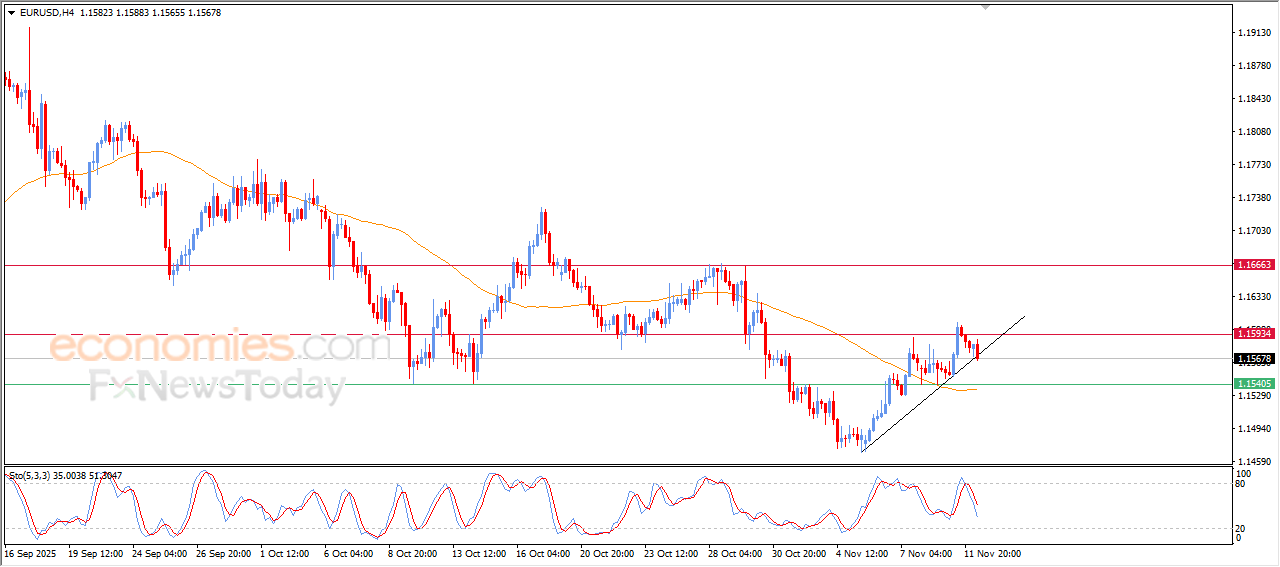
The Euro to Dollar exchange rate (EUR/USD) briefly broke above 1.16 before steadying as investors positioned for upcoming US employment figures that could determine whether the Federal Reserve delivers another December rate cut.
Analysts, including ING and MUFG, expect further dollar softness if data confirms a slowing labour market.
UoB commented; “The price movements have resulted in an increase in upward momentum, but it is not sufficient to indicate a sustained rise. Today, we continue to expect EUR to trade in a range, likely between 1.1560 and 1.1610.”
According to ING; “We’re happy that EUR/USD is trading closer to 1.16 than 1.15, but will probably require some softer US data to justify a move well above 1.16 now.”
The bank has a year-end EUR/USD target of 1.18.
On Wednesday, the House of Representatives is due to vote on the resolution which would allow a re-opening of the government.
Get better rates and lower fees on your next international money transfer.
Compare TorFX with top UK banks in seconds and see how much you could save.
There are expectations that it will be passed, although the vote is liable to be close.
ING commented; “If approved, that means the US government can reopen, perhaps on Friday, and that the September NFP jobs report (potentially USD negative) can be released early next week.”
Rabobank added; “The Employment Report for September may be one of the first to be published, because it was originally scheduled for October 3, so it was likely almost or completely finished. This will be lagging data, but it could confirm the continued labor market weakness assumed by the FOMC and shown in other labor market data for September.”
On Tuesday, ADP data released data which indicated private-sector job losses of 11,000 per week during October.
MUFG commented; “The drop in the dollar underlined the sensitivity to private sector employment that could shape the NFP data to be released.”
The bank added; “The jobs data will be key to whether the Fed can continue to cut and is an important element of our view that the dollar can weaken notably as we approach the end of the year.”
At this stage, markets are pricing in around a 63% chance of a December rate cut with the dollar responding to any shift in expectations.

Euro-Zone data has not triggered any positive assessment of the economic outlook.
The German ZEW investor confidence index edged lower to 38.5 for November from 39.3 previously, but wider Euro-Zone data posted a net gain.
Danske Bank commented on the German data; “The report thus indicates that the economy is still at a weak footing and the expectation for an improvement is weakening.”
International Money Transfer? Ask our resident FX expert a money transfer question or try John’s new, free, no-obligation personal service! ,where he helps every step of the way,
ensuring you get the best exchange rates on your currency requirements.
TAGS: Euro Dollar Forecasts
The GBPCHF ended the bullish corrective rebound by providing new close below the minor bearish channel’s resistance at 1.0620, forming sharp decline and its stability near 1.0515, confirming the stability of the previously suggested bearish scenario.
Note that the beginning of providing extra negative momentum by stochastic reaching below 50 level will increase the chances of resuming the negative attack, to keep waiting for targeting 1.0475 level reaching 161.8%Fibonacci extension level at 1.0455, to face the support of the bearish channel as appears in the above image.
The expected trading range for today is between 1.0560 and 1.0475
Trend forecast: Bearish
The Japanese yen continued its downtrend this week, moving to its lowest level since February this year. The USD/JPY exchange rate was trading at 154.70, up sharply from the year-to-date low of 139.86. So, what next go the yen and will the Bank of Japan intervene?
The Japanese yen has come under renewed pressure in the past few months, making it one of the worst-performing currencies in the developed world.
The main reason for the ongoing crash is the recent political changes in the country that saw Sanae Takaichi become the first woman prime minister.
Takaichi is widely seen as a growth-oriented premier like Shinzo Abe. She has already called for parliament to provide more stimulus funds worth billions of dollars to boost the economy. Additional funds in the economy normally leads to more currency weakness over time.
The Japanese yen has also dropped because of the Bank of Japan (BoJ), which has been reluctant to hike interest rates as most economists were expecting. Recent inflation numbers show that the country does not need to hike rates as inflation is moving in the right direction.
The most recent report showed that the headline Consumer Price Index (CPI) rose to 2.8% in September from the previous 2.7%. Economists expect the upcoming figure to come in at 2.6%, much lower than the January high of 4.0%.
The ongoing Japanese yen has pros and cons for the country. On the positive side, it is making Japan a relatively cheaper destination for international tourists. It is also benefiting its exporters, especially those selling goods to the United States, where Donald Trump left tariffs on all imports.
On the other hand, a weaker yen can lead to higher inflation since the country imports most of its supplies, like crude oil and natural gas. At the same time, the country could see higher tariffs as Trump has always criticized it for maintaining a weak currency.
Japan has tools to intervene when the yen crashes too much. It can hike interest rates or deploy some of its $1.15 trillion in foreign currency to intervene. For example, it intervened last yrear by buying yen and selling dollars.
The USD/JPY exchange rate will also react to developments in the United States, where the government shutdown is expected to end this week. The House of Representatives will vote for this bill today, a move that will reopen the government.
The end of the government shutdown means that top statistics agencies will start publishing economic numbers on the labor market and inflation.

The daily timeframe chart shows that the USD to JPY exchange rate has been in a strong bull run in the past few months. It has jumped from a low of 139.86 in April to 154.55 today. The current level is the highest point since February this year.
The pair has recently moved above the important resistance level at 153.12, the highest point in October. It formed a golden cross pattern in October as the 50-day and 200-day Exponential Moving Averages (EMA) crossed each other.
Top oscillators like the Relative Strength Index (RSI) and the MACD indicators have pointed upwards. Therefore, the most likely scenario is where the pair keeps rising as bulls target the next key resistance level at 156. A move below the support at 153 will invalidate the bullish outlook.
The post USD/JPY forecast: here’s why the Japanese yen is crashing appeared first on Invezz
Silver price settled higher in its last intraday trading, after reaching $51.25 resistance, which was a potential target in our previous analysis, attempting to gain bullish momentum that might help it to breach this resistance, amid the dominance of minor bullish wave on the short-term basis and its trading alongside supportive trend line for this track, besides the emergence of the positive signals on the relative strength indicators, after offloading its overbought conditions, opening the way fpr achieving more gains in the upcoming period.
Get high-accuracy trading signals delivered directly to your Telegram. Subscribe to specialized packages tailored for the world’s top markets:
Full VIP signals performance report for 20-31, October 2025:
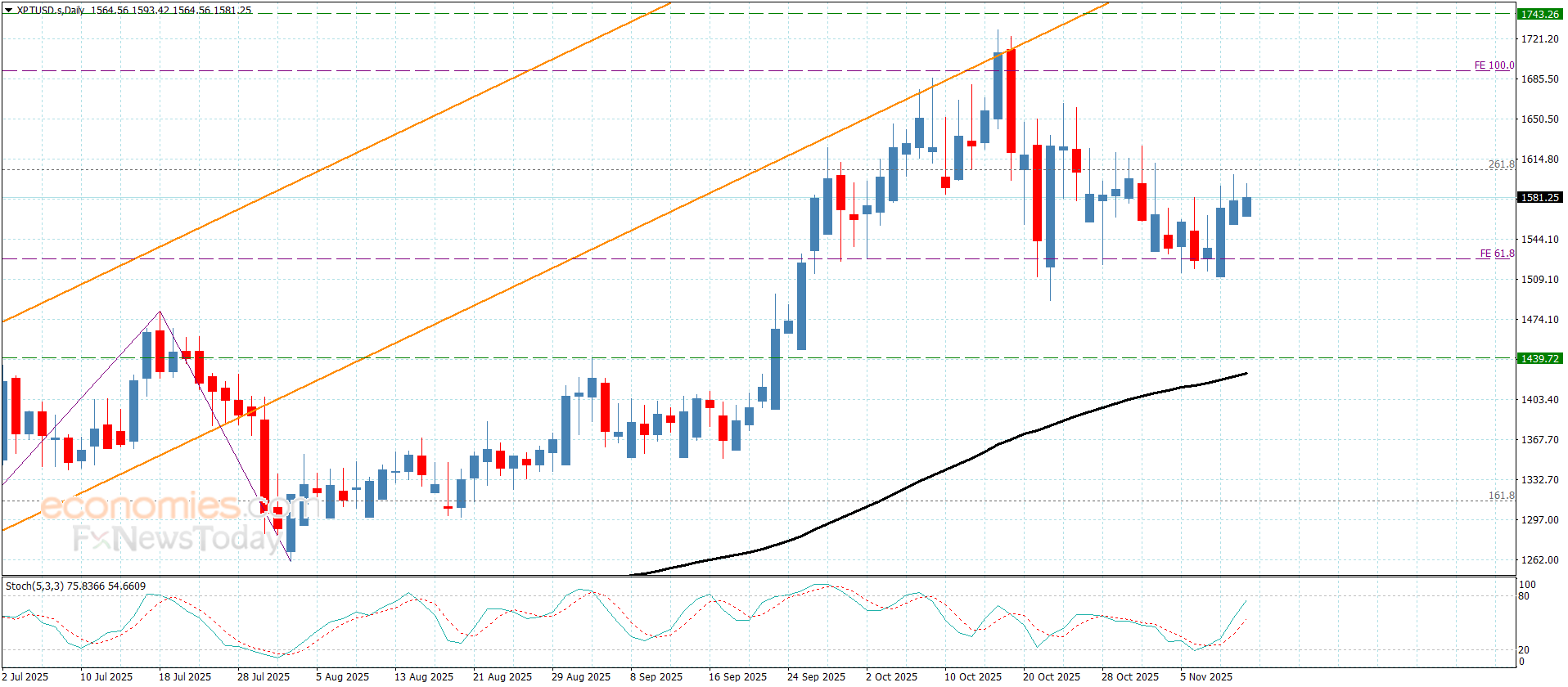
Platinum price kept its fluctuation below $1605.00 barrier, forcing it to provide new nixed trading by its continued fluctuation near $1580.00, reminding you that the stability above the sideways track’s support at $1520.00 and the continuation of providing positive momentum by the main indicators, these factors make us keep the bullish suggestion, to expect surpassing the current barrier by recording new gains by its rally towards $1642.00 and $1660.00.
While the decline below the current support and providing negative close, will confirm activating the bearish corrective track, to expect suffering several losses by reaching $1485.00 reaching the next support at $1440.00.
The expected trading range for today is between $1545.00 and$1642.00
Trend forecast: Bullish
Platinum price kept its fluctuation below $1605.00 barrier, forcing it to provide new nixed trading by its continued fluctuation near $1580.00, reminding you that the stability above the sideways track’s support at $1520.00 and the continuation of providing positive momentum by the main indicators, these factors make us keep the bullish suggestion, to expect surpassing the current barrier by recording new gains by its rally towards $1642.00 and $1660.00.
While the decline below the current support and providing negative close, will confirm activating the bearish corrective track, to expect suffering several losses by reaching $1485.00 reaching the next support at $1440.00.
The expected trading range for today is between $1545.00 and$1642.00
Trend forecast: Bullish
– Written by
Tim Boyer
STORY LINK Pound-to-Dollar Forecast: GBP/USD Recovery Halts on Dovish BoE Outlook
The British Pound’s recent rebound faltered after disappointing UK jobs data pushed the Pound-to-Dollar exchange rate down toward 1.31, with analysts warning that a softening labour market gives the BoE room to cut rates again next month.
MUFG and ING both see further GBP losses ahead with a December move as increasingly likely.
Pound Sterling was hurt on Tuesday by increased speculation of a December Bank of England (BoE) interest rate cut following weaker-than-expected UK jobs data.
The Pound to Dollar (GBP/USD) exchange rate dipped sharply to 1.3120 from highs near 1.3180 ahead of the data with the Pound struggling to secure any benefit from favour able risk conditions and a fresh record high in the FTSE 100 index.
Crucial Pound support remains at 1.30. ING has a year-end GBP/USD forecast of 1.34 as the dollar loses ground.
The UK jobs data was significantly weaker than expected with the unemployment rate increasing to a fresh 4-year high of 5.0% in the three-months to September from 4.8% previously and above consensus forecasts of 4.9%.
Get better rates and lower fees on your next international money transfer.
Compare TorFX with top UK banks in seconds and see how much you could save.
The ONS also reported a decline in payrolls of 32,000 for October, matching a final 32,000 retreat for September.
There was also a small net slowdown in underlying wages growth to 4.6% from 4.7%.
According to MUFG; “The data suggests that the downturn in the labour market is getting worse ahead of the Autumn Statement.”
Markets are now more convinced that the BoE will cut rates again in December.
MUFG added; “Loosening labour market conditions should give the BoE more confidence that wage growth will continue to slow dampening upside inflation risks. The weak labour market report supports our forecast for the BoE to cut rates next month.”
There will be potential implications for politics and the budget with pressure for measures to support the jobs market.
Capital Economics UK economist Ashley Webb commented; “The 32,000 fall in payroll employment in October was the eleventh monthly decline over the past year and suggests that businesses continued to trim headcounts after the Chancellor announced the rises in payroll taxes and the minimum wage in last year’s October Budget.”
According to ING; “Now, both inflation and jobs data are starting to point down, and we think the Autumn Budget’s tax hikes will provide the final argument for a cut in December.”
On Monday, the US Senate voted to end the government shutdown and it will now move to the House of Representatives.
Assuming there is a near-term re-opening, there is the potential for some relief surrounding consumer confidence while the focus will switch to postponed data releases with a particular focus on the jobs market.
ING commented; “a resumption of data releases in the US does carry non-negligible downside risks to the dollar. In our view, the latter factors should prevail, as we think markets are underestimating the downside risks for the labour market, US front-end rates and – by extension – the dollar into year-end.”
International Money Transfer? Ask our resident FX expert a money transfer question or try John’s new, free, no-obligation personal service! ,where he helps every step of the way,
ensuring you get the best exchange rates on your currency requirements.
TAGS: Pound Dollar Forecasts
Silver price (XAG/USD) edges lower to near $51.10, snapping the five-day winning streak during the early European session on Wednesday. The white metal loses ground amid the renewed US Dollar (USD) demand. The Federal Reserve (Fed) policymakers are set to speak later in the day, including John Williams, Anna Paulson, Christopher Waller, Raphael Bostic, Stephen Miran and Susan Collins.
The US Dollar Index (DXY), an index of the value of the US Dollar (USD) measured against a basket of six world currencies, trades in positive territory around 99.55, bolstered by hopes for the end of the US government shutdown. This, in turn, could weigh on the USD-denominated commodity price in the near term.
After the Senate voted 60-40 on Monday to pass a temporary continuing resolution to fund the government, the House is set to vote on the measure on Wednesday, and House Speaker Johnson said he expects it will pass quickly. If it passes in both chambers of Congress, it will head to US President Donald Trump to be signed into law. The bill will restore funding to government agencies through January 30.
Markets brace for an imminent US government reopening that is expected to unleash a backlog of US economic releases. “Traders believe (data) will show some weakening economic numbers, and that would prompt the Fed to cut interest rates in December… that is probably encouraging the gold and silver market bulls today,” said Jim Wyckoff, senior analyst at Kitco Metals.
According to the CME FedWatch tool, traders have currently priced in nearly a 68% probability that the US central bank would lower rates by 25 basis points (bps) in the December meeting, up from around a 62% chance a day ago. Lower interest rates could reduce the opportunity cost of holding Silver, supporting the non-yielding precious metal.
Silver is a precious metal highly traded among investors. It has been historically used as a store of value and a medium of exchange. Although less popular than Gold, traders may turn to Silver to diversify their investment portfolio, for its intrinsic value or as a potential hedge during high-inflation periods. Investors can buy physical Silver, in coins or in bars, or trade it through vehicles such as Exchange Traded Funds, which track its price on international markets.
Silver prices can move due to a wide range of factors. Geopolitical instability or fears of a deep recession can make Silver price escalate due to its safe-haven status, although to a lesser extent than Gold’s. As a yieldless asset, Silver tends to rise with lower interest rates. Its moves also depend on how the US Dollar (USD) behaves as the asset is priced in dollars (XAG/USD). A strong Dollar tends to keep the price of Silver at bay, whereas a weaker Dollar is likely to propel prices up. Other factors such as investment demand, mining supply – Silver is much more abundant than Gold – and recycling rates can also affect prices.
Silver is widely used in industry, particularly in sectors such as electronics or solar energy, as it has one of the highest electric conductivity of all metals – more than Copper and Gold. A surge in demand can increase prices, while a decline tends to lower them. Dynamics in the US, Chinese and Indian economies can also contribute to price swings: for the US and particularly China, their big industrial sectors use Silver in various processes; in India, consumers’ demand for the precious metal for jewellery also plays a key role in setting prices.
Silver prices tend to follow Gold’s moves. When Gold prices rise, Silver typically follows suit, as their status as safe-haven assets is similar. The Gold/Silver ratio, which shows the number of ounces of Silver needed to equal the value of one ounce of Gold, may help to determine the relative valuation between both metals. Some investors may consider a high ratio as an indicator that Silver is undervalued, or Gold is overvalued. On the contrary, a low ratio might suggest that Gold is undervalued relative to Silver.