The main category of Forex News.
You can use the search box below to find what you need.
[wd_asp id=1]
The main category of Forex News.
You can use the search box below to find what you need.
[wd_asp id=1]
EUR/USD fluctuates in a narrow channel below 1.1900 in the European session on Monday after posting small gains in the previous week. The pair’s trading action is likely to remain subdued in the short term, with stock and bond markets in the US remaining closed in observance of the Presidents Day holiday.
The table below shows the percentage change of Euro (EUR) against listed major currencies last 7 days. Euro was the strongest against the US Dollar.
| USD | EUR | GBP | JPY | CAD | AUD | NZD | CHF | |
|---|---|---|---|---|---|---|---|---|
| USD | -0.41% | -0.39% | -2.53% | -0.39% | -1.05% | -0.43% | -0.97% | |
| EUR | 0.41% | 0.02% | -2.17% | 0.02% | -0.64% | -0.03% | -0.56% | |
| GBP | 0.39% | -0.02% | -1.91% | -0.01% | -0.67% | -0.05% | -0.59% | |
| JPY | 2.53% | 2.17% | 1.91% | 2.24% | 1.56% | 2.20% | 1.53% | |
| CAD | 0.39% | -0.02% | 0.00% | -2.24% | -0.56% | -0.03% | -0.58% | |
| AUD | 1.05% | 0.64% | 0.67% | -1.56% | 0.56% | 0.62% | 0.07% | |
| NZD | 0.43% | 0.03% | 0.05% | -2.20% | 0.03% | -0.62% | -0.54% | |
| CHF | 0.97% | 0.56% | 0.59% | -1.53% | 0.58% | -0.07% | 0.54% |
The heat map shows percentage changes of major currencies against each other. The base currency is picked from the left column, while the quote currency is picked from the top row. For example, if you pick the Euro from the left column and move along the horizontal line to the US Dollar, the percentage change displayed in the box will represent EUR (base)/USD (quote).
Soft inflation data from the US made it difficult for the US Dollar (USD) to gather strength heading into the weekend and allowed EUR/USD to hold its ground. The US Bureau of Labor Statistics reported that the Consumer Price Index (CPI) rose 2.4% on a yearly basis in January, following the 2.7% increase recorded in December. This print came in below the market expectation of 2.5%. On a monthly basis, the CPI and the core CPI, which excludes volatile food and energy prices, increased 0.2% and 0.3%, respectively.
In the second half of the day, European Central Bank (ECB) policymaker Joachim Nagel will be delivering a speech.
Meanwhile, the ECB announced over the weekend that they are planning to widen the global access to the Euro liquidity backstop to boost the Euro’s global role, by making it easier for foreign central banks to secure funding in Euros at times of financial stress.
Rabobank analysts pointed out some potential issues with this decision. “The key issues are: (1) is the supply of Euros globally an issue or the demand for them?; (2) it implies a much larger number of Euro-denominated assets and a much larger European trade deficit; and (3) a much higher Euro exchange rate, which wouldn’t be welcome in all member states to put it mildly,” they explained.
The Relative Strength Index (RSI) indicator on the 4-hour chart moves sideways slightly below 50 and EUR/USD fluctuates at around the 20-period, 50-period and 100-period SMAs, reflecting the pair’s indecisiveness.
The Fibonacci 38.2% retracement of the latest uptrend, the 100-period SMA and the 50-period SMA form a pivot area in 1.1850-1.1860. In case EUR/USD stabilizes above this region, technical buyers could remain interested. In this case, 1.1900 (static level, round level) could be seen as an interim resistance level before 1.1925 (Fibonacci 23.6% retracement).
Looking south, support levels could be spotted at 1.1810-1.1800 (Fibonacci 50% retracement, static level) and 1.1770 (200-period SMA).
The Euro is the currency for the 20 European Union countries that belong to the Eurozone. It is the second most heavily traded currency in the world behind the US Dollar. In 2022, it accounted for 31% of all foreign exchange transactions, with an average daily turnover of over $2.2 trillion a day.
EUR/USD is the most heavily traded currency pair in the world, accounting for an estimated 30% off all transactions, followed by EUR/JPY (4%), EUR/GBP (3%) and EUR/AUD (2%).
The European Central Bank (ECB) in Frankfurt, Germany, is the reserve bank for the Eurozone. The ECB sets interest rates and manages monetary policy.
The ECB’s primary mandate is to maintain price stability, which means either controlling inflation or stimulating growth. Its primary tool is the raising or lowering of interest rates. Relatively high interest rates – or the expectation of higher rates – will usually benefit the Euro and vice versa.
The ECB Governing Council makes monetary policy decisions at meetings held eight times a year. Decisions are made by heads of the Eurozone national banks and six permanent members, including the President of the ECB, Christine Lagarde.
Eurozone inflation data, measured by the Harmonized Index of Consumer Prices (HICP), is an important econometric for the Euro. If inflation rises more than expected, especially if above the ECB’s 2% target, it obliges the ECB to raise interest rates to bring it back under control.
Relatively high interest rates compared to its counterparts will usually benefit the Euro, as it makes the region more attractive as a place for global investors to park their money.
Data releases gauge the health of the economy and can impact on the Euro. Indicators such as GDP, Manufacturing and Services PMIs, employment, and consumer sentiment surveys can all influence the direction of the single currency.
A strong economy is good for the Euro. Not only does it attract more foreign investment but it may encourage the ECB to put up interest rates, which will directly strengthen the Euro. Otherwise, if economic data is weak, the Euro is likely to fall.
Economic data for the four largest economies in the euro area (Germany, France, Italy and Spain) are especially significant, as they account for 75% of the Eurozone’s economy.
Another significant data release for the Euro is the Trade Balance. This indicator measures the difference between what a country earns from its exports and what it spends on imports over a given period.
If a country produces highly sought after exports then its currency will gain in value purely from the extra demand created from foreign buyers seeking to purchase these goods. Therefore, a positive net Trade Balance strengthens a currency and vice versa for a negative balance.
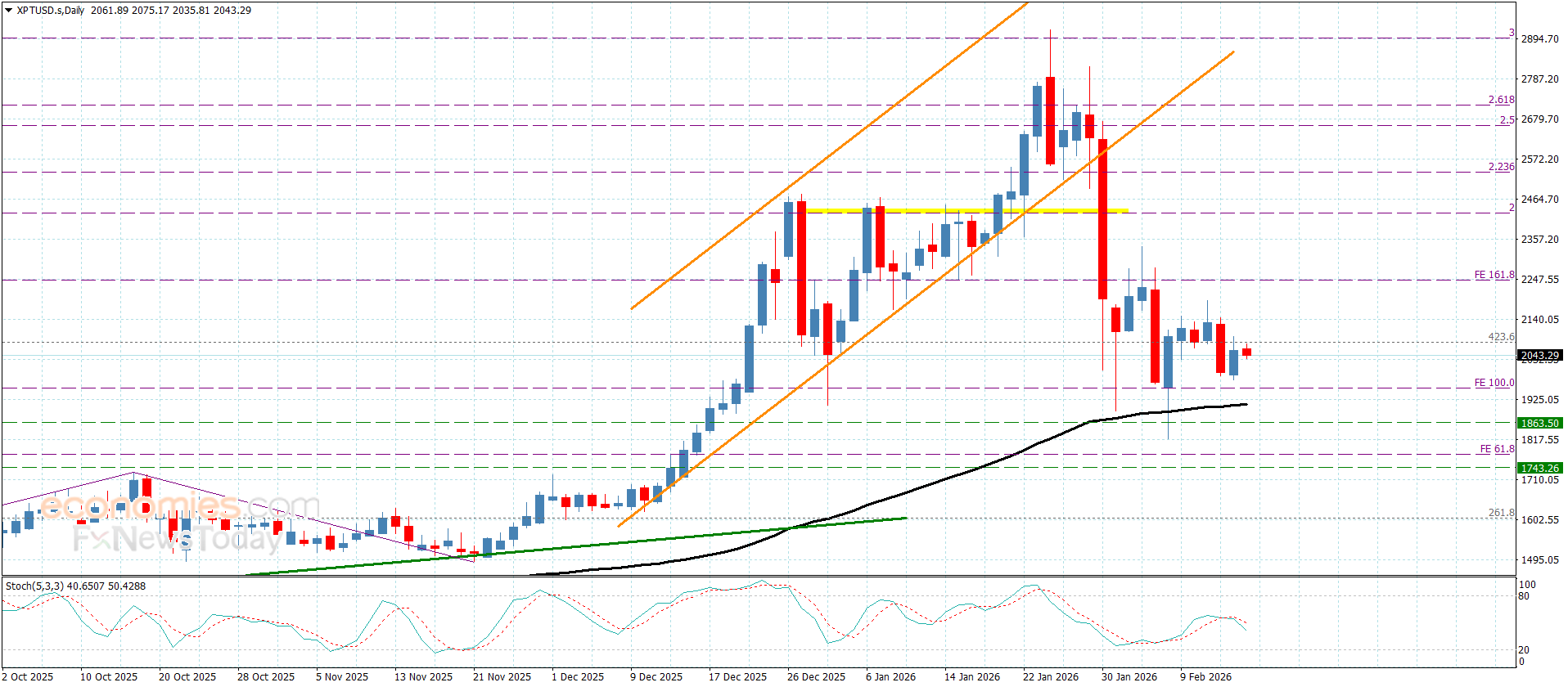
Platinum price remains under the dominance of the bearish trend until this moment, due to its stability below $2245.00 level, forming mixed trading to keep its stability near $2040.00.
We will keep waiting for the price to activate with stochastic negativity, to repeat the pressure on $1950.00 level, and breaking it will open the way for resuming the bearish moves until reaching the extra targets that are located at $1880.00 and $1785.00.
The expected trading range for today is between $1950.00 and $2100.00
Trend forecast: Bearish
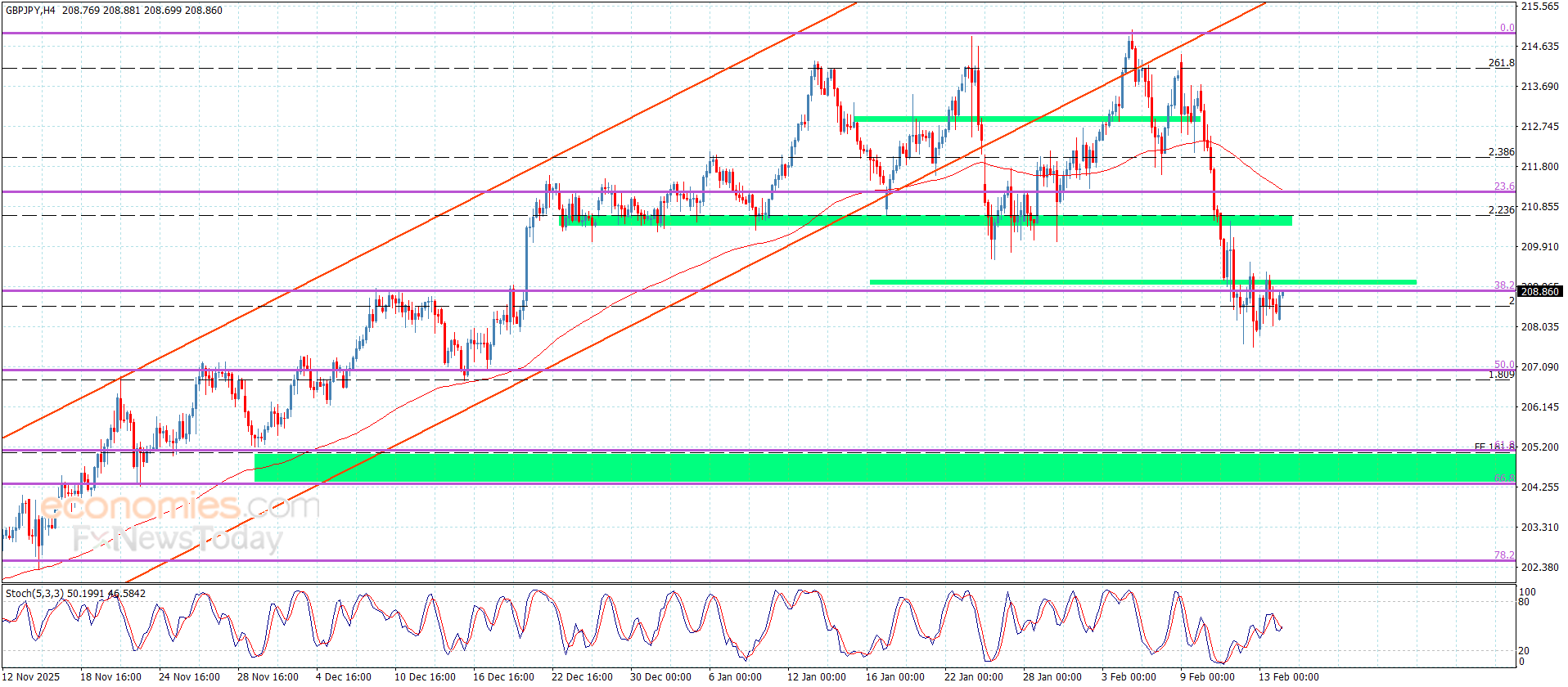
The GBPJPY pair affected by the contradiction of the main indicators, since Friday’s trading to delay the negative attack and providing mixed trading, to approach from 209.15 barrier.
This scenario depends on the strength of this barrier, the stability below it will increase the chances of forming new bearish waves, attempting to reach 207.60 and 207.05, while surpassing the barrier will allow it to recover some losses by its rally towards 209.80 directly, to attempt to test the resistance near 210.60.
The expected trading range for today is between 208.00 and 209.20
Trend forecast: Fluctuated within the bearish track.
Silver price (XAG/USD) trades 2% lower at around $75.00 during the Asian trading session on Monday. The white metal is under pressure as lower-than-expected United States (US) Consumer Price Index (CPI) data for January fails to prompt hopes of interest rate cuts by the Federal Reserve (Fed) in the near term.
Theoretically, lower inflation boosts hopes of monetary policy easing by the Fed in the near term. It seems that market participants are more focused on the labor market than on changes in price pressures.
According to the CME FedWatch tool, traders remain confident that the Fed will keep interest rates steady in the current range of 3.50%-3.75% in March and April.
The data showed on Friday that the US headline inflation cooled down to 2.4% Year-on-year (YoY) from 2.7% in December. On a monthly basis, the US headline CPI grew at a slower pace of 0.2% against estimates and the prior reading of 0.3%.
On the geopolitical front, investors remain concerned over tensions between the US and Iran. A report from Reuters has stated that the US military is preparing for the possibility of sustained, weeks-long operations against Iran if President Donald Trump orders an attack, a scenario that would force investors to shift to the safe-haven fleet.
XAG/USD trades down to near $75.61 as of writing. Price holds below the falling 20-EMA at $84.23, keeping the near-term bias heavy as trend pressure remains to the downside. The average continues to descend, underscoring persistent supply. RSI at 43.47 sits below the 50 midline, confirming weak momentum rather than capitulation.
Below the dynamic cap, rebounds could fade on approach to the average and keep the sequence of lower highs intact. A daily close above $84.23 would ease pressure and open room for a corrective recovery, with confirmation strengthened if RSI reclaims 50. Until that occurs, risk stays skewed toward further weakness, and rallies would be sold into.
(The technical analysis of this story was written with the help of an AI tool.)
Silver is a precious metal highly traded among investors. It has been historically used as a store of value and a medium of exchange. Although less popular than Gold, traders may turn to Silver to diversify their investment portfolio, for its intrinsic value or as a potential hedge during high-inflation periods. Investors can buy physical Silver, in coins or in bars, or trade it through vehicles such as Exchange Traded Funds, which track its price on international markets.
Silver prices can move due to a wide range of factors. Geopolitical instability or fears of a deep recession can make Silver price escalate due to its safe-haven status, although to a lesser extent than Gold’s. As a yieldless asset, Silver tends to rise with lower interest rates. Its moves also depend on how the US Dollar (USD) behaves as the asset is priced in dollars (XAG/USD). A strong Dollar tends to keep the price of Silver at bay, whereas a weaker Dollar is likely to propel prices up. Other factors such as investment demand, mining supply – Silver is much more abundant than Gold – and recycling rates can also affect prices.
Silver is widely used in industry, particularly in sectors such as electronics or solar energy, as it has one of the highest electric conductivity of all metals – more than Copper and Gold. A surge in demand can increase prices, while a decline tends to lower them. Dynamics in the US, Chinese and Indian economies can also contribute to price swings: for the US and particularly China, their big industrial sectors use Silver in various processes; in India, consumers’ demand for the precious metal for jewellery also plays a key role in setting prices.
Silver prices tend to follow Gold’s moves. When Gold prices rise, Silver typically follows suit, as their status as safe-haven assets is similar. The Gold/Silver ratio, which shows the number of ounces of Silver needed to equal the value of one ounce of Gold, may help to determine the relative valuation between both metals. Some investors may consider a high ratio as an indicator that Silver is undervalued, or Gold is overvalued. On the contrary, a low ratio might suggest that Gold is undervalued relative to Silver.
The GBPJPY pair affected by the contradiction of the main indicators, since Friday’s trading to delay the negative attack and providing mixed trading, to approach from 209.15 barrier.
This scenario depends on the strength of this barrier, the stability below it will increase the chances of forming new bearish waves, attempting to reach 207.60 and 207.05, while surpassing the barrier will allow it to recover some losses by its rally towards 209.80 directly, to attempt to test the resistance near 210.60.
The expected trading range for today is between 208.00 and 209.20
Trend forecast: Fluctuated within the bearish track.
While Japanese GDP data weighed on demand for the yen, US economic indicators and Fed commentary on monetary policy will influence expectations of a June Fed rate cut. Later on Monday, FOMC voting member Michelle Bowman is scheduled to speak following last week’s US jobs and CPI reports. Support for a June rate cut on cooling inflation would weaken demand for the US dollar, sending USD/JPY lower.
Last week’s inflation data overshadowed a hotter-than-expected US jobs report, raising bets on a June Fed rate cut. According to the CME FedWatch Tool, the probability of a June cut rose from 64.6% on February 12 to 68.6% on February 13, after the data release. However, Friday’s US Personal Income and Outlays Report, Services PMI numbers, and GDP data are likely to be key for US dollar demand.
Market expectations of a more dovish Fed policy stance and a hawkish BoJ rate path would reaffirm the negative short- to medium-term outlook.
For USD/JPY price trends, traders should closely track technical indicators, key economic indicators, government policy announcements, and central bank chatter.
On the daily chart, USD/JPY trades below its 50-day Exponential Moving Average (EMA), but remains above the 200-day EMA. The EMA positions signal a bearish near-term but bullish longer-term bias. Nevertheless, favorable yen fundamentals align with the short-term technicals, indicating a bearish medium-term outlook.
A sustained break below the 200-day EMA would signal a bearish trend reversal, bringing the 150 support level into play. If breached, 145 would be the next key support level.
Importantly, a sustained fall through the EMAs would reinforce the negative medium- to longer-term price outlook.
By mid-February 2026, gold prices have made a strong comeback, moving back above the key $5,000 per ounce level. After a volatile stretch with prices ranging from January’s record high of $5,600 to below $4,920, gold is regaining its appeal.
At the start of the new trading week, the market shows renewed optimism:
The mid-February rebound was driven by a mix of economic data and changing market expectations.
January’s CPI data showed annual inflation at 2.4% and core inflation at 2.5%. These lower-than-expected numbers have slowed the rise in Treasury yields and weakened the US Dollar. As a result, markets now expect the Federal Reserve to cut rates later in 2026.
Although central bank buying has slowed from the record 1,000-tonne years of 2022 to 2024, it still provides strong support. In 2026, net purchases are estimated at 800 tonnes, about 26% of yearly mine output.
XAU/USD
Emerging markets such as Poland, China, and Turkey are continuing to reduce their reliance on the US Dollar as a strategy to protect against currency risks.
As global divisions and trade tensions grow, gold’s role as a neutral asset is becoming more important. More portfolio managers are using gold to protect against rising government debt and economic uncertainty in major countries.
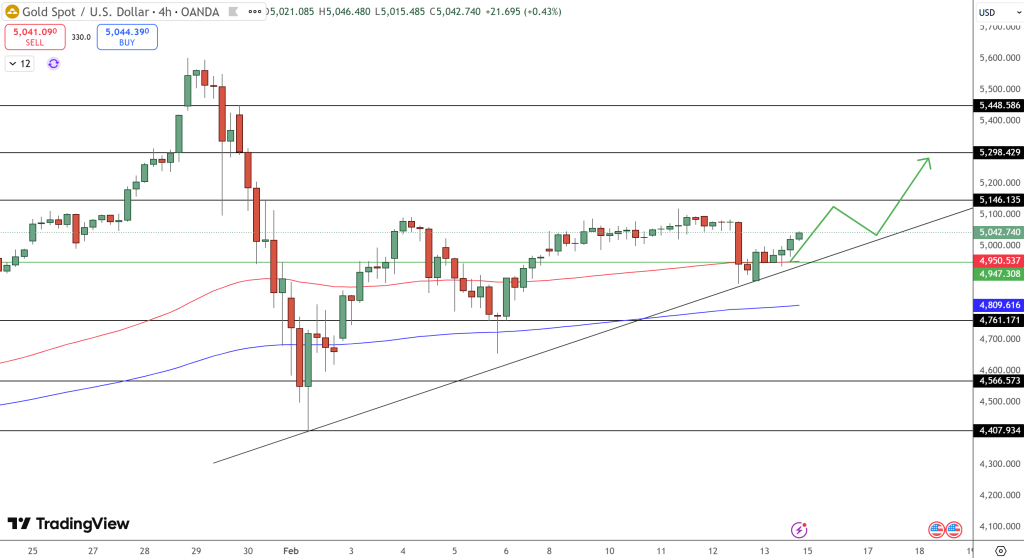
Gold’s technical outlook is still positive, even after the late-January speculative squeeze. The price is now well above the 50-day EMA ($4,947) and the 200-day EMA ($4,809).
| Level Type | Price Point | Significance |
| Primary Resistance | $5,146 | A break above this confirms the end of the consolidation phase. |
| Secondary Resistance | $5,298 | Target for a bullish breakout toward new quarterly highs. |
| Key Support | $4,950 | The “Must-Hold” zone; serves as the new baseline for buyers. |
| Deep Support | $4,761 | The floor established during the late-January correction. |
For the week of February 16, 2026, the outlook is bullish as long as gold stays above $4,950.
Some short-term volatility is likely, especially with lower trading volumes during the Chinese Lunar New Year break (Feb 16 to 23). However, strong fundamentals like supply shortages and institutional demand mean any price drops should be limited.
Analyst Note: “The $5,000 mark isn’t just a number; it’s a psychological rebasing of the market. As long as gold holds this level, the path of least resistance is toward the $5,300 handle.”

Arslan Butt
Lead Markets Analyst – Multi-Asset (FX, Commodities, Crypto)
Arslan Butt serves as the Lead Commodities and Indices Analyst, bringing a wealth of expertise to the field. With an MBA in Behavioral Finance and active progress towards a Ph.D., Arslan possesses a deep understanding of market dynamics.
His professional journey includes a significant role as a senior analyst at a leading brokerage firm, complementing his extensive experience as a market analyst and day trader. Adept in educating others, Arslan has a commendable track record as an instructor and public speaker.
His incisive analyses, particularly within the realms of cryptocurrency and forex markets, are showcased across esteemed financial publications such as ForexCrunch, InsideBitcoins, and EconomyWatch, solidifying his reputation in the financial community.
WTI crude oil (US crude) is trading around $58.41 per barrel in intraday trading, after moving between a low of $56.37 and a high of $58.44 based on Capital.com pricing at 10:49am UTC on 6 January 2026. Meanwhile, UK oil (Brent crude) is trading around $61.94 per barrel, close to the top of its intraday range between $59.88 and $61.99, as of 10:49am UTC on 6 January 2026. Past performance is not a reliable indicator of future results.
Intraday price movements are unfolding amid continued market attention on geopolitical developments in Venezuela, where recent US actions involving President Nicolás Maduro have contributed to a modest risk premium across crude benchmarks (Bloomberg, 6 January 2026). Price action is also taking place against a backdrop of a slightly softer US dollar, after the Dollar Index eased from recent highs near 98.8 (Trading Economics, 6 January 2026).
As of 6 January 2026, third-party oil price predictions generally cluster in the low- to mid-$50s per barrel range for annual averages, with some variation across agencies and banks. The figures below primarily reflect forecast annual average spot or benchmark prices, rather than specific year-end targets, and are typically framed around expectations for supply growth, demand trends and inventory balances.
A Reuters poll of analysts reported in early January 2026 that US crude is projected to average around $58.15 per barrel in 2026, slightly below the prior November consensus of approximately $59.00. The survey highlights expectations for ample supply and a relatively balanced market, with respondents citing rising non-OPEC output as a key factor (Reuters, 5 January 2025).
Goldman Sachs has been cited as expecting Brent crude to average around $56 per barrel, with WTI near $52 per barrel in 2026, below prevailing forward curves as of mid-November 2025. The bank notes that higher-than-expected supply growth alongside a softer demand profile could keep prices under pressure across the 2025–2026 period (BOE Report, 17 November 2025).
J.P. Morgan’s commodities research team, as referenced in industry coverage, forecasts WTI crude averaging about $65 per barrel in 2025 and around $54 per barrel in 2026. The bank points to factors such as strategic stockpiling, evolving sanctions affecting Russian exports, and a gradual moderation in demand growth as shaping a relatively contained price trajectory (Rigzone, 16 December 2025).
Research excerpts circulated via industry reports show Macquarie expecting WTI to average approximately $57.25 per barrel in 2026, while BMI, part of Fitch Solutions, projects a front-month WTI average closer to the low-$60s per barrel range for the same year, based on assumptions published in early December 2025. These institutions generally highlight the interaction between robust US and non-OPEC supply, slowing but still positive demand growth, and ongoing geopolitical and sanctions-related uncertainties (Investing.com, 31 December 2025).
The US EIA’s December 2025 Short-Term Energy Outlook indicates a Brent spot price forecast averaging around $55.08 per barrel in 2026, with quarterly projections centred on the mid-$50s per barrel range. The agency’s outlook suggests prices may ease from late-2025 levels into early 2026, reflecting expectations that growing global oil production and rising inventories could outweigh demand. OPEC+ policy decisions and China’s inventory trends are cited as important variables influencing the extent of any price adjustment ( U.S. Energy Information Administration, 9 December 2025).
Takeaway: Across these sources, third-party oil price predictions generally span from the low-$50s to the low-$60s per barrel, with common reference to ample supply, moderating demand growth and sanctions-related disruptions as underlying assumptions, rather than guarantees of any specific outcome.
Past performance is not a reliable indicator of future results. Projections and third-party forecasts are not recommendations and may not reflect actual future performance, as they cannot account for unforeseen events or changing market conditions.
Brent crude oil is trading near $61.94 as of 10:49am UTC on 6 January 2026, holding just above the Classic Pivot at $61.24 and below first resistance at $63.80, within a relatively tight intraday range. The 20-, 50-, 100- and 200-day simple moving averages sit between roughly $61.3 and $66.0, with shorter-dated averages positioned below longer-dated levels, suggesting a neutral-to-cautious technical structure. The 14-day RSI near 51 remains mid-range, while the ADX around 23 indicates only a modestly developed trend.
A daily close above $63.80 could bring the R2 zone near $66.60 into focus, while a break below the pivot would shift attention toward the S1 area around $58.40 (TradingView, 6 January 2026).
US crude technical analysis
US crude oil is trading around $58.41 per barrel as of 10:49am UTC on 6 January 2026, holding modestly above the Classic Pivot at $57.68 and below the R1 area near $60.39. On the daily chart, price remains supported above the short-term 10-, 20- and 30-day simple moving averages clustered around the high-$57 to low-$58 area, while the 50-, 100- and 200-day SMAs between roughly $58.8 and $62.6 continue to cap the upside. The 14-day RSI near 52.6 sits in neutral territory, while the ADX around 19.6 points to a weak trend environment rather than a strong directional move.
A sustained break above R1 could bring R2 near $63.19 into view, while a move below the pivot risks exposing S1 around $54.87 (TradingView, 6 January 2026).
|
Brent crude technical analysis
Brent crude oil is trading near $61.94 as of 10:49am UTC on 6 January 2026, holding just above the Classic Pivot at $61.24 and below first resistance at $63.80, within a relatively tight intraday range. The 20-, 50-, 100- and 200-day simple moving averages sit between roughly $61.3 and $66.0, with shorter-dated averages positioned below longer-dated levels, suggesting a neutral-to-cautious technical structure. The 14-day RSI near 51 remains mid-range, while the ADX around 23 indicates only a modestly developed trend.
A daily close above $63.80 could bring the R2 zone near $66.60 into focus, while a break below the pivot would shift attention toward the S1 area around $58.40 (TradingView, 6 January 2026).
|
This is technical analysis for informational purposes only and does not constitute financial advice or a recommendation to buy or sell any instrument.
US crude oil (WTI) spent much of 2024 trading within a broad $70–80 per barrel range, with several spikes above $80 around April and July before retreating towards the low-$70s into year-end. Prices then rolled over during late 2024 and early 2025, slipping from closing levels near $71–72 at the end of December 2024 into the low-$70s and upper-$60s by March, before rallying sharply towards $85 in mid-April 2025. This move was followed by a pullback, with prices easing into the low-$60s by early June.
The remainder of 2025 saw WTI gradually ease from early-summer highs around $70–75 into the mid-$60s and later the high-$50s, with the market closing the year at $57.35 on 31 December 2025 and edging slightly higher to around $58.40 by 6 January 2026.
When the GBP/USD begins trading tomorrow it will take place under a cautious banner which has produced rather choppy results the past month. The currency pair is still within its long-term higher realm, but below its apex values achieved in late January when the 1.38500 was challenged.
However, as the day ended the GBP like other major currencies saw strength build against the USD as weaker inflation in the U.S. once again sparked the notion the Federal Reserve needs to be more aggressive about cutting interest rates.

The broad Forex market has seen increased volatility the past couple of weeks. Tomorrow will see an absence of the large U.S. financial institutions because of an American holiday. This means lighter volumes will factor into the GBP/USD early and full trading will not return until early on Tuesday. However, the moves which have been sparked in recent trading should be kept in mind and the notion that surprises may happen should be monitored. Intriguingly, during the height of cautious trading in the GBP/USD on Friday, the 1.36000 while getting challenged and penetrated lower, showed resilience as the weekend grew near buying was sparked the last handful of hours.
The 1.36500 level could prove to be an interesting barometer early this week. If trading on Monday via Asia and the London desks maintain the GBP/USD above the 1.35500 as Tuesday takes hold, this may be signal financial institutions are leaning into a strong GBP outlook. While an internal fight has certainly been heard from inside the U.S. Fed about what to do regarding interest rates, the lower than anticipated inflation numbers this past Friday certainly gave the White House more firepower regarding their argument for the Federal Funds Rate to be cut.
However, an important element still must be considered regarding the GBP/USD, and that is caution. The broad financial markets continue to produce a high level of noise regarding equity values, bonds, and commodity prices.
Speculative price range for GBP/USD is 1.36060 to 1.37300
The door is open for the possibility of dramatic trading this week in the GBP/USD. The currency pair still finished below Thursday’s high watermarks. And even though the GBP/USD finished with an uptick, the currency pair’s inability to really gather strength and jump higher is concerning. The lack of velocity upwards after the U.S. CPI data highlights that caution is still a factor in financial institutions. Risk-adverse attitudes remain genuine.
The absence of the Americans tomorrow will be a good indicator of where behavioral sentiment is with the Asian and European financial institutions. Canada is also on holiday tomorrow it should be noted. The GBP/USD is at an interesting juncture and the 1.36500 could prove to be a solid barometer for traders moving forward, particularly upon the return of North American financial institutions on Tuesday. Day traders should be careful, Forex has shown the capability of producing choppy results the past few weeks as reversals have been ignited quickly. Looking for upside may feel correct in the GBP/USD, but nervousness remains a threat.
Ready to trade our weekly forecast? Check out the best forex trading company in UK worth using.
I wrote on the 8th February that the best trades for the week would be:
A summary of last week’s most important data in the market:
Last week’s data had some minor effects upon the US Dollar and general outlook for risk appetite, with the US economy first looking more ready for rate cuts, but then at the end of the week still looking like its running slightly hot. Overall, the CME FedWatch tool has narrowly moved in favour of expecting three rate cuts in 2026 of 0.25% (June, September, and December), which is a dovish change for the US Dollar.
The other big news, in fact really the big news of the week in the market, was the huge gain printed by the Japanese Yen, which rose by almost 3% against the US Dollar and by a bit less against 4 other currencies. This was an unusually strong appreciation and was driven by the previous weekend’s stunning election victory by the current administration, which gives Japan its strongest government in many years. Investment has been flowing strongly into the Japanese stock market, which accounts for some of the Yen’s gain. There is also an expectation that the Bank of Japan will be hiking its interest rate soon, which is leading traders to get out of short Yen carry trade positions. However, there are strong questions as to how much further the Yen can rise over the coming days, as it looks very overbought and is due for a bullish retracement.
The US military buildup against Iran continues, although the USA and Iran will be holding a second round of talks in Geneva this Tuesday. President Trump has signaled that he will likely give talks about another 3 weeks to succeed before resorting to military action. Prediction markets such as Polymarket now suggest that a US attack on Iran by the end of June this year is unlikely to happen.
The coming week’s most important data points, in order of likely importance, are:
Monday will be a public holiday in the USA and Canada. The entire week is a public holiday in China.
Currency Price Changes and Interest Rates
For the month of February, I forecasted that the EUR/USD currency pair would rise in value.

February 2026 Monthly Forecast Performance to Date
Last week saw one cross with excessive volatility, so I made the following weekly forecast:
There were several Yen crosses which made excessive moves, so I forecast that these crosses will rise over the coming week:
The Japanese Yen was the strongest major currency last week, while the US Dollar was the weakest. Directional volatility rose slightly last week, with just over one third of all major pairs and crosses changing in value by more than 1%. The Yen was extremely volatile and made a large move higher over the week.
Next week’s volatility is likely to be similar or maybe a bit less.
You can trade these forecasts in a real or demo Forex brokerage account.
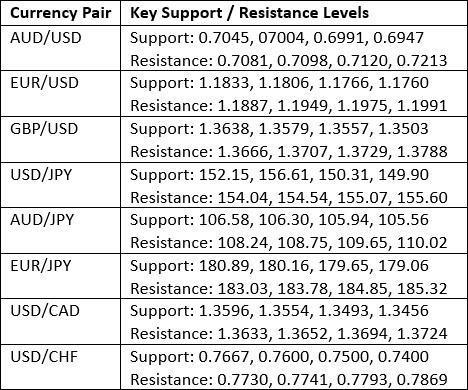
Key Support and Resistance Levels
Last week, the US Dollar printed a bearish candlestick which engulfed the real bodies of the previous two bullish candlesticks. However, there is a notable lower wick, and the price action taken together with previous candlesticks is only very marginally bearish.
Zooming out, we can see that although last week’s close was almost the lowest in more than a year, and although there is a clear long-term bearish trend in terms of the price, the action of the past year has been quite consolidative.
We certainly saw the interest rate outlook turn more bearish last week on the greenback, with markets now pricing in three rate cuts of 0.25% over the course of 2026 instead of two.
All in all, a weakly bearish bias looks sensible, but a minor rise in the greenback over the coming week would not be very surprising.
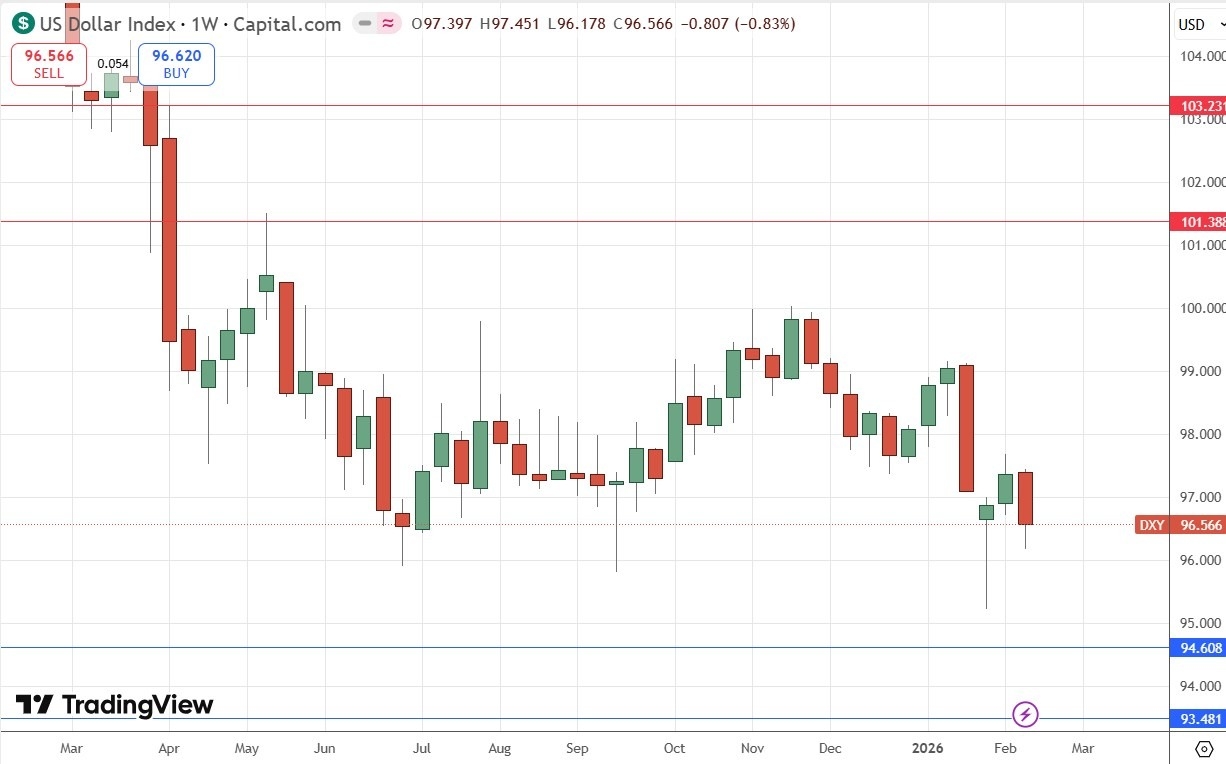
US Dollar Index Weekly Price Chart
The USD/JPY currency pair was at the heart of the Forex market last week, as it made an unusually strong move, with both the US Dollar dropping, plus the Japanese Yen gaining very strongly. The move really came from the Yen, and the Yen also gained excessively against several other currencies as well as the US Dollar.
The weekly candlestick shown below in the price chart completely engulfed the previous week, and most of the week before that. There is a very small lower wick, which could be a bearish sign, but there is a key support level close by. Shorter-term price action also shows a consolidation near the low.
The Japanese Yen gained over the past week as money flowed into Japan to invest in the strong stock market following the government’s landslide election win. There is also an expectation that the Bank of Japan will make more rate hikes soon, which will tend to boost the Yen.
Despite these factors, I expect that the Yen will give up some of its gains over the coming week. As well as the support level at ¥152.14 there is also a long-term bullish ascending trend line which is currently located at the support level below that, at ¥151.61.
Bullish bounces off either of these support levels could be excellent long trade entries with the kind of volatility we are seeing now. This kind of trade against the Yen will likely work even better in one or more of the Yen crosses over the coming week.
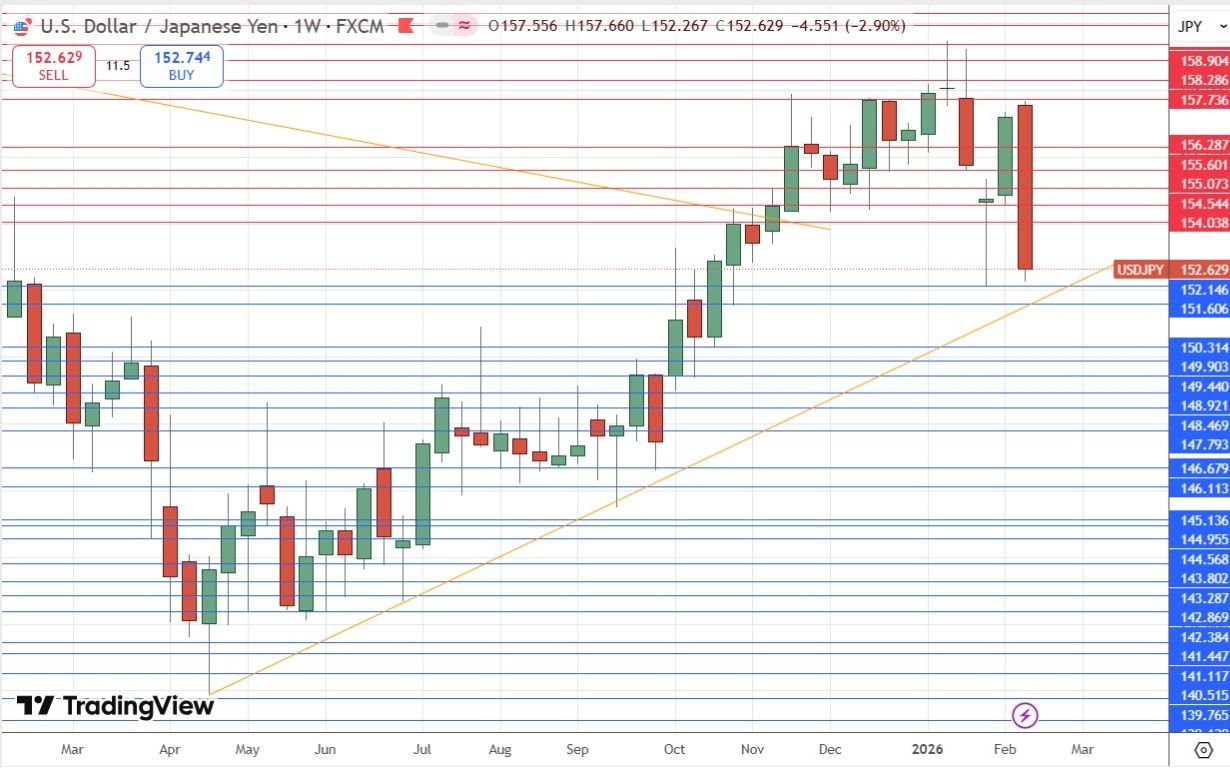
USD/JPY Weekly Price Chart
The S&P 500 Index has been in a strong bull market for a long time. However, although we did see a new record high price just a couple of weeks ago, a look at the weekly chart below shows that the price has just been consolidating, or topping out, for about the last 9 weeks. The support below at 6737 looks pivotal, and the support below that confluent with 6,500 looks even more so, especially when you consider the 200-day simple moving average is confluent with that major half-number.
It is still technically a bull market, and I would go long if we got a record high daily close above 7,025, but the choppiness and reluctance to make new highs suggests we are going to see a deeper drop, which may or may not be the beginning of the end of this bull market.
The NASDAQ 100 Index looks even more vulnerable to a significant fall.
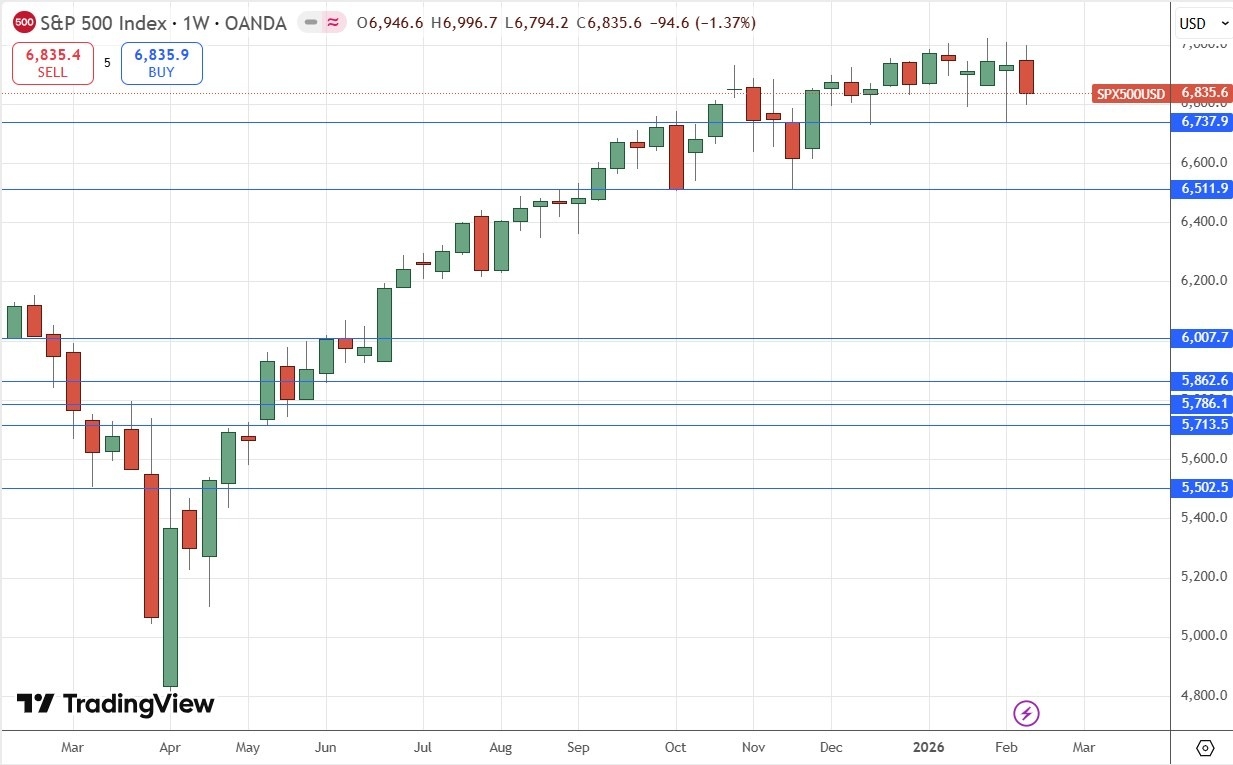
S&P 500 Index Weekly Price Chart
BTC/USD has been making significant bearish breakdowns below some long-term support levels and reached a new 16-month low. This was technically very significant in a bearish way. However, this week’s candlestick is an inside bullish near-doji / pin bar, which suggests an end to the drop, even if temporary. So, we may have finally seen some long-term dip buying, although the price action here does not look confidently bullish.
I would be nervous to be bullish as Bitcoin has been such a standout bearish asset over recent weeks and months. If the price can get established above the resistance level near $81,000 then I would have more confidence that bulls were getting the upper hand.
Alternatively, if the price breaks below the recent low at about $60,000 that would be a very bearish sign, and one that might be worth trading short on the breakdown. That would probably trigger a further drop towards the $50,000 area soon.
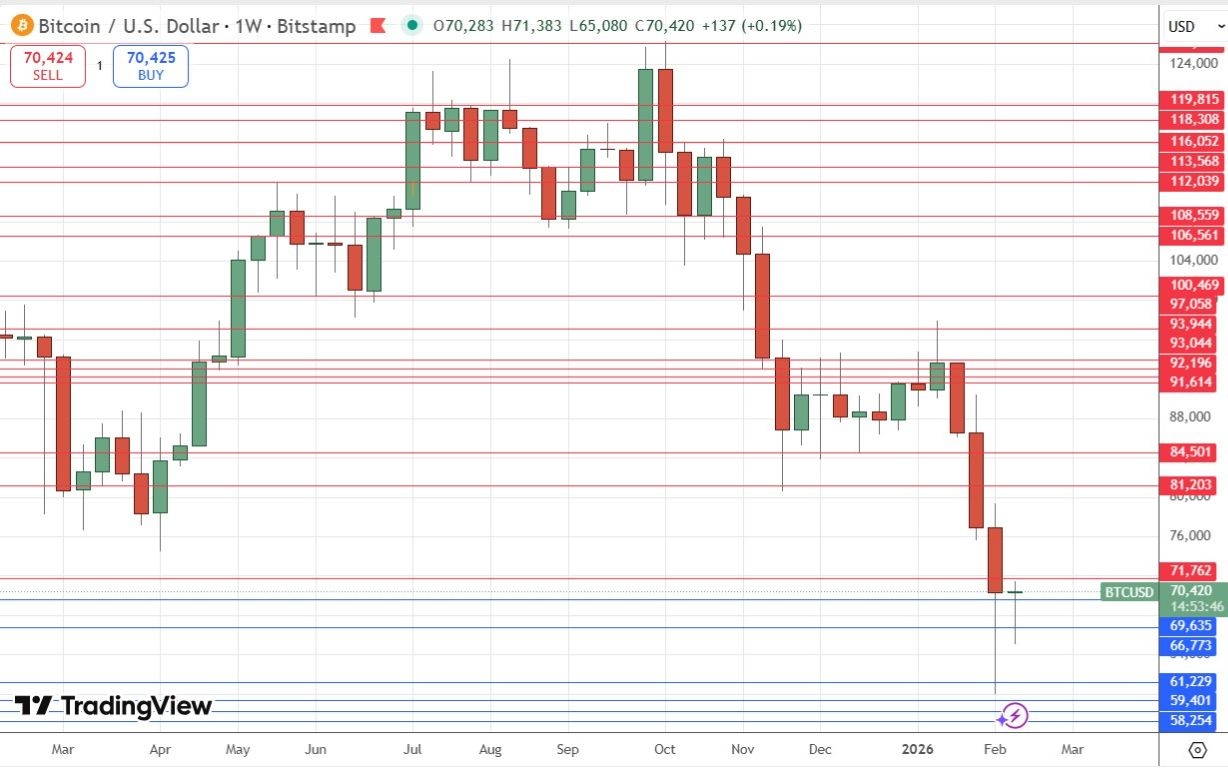
Bitcoin Weekly Price Chart
Gold, like Silver, saw a massive drop in just a day or two at the end of January. Gold fell quickly from a record high at about $5,600 to a low at $4,400 by the end of the week, but has been regaining ground with choppy, wide-swinging price action, as you can see in the daily chart below.
Applying a Fibonacci retracement study, we can see that the halfway level of this movement is very confluent with a major round number at $5,000 and this has been broken to the upside, although it has not managed to hold as key support – yet $4,880 has.
The price action suggests we are going to get a slowly rising consolidation on gradually declining volatility, like a struck tuning fork playing itself out.
Despite seeing Gold as likely to be weakly bullish, I am not interested in being long here again until the price makes a long-term, multi-month high closing price.
It is also notable that Gold is behaving more bullishly than any other precious metal.
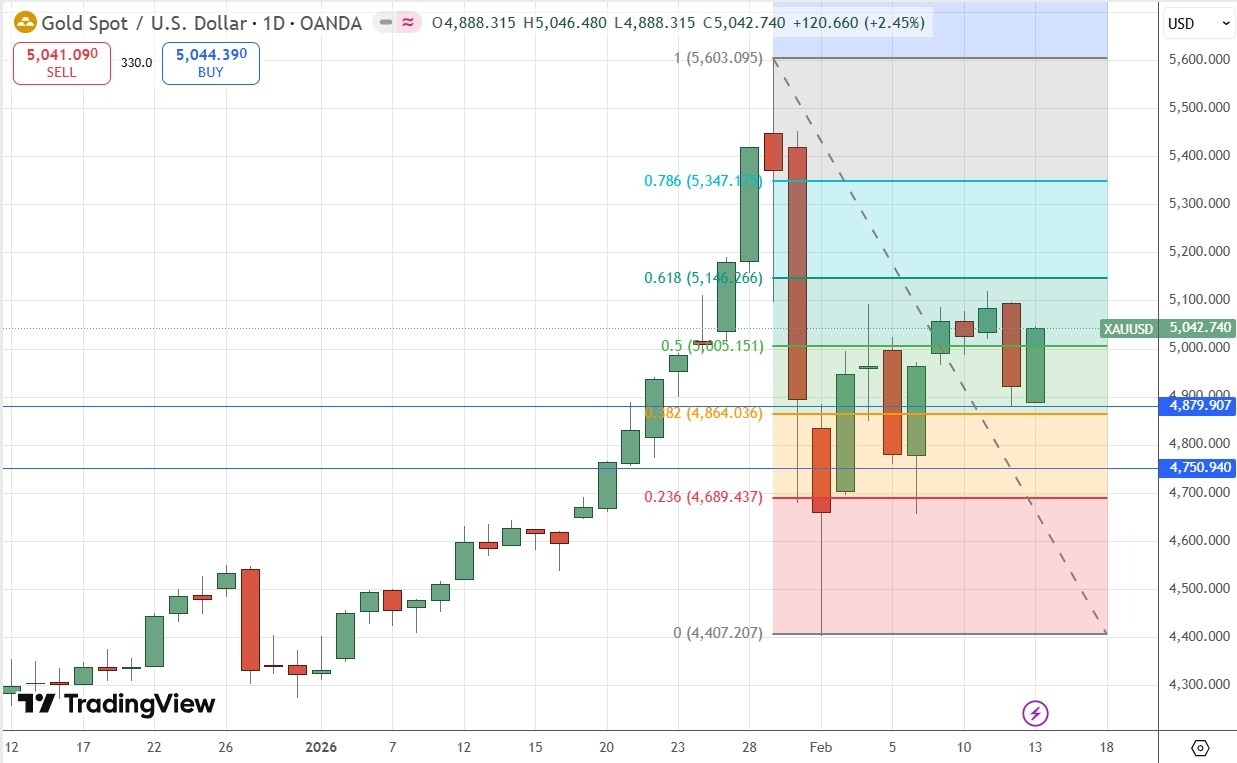
Gold Daily Price Chart
I see the best trades this week as:
Ready to trade our weekly Forex forecast? Check out our list of the top 10 Forex brokers in the world.