The main category of Forex News.
You can use the search box below to find what you need.
[wd_asp id=1]
The main category of Forex News.
You can use the search box below to find what you need.
[wd_asp id=1]
Binance Coin (BNBUSD) declined slightly in its latest intraday trading under continued negative pressure from trading below the 50-day SMA and within the dominance of a short-term corrective bearish trend, with trading along a descending line. Meanwhile, the relative strength indicators have reached extremely overbought levels compared to the price movement, accompanied by the early appearance of a bearish crossover, which further intensifies the negative pressure around the cryptocurrency.
Therefore, we expect the cryptocurrency to decline in its upcoming intraday trading as long as the resistance level of $1,181.90 holds, targeting the key support level of $1,020.50.
Today’s price forecast: Bearish.
The GBP/USD pair has plunged to 1.3116, marking its weakest level since April as a hawkish Federal Reserve stance collides with growing UK fiscal anxiety. The pound’s fourth straight day of declines underscores deep market unease over the Bank of England’s policy paralysis, a surging U.S. dollar, and expectations that the upcoming UK Autumn Budget will tighten spending rather than stimulate growth. Sterling has now fallen over 2% through October, and traders are eyeing a potential test of the 1.3080–1.3000 zone if downside momentum persists.
The Federal Reserve’s recent 25 bps rate cut, initially viewed as a dovish sign, turned sharply hawkish after Chair Jerome Powell warned that further easing in December was “not a foregone conclusion.” This recalibration pushed the U.S. Dollar Index (DXY) to 99.70, its highest in nearly three months, driving broad-based gains against major currencies. Futures pricing of another cut in December dropped from 100% to 70%, flattening the yield curve and tightening financial conditions. The dollar’s strength has crushed the pound’s fragile recovery attempts, with investors shifting capital toward higher-yielding U.S. assets while the UK remains stuck in policy indecision.
The Bank of England faces a dilemma as headline inflation remains at 3.8% year-over-year, nearly double its 2% target, while unemployment has risen to 4.8%, its highest since mid-2021. GDP growth for Q2 came in at a weak 0.3%, reflecting stagnation. Despite mounting pressure for stimulus, the BoE is widely expected to hold rates at 4.00% in the November 6 meeting. Market consensus now sees the first BoE rate cut delayed until February 2026, with policymakers fearing further pound depreciation could worsen imported inflation. This combination of sticky prices and slowing growth has revived concerns of stagflation, a toxic mix last seen during the late 1970s.
The looming Autumn Budget on November 26 adds another layer of uncertainty. The Office for Budget Responsibility (OBR) projects a £20 billion productivity shortfall and £7.2 billion in higher-than-expected borrowing in the first half of 2025, leaving the Chancellor with limited fiscal room. Rachel Reeves is cornered between keeping her no-tax-rise pledge and closing a widening deficit that could exceed £30 billion. Any sign of aggressive fiscal tightening could weigh further on domestic growth expectations and investor sentiment. Sterling traders are now demanding higher yields on gilts, reflecting greater risk premiums to hold UK-denominated assets amid this policy uncertainty.
Technically, GBP/USD has broken through several critical support zones. The 1.3140 region—marking the 38.2% Fibonacci retracement of the 1.2099–1.3788 rally—failed to hold, confirming a medium-term bearish continuation. The next layer sits at 1.3080–1.3088, aligned with the 100% extension of the June decline and the 52-week moving average. A decisive close below this threshold would open a path toward 1.2940, the 50% retracement of the yearly range. Momentum indicators back the bearish tone: the RSI hovers near 30, showing oversold but not exhausted conditions, while price action remains capped below the 20-day and 50-day moving averages. Short-term rebounds toward 1.3200 or 1.3280 are likely to face heavy selling pressure as traders position for deeper downside.
Hopes of improved U.S.–China relations offered brief relief earlier in the week after President Trump hinted at renewed energy purchases from Alaska, but traders quickly dismissed the optimism. With China’s PMI contracting to 49.0, its seventh straight month of decline, and U.S. sanctions on Russian oil limiting supply flows, risk sentiment remains fragile. The stronger dollar environment has persisted despite intermittent risk-on sessions, underscoring global preference for U.S. liquidity amid uncertainty.
With U.S. yields holding near cycle highs and UK macro fundamentals deteriorating, the pound remains vulnerable to further weakness. Market positioning shows elevated short interest on GBP/USD, suggesting continued bearish sentiment through early November. Unless the Bank of England surprises with dovish guidance or the U.S. data turns sharply weaker, upside potential appears limited. The pair could consolidate briefly above 1.3080, but a break lower would likely extend the decline toward 1.2940–1.3000, marking new multi-month lows.
Verdict: Bearish — GBP/USD likely to test 1.3000 before any meaningful recovery as fiscal and policy pressures intensify
Gold is consolidating weekly losses in Asian trades on Friday, having stalled Thursday’s turnaround just shy of the $4,050 mark.
Gold buyers seem to catch a breather following the previous upswing before the end-of-the-week and – month profit-taking wave creeps back in.
Markets resorted to taking profits off the table after the recent tremendous correction in Gold in anticipation of a potential US-China trade deal, while taking account of a less dovish US Federal Reserve (Fed) monetary policy decision.
The Fed on Wednesday delivered the expected 25 basis points (bps) interest rate cut, with Chair Jerome Powell noting that policymakers are likely to become more cautious if it deprives them of further job and inflation reports.
Markets are now pricing in a 72.8% probability of a 25 bps Fed rate cut in December compared with a 91.1% chance a week ago, the CME Group’s FedWatch tool shows.
The Gold rebound was also powered by the latest World Gold Council report that showed, “global gold demand rose 3% year-on-year to 1,313 metric tons, the highest quarterly number on record, in the third quarter as investment demand soared,” per Reuters.
What remains to be seen is if Gold could regain the recovery momentum as the US Dollar (USD) stands tall at two-month highs against its major currency rivals.
Additionally, the continued contraction in the Chinese manufacturing sector weighs negatively on Gold. China is the world’s top yellow metal consumer. The official Manufacturing purchasing managers’ index (PMI) fell to 49.0 in October from 49.8 in September, a six-month low.
That said, the downside in Gold will likely be cushioned by lingering US economic and fiscal concerns as the government shutdown shows no signs of reopening and markets are flying blind amid the data drought.
The daily chart shows that Gold price recaptured the $4,000 barrier on a closing basis on Thursday, reviving the bullish potential.
Adding credence to the upside bias, the 14-day Relative Strength Index (RSI) stays bullish after breaking above the 50 level.
The important resistance levels to watch now are the $4,050 psychological level and the 21-day Simple Moving Average (SMA) at $4,078, followed by $4,129 – the 23.6% Fibo level of the same ascent.
To the downside, the immediate support is seen at the 38.2% Fibo level at $3,973, below which a test of the 50% Fibo of $3,847 will be inevitable
Deeper declines will challenge the 50-day SMA at $3,822.
Gold has played a key role in human’s history as it has been widely used as a store of value and medium of exchange. Currently, apart from its shine and usage for jewelry, the precious metal is widely seen as a safe-haven asset, meaning that it is considered a good investment during turbulent times. Gold is also widely seen as a hedge against inflation and against depreciating currencies as it doesn’t rely on any specific issuer or government.
Central banks are the biggest Gold holders. In their aim to support their currencies in turbulent times, central banks tend to diversify their reserves and buy Gold to improve the perceived strength of the economy and the currency. High Gold reserves can be a source of trust for a country’s solvency. Central banks added 1,136 tonnes of Gold worth around $70 billion to their reserves in 2022, according to data from the World Gold Council. This is the highest yearly purchase since records began. Central banks from emerging economies such as China, India and Turkey are quickly increasing their Gold reserves.
Gold has an inverse correlation with the US Dollar and US Treasuries, which are both major reserve and safe-haven assets. When the Dollar depreciates, Gold tends to rise, enabling investors and central banks to diversify their assets in turbulent times. Gold is also inversely correlated with risk assets. A rally in the stock market tends to weaken Gold price, while sell-offs in riskier markets tend to favor the precious metal.
The price can move due to a wide range of factors. Geopolitical instability or fears of a deep recession can quickly make Gold price escalate due to its safe-haven status. As a yield-less asset, Gold tends to rise with lower interest rates, while higher cost of money usually weighs down on the yellow metal. Still, most moves depend on how the US Dollar (USD) behaves as the asset is priced in dollars (XAU/USD). A strong Dollar tends to keep the price of Gold controlled, whereas a weaker Dollar is likely to push Gold prices up.
Following Wednesday’s sharp decline, EUR/USD failed to shake off the bearish pressure on Thursday and dropped to its weakest level in more than two weeks, below 1.1550. Early Friday, the pair stays in a consolidation phase but the technical outlook suggests that the bearish bias remains unchanged.
The table below shows the percentage change of Euro (EUR) against listed major currencies this week. Euro was the weakest against the Canadian Dollar.
| USD | EUR | GBP | JPY | CAD | AUD | NZD | CHF | |
|---|---|---|---|---|---|---|---|---|
| USD | 0.58% | 1.40% | 0.88% | -0.04% | -0.02% | 1.03% | 0.76% | |
| EUR | -0.58% | 0.83% | 0.36% | -0.62% | -0.53% | 0.44% | 0.18% | |
| GBP | -1.40% | -0.83% | -0.57% | -1.43% | -1.33% | -0.38% | -0.67% | |
| JPY | -0.88% | -0.36% | 0.57% | -1.01% | -0.98% | 0.02% | -0.22% | |
| CAD | 0.04% | 0.62% | 1.43% | 1.01% | -0.03% | 1.07% | 0.77% | |
| AUD | 0.02% | 0.53% | 1.33% | 0.98% | 0.03% | 0.96% | 0.66% | |
| NZD | -1.03% | -0.44% | 0.38% | -0.02% | -1.07% | -0.96% | -0.30% | |
| CHF | -0.76% | -0.18% | 0.67% | 0.22% | -0.77% | -0.66% | 0.30% |
The heat map shows percentage changes of major currencies against each other. The base currency is picked from the left column, while the quote currency is picked from the top row. For example, if you pick the Euro from the left column and move along the horizontal line to the US Dollar, the percentage change displayed in the box will represent EUR (base)/USD (quote).
The European Central Bank (ECB) announced on Thursday that it left key rates unchanged following the October policy meeting, as widely anticipated. In the policy statement, the ECB reiterated its data-dependent approach to policymaking and said that they are not “pre-committing” to a particular rate path.
While responding to questions from the press, ECB President Chritsine Lagarde acknowledged that they are in a “period of great uncertainty” and added that a stronger Euro (EUR) could bring down inflation further than expected.
The persistent US Dollar (USD) strength that followed Federal Reserve (Fed) Chair Jerome Powell’s cautious comments on further policy easing, combined with the negative impact of the ECB event on the Euro, EUR/USD extended its weekly slide on Thursday.
The economic calendar will not feature any high-impact data releases on Friday. In the American session, several Fed policymakers will be delivering speeches.
The CME FedWatch Tool’s probability of a 25 basis points (bps) rate cut in December dropped below 70% from around 90% earlier in the week. In case Fed officials leave the door open for a December cut, the immediate reaction could weigh on the USD and help EUR/USD erase some of its weekly losses. On the other hand, the USD could preserve its strength heading into the weekend if policymakers echo Powell’s tone, noting another rate cut before the end of the year is far from assured.
The Relative Strength Index (RSI) indicator on the 4-hour chart stays in between 30 and 40, suggesting that the bearish bias remains unchanged and that there is room on the downside before EUR/USD turns technically oversold.
On the downside, 1.1550 (static level) aligns as the immediate support level before 1.1500 (Fibonacci 78.6% retracement) and 1.1450 (static level). Looking north, the first resistance level could be spotted at 1.1620 (20-day SMA) ahead of 1.1670-1.1680 (100-day SMA, 50-day SMA).
The Euro is the currency for the 20 European Union countries that belong to the Eurozone. It is the second most heavily traded currency in the world behind the US Dollar. In 2022, it accounted for 31% of all foreign exchange transactions, with an average daily turnover of over $2.2 trillion a day.
EUR/USD is the most heavily traded currency pair in the world, accounting for an estimated 30% off all transactions, followed by EUR/JPY (4%), EUR/GBP (3%) and EUR/AUD (2%).
The European Central Bank (ECB) in Frankfurt, Germany, is the reserve bank for the Eurozone. The ECB sets interest rates and manages monetary policy.
The ECB’s primary mandate is to maintain price stability, which means either controlling inflation or stimulating growth. Its primary tool is the raising or lowering of interest rates. Relatively high interest rates – or the expectation of higher rates – will usually benefit the Euro and vice versa.
The ECB Governing Council makes monetary policy decisions at meetings held eight times a year. Decisions are made by heads of the Eurozone national banks and six permanent members, including the President of the ECB, Christine Lagarde.
Eurozone inflation data, measured by the Harmonized Index of Consumer Prices (HICP), is an important econometric for the Euro. If inflation rises more than expected, especially if above the ECB’s 2% target, it obliges the ECB to raise interest rates to bring it back under control.
Relatively high interest rates compared to its counterparts will usually benefit the Euro, as it makes the region more attractive as a place for global investors to park their money.
Data releases gauge the health of the economy and can impact on the Euro. Indicators such as GDP, Manufacturing and Services PMIs, employment, and consumer sentiment surveys can all influence the direction of the single currency.
A strong economy is good for the Euro. Not only does it attract more foreign investment but it may encourage the ECB to put up interest rates, which will directly strengthen the Euro. Otherwise, if economic data is weak, the Euro is likely to fall.
Economic data for the four largest economies in the euro area (Germany, France, Italy and Spain) are especially significant, as they account for 75% of the Eurozone’s economy.
Another significant data release for the Euro is the Trade Balance. This indicator measures the difference between what a country earns from its exports and what it spends on imports over a given period.
If a country produces highly sought after exports then its currency will gain in value purely from the extra demand created from foreign buyers seeking to purchase these goods. Therefore, a positive net Trade Balance strengthens a currency and vice versa for a negative balance.
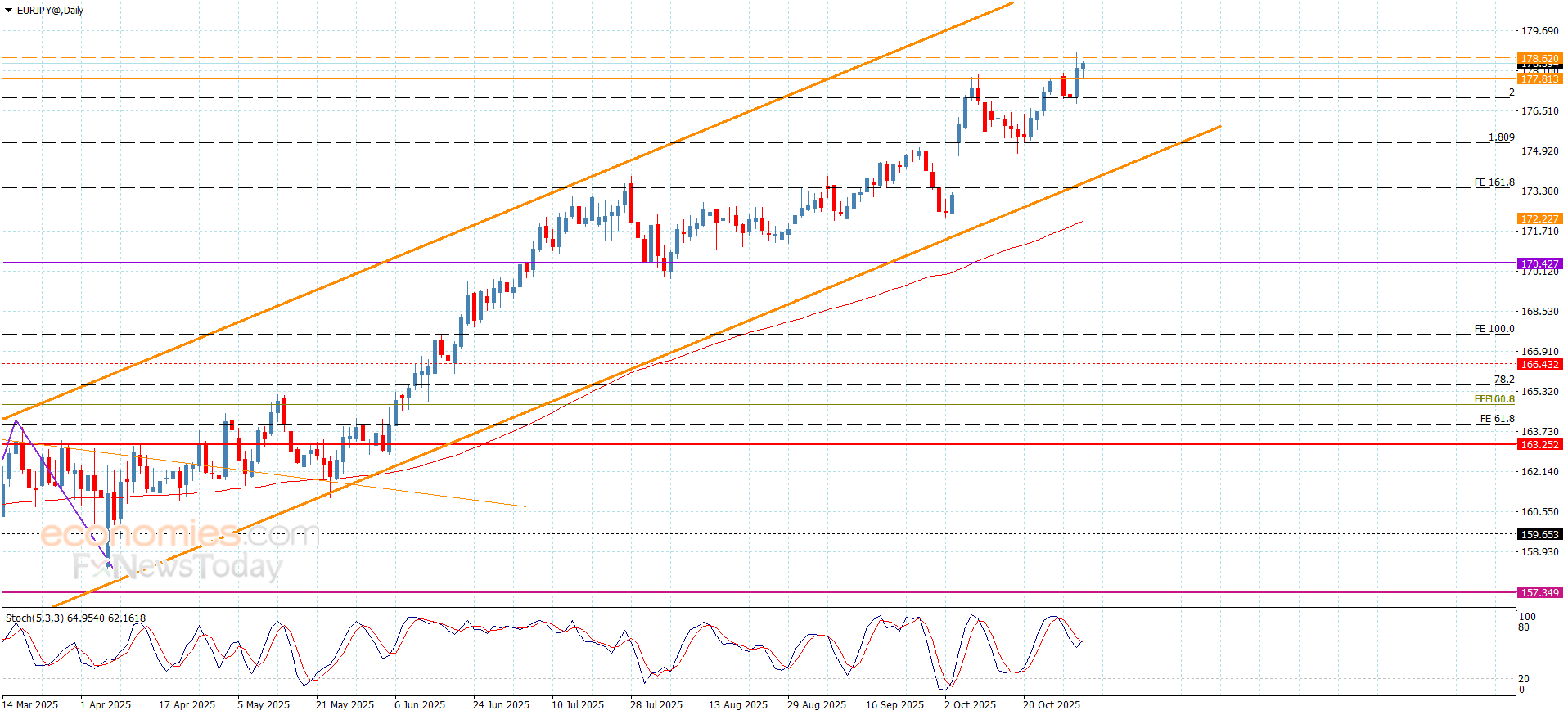
The EURJPY pair formed strong bullish rally, taking advantage of the positive factors that are represented by its stability above the extra support at 177.05 besides the main indicators attempt to provide positive momentum, to notice recording the initial target by reaching 178.80.
No escape from renewing the bullish attempts, to attempt to breach 178.80 level and hold above to open the way for recording extra gains that might extend towards 179.35 reaching 180.00, forming temporary psychological barrier against the bullish trading.
The expected trading range for today is between 177.70 and 179.35
Trend forecast: Bullish
Copper price attempted to activate the bullish trend, to end it after reaching the barrier at$5.2000, which forces it to decline correctively to settle near$5.0400.
We expect providing mixed trading, but its main stability within the bullish channel’s levels by forming extra support at $4.7500 level will increase the chances of gathering positive momentum, to repeat the attempts to achieve extra gains that might extend to $5.3200 and $5.5000.
The expected trading range for today is between $4.9200 and $5.2200
Trend forecast fluctuated within the bullish track
Copper price attempted to activate the bullish trend, to end it after reaching the barrier at$5.2000, which forces it to decline correctively to settle near$5.0400.
We expect providing mixed trading, but its main stability within the bullish channel’s levels by forming extra support at $4.7500 level will increase the chances of gathering positive momentum, to repeat the attempts to achieve extra gains that might extend to $5.3200 and $5.5000.
The expected trading range for today is between $4.9200 and $5.2200
Trend forecast fluctuated within the bullish track
Copper price attempted to activate the bullish trend, to end it after reaching the barrier at$5.2000, which forces it to decline correctively to settle near$5.0400.
We expect providing mixed trading, but its main stability within the bullish channel’s levels by forming extra support at $4.7500 level will increase the chances of gathering positive momentum, to repeat the attempts to achieve extra gains that might extend to $5.3200 and $5.5000.
The expected trading range for today is between $4.9200 and $5.2200
Trend forecast fluctuated within the bullish track
Silver price (XAG/USD) extends its gains for the second successive session, trading around $48.00 per troy ounce during the European hours on Monday. The price of the grey metal declines due to weakened safe-haven demand, driven by the progress in the United States (US)-China trade negotiations. Silver prices also decline as profit-taking emerges amid concerns of overvaluation following the metal’s surge to record highs.
The risk-on sentiment improves after reports that top negotiators from the US and China have reached a consensus on major disputes and paved the way for Presidents Donald Trump and Xi Jinping to meet on Thursday to finalize a trade deal. Officials in Malaysia announced after two days of talks that both sides had agreed on key issues, including export controls, fentanyl, and shipping levies.
Moreover, US Treasury Secretary Scott Bessent told CBS News that President Trump’s threat to impose 100% tariffs on Chinese goods “is effectively off the table.” Bessent added that China has agreed to make “substantial” soybean purchases and to postpone its rare-earth export controls “for a year while they re-examine it.”
The downside of the non-interest-bearing Silver could be restrained as softer recent US inflation data for September support the likelihood of a rate cut by the US Federal Reserve (Fed) this week. The CME FedWatch Tool indicates that markets are now pricing in nearly a 97% chance of a Fed rate cut in October and a 96% possibility of another reduction in December. It is worth noting that returns on interest-bearing assets decline when interest rates fall. This makes non-yielding assets such as Silver more appealing, since investors aren’t missing out on as much interest income by holding them.
Silver is a precious metal highly traded among investors. It has been historically used as a store of value and a medium of exchange. Although less popular than Gold, traders may turn to Silver to diversify their investment portfolio, for its intrinsic value or as a potential hedge during high-inflation periods. Investors can buy physical Silver, in coins or in bars, or trade it through vehicles such as Exchange Traded Funds, which track its price on international markets.
Silver prices can move due to a wide range of factors. Geopolitical instability or fears of a deep recession can make Silver price escalate due to its safe-haven status, although to a lesser extent than Gold’s. As a yieldless asset, Silver tends to rise with lower interest rates. Its moves also depend on how the US Dollar (USD) behaves as the asset is priced in dollars (XAG/USD). A strong Dollar tends to keep the price of Silver at bay, whereas a weaker Dollar is likely to propel prices up. Other factors such as investment demand, mining supply – Silver is much more abundant than Gold – and recycling rates can also affect prices.
Silver is widely used in industry, particularly in sectors such as electronics or solar energy, as it has one of the highest electric conductivity of all metals – more than Copper and Gold. A surge in demand can increase prices, while a decline tends to lower them. Dynamics in the US, Chinese and Indian economies can also contribute to price swings: for the US and particularly China, their big industrial sectors use Silver in various processes; in India, consumers’ demand for the precious metal for jewellery also plays a key role in setting prices.
Silver prices tend to follow Gold’s moves. When Gold prices rise, Silver typically follows suit, as their status as safe-haven assets is similar. The Gold/Silver ratio, which shows the number of ounces of Silver needed to equal the value of one ounce of Gold, may help to determine the relative valuation between both metals. Some investors may consider a high ratio as an indicator that Silver is undervalued, or Gold is overvalued. On the contrary, a low ratio might suggest that Gold is undervalued relative to Silver.

Image © Adobe Images
“We retain a negative view on the U.S. dollar, despite recent stabilisation,” says Kiran Kowshik, Global FX Strategist at Lombard Odier.
The Swiss bank says the U.S. dollar has stabilised higher since mid-September, reflecting a voting pattern at the September Fed meeting where some members preferred a more cautious approach to cuts.
Globally, ex-USD weakness was also apparent due to the uncertain political news flow from France and Japan.
Looking aheada, Lombard Odier says dollar-specific drivers are to resume dominance of pairs like EUR/USD and GBP/USD.

Pound Sterling Live consistently delivers stronger rates than major UK banks.
In July, you could have saved up to $1,515 on a £50,000 transfer thanks to our competitive pricing.
i – Based on average GBP/USD rates observed in July.
“While markets already price in the Fed funds rate eventually falling to 3%, the sequencing matters: the Fed is cutting rates just as several other major central banks (including in Europe and Switzerland) have ended their easing cycles,” says Kowshik.
“This type of sequencing was seen in the 1980s and 1990s and resulted in USD depreciation as the Fed eased (see chart 2). We maintain a 12-month EURUSD forecast of 1.22.”
Regarding the pound vs. dollar, a GBP/USD recovery is anticipated by the Swiss bank.
“Combined with renewed weakness in the USD, GBP/USD could see a more significant move higher heading into December if the UK Budget does not surprise market expectations. Our 12-month GBP/USD forecast stands at 1.37,” says Kowshik.
He adds that the pre-budget anxieties that have pressed down on sterling over recent months are not unusual and the currency tends to recover after budget events.
“Historically, sterling tends to weaken heading into the Budget but sees relief thereafter,” says Kowshik.