The main category of Forex News.
You can use the search box below to find what you need.
[wd_asp id=1]
The main category of Forex News.
You can use the search box below to find what you need.
[wd_asp id=1]
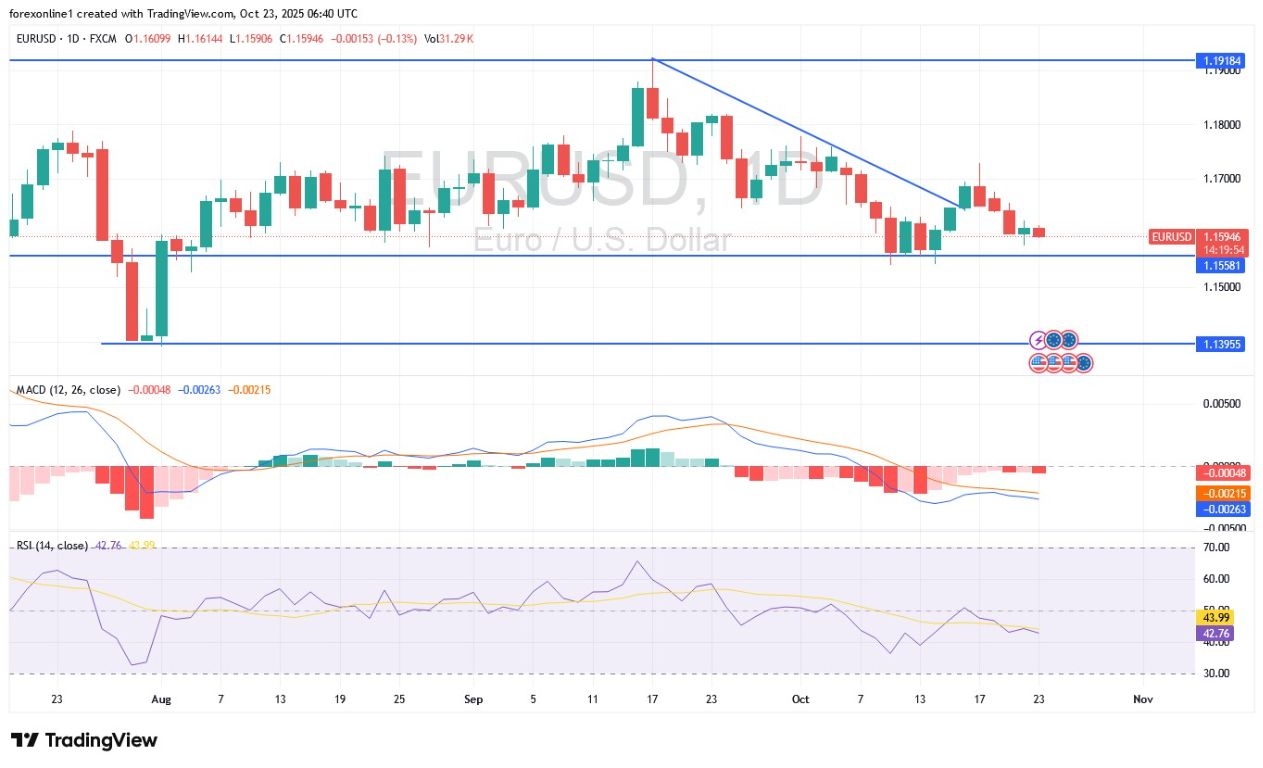
As anticipated, the bearish bias for EUR/USD has strengthened, moving towards and below the 1.1600 support level. During yesterday’s trading session, the most famous currency pair in the Forex market saw losses extend to the 1.1576 support level, near its lowest point in a week, before stabilizing around the 1.1610 level at the time of writing this analysis. Overall, the EUR/USD bias may remain bearish as traders now look to US inflation data for clues on whether the Federal Reserve will implement another interest rate cut next week.

The consolidation of the 14-day Relative Strength Index (RSI) around a reading of 43, below the neutral line, confirms the bearish shift for the EUR/USD pair across reliable trading platforms. Despite the losses, the pair still has more room for stronger declines before reaching oversold territory. This could happen if the bears succeed in pushing towards the support levels of 1.1540, 1.1470, and 1.1400, respectively.
As we mentioned before, the EUR/USD pair’s upward trend, based on the daily chart, will continue to be contingent on a move towards the 1.1800 resistance level again.
Wait for the reaction to the US inflation figures to anticipate the most appropriate EUR/USD trades, whether to buy or sell.
According to Forex market trading, the EUR/USD exchange rate failed to breach the 1.1700 area at the start of this week’s trading and quickly inclined to move towards and below the 1.1600 support as the US Dollar achieved net gains in currency markets. Although the 10-year US Treasury yield remained below 4.00%, the US Dollar still managed to post net gains while the Yen recorded sharp losses.
Regarding the future of currency prices, UoB Bank does not expect a breakout; while a calmer fundamental tone suggests a potential drop in the Euro price today, any decline is likely to be part of a lower range between 1.1625 and 1.1660. However, according to ING Bank, there is room for further short-term decline; “EUR/USD remains almost entirely driven by US credit/equity sentiment. Accordingly, further stability could lead to EUR/USD trading reaching the 1.160 support. Levels below that will be difficult to justify unless Friday’s US CPI comes in higher than expected.”
Overall, US interest rate expectations will be a key market influencer.
At this stage, traders are pricing in a near-100% chance of a US rate cut at next week’s meeting, and the Federal Reserve has not expressed any objection. In this regard, Rabobank commented, “The FOMC remains likely to make another cut in October, even if the committee’s vision is limited. In the absence of convincing evidence to go beyond October or to make a larger cut in October, the FOMC is operating automatically.”
Generally, financial markets also estimate a probability exceeding 95% for an additional 25 basis point US interest rate cut in December. Before that, with the government shutdown, US markets continue to operate with a scarcity of data, which increases the risk of misjudging subsequent meetings.
Ready to trade our EUR/USD daily forecast? Here’s a list of some of the top forex brokers in Europe to check out.
Bitcoin (BTCUSD) prices settled with cautious gains during their last intraday trading, after the stability of the key support of $107,400, gaining bullish momentum that helped it to achieve these gains and surpass the resistance of its EMA50, however the main bearish trend remains the dominant on the trading, especially with its trading alongside supportive trendline, besides the relative strength indicators reaching sever overbought levels compared to the price move, indicating the beginning of forming negative divergence, which intensified the negative pressure on the price.
Get high-accuracy trading signals delivered directly to your Telegram. Subscribe to specialized packages tailored for the world’s top markets:
Full VIP signals performance report for 13-17, October 2025:
View Full Performance Report Telegram (https://t.me/besttradingsignalstocksbot?start=p88d632b0-66dd-11f0-a948-13815052d5ae)
The British Pound is has reverted to Wednesday’s pullback and trades at the upper range of the 203.00s, as news that the new Japanese government should be preparing a large stimulus program is hammering the Yen on Thursday.
Reuters has reported, citing a government document, that Prime Minister Takaichi’s cabinet would be planning a USD 90 billion stimulus package to support households against the impact of increasing prices. This stimulus would come less than a year after a similar one introduced in 2024 and is expected to add pressure on the already strained public finances.
The technical picture shows the bulls in control and trying to confirm above the resistance area between the top of an ascending wedge pattern and the October 10 high, at the 203.75 area. The 4-hour RSI remains well above the 50 level, and the MACD is about to perform a bullish cross, which reinforces the positive outlook.
A successful break of that resistance area would shift the focus to the October 9 high, at 204.85, ahead of the year-to-date high, at 205.33.
To the downside, trendline support is at the 202.80 area, ahead of the October 21 and 22 lows, in the area of 201.90. Further down, the key 202.790 support (October 17 low) emerges as the next plausible target.
The table below shows the percentage change of Japanese Yen (JPY) against listed major currencies today. Japanese Yen was the strongest against the Swiss Franc.
| USD | EUR | GBP | JPY | CAD | AUD | NZD | CHF | |
|---|---|---|---|---|---|---|---|---|
| USD | 0.17% | 0.12% | 0.52% | -0.01% | -0.26% | -0.07% | 0.28% | |
| EUR | -0.17% | -0.05% | 0.32% | -0.17% | -0.42% | -0.24% | 0.12% | |
| GBP | -0.12% | 0.05% | 0.37% | -0.11% | -0.37% | -0.19% | 0.17% | |
| JPY | -0.52% | -0.32% | -0.37% | -0.51% | -0.74% | -0.58% | -0.21% | |
| CAD | 0.00% | 0.17% | 0.11% | 0.51% | -0.24% | -0.06% | 0.29% | |
| AUD | 0.26% | 0.42% | 0.37% | 0.74% | 0.24% | 0.18% | 0.54% | |
| NZD | 0.07% | 0.24% | 0.19% | 0.58% | 0.06% | -0.18% | 0.36% | |
| CHF | -0.28% | -0.12% | -0.17% | 0.21% | -0.29% | -0.54% | -0.36% |
The heat map shows percentage changes of major currencies against each other. The base currency is picked from the left column, while the quote currency is picked from the top row. For example, if you pick the Japanese Yen from the left column and move along the horizontal line to the US Dollar, the percentage change displayed in the box will represent JPY (base)/USD (quote).

Gold price forecast indicates that XAU/USD is trading near $4107.86, slightly up after a sharp correction from Monday’s high of $4381.44 to a low of $4004.28. The yellow metal is consolidating between key pivots at $4100.43 and $4162.93. Traders are focusing on the $4192.86 level, which could signal renewed bullish momentum if broken.
At 10:30 GMT, XAU/USD traded $8.46 higher, or 0.21%. The $4000 level remains an important support area. Market participants are deciding whether this represents a buying opportunity or a short-term bounce before another decline.
If bulls fail to maintain momentum, targets below include $3846.50 and the 50-day moving average at $3741.61. This area now defines the near-term value zone, and a break below it could restore bearish sentiment.
Geopolitical events continue to influence the gold price forecast. The U.S. has imposed new sanctions on Russian oil firms Lukoil and Rosneft. At the same time, trade tensions with China have resurfaced due to Washington’s plan to restrict software-related exports.
These developments are keeping gold’s safe-haven demand steady. According to market analysts, ongoing geopolitical risks may maintain long-term interest in gold, even if short-term reactions remain subdued.
Gold price forecast also depends on upcoming macroeconomic data. Traders await the delayed U.S. Consumer Price Index (CPI) report, which could guide the Federal Reserve’s next interest rate decision. Markets currently expect a 25-basis-point rate cut. Falling real yields and continued central bank gold buying support a longer-term positive outlook. These factors keep the precious metal attractive despite short-term volatility.
Gold price forecast shows XAU/USD at a technical decision point. Holding above $4004.28 keeps the short-term bullish setup intact. A breakout through $4192.86 could push prices toward the record high of $4381.44.
Failure to hold above $4004.28, however, could send the price into the $3846.50–$3741.61 value zone. Traders waiting for this pullback might find a stronger base, though it risks missing a move if buyers defend the current range.
Currently, gold is trading at $4126.53, with prices expected to stabilize within the $4059.90–$4114.01 range before testing higher resistance levels.
On the 4-hour chart, several indicators shape the gold price forecast:
Trading Plan:
Tomorrow (October 24, 2025):
Gold is expected to trade between $4005.79 and $4202.40, averaging near $4104.09.
Next Week (October 20–26, 2025):
Volatility remains high, with expected lows near $3951.68 and highs around $4441.34.
Next 30 Days (October 2025):
Prices may fluctuate between $3951.68 and $4645.91, averaging $4298.79. Inflation reports and the Fed’s rate decision on October 29 will play a key role.
This gold price forecast is based on:
Will the gold price increase tomorrow?
Gold price movement depends on U.S. data and geopolitical events. Key levels are $4005.79 support and $4202.40 resistance, with potential consolidation and limited upside momentum.
What could cause gold prices to decline next week?
Stronger economic data, easing geopolitical tensions, or a stronger U.S. dollar could lead to short-term declines in gold prices below $3951.68.
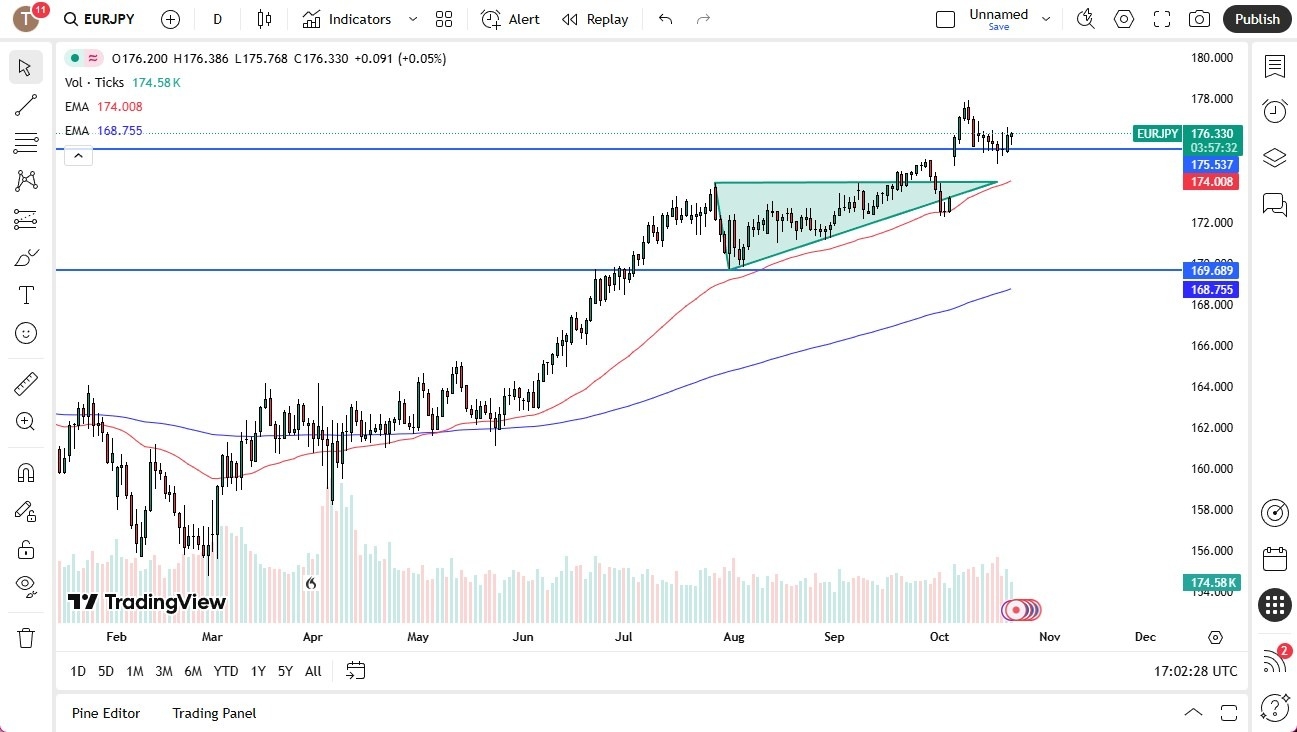
The technical analysis for this market is obviously very bullish overall, as we had gapped to the upside after the Japanese election. With that being said, the market has pulled back to test the top of the gap, and now it looks like we are trying to turn things around and start to look like we are going to go to the ¥178 level. The ¥178 level is an area that offered resistance previously, so I think you have a situation where we are going to continue to see a lot of noise overall, and ultimately, I think this volatility probably has people looking at this through the prism of a “buy on the dips” market.
It’s not necessarily that like the euro itself, it’s just that the Japanese yen has so many issues with it at the moment that it makes sense that this pair will move right along with the other JPY-denominated markets. Ultimately, I do think we are higher, not only in this pair, but all of the other JPY-denominated pairs. All things being equal, I also would watch the 50 Day EMA near the ¥174 level, which is rising and offering itself as a bit of an uptrend line. Typically, this is a market that continues to see a lot of noisy behavior, but I also think all things being equal, the Japanese yen weakness will be the main driver here, although there is a bit of a positive swap in this pair if you are long.
Begin trading our daily forecasts and analysis. Here is a list of Forex brokers in Japan to work with.
Christopher Lewis has been trading Forex and has over 20 years experience in financial markets. Chris has been a regular contributor to Daily Forex since the early days of the site. He writes about Forex for several online publications, including FX Empire, Investing.com, and his own site, aptly named The Trader Guy. Chris favours technical analysis methods to identify his trades and likes to trade equity indices and commodities as well as Forex. He favours a longer-term trading style, and his trades often last for days or weeks.
Gold has reversed the early Asian dip to near $4,065 on Thursday, battling the $4,100 mark as traders look for fresh developments on the geopolitical and trade front.
Risk-off flows extended into early Thursday as markets reacted negatively to reports of fresh US threats on Chinese products.
Reuters reported that the US is considering a plan to restrict an array of software-powered exports to China, from laptops to jet engines, to retaliate against Beijing’s latest round of rare earth export restrictions.
Meanwhile, renewed geopolitical headlines also hogged the limelight after US President Donald Trump imposed sanctions on Russia’s major oil companies and accused the Russians of a lack of commitment toward ending the war in Ukraine.
Markets also weighed the disappointing earnings reports from US tech giants. Tesla reported below forecast profits, while Netflix tumbled on grim outlook.
“Apple shares fell 1.6% after the tech giant was hit with a complaint to EU antitrust regulators by two civil rights groups on Wednesday,” per Reuters.
These factors overshadow any optimism over a likely US-China trade deal next week, as hinted by US President Donald Trump.
Broad risk aversion helps the US Dollar (USD) regain its safe-haven status, limiting Gold’s recovery momentum. The recent decline in the Pound Sterling (GBP) and the Japanese Yen (JPY) also keeps the sentiment around the Greenback underpinned.
Looking ahead, it remains to be seen if Gold can sustain its recovery, despite the USD’s dominance. This depends on the incoming geopolitical and trade updates in the absence of the US economic data releases.
All eyes turn to Friday’s US Consumer Price Index (CPI) data, but an interest rate cut by the Federal Reserve next week is fully priced in. However, traders could continue taking profits on their Gold longs in the lead-up to the US CPI event risk.
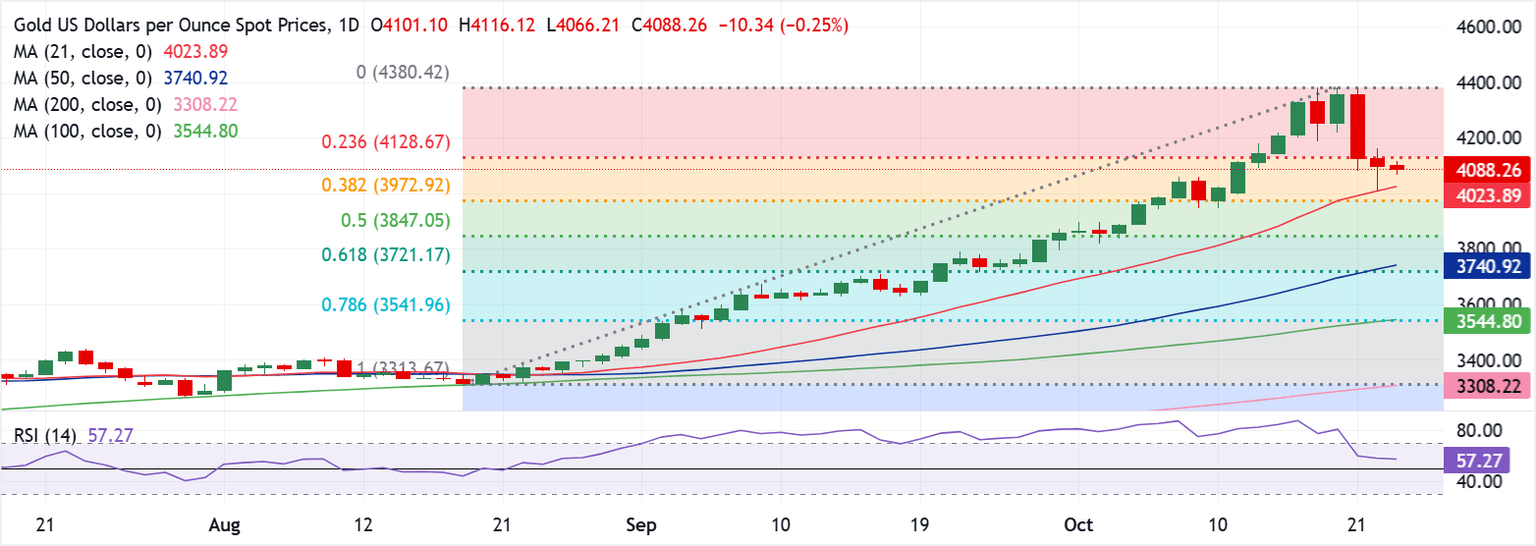
Gold continues to defend the 21-day Simple Moving Average (SMA), now at $4,024.
Meanwhile, the 14-day Relative Strength Index (RSI) looks to turn around, currently near 57.
The leading indicator suggests that Gold buyers could likely regain control in the near term.
However, they must recapture the 23.6% Fibonacci Retracement (August 19 low to October 20 high) support-turned-resistance at $4,129 to revive the record-setting rally.
The next topside hurdle is seen at the $4,300 round level, followed by the all-time highs of $4,382.
On the flip side, if the 21-day SMA is breached on a daily candlestick closing basis, the 38.2% Fibo level at $3,972 could lend immediate support.
A steeper correction could unfold on a failure to resist above the latter, opening doors toward the 50% Fibo level at $3,847.
Generally speaking, a trade war is an economic conflict between two or more countries due to extreme protectionism on one end. It implies the creation of trade barriers, such as tariffs, which result in counter-barriers, escalating import costs, and hence the cost of living.
An economic conflict between the United States (US) and China began early in 2018, when President Donald Trump set trade barriers on China, claiming unfair commercial practices and intellectual property theft from the Asian giant. China took retaliatory action, imposing tariffs on multiple US goods, such as automobiles and soybeans. Tensions escalated until the two countries signed the US-China Phase One trade deal in January 2020. The agreement required structural reforms and other changes to China’s economic and trade regime and pretended to restore stability and trust between the two nations. However, the Coronavirus pandemic took the focus out of the conflict. Yet, it is worth mentioning that President Joe Biden, who took office after Trump, kept tariffs in place and even added some additional levies.
The return of Donald Trump to the White House as the 47th US President has sparked a fresh wave of tensions between the two countries. During the 2024 election campaign, Trump pledged to impose 60% tariffs on China once he returned to office, which he did on January 20, 2025. With Trump back, the US-China trade war is meant to resume where it was left, with tit-for-tat policies affecting the global economic landscape amid disruptions in global supply chains, resulting in a reduction in spending, particularly investment, and directly feeding into the Consumer Price Index inflation.
GBP/USD struggles to stage a rebound and trades in a narrow channel at around 1.3350 after closing the previous four trading days in negative territory. As investors await the key September Consumer Price Index (CPI) data from the United States, which will be published on Friday, the technical outlook suggests that the bearish bias remains intact.
On Wednesday, Pound Sterling came under bearish pressure after the data from the UK showed that the annual inflation, as measured by the change in the CPI, held steady at 3.8% in September. This print came in below the market expectation of 4%. Read more…
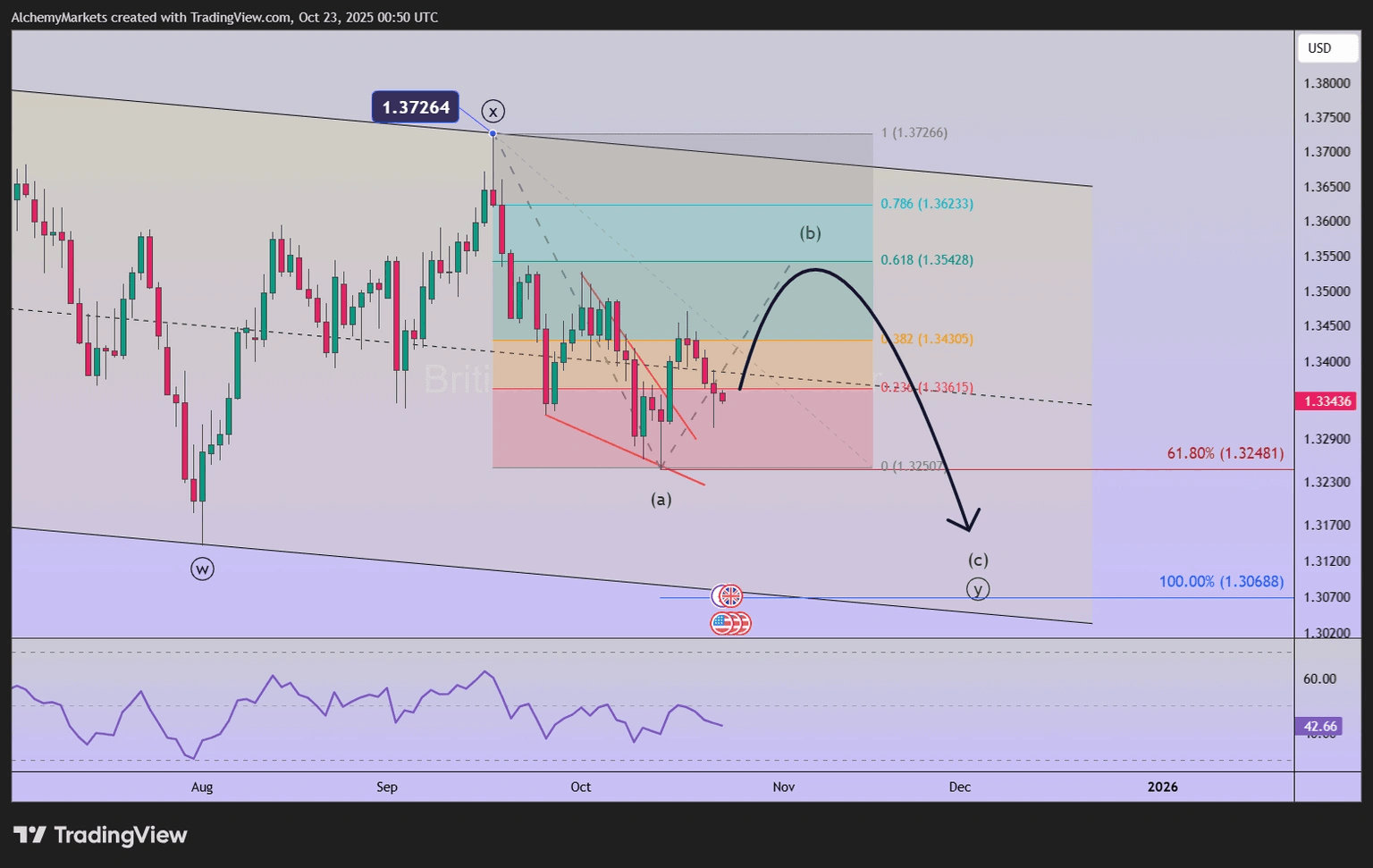
Back on September 19, two-days after a medium term top, we forecasted a decline in GBP/USD reaching to 1.31 and possibly 1.28. Cable has progressed lower and the Elliott wave pattern appears to be incomplete to the downside.
GBP/USD carved a wave ((x)) high on September 17 at 1.3726. The decline since September 17 fits best as wave ((y)). We know from our Elliott wave studies that this y-wave is likely to take shape as an (a)-(b)-(c) zigzag pattern. Read more…
In this forex trading video we cover the entry,exit reasons and management for our forex trade today on the GBP/USD and how you can trade the forex structure on daily, four, hourly, and 15 minute charts and how you can target the next support/resistance. In the last few videos we covered the steps to find and trade structure. In this video you will learn how we traded the GBP/USD structure today using the trading charts and price action.
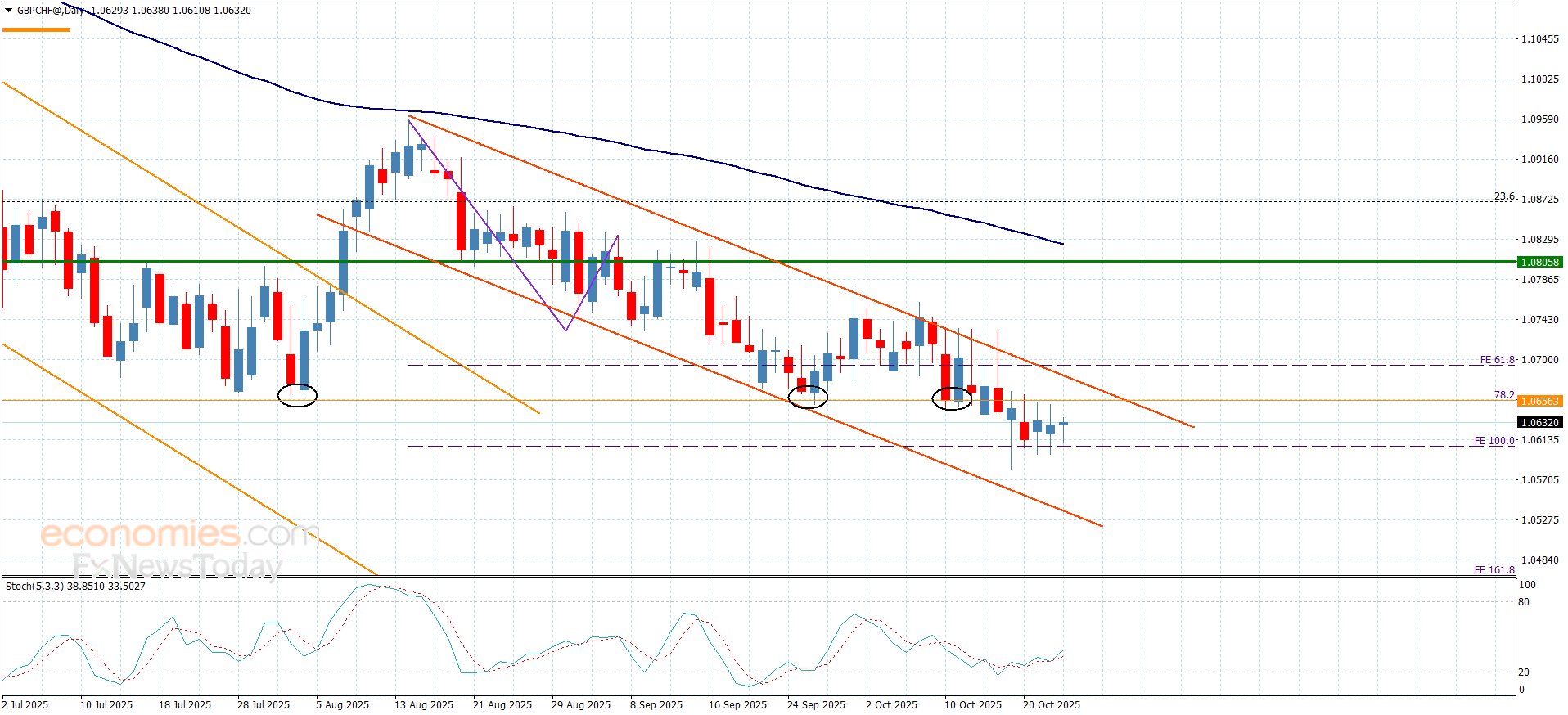
The GBPCAD reached the extra support level near 1.0605 in its last negative attack, forming strong barrier against the negative attack, which forces it to form mixed trading by its fluctuation near 1.0635.
Note that the main stability within the bearish channel’s levels and by the stability of the main resistance at 1.0675 makes us wait to gather extra negative momentum, which allows it to break the current support and begin targeting extra bearish stations by reaching 1.0570 followed by the support of the bearish channel’s support at 1.0530.
The expected trading range for today is between 1.0650 and 1.0570
Trend forecast: Bearish
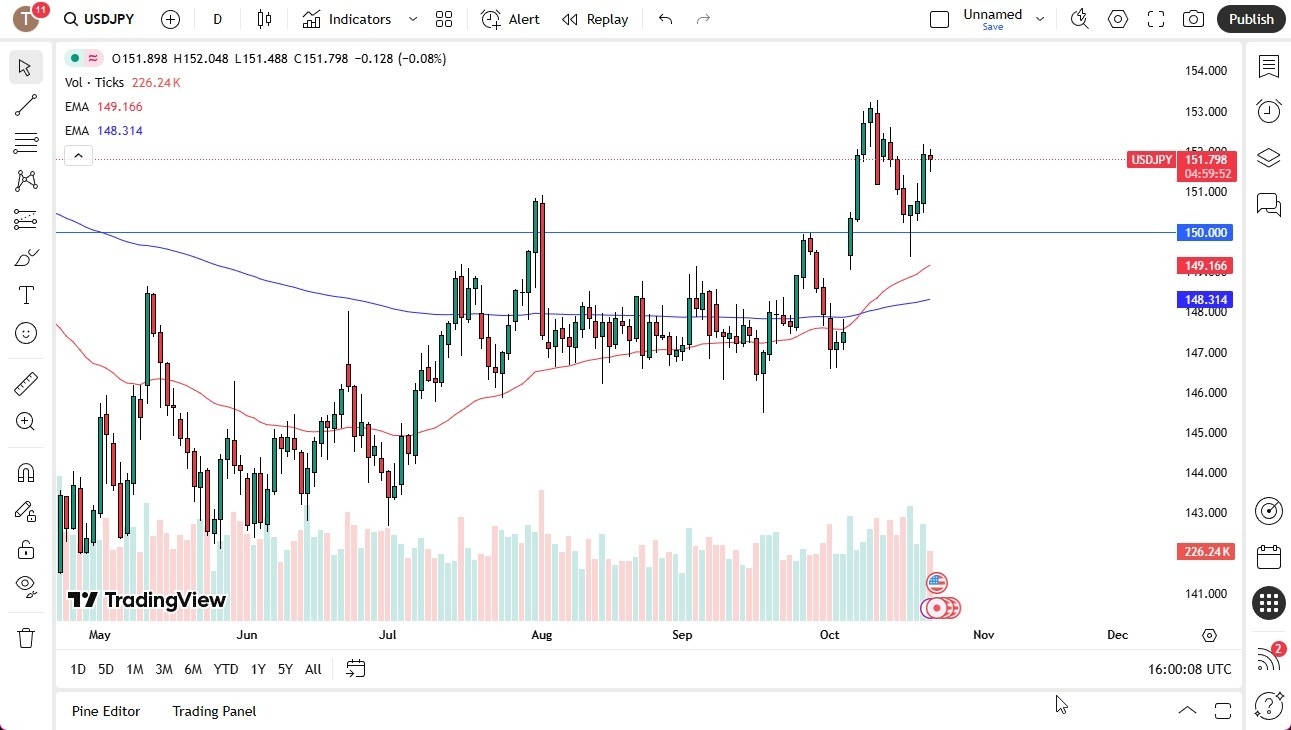
The U.S. dollar remains steady against the yen on Wednesday, holding above ¥150 support. Analysts expect continued upside toward ¥153–¥155, citing strong rate differentials and Bank of Japan policy, with dips viewed as long-term buying opportunities.
The ¥150 level has shown itself to be important multiple times, with the ¥150 level being resistance previously and then offering support when we fell on Friday to turn around and form a hammer. All things being equal, if the market were to break above the ¥152 level, then it’s possible that we could go looking to the ¥153.25 level.
Over the longer term, I do anticipate that the ¥155 level will be targeted, possibly even higher than that. The 50-day EMA currently sits right around the ¥149 level and is rising, and should end up being a nice buying opportunity. Ultimately, this is a market where I think the interest rate differential continues to pay.
Therefore, you have to look at this as a market that is trying to go much higher over the longer term. Eventually, I think each dip gets bought into, and with the Bank of Japan in a situation where they are probably going to have to stay pretty loose, I think you’ve got a situation where we just cannot go in any other direction. For what it’s worth, the U.S. dollar is strengthening against most currencies, so I like this as a buy-on-the-dip scenario.
Want to trade our USD/JPY forex analysis and predictions? Here’s a list of forex brokers in Japan to check out.
Christopher Lewis has been trading Forex and has over 20 years experience in financial markets. Chris has been a regular contributor to Daily Forex since the early days of the site. He writes about Forex for several online publications, including FX Empire, Investing.com, and his own site, aptly named The Trader Guy. Chris favours technical analysis methods to identify his trades and likes to trade equity indices and commodities as well as Forex. He favours a longer-term trading style, and his trades often last for days or weeks.
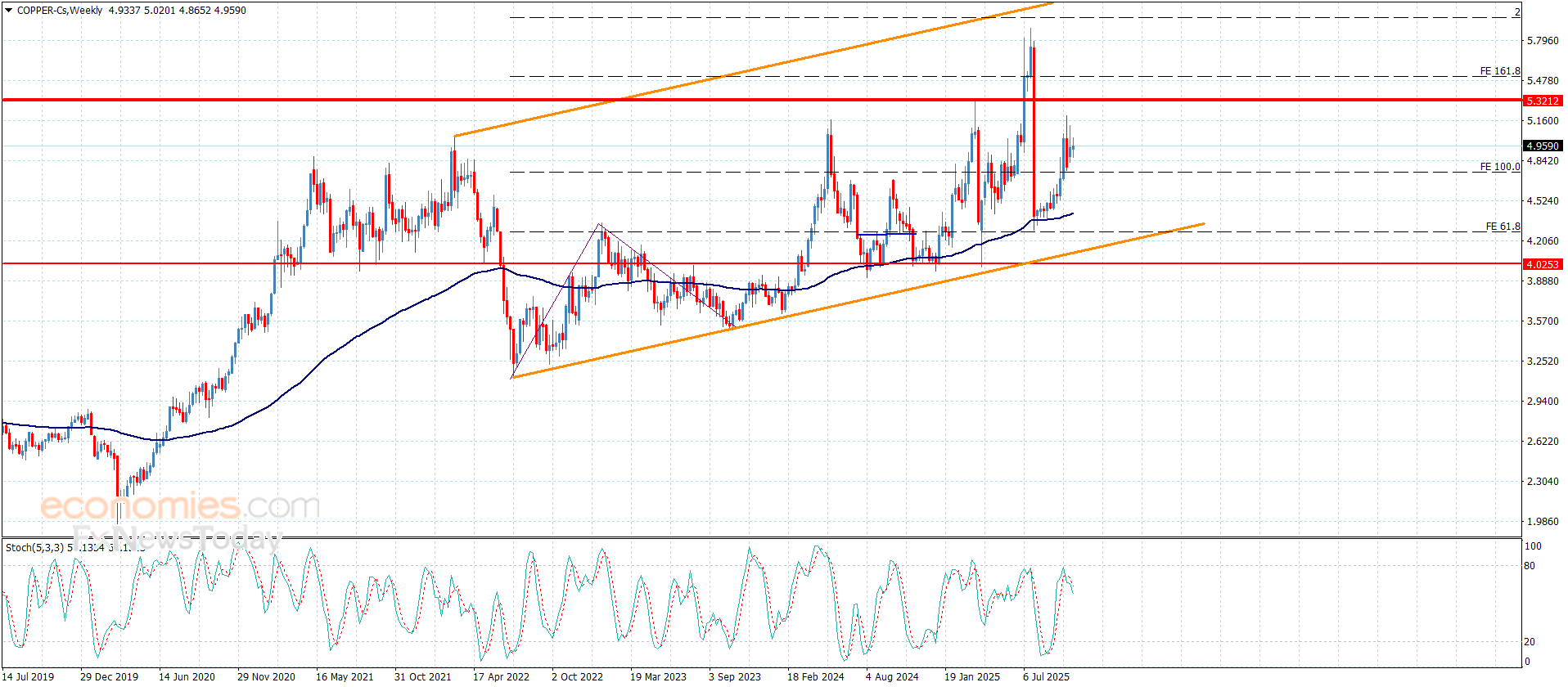
Copper price confirmed its surrender in its current period trading to the dominance of the sideways bias, affected by the stability of the barrier near $5.0600, which forces it to delay the attempts of resuming the main bullish attack, to notice its fluctuation near $4.9500 level.
Note that the stochastic contradiction with the main stability within the bullish channel’s levels and attempting to providing negative momentum that might force the price to form some corrective trading, to target the extra support at $4.7500, by breaking this support might force it to suffer extra losses by reaching $4.5800 and $4.4100.
The expected trading range for today is between $4.7500 and $5.0600
Trend forecast: Fluctuated within the bullish track