The main category of Forex News.
You can use the search box below to find what you need.
[wd_asp id=1]
The main category of Forex News.
You can use the search box below to find what you need.
[wd_asp id=1]
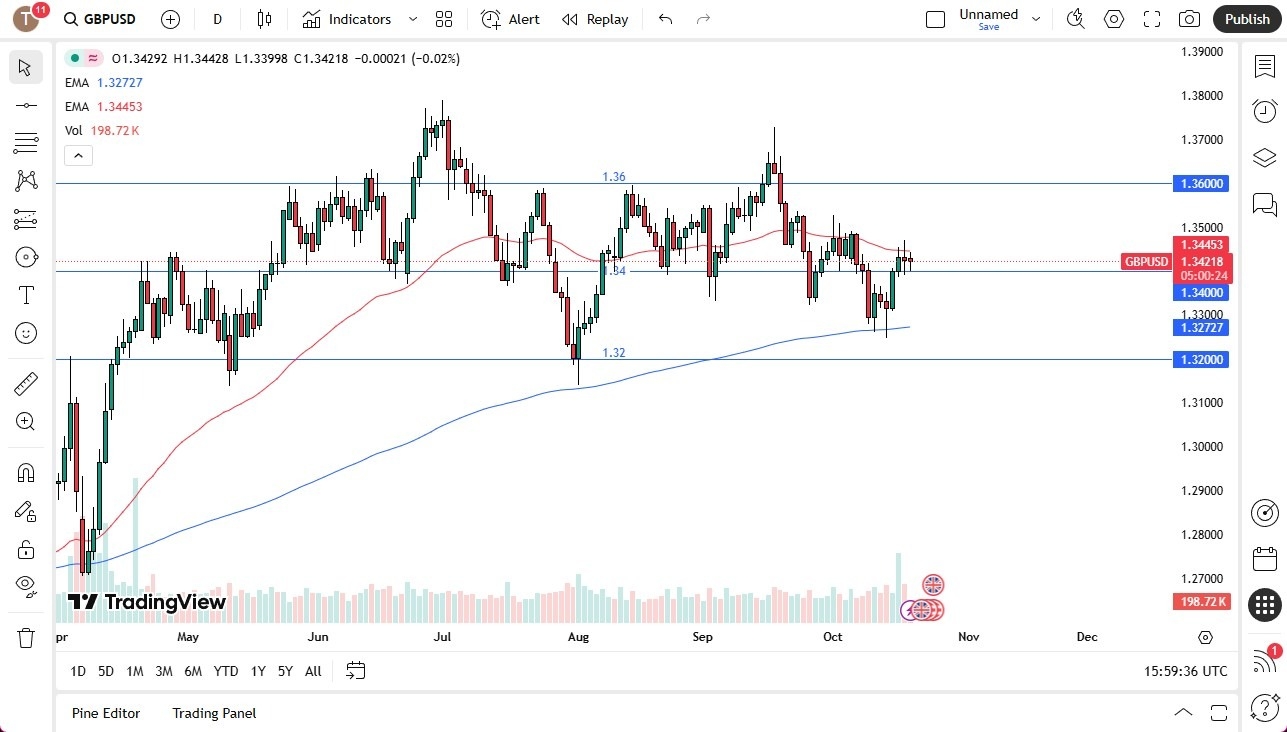
The British pound is starting to roll over slightly from the 50-day EMA as well. Although bearish, I wouldn’t worry too much about it because we’re basically in the middle of the overall consolidation. So, therefore, we’re essentially at fair value. I do favor the US dollar over the pound. Although the British pound is a little bit of an outlier considering how it performs against the US dollar, even as we were falling during 2024, it was falling less rapidly against the greenback than many other currencies. Conversely, on the way back up, the British pound was one of the best performers. So it’s got a history of fighting the dollar a little bit more. So although it does look weaker than strong, I’m not overly concerned. I think we will stay in this range for the time being.
And finally, when it comes to triangulation between the euro, the pound, and the dollar, it makes sense that the euro and the pound look pretty much the same. That’s because they’re pretty neutral towards each other. The euro is currently sitting right out of the 50-day EMA against the British pound, right in the middle of a larger consolidation area.
I think this is essentially trying to tell us something important, and that’s where the dollar goes, which will dictate where everything moves in the first two pairs in this analysis. This is about the dollar and not really about the pound and the euro. There is no strength in the euro versus the pound or vice versa. Over the longer term, the euro has risen quite nicely, but going back to the last three months or so, we’ve been pretty sideways between 0.86 and 0.8750. I don’t see that changing anytime soon.
For a look at all of today’s economic events, check out our economic calendar.
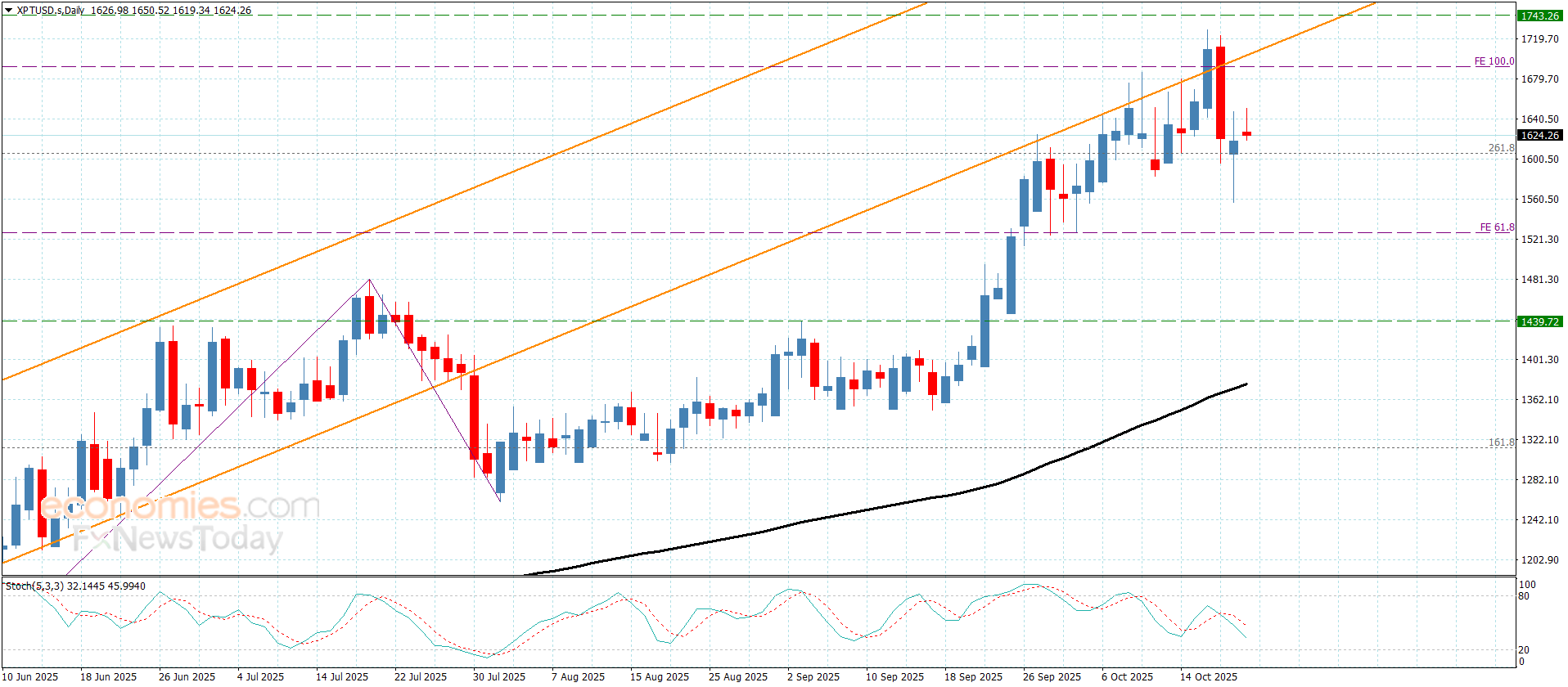
Platinum price reached $1557.00 level in its last corrective decline, then rallies again to settle above the extra support level at $1605.00, but this will not confirm its readiness to activate the bullish track again, due to its fluctuation below the resistance at $1695.00.
The continuation of providing negative momentum by stochastic will increase the efficiency of the bearish corrective track, to expect reaching $1575.00 and facing extra pressure might force it to target $1525.00 level, which forms an extra support against the current trading.
The expected trading range for today is between $1575.00 and $1670.00
Trend forecast: Bearish

I think there are still a lot of questions asked about whether or not this trend can continue, as we had pulled back rather significantly, but we also have the situation where the market had been so bullish previously. The one thing that I do know is that the British pound has been much stronger against the US dollar than most other currencies, so if this pair starts to fall apart, I think that tells you that the US dollar is about to get very strong, and therefore punish not only the British pound, but other weaker currency such as the Japanese yen, Canadian dollar, New Zealand dollar, and so on.
Alternatively, if this pair rises, then it tells is that the US dollar is probably going to soften a bit, but I actually would prefer to buy the British pound in that environment, because it has outperformed and therefore I don’t feel that there’s any reason to go looking somewhere else to really take advantage of a weaker US dollar. Ultimately, this is a very choppy currency pair, and I think that will continue to be the case in this market, and I think we remain rangebound. In fact, the larger consolidation area, I believe, is between the 1.37 level and the 1.35 level. We are currently right around the middle of that, meaning that we are essentially near “fair value.”
Ready to trade our daily Forex GBP/USD analysis? We’ve made this UK forex brokers list for you to check out.
Christopher Lewis has been trading Forex and has over 20 years experience in financial markets. Chris has been a regular contributor to Daily Forex since the early days of the site. He writes about Forex for several online publications, including FX Empire, Investing.com, and his own site, aptly named The Trader Guy. Chris favours technical analysis methods to identify his trades and likes to trade equity indices and commodities as well as Forex. He favours a longer-term trading style, and his trades often last for days or weeks.
Silver has entered a tension-filled holding pattern — not weak, just waiting for ignition.
After rallying to $54/oz, its highest in more than a decade, the market is now consolidating just below that level, mirroring gold’s earlier pattern before its own explosive breakout.
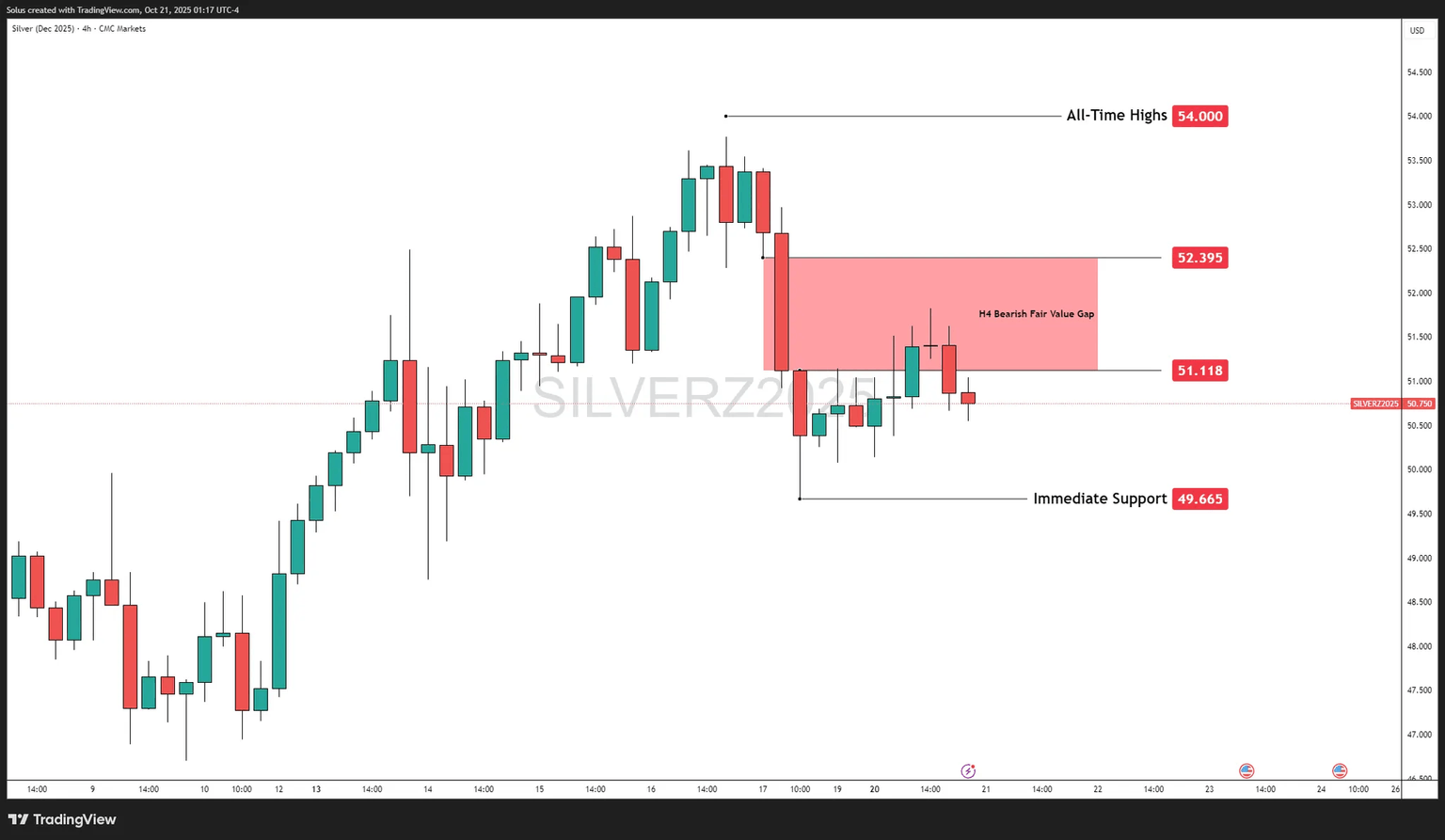
The reason? The metal is balancing order flow inside a critical 4-hour Fair Value Gap (FVG) between $51.118–$52.395 — a zone where prior selling created inefficiency.
Price currently sits at $50.75, testing buyers’ commitment as volume compresses and liquidity builds.
This “pause before propulsion” could define silver’s next major phase — and traders are watching whether it repeats gold’s parabolic move.
Silver’s dual role — industrial metal and monetary hedge — keeps it in demand. The solar and EV sectors continue to consume record levels of silver, straining mine output in Mexico, Peru, and China.
Physical silver inventories at London and COMEX remain near multi-year lows, forcing refiners to reroute supply from Asia. This supply squeeze underpins the spot premium and keeps futures backwardated.
With the U.S. shutdown dragging on and investors bracing for further Fed cuts, funds are once again rotating into metals. As gold flirts with $4,500, silver is attracting renewed speculative inflows aiming to catch “the next gold-style breakout.”
Silver’s structure remains constructively bullish, though tactically neutral within the current balance.
The 4-hour volume imbalance ($51.118–$52.395) acts as the pivot — a zone where supply met demand but delivery remains unfinished.
Price is compressing between this imbalance and immediate support at $49.665.
When that compression breaks, momentum should accelerate sharply.
|
Type |
Price Zone |
Technical Role |
|---|---|---|
|
All-Time High |
$54.000 |
Liquidity target |
|
H4 Volume Imbalance (FVG) |
$51.118 – $52.395 |
Control zone / re-pricing area |
|
Immediate Support |
$49.665 |
Short-term liquidity base |
|
Bullish Targets |
$53 → $54 → $55 |
Expansion levels |
|
Bearish Targets |
$49.00 → $47.80 |
Re-pricing zones |
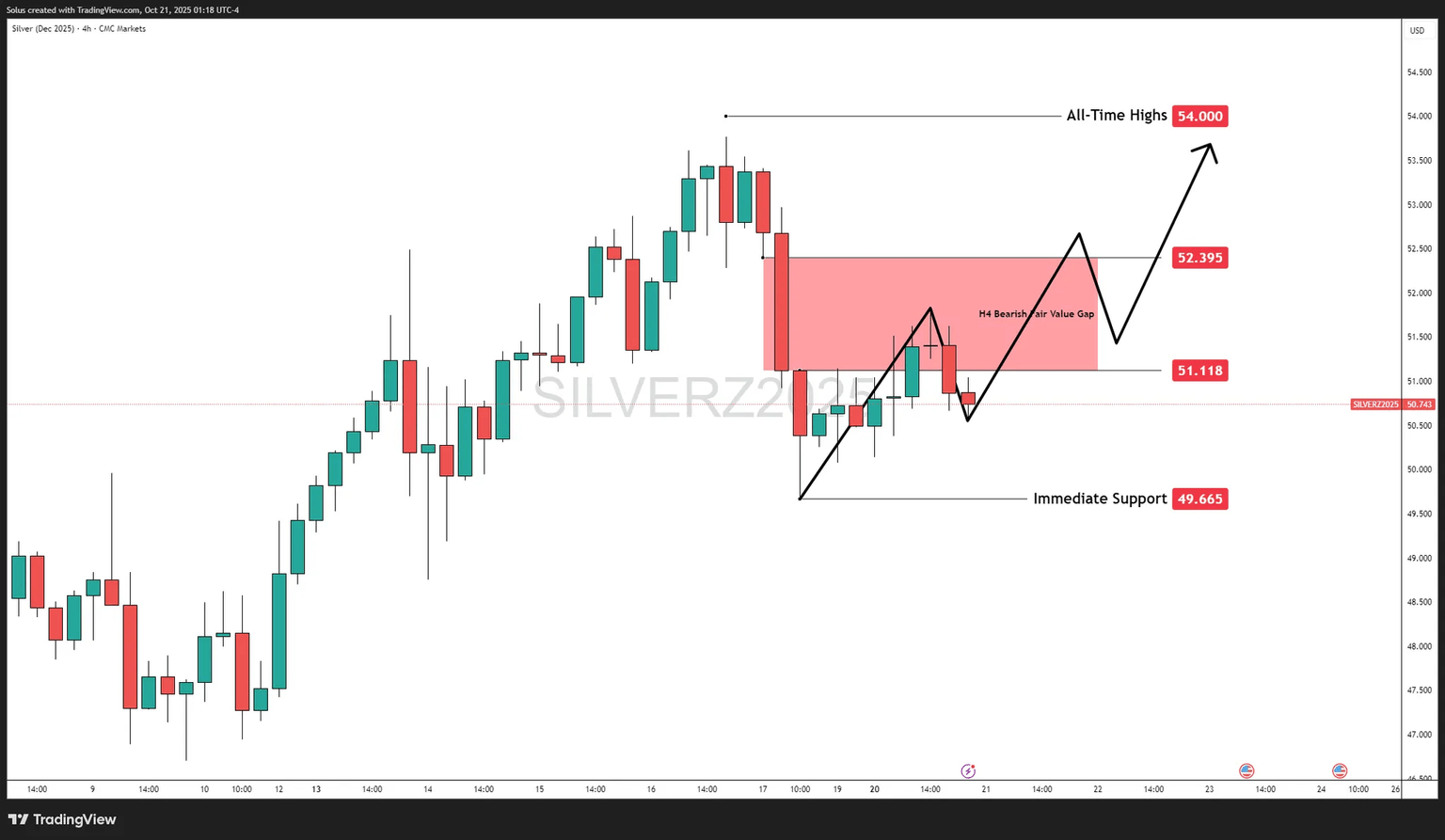
Silver’s repeated defense of $50–$50.70 shows buy-side absorption.
If price reclaims $51.118, it signals demand stepping back into imbalance territory.
Trigger:
A 4H close above $51.118 followed by a break through $52.395 confirms that sellers’ inefficiency has been filled and flipped to support.
Targets:
Narrative:
This would mark a bullish re-balancing of volume, restoring buy-side delivery similar to gold’s prior structure.
A successful FVG reclaim transforms the zone into demand — often the prelude to a sustained breakout.
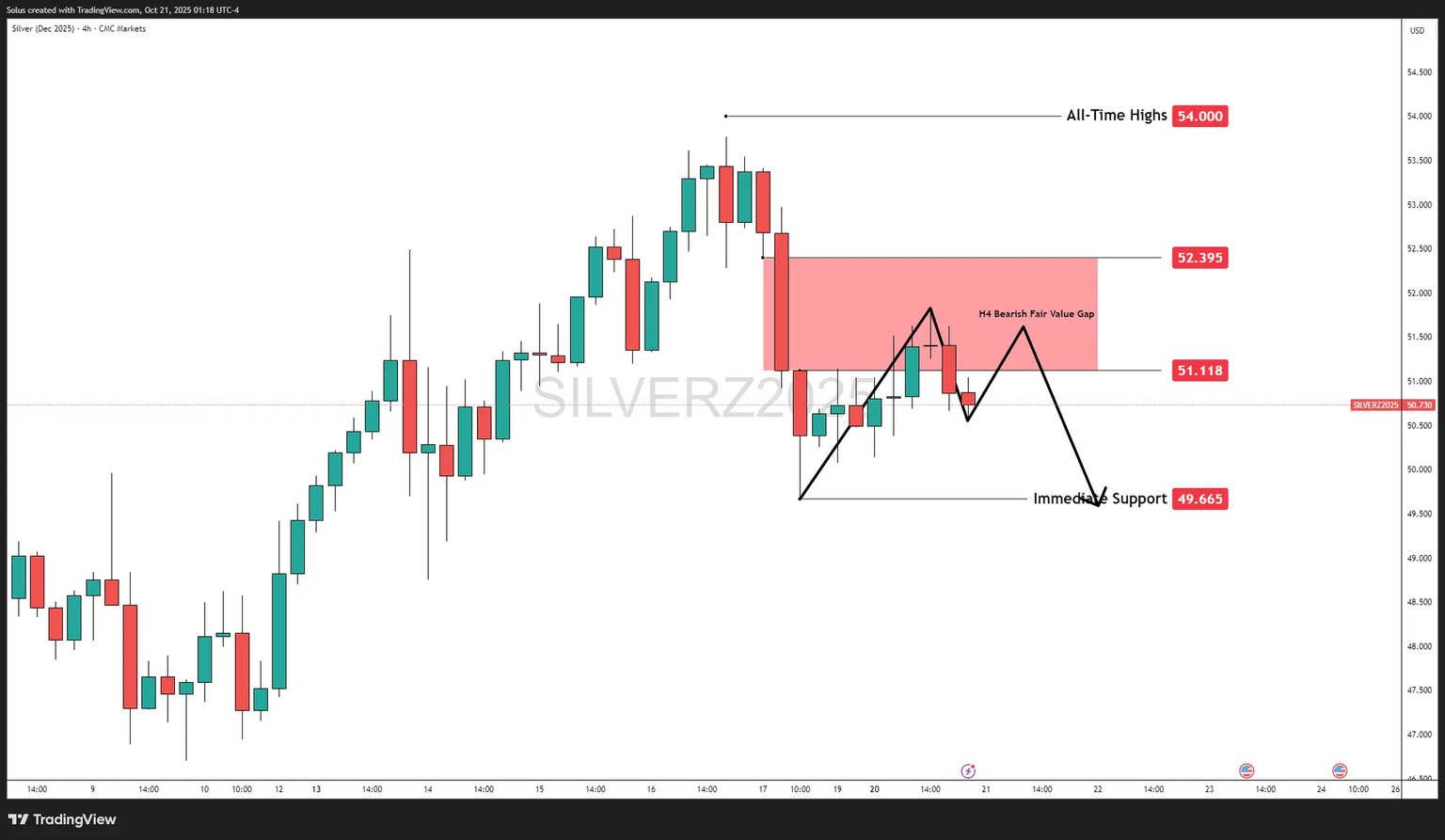
Failure to close above $52.395 or repeated rejections inside the FVG suggest sellers are still defending overhead liquidity.
Trigger:
A 4H close below $50.60 signals renewed sell-side control and continuation toward liquidity resting below $49.60.
Targets:
Narrative:
As long as $51.118 remains unclaimed, the imbalance stays bearish.
Price could slide into discount levels before rebuilding another leg higher.
The $51.118–$52.395 zone is the line in the sand.
Volume is evenly balanced — neither bulls nor bears hold control — but this balance is unstable.
This equilibrium reflects a coiled-spring structure: energy building beneath resistance, similar to gold’s pre-breakout profile earlier this quarter.
Silver is standing at a technical crossroads that echoes gold’s structure weeks ago — tight compression, rising demand, and a visible imbalance zone waiting to break.
Reclaiming $52.395 could unleash a fast leg toward $54–$55, validating the idea that silver is becoming “the next gold.”
Failing to do so simply extends the accumulation window around $50–$49, where long-term buyers likely reload for the next wave.
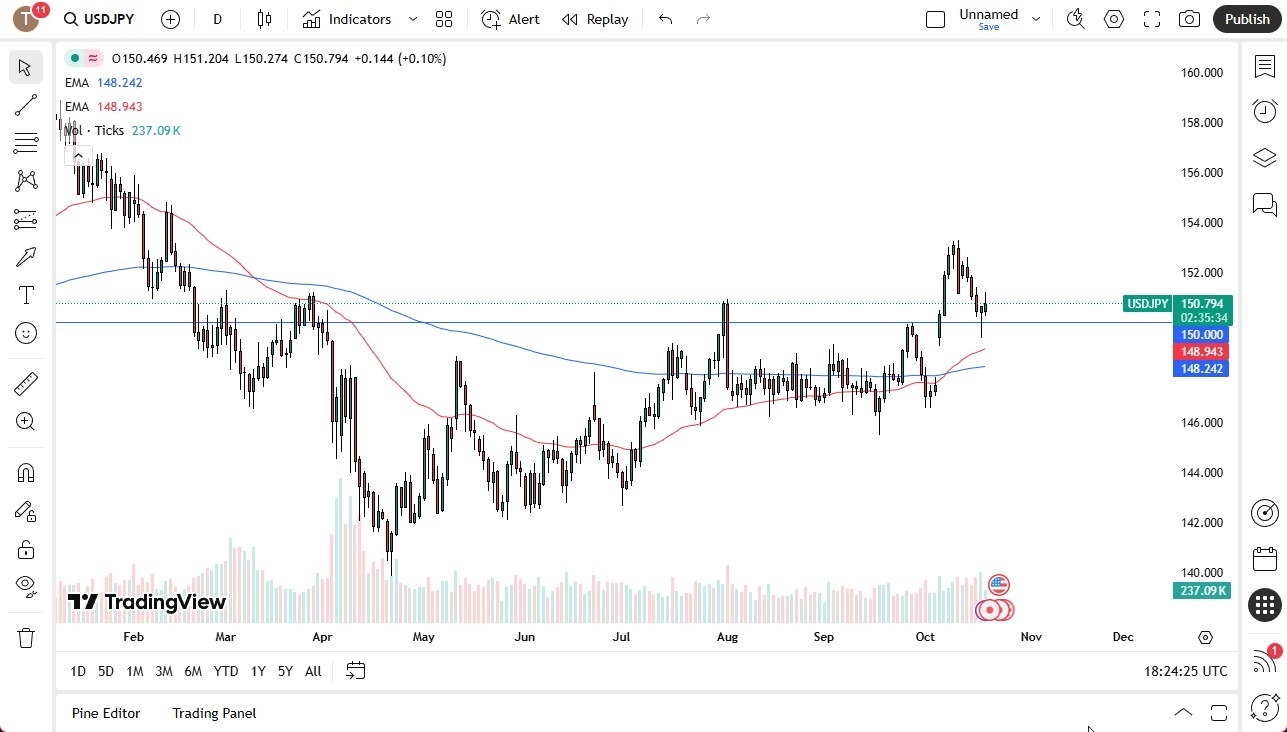
The U.S. dollar strengthened sharply against the yen on Monday, rebounding from ¥150 support with a bullish hammer formation. Analysts expect continued upside toward ¥153, supported by yield differentials, while pullbacks remain buying opportunities above ¥147.
Ultimately, this is a market that I think continues to see a lot of upward trajectory, mainly due to the fact that the interest rate differential continues to favor the U.S. dollar. And I just don’t see how that changes anytime soon. Ultimately, this is a market that has been breaking out for a while.
And as you get paid at the end of the day, if you’ve been watching me for several months, all the way back to somewhere in June, I think I have started to tout the strength of the idea of being long in this market, and I have been long in this market for quite some time.
At this point, it’s going to be more of a grind to the upside than anything else, but you get paid to wait, and I think that’s a huge advantage. If we were to break down below the ¥147 level, then okay, things change. But until then, this looks like a market where short-term dips offer the possibility of buying opportunities to take advantage of as market participants continue to shun the Japanese yen for a whole host of economic reasons in that country.
Want to trade our USD/JPY forex analysis and predictions? Here’s a list of forex brokers in Japan to check out.
Christopher Lewis has been trading Forex and has over 20 years experience in financial markets. Chris has been a regular contributor to Daily Forex since the early days of the site. He writes about Forex for several online publications, including FX Empire, Investing.com, and his own site, aptly named The Trader Guy. Chris favours technical analysis methods to identify his trades and likes to trade equity indices and commodities as well as Forex. He favours a longer-term trading style, and his trades often last for days or weeks.
Gold continues to defy gravity. Prices surged beyond $4,300, printing a fresh all-time high at $4,400, and remain elevated as traders weigh a U.S. government shutdown against the prospect of deeper Federal Reserve rate cuts.
This rally isn’t just sentiment-driven – it’s underpinned by real shifts in macro positioning. The longer the U.S. stays in fiscal limbo, the stronger the bid for havens like gold becomes. Treasury yields are easing, the dollar is softening, and global fund flows are rotating back into metals.
At the same time, institutional forecasts are rising. Several banks, including HSBC, now envision scenarios reaching $4,700–$5,000/oz by 2026. This bullish conviction is showing up in price structure itself – higher lows, expanding imbalances, and repeated demand rejections that reveal ongoing accumulation.
“Every dip is being bought; every pause becomes a platform,” one analyst noted.
Gold’s behavior mirrors that – shallow pullbacks, aggressive reclaims, and clean Fair Value Gaps tell the story.
Together, these drivers reinforce one message: the gold bull cycle is not done.
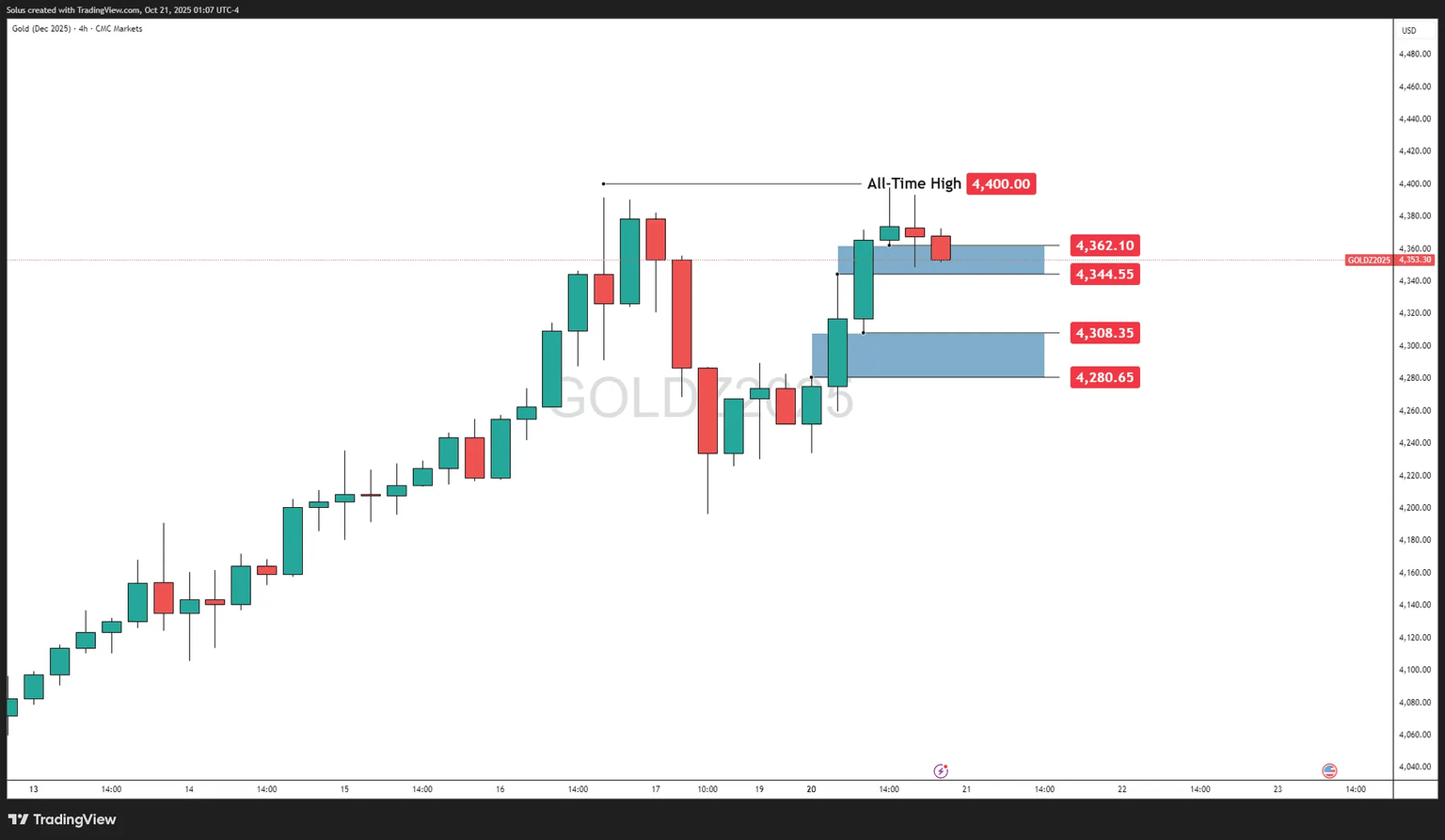
Gold’s 4H structure remains clean and bullish. After printing the $4,400 all-time high, price has pulled back modestly into a tight $4,340–$4,360 consolidation zone, resting just above two well-defined Fair Value Gaps (FVGs).
These volume-weighted imbalances are telling a consistent story: buyers remain in control of delivery. Each time gold retraces into these zones, aggressive bidding emerges – proof of institutional absorption and bullish imbalance continuity.
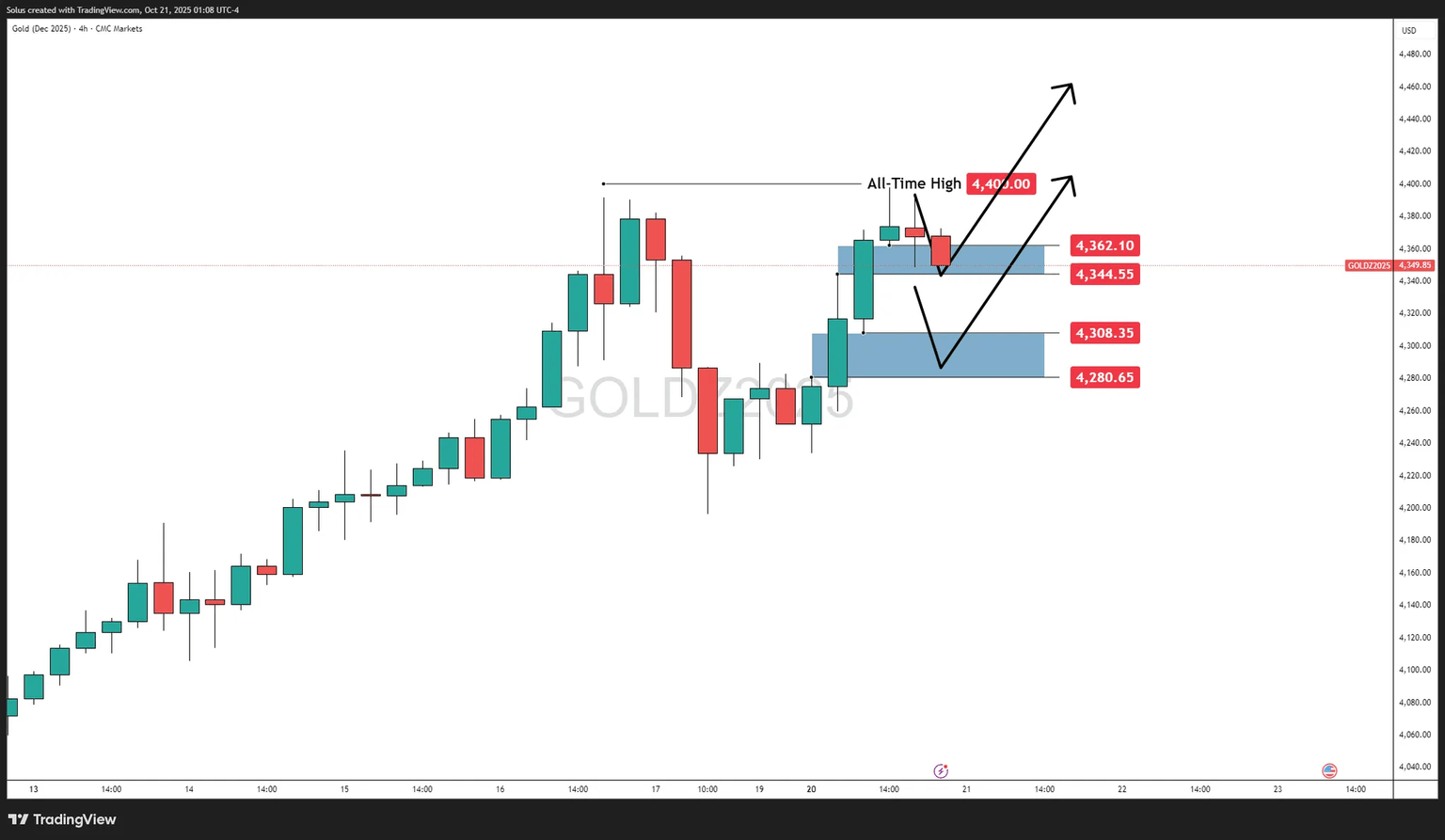
Price consolidates above the upper FVG ($4,344–$4,362) while respecting the $4,308 demand base. The structure shows higher lows and a compression pattern under resistance – classic signs of reaccumulation before expansion.
Trigger:
A decisive close above $4,380–$4,400 confirms a liquidity sweep and continuation phase.
Targets:
The current imbalances act as launchpads, not exhaustion points. Volume profiles reveal sustained buy-side inefficiency – meaning supply hasn’t caught up. As long as $4,344 holds, gold remains in bullish delivery targeting $4,500.
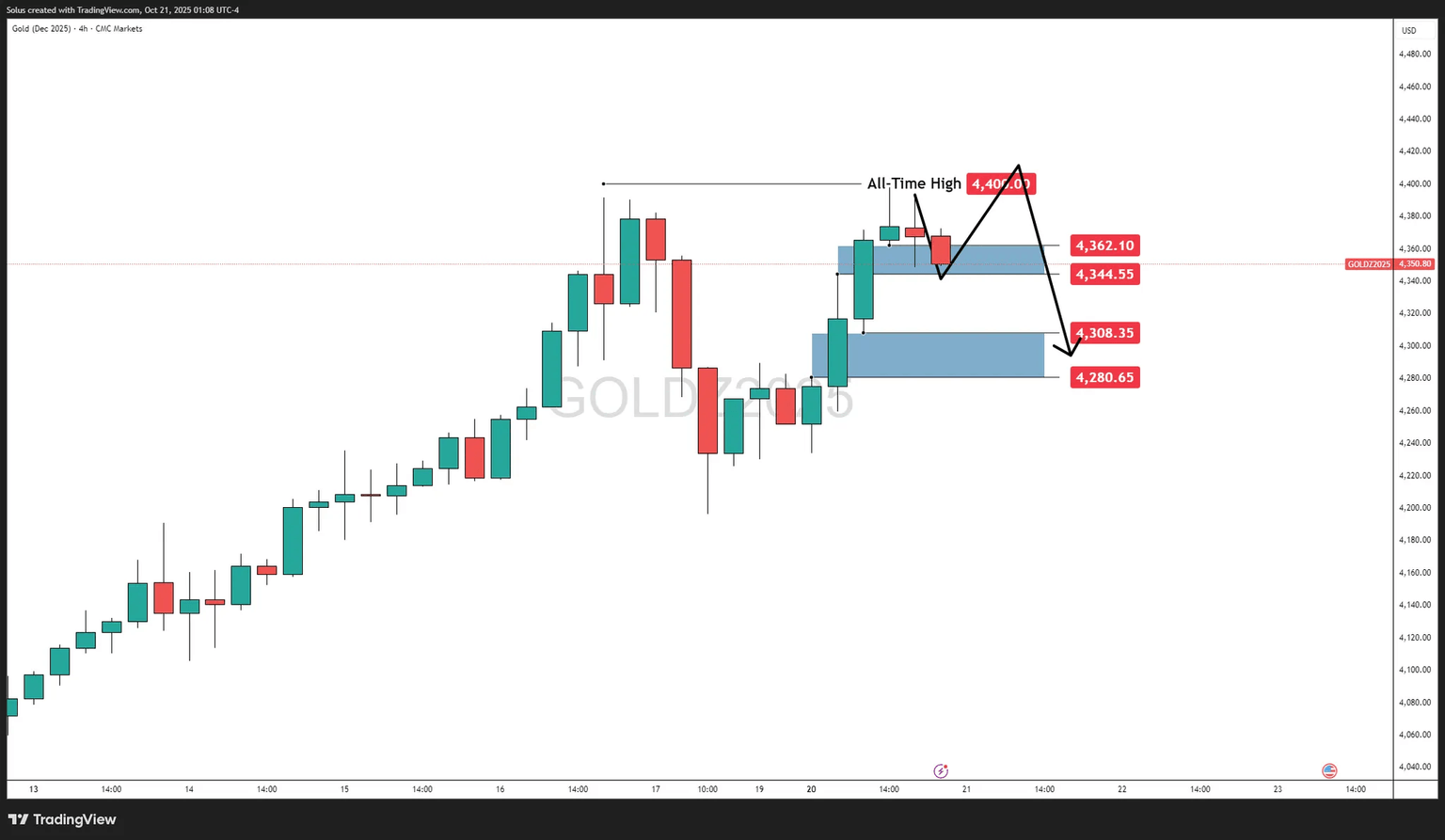
If gold fails to defend the upper imbalance ($4,344–$4,362), the market could engineer a deeper pullback into the lower FVG ($4,280–$4,308) for liquidity mitigation.
Trigger:
A clean close below $4,344 signals a short-term correction toward the lower zone.
Targets:
Continuation Risk:
Only a decisive breakdown below $4,280 would suggest a deeper retracement to $4,240–$4,210. Otherwise, this scenario represents a liquidity grab and reload opportunity for bullish continuation back toward $4,500.
Gold’s current structure is not showing exhaustion; it’s showing controlled aggression.
The story told by the charts – through price gaps, imbalances, and failed breakdowns – is one of institutional continuation.
As long as price holds above $4,280–$4,300, every pullback remains an opportunity within the broader bullish delivery cycle.
The next big psychological magnet sits at $4,500 – and unless macro sentiment shifts dramatically, the path there looks more like a question of “when,” not “if.”
According to recent trading, the EUR/USD pair has broken through a key resistance area at the key psychological support level of 1.1600, indicating that the uptrend may be gaining momentum. However, the price appears to be retreating to this broken resistance level, which has now become support, potentially attracting more buyers willing to join the rally. According to reliable trading platforms, the current price zone corresponds to the 50% and 61.8% Fibonacci retracement levels at 1.1637 and 1.16157, respectively, extending from the previous swing low at 1.1545 to the swing high at 1.1728. These technical areas may be sufficient to control losses and trigger a rebound to or above the previous highs.
Consequently, if the broken resistance zone and the Fibonacci levels hold as a base, the EUR/USD pair may resume its ascent and could target the psychological upward level of 1.18000 later. On the other hand, a break below these support areas could indicate a weakening of the upward momentum, leading to a deeper correction toward the swing low.
Therefore, if the broken resistance area and Fibonacci levels hold as a bottom, the EUR/USD pair may resume its upward trend, potentially targeting the psychologically significant 1.18000 level later. Conversely, a break below these support areas could indicate weakening upward momentum, leading to a deeper correction towards the swing low. Meanwhile, the 100-period simple moving average (SMA) is below the 200-period simple moving average (SMA) on the short-term timeframe, suggesting that the strongest trend was previously downward. However, the price has broken both SMAs, indicating a potential shift in momentum. The 200-period simple moving average appears to be stabilizing, suggesting that upward pressure may be increasing.
The stochastic indicator is also rising from the oversold zone, reflecting a return of buying interest. The oscillator has plenty of room to rise before reaching the overbought zone, so buyers may take control for a longer period, bringing the EUR/USD pair back to the swing high or achieving new highs above 1.17288. The Relative Strength Index (RSI) is also trending upward from the mid-range, confirming the increasing upward momentum. As long as the oscillator maintains its upward trend, the price may continue to follow the same trend.
The bullish shift in EUR/USD is at its beginning. Therefore, the currency pair may be influenced by upcoming economic data and central bank commentary as traders assess monetary policy expectations for both regions, while the US government shutdown may further weigh on the US Dollar.
According to Forex trading, the euro appears to be better supported at this stage; it just needs something to spark a continued recovery. This spark could come from the release of US inflation data, scheduled for the end of the week. The US dollar is likely to decline if US inflation meets or falls below expectations, which would push the EUR/USD exchange rate to extend its recent recovery to 1.1750.
In general, Markets expect US CPI inflation to reach 3.1% in September, up from 2.9% in August, while core inflation is expected to reach 3.1%. Any reading above expectations will naturally strengthen the dollar, as investors will have no choice but to lower their expectations for future interest rate cuts, a development typically considered supportive of the US dollar. Before the US inflation data is released, the euro will be subject to the Eurozone Purchasing Managers’ Index (PMI) survey, which will provide insight into the region’s economic performance in October. A strong set of PMIs will support the euro against the dollar, as they will support the European Central Bank’s stance on maintaining interest rates at their current level.
Ready to trade our daily Forex analysis? We’ve made a list of the best forex trading platforms for beginners worth trading with.
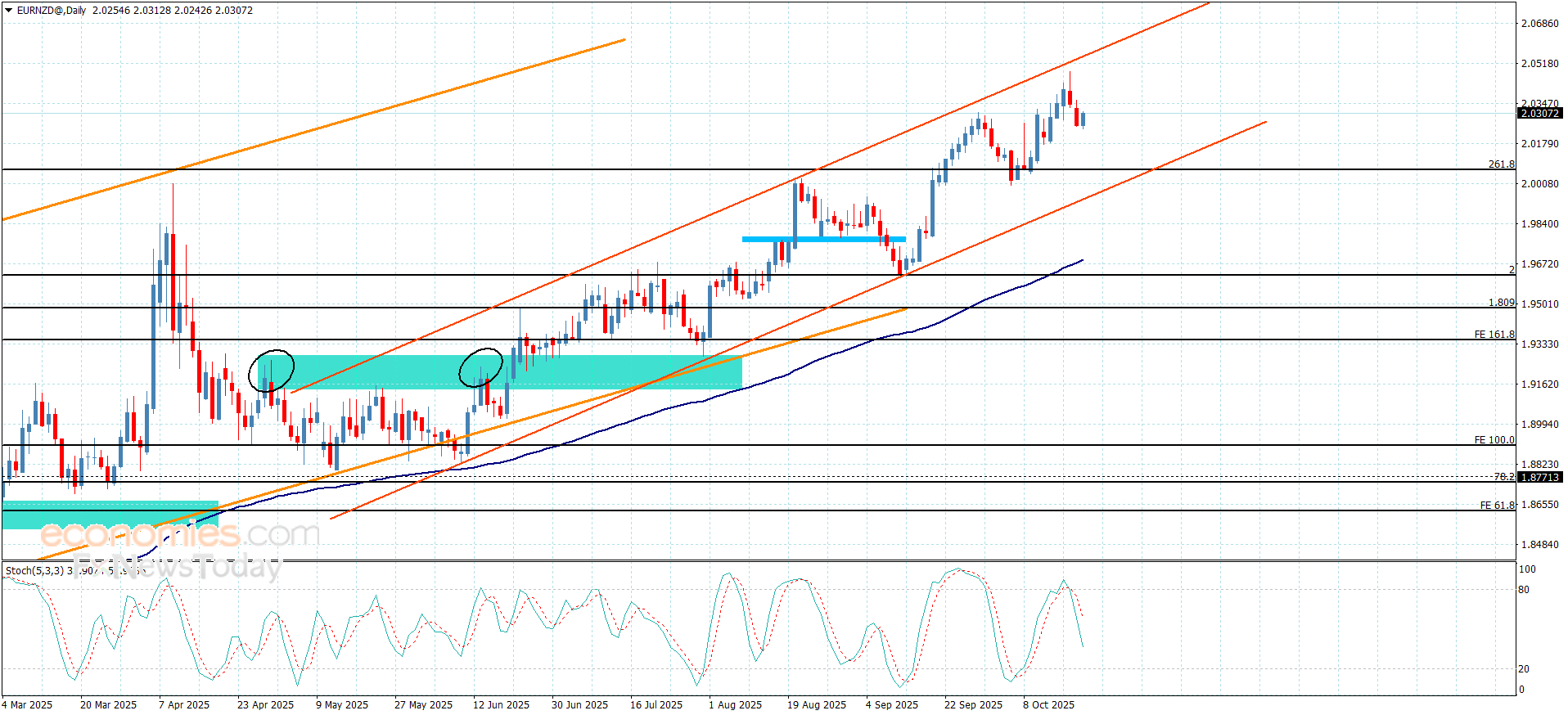
The EURNZD approached by its last bullish rally from the resistance of the bullish channel by hitting 2.04840 level, forcing it to form temporary bearish correction, affected by stochastic exit from the overbought level, activating the attempts of taking the profits by reaching 2.02425.
Note that the stability of the price within the bullish channel’s levels mainly by forming extra support at 2.01850 level, make us wait for gathering bullish momentum then begin forming strong bullish waves, to target 2.04185 level re205420 resistance, which forms the main target in the current period trading.
The expected trading range for today is between 2.02245 and 2.04285
Trend forecast: Bullish
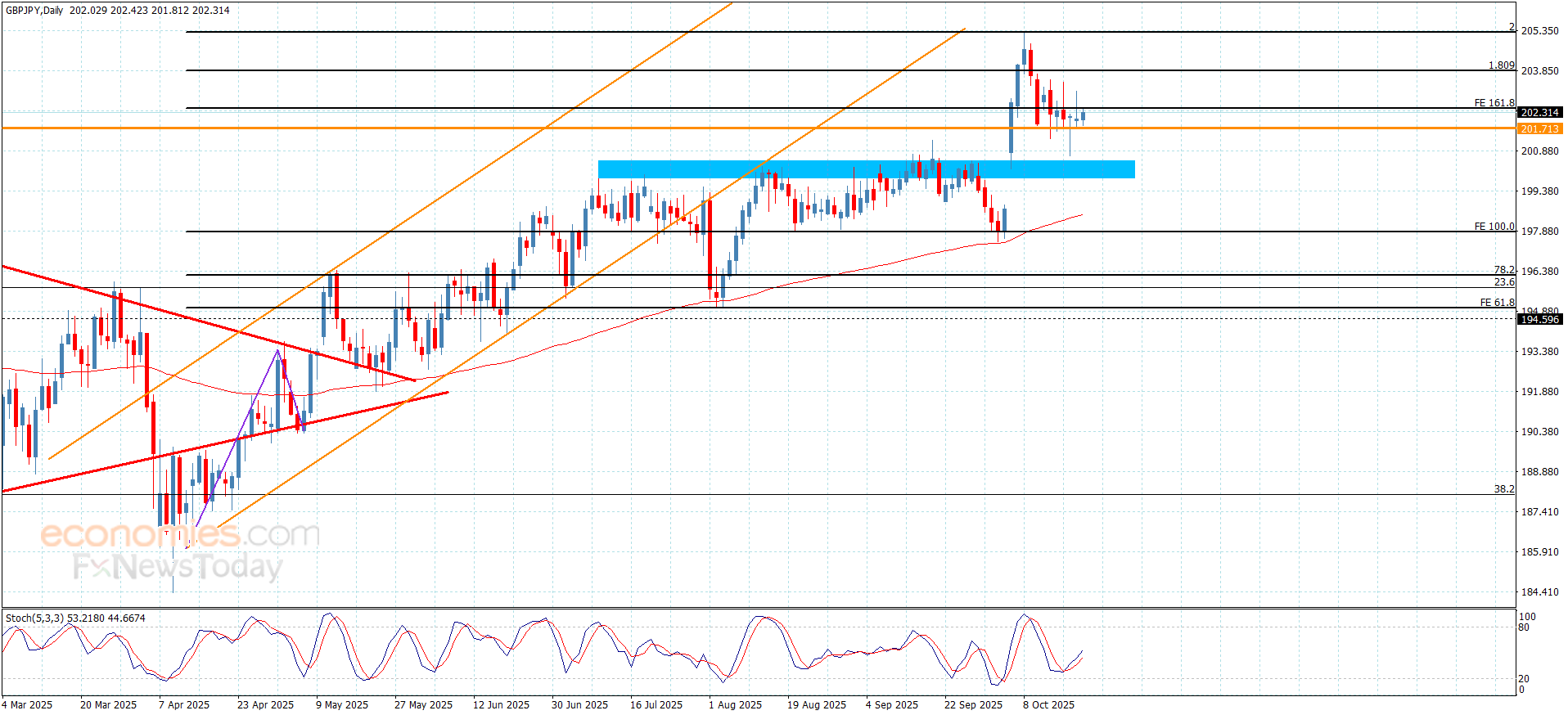
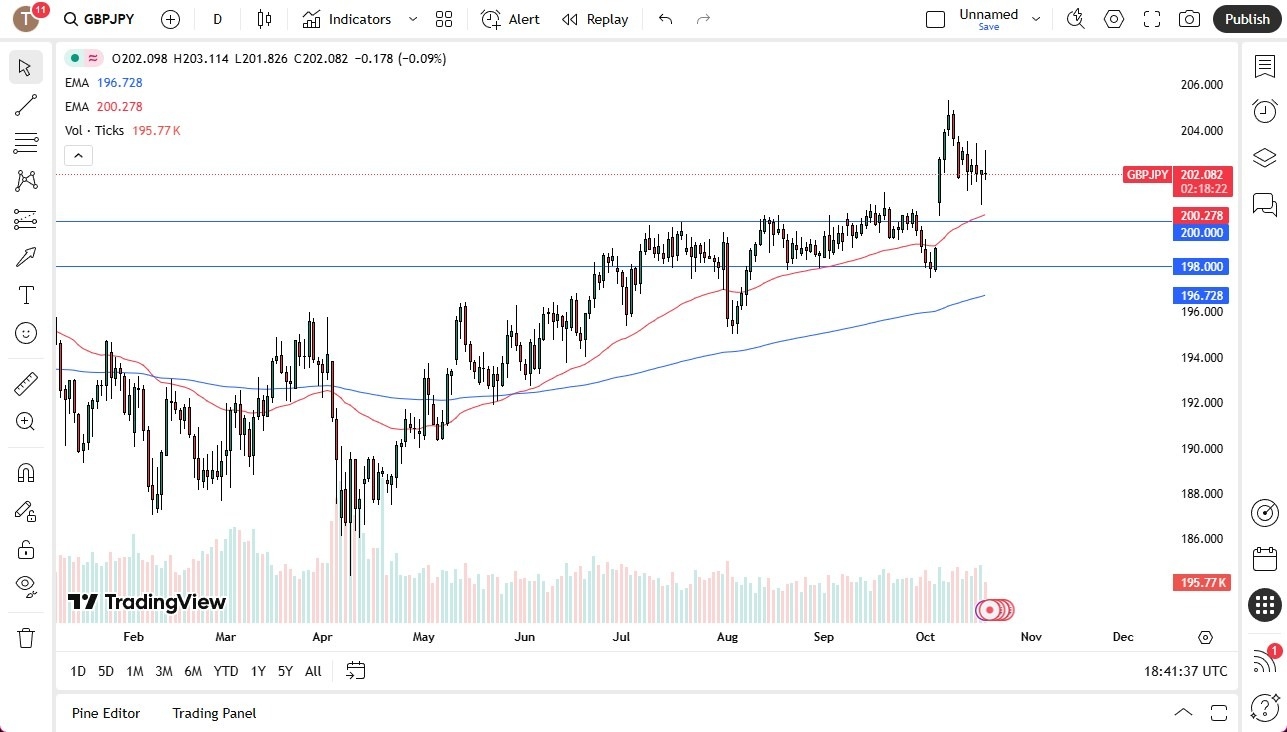
The British pound initially rallied during the trading session on Monday against the Japanese yen. As we continue to see a lot of noisy trading over the last four sessions, we have seen a hammer, an inverted hammer, a hammer, and then another inverted hammer. With that being said, it looks very much like a market that is stuck at the ¥202 level. Even if we break down from here, I think there’s a lot of support near the ¥200 level, which also has the 50-day EMA coming into the picture.
The 50-day EMA is a famous trend-following type of indicator that I think will attract a lot of attention. And the fact that it’s right there at that ¥200 level, of course, has even more people paying attention to it. If we can break above the ¥204 level, then it opens up the possibility of the ¥205 level rather quickly.
Overall, we are in a positive trend, with the British pound offering a positive swap against the Japanese yen. And when you look around the forex world at the moment, all of the yen-related pairs look the same. They all gapped higher, pulled back a bit, and now they look as if they are trying to at least grind to the upside.
That being said, this is a very noisy couple of sessions, so I don’t think we’re in the all clear to get overly bullish yet. But you get the payment at the end of every day via swap to at least make this pair work out over the longer term, assuming that the trend continues. I see nothing on this chart that changes that trend anytime soon.
Begin trading our daily forecasts and analysis. Here is a list of Forex brokers in Japan to work with.
Christopher Lewis has been trading Forex and has over 20 years experience in financial markets. Chris has been a regular contributor to Daily Forex since the early days of the site. He writes about Forex for several online publications, including FX Empire, Investing.com, and his own site, aptly named The Trader Guy. Chris favours technical analysis methods to identify his trades and likes to trade equity indices and commodities as well as Forex. He favours a longer-term trading style, and his trades often last for days or weeks.
Platinum price reached $1557.00 level in its last corrective decline, then rallies again to settle above the extra support level at $1605.00, but this will not confirm its readiness to activate the bullish track again, due to its fluctuation below the resistance at $1695.00.
The continuation of providing negative momentum by stochastic will increase the efficiency of the bearish corrective track, to expect reaching $1575.00 and facing extra pressure might force it to target $1525.00 level, which forms an extra support against the current trading.
The expected trading range for today is between $1575.00 and $1670.00
Trend forecast: Bearish