The main category of Forex News.
You can use the search box below to find what you need.
[wd_asp id=1]
The main category of Forex News.
You can use the search box below to find what you need.
[wd_asp id=1]
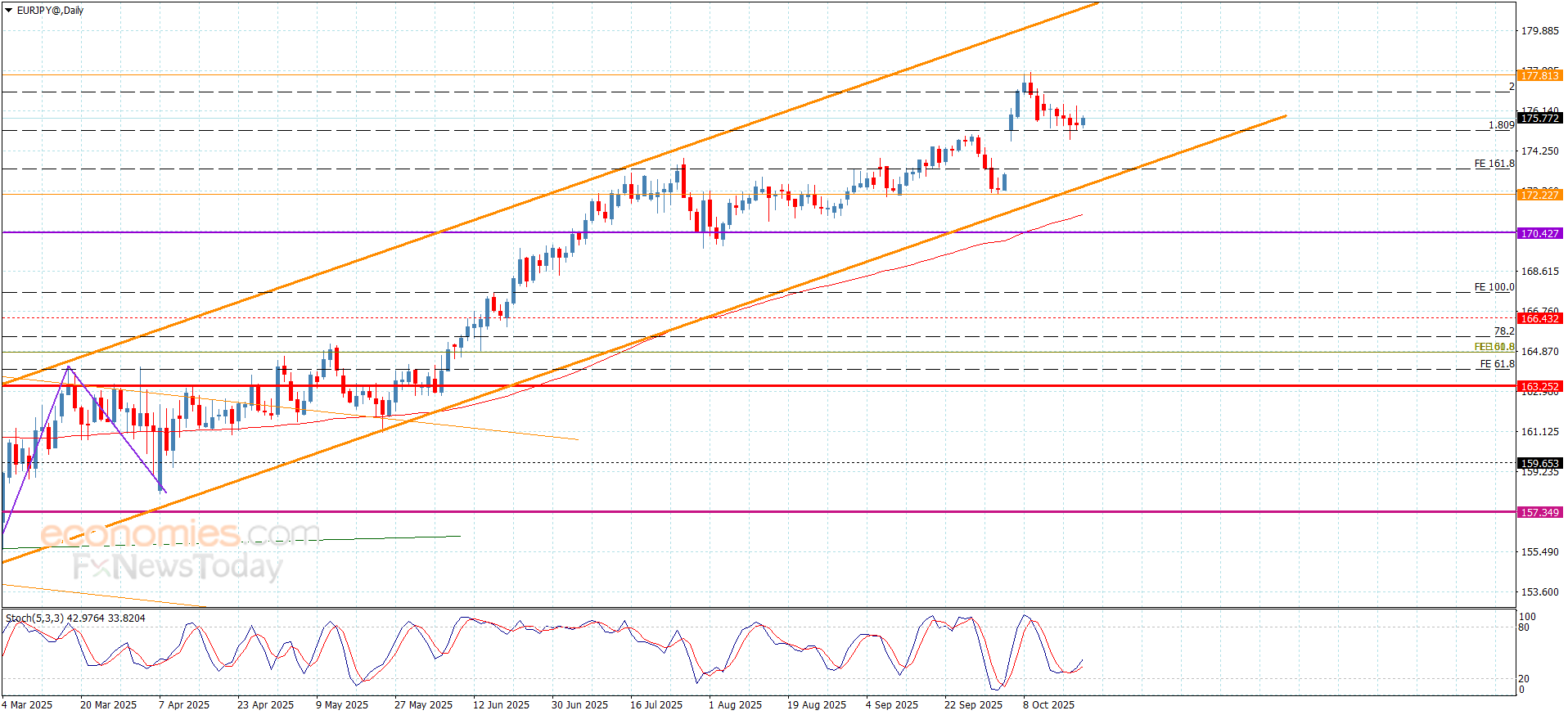
Despite the weakness of the EURJPY pair last trading, its stability within the bullish channel’s levels and the continuation of forming extra support at 175.25 level supports our bullish suggestion in the near trading, to keep waiting for targeting 177.05 level reaching the top at 177.85.
Note that reaching below the current support and providing negative close will force it to activate the bearish corrective track, reaching 174.15 initially, and breaking this level will force it to decline towards 173.40, approaching the support of the main bullish channel.
The expected trading range for today is between 175.25 and 177.05
Trend forecast: Bullish
Silver price (XAG/USD) declines near $52.35 during the early Asian session on Tuesday. The white metal retreat from last week’s record high due to the safe-haven demand eased as trade tensions between the US and China softened. Traders will take more cues about the US interest rate path from the speech of Federal Reserve (Fed) Bank Governor Christopher Waller later on Tuesday.
Analysts believe that Silver might decline on profit-booking, as traders cash in on their gains. Additionally, US President Donald Trump on Friday sought to ease trade tensions with China, saying that his proposed 100% tariff on goods from China would not be sustainable. His softer tone and confirmation of his intention to meet with Chinese President Xi Jinping this week help to mitigate trade tensions between the world’s two largest economies. This, in turn, dampens the safe-haven demand and drags the Silver price lower.
On the other hand, Fed rate cut expectations and dovish comments from Fed officials might lift the white metal. Fed Governor Christopher Waller said that he is on board for another interest rate cut at the Fed’s meeting later this month, citing the mixed readings on the state of the job market.
Meanwhile, St. Louis Fed President Alberto Musalem said that he could support a path with another rate cut if more risks to jobs emerge and inflation is contained. Lower interest rates could reduce the opportunity cost of holding Silver, supporting the non-yielding precious metal.
Silver is a precious metal highly traded among investors. It has been historically used as a store of value and a medium of exchange. Although less popular than Gold, traders may turn to Silver to diversify their investment portfolio, for its intrinsic value or as a potential hedge during high-inflation periods. Investors can buy physical Silver, in coins or in bars, or trade it through vehicles such as Exchange Traded Funds, which track its price on international markets.
Silver prices can move due to a wide range of factors. Geopolitical instability or fears of a deep recession can make Silver price escalate due to its safe-haven status, although to a lesser extent than Gold’s. As a yieldless asset, Silver tends to rise with lower interest rates. Its moves also depend on how the US Dollar (USD) behaves as the asset is priced in dollars (XAG/USD). A strong Dollar tends to keep the price of Silver at bay, whereas a weaker Dollar is likely to propel prices up. Other factors such as investment demand, mining supply – Silver is much more abundant than Gold – and recycling rates can also affect prices.
Silver is widely used in industry, particularly in sectors such as electronics or solar energy, as it has one of the highest electric conductivity of all metals – more than Copper and Gold. A surge in demand can increase prices, while a decline tends to lower them. Dynamics in the US, Chinese and Indian economies can also contribute to price swings: for the US and particularly China, their big industrial sectors use Silver in various processes; in India, consumers’ demand for the precious metal for jewellery also plays a key role in setting prices.
Silver prices tend to follow Gold’s moves. When Gold prices rise, Silver typically follows suit, as their status as safe-haven assets is similar. The Gold/Silver ratio, which shows the number of ounces of Silver needed to equal the value of one ounce of Gold, may help to determine the relative valuation between both metals. Some investors may consider a high ratio as an indicator that Silver is undervalued, or Gold is overvalued. On the contrary, a low ratio might suggest that Gold is undervalued relative to Silver.
The sharp advance cleared multiple hurdles, including a breakout above a downtrend line, likely confirmed with a close above it today. A long-term uptrend line was also reclaimed, adding weight to the bullish shift following last week’s $2.89 swing low, which found footing at the rising channel’s lower boundary. These breakouts mark a clear end to the recent bearish correction, setting the stage for further gains.
Today’s rally past resistance zones like the downtrend line boosts the odds of a third upswing within the rising channel, triggered by a break above the $3.59 swing high. First, the 200-day moving average at $3.46—tested twice as resistance in October—looms as the next key test. A third attempt could break through, but expect some pullback before a sustained reclaim, given its prior rejections.
The extent of any pullback will shed light on the pattern’s strength. A minor dip toward $3.18 could reinforce support, but a deeper drop would question the breakout’s staying power. The weekly chart’s one-week bullish reversal, with minimal overlap into last week’s range, adds to the optimistic outlook.
Symmetry between the current upswing and prior measured moves points to a $3.71 pivot, where advances align. For now, $3.18 support and $3.46 resistance frame the trade. A close above $3.18 locks in bullish momentum, while $3.59 is the gateway to higher targets. Watch today’s close for confirmation—buyers are back, but the 200-day line will test their resolve.
For a look at all of today’s economic events, check out our economic calendar.
– Written by
Frank Davies
STORY LINK Euro-Dollar Forecast: Huge Week for the Dollar, Can EUR/USD Break Higher?
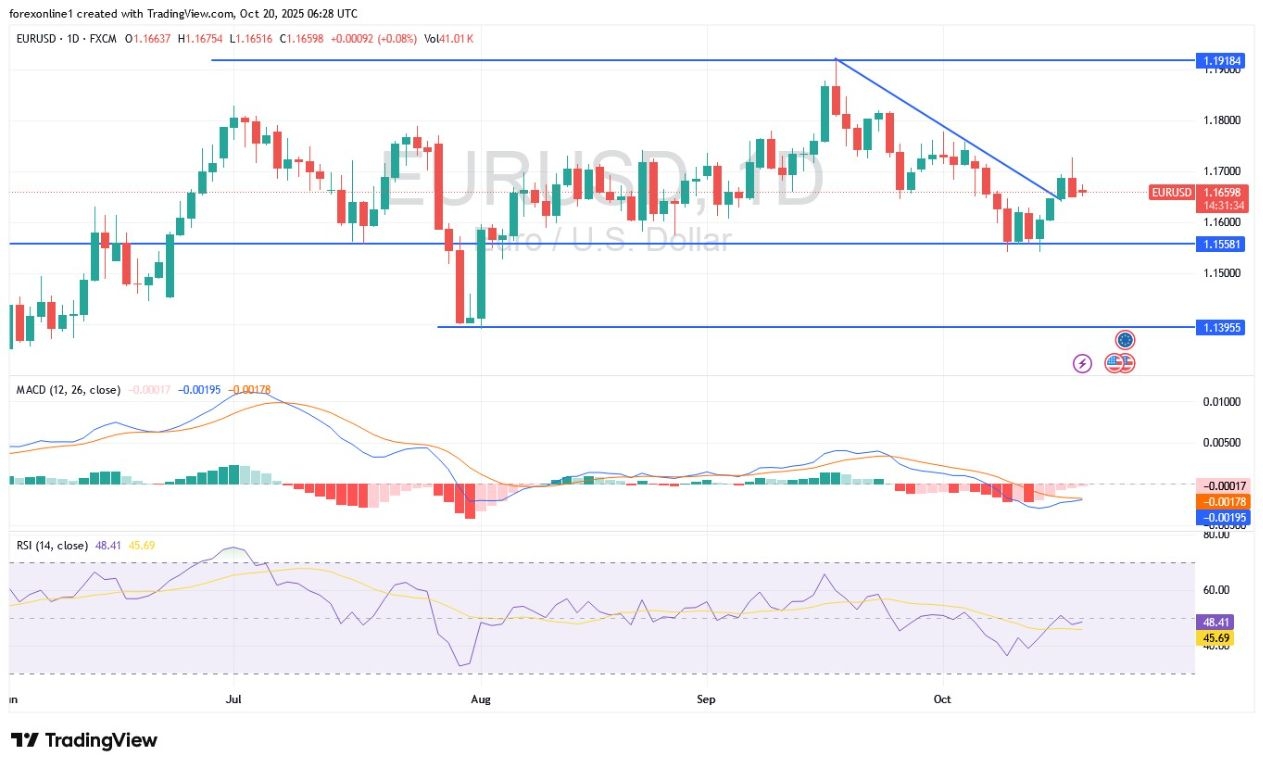
The Euro to Dollar exchange rate (EUR/USD) was unable to hold above 1.1700 on Friday and traded around 1.1660 on Monday with some support near 1.1650.
ING noted French concerns but added; “this week the focus should stay on the US, and a further souring of credit sentiment could send EUR/USD on a path to 1.180.
There will be important data releases late in the week with the PMI business confidence releases and the US consumer prices report.
The US banking sector, government shutdown and political rhetoric will all be potentially market-moving events.
There has been some relief surrounding the US banking sector with equity markets making gains.
Danske Bank noted that earnings releases from the major UK banks have been solid. It added; “Those earnings helped stabilize sentiment and provided some support to the sector overall, even as worries linger around smaller regional lenders.”
ING remained cautious; “Indications that lending issues don’t extend beyond Zions Bancorp and Western Alliance could offer some further relief to the dollar, but it might not be enough to fully price out concerns about the underlying health of the credit market and have the greenback reclaim all losses.
Get better rates and lower fees on your next international money transfer.
Compare TorFX with top UK banks in seconds and see how much you could save.
It added; “As Jamie Dimon warned, there may be more ‘cockroaches’ (i.e. distressed lenders) out there after two US regional banks reported credit issues last week. Markets will be looking very closely for evidence of that, and the dollar continues to face substantial downside risks.”
At this stage, markets are pricing in close to 100% chance of rates being cut next week with over a 95% chance that the central bank will cut rates again at the December meeting.
The Fed is now in a blackout period ahead of the meeting and there should be no official comments.
Any unofficial media briefings will be watched closely if there are sharp moves in equity markets.
US-China trade stresses will continue to be a key element. Rhetoric from President Trump was slightly more conciliatory over the weekend, increasing hopes that pressure on China will be successful.
MUFG market participants remain cautiously optimistic that much higher tariffs are unlikely to remain in place for long and may not even be implemented at all helping to dampen the negative market reaction.
Rabobank; “Before we get too carried away with buying the dip on the latest hopes of TACO perhaps it is worth remembering that the advocates of TACO theory are mostly the same people who told us that universal tariffs would never happen, yet here we are.

It added; “To predict what is likely to be the direction of travel on trade there is only one indicator you need to watch, and that is the US goods trade balance.”
S&P downgraded the French credit rating to A+ from AA- after Friday’s market close due to persistent unease over fiscal trends.
ING commented; “Given the fragility of the government, it remains too early to price out the French effect from the euro fully.”
International Money Transfer? Ask our resident FX expert a money transfer question or try John’s new, free, no-obligation personal service! ,where he helps every step of the way,
ensuring you get the best exchange rates on your currency requirements.
TAGS: Euro Dollar Forecasts
The 10-day average has anchored the uptrend, and today’s low finding support there reinforces its role. A decisive drop below $51.28 signals weakness, with a break past Friday’s $50.62 low paving the way for a deeper pullback. The 20-day average at $48.77, rising and positioned above the short-term rising channel’s top, emerges as a logical next support. Only a failure there would flag a more significant correction, so watch these levels closely.
Last week’s close in the lower half of the weekly range—after five weeks of upper-third finishes—suggests fading bullish momentum. The Relative Strength Index (RSI) dipped below 70 after a month in overbought territory, further supporting this cooling. The outside week’s aggressive selling hints at an early sentiment shift, making any rally suspect without clearing key hurdles.
A push above today’s $52.78 high would signal short-term strength, but only a sustained break past $54.49 confirms renewed upside conviction. Until then, rallies face resistance, with sellers poised to counter. The prior overbought run amplifies correction risks, though the bullish structure holds for now.
Silver’s trend remains upward if $51.28 support persists, but the RSI pullback and weekly weakness warrant caution. A close above $52.78 keeps bulls in play, while a drop below $50.62 targets $48.77. Monitor today’s close for directional cues—$54.49 is the gateway to higher prices, but a deeper breather looms if support gives way.
For a look at all of today’s economic events, check out our economic calendar.
– Written by
David Woodsmith
STORY LINK GBP/USD Price Forecast: Pound Sterling Soft, Underperforms G10 Currencies
The Pound US Dollar exchange rate (GBP/USD) was mostly rangebound on Monday amid a lack of both UK and US data releases.
At the time of writing, GBP/USD was trading at approximately $1.3437, virtually unchanged from the start of Monday’s session.
The US Dollar (USD) held largely steady against most of its major peers on Monday, as a lack of significant US economic releases left the currency without a clear directional driver.
Ongoing uncertainty surrounding the government shutdown has led to the postponement of several key data releases, limiting opportunities for USD investors to take decisive positions.
As a result, the ‘Greenback’ traded in a tight range throughout Monday’s European session, struggling to make any meaningful gains against its rivals.
The Pound (GBP) also treaded water against most of its major peers on Monday, as the absence of notable UK economic releases left Sterling without a clear catalyst.
With no fresh domestic data to influence movement, investors remained cautious, holding back from making significant bets on the currency ahead of this week’s key releases, including the UK’s consumer price index (CPI) due on Wednesday.
Get better rates and lower fees on your next international money transfer.
Compare TorFX with top UK banks in seconds and see how much you could save.
As such, GBP exchange rates stayed largely rangebound throughout Monday’s European session, with the currency showing little momentum and remaining subdued against its major counterparts.
Adding to the subdued tone, analysts at Scotiabank highlighted that Sterling began the week on a softer footing, struggling to gain traction against most of its G10 peers.
Chief FX Strategist Shaun Osborne noted that while the Pound remains relatively stable, underlying sentiment and positioning continue to act as key near-term drivers.
According to Osborne: “The GBP is soft, down a marginal 0.1% vs. the USD and underperforming most of the G10 currencies into Monday’s NA open. This week’s release calendar is dominated by Wednesday’s CPI and Friday’s retail sales. Preliminary PMI’s will also be released on Friday. Fundamentals remain a secondary driver for the pound, as yield spreads extend their two-month consolidation and correlation studies reveal a newly negative relationship between GBP and spreads. Sentiment appears to be more dominant as a near-term driver, with risk reversals showing a 0.64 correlation to GBP on a 21-day rolling basis. Risk reversals remain deeply negative (pricing a premium for puts) but appear to be in the early stages of a recovery.”
Looking ahead to Tuesday’s European session, the GBP/USD exchange rate is expected to be shaped primarily by a speech from Federal Reserve official Christopher Waller, as both the US and UK economic calendars remain notably quiet.
Last week, Waller signalled the possibility of another US interest rate cut this year, citing ongoing concerns over the labour market and broader economic conditions.
Should he echo these dovish remarks this week, the ‘Greenback’ could come under renewed pressure, potentially seeing USD exchange rates slip against its major rivals.
Meanwhile, the UK data calendar is also devoid of notable releases, leaving Sterling without fresh domestic catalysts once more.
In this environment, GBP exchange rates are likely to remain confined within a narrow range, with trading largely guided by market sentiment and risk appetite rather than fundamental data.
Investor attention is expected to remain focused on Wednesday’s CPI release, meaning traders may continue to exercise restraint, maintaining a cautious approach and limiting significant GBP/USD movement ahead of the key inflation figures.
International Money Transfer? Ask our resident FX expert a money transfer question or try John’s new, free, no-obligation personal service! ,where he helps every step of the way,
ensuring you get the best exchange rates on your currency requirements.
TAGS: Pound Dollar Forecasts
Spot Gold trades near its all-time high of $4,379.76 a troy ounce, up on a daily basis on Monday. The positive tone of global equities limits XAU/USD’s near-term bullish potential, but underlying political and trade woes keep the bright metal afloat.
Market participants are keeping an eye on the United States (US) – China trade relationship. US President Donald Trump demanded that Beijing buy additional soybeans and take action on fentanyl to take back the threat of additional levies. Beijing, however, seems less worried.
According to data released at the beginning of the day, the Chinese Gross Domestic Product (GDP) rose 1.1% in the three months to September, beating the market’s expectations of 0.8%. The annualized figure posted a healthy 4.8%, as expected. Other than that, the country reported that Retail Sales in the year to September were up 3%, while Industrial Production in the same period increased 6.5%, both beating expectations of 2.9% and 5% respectively.
The figures suggest China has little to worried about what the US may or may not do, as the economy is doing well regardless of the White House actions and threats.
Meanwhile, the macroeconomic calendar has little to offer these days, although the United Kingdom (UK), Canada, and the US will release fresh Consumer Price Index (CPI) data. The US CPI will be released regardless of the government shutdown on Friday, according to the Bureau of Labor Statistics (BLS).
The XAU/USD pair is hovering around $4,350, and the daily chart shows bulls are in full control of the metal. In the mentioned time frame, technical indicators resumed their advances within overbought territory after correcting extreme readings. At the same time, the pair is far above all bullish moving averages, with the $3,0 SMA currently at around $3,983.
In the near term, the risk skews to the upside, although the momentum faded. Technical indicators stand far above their midlines, but lack directional strength. Meanwhile, intraday slides below a bullish 20 SMA were quickly reversed, with the pair currently well above the indicator. The 20 SMA provides support in the $4,278 price zone.
Support levels: 4,323.80 4,311.40 4,300.00
Resistance levels: 4,355.60 4,367.10 4,379.80
Based on recent Forex market trading. Euro trading has turned the tide against the US dollar, and further gains are likely as a result. The US dollar has come under renewed pressure against the euro following a sharp sell-off in US regional bank stocks. Zions Bank shares fell 13% after a $50 million write-off linked to a loan to California Bank & Trust, while Western Alliance Bank shares fell 11% after revealing its exposure to the same borrowers. Overall, these developments point to the potential emergence of vulnerabilities in US credit markets.
As currency investors know, when market concerns focus on US-specific issues, the US dollar tends to come under pressure: EUR/USD jumped to 1.1720 following these headlines before quickly rebounding and closing last week’s trading session around 1.1650, awaiting strong catalysts for a rapid rebound.
However, as the stock market sell-off extended to major European bank stocks last Friday, this US-centric feature faded somewhat, allowing the US Dollar to recover some of those losses, bringing the EUR/USD pair back to 1.1690. Nevertheless, the US Dollar fell by $0.65%$ against the Euro over the week, and the EUR/USD pair is heading for a rally again amidst a shift in momentum, with some analysts predicting a potential test of the 1.18 resistance level soon.

Recently, according to currency experts, French Prime Minister Lecornu’s resilience in two no-confidence votes last Thursday contributed to the euro’s trading. He survived after announcing plans to suspend pension reforms until after the next presidential election in 2027, sacrificing fiscal discipline for political necessity. According to experts, the French government’s stability, albeit volatile, is enough for the euro to offset a significant portion of France’s risk premium. Unless a new French government collapses before the end of the year, this should allow the EUR/USD pair to refocus on fundamental market drivers (interest rates and stocks).
On the other hand, the US dollar has also been under pressure due to the Federal Reserve’s ambition to cut interest rates by another quarter percentage point at its October meeting, seeking to support growth while avoiding rising inflation. As a result, the EUR/USD pair is now heading towards the resistance level it will reach in early October at 1.1750/1.1770. Overall, the Fed’s dovish tone has anchored the EUR/USD pair around the 1.18 resistance level, and this gap is expected to close quickly in light of the above developments.
In this regard, US Federal Reserve Chairman Jerome Powell indicated in a speech he delivered at the annual meeting of the National Association for Business Economics (NABE) last week: “This policy stance, which I see as still constrained, is… A bit, it puts us in a good position to respond to potential economic developments.” In this context, Powell says the Federal Reserve has ample room to cut interest rates without risking inflation. The rise in stock prices and subsequent decline in the dollar confirm traders’ adoption of this interpretation. In light of these developments, forex market analysts see the 1.18 resistance level as a potential target for the EUR/USD pair in the near term.
Today’s EUR/USD trading is not anticipating any significant European or US economic releases, so forex investor sentiment will be the most important factor driving currency prices today.
The bullish shift for the EUR/USD pair needs more stimulus for confirmation, and that may only happen with stability above the 1.1800 resistance, which increases the positive expectations for the psychological resistance of 1.2000. Otherwise, selling pressure will remain the stronger force.
Ready to trade our Forex daily forecast? We’ve shortlisted the best currency trading platforms in the industry for you.
Gold price (XAU/USD) trades in a tight range around $4,250.00 during the European trading session on Monday. The precious metal stabilizes after Friday’s corrective move, which pushed it lower from the all-time high of $4,380 to near $4,200.
The yellow faced intense selling pressure on Friday after comments from United States (US) President Donald Trump signaled that an additional 100% tariffs announced by Washington on imports from China will not be sustained for long.
The scenario of easing global trade tensions diminishes the appeal of safe-haven assets, such as Gold.
“High tariffs were not sustainable though it could stand,” Trump said in an interview with Fox Business over the weekend. Trump expressed optimism that he could reach a fair deal with Chinese leader Xi Jinping in the meeting scheduled later this month in October.
Broadly, the outlook of the Gold price is upbeat as traders remain highly confident that the Federal Reserve (Fed) will cut interest rates in the policy meeting later this month. According to the CME FedWatch tool, traders are almost certain that the Fed will reduce interest rates by 25 basis points (bps) to 3.75%-4.00% in the October policy meeting.
Ahead of the Fed’s policy meeting, investors will pay close attention to the US Consumer Price Index (CPI) data for September, which will be released on Friday.
Lower interest rates by the Fed bode well for non-yielding assets, such as Gold.
Gold price corrects from its all-time high near $4,380 posted on Friday. The overall trend of the Gold price remains bullish as the 20-day Exponential Moving Average (EMA) slopes higher around $4,011.89. The upward-sloping trendline from the August 22 low around $3,321.50 will act as key support for the Gold price.
The 14-day Relative Strength Index (RSI) stays above 60.00 for a long period, suggesting a strong bullish momentum.
On the upside, the Gold price would struggle to extend its upside above the fresh all-time high of $4,380. Looking down, the psychological level of $4,000 would act as key support.
Gold has played a key role in human’s history as it has been widely used as a store of value and medium of exchange. Currently, apart from its shine and usage for jewelry, the precious metal is widely seen as a safe-haven asset, meaning that it is considered a good investment during turbulent times. Gold is also widely seen as a hedge against inflation and against depreciating currencies as it doesn’t rely on any specific issuer or government.
Central banks are the biggest Gold holders. In their aim to support their currencies in turbulent times, central banks tend to diversify their reserves and buy Gold to improve the perceived strength of the economy and the currency. High Gold reserves can be a source of trust for a country’s solvency. Central banks added 1,136 tonnes of Gold worth around $70 billion to their reserves in 2022, according to data from the World Gold Council. This is the highest yearly purchase since records began. Central banks from emerging economies such as China, India and Turkey are quickly increasing their Gold reserves.
Gold has an inverse correlation with the US Dollar and US Treasuries, which are both major reserve and safe-haven assets. When the Dollar depreciates, Gold tends to rise, enabling investors and central banks to diversify their assets in turbulent times. Gold is also inversely correlated with risk assets. A rally in the stock market tends to weaken Gold price, while sell-offs in riskier markets tend to favor the precious metal.
The price can move due to a wide range of factors. Geopolitical instability or fears of a deep recession can quickly make Gold price escalate due to its safe-haven status. As a yield-less asset, Gold tends to rise with lower interest rates, while higher cost of money usually weighs down on the yellow metal. Still, most moves depend on how the US Dollar (USD) behaves as the asset is priced in dollars (XAU/USD). A strong Dollar tends to keep the price of Gold controlled, whereas a weaker Dollar is likely to push Gold prices up.
The British pound initially tried to rally during the trading session against the US dollar but then fell to reach the 1.34 level. If we break down below the 1.34 level, then the 200-day EMA could be targeted at the 1.3272 level. Short-term rallies, I think, ultimately are situations where you look to fade signs of exhaustion. The 1.35 level, of course, is an area that has been resistant recently. And if we can break above there, then the 1.36 level could be targeted. All things being equal, this is more or less a neutral and sideways market as far as I can see.
And new for today, we’re going to start looking at the euro against the British pound. The euro has gone back and forth against the British pound as we are in a very tight and kind of neutral range of about 150 pips. We have 0.86 offering support and 0.8750 above offering resistance. We are sitting right here on the 50-day EMA.
So, I think this remains a market that trades roughly in about a 50 pip range between 0.8666 and 0.8730, give or take a few pips on each turn. So ultimately, if we get to the bottom of that range, I’m interested in short-term longs. If we get to the top of that range, I’m interested in short-term shorts. That being said, if we break out of the 150 pip range, then obviously a much bigger move would be at foot.
For a look at all of today’s economic events, check out our economic calendar.