The main category of Forex News.
You can use the search box below to find what you need.
[wd_asp id=1]
The main category of Forex News.
You can use the search box below to find what you need.
[wd_asp id=1]
The GBPJPY pair is under strong bearish trading in Friday’s trading, suffering extra losses by its approach from the extra support at 200.45, forming quick bullish rebound, reaching 203.15 level, announcing its attempt to regain the bullish bias.
Note that the stability of the trading above 201.70 level is important to increase the chances of renewing the bullish attempts, repeating the pressure on 203.10 obstacle, and surpassing it will make it achieve extra gains by its rally towards 203.95, while the price return to settle below 201.70 will force it to form new bearish waves, waiting for attacking 200.45 level again.
The expected trading range for today is between 201.70 and 203.00
Trend forecast: Bullish
– Written by
James Fuller
STORY LINK Pound to Dollar Week Ahead Forecast: Near-Term GBP/USD Rangebound
The Pound to Dollar exchange rate (GBP/USD) endured choppy trading through the week, supported by dollar weakness but capped by UK fiscal uncertainty.
Some analysts forecast a multi-year climb to 1.43 by 2026, while others expect the GBPUSD to stay trapped between 1.32 and 1.37 through next year.
After initial losses, RBC Capital Markets forecasts that GBP/USD will strengthen to 1.43 by the end of 2026 on dollar losses.
ING, however, has a 12-month forecast of 1.36 even with a weaker US currency.
After sliding to 10-week lows near 1.3250 during the week, GBP/USD secured a net gain to 1.3430 in choppy trading.
Risk appetite dipped late in the week on US-China fears and a slide in US banking stocks with traders also having to contend with the on-going US government shutdown while gold surged to a fresh record high as risk conditions remained a key focus.
Get better rates and lower fees on your next international money transfer.
Compare TorFX with top UK banks in seconds and see how much you could save.
Danske Bank commented on trade war fears; “The tariff escalation underscored two key points: first, that any renewed trade tensions under a Trump administration are unambiguously negative for the broad USD. Second, markets still view the announced measures largely as negotiation tactics rather than policy reality.”
Standard Chartered is relatively sanguine over the outlook; “We expect the US and China to reach a trade truce again as both sides have economic leverage to avoid a downward spiral.”
Rabobank noted a high degree of uncertainty over trade policy; “Whether both players have a full grasp of their own and their opponent’s tools and power(s) remains an open question.”
It also expects a radical shift in the global order which risks dramatic shifts and high volatility; “That said, it’s even harder to see the spirit going back into the bottle. In other words, the world is changing more rapidly and profoundly than many would have imagined only a few months ago.”
The debate over UK fiscal policy will continue to simmer.
According to ING; “The fiscal risks are more prevalent into the budget in November. We’re not looking for a gilt crisis, but the Chancellor is going to have to make some tough decisions on tax rises or spending cuts.”
It added; “Tighter fiscal and looser monetary policy should ultimately be a bit bearish for sterling – though GBP/USD should trade between 1.32-1.37.

According to RBC; “In the short-term, we think there is room for sterling to underperform, particularly against the USD where the strength in GBP over the last year looks overstretched.
It notes the importance of November’s budget; “Increasingly these announcements have had an FX impact, most notably in 2022. The Budget last year was poorly received by markets and sterling considerably weakened in the weeks that followed.”
RBC, however, expects a multi-year dollar downtrend which will underpin GBP/USD.
It noted; “These long-term trends are rooted in structural asset allocation shifts rather than short-term market fluctuations, reinforcing the idea that the USD’s depreciation is a multi-year process driven by fundamental factors.”
At this stage, markets are still backing very cautious Bank of England rate cuts.
In contrast, traders have fully priced in two further Fed rate cuts before the end of 2025.
Standard Chartered commented; “Over the next three to six months, we continue to expect the USD to weaken, due to a cooling U.S. labour market, slower wage growth, and a more dovish Federal Reserve stance.”
International Money Transfer? Ask our resident FX expert a money transfer question or try John’s new, free, no-obligation personal service! ,where he helps every step of the way,
ensuring you get the best exchange rates on your currency requirements.
TAGS: Pound Dollar Forecasts
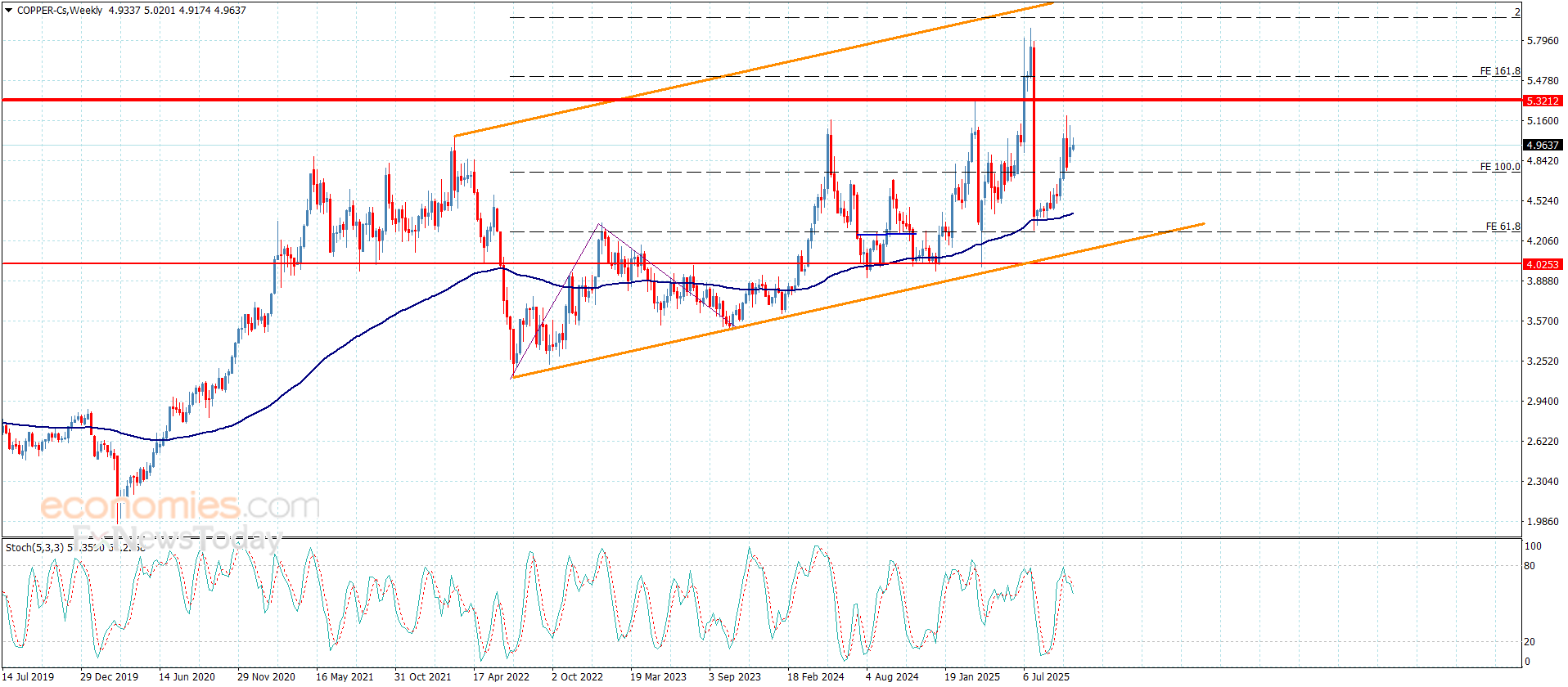
Copper price surrendered to the dominance of the sideways bias, due to its continuous neediness to the positive momentum, besides the stability of the barrier at$5.0600, fluctuating near $4.9500 level without recording any of the previously waited positive targets.
Stochastic decline below 80 level might increase the chances for a temporary corrective decline, to repeat the pressure on the extra support at $4.7500, while its success in surpassing the barrier and holding above it will renew the chances of recording extra gains by its rally towards $5.2000 and $5.3200 directly.
The expected trading range for today is between $4.7500 and $5.0600
Trend forecast: Fluctuated
Following a three-day rally, EUR/USD closed in negative territory on Friday. The pair holds steady above 1.1650 to start the new week, while the technical outlook fails to point to a buildup in directional momentum.
The table below shows the percentage change of Euro (EUR) against listed major currencies last 7 days. Euro was the strongest against the Australian Dollar.
| USD | EUR | GBP | JPY | CAD | AUD | NZD | CHF | |
|---|---|---|---|---|---|---|---|---|
| USD | -0.39% | -0.54% | -0.78% | 0.26% | 0.22% | 0.09% | -1.08% | |
| EUR | 0.39% | -0.16% | -0.33% | 0.63% | 0.69% | 0.47% | -0.71% | |
| GBP | 0.54% | 0.16% | -0.14% | 0.79% | 0.83% | 0.63% | -0.57% | |
| JPY | 0.78% | 0.33% | 0.14% | 1.00% | 0.97% | 0.92% | -0.34% | |
| CAD | -0.26% | -0.63% | -0.79% | -1.00% | -0.07% | -0.15% | -1.35% | |
| AUD | -0.22% | -0.69% | -0.83% | -0.97% | 0.07% | -0.20% | -1.40% | |
| NZD | -0.09% | -0.47% | -0.63% | -0.92% | 0.15% | 0.20% | -1.20% | |
| CHF | 1.08% | 0.71% | 0.57% | 0.34% | 1.35% | 1.40% | 1.20% |
The heat map shows percentage changes of major currencies against each other. The base currency is picked from the left column, while the quote currency is picked from the top row. For example, if you pick the Euro from the left column and move along the horizontal line to the US Dollar, the percentage change displayed in the box will represent EUR (base)/USD (quote).
The US Dollar (USD) gathered strength on Friday and caused EUR/USD to stretch lower. In the absence of high-impact data releases, United States (US) President Donald Trump’s relatively less aggressive tone on trade relations with China helped the USD stay resilient against its peers.
Trump acknowledged that 100% tariff would not be sustainable and added that he this they are “going to do fine” with China.
Over the weekend, Trump said that he wants China to buy soybeans at least in the amount they were buying before and noted that he believes China will make a deal on soybeans.
Meanwhile, S&P Global Ratings downgraded France’s credit rating to A+ from AA-, citing the country’s elevated budget uncertainty despite the submission of a 2025 draft budget.
In the second half of the day, the risk perception could drive EUR/USD’s action. In the early European session, US stock index futures rise between 0.3% and 0.5%. In case risk flows dominate the action in the second half of the day, the USD could struggle to outperform its rivals. However, any positive developments in the US-China relations could support the USD, alongside Wall Street’s main indexes.
EUR/USD trades between the 50-day and the 100-day Simple Moving Averages (SMAs), while the Relative Strength Index (RSI) indicator on the 4-hour chart stays near 50, reflecting a neutral stance.
In case EUR/USD continues to use 1.1650 (100-day SMA) as support, technical buyers could remain interested. In this scenario, 1.1700 (50-day SMA) could be seen as the next resistance before 1.1765 (Fibonacci 23.6% retracement of the latest uptrend) and 1.1820 (static level).
If EUR/USD retreats below 1.1650 and confirms that level as resistance, support levels could be spotted at 1.1580 (Fibonacci 61.8% retracement) and 1.1550 (static level).
The Euro is the currency for the 19 European Union countries that belong to the Eurozone. It is the second most heavily traded currency in the world behind the US Dollar. In 2022, it accounted for 31% of all foreign exchange transactions, with an average daily turnover of over $2.2 trillion a day.
EUR/USD is the most heavily traded currency pair in the world, accounting for an estimated 30% off all transactions, followed by EUR/JPY (4%), EUR/GBP (3%) and EUR/AUD (2%).
The European Central Bank (ECB) in Frankfurt, Germany, is the reserve bank for the Eurozone. The ECB sets interest rates and manages monetary policy.
The ECB’s primary mandate is to maintain price stability, which means either controlling inflation or stimulating growth. Its primary tool is the raising or lowering of interest rates. Relatively high interest rates – or the expectation of higher rates – will usually benefit the Euro and vice versa.
The ECB Governing Council makes monetary policy decisions at meetings held eight times a year. Decisions are made by heads of the Eurozone national banks and six permanent members, including the President of the ECB, Christine Lagarde.
Eurozone inflation data, measured by the Harmonized Index of Consumer Prices (HICP), is an important econometric for the Euro. If inflation rises more than expected, especially if above the ECB’s 2% target, it obliges the ECB to raise interest rates to bring it back under control.
Relatively high interest rates compared to its counterparts will usually benefit the Euro, as it makes the region more attractive as a place for global investors to park their money.
Data releases gauge the health of the economy and can impact on the Euro. Indicators such as GDP, Manufacturing and Services PMIs, employment, and consumer sentiment surveys can all influence the direction of the single currency.
A strong economy is good for the Euro. Not only does it attract more foreign investment but it may encourage the ECB to put up interest rates, which will directly strengthen the Euro. Otherwise, if economic data is weak, the Euro is likely to fall.
Economic data for the four largest economies in the euro area (Germany, France, Italy and Spain) are especially significant, as they account for 75% of the Eurozone’s economy.
Another significant data release for the Euro is the Trade Balance. This indicator measures the difference between what a country earns from its exports and what it spends on imports over a given period.
If a country produces highly sought after exports then its currency will gain in value purely from the extra demand created from foreign buyers seeking to purchase these goods. Therefore, a positive net Trade Balance strengthens a currency and vice versa for a negative balance.
Copper price surrendered to the dominance of the sideways bias, due to its continuous neediness to the positive momentum, besides the stability of the barrier at$5.0600, fluctuating near $4.9500 level without recording any of the previously waited positive targets.
Stochastic decline below 80 level might increase the chances for a temporary corrective decline, to repeat the pressure on the extra support at $4.7500, while its success in surpassing the barrier and holding above it will renew the chances of recording extra gains by its rally towards $5.2000 and $5.3200 directly.
The expected trading range for today is between $4.7500 and $5.0600
Trend forecast: Fluctuated
The British Pound has been on an extended correction since peaking at the 206.30 area in early October. Price action is moving within a downward channel, with the larger wicks in the daily chart showing a hesitant market. The pair was capped at 203.00 earlier on Monday and is testing support at the 202.00 area at the time of writing.
News that the fiscal dove Sanae Takaichi secured the necessary support to become prime minister has hurt the Yen earlier today, but the Pound seems unable to capitalize on JPY’s weakness and is trading practically flat on the day, undermined by investors’ concerns about the UK’s fiscal policy.
A look at the 4-hour chart confirms a hesitant market with a moderate bearish bias. The Relative Strength Index (RSI)keeps wavering back and forth around the 50 level, and the succession of lower peaks and lower troughs seen over the last two weeks suggests that bears keep the upper hand.
The pair was capped at the channel top.,near 203.10, and is giving away gains on the early European session, approaching the intra-day low at 202.00. Further down the bottom of the channel, at the 200.90 area, appears as a likely target.
On the upside, the pair should breach the mentioned channel top, right above 203.0,0 and the October 14 high, atthe 203.50 area to cancel the bearish pattern. A confirmation above those levels would clear the way towards the 204.40-204.50 area (October 8 lows) and the YTD high, at 205.30.
The table below shows the percentage change of Japanese Yen (JPY) against listed major currencies today. Japanese Yen was the strongest against the British Pound.
| USD | EUR | GBP | JPY | CAD | AUD | NZD | CHF | |
|---|---|---|---|---|---|---|---|---|
| USD | -0.09% | 0.03% | 0.11% | 0.04% | -0.06% | -0.15% | -0.06% | |
| EUR | 0.09% | 0.13% | 0.16% | 0.12% | 0.05% | -0.06% | 0.05% | |
| GBP | -0.03% | -0.13% | 0.06% | -0.01% | -0.10% | -0.19% | -0.08% | |
| JPY | -0.11% | -0.16% | -0.06% | -0.07% | -0.14% | -0.31% | -0.16% | |
| CAD | -0.04% | -0.12% | 0.00% | 0.07% | -0.02% | -0.20% | -0.08% | |
| AUD | 0.06% | -0.05% | 0.10% | 0.14% | 0.02% | -0.12% | 0.00% | |
| NZD | 0.15% | 0.06% | 0.19% | 0.31% | 0.20% | 0.12% | 0.11% | |
| CHF | 0.06% | -0.05% | 0.08% | 0.16% | 0.08% | -0.00% | -0.11% |
The heat map shows percentage changes of major currencies against each other. The base currency is picked from the left column, while the quote currency is picked from the top row. For example, if you pick the Japanese Yen from the left column and move along the horizontal line to the US Dollar, the percentage change displayed in the box will represent JPY (base)/USD (quote).
Silver price (XAG/USD) trades 0.7% higher to near $52.30 during the late Asian trading session on Monday. The white metal rebounds after a steep corrective move seen on Friday from the all-time high of $54.50.
The precious metal faced intense selling pressure after comments from United States (US) President Donald Trump signaling that the additional 100% tariffs announced on imports from Beijing won’t last long. “High tariffs were not sustainable, though they could stand,” Trump said, Fox Business reported.
Signs of easing global trade tensions diminish the appeal of safe-haven assets, such as Silver.
Trade frictions between the US and China stemmed after Beijing announced export controls on rare earth minerals.
For major updates on US-China trade relations, investors will focus on the meeting between US President Trump and Chinese leader Xi Jinping, which is scheduled later this month at the Asia-Pacific Economic Cooperation meeting in South Korea. Before that, US Treasury Secretary Scott Bessent is scheduled to meet his Chinese counterpart, Vice Premier He Lifeng, later this week.
Meanwhile, firm expectations that the Federal Reserve (Fed) will reduce interest rates atleast by 50 basis points (bps) in the remaining year will keep the Silver price on the front foot. Lower interest rates by the Fed bode well for non-yielding assets, such as Silver.
According to the CME FedWatch tool, traders have almost priced in atleast 50-basis-points (bps) reduction in interest rates in the remaining year and see a 4.8% chance that the Fed could cut borrowing rates by 75 bps.
Silver price retraces from the all-time high of around $54.50 posted on Friday. However, the near-term trend remains bullish as the 20-day Exponential Moving Average (EMA) slopes higher, which trades around $49.00.
The 14-day Relative Strength Index (RSI) oscillates above 60.00, suggesting that a strong bullish momentum remains intact.
Looking down the 20-day EMA would remain a key support. On the upside, the all-time high of $54.50 might act as key barrier.
Silver is a precious metal highly traded among investors. It has been historically used as a store of value and a medium of exchange. Although less popular than Gold, traders may turn to Silver to diversify their investment portfolio, for its intrinsic value or as a potential hedge during high-inflation periods. Investors can buy physical Silver, in coins or in bars, or trade it through vehicles such as Exchange Traded Funds, which track its price on international markets.
Silver prices can move due to a wide range of factors. Geopolitical instability or fears of a deep recession can make Silver price escalate due to its safe-haven status, although to a lesser extent than Gold’s. As a yieldless asset, Silver tends to rise with lower interest rates. Its moves also depend on how the US Dollar (USD) behaves as the asset is priced in dollars (XAG/USD). A strong Dollar tends to keep the price of Silver at bay, whereas a weaker Dollar is likely to propel prices up. Other factors such as investment demand, mining supply – Silver is much more abundant than Gold – and recycling rates can also affect prices.
Silver is widely used in industry, particularly in sectors such as electronics or solar energy, as it has one of the highest electric conductivity of all metals – more than Copper and Gold. A surge in demand can increase prices, while a decline tends to lower them. Dynamics in the US, Chinese and Indian economies can also contribute to price swings: for the US and particularly China, their big industrial sectors use Silver in various processes; in India, consumers’ demand for the precious metal for jewellery also plays a key role in setting prices.
Silver prices tend to follow Gold’s moves. When Gold prices rise, Silver typically follows suit, as their status as safe-haven assets is similar. The Gold/Silver ratio, which shows the number of ounces of Silver needed to equal the value of one ounce of Gold, may help to determine the relative valuation between both metals. Some investors may consider a high ratio as an indicator that Silver is undervalued, or Gold is overvalued. On the contrary, a low ratio might suggest that Gold is undervalued relative to Silver.
The GBPJPY pair is under strong bearish trading in Friday’s trading, suffering extra losses by its approach from the extra support at 200.45, forming quick bullish rebound, reaching 203.15 level, announcing its attempt to regain the bullish bias.
Note that the stability of the trading above 201.70 level is important to increase the chances of renewing the bullish attempts, repeating the pressure on 203.10 obstacle, and surpassing it will make it achieve extra gains by its rally towards 203.95, while the price return to settle below 201.70 will force it to form new bearish waves, waiting for attacking 200.45 level again.
The expected trading range for today is between 201.70 and 203.00
Trend forecast: Bullish
Gold price (XAU/USD) trades in negative territory around $4,245 during the early Asian session on Monday. The precious metal edges lower as the recent record-breaking rally seems overstretched and physical demand eases after the festive rush. Traders brace for China’s Q3 Gross Domestic Product (GDP) data later on Monday, along with Industrial Production and Retail Sales reports for September.
The yellow metal ended last week on a positive note, bolstered by festive demand in India and strong ETF buying. However, some profit-taking or consolidation cannot be ruled out in the near term as ongoing fundamentals are already priced in and physical demand wanes.
“Gold prices are likely to see some corrections/ consolidation as ongoing fundamentals are already priced in and physical demand wanes post mid-week,” said Pranav Mer, Vice President, EBG – Commodity & Currency Research, JM Financial Services Ltd.
On the other hand, the escalating US-China trade tensions, worries about uncertainty and global geopolitical risks could boost the safe-haven assets like Gold. US trade officials condemned China’s expansion of export controls on rare earths, while Beijing accused Washington of causing global panic over supply chain disruption. “Trade uncertainty is one driver helping to launch gold prices to all-time highs,” said Sam Stovall, chief investment strategist of CFRA Research in New York.
Gold has played a key role in human’s history as it has been widely used as a store of value and medium of exchange. Currently, apart from its shine and usage for jewelry, the precious metal is widely seen as a safe-haven asset, meaning that it is considered a good investment during turbulent times. Gold is also widely seen as a hedge against inflation and against depreciating currencies as it doesn’t rely on any specific issuer or government.
Central banks are the biggest Gold holders. In their aim to support their currencies in turbulent times, central banks tend to diversify their reserves and buy Gold to improve the perceived strength of the economy and the currency. High Gold reserves can be a source of trust for a country’s solvency. Central banks added 1,136 tonnes of Gold worth around $70 billion to their reserves in 2022, according to data from the World Gold Council. This is the highest yearly purchase since records began. Central banks from emerging economies such as China, India and Turkey are quickly increasing their Gold reserves.
Gold has an inverse correlation with the US Dollar and US Treasuries, which are both major reserve and safe-haven assets. When the Dollar depreciates, Gold tends to rise, enabling investors and central banks to diversify their assets in turbulent times. Gold is also inversely correlated with risk assets. A rally in the stock market tends to weaken Gold price, while sell-offs in riskier markets tend to favor the precious metal.
The price can move due to a wide range of factors. Geopolitical instability or fears of a deep recession can quickly make Gold price escalate due to its safe-haven status. As a yield-less asset, Gold tends to rise with lower interest rates, while higher cost of money usually weighs down on the yellow metal. Still, most moves depend on how the US Dollar (USD) behaves as the asset is priced in dollars (XAU/USD). A strong Dollar tends to keep the price of Gold controlled, whereas a weaker Dollar is likely to push Gold prices up.
– Written by
Ben Hughes
STORY LINK Pound Sterling to Dollar Forecast: CIBC Sees 1.37 Year-End Despite Risk-Off Slide
The Pound to Dollar exchange rate (GBP/USD) slipped back to 1.3415 after failing to hold 10-day highs, with risk aversion blunting Sterling gains.
CIBC analysts maintain a year-end target of 1.37 but warn volatility will persist as US banking fears resurface.
The Pound to Dollar (GBP/USD) exchange rate strengthened to 10-day highs at 1.3470 during Friday’s Asian session before a retreat to around 1.3415 as the dollar recovered ground.
The dollar was hurt by fresh concerns over US regional banks and very strong expectations of further Federal Reserve rate cuts, but the Pound was undermined by a notable deterioration in risk appetite.
UoB does not expect a break of resistance; “Although there has been no clear increase in upward momentum, today there is a chance for GBP to test 1.3475 today. Based on the current momentum, a continued advance above this level is unlikely.”
CIBC has a year-end GBP/USD forecast of 1.37.
Get better rates and lower fees on your next international money transfer.
Compare TorFX with top UK banks in seconds and see how much you could save.
US equities dipped after warnings of loan-related losses from Zions Bancorp and Western Alliance Bancorp.
The S&P Regional Banks Select Industry Index declined by -6.3% and the largest daily decline since the sell-off in April triggered by President Trump’s “Liberation Day” tariffs announcement.
After a significant setback on Wall Street, the FTSE 100 index posted significant losses with notable declines in the banking sector.
Weaker risk conditions are an important negative factor for the Pound with investors also still wary over the UK fundamentals.
Richard Hunter, head of markets at interactive investor commented; “There are increasing signs of storm clouds gathering over markets, with little relief from the building wall of worry.”
He added; “Already grappling with stretched stock valuations in the AI space, an unresolved government shutdown and a deteriorating relationship between Beijing and Washington, investors were exposed to a new source of concern in the form of lending practices and bad loans for US regional banks.”
Overnight, Fed Governor Waller backed a further rate cut at the October meeting despite a lack of official data and there has been a further shift in market pricing.
Traders are pricing in over an 80% chance that rates will be cut again in December, but there is now close to a 20% chance of a more aggressive 50 basis-point cut at that meeting.
Domestically, Bank of England (BoE) chief economist Pill maintained a relatively hawkish stance in comments on Friday.
According to Pill, the bank needs to recognise that CPI stubbornness is more pressing and that the policy committee should adopt a more cautious pace of easing.
He did, however, add that he does see rate cuts if the economy evolves as forecast.
If the BoE holds firm and the Fed does deliver sharp rate cuts, yield spreads could underpin the Pound in global markets.
There will, however, be the risk that the BoE narrative changes
CIBC commented on BoE expectations; “we remain mindful of the market underpricing risks of a December adjustment.”
International Money Transfer? Ask our resident FX expert a money transfer question or try John’s new, free, no-obligation personal service! ,where he helps every step of the way,
ensuring you get the best exchange rates on your currency requirements.
TAGS: Pound Dollar Forecasts