The main category of Forex News.
You can use the search box below to find what you need.
[wd_asp id=1]
The main category of Forex News.
You can use the search box below to find what you need.
[wd_asp id=1]
This may signal the onset of a correction, fueled by the recent sharp ascent and growing extension from the 10-day moving average at $4,098. A sustained breach below today’s low points to a test of support at this key dynamic support line. The bearish candle aligns near a predefined target from a rising measured move, matching the rally from May’s swing low to the prior upswing from November’s bottom. Symmetry in these advances often breeds resistance, evident in today’s reversal.
Bounces into today’s range should meet eventual resistance, reversing lower amid emerging seller dominance—the most bearish daily action since the rally ignited around August 22. Despite this, gold’s underlying demand stays robust, potentially fostering a consolidation correction near highs above the 10-day line.
Recent upside breaches of two rising trend channels underscore strength, offering potential support on pullbacks. The long-term bullish channel’s top line activated last Wednesday, following a smaller channel breakout Monday. The long-term bull trend holds firm, yet the RSI lingers in extreme overbought territory, amplifying speculative acceleration in the rise.
A correction would prove beneficial, realigning with a more sustainable ascent rate. Overbought readings and parabolic moves heighten this likelihood, even as breakouts affirm momentum.
Bears gain footing short-term, with $4,098 as the litmus test—hold for consolidation, break for deeper retracement. Watch the close for engulfing confirmation; channel lines could cushion falls, but symmetry resistance suggests caution until support is proven.
For a look at all of today’s economic events, check out our economic calendar.
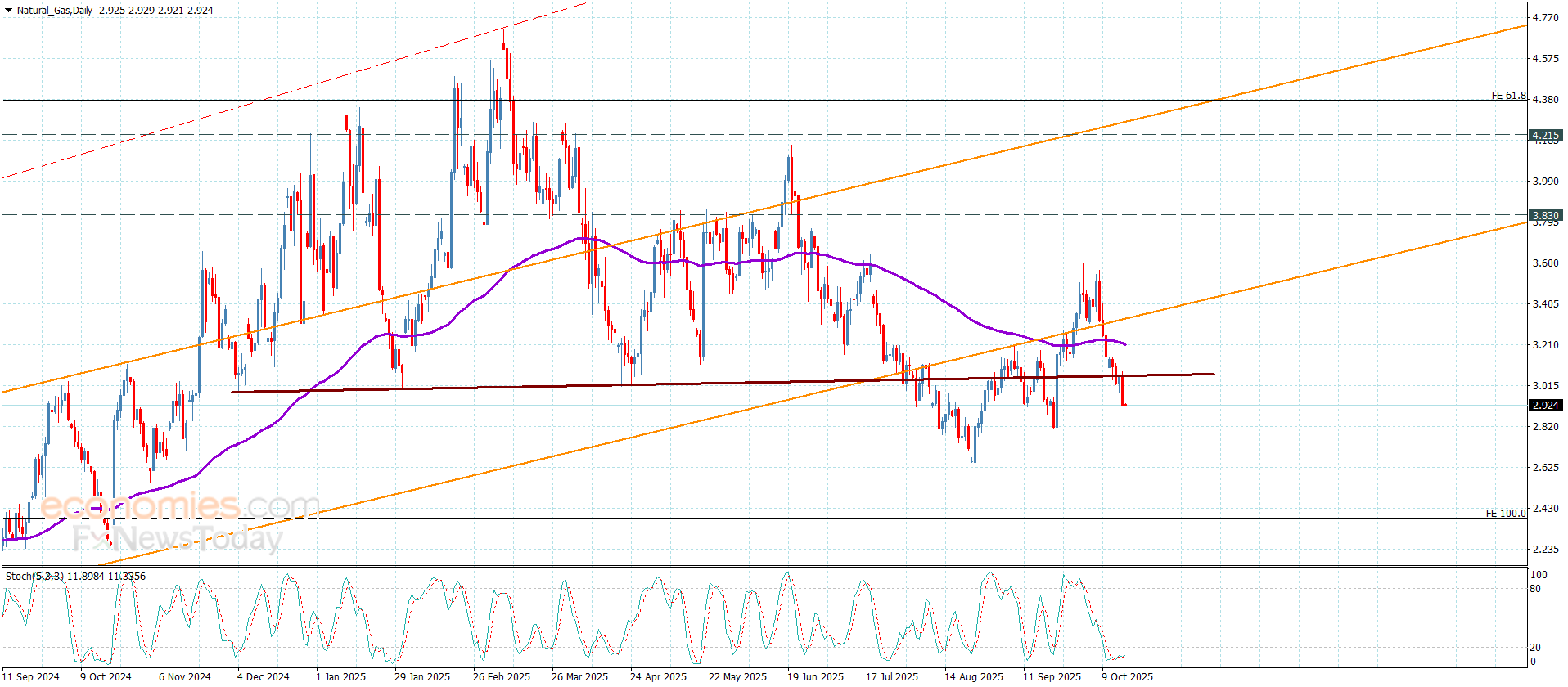
The support cluster—breached earlier – was reclaimed as prices climbed above the open. Key elements include the 78.6% Fibonacci retracement at $2.95, a long-term anchored Volume Weighted Average Price (AVWAP) line, and the top quarter line of a large falling trend channel. This recovery highlights a bullish buyer response but doesn’t erase the broader correction’s grip.
More telling is the reaction at the 50-day average: today’s range marks the first full session below it since September 26’s reclaim. A drop below today’s low would reinforce this; otherwise, upside reversal potential lingers via a breakout above $3.02 and the 50-day line. Sustained gains above Thursday’s $3.07 high would bolster confidence.
Initial upside aims at the 20-day average ($3.16), converging with the falling 10-day average ($3.17) and the rising channel’s top centerline. Channel vibrations could propel natural gas toward the top boundary, though the falling channel’s upper line resulted in resistance and a double top.
An intersection of two lines at $2.95 arrives Tuesday, potentially signaling timing for resolution or retest.
The channel floor hold favors a pause in selling, but 50-day rejection caps enthusiasm. Watch $3.02 for breakout validity or $2.89 for renewed downside. A close above $2.98 strengthens the rebound case, while the $3.16 cluster tests conviction—Tuesday’s line cross adds intrigue to the unfolding setup.
For a look at all of today’s economic events, check out our economic calendar.

The gold silver platinum price forecast indicates that precious metals may soon face a turning point after sharp gains in recent months. Technical indicators suggest a possible blow-off top, followed by corrections similar to those seen in past bull market cycles.
Gold prices have risen by more than 25% in two months. Analysts see similarities with 2006 when gold peaked and then dropped 25% within a month. Current signals point to an imminent top, with a possible pullback to around $3,500.
The surge began in early 2024, and experts believe a peak could occur between now and the end of October. Gold has now extended more than 75% above its 200-week moving average, a level that in past cycles led to 20% or more corrections.
If gold follows the same path as in the last bull market, it could reach $6,500 by 2027 and possibly $10,000 by 2030. However, short-term technicals suggest caution as the price nears $4,400–$4,600 before a likely correction.
In 2005, gold entered a strong uptrend when it broke above $500. Prices never returned to that level. A blow-off top followed in 2006, with a 36% surge in two months and a 25% correction soon after. This historical trend shows how extreme rallies often lead to sharp pullbacks. Gold is again moving beyond its trendline resistance, indicating a similar pattern could be forming. Analysts expect that after reaching $4,400–$4,600, gold may quickly correct to $3,500.
Silver has officially broken out of a 45-year cup-and-handle formation. Analysts believe this marks the beginning of a long-term repricing. Silver reached a new inflation-adjusted high and could eventually move toward $200 per ounce.
Supply deficits and industrial demand from sectors like artificial intelligence and solar are key drivers. Over the next decade, silver could surpass its 1980 inflation-adjusted high and set a new price floor around $50.
Recently, silver hit $54.14, with a possible surge toward $60 if gold continues higher. However, if gold corrects 20% or more, silver could also pull back toward $40.
Platinum prices have reached a new high and could briefly move above $1,800 before correcting toward $1,300. The move reflects a temporary spike driven by investor momentum and market sentiment.
While gold and silver dominate headlines, platinum is also showing volatility, suggesting the entire precious metals sector may be nearing a peak before stabilizing.
Gold miners (GDX) have reached the $85 target projected from a four-year rounded bottom pattern. Any further gains are expected to be limited. If gold rises to $4,400–$4,600, that could mark a near-term top, leading to a 20%–25% correction.
Junior miners (GDXJ) could still rise by 5%–10% if gold enters a final blow-off phase. Silver juniors (SILJ) have also hit new highs, but their gains are likely to end when gold and silver peak.
Despite possible near-term corrections, analysts remain positive about long-term prospects. The gold silver platinum price forecast for the decade suggests higher levels by 2030 as inflation, currency weakness, and industrial demand support metal prices.
The 2024–2025 rally has confirmed a new bull phase. Corrections in late 2025 may create opportunities before the next growth cycle begins.
What is the gold price forecast for the next few months?
Gold could rise toward $4,600 before correcting to around $3,500, following a possible blow-off top similar to the 2006 pattern.
How high can silver and platinum go by 2030?
Silver may reach $200 or higher, while platinum could see levels above $2,000 as long-term demand trends continue.
Market analysts attribute this surge to persistent safe-haven flows, as traders hedge against volatility in equities and currencies. “Markets are increasingly pricing in policy easing and slower growth, which keeps demand for non-yielding assets like gold strong,” said a commodities strategist at OANDA.
Concerns over a prolonged U.S. government shutdown and weakening macro indicators have amplified demand for precious metals. The Senate’s continued failure to pass a short-term funding bill has deepened fears of reduced consumer confidence and delayed economic data, clouding the outlook for growth.
At the same time, the Federal Reserve is signaling a dovish tilt. Chair Jerome Powell recently acknowledged labor market softening, while Governor Christopher Waller said inflation is nearing the central bank’s 2% target. These comments fueled expectations of back-to-back 25-basis-point rate cuts at the Fed’s October and December meetings. A weaker U.S. dollar, which has fallen to a one-week low, has further supported gold and silver prices.
Renewed trade friction between the U.S. and China is another driver of bullion demand. Recent tariff threats and export restrictions have intensified concerns about global supply chains. Meanwhile, broader geopolitical tensions across Eastern Europe and other regions have reinforced gold’s role as a hedge against instability.
Gold (XAU/USD) is expected to consolidate between $4,280 and $4,400 before attempting another breakout, while Silver (XAG/USD) may retest $53.40 support before targeting $54.50 and $55.40. Traders are now watching upcoming Fed communications, U.S. labor data, and global trade updates for cues on the next directional move.
The EURJPY pair forced it to form slow sideways trading, to face stochastic negativity which keeps its positive stability above the extra support at 175.20 level, confirming the continuation of the suggested bullish attempts.
Gathering the positive momentum is important to ease the mission of forming bullish waves, to help it surpass the obstacle at 176.40, then targeting the next positive station at 177.05, while breaking the current support will force it to activate the bearish corrective trend, to suffer extra losses by reaching 174.25.
The expected trading range for today is between 175.20 and 176.45
Trend forecast: Bullish
– Written by
Tim Boyer
STORY LINK Euro to Dollar Forecast: USD Retreats on Trade Fears, EUR Finds Support
The Euro to Dollar exchange rate (EUR/USD) climbed to one-week highs near 1.1650 as renewed US economic worries and rising trade tensions weighed on the dollar.
ING analysts maintain a bullish stance, keeping its 1.20 year-end target intact.
The dollar has lost ground in global markets amid expectations of two further Fed rate cuts this year with the US currency also hurt by renewed fears over a US-China trade war.
In contrast, the Euro has also gained some support from optimism that the French government will survive confidence votes on Thursday.
The Euro to Dollar rate traded just above the 1.1650 level with the US official data vacuum contributing to the wider sense of unease with gold hitting a fresh all-time high.
UoB expects a near-term cap around 1.1680; “Given that there is still no significant increase in upward momentum, we do not expect a continued rise above this level. The major resistance at 1.1720 is also not expected to come into view.”
Get better rates and lower fees on your next international money transfer.
Compare TorFX with top UK banks in seconds and see how much you could save.
ING is also cautious at this stage; “It’s hard to see EUR/USD breaking above the 1.1685/1730 area in the near term. However, the longer EUR/USD can consolidate here, the closer it comes to the seasonally bullish period of November and especially December. We retain a 1.20 year-end call.”
US-China trade tensions have increased further with overnight comments from President Trump that the US and China are in a trade war.
ING commented; “FX markets are reasonably calm as attention builds on China’s export controls on rare earths. The decision to impose such controls has clearly touched a nerve in the US and across G7 nations. The ability or failure to get those controls negotiated away will be one of the hottest topics for financial markets over the next four weeks.”
Rhetoric will be watched closely in the short term. Markets will be looking for further evidence whether Trump will meet Chinese President Xi late this month.
Another key issue is whether there will be an extension of the current truce on overall tariffs will be extended beyond November 10th. Without an extension, tariffs are due to revert to 145%.
According to Joseph Capurso, head of foreign exchange at Commonwealth Bank of Australia; “An extension, rather than a grand bargain that settles all trade issues, is probably the most realistic second-best outcome compared to the alternative of escalation of retaliation.”
Betting markets expect the US government shutdown to extend into November, increasing potential economic damage, and traders are pricing in around a 95% chance of two Fed rate cuts by the end of 2025.

At this stage, markets expect no change in ECB rates which would support the Euro if the Federal Reserve does deliver two further rate cuts by the end of this year.
MUFG considers that the ECB should keep its options open.
It added; “One cut by mid-2026 is unlikely to derail prospects of a rebound in EUR/USD given the Fed is set to be much more active and with a risk of pricing of cuts over that period increasing further as well.”
International Money Transfer? Ask our resident FX expert a money transfer question or try John’s new, free, no-obligation personal service! ,where he helps every step of the way,
ensuring you get the best exchange rates on your currency requirements.
TAGS: Euro Dollar Forecasts
The American Petroleum Institute (API) estimated that crude oil inventories in the United States increased by a large 7.36 million barrels in the week ending October 10. Analysts had forecast a much smaller 120,000-barrel build for the week. Today’s build comes after the IEA predicted a smaller global oil demand growth estimate for this year, along with a higher supply growth, which would, according to the agency, result in a rather large supply overhang globally.
But crude oil inventories in the United States are not showing signs of an inventory overhang, with net crude oil inventories just 7.9 million barrels higher than they were at the beginning of the year, according to Oilprice calculations of API data.
Earlier this week, the Department of Energy (DoE) reported that crude oil inventories in the Strategic Petroleum Reserve (SPR) have risen by 700,000 barrels to 407.7 million barrels in the week ending October 10 as the government attempts to replenish stockpiles that were eaten into by the previous administration.
US production has reached an all-time high for the week of October 3, of 13.629 million bpd, according to the EIA.
At 4:14 pm ET, Brent crude was trading down again, by $0.28 (-0.45%) on the day, reaching $62.11 $65.73. Brent prices are now down $3.60 per barrel from this time last week following a fragile ceasefire and hopes of a lasting peace deal, on top of the IEA’s gloomy predictions of a bearish market. WTI was also trading down on the day, by $0.26 (-0.44%) at $58.44.
Gasoline inventories also saw a build, of 2.99 million barrels in the week ending October 10, after falling by 1.245 million barrels in the week prior. As of last week, gasoline inventories were about 1% below the five-year average for this time of year, according to the latest EIA data.
Distillate inventories fell in the reporting period, losing 4.79 million barrels on top of the week prior’s 1.822-million-barrel drawdown. Distillate inventories were already 6% below the five-year average as of the week ending October 3, the latest EIA data shows.
Cushing inventory data was not available at the time of writing.
By Julianne Geiger for Oilprice.com
More Top Reads From Oilprice.com:
– Written by
Frank Davies
STORY LINK Pound to Dollar Forecast: GBP Advances as Fed Dovish Shift Hits USD
The Pound to Dollar exchange rate (GBP/USD) advanced to a one-week high near 1.3440, taking advantage of a broad dollar retreat as traders priced in two Fed rate cuts by the end of 2025.
Foreign exchange strategists, however, remain wary of UK economic fragility and limited BoE flexibility.
Pound Sterling secured a net advance on Tuesday, able to take advantage of a dollar setback to make net gains to a 1-week high of 1.3440 in Europe on Thursday.
According to UoB, further gains are likely to be limited; “The major resistance at 1.3475 is unlikely to come into view. To keep the mild momentum going, GBP must hold above 1.3360.”
The Pound also still has work to do to regain a firmer trend.
ING, for example, expects GBP/USD will be capped below 1.40 throughout the next 12 months.
Get better rates and lower fees on your next international money transfer.
Compare TorFX with top UK banks in seconds and see how much you could save.
Markets remain very confident that the Fed will cut interest rates this month and are now pricing in close to a 95% chance of two rate cuts by the end of 2025.
The US 10-year yield has dipped to near 4.00% with the prospect for lower interest rates undermining the dollar.
ABN Amro, however, is not convinced over the merits of further rate cuts; “We think policy is currently not as restrictive as the FOMC appears to think, and we think the upside risks to inflation outweigh the downside risks to the labour market. This frontloaded easing path increases the probability of the upside inflation risks materializing.”
Markets are also fretting over trade developments as US-China tensions continue to intensify.
Overnight, President Trump stated that the US is in a trade war with China.
ING commented; “The question for financial markets is whether China’s proposed export controls on rare earths are merely part of a bargaining ploy to achieve greater concessions from the US. Or really whether it is a threat which would stick and greatly disrupt global supply chains.”
The aggressive rhetoric has increased concerns over a further hit to the US economy and hurt the dollar.
It is, however, unlikely that the Pound would find strong support if global risk appetite deteriorates sharply.
As far as the UK economy is concerned, GDP increased 0.1% for August, in line with expectations, but the July figure was revised down to –0.1% compared with the flash figure of no change.
Capital Economics deputy chief UK economist Ruth Gregory maintains a generally downbeat stance; “The meagre rise in real GDP in August suggests growth is still being hampered by high interest rates, higher taxes and soft overseas activity. With business sentiment on the floor and employment still falling, we doubt growth will improve much in Q4.”
The implications for interest rates and taxes will be important.
Gregory does not expect a shift within the Bank of England; “With inflation still high and rising, we doubt the soft GDP news will tempt the Bank of England to cut interest rates again this year.”
She expects the next rate cut will be in February.
The UK goods trade deficit widened to £21.1bn for August from £20.65bn the previous month. Exports declined £1.1bn on the month with a £0.7bn decline in exports to the US, illustrating the stresses caused by tariffs.
International Money Transfer? Ask our resident FX expert a money transfer question or try John’s new, free, no-obligation personal service! ,where he helps every step of the way,
ensuring you get the best exchange rates on your currency requirements.
TAGS: Pound Dollar Forecasts
The EURJPY pair forced it to form slow sideways trading, to face stochastic negativity which keeps its positive stability above the extra support at 175.20 level, confirming the continuation of the suggested bullish attempts.
Gathering the positive momentum is important to ease the mission of forming bullish waves, to help it surpass the obstacle at 176.40, then targeting the next positive station at 177.05, while breaking the current support will force it to activate the bearish corrective trend, to suffer extra losses by reaching 174.25.
The expected trading range for today is between 175.20 and 176.45
Trend forecast: Bullish
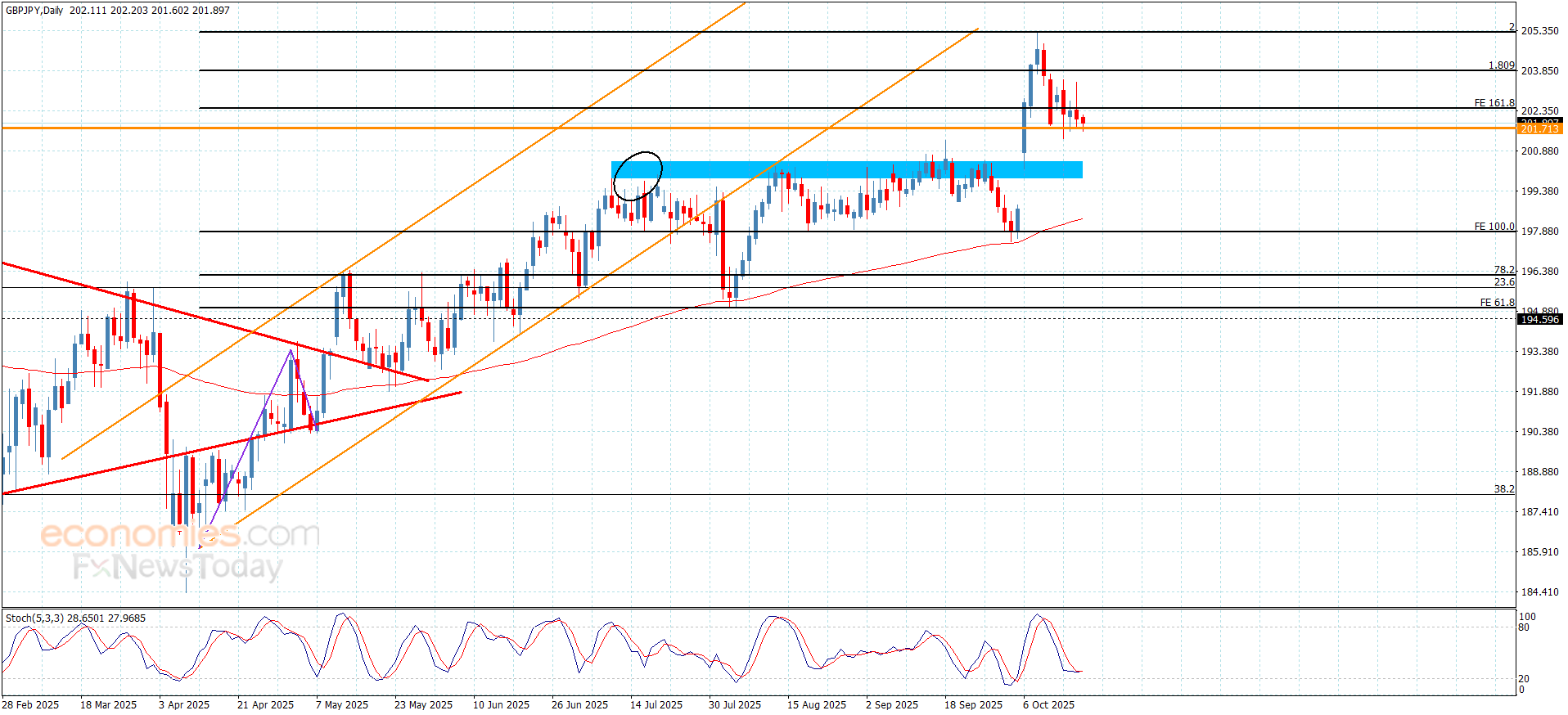
The GBPJPY pair still needs positive momentum until this moment, which forces it to form sideways fluctuated moves by its stability near 201.70 support level, which represents the key of detecting the expected trend in the near trading, as its stability makes us expect motivating the bullish trend, which might target 202.55 level reaching 203.85 barrier.
While breaking the current support and providing negative close below it will force it to activate the bearish correctional track, which forces it to suffer extra losses by reaching 201.10, reaching the next support at 200.45.
The expected trading range for today is between 201.70 and 203.00
Trend forecast: Bullish