The main category of Forex News.
You can use the search box below to find what you need.
[wd_asp id=1]
The main category of Forex News.
You can use the search box below to find what you need.
[wd_asp id=1]
The day’s high aligned precisely with the upper parallel trendline of a long-term rising channel, with the lower channel line connecting the September 2018 swing low and the upper parallel touching the July 2011 swing high. This alignment suggests the market recognizes the line as potential dynamic resistance. But what happens next will be key.
The Relative Strength Index (RSI) reflects overbought conditions, approaching extreme levels, which could preclude consolidation or retracement. Monday’s breakout above a near-term rising channel, following consolidation near its upper boundary, demonstrates robust momentum. Yesterday’s wide-range green candle and close near the high reinforce this bullish behavior, though such trend extensions carry the risk of a blow-off top.
Should the top channel line assert resistance, an initial sign of weakness would emerge on a decline below today’s low of $4,090. The 10-day moving average at $3,983 serves as key near-term support, consistently effective since its reclaim on August 22. This level warrants monitoring for signs of buyer defense on approach. A decisive break below $3,983 would target the 20-day average at $3,870, indicating a deeper pullback.
A confirmed breakout above $4,180 would position gold for higher targets, though the rising nature of the top channel line means prices could advance further while remaining near or below resistance. The overall structure supports continued upside potential until confirmed weakness appears. Today’s close will provide clarity on momentum sustainability, with the 10-day average as a critical benchmark for the trend’s health.
For a look at all of today’s economic events, check out our economic calendar.
– Written by
David Woodsmith
STORY LINK GBP/USD Forecast: Pound Sterling Falls as Traders Awaited Powell’s Speech
The Pound US Dollar exchange rate (GBP/USD) slumped on Tuesday, as the release of the UK’s latest labour market figures weighed on Sterling sentiment.
At the time of writing, GBP/USD was trading at approximately $1.3268, down roughly 0.5% from the start of Tuesday’s session.
The Pound (GBP) came under fresh pressure against most of its peers on Tuesday following the release of the UK’s latest labour market figures.
The Office for National Statistics (ONS) reported that unemployment in August rose unexpectedly from 4.7% to 4.8%, marking its highest level since 2021.
Meanwhile, regular wage growth also underperformed, slipping to 4.7% from 4.8% in the same time period.
The weaker-than-expected data dented Sterling sentiment during Tuesday’s European session, fuelling speculation that the Bank of England (BoE) could still consider an interest rate cut this year.
The US Dollar (USD) held steady for the majority of Tuesday’s European session, managing to regain some ground against several of its peers.
Get better rates and lower fees on your next international money transfer.
Compare TorFX with top UK banks in seconds and see how much you could save.
Despite renewed trade tensions between the US and China, the ‘Greenback’ was supported by a slightly cautious market mood and its traditional safe-haven appeal.
Investors, however, remained hesitant to take aggressive positions on USD ahead of a scheduled speech from Federal Reserve Chair Jerome Powell later in the day.
Should Powell adopt a hawkish tone, USD exchange rates could rise during the latter part of Tuesday’s European trading session.
Looking ahead to Wednesday’s European session, the GBP/USD exchange rate is likely to be influenced by a series of central bank speeches, with both the Bank of England and the Federal Reserve in focus amid a quiet UK and US data calendar.
In the UK, BoE officials Dave Ramsden and Sarah Breeden are scheduled to speak, and any remarks that challenge current expectations for interest rate cuts this year could lend Sterling some support.
Meanwhile, across the Atlantic, a number of Federal Reserve speeches are also expected to shape mid-week trading.

Hawkish commentary from Fed officials could bolster the US Dollar, while dovish signals may weigh on the ‘Greenback’, leaving USD exchange rates vulnerable.
As a result, GBP/USD could experience heightened volatility on Wednesday, responding primarily to central bank sentiment and market appetite for risk, in the absence of major economic releases.
International Money Transfer? Ask our resident FX expert a money transfer question or try John’s new, free, no-obligation personal service! ,where he helps every step of the way,
ensuring you get the best exchange rates on your currency requirements.
TAGS: Pound Dollar Forecasts
Spot Gold reached $4,179.76 a troy ounce on Tuesday, a fresh record high. The XAU/USD pair currently hovers in the 4,140 region, holding on to solid intraday gains amid risk aversion taking over financial boards. Concerns revolve around the United States (US), as on the one hand, the federal government remains shut down amid the lack of funding. On the other hand, fresh trade tensions between the US and China seem to have been interrupted, and threats of reciprocal levies resumed.
The US Dollar (USD) was able to advance throughout the first half of the day, but not versus the bright metal. It changed course after Wall Street’s opening, as US indexes trade in positive territory, shrugging off concerns and limiting Gold’s gains.
Meanwhile, Federal Reserve (Fed) Chairman Jerome Powell spoke about the economic outlook and monetary policy at the National Association for Business Economics (NABE) conference in Philadelphia, adding to the USD weakness in the American session.
Among other things, Powell noted that right now there is no risk-free path for monetary policy and that decisions will be driven by data and risk assessments. Additionally, he said that there is a risk that the slow pass-through of tariffs starts to look like persistent inflation, and that the labour market has demonstrated significant downside risk.
The XAU/USD pair is extremely overbought in the daily chart, but still bullish. Technical indicators maintain their strong upward slopes within overbought levels, without signs of exhaustion. At the same time, the pair advances far beyond bullish moving averages, which reflect the ongoing persistent demand. The 20 Simple Moving Average (SMA) currently stands at $3,863.90.
In the near term, and according to the 4-hour chart, XAU/USD has scope to extend its advance. The pair met intraday buyers in the $4,090 area, while developing above all bullish moving averages. At the same time, the Momentum indicator resumed its advance after correcting extreme readings, while the Relative Strength Index (RSI) indicator currently consolidates around 66, also supporting the bullish case.
Support levels: 4,123.20 4,090.00 4,078.10
Resistance levels: 4,155.30 4,180.00 4,200.00
The EURJPY pair continued providing temporary trading, affected by the stability of the barrier at 177.05 to reach 175.95 again, to announce delaying the bullish attack in the current period.
Stochastic reach below 50 level might force the price to provide more of the corrective trading, to test the extra support at 175.20 to confirm monitoring the price behavior, as monitoring the price behavior is important due to the importance of the support by detecting the expected targets in the near and medium period trading.
The expected trading range for today is between 175.20 and 176.50
Trend forecast: Fluctuated within the bullish track
The copper market is approaching a critical juncture as prices hover near record territory in October 2025. Currently trading around $10,900 per ton, copper has demonstrated remarkable resilience despite global economic uncertainties, gaining over 15% year-over-year. This comprehensive analysis examines whether copper will break through to new all-time highs in the coming months, potentially reaching the $12,000 per ton threshold that leading industry experts are forecasting.
Copper’s impressive performance comes amid a complex interplay of supply constraints and growing demand from the energy transition sector. The metal has surged toward all-time highs primarily due to widespread supply disruptions, with prices recently coming within $600 of breaking the record high of approximately $11,100 per ton set earlier in 2025.
Market volatility has increased in recent weeks, particularly after President Trump announced potential additional 100% tariff impacts on copper in early October. Despite this temporary cooling effect, copper prices have maintained their elevated position, reflecting the market’s focus on fundamental supply tightness rather than short-term policy fluctuations.
The copper market has experienced significant supply-side challenges throughout 2025. A wave of accidents and operational issues at major mines in Chile, the Democratic Republic of Congo (DRC), and Indonesia has severely constrained global output at critical moments.
These disruptions have prevented the market from building anticipated inventories, effectively offsetting what analysts had previously forecasted as a potential surplus year. The persistence of these operational challenges suggests that supply constraints may continue to provide price support through early 2026.
In Chile, which accounts for approximately 28% of global copper supply forecast, labor disputes and technical difficulties at several major operations have reduced output expectations. Similar issues in the DRC and Indonesia have compounded the global supply shortfall, with mining companies struggling to meet production targets despite high price incentives.
Leading industry figures have presented decidedly optimistic outlooks for copper prices through the end of 2025 and into 2026.
Kenny Ives, chief commercial officer at Chinese copper and cobalt producer CMOC Group and CEO of its trading arm IXM, projects copper prices potentially reaching $11,000-$12,000 per ton before the end of 2025. During the London Metal Exchange (LME) Week summit in October 2025, Ives described himself as “nice and bullish” on copper’s prospects.
This positive sentiment carries particular weight as Ives, once a contender for the top position at Glencore Plc, rarely offers public market views. His optimistic stance signals confidence despite recent price volatility stemming from escalating U.S.-China trade tensions.
Nick Snowdon, head of metals research at Mercuria Energy Group and a well-known copper bull, has echoed this positive stance. Speaking at the same industry event, Snowdon suggested prices could “quite easily” reach $12,000 per ton, representing a potential 10% increase from current levels.
Financial institutions present a somewhat more measured outlook, though forecasts have been trending higher throughout 2025:
BMI (Fitch Solutions): Recently raised its 2025 average copper price forecast to $9,650 per ton, up from its previous estimate of $9,500, citing resilient demand and persistent supply disruptions
Trading Economics: Projects copper prices to reach approximately $11,900 per ton by late 2026
Investment Banks: Several major banks maintain price targets in the $9,000-$10,000 range for 2025-2026, with bull case scenarios extending to $15,000 if supply constraints persist and energy transition demand accelerates
The disparity between bullish industry insiders and more conservative bank analysts highlights the uncertainty surrounding both supply recovery timelines and the pace of demand growth.
The consensus among analysts points to sustained strength in copper prices through 2026, with most forecasts placing the metal in the $10,000-$12,000 per ton range. The potential for new record highs remains contingent on several factors:
Notably, even the more conservative copper price insights represent historically strong levels for copper, suggesting widespread agreement that structural support for prices will persist.
Despite projections of increased global copper output at the beginning of 2025, actual production has consistently underperformed expectations throughout the year. Several factors contribute to this underperformance:
CMOC Group, which operates two copper-cobalt mines in the DRC, has firsthand experience with the operational challenges facing producers. The fact that Kenny Ives maintains a bullish outlook despite CMOC’s exposure to disrupted regions suggests the company views supply constraints as likely to persist.
While mine supply has faced constraints, refined copper production capacity has expanded, particularly in China. New smelters and refineries have increased global processing capabilities, though their utilization depends on concentrate availability.
This dynamic creates periods where refined copper markets can quickly shift between surplus and deficit conditions based on concentrate flow disruptions. Treatment charges, which miners pay smelters to process their concentrate, have fluctuated significantly throughout 2025, reflecting this tension between processing capacity and mine output.
Copper inventories on major exchanges have fluctuated significantly throughout 2025. Low visible inventory levels have periodically triggered price spikes, while strategic releases from China’s State Reserve Bureau have occasionally tempered rallies.
This inventory management aspect adds another layer of complexity to price forecasting, as government policy decisions regarding strategic reserves can temporarily offset physical market tightness. However, with exchange inventories generally remaining below historical averages, the market remains vulnerable to supply shocks.
China remains the dominant force in global copper consumption, accounting for over 50% of worldwide demand. The country’s manufacturing sector, particularly in electronics and electrical equipment, continues to drive substantial copper usage despite economic headwinds.
Chinese copper consumption patterns provide critical signals for global price direction. While overall economic growth has moderated, copper-intensive sectors have shown resilience, particularly those aligned with strategic priorities like renewable energy and electric transportation.
China’s ongoing infrastructure development programs, including renewable energy projects and grid modernization, create significant copper demand. Policy shifts toward greater infrastructure spending have historically correlated with copper price rallies.
Recent government announcements regarding infrastructure investment have supported copper prices despite concerns about the broader Chinese economy. These targeted spending programs often prioritize electricity transmission, renewable energy, and transportation—all copper-intensive sectors.
The troubled Chinese property sector has been a counterbalancing force to otherwise strong copper demand. Housing construction activities, a major source of copper consumption, have remained subdued in 2025.
Any policy-driven revival in this sector could significantly boost copper demand and prices. Analysts closely monitor policy announcements related to property market support, as these could signal additional copper demand not currently factored into price forecasts.
Chinese copper import premiums—the additional amount buyers are willing to pay above exchange prices—serve as a key indicator of real demand. These premiums have shown strength in late 2025, suggesting robust physical market conditions despite macroeconomic concerns.
The persistence of high import premiums indicates that Chinese consumers are actively securing physical metal, potentially in anticipation of future supply constraints or price increases. This behavior supports the bullish case for copper price forecast through 2026.
The accelerating production of electric vehicles represents a structural shift in copper demand. Each electric vehicle requires substantially more copper than conventional vehicles:
This intensity differential means that even modest EV market share gains translate into significant additional copper demand. With major automotive manufacturers accelerating their electrification timelines, this demand growth appears increasingly structural rather than cyclical.
Wind and solar power installations continue to drive copper demand growth:
Global renewable capacity additions have consistently exceeded forecasts in recent years, creating additional copper demand beyond what was projected in earlier market analyses. This trend appears likely to continue as renewable energy economics improve and policy support strengthens.
The global push to upgrade aging electrical grids and expand capacity to accommodate renewable energy sources creates additional copper demand. Smart grid technologies, energy storage systems, and charging infrastructure all require significant copper inputs.
In mature economies, grid infrastructure replacement and upgrades represent a major source of copper demand. Meanwhile, in developing economies, the expansion of basic electricity access creates new copper consumption that may persist for decades.
The global shift to electrifying copper demand is set to underpin rising copper prices—triggering forecasts of looming shortages later this decade. This structural demand growth occurs independently of typical economic cycles, potentially changing copper’s traditional role as a purely cyclical commodity.
Escalating trade disputes, particularly between the United States and China, pose risks to copper prices. Recent threats by President Trump of additional 100% tariffs on Chinese goods have temporarily dampened price momentum, highlighting the market’s sensitivity to trade policy developments.
Trade friction can impact copper through multiple channels:
The market’s reaction to the October 2025 tariff threat demonstrates that geopolitical developments can create short-term price volatility, even amid tight supply fundamentals.
Producer countries are increasingly seeking greater control and benefits from their mineral resources. This trend manifests in higher taxation, stricter environmental regulations, and requirements for local processing—all factors that can constrain supply and support prices.
Recent policy changes in Latin American copper-producing countries have created additional uncertainty about future supply growth. These measures range from increased royalties to more stringent permitting requirements, potentially extending development timelines and raising production costs.
Political instability in key copper-producing regions creates periodic supply concerns:
These regional risks tend to be priced into the market inconsistently, creating potential opportunities for traders who closely monitor political and operational developments in key producing regions.
Technical analysts identify several key price levels that could influence copper’s trajectory:
The metal’s repeated approaches toward record territory in 2025 have established a clear resistance zone that many traders believe will eventually be broken if fundamental supply constraints persist.
Speculative positioning in copper futures provides insights into market sentiment. Recent data shows hedge funds and other financial investors maintaining substantial long positions, reflecting confidence in copper’s upward potential despite short-term volatility.
The current positioning suggests that many financial participants share the bullish outlook expressed by industry veterans like Ives and Snowdon. However, this positioning also creates risk of short-term liquidation should economic data disappoint or supply conditions unexpectedly improve.
Copper’s traditional correlation with equity markets and risk assets has evolved in 2025, with the metal occasionally demonstrating independent strength during broader market downturns. This changing correlation pattern reflects copper’s dual role as both an economic barometer and a critical energy transition metal.
The partial decoupling from traditional correlations suggests growing recognition of copper’s structural demand story, potentially providing support during economic slowdowns that would historically have pressured prices more significantly.
Industry forecasts for the copper market balance show divergent views:
These divergent forecasts reflect the uncertainty surrounding both production recovery timelines and the pace of demand growth. The actual balance outcome will significantly influence price direction in early 2026.
Looking toward 2026 and beyond, structural supply challenges become more pronounced:
This combination of factors has led many industry observers to predict a sustained period of market deficits beginning in 2026 or 2027, providing fundamental support for elevated price levels.
Copper inventory cycles typically influence price movements. The projected path suggests:
Historical analysis suggests that sustained price rallies often coincide with inventory drawdowns, while periods of inventory rebuilding can temporarily pressure prices even in structurally tight markets.
Several factors could pressure copper prices below current forecasts:
A severe global recession would likely trigger at least a temporary price correction, though energy transition demand might provide a higher floor than in previous economic downturns.
Conversely, several developments could drive prices toward or beyond record levels:
The combination of persistent supply constraints and accelerated energy transition spending could create conditions for a significant price rally, potentially pushing copper well beyond the $12,000 per ton level suggested by industry veterans.
For investors considering exposure to copper:
The optimal approach depends on investor risk tolerance, time horizon, and views on both copper price direction and broader market conditions.
The copper industry faces long-term challenges in replacing depleted reserves:
These structural challenges suggest that even if copper prices incentivize new exploration and development, the supply response may be both slower and smaller than in previous price cycles.
Technological advancements are helping address some supply challenges:
While these innovations can incrementally improve existing operations, they are unlikely to fully offset the challenges of declining grades and increasingly complex ore bodies without significantly higher prices.
Secondary copper production from recycled sources is gaining prominence:
Recycling will likely play an increasingly important role in the copper market, but technical constraints and the long lifecycle of many copper applications limit its ability to fully address potential primary supply shortfalls.
Many analysts believe copper has a strong chance of setting new price records by 2026, potentially exceeding $12,000 per ton if supply disruptions persist and energy transition demand accelerates. However, this outcome depends on global economic conditions remaining supportive and Chinese demand maintaining strength.
The bullish case is supported by ongoing supply disruptions and structural demand growth from energy transition applications. The bearish case centers on potential economic slowdowns and faster-than-expected supply recovery.
Price volatility creates both challenges and opportunities for mining investments. While higher average prices improve project economics, volatility complicates investment decisions and financing arrangements. Companies with low-cost operations and strong balance sheets are better positioned to weather price fluctuations.
Mining companies must evaluate projects against a range of potential price scenarios, with most now using conservative long-term price assumptions while recognizing the potential upside from structural demand growth.
Copper is essential to virtually all aspects of the energy transition, from renewable generation to electrified transportation and grid modernization. The International Energy Agency estimates that achieving net-zero emissions targets would require copper demand for clean energy technologies to more than double by 2040.
This growing role in the energy transition may fundamentally change copper’s market dynamics, with demand becoming less cyclical and more driven by policy and climate goals than traditional economic cycles.
Futures markets provide price discovery and risk management tools for the copper industry. While speculative activity can temporarily drive price movements, physical market fundamentals ultimately determine sustainable price levels. The relationship between futures and physical premiums offers insights into real supply-demand conditions.
Changes in futures market regulations, participant behavior, or exchange rules can influence short-term price discovery, but lasting price trends reflect underlying physical market conditions.
A global recession would likely pressure copper prices downward in the short term as industrial demand contracts. However, the magnitude of decline might be less severe than in previous downturns due to structural support from energy transition applications.
Government infrastructure stimulus programs often target copper-intensive sectors during economic recoveries, potentially creating a faster rebound than in previous cycles. The growing portion of demand tied to energy transition may also provide support during economic weakness.
Discovery Alert’s proprietary Discovery IQ model delivers instant notifications on significant ASX mineral discoveries, offering investors an immediate edge in markets like copper. Explore historic returns from major mineral discoveries on our dedicated discoveries page and position yourself ahead of the market.
The GBP/USD pair attracts heavy selling during the early part of the European session on Tuesday and drops to mid-1.3200s, or its lowest level since early August, in reaction to the disappointing UK labor market report. Data published by the Office for National Statistics (ONS) showed that the UK ILO Unemployment Rate edged up to 4.8% in the three months to August, compared to 4.7% recorded in the previous month and consensus estimates. Further details revealed that the number of people claiming jobless benefits rose 25.8K in September, against a revised fall of 2.0K in August.
Meanwhile, Average Earnings, including Bonus, increased by 5.0% during the quarter through August, beating expectations and the previous reading of 4.7%. That said, regular pay growth, excluding Bonus, eased to 4.7% during the reported period, down slightly from 4.8% previously and marking the weakest pace since March–May 2022. The data fuels speculations that the Bank of England (BoE) could continue cutting interest rates gradually and weighs heavily on the British Pound (GBP). This, along with renewed US Dollar (USD) buying, is seen exerting pressure on the GBP/USD pair. Read more…
GBP/USD is diving toward the two-month low of 1.3260 following the release of disappointing UK labor market figures. The unemployment rate unexpectedly rose to 4.8% in the three months to August, up from 4.7% in the previous quarter, while employment levels declined, adding pressure to the British pound.
The pair is nearing a medium-term ascending trendline, which may act as a support level. A potential rebound from this area could shift attention toward the 23.6% Fibonacci retracement level at 1.3370, followed by resistance at the mid-level of the Bollinger Band and the 50-day simple moving average (SMA) in the 1.3435–1.3475 zone. Read more…
Silver price (XAG/USD) maintains its position after retreating from a fresh record high of $53.77, currently trading around $52.40 per troy ounce during the European hours on Tuesday. Silver prices climbed as a historic short squeeze in London intensified a rally driven by soaring demand for safe-haven assets.
The price of the grey metal surged amid growing concerns over liquidity shortages in London, prompting some traders to secure cargo space on transatlantic flights for Silver bars, an unusually costly transport method typically reserved for Gold, in a bid to capitalize on higher prices in the London market, according to a Bloomberg report.
Meanwhile, Silver is trading at a significant premium in India compared to global prices, facing a surge in domestic demand from millions of investors. The premium has risen to as much as 10% above international rates, forcing physically backed exchange-traded funds to halt new subscriptions. Meanwhile, jewelers are struggling to keep up with strong festive demand ahead of Diwali.
The safe-haven demand for Silver surged amid renewed United States (US)-China trade tensions. The United States (US) and China decided to impose additional port fees on ocean shipping companies. The US is scheduled to start collecting fees on Tuesday.
China also started to collect the special taxes on US-owned, operated, built, or flagged vessels, but stated that Chinese-built ships would be exempted from the levies. However, China’s Commerce Ministry said in a statement on Tuesday that Beijing “hopes to resolve concerns through dialogue.”
Silver is a precious metal highly traded among investors. It has been historically used as a store of value and a medium of exchange. Although less popular than Gold, traders may turn to Silver to diversify their investment portfolio, for its intrinsic value or as a potential hedge during high-inflation periods. Investors can buy physical Silver, in coins or in bars, or trade it through vehicles such as Exchange Traded Funds, which track its price on international markets.
Silver prices can move due to a wide range of factors. Geopolitical instability or fears of a deep recession can make Silver price escalate due to its safe-haven status, although to a lesser extent than Gold’s. As a yieldless asset, Silver tends to rise with lower interest rates. Its moves also depend on how the US Dollar (USD) behaves as the asset is priced in dollars (XAG/USD). A strong Dollar tends to keep the price of Silver at bay, whereas a weaker Dollar is likely to propel prices up. Other factors such as investment demand, mining supply – Silver is much more abundant than Gold – and recycling rates can also affect prices.
Silver is widely used in industry, particularly in sectors such as electronics or solar energy, as it has one of the highest electric conductivity of all metals – more than Copper and Gold. A surge in demand can increase prices, while a decline tends to lower them. Dynamics in the US, Chinese and Indian economies can also contribute to price swings: for the US and particularly China, their big industrial sectors use Silver in various processes; in India, consumers’ demand for the precious metal for jewellery also plays a key role in setting prices.
Silver prices tend to follow Gold’s moves. When Gold prices rise, Silver typically follows suit, as their status as safe-haven assets is similar. The Gold/Silver ratio, which shows the number of ounces of Silver needed to equal the value of one ounce of Gold, may help to determine the relative valuation between both metals. Some investors may consider a high ratio as an indicator that Silver is undervalued, or Gold is overvalued. On the contrary, a low ratio might suggest that Gold is undervalued relative to Silver.
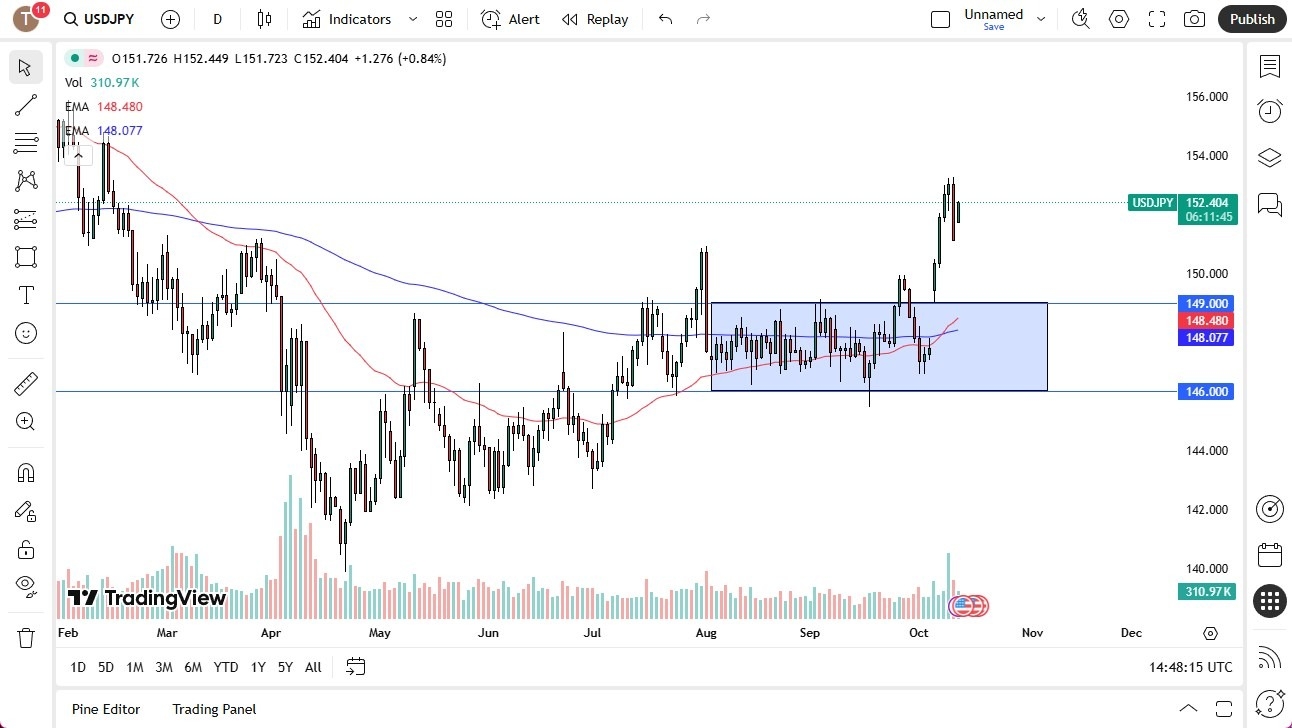
This is a market that I think continues to go much higher. But what I’m worried about is the massive stop loss you may have to take into account in order to protect against this gap getting filled because gaps typically get filled eventually. That being said, we have gapped basically 130. Well, we gapped to open up right around 70 pips and then we’re up about 130 at this point.
So, all things being equal, this is a market that I think remains by on the dips, but I was hoping to get a little bit more of a dip than we got on Friday, to be honest with you. Longer term, we go higher. I just don’t see how that changes. I’ve been saying that for a while from somewhere around here in July, I think, and I’ve been buying dips and collecting swap. The gap, of course, is a completely different animal that you have to deal with, but it’s still the same strategy. You just look for cheaper dollars if you get that opportunity.

Want to trade our USD/JPY forex analysis and predictions? Here’s a list of forex brokers in Japan to check out.
Christopher Lewis has been trading Forex and has over 20 years experience in financial markets. Chris has been a regular contributor to Daily Forex since the early days of the site. He writes about Forex for several online publications, including FX Empire, Investing.com, and his own site, aptly named The Trader Guy. Chris favours technical analysis methods to identify his trades and likes to trade equity indices and commodities as well as Forex. He favours a longer-term trading style, and his trades often last for days or weeks.
Occidental Petroleum Corporation (OXY) rose slightly in its latest intraday trading, attempting to recover part of its previous losses. However, the stock remains pressured after breaking a short-term corrective uptrend line earlier, while continuing to trade below the 50-day simple moving average, which reinforces the prevailing bearish momentum. In addition, the RSI shows ongoing negative signals despite reaching heavily oversold areas.
Therefore, we expect the stock to decline in upcoming trading sessions, especially if it breaks below the key support level of 42.35, targeting the next support at 40.15.
Today’s price forecast: Bearish.
Tuesday, October 14, 2025: Analysis of euro price against the dollar EUR/USD
EUR/USD Trading Signals:
Amid heightened interest from forex traders in the future of US Federal Reserve policies and the ongoing dispute between Trump and bank officials over pressure to continue cutting interest rates, the main focus during today’s trading session will be on the reaction to remarks from US Federal Reserve Chair Jerome Powell at 19:30 Egypt time. Prior to that, during the European session, the Euro’s price will be influenced by the release of the German ZEW Indicator, which measures confidence in the Eurozone’s largest economy, at 12:00 Egypt time.
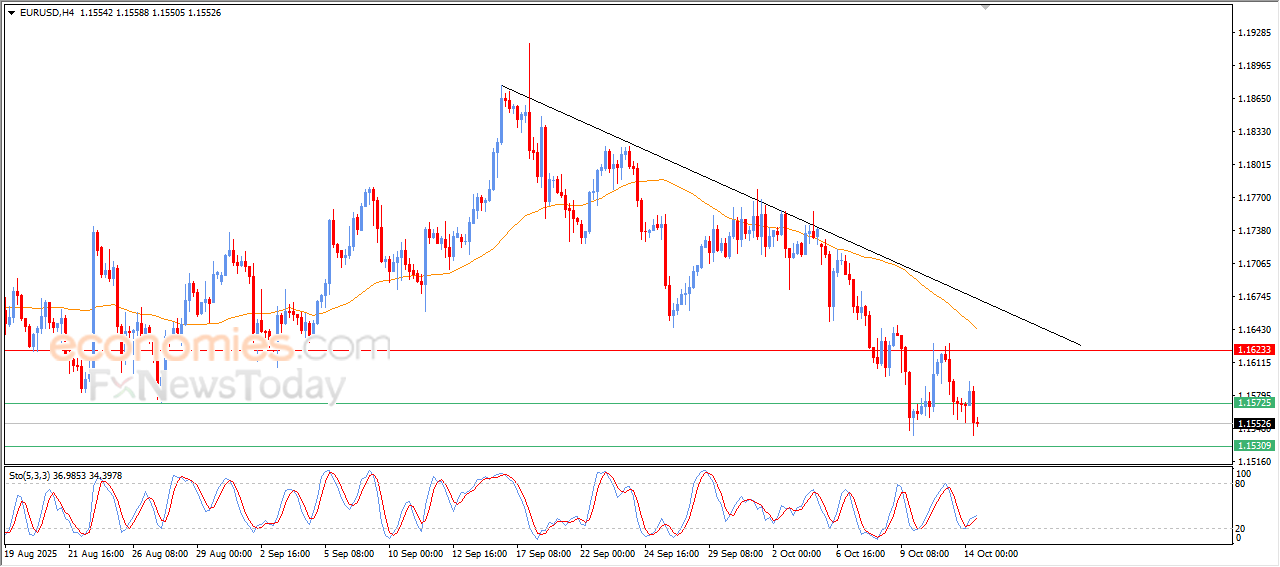
Previously, according to reliable trading platforms, the euro-dollar price is stabilizing around the 1.1555 support level, the lowest level for the currency pair in more than two months.
According to the insights of forex trading experts, the Euro is not benefiting from the renewed trade tensions between China and the United States. At the end of last week, the EUR/USD exchange rate rose on news that US President Donald Trump would respond to new Chinese export controls by imposing 100% tariffs on Chinese goods, set to take effect in November.
Consequently, the market responded by reviewing the 2025 trade rules and adhering to instructions to buy the euro as concerns about the US economy increased. Furthemore, the euro-dollar rose to resistance at 1.1630 following Trump’s unexpected move. Also, bulls hoped for continued price action at the start of the new week until the exchange rate’s technical outlook reversed from negative to positive in the near term.
Unfortunately for these bulls, the Euro was unable to capitalize on its sudden rise on Friday, putting it in a position that warns of further weakness in the coming days and weeks.
Over the weekend, both the United States and China indicated a willingness for dialogue, suggesting some back-channel communications are underway. We see these recent developments as strengthening both sides’ positions ahead of the expected meeting between Trump and Xi at the Asia-Pacific Economic Cooperation (APEC) forum in South Korea, held from October 27 to November 1. If the market agrees, stocks and the US dollar could recover from Friday’s weakness, which would keep the Euro under pressure in the near term.
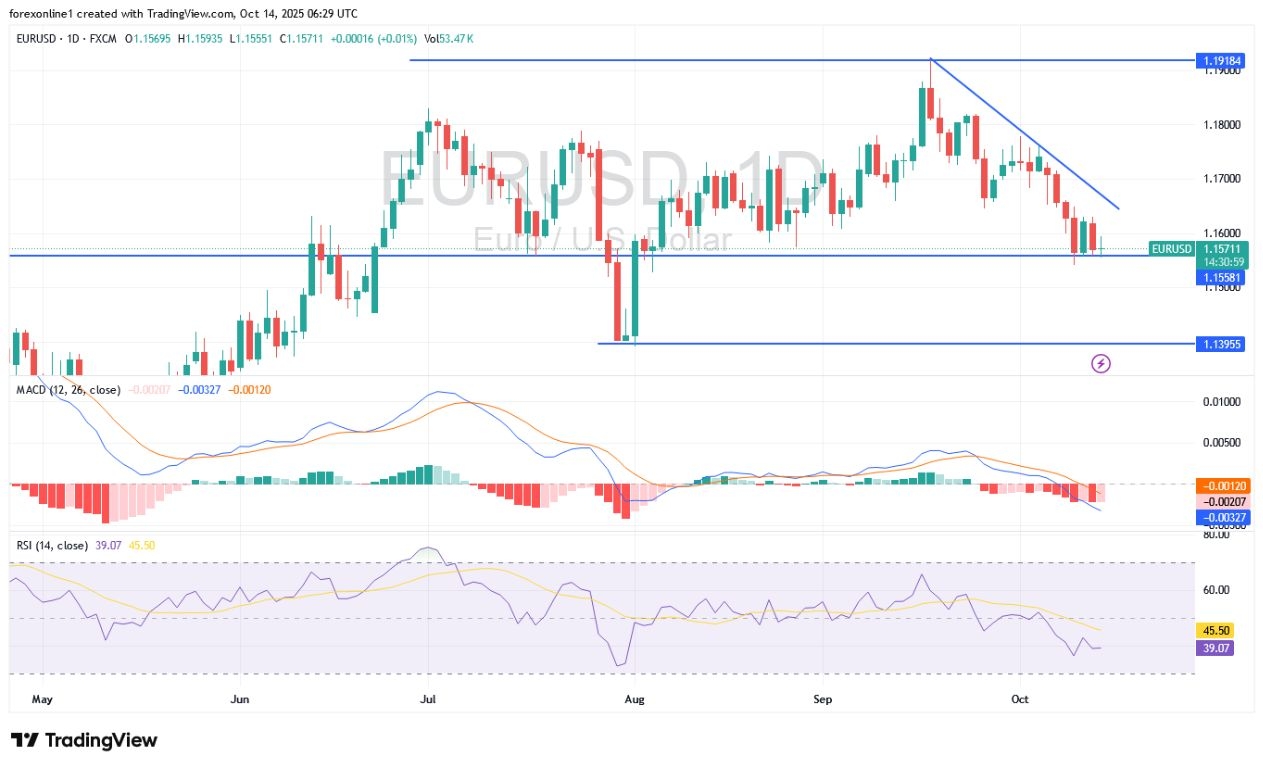
Technically, the daily chart of the EUR/USD pair shows that the current level in the spot market is below the nine-day exponential moving average (EMA), which is consistent with a near-term downtrend. Our base case is that the EUR/USD pair may see some stability in the coming days, benefiting from Friday’s decline and increased attention on trade-related headlines. However, when the pair returns to its current trajectory, we will look for further declines, as this is consistent with its pre-stabilization trajectory. Therefore, a return to 1.1550, and then lower, is likely over the next two weeks. Technically, the single currency is at risk of a further decline to the 1.14 support level.
Dear TradersUp trader, the EUR/USD price will remain in its bearish range until technical indicators reach strong oversold levels or a sudden technical correction occurs amid a change in the current factors affecting the EUR/USD decline.
Away from trade headlines, we finally have an opportunity to look at some real US economic data, something that has been absent from the forex market since the partial US government shutdown began earlier this month. The US Department of Labor has reportedly recalled some of its staff to prepare for the release of the September Consumer Price Index (CPI) report, scheduled for October 15. In this context, US inflation is expected to rise by 0.4% month-on-month, with the annual rate increasing to 3.1% from 1.9%. Any reading below this rate will lead to a weaker US dollar, as it would push markets to increase their expectations of a rate cut by the Federal Reserve.
Ultimitaly, the market expects more US interest rate cuts in the coming months, but its conviction is wavering as the economy continues to perform with strong confidence, reducing the demand for rate cuts.
Ready to trade our daily Forex forecast? Here’s a list of some of the best regulated forex brokers to check out.