The main category of Forex News.
You can use the search box below to find what you need.
[wd_asp id=1]
The main category of Forex News.
You can use the search box below to find what you need.
[wd_asp id=1]
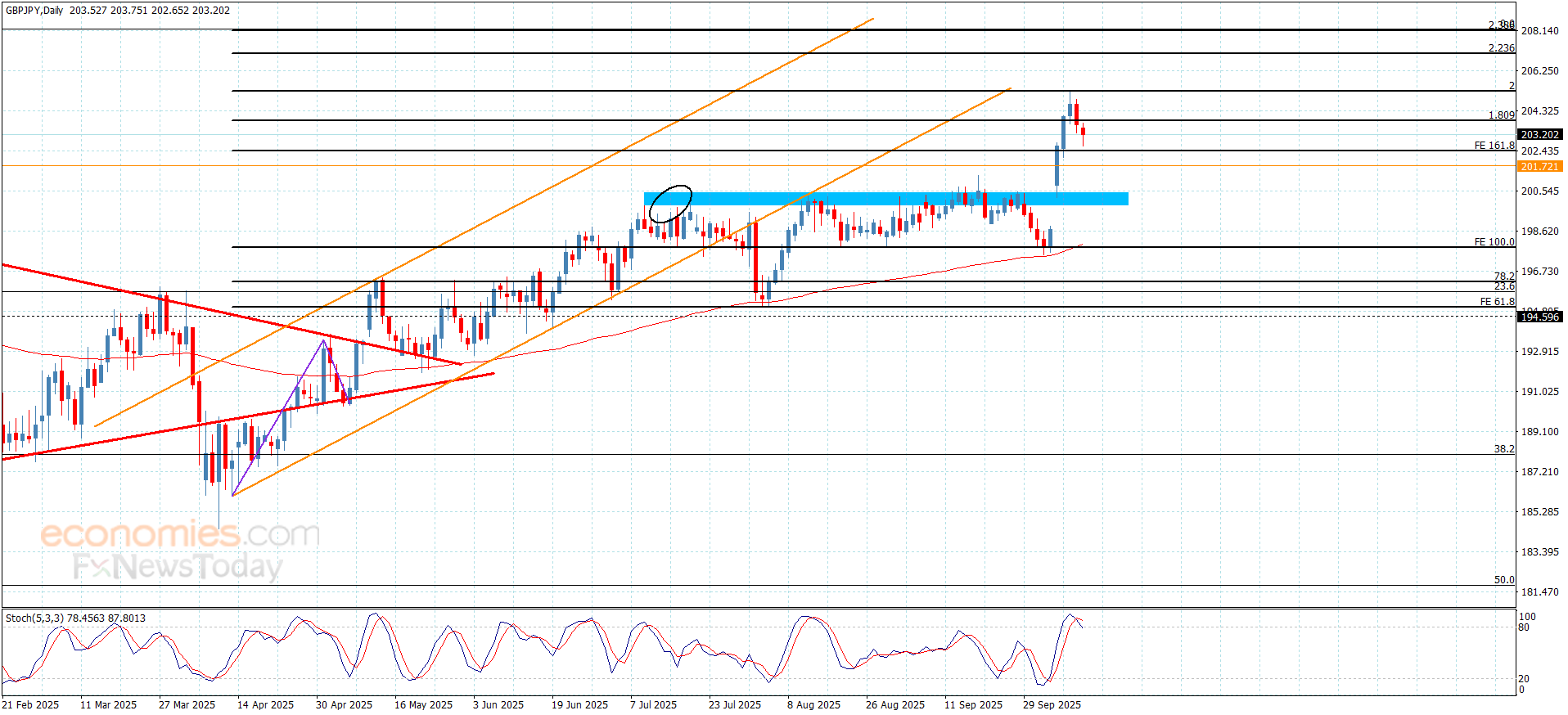
The GBPJPY pair confirmed its surrender to the bearish corrective trend by providing a new negative close below the barrier at 205.35 level, activating the suggested corrective attack, hitting 202.65 level to record the suggested targets in the previous report.
The continuation of the main indicators contradictions makes us expect the price affection by the sideways trend, to keep waiting for surpassing 203.85 level, to motive the bullish track by targeting 204.55 and 205.20.
The expected trading range for today is between 202.75 and 203.85
Trend forecast: Bullish
West Texas Intermediate (WTI) Oil price falls on Friday, early in the European session. WTI trades at $60.99 per barrel, down from Thursday’s close at $61.16.
Brent Oil Exchange Rate (Brent crude) is also shedding ground, trading at $64.82 after its previous daily close at $64.99.
WTI Oil is a type of Crude Oil sold on international markets. The WTI stands for West Texas Intermediate, one of three major types including Brent and Dubai Crude. WTI is also referred to as “light” and “sweet” because of its relatively low gravity and sulfur content respectively. It is considered a high quality Oil that is easily refined. It is sourced in the United States and distributed via the Cushing hub, which is considered “The Pipeline Crossroads of the World”. It is a benchmark for the Oil market and WTI price is frequently quoted in the media.
Like all assets, supply and demand are the key drivers of WTI Oil price. As such, global growth can be a driver of increased demand and vice versa for weak global growth. Political instability, wars, and sanctions can disrupt supply and impact prices. The decisions of OPEC, a group of major Oil-producing countries, is another key driver of price. The value of the US Dollar influences the price of WTI Crude Oil, since Oil is predominantly traded in US Dollars, thus a weaker US Dollar can make Oil more affordable and vice versa.
The weekly Oil inventory reports published by the American Petroleum Institute (API) and the Energy Information Agency (EIA) impact the price of WTI Oil. Changes in inventories reflect fluctuating supply and demand. If the data shows a drop in inventories it can indicate increased demand, pushing up Oil price. Higher inventories can reflect increased supply, pushing down prices. API’s report is published every Tuesday and EIA’s the day after. Their results are usually similar, falling within 1% of each other 75% of the time. The EIA data is considered more reliable, since it is a government agency.
OPEC (Organization of the Petroleum Exporting Countries) is a group of 12 Oil-producing nations who collectively decide production quotas for member countries at twice-yearly meetings. Their decisions often impact WTI Oil prices. When OPEC decides to lower quotas, it can tighten supply, pushing up Oil prices. When OPEC increases production, it has the opposite effect. OPEC+ refers to an expanded group that includes ten extra non-OPEC members, the most notable of which is Russia.
– Written by
Tim Boyer
STORY LINK Pound Sterling to Dollar Forecast: Fiscal Jitters Keep GBP/USD Under Pressure
The Pound to Dollar (GBP/USD) exchange rate fell to two-week lows under 1.3350 on Thursday before edging back to 1.3385. Dollar strength and fiscal caution in both London and Washington continue to limit Sterling’s recovery prospects.
The dollar held firm as confidence in UK fundamentals stayed fragile, with traders wary of rising debt-servicing costs and the late-November budget.
Key GBP/USD support remains at 1.3325, with a sustained break exposing 1.3150.
UoB commented; “As long as GBP holds below the ‘strong resistance’ at 1.3465, the downside bias toward 1.3325 remains intact.”
Bank of England policymaker Catherine Mann struck a hawkish tone, warning that inflation expectations remain inconsistent with target levels.
She said; “High inflation itself is behind scarring, income uncertainty, and weak consumption growth. Therefore, monetary policy needs to continue to focus on reducing inflation to achieve the environment of price stability.”
Get better rates and lower fees on your next international money transfer.
Compare TorFX with top UK banks in seconds and see how much you could save.
Despite Mann’s remarks, the Pound struggled to benefit amid persistent fiscal concerns.
Commerzbank cautioned; “Stability is also too important for the foreign exchange market to ignore disputes within Western governments over fiscal policy. This is likely to occupy us in the coming months.”
It added; “The fact that the options market is becoming increasingly nervous about the upcoming budget of the British government illustrates this impressively.”
The Federal Reserve’s September minutes had limited impact, revealing some internal splits, with a few members preferring to hold rates at 4.50%.
However, most officials still viewed further easing this year as appropriate.
MUFG noted; “Assuming the flow of economic data continues as we have seen, a rate cut on 29th October seems most likely and that prospect remains close to fully priced.”
It added; “That said, perhaps just one bad inflation print would be enough to see the FOMC change tack and quickly decide to hold off cutting. But the government shutdown means we may not get any top-tier jobs or inflation data before that meeting, so a rate cut would most likely still be delivered.”
International Money Transfer? Ask our resident FX expert a money transfer question or try John’s new, free, no-obligation personal service! ,where he helps every step of the way,
ensuring you get the best exchange rates on your currency requirements.
TAGS: Pound Dollar Forecasts
Gold price (XAU/USD) trades 0.4% higher to near $3,995.00 during the European trading session on Friday. The yellow metal stabilized after a corrective move on Thursday, which followed a fresh all-time high of nearly $4,060 posted on Wednesday.
Four-day winning streak in the precious metal halted after Israel and Hamas signed a ceasefire agreement to end the war in Gaza. According to the first phase of the ceasefire, the Israeli army has released hostages and Hamas has now 72 hours to release Israeli hostages, BBC News reported.
Theoretically, easing geopolitical tensions diminishes demand for safe-haven assets, such as Gold.
However, the outlook for the Gold price remains firm as comments from Federal Reserve officials have signaled that more interest rate cuts are highly likely in the remaining year.
On Thursday, New York Fed Bank President John Williams and San Francisco Federal Reserve Bank President Mary Daly call for more interest rate cuts this year, citing downside risks to the labour market. “We’re to a point now where the softening in the labor market looks like it could be more worrisome if we don’t risk manage it, Daly said, Reuters reported. On the current status of inflation, Daly stated that growth in price pressures has come “much less than had been feared”.
Lower interest rates by the Fed bode well for non-yielding assets, such as Gold.
Gold price retraces after posting a fresh all-time high near $4,060. However, the overall trend of the Gold price remains bullish as the 20-day Exponential Moving Average (EMA) slopes higher around $3,834.10. The upward-sloping trendline from the August 22 low around $3,321.50 will act as key support for the Gold price.
The 14-day Relative Strength Index (RSI) stays above 60.00 for a long period, suggesting a strong bullish momentum.
On the upside, the Gold price could extend its upside towards $4,100. Looking down, the October 2 high of around $3,900 would act as key support.
Gold has played a key role in human’s history as it has been widely used as a store of value and medium of exchange. Currently, apart from its shine and usage for jewelry, the precious metal is widely seen as a safe-haven asset, meaning that it is considered a good investment during turbulent times. Gold is also widely seen as a hedge against inflation and against depreciating currencies as it doesn’t rely on any specific issuer or government.
Central banks are the biggest Gold holders. In their aim to support their currencies in turbulent times, central banks tend to diversify their reserves and buy Gold to improve the perceived strength of the economy and the currency. High Gold reserves can be a source of trust for a country’s solvency. Central banks added 1,136 tonnes of Gold worth around $70 billion to their reserves in 2022, according to data from the World Gold Council. This is the highest yearly purchase since records began. Central banks from emerging economies such as China, India and Turkey are quickly increasing their Gold reserves.
Gold has an inverse correlation with the US Dollar and US Treasuries, which are both major reserve and safe-haven assets. When the Dollar depreciates, Gold tends to rise, enabling investors and central banks to diversify their assets in turbulent times. Gold is also inversely correlated with risk assets. A rally in the stock market tends to weaken Gold price, while sell-offs in riskier markets tend to favor the precious metal.
The price can move due to a wide range of factors. Geopolitical instability or fears of a deep recession can quickly make Gold price escalate due to its safe-haven status. As a yield-less asset, Gold tends to rise with lower interest rates, while higher cost of money usually weighs down on the yellow metal. Still, most moves depend on how the US Dollar (USD) behaves as the asset is priced in dollars (XAU/USD). A strong Dollar tends to keep the price of Gold controlled, whereas a weaker Dollar is likely to push Gold prices up.
From Trump to trade, FX to Brexit, ING’s global economists have it covered. Go to ING.com/THINK to stay a step ahead. We’re sorry we can’t reply to individuals’ comments.Content disclaimer: The information in the publication is not an investment recommendation and it is not investment, legal or tax advice or an offer or solicitation to purchase or sell any financial instrument.This publication has been prepared by ING solely for information purposes without regard to any particular user’s investment objectives, financial situation, or means. For our full disclaimer please click here.

The Netherlands-based banking group ING has published updated forecasts for the prices of Brent Crude oil and Dutch TTF natural gas through 2028.
Find the plan that suits you best.
Full digital access to all news for 1 month
Full digital access to all news for 3 months
-33%
Full digital access to all news for 6 months
-36%
Full digital access to all news for 1 year
-41%
Here we are to serve you with news right now. It does not cost much, but worth your attention.
Choose to support open, independent, quality journalism and subscribe on a monthly basis.
By subscribing to our online newspaper, you can have full digital access to all news, analysis, and much more.
Subscribe
You can also follow AzerNEWS on Twitter @AzerNewsAz or Facebook @AzerNewsNewspaper
Thank you!
EUR/USD lost more than 0.5% on Thursday and closed the fourth-consecutive day in negative territory. Although the pair edges higher in the European session on Friday, it shows no signs of a decisive recovery yet.
The table below shows the percentage change of Euro (EUR) against listed major currencies this week. Euro was the weakest against the US Dollar.
| USD | EUR | GBP | JPY | CAD | AUD | NZD | CHF | |
|---|---|---|---|---|---|---|---|---|
| USD | 1.27% | 1.09% | 2.17% | 0.44% | 0.48% | 1.12% | 1.13% | |
| EUR | -1.27% | -0.28% | 0.81% | -0.86% | -0.82% | -0.19% | -0.17% | |
| GBP | -1.09% | 0.28% | 1.20% | -0.57% | -0.54% | 0.10% | 0.11% | |
| JPY | -2.17% | -0.81% | -1.20% | -1.64% | -1.70% | -1.09% | -1.06% | |
| CAD | -0.44% | 0.86% | 0.57% | 1.64% | 0.08% | 0.68% | 0.69% | |
| AUD | -0.48% | 0.82% | 0.54% | 1.70% | -0.08% | 0.65% | 0.65% | |
| NZD | -1.12% | 0.19% | -0.10% | 1.09% | -0.68% | -0.65% | 0.00% | |
| CHF | -1.13% | 0.17% | -0.11% | 1.06% | -0.69% | -0.65% | -0.01% |
The heat map shows percentage changes of major currencies against each other. The base currency is picked from the left column, while the quote currency is picked from the top row. For example, if you pick the Euro from the left column and move along the horizontal line to the US Dollar, the percentage change displayed in the box will represent EUR (base)/USD (quote).
The persistent US Dollar (USD) strength forced EUR/USD to stay on the back foot on Thursday. Meanwhile, the Euro continues to have a difficult time attracting investors amid the ongoing political drama in France.
Nevertheless, European Central Bank (ECB) policymakers’ cautious comments on policy easing seems to be helping EUR/USD holds its ground. ECB policymaker Martins Kazaks said on Friday that it is appropriate for the key ECB rate to remain at 2%, while Governing Council member Jose Luis Escriva noted that inflation remains contained, adding negative risks to growth have not materialized.
In the second half of the day, the University of Michigan will publish the preliminary Consumer Sentiment Index data for October. In case there is a significant improvement in consumer confidence, the USD could gather strength heading into the weekend and weigh on the pair. Investors will also pay close attention to the 1-year Consumer Inflation Expectations component of the survey. A noticeable decline in this data could hurt the USD and help EUR/USD stretch higher.
The Relative Strength Index (RSI) indicator on the 4-hour chart remains below 40, suggesting that the latest recovery attempt is a technical correction, with the bearish bias staying unchanged. Moreover, EUR/USD trades well below the 100-day Simple Moving Average (SMA), after posting its first daily close below this level since February.
In case EUR/USD stays below 1.1580 (Fibonacci 61.8% retracement of the latest uptrend), technical sellers could remain interested. In this scenario, 1.1550 (static level) could be seen as an interim support level before 1.1500 (round level, Fibonacci 78.6% retracement). Looking north, resistance levels could be spotted at 1.1630-1.1640 (100-day SMA, Fibonacci 50% retracement) and 1.1700-1.1715 (Fibonacci 38.2% retracement, 200-period SMA).
The Euro is the currency for the 19 European Union countries that belong to the Eurozone. It is the second most heavily traded currency in the world behind the US Dollar. In 2022, it accounted for 31% of all foreign exchange transactions, with an average daily turnover of over $2.2 trillion a day.
EUR/USD is the most heavily traded currency pair in the world, accounting for an estimated 30% off all transactions, followed by EUR/JPY (4%), EUR/GBP (3%) and EUR/AUD (2%).
The European Central Bank (ECB) in Frankfurt, Germany, is the reserve bank for the Eurozone. The ECB sets interest rates and manages monetary policy.
The ECB’s primary mandate is to maintain price stability, which means either controlling inflation or stimulating growth. Its primary tool is the raising or lowering of interest rates. Relatively high interest rates – or the expectation of higher rates – will usually benefit the Euro and vice versa.
The ECB Governing Council makes monetary policy decisions at meetings held eight times a year. Decisions are made by heads of the Eurozone national banks and six permanent members, including the President of the ECB, Christine Lagarde.
Eurozone inflation data, measured by the Harmonized Index of Consumer Prices (HICP), is an important econometric for the Euro. If inflation rises more than expected, especially if above the ECB’s 2% target, it obliges the ECB to raise interest rates to bring it back under control.
Relatively high interest rates compared to its counterparts will usually benefit the Euro, as it makes the region more attractive as a place for global investors to park their money.
Data releases gauge the health of the economy and can impact on the Euro. Indicators such as GDP, Manufacturing and Services PMIs, employment, and consumer sentiment surveys can all influence the direction of the single currency.
A strong economy is good for the Euro. Not only does it attract more foreign investment but it may encourage the ECB to put up interest rates, which will directly strengthen the Euro. Otherwise, if economic data is weak, the Euro is likely to fall.
Economic data for the four largest economies in the euro area (Germany, France, Italy and Spain) are especially significant, as they account for 75% of the Eurozone’s economy.
Another significant data release for the Euro is the Trade Balance. This indicator measures the difference between what a country earns from its exports and what it spends on imports over a given period.
If a country produces highly sought after exports then its currency will gain in value purely from the extra demand created from foreign buyers seeking to purchase these goods. Therefore, a positive net Trade Balance strengthens a currency and vice versa for a negative balance.
The (ETHUSD) price rose in its last trading on the intraday basis, after its leaning on the support level of $4,275, gaining some bullish momentum that helped it to achieve these gains, this support was our suggested target in our previous analysis, to attempt to recover some of the previous losses, attempting to offload some of its clear oversold conditions on the relative strength indicators, especially with the emergence of the positive signals from there, amid the dominance of bearish corrective wave on the short-term basis, with the continuation of the negative pressure due to its trading below EMA50, which reduces the chances of the price recovery on the near-term basis.
Get high-accuracy trading signals delivered directly to your Telegram. Subscribe to specialized packages tailored for the world’s top markets:
Full VIP signals performance report for Sept 29 – Oct 3, 2025:
The (ETHUSD) price rose in its last trading on the intraday basis, after its leaning on the support level of $4,275, gaining some bullish momentum that helped it to achieve these gains, this support was our suggested target in our previous analysis, to attempt to recover some of the previous losses, attempting to offload some of its clear oversold conditions on the relative strength indicators, especially with the emergence of the positive signals from there, amid the dominance of bearish corrective wave on the short-term basis, with the continuation of the negative pressure due to its trading below EMA50, which reduces the chances of the price recovery on the near-term basis.
Get high-accuracy trading signals delivered directly to your Telegram. Subscribe to specialized packages tailored for the world’s top markets:
Full VIP signals performance report for Sept 29 – Oct 3, 2025:
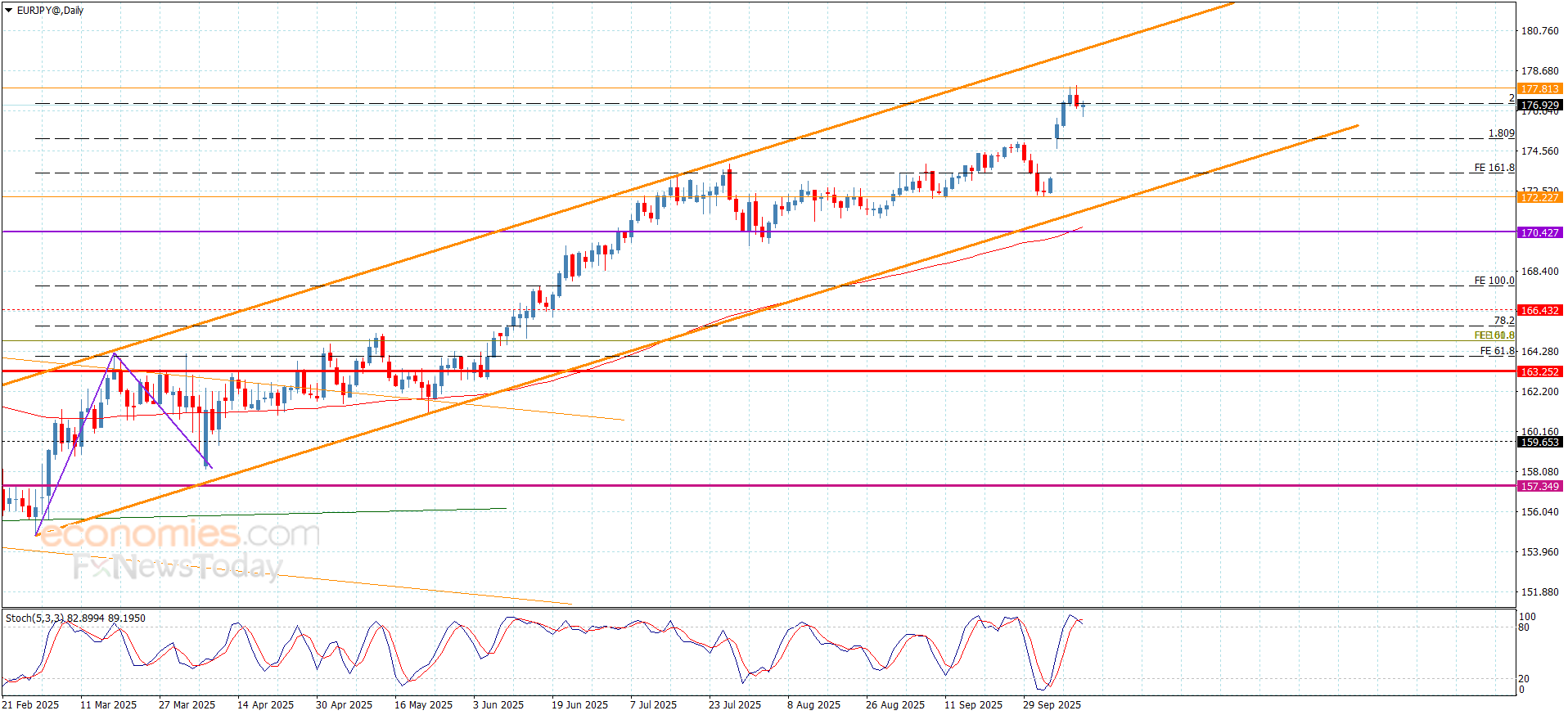
EUR/JPY loses ground for the second successive session, trading around 176.70 during the European hours on Friday. The technical analysis of the daily chart indicates that short-term price momentum is stronger as the currency cross remains above the nine-day Exponential Moving Average (EMA).
However, the 14-day Relative Strength Index (RSI) moves below the 70 mark, suggesting that bullish bias is weakening and the EUR/JPY cross is exiting overbought territory, signaling a price correction.
The EUR/JPY cross may find its primary support at the nine-day EMA of 175.84. A break below this level could weaken the short-term price momentum and lead the currency cross to test the 50-day EMA at 173.30, followed by the five-week low of 172.14, which was recorded on September 9.
On the upside, the EUR/JPY cross may target the new all-time high of 177.94, which was recorded on October 9. A break above this level would prompt the currency cross to test the upward trendline around 179.50. Further advances would strengthen the bullish bias and support the currency cross to explore the region around the psychological level of 180.00.
The table below shows the percentage change of Euro (EUR) against listed major currencies today. Euro was the strongest against the Australian Dollar.
| USD | EUR | GBP | JPY | CAD | AUD | NZD | CHF | |
|---|---|---|---|---|---|---|---|---|
| USD | -0.09% | 0.05% | -0.03% | 0.02% | 0.05% | 0.21% | -0.18% | |
| EUR | 0.09% | 0.17% | 0.00% | 0.10% | 0.18% | 0.06% | 0.00% | |
| GBP | -0.05% | -0.17% | -0.14% | -0.10% | 0.00% | 0.11% | -0.21% | |
| JPY | 0.03% | 0.00% | 0.14% | 0.16% | 0.16% | 0.25% | -0.04% | |
| CAD | -0.02% | -0.10% | 0.10% | -0.16% | -0.02% | 0.16% | -0.11% | |
| AUD | -0.05% | -0.18% | -0.00% | -0.16% | 0.02% | 0.13% | -0.22% | |
| NZD | -0.21% | -0.06% | -0.11% | -0.25% | -0.16% | -0.13% | -0.34% | |
| CHF | 0.18% | -0.00% | 0.21% | 0.04% | 0.11% | 0.22% | 0.34% |
The heat map shows percentage changes of major currencies against each other. The base currency is picked from the left column, while the quote currency is picked from the top row. For example, if you pick the Euro from the left column and move along the horizontal line to the US Dollar, the percentage change displayed in the box will represent EUR (base)/USD (quote).