The main category of Forex News.
You can use the search box below to find what you need.
[wd_asp id=1]
The main category of Forex News.
You can use the search box below to find what you need.
[wd_asp id=1]
West Texas Intermediate (WTI) Oil price falls on Thursday, early in the European session. WTI trades at $64.60 per barrel, down from Wednesday’s close at $64.68.
Brent Oil Exchange Rate (Brent crude) is also shedding ground, trading at $68.28 after its previous daily close at $68.37.
WTI Oil is a type of Crude Oil sold on international markets. The WTI stands for West Texas Intermediate, one of three major types including Brent and Dubai Crude. WTI is also referred to as “light” and “sweet” because of its relatively low gravity and sulfur content respectively. It is considered a high quality Oil that is easily refined. It is sourced in the United States and distributed via the Cushing hub, which is considered “The Pipeline Crossroads of the World”. It is a benchmark for the Oil market and WTI price is frequently quoted in the media.
Like all assets, supply and demand are the key drivers of WTI Oil price. As such, global growth can be a driver of increased demand and vice versa for weak global growth. Political instability, wars, and sanctions can disrupt supply and impact prices. The decisions of OPEC, a group of major Oil-producing countries, is another key driver of price. The value of the US Dollar influences the price of WTI Crude Oil, since Oil is predominantly traded in US Dollars, thus a weaker US Dollar can make Oil more affordable and vice versa.
The weekly Oil inventory reports published by the American Petroleum Institute (API) and the Energy Information Agency (EIA) impact the price of WTI Oil. Changes in inventories reflect fluctuating supply and demand. If the data shows a drop in inventories it can indicate increased demand, pushing up Oil price. Higher inventories can reflect increased supply, pushing down prices. API’s report is published every Tuesday and EIA’s the day after. Their results are usually similar, falling within 1% of each other 75% of the time. The EIA data is considered more reliable, since it is a government agency.
OPEC (Organization of the Petroleum Exporting Countries) is a group of 12 Oil-producing nations who collectively decide production quotas for member countries at twice-yearly meetings. Their decisions often impact WTI Oil prices. When OPEC decides to lower quotas, it can tighten supply, pushing up Oil prices. When OPEC increases production, it has the opposite effect. OPEC+ refers to an expanded group that includes ten extra non-OPEC members, the most notable of which is Russia.
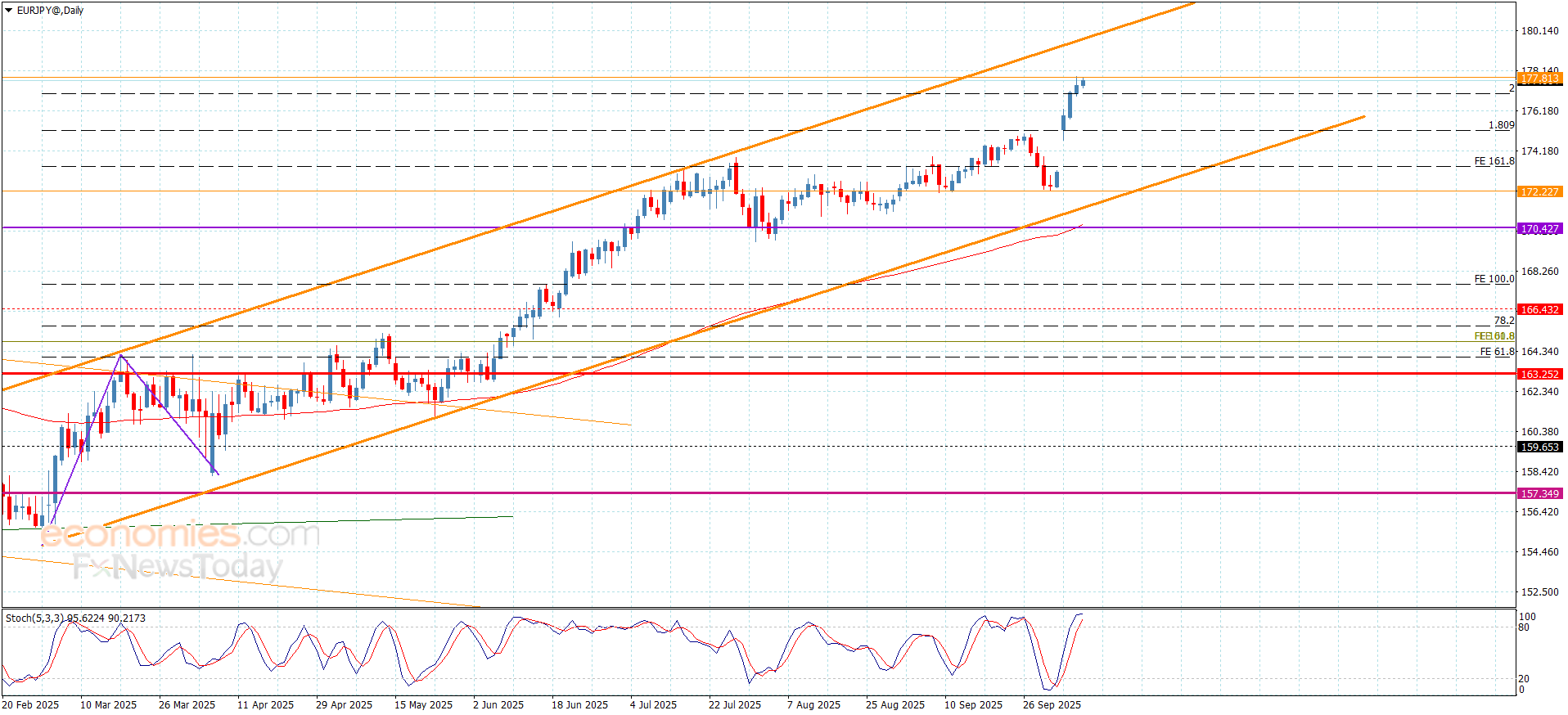
The EURJPY pair succeeded in resuming its bullish attempts yesterday, to hit the extra target at 177.80, to settle below it announces its confinement within tight track that is represented by the initial support at 176.95, and 177.80 level forms a key barrier against the bullish trading.
We remain neutral due to the instability of the price, until surpassing the previously- mentioned levels, to confirm the suggested targets in the near trading, the price success in breaching the barrier and holding above it will increase the chances for resuming the main bullish trend, attempting to reach 178.45 followed by the trading towards the bullish channel’s resistance at 179.60 level, while the decline below the extra support will support activating the attempts of gathering the gains, to reach 176.20 directly, then testing the next support near 175.20.
The expected trading range for today is between 176.90 and 177.80
Trend forecast: Neutral
With yields rising at the same time that the is falling, the Japanese economy is highly vulnerable to any additional setbacks, especially given the country’s extreme sovereign debt load.
If you were actively trading this time three years ago, this current environment may feel eerily familiar.
Back in September 2022, the UK selected Liz Truss as its next Prime Minister. At the time, the was in a clear downtrend while UK sovereign yields were on the rise. A few weeks later, Truss’s Finance Minister, Kwasi Kwarteng, introduced a “mini-budget” focused on fiscal stimulus (large-scale borrowing and tax cuts) for the economy, and the market soundly rejected the budget, driving long-term to multi-decade highs and the pound to multi-decade lows against most major rival currencies:
Source: StoneX, TradingView
Liz Truss ultimately dismissed Kwarteng a few weeks later and then resigned, making her the shortest-serving UK Prime Minister in UK history.
It’s cliché to say that “history doesn’t repeat, but it does rhyme,” but there are some eerie parallels with Sanae Takaichi’s nascent tenure as Japan’s Prime Minister. Last weekend, Takaichi was selected as the leader of the ruling LDP party, making her the Prime Minister apparent.
Takaichi is seen as a protégé of Shinzo Abe, who advocated heavily for fiscal and monetary stimulus to support the moribund Japanese economy. Like the pound three years ago, the yen has been in a clear downtrend for months, and have been rising consistently for years: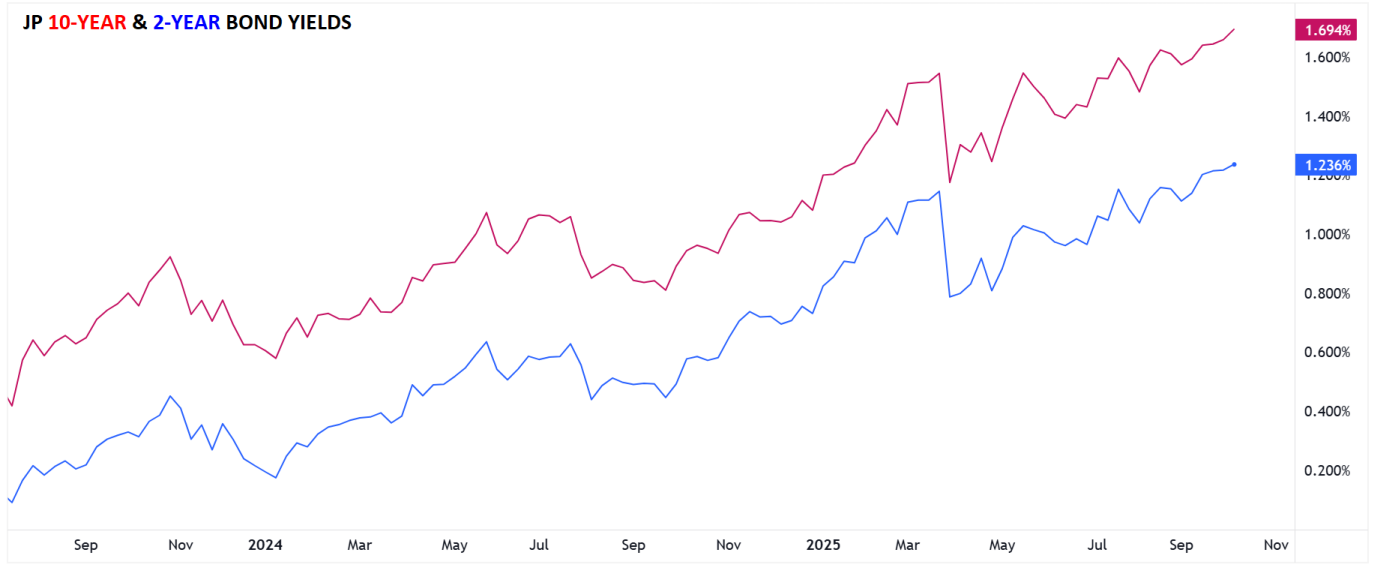
Source: StoneX, TradingView
Much like Truss at the outset of her tenure, Takaichi’s leadership has encountered early turbulence, as Komeito, the LDP’s coalition partner, hesitated to endorse her, sparking doubts about her grip on power. While we have yet to see a catalyst akin to Kwarteng’s mini-budget fiasco, the yen is hitting multi-decade lows against the euro and pound, while longer-term sovereign yields are surging.
With yields rising at the same time that the yen is falling, the Japanese economy is highly vulnerable to any additional setbacks, especially given the country’s extreme sovereign debt load: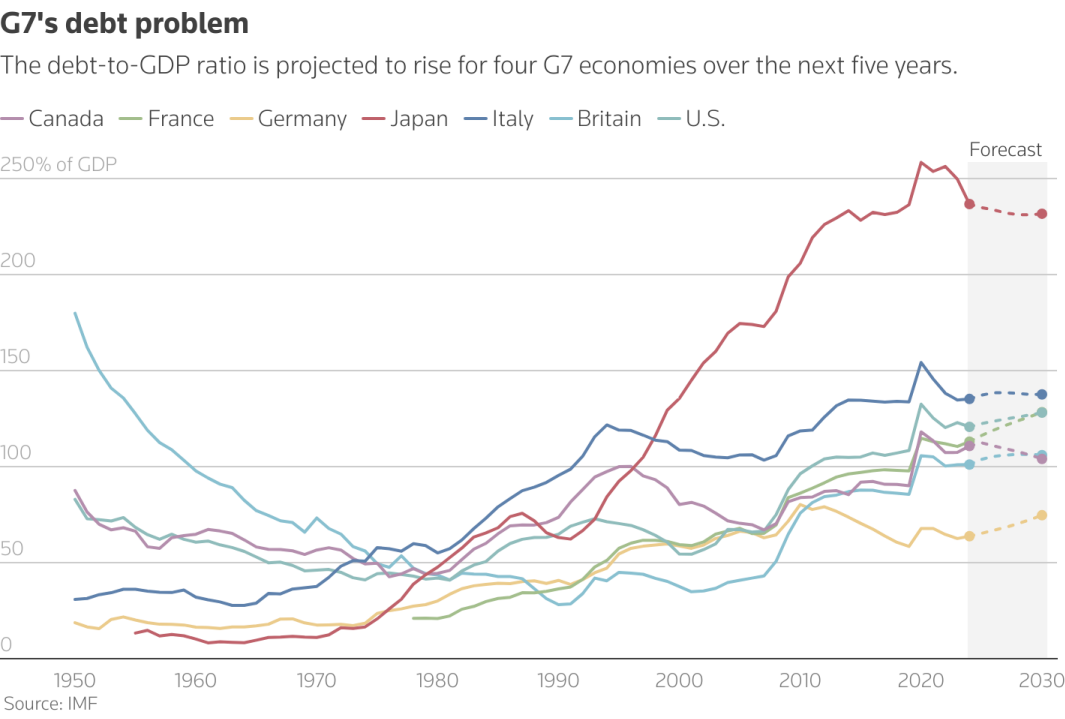
Source: IMF
Source: StoneX, TradingView
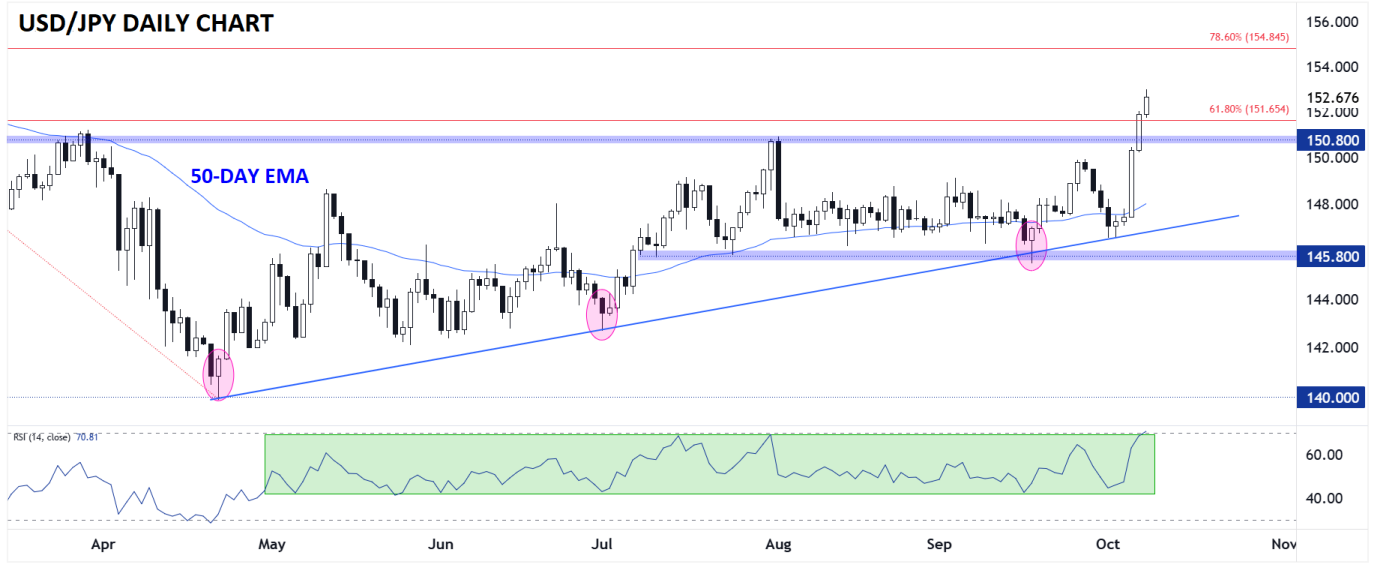
Looking at the chart above, USD/JPY is in the midst of a huge three-day, post-election surge, rising more than 500 pips from Friday’s close to today’s high. More to the point for technically-inclined traders, the rally has taken the pair through previous resistance at 150.80 and the 61.8% Fibonacci retracement of the H1 drop at 151.65. From here, there’s little in the way of technical resistance until 155.00 (the 78.6% Fibonacci retracement) and then the 159.00 zone beyond that.
While the short-term price momentum remains strong, the pair is now peeking into “overbought” territory on the 14-day RSI, hinting at the potential for a near-term pullback if we get any kind of positive political news out of Japan. That said, traders would likely look to buy any short-term dips as long as the breakout above 150.80 (and the longer-term fiscal issue) remains intact.
Gold has managed to defend the key $4,000 level on its retracement from lifetime highs of $4,059 reached on Wednesday. All eyes now turn to a slew of speeches from US Federal Reserve (Fed) officials, including Chairman Jerome Powell, due later in the day.
Gold price sustains its pullback alongside the US Dollar (USD) as the Israel-Hamas peace deal lifts risk sentiment and curbs their demand as safe-havens.
Citing US President Donald Trump, BBC News reported early Thursday that Israel and Hamas have both signed off on the first phase of peace plan.
A senior White House official said the latest truce agreement aimed at the release of hostages will be presented to the Israeli cabinet on Thursday.
Meanwhile, markets are also seeing fresh signs of hope that the US government shutdown could partially reopen. This optimism somewhat dents Gold’s appeal as a traditional store of value.
“US Senate Majority Leader John Thune is considering bringing full-year appropriations bills — such as one to fund the Pentagon and pay the military — to the floor for a vote,” he told Axios on Wednesday. Thune is looking at options for a piecemeal government reopening.
However, for now, nothing seems official and confirmed, and hence, the heightened economic uncertainty continues to put a floor on any Gold price pullbacks.
Gold also keeps drawing support from the French and Japanese political crisis, and on hopes of an expansionary fiscal era returning globally.
Increased bets that the Fed will deliver two interest rate cuts this year allow Gold to keep the downside cushioned.
Even though the Minutes of the Fed’s September monetary policy meeting showed prudence and division amongst the policymakers, markets continue to fully price in a cut at the October meeting, with the odds of another reduction in December are seen at about 80%, the CME Group’s FedWatch Tool shows.
Amid a data-sparse US docket, attention remains on the Fedspeak, with Powell set to deliver opening remarks in a pre-recorded video at the Community Bank Conference hosted by the Federal Reserve Board, in Washington DC.
Any hints by Powell on the Fed’s path forward on interest rates amid looming shutdown could fuel a significant reaction in the USD-denominated Gold price.
The four-hour chart shows that the 14-day Relative Strength Index (RSI) has pulled back from the extreme overbought zone to re-entered into the bullish territory, currently near 66.
The leading indicator indicates that a fresh upswing remains on the cards in the session ahead, with a retest of the all-time high of $4,059 likely. A sustained break above that will call for a test of the $4,100.
On the contrary, if the corrective downside regains momentum, Gold could test the initial support of the 21-Simple Moving Average (SMA) at $3,979, below which the 50-SMA at $3,906 could come to buyers’ rescue.
Further south, the $3,850 psychological level could act as a tough nut to crack for sellers.
Jerome H. Powell took office as a member of the Board of Governors of the Federal Reserve System on May 25, 2012, to fill an unexpired term. On November 2, 2017, President Donald Trump nominated Powell to serve as the next Chairman of the Federal Reserve. Powell assumed office as Chair on February 5, 2018.
Next release:
Thu Oct 09, 2025 12:30
Frequency:
Irregular
Consensus:
–
Previous:
–
Source:
Federal Reserve
Quebrada Blanca mine in Chile is Teck’s largest copper project. (Image courtesy of Teck Resources.)
Copper surged to a 16-month high in London Wednesday when Teck Resources (TSX: TECK.A, TECK.B)(NYSE: TECK) lowered its copper production guidance for 2025 after persistent setbacks at its Quebrada Blanca (QB) mine in Chile and Highland Valley Copper (HVC) operation in Canada.
Prices climbed as much as 0.5% to $10,815 per tonne on the London Metal Exchange. The company said it now expects to produce 170,000 to 190,000 tons in 2025, down from its previous target of 210,000 to 230,000 tons. Teck also trimmed annual production targets for the next three years.
The QB project has long frustrated investors, coming in $4 billion over budget and years behind schedule. Current challenges include tailings storage at the high-altitude site in the Andes, as well as damage to key equipment and instability within the mine pit.
So far this year, copper prices have risen about 23%, as mounting supply concerns outweigh weak demand in major industrial economies. Analysts have cut output projections after a series of accidents and operational setbacks at mines in Chile, the Democratic Republic of Congo, and Indonesia, leading many to anticipate sizable supply deficits.
Supply worries intensified after Freeport-McMoRan (NYSE: FCX) declared force majeure at its Grasberg mine in Papua, Indonesia—the world’s second-largest copper operation—following severe flooding that halted production. The company confirmed over the weekend that all seven missing workers were found dead after the discovery of five additional bodies.
“We are in a world of unprecedented copper supply disruptions, and many of these issues are not short-term,” analysts at Jefferies wrote in a note. “Yet another miss at QB just adds more fuel to the fire.”
Citigroup analysts expect copper to climb further, forecasting prices could reach $12,000 per tonne in the first half of next year amid supply cuts and favorable macro trends, including a weaker US dollar. They project prices will gradually ease through 2026 as disrupted mines resume production.
Click on chart for live prices.
On the Chicago Mercantile Exchange, three-month copper futures rose 1.15% to $11,343 per tonne ($5.156 per pound).
(With files from Bloomberg)
– Written by
David Woodsmith
STORY LINK Pound to Dollar Forecast: GBP/USD Slips as BoE’s Pill Calls for Cautious Approach
The Pound to Dollar exchange rate (GBP/USD) traded mostly flat on Wednesday ahead of the release of the Federal Reserve’s September FOMC meeting minutes.
At the time of writing, GBP/USD was trading at approximately $1.3423, virtually unchanged from the start of Wednesday’s session.
The US Dollar (USD) strengthened against most of its major counterparts on Wednesday, extending its gains as investors sought safe-haven assets amid ongoing geopolitical tensions in Europe and Japan.
The prevailing risk-off sentiment continued to underpin demand for the ‘Greenback’, keeping USD exchange rates on the front foot through the first half of the session.
However, later in the day, the Dollar could face headwinds with the release of the Federal Reserve’s latest FOMC meeting minutes.
If the minutes strike a dovish tone or hint at a greater willingness to cut interest rates, this could prompt a pullback in USD, potentially halting the currency’s recent winning streak.
The Pound (GBP) held its ground against most major peers on Wednesday, showing resilience despite a lack of UK economic data and a broadly risk-off market mood.
Get better rates and lower fees on your next international money transfer.
Compare TorFX with top UK banks in seconds and see how much you could save.
Sterling was offered mild support later in the session after comments from Bank of England (BoE) Chief Economist Huw Pill.
Speaking at the University of Birmingham, Pill said policymakers should take a “conservative” approach to setting interest rates and stand ready to act firmly if inflation risks rise.
He reiterated that the Bank must remain focused on price stability, while acknowledging the high level of uncertainty facing the economy.
Looking ahead to Thursday’s European session, the Pound US Dollar (GBP/USD) exchange rate is likely to remain at the mercy of broader market sentiment amid a continued lack of key economic data.
With the US government still in shutdown, the release of the latest initial jobless claims report will be delayed, leaving investors without fresh US data to guide trading.
In the absence of new catalysts, the ‘Greenback’ is expected to react primarily to shifts in risk appetite.

Should a cautious, risk-off tone persist across markets, the safe-haven US Dollar could stay in demand, extending its recent strength.
As for the Pound, the UK calendar also remains bare, likely leaving Sterling directionless once again.
GBP exchange rates may therefore fluctuate in response to prevailing risk trends and external developments, with the currency likely to struggle to find a firm footing through Thursday’s session.
International Money Transfer? Ask our resident FX expert a money transfer question or try John’s new, free, no-obligation personal service! ,where he helps every step of the way,
ensuring you get the best exchange rates on your currency requirements.
TAGS: Pound Dollar Forecasts
Technical indicators confirm gold’s extended condition. The relative strength index (RSI) remains in overbought territory, while the slope of the bull trend has steepened notably. This upper dashed line represents the outer boundary of the advance projected from the March base. Though further upside cannot be ruled out, a brief correction would be healthy, allowing the trend to reset before a potential continuation. Without some form of pullback, the odds of a fast, sharp decline increase if momentum falters suddenly.
Initial support lies at the 10-Day moving average, currently near $3,879. A drop below today’s low would hint at the first test of that line. Should it hold, buyers could quickly regain control and drive another leg higher. Deeper support sits at the 20-Day moving average around $3,783, which may come into play if selling accelerates. Given the rapid ascent of recent weeks, a move toward the 20-Day average would not be unexpected and could help stabilize the trend.
For now, no clear weakness has emerged. A rally above today’s $4,059 high would reaffirm the dominant uptrend and continue the pattern of higher highs and higher lows. Given the enthusiasm of recent sessions, a sharp upward burst toward a potential blow-off top remains possible.
The upper estimate on the chart aligns with a measured move projection from the December swing low. Traders should remain alert, however, as any bearish follow-through from current levels could shift attention to lower targets and mark the beginning of a cooling phase.
For a look at all of today’s economic events, check out our economic calendar.
The lower high recorded today raises the potential for a double top bearish reversal if prices decline below Monday’s $3.30 low. Such a move would likely trigger additional selling pressure, especially as it coincides with a breakdown beneath the 10-Day average and tests of dynamic support along a long-term rising trendline. While the 10-Day average provides a short-term directional cue, a decisive close below the uptrend line would carry greater significance, confirming a shift in control toward sellers.
Should natural gas fall beneath the uptrend line, the broader bearish structure – defined by a descending trend channel – could reassert dominance. That scenario opens the door to retests of the recent swing lows and key moving averages. The 20-Day average, currently near $3.13, offers interim support, followed by the 50-Day at $3.02. Importantly, an anchored volume-weighted average price (AVWAP) from a major prior pivot aligns near $2.97, reinforcing the significance of that support zone.
Despite today’s weakness, buyers still have an opportunity to reclaim control. A move above the recent swing high at $3.59 would confirm a resumption of the short-term uptrend and reestablish momentum above the 200-Day average, now near $3.49. Such strength would invalidate the developing double top and signal that bullish forces remain intact. Until then, the market remains vulnerable to deeper retracements, with traders watching whether support near the 10-Day line and trendline can hold in the days ahead.
For a look at all of today’s economic events, check out our economic calendar.
– Written by
Ben Hughes
STORY LINK Euro to Dollar Forecast: USD Benefits from Undermined Confidence in EUR and JPY
The Euro to Dollar exchange rate (EUR/USD) slid to its weakest level in six weeks as French political uncertainty, poor German data, and a resurgent dollar combined to leave investors braced for further volatility.
The US Dollar has continued to make headway in global markets with support from Euro and yen selling.
The Euro to Dollar (EUR/USD) exchange rate dipped sharply to 6-week lows at 1.1610 and struggled to recover amid negative sentiment. French developments will be a key element on Wednesday.
UoB commented; “The decline is oversold, but with no sign of stabilisation just yet.”
According to ING; “based on our view that the dollar will face downside risks with today’s Fed minutes and the USD rally looking a bit overdone in general, we think EUR/USD back at 1.170 is more likely than a test of 1.150 in the coming days.”
The yen has remained under pressure following the weekend election while French political fears have continued to unsettle the Euro.
Get better rates and lower fees on your next international money transfer.
Compare TorFX with top UK banks in seconds and see how much you could save.
MUFG commented; “The US dollar has benefitted this week from political developments outside of the US which have undermined confidence in the euro and yen in the near-term and overshadowed the more negligible negative impact on the US dollar from the ongoing US government shutdown.”
The latest German data recorded a 4.3% slide in industrial production for August compared with market expectations of a 1.0% decline.
ING commented; “Extremely disappointing industrial data in August has just increased the risk of yet another quarter of contraction for the German economy.”
MUFG added; “the weakness will add to concerns over the disruptive impact from higher tariffs.”
French political developments will continue to be watched closely with Prime Minister Lecornu facing a deadline today to find a solution to the political impasse and budget deadlock.
MUFG commented; “Lecornu’s last-ditch efforts to reach a political agreement by today’s deadline appear likely to fail. President Macron’s close ally and his first Prime Minister Edouard Philippe has even suggested that he should take a more radical step of offering to resign before the end of his term in 2027 on the condition of a budget being adopted.”
The US data flow is continuing to be disrupted by the US government shutdown
Minutes from the September Federal Reserve policy meeting will, however, be released on Wednesday.
At that meeting, interest rates were cut by 25 basis points with Miran dissenting and calling for a 50 basis-point cut.
Markets are still pricing over just over an 80% chance of two further Fed rate cuts by the end of 2025.
There are, however, also doubts whether further rate cuts are appropriate given overall financial conditions which will create further uncertainty.
Macquarie Group global forex and rates strategist Thierry Wizman commented; “With stock indexes near all-time highs, gold prices rallying higher, and corporate bond credit spreads very tight, the case for monetary policy being overly restrictive still looks rather flimsy.”
International Money Transfer? Ask our resident FX expert a money transfer question or try John’s new, free, no-obligation personal service! ,where he helps every step of the way,
ensuring you get the best exchange rates on your currency requirements.
TAGS: Euro Dollar Forecasts
A looming oversupply of crude oil is going to cause prices to take a dive as the world moves on to alternatives to hydrocarbons and economic growth remains weak. This has been the message from virtually every price forecaster for months. Yet benchmark oil prices have remained remarkably stable. Some call it a mystery. Yet there is nothing mysterious about it. Forecasts do not reflect real-life supply and demand.
“There is a bit of a mystery,” Vikas Dwivedi, global energy strategist at Macquarie, told the Financial Times this month. “The whole marketplace is looking for enormous surpluses and yet the price isn’t buckling. Instead of $67 a barrel, why are we not looking at $47 a barrel?”
There are two likely reasons why we are not looking at $47 a barrel. One of these reasons is the EU’s and the United States’ continued efforts to decimate Russia’s energy export income via additional sanctions. Since Russia is the second-largest oil producer in the world, right before Saudi Arabia, disruption in its oil flows will affect the global balance of supply and demand—and analysts know it. So do forecasters. However, they are downplaying such geopolitical risks in favor of the argument that the electrification of transport and weak economic growth in many key markets are undermining oil demand. Supply, meanwhile, is growing, according to the forecasters, and apparently this supply growth is completely disconnected from prices—which it obviously is not.
Related: Turkey Silent After Tripartite Deal That Could Get Kurdish Flowing This Week
The second reason why prices are not down all the way to $47 a barrel is China. Millions of words have been spent on media reports suggesting China‘s oil demand is close to peaking, and afterwards it will drop off a cliff. China, meanwhile, has been stocking up on crude, even with weakening demand growth, which is a fact, after over two decades of leaps and bounds. Indeed, Reuters’ Clyde Russell noted in a recent column that China’s crude oil imports have been on the rise since March this year, even if some of the crude goes into storage rather than refineries. Indeed, per Russell, “from March onwards China has been importing crude at a far higher rate than it needs to meet its domestic fuel requirements.”
This has, in turn, been keeping international oil prices stable and higher than many would like to see them, including President Donald Trump, who had cheap gas on his agenda when he took office. On the other hand, Trump strongly believes that hurting Russia’s oil export revenues would speed up the end of hostilities in Ukraine. That, however, would push prices higher, which may be why he has been in no rush to impose additional sanctions on Russia’s energy industry—unlike the EU, which just did, facing an even higher energy bill as it voluntarily gives up Russian oil.
There is also the aspect of perceived versus actual demand and consumption of oil. Oxford Energy addressed this aspect of the oil market in a recent report, dispelling rumors of an impending glut by citing storage numbers that show no sign of oversupply. Floating storage, for instance, is below the levels reached in 2022, when everyone rushed to prepare for the anti-Russian sanctions. OECD stocks, often used as a reference point for forecasts, are below the five-year average, meaning consumption is quite healthy. One final indicator of stronger-than-expected demand comes again from China, in the form of lower fuel exports, cited by Oxford Economics.
Yet this context remains largely ignored in favor of what basically amounts to a fixation on EV sales projections and GDP forecasts, plus references to OPEC+’s decision to unwind output curbs installed in 2022.
“Yes, there will be downward pressure on prices, I just don’t buy into the narrative that we’re going to see $40 oil,” Sen said. “As long as the Chinese bid is there and Opec+ spare capacity is constrained, the downside is going to be protected.” In addition to these, there is also the producer response to prices that are sub-optimal for most producers. It is inevitable and, indeed, U.S. producers are already responding by slackening the pace of production growth this year.
While forecasters forecast, oil prices remain stable, despite claims that oil market volatility has increased over the past couple of years amid a surge in the use of so-called shadow fleet tankers to transport Russian crude, creating what Reuters’ Ron Bousso called “blind spots” on the market that make it increasingly difficult for traders to glean the facts about supply-demand balance. They will remain stable for the observable future as well, as geopolitical factors continue to push them higher, while forecasts of a glut curb the upside, regardless of whether there are signs of such a glut about to materialize.
Such materialization is becoming less likely by the day, it seems. According to one of the glut-prediction forecasters, Maquarie, “The problem is, a bear market needs the element of surprise, and this has no surprise in it.”
By Irina Slav for Oilprice.com
More Top Reads From Oilprice.com