The main category of Forex News.
You can use the search box below to find what you need.
[wd_asp id=1]
The main category of Forex News.
You can use the search box below to find what you need.
[wd_asp id=1]
The US dollar initially jumped against the yen on Friday, but it is worth noting that the markets are still paying you to hold this pair to the long side.
The US dollar initially did rally a bit during the trading session here on Friday, but we have given some of that back. It isn’t a huge surprise, nor do I think it really matters because, quite frankly, Friday is essentially a throwaway day as most traders won’t even be bothered trading until Monday at the earliest.

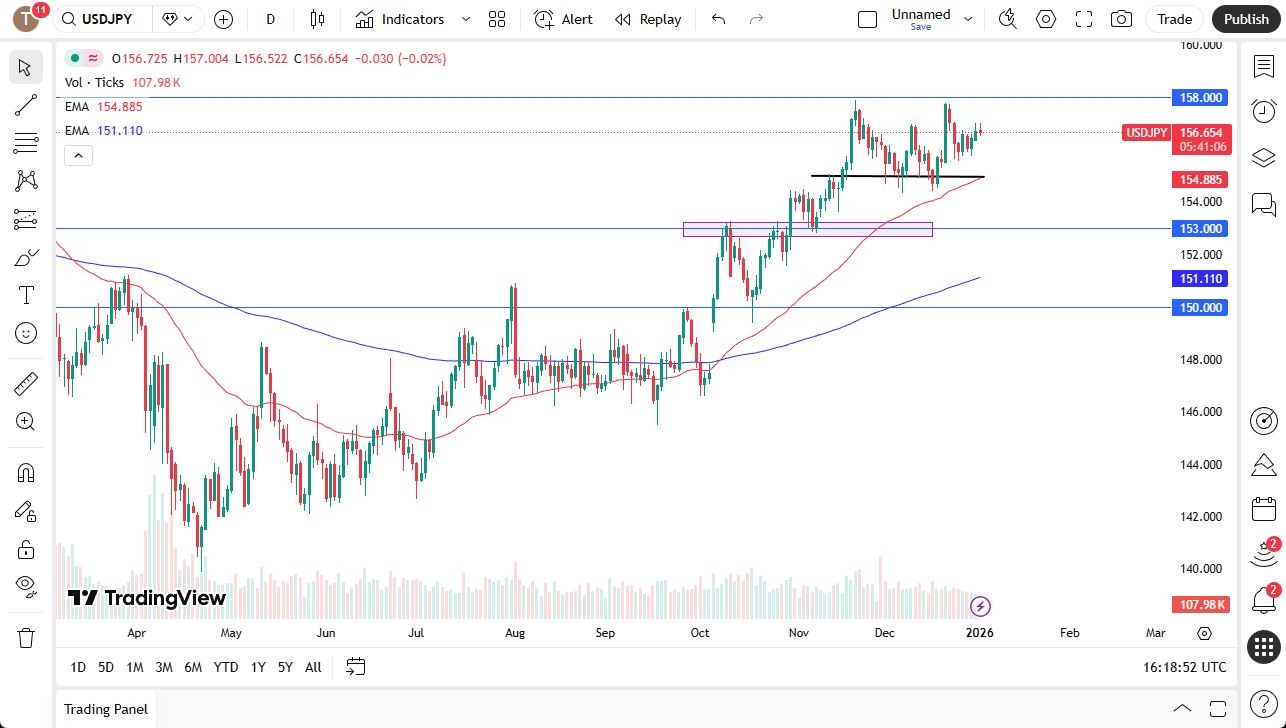
That being said, we are in the middle of consolidation, so the fact that we went up early and then turned around later in the same session really doesn’t surprise me. This is a market that continues to see the 158 yen level above offer resistance while 155 yen starts the floor. We have the 50-day EMA sitting right there as well, but I think the floor is a little thick here and therefore short-term dips almost certainly offer opportunities.
If we can break above 158 yen, and I do expect that to happen eventually, we go looking to the 160 yen level. On a breakdown below the 50-day EMA, then the 153 yen level could be targeted for support.
I do expect to see a lot of choppy and erratic behavior, but over the longer term, this is a market that I think continues to be bullish mainly due to the fact that the Bank of Japan cannot tighten monetary policy seriously, and you will continue to get paid to hold onto this pair to the long side at the end of every session.
Granted, that interest rate differential might shrink a bit, and it takes away some of the momentum, but as things stand right now, I don’t see any reason to get short, at least not unless there’s some type of external shock that really throws a monkey wrench into risk appetite.
Want to trade our USD/JPY forex analysis and predictions? Here’s a list of forex brokers in Japan to check out.
Copper price kept the positive stability above $5.5100 support in the last trading, to rally towards the initial target at $5.8100, taking advantage of stochastic stability within the overbought level.
The continuation of the pressure on $5.8100 level might allow it find an exit for resuming the bullish attack, to expect breaching $5.9700 to extend the trading towards the bullish channel’s resistance at $6.1700 level.
The expected trading range for today is between $5.6100 and $5.9700
Trend forecast: Bullish
The EUR/USD pair ended the week in the red last week as many investors remained in a holiday mood. It was trading at 1.1720, down slightly from last year’s high of 1.1910 ahead of key events this week.
The EUR/USD exchange rate will likely be volatile this week as investors react to the upcoming US Non-Farm Payrolls (NFP) data, which are scheduled on Friday.
The report is expected to show that the American economy added over 55k jobs in December after adding 64k in the previous month. Most notably, the report is expected to show that manufacturing jobs continued falling, mostly because of Donald Trump’s tariffs.
Economists expect the upcoming report to show that the unemployment rate dropped to 4.5% in December from the previous 4.6%. The unemployment rate has jumped in the past few months because of Donald Trump’s policy to purge thousands of government workers.
The upcoming jobs report comes a week after the Federal Reserve published minutes of the last monetary policy meeting. These minutes showed that most officials hinted that they were supportive of interest rate cuts if the country’s inflation continues falling.
The EUR/USD pair will also react mildly to the weekend events in which Donald Trump invaded Venezuela, took its leader, and charged him in a New York court. While Venezuela has vast oil resources, the amount of oil it ships to other countries is relatively lower than other countries.
The other major catalysts for the EUR/USD pair will be the upcoming macro data from Europe and the United States. For example, the ISM will publish the latest manufacturing PMI numbers, which will provide more data on the state of the sector.
Also, Eurostat will release the latest consumer price index (CPI) data on Wednesday, which will provide more information about the state of inflation and hints on what to expect from the European Central Bank.
The weekly chart shows that the EUR/USD pair has remained in a tight range in the past few weeks. It was trading at 1.1720 on Friday, down slightly from last month’s high of 1.1806.
The pair has remained slightly above the 50-week and 25-week Exponential Moving Averages (EMA), a sign that the bullish trend will continue. It has also remained above the Supertrend indicator.
However, a closer look shows that it has formed a double-top pattern at 1.1800 and a neckline at 1.1466. It also remains at the ultimate resistance level of the Murrey Math Lines tool.
Therefore, there is a likelihood that the pair will retreat this week as investors price in geopolitical risks. If this happens, it may drop to the key support level at 1.1600. A move above the resistance at 1.1800 will invalidate the bearish outlook.
Ready to trade our Weekly Forex forecast? Check out our list of the best Forex brokers in the world.
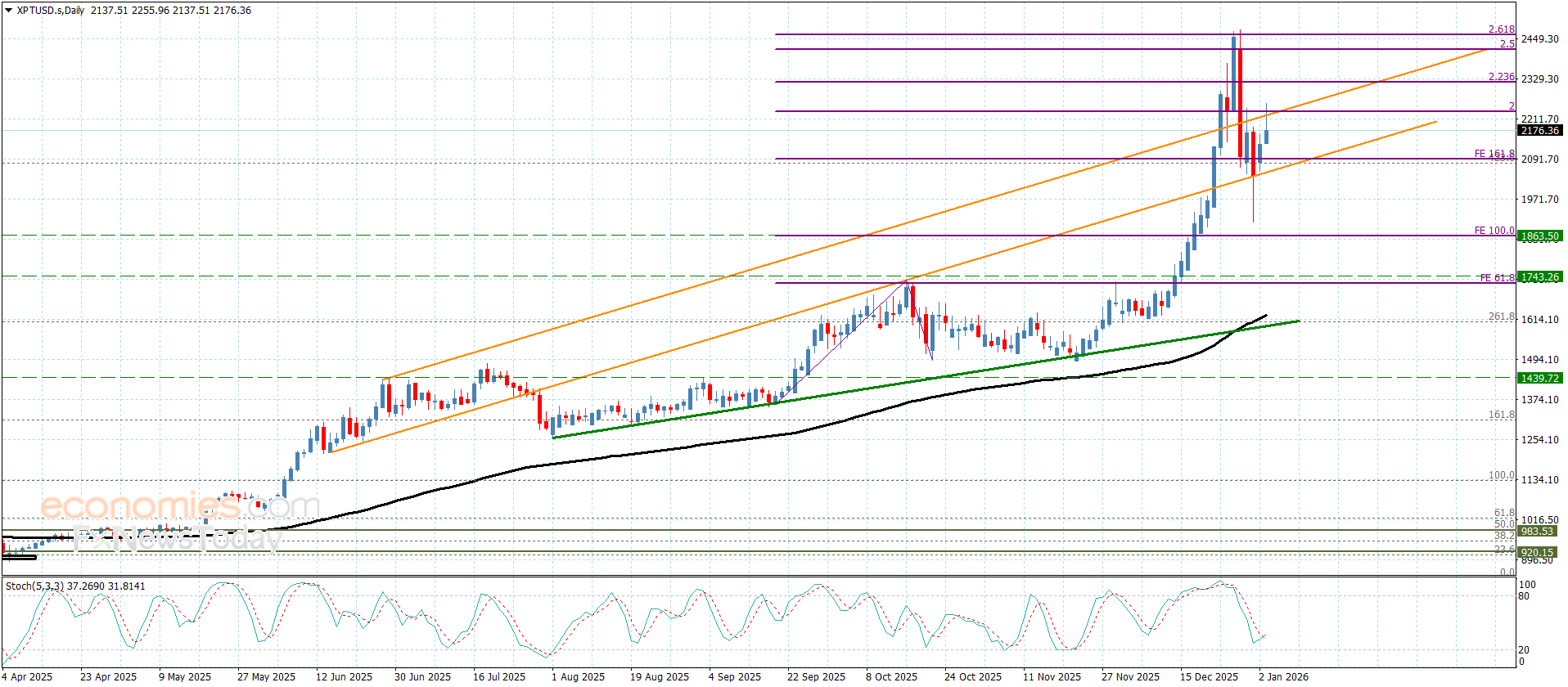
Platinum price ended the bearish corrective attack by targeting $1905.00 level, forming key liquidity sweep zones, enabling it to renew the bullish rally to reach $2255.00 level, announcing the continuation of the main bullish scenario.
To confirm gathering extra bullish momentum to ease the mission of holding above $2235.00 level is important to reinforce the chances of recording new gains by its rally towards $2325.00 reaching the next barrier near $2415.00.
The expected trading range for today is between $2095.00 and $2290.00
Trend forecast: Bullish
The Sterling has failed, once again, to break above the resistance area at 211.50, where it was capped on December 22 and 26, and is trading lower on Monday. Technical indicators hint at a weaker bullish momentum, although the pair has not shown a clear sign of a trend shift as of yet.
In the fundamental front, the Bank of Japan’s (BoJ) Governor, Kazuho Ueda, has reiterated the central bank’s commitment to keep tightening its monetary policy if its economic projections are met. This, coupled with a broader GBP weakness, is keeping the pair on the back foot on Monday.
In the 4-hour chart, GBP/JPY trades at 210.88, posting moderate losses on the daily chart after rejection at the 211.50 area on Friday.
Technical indicators show are heading lower. The Relative Strength Index (RSI) is testing levels below the key 50 line, showing some bearish divergence with price action. The Moving Average Convergence Divergence (MACD) turns marginally negative near the zero line, and the MACD line slips below the Signal line, highlighting a fading momentum.
Trendline support is now at the 210.50 area, but a decline below 210.05 (December 24 low) would be needed to confirm a triple top in the 211.50 area and signal a trend shift. The next downside targets would be the November 9 and 1o highs, at 208.90, and the December 19 low, near 208.00.
On the upside, above the long-term high, at 211.59 (December 22 high), the potential targets are the 127.2% Fibonacci extension of the December 15 to December 22 rally, at 212.75, and the 161.8% extension of the same cycle, at 214.38,.
(The technical analysis of this story was written with the help of an AI tool)
The table below shows the percentage change of British Pound (GBP) against listed major currencies today. British Pound was the strongest against the Canadian Dollar.
| USD | EUR | GBP | JPY | CAD | AUD | NZD | CHF | |
|---|---|---|---|---|---|---|---|---|
| USD | 0.25% | 0.21% | 0.05% | 0.28% | 0.24% | 0.25% | 0.24% | |
| EUR | -0.25% | -0.04% | -0.20% | 0.02% | -0.02% | -0.00% | -0.01% | |
| GBP | -0.21% | 0.04% | -0.17% | 0.07% | 0.03% | 0.04% | 0.03% | |
| JPY | -0.05% | 0.20% | 0.17% | 0.24% | 0.20% | 0.21% | 0.20% | |
| CAD | -0.28% | -0.02% | -0.07% | -0.24% | -0.04% | -0.03% | -0.04% | |
| AUD | -0.24% | 0.02% | -0.03% | -0.20% | 0.04% | 0.01% | 0.00% | |
| NZD | -0.25% | 0.00% | -0.04% | -0.21% | 0.03% | -0.01% | -0.01% | |
| CHF | -0.24% | 0.01% | -0.03% | -0.20% | 0.04% | -0.00% | 0.00% |
The heat map shows percentage changes of major currencies against each other. The base currency is picked from the left column, while the quote currency is picked from the top row. For example, if you pick the British Pound from the left column and move along the horizontal line to the US Dollar, the percentage change displayed in the box will represent GBP (base)/USD (quote).
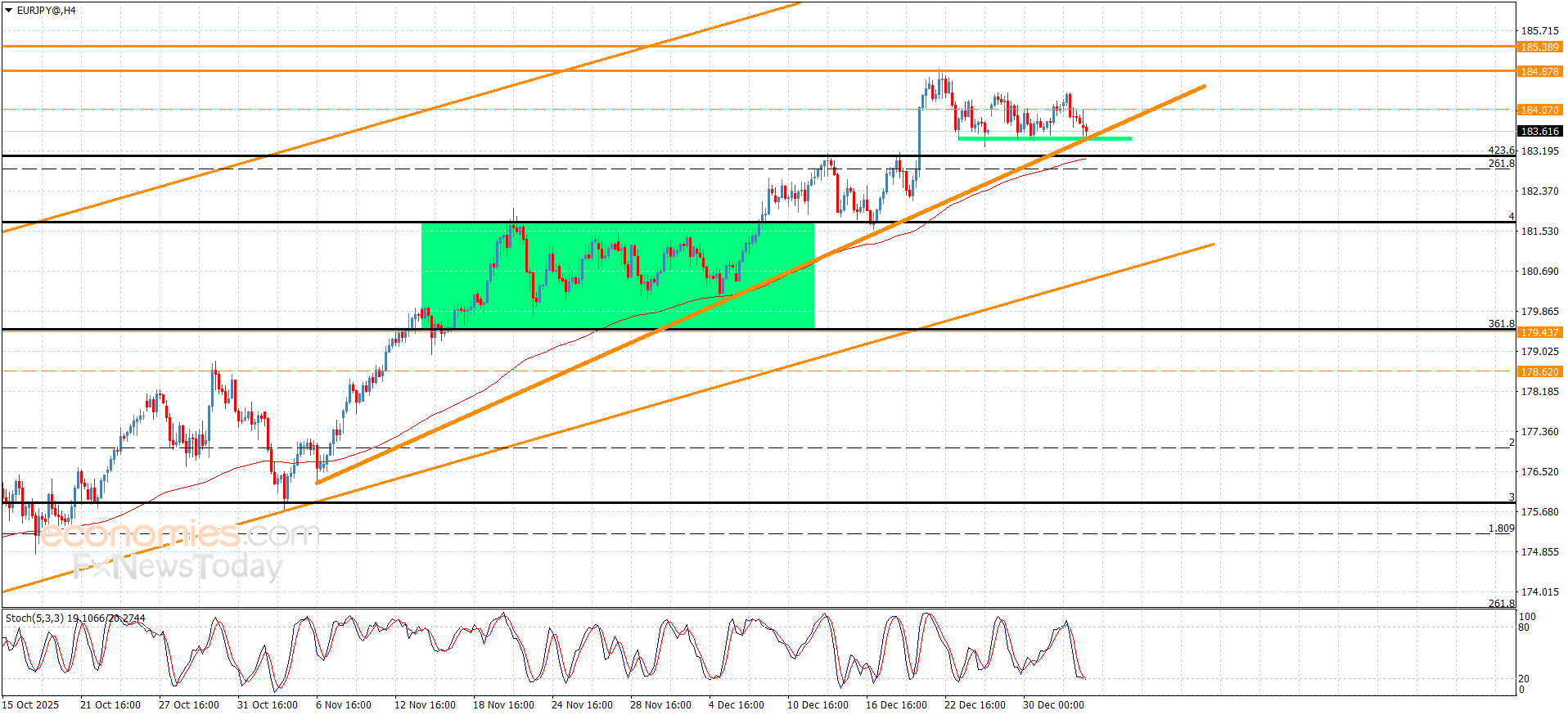
No news for GBPJPY pair until this moment due to its stability below 211.30 barrier, which forces it to provide new sideways fluctuated moves and delay the bullish rally in the current trading.
There are a chance for forming bearish corrective waves to target 210.40 level, reaching extra support near 209.70, while breaching the current barrier and holding above it, will provide a chance for a new bullish waves, to record extra gains by its rally towards 212.50 reaching the bullish channel’s resistance at 213.55.
The expected trading range for today is between 209.30 and 211.30
Trend forecast: Fluctuated within the bullish trend
No news for GBPJPY pair until this moment due to its stability below 211.30 barrier, which forces it to provide new sideways fluctuated moves and delay the bullish rally in the current trading.
There are a chance for forming bearish corrective waves to target 210.40 level, reaching extra support near 209.70, while breaching the current barrier and holding above it, will provide a chance for a new bullish waves, to record extra gains by its rally towards 212.50 reaching the bullish channel’s resistance at 213.55.
The expected trading range for today is between 209.30 and 211.30
Trend forecast: Fluctuated within the bullish trend
Important DisclaimersFXEmpire is owned and operated by Empire Media Network LTD., Company Registration Number 514641786, registered at 7 Jabotinsky Road, Ramat Gan 5252007, Israel. The content provided on this website includes general news and publications, our personal analysis and opinions, and materials provided by third parties. This content is intended for educational and research purposes only. It does not constitute, and should not be interpreted as, a recommendation or advice to take any action, including making any investment or purchasing any product. Before making any financial decision, you should conduct your own due diligence, exercise your own discretion, and consult with competent advisors. The content on this website is not personally directed to you, and we do not take into account your individual financial situation or needs. The information contained on this website is not necessarily provided in real time, nor is it guaranteed to be accurate. Prices displayed may be provided by market makers and not by exchanges. Any trading or other financial decision you make is entirely your own responsibility, and you must not rely solely on any information provided through the website. FXEmpire does not provide any warranty regarding the accuracy, completeness, or reliability of any information contained on the website and shall bear no responsibility for any trading losses you may incur as a result of using such information. The website may include advertisements and other promotional content. FXEmpire may receive compensation from third parties in connection with such content. FXEmpire does not endorse, recommend, or assume responsibility for the use of any third-party services or websites. Empire Media Network LTD., its employees, officers, subsidiaries, and affiliates shall not be liable for any loss or damage resulting from your use of the website or reliance on the information provided herein.Risk DisclaimersThis website contains information about cryptocurrencies, contracts for difference (CFDs), and other financial instruments, as well as about brokers, exchanges, and other entities trading in such instruments. Both cryptocurrencies and CFDs are complex instruments and involve a high risk of losing money. You should carefully consider whether you understand how these instruments work and whether you can afford to take the high risk of losing your money. FX Empire encourages you to conduct your own research before making any investment decision and to avoid investing in any financial instrument unless you fully understand how it works and the risks involved.
Gold price (XAU/USD) climbs to around $4,370 during the early Asian trading hours on Monday. The precious metal extends its upside amid a renewed surge in geopolitical risk after the United States’ (US) capture of Venezuelan President Nicolas Maduro. Traders will closely monitor developments surrounding the US seizure of Maduro and await the US ISM Manufacturing Purchasing Managers’ Index (PMI) data later on Monday.
CNN reported over the weekend that the US President Donald Trump administration called a “large-scale strike against Venezuela” and captured its President Maduro to face charges. This action came without the approval of Congress. Trump added that the US will be running Venezuela until it can do a safe, proper, and judicious transition.
On Sunday, US Secretary of State Marco Rubio said the US will use leverage over oil to force further change in Venezuela. The US attack on Venezuela is expected to trigger geopolitical tensions in the region and fuel the uncertainty. This, in turn, could boost traditional safe-haven assets such as Gold.
The recent Federal Open Market Committee (FOMC) Minutes showed that most US Federal Reserve (Fed) officials saw further interest-rate reductions as appropriate so long as inflation declines over time, though they remained divided over when and how far to cut. Lower interest rates could reduce the opportunity cost of holding Gold, supporting the non-yielding precious metal.
The release of the US December employment report will be in the spotlight later on Friday. The market consensus forecast for Nonfarm Payrolls (NFP) is for a gain of 57,000 jobs. In case of a stronger-than-expected outcome, this could strengthen the US Dollar (USD) and weigh on the USD-denominated commodity price in the near term.
Gold has played a key role in human’s history as it has been widely used as a store of value and medium of exchange. Currently, apart from its shine and usage for jewelry, the precious metal is widely seen as a safe-haven asset, meaning that it is considered a good investment during turbulent times. Gold is also widely seen as a hedge against inflation and against depreciating currencies as it doesn’t rely on any specific issuer or government.
Central banks are the biggest Gold holders. In their aim to support their currencies in turbulent times, central banks tend to diversify their reserves and buy Gold to improve the perceived strength of the economy and the currency. High Gold reserves can be a source of trust for a country’s solvency. Central banks added 1,136 tonnes of Gold worth around $70 billion to their reserves in 2022, according to data from the World Gold Council. This is the highest yearly purchase since records began. Central banks from emerging economies such as China, India and Turkey are quickly increasing their Gold reserves.
Gold has an inverse correlation with the US Dollar and US Treasuries, which are both major reserve and safe-haven assets. When the Dollar depreciates, Gold tends to rise, enabling investors and central banks to diversify their assets in turbulent times. Gold is also inversely correlated with risk assets. A rally in the stock market tends to weaken Gold price, while sell-offs in riskier markets tend to favor the precious metal.
The price can move due to a wide range of factors. Geopolitical instability or fears of a deep recession can quickly make Gold price escalate due to its safe-haven status. As a yield-less asset, Gold tends to rise with lower interest rates, while higher cost of money usually weighs down on the yellow metal. Still, most moves depend on how the US Dollar (USD) behaves as the asset is priced in dollars (XAU/USD). A strong Dollar tends to keep the price of Gold controlled, whereas a weaker Dollar is likely to push Gold prices up.
Later on Monday, US private sector PMI figures are likely to influence demand for the US dollar and the USD/JPY pair. Economists forecast the ISM Manufacturing PMI to increase from 48.2 in November to 48.3 in December.
Typically, a less pronounced contraction, rising employment, and higher prices support a less dovish Fed policy stance, which would lift demand for the US dollar. While the sector accounts for around 10% of the US GDP, the underlying PMI data provide insights into the effect of tariffs and the higher interest rate backdrop on prices.
Last week, the less influential S&P Global US Manufacturing PMI revealed that tariffs continued to drive prices higher, suggesting a more hawkish Fed policy stance. However, the ISM Services PMI, due out on January 7, will be key, given that the sector accounts for roughly 80% of US GDP and is the key inflation contributor.
While the PMI data will influence US dollar demand, Fed commentary remains key for USD/JPY trends. Increased calls to cut rates to bolster the labor market would dampen demand for the US dollar, pushing USD/JPY lower.
According to the CME FedWatch Tool, the probability of a March Fed rate cut increased from 51.1% on January 2 to 54.0% on January 3.
Looking ahead, expectations of further BoJ rate hikes, a new Fed Chair, potentially favoring lower rates, and a cooling US labor market remain key drivers. These scenarios continue to support a bearish short- to medium-term outlook for USD/JPY.
For USD/JPY price trends, technicals, and fundamentals will continue to require close monitoring.
Looking at the daily chart, USD/JPY traded above its 50-day and 200-day Exponential Moving Averages (EMAs), signaling a bullish bias. While technicals remained bullish, bearish fundamentals are developing, outweighing the technical structure.
A break below the 155 support level and the 50-day EMA would indicate a bearish near-term trend reversal. A sustained fall through the 50-day EMA would expose the 200-day EMA. If breached, 150 would be the next key support level.
Crucially, a sustained fall through the 50-day and 200-day EMAs would reinforce the bearish price outlooks for USD/JPY.