The main category of Forex News.
You can use the search box below to find what you need.
[wd_asp id=1]
The main category of Forex News.
You can use the search box below to find what you need.
[wd_asp id=1]
Gold prices edged sharply lower in the American session on Monday, with the bright metal currently hovering at around $4,330, after flirting with the $4,550 figure at the beginning of the new week. Gold run to record levels continued on the back of diminished US Dollar (USD) demand, exacerbated by thinned market conditions. New Year’s holiday cuts the week in half, and investors seem unwilling to take fresh risk or commit to a certain trend.
The ongoing XAU/USD slump is the result of profit taking, but by no means suggests the rally is over. The USD weakness results from speculation that the Federal Reserve (Fed) will trim interest rates in 2026 by more than what policy makers actually hinted during their December meeting. The Federal Open Market Committee (FOMC) Minutes will be released next Wednesday, and are likely to clarify some of the thinking related to the matter.
In the meantime, Wall Street trades with a negative note, with the three major indexes in the red at the time of writing, also affected by profit-taking.
From a technical perspective, the XAU/USD is not yet bearish. The 4-hour chart shows that the 20-period Simple Moving Average (SMA) turned south above the current level, providing resistance at around $3,382.50. At the same time, the pair stands above the 100- and 200-period SMAs, and in fact, buyers seem to be defending the downside around the shorter one, located at $4,330.81. Meanwhile, technical indicators neared oversold readings and are currently aiming to recover, not enough, however, to confirm a near-term advance.
In the daily chart, XAU/USD bounced after testing a bullish 20-day SMA, which advances above the 100- and 200-day SMAs, with the longer ones retaining their firm upward slopes, all of which hint at buyers holding the grip. The 20-day SMA at $4,309.32 offers nearby dynamic support, while the 100-day SMA stands at $3,924.00. Finally, the Momentum indicator eases, but remains above its midline, while the Relative Strength Index (RSI) eases and stands at 54, confirming a cooldown from prior overbought conditions. A daily close above the 20-day SMA at $4,309.32 would keep buyers in control, whereas a break below that level could expose the 100-day SMA at $3,924.00.
(The technical analysis of this story was written with the help of an AI tool)
Silver (XAG/USD) has lost more than $10 since hitting a fresh record high near $86.00 on Monday’s early trading. The precious metal has retreated to levels in the $74.00 area at the time of writing, weighed by comments by US President Trump about the chances of a peace deal in Ukraine.
Trump appeared at a news conference, together with Ukrainian President Volodymyr Zelenskyy, late Sunday, and said that he thinks that peace in Ukraine is “a lot closer,” although he acknowledged that thorny issues remain.
Meanwhile, China has announced “major” military exercises around Taiwan, and Taipei affirmed that several Chinese vessels have been seen near Taiwan’s territorial waters. A further escalation of tensions in an already sensitive area, which might limit the current reversal of precious metals.
In the 4-hour chart, XAG/USD trades at $74.92, approaching the 21-period Simple Moving Average (SMA), at the $74.00 area, which is providing support and highlights the broader bullish bias. The Relative Strength Index (RSI) stands at 54.79, near neutral levels, after unwinding from overbought territory, while the Moving Average Convergence Divergence (MACD) turns lower toward the zero line after recent highs, suggesting waning upside momentum.
Below the mentioned 21-day SMA, the next support levels are seen at $72.60, where the pair was capped on December 24, and the area between $69.60 and $70.20, where the 50-period SMA converges with the December 24 low and the December 22 high.
To the upside, the $80.00 psychological level is likely to check the strength of a potential bullish reversal, ahead of the all-time high, at $85.87 hit earlier on the day.
(The technical analysis of this story was written with the help of an AI tool)
(This story was corrected on December 29 at 09:50 GMT as the name of Ukraine’s President Volodymyr Zelenskyy was misspelled in the headline.)
Half of Europe was celebrating Boxing Day or something similar to it, and the United States, although technically open, has most people away from work and ignoring the markets in general.
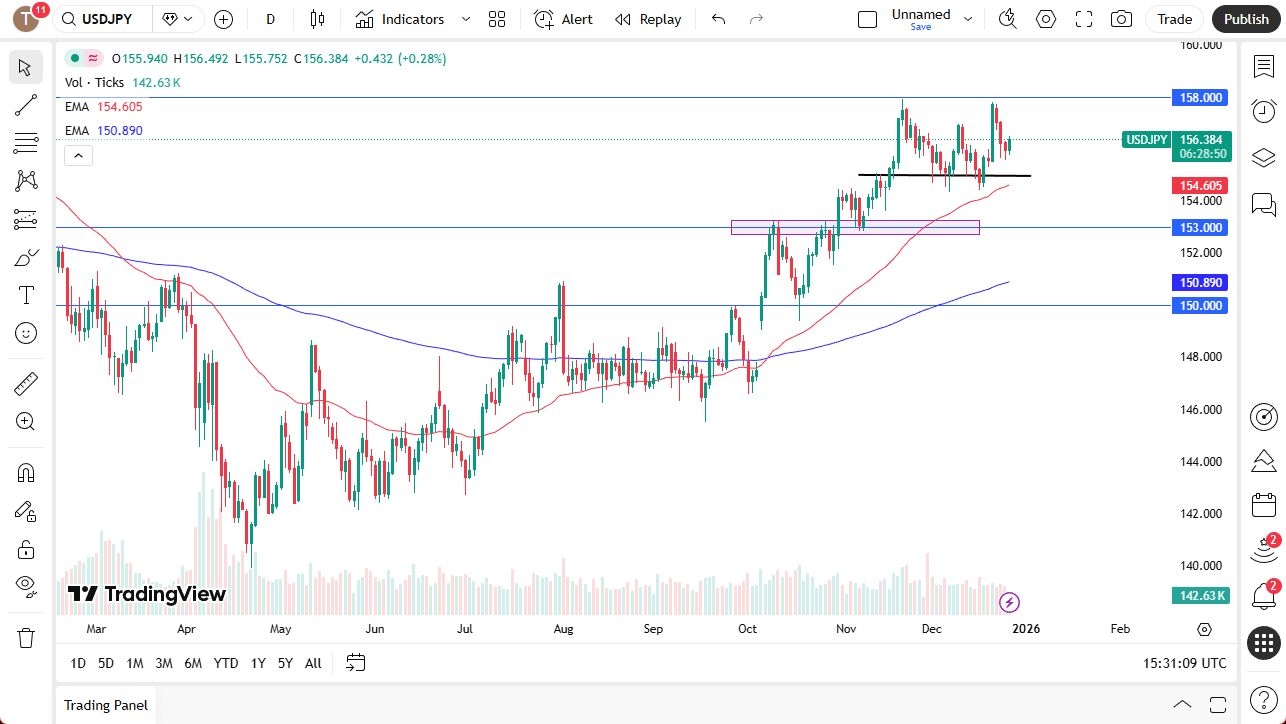
The market has done exactly what you would expect in the scenario that we find ourselves in, and it’s continued the overall consolidation. The interest rate differential does favor the US dollar, and therefore I think there’s nothing wrong with buying it, but I do recognize that there’s a very real anti-US dollar sentiment at the moment and that will lead to more volatility.

The 50-day EMA sits right around the 154.50 level, which is basically the floor in the consolidation that we have been involved in for the entire month of December.
Over the longer term, I would still favor the US dollar over the Japanese yen. That’s not really a US dollar call; that’s more about the Japanese yen than anything else, as you can see several other currencies around the world working their way higher against the yen as well.
The Bank of Japan did hike rates, but I think traders at this point in time have voiced their opinion of that as the Japanese yen continues to be fairly soft.
It is not until we break down below the 153 yen level that I even begin to have the conversation of maybe the trend could be changing. I’m a buyer of dips. I think we’ll get back to 158 yen, and I do think we eventually break above there.
Want to trade our USD/JPY forex analysis and predictions? Here’s a list of forex brokers in Japan to check out.
Christopher Lewis has been trading Forex and has over 20 years experience in financial markets. Chris has been a regular contributor to Daily Forex since the early days of the site. He writes about Forex for several online publications, including FX Empire, Investing.com, and his own site, aptly named The Trader Guy. Chris favours technical analysis methods to identify his trades and likes to trade equity indices and commodities as well as Forex. He favours a longer-term trading style, and his trades often last for days or weeks.
Verizon Communications (VZ) rose in its latest intraday trading, as the stock attempts to unwind part of its clear oversold conditions on the RSI, supported by the emergence of positive signals from the indicator. However, this rebound collided with resistance at its 50-period SMA, while price action continues to move alongside a minor downward trendline on the short term, keeping downside pressure intact.
Therefore we expect the stock price to decline in the upcoming intraday trading, as long as resistance at 41.00 holds, to target the support level at 39.70.
Today’s price forecast: Bearish
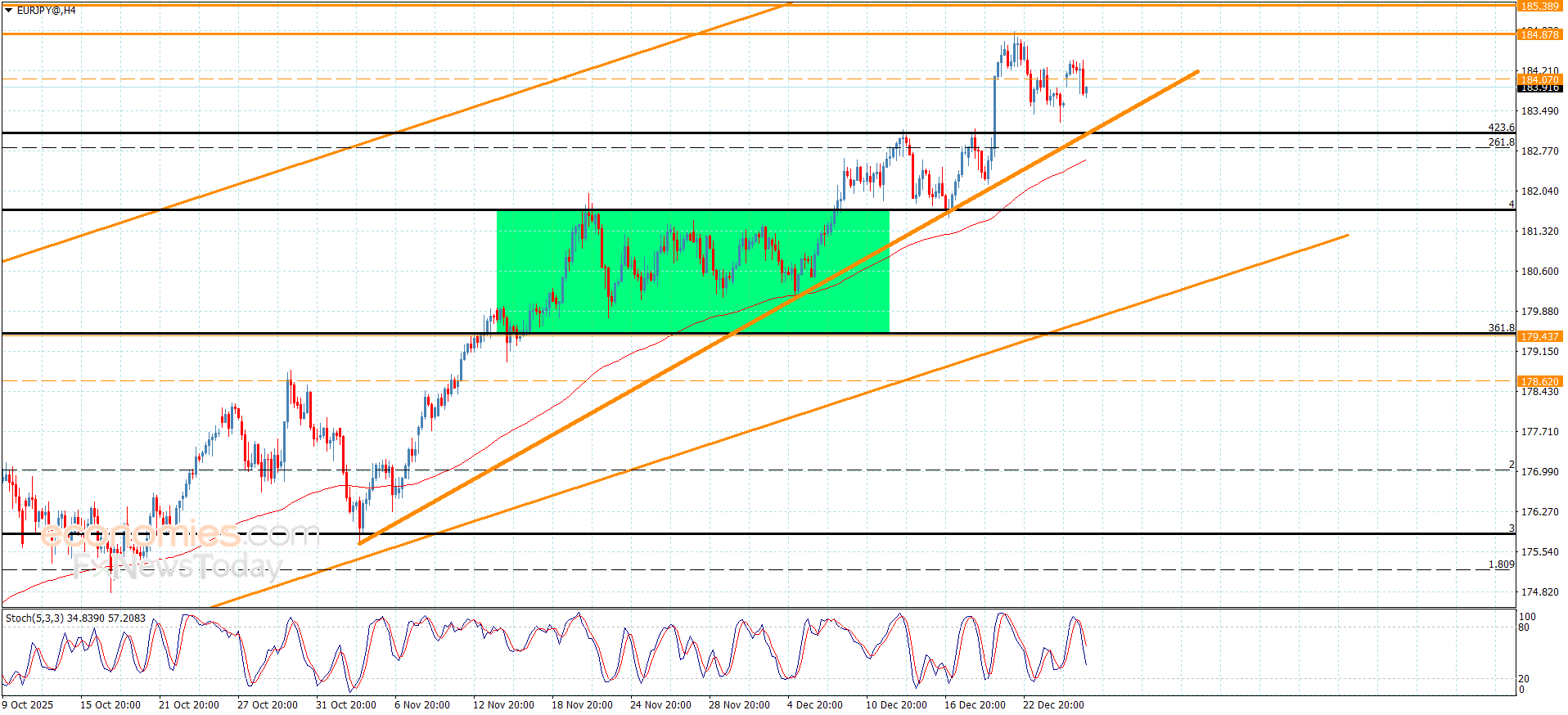
The EURJPY pair began with clear negativity this morning, by forming a new corrective decline by targeting 183.75 level, due to providing negative momentum by stochastic by reaching below 50 level, besides forming extra barrier at 184.40 level.
We expect providing more corrective attempts, which might target 183.55 level reaching the main support at 183.05, while surpassing the mentioned barrier and holding above it will confirm its readiness to renew the bullish attempts, repeating the pressure on 184.90 level to find an exit to record new historical gains in the upcoming period.
The expected trading range for today is between 183.05 and 184.00
Trend forecast: Bearish
The EURJPY pair began with clear negativity this morning, by forming a new corrective decline by targeting 183.75 level, due to providing negative momentum by stochastic by reaching below 50 level, besides forming extra barrier at 184.40 level.
We expect providing more corrective attempts, which might target 183.55 level reaching the main support at 183.05, while surpassing the mentioned barrier and holding above it will confirm its readiness to renew the bullish attempts, repeating the pressure on 184.90 level to find an exit to record new historical gains in the upcoming period.
The expected trading range for today is between 183.05 and 184.00
Trend forecast: Bearish
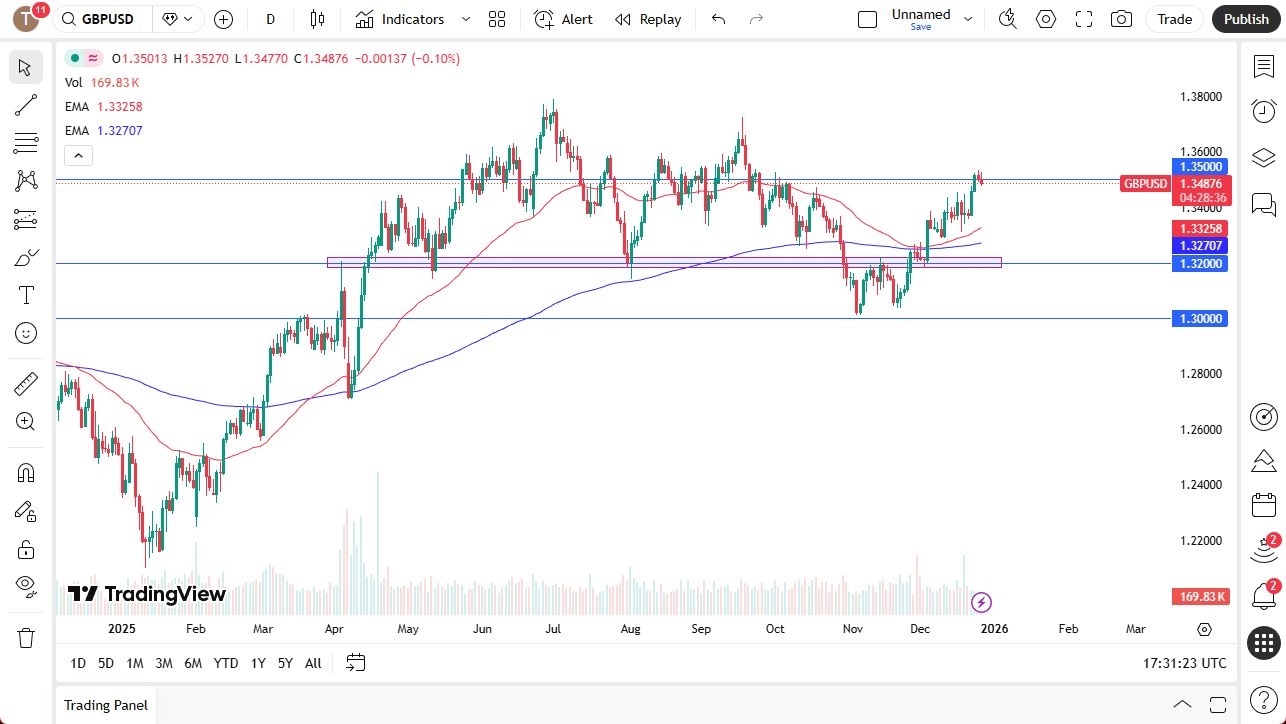
I do believe that in the next couple of weeks we will make a significant decision, but as things stand right now, it looks very much like a market that I think is going to continue to see a lot of questions asked of it near the 1.35 level.
The 1.35 level is a level that I think has been important multiple times. If we pull back from here, and I think we could, the 1.34 level is an area that would be your initial target. Breaking down below there, then opens up the possibility of a drop down to the 1.32 level. All things being equal, I suspect that might be the initial move to a bigger pullback.
However, we have to understand that the US dollar will probably move in the same direction against most currencies and not just this one. So, with this, I think you have a scenario where if we were to break above the 1.36 level, then it is obvious that we have a much bigger move to the upside waiting to happen, perhaps to the 1.38 level. I do expect a lot of choppy and noisy behavior, but I also recognize that the British Pound has outperformed most of its contemporaries against the US dollar. We are at a major point of inflection that we need to be watching.
Ready to trade our daily GBP/USD Forex forecast? Here’s some of the best forex broker UK reviews to check out.
Christopher Lewis has been trading Forex and has over 20 years experience in financial markets. Chris has been a regular contributor to Daily Forex since the early days of the site. He writes about Forex for several online publications, including FX Empire, Investing.com, and his own site, aptly named The Trader Guy. Chris favours technical analysis methods to identify his trades and likes to trade equity indices and commodities as well as Forex. He favours a longer-term trading style, and his trades often last for days or weeks.
The GBPJPY pair continued providing negative closes below 211.30 level, to confirm its surrender to the previously suggested bearish corrective bias dominance, reaching 210.40 taking advantage of stochastic exit from the overbought level.
We will keep our corrective expectations in the near trading, reminding you that the stability of the initial targets near 209.75 and 209.30, while the price success to step above the barrier and providing positive close will turn the bullish bias back, to expect its rally towards the next positive target near 212.65.
The expected trading range for today is between 209.75 and 211.20
Trend forecast: Bearish
USD/JPY retraces its recent gains registered in the previous session, trading around 156.10 during the European hours on Monday. On the daily chart, technical analysis indicates the 14-day Relative Strength Index (RSI) sitting at 52.80 (neutral) after easing from recent readings. A turn higher in RSI would strengthen bullish conviction, while a drift toward 50 would keep range-bound conditions in place.
The 50-day Exponential Moving Average (EMA) rises, supporting the broader uptrend. The nine-day EMA is flat with price hovering around it, pointing to near-term consolidation. The setup keeps a modest bullish bias while above the rising 50-day EMA.
Upside momentum would re-accelerate on a daily close above the immediate barrier at the nine-day EMA of 156.19, opening the path toward the next resistance around the 11-month high of 157.90. Further advances would support the USD/JPY pair to test the 158.88, the highest since July 2024.
On the downside, a rejection at the nine-day EMA and a break beneath the nearest support at the upside trendline around 155.10 would shift focus to the secondary floor and risk a deeper pullback toward the 50-day EMA at 154.72.
The table below shows the percentage change of Japanese Yen (JPY) against listed major currencies today. Japanese Yen was the strongest against the New Zealand Dollar.
| USD | EUR | GBP | JPY | CAD | AUD | NZD | CHF | |
|---|---|---|---|---|---|---|---|---|
| USD | -0.00% | 0.14% | -0.20% | 0.18% | 0.18% | 0.37% | -0.02% | |
| EUR | 0.00% | 0.15% | -0.18% | 0.19% | 0.19% | 0.35% | -0.02% | |
| GBP | -0.14% | -0.15% | -0.32% | 0.04% | 0.03% | 0.22% | -0.17% | |
| JPY | 0.20% | 0.18% | 0.32% | 0.36% | 0.38% | 0.55% | 0.11% | |
| CAD | -0.18% | -0.19% | -0.04% | -0.36% | 0.00% | 0.19% | -0.21% | |
| AUD | -0.18% | -0.19% | -0.03% | -0.38% | -0.00% | 0.18% | -0.21% | |
| NZD | -0.37% | -0.35% | -0.22% | -0.55% | -0.19% | -0.18% | -0.39% | |
| CHF | 0.02% | 0.02% | 0.17% | -0.11% | 0.21% | 0.21% | 0.39% |
The heat map shows percentage changes of major currencies against each other. The base currency is picked from the left column, while the quote currency is picked from the top row. For example, if you pick the Japanese Yen from the left column and move along the horizontal line to the US Dollar, the percentage change displayed in the box will represent JPY (base)/USD (quote).
(The technical analysis of this story was written with the help of an AI tool.)
EUR/USD stays in a consolidation phase and moves sideways above 1.1750 early Monday after registering marginal losses on Friday. In the absence of fundamental drivers and key macroeconomic data releases, the pair could have a difficult time finding direction heading into the New Year holiday.
Following the Christmas break, the US Dollar (USD) held its ground but failed to gather recovery momentum as trading volumes remained thin.
On Monday, the Federal Reserve Bank of Dallas’ Texas Manufacturing Survey and November Pending Home Sales data will be featured in the US economic calendar, which are likely to be ignored by market participants. On Tuesday, the minutes of the Federal Reserve’s December policy meeting will be scrutinized by investors but the actual market impact could be hard to see until trading conditions normalize later this week or early next week.
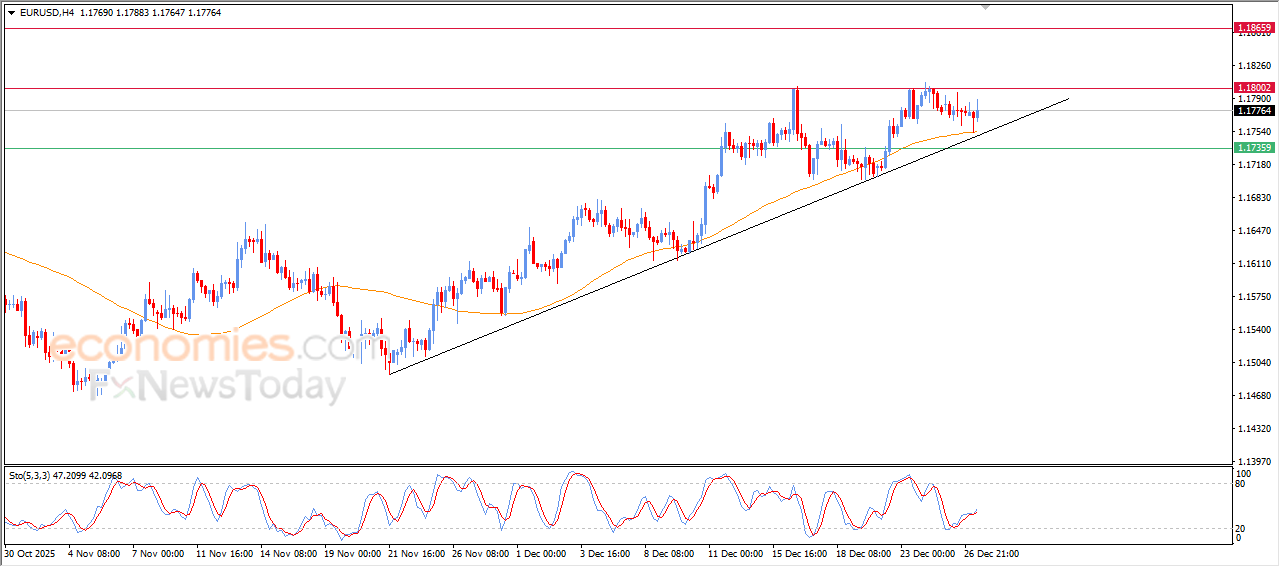
The 20-period Simple Moving Average (SMA) climbs above the 50-, 100-, and 200-period ones, signaling bullish alignment. Price holds over the 50-, 100-, and 200-period SMAs but remains capped by the 20-period SMA at 1.1782.
The Relative Strength Index (RSI) prints 49.8, neutral as momentum cools. The lower limit of the ascending regression channel and the 50-period SMA align as the initial support level at 1.1750. Measured from the 1.1501 low to the 1.1800 high, the 23.6% retracement at 1.1730 could be seen as the next support level, followed by the 100-SMA at 1.1715 and the 38.2% retracement at 1.1685.
On the upside, 1.1780 (20-period SMA) could act as an interim resistance level before 1.1800 (static level, mid-point of the ascending channel) and 1.1855 (upper limit of the ascending channel).
(The technical analysis of this story was written with the help of an AI tool)
The Euro is the currency for the 20 European Union countries that belong to the Eurozone. It is the second most heavily traded currency in the world behind the US Dollar. In 2022, it accounted for 31% of all foreign exchange transactions, with an average daily turnover of over $2.2 trillion a day.
EUR/USD is the most heavily traded currency pair in the world, accounting for an estimated 30% off all transactions, followed by EUR/JPY (4%), EUR/GBP (3%) and EUR/AUD (2%).
The European Central Bank (ECB) in Frankfurt, Germany, is the reserve bank for the Eurozone. The ECB sets interest rates and manages monetary policy.
The ECB’s primary mandate is to maintain price stability, which means either controlling inflation or stimulating growth. Its primary tool is the raising or lowering of interest rates. Relatively high interest rates – or the expectation of higher rates – will usually benefit the Euro and vice versa.
The ECB Governing Council makes monetary policy decisions at meetings held eight times a year. Decisions are made by heads of the Eurozone national banks and six permanent members, including the President of the ECB, Christine Lagarde.
Eurozone inflation data, measured by the Harmonized Index of Consumer Prices (HICP), is an important econometric for the Euro. If inflation rises more than expected, especially if above the ECB’s 2% target, it obliges the ECB to raise interest rates to bring it back under control.
Relatively high interest rates compared to its counterparts will usually benefit the Euro, as it makes the region more attractive as a place for global investors to park their money.
Data releases gauge the health of the economy and can impact on the Euro. Indicators such as GDP, Manufacturing and Services PMIs, employment, and consumer sentiment surveys can all influence the direction of the single currency.
A strong economy is good for the Euro. Not only does it attract more foreign investment but it may encourage the ECB to put up interest rates, which will directly strengthen the Euro. Otherwise, if economic data is weak, the Euro is likely to fall.
Economic data for the four largest economies in the euro area (Germany, France, Italy and Spain) are especially significant, as they account for 75% of the Eurozone’s economy.
Another significant data release for the Euro is the Trade Balance. This indicator measures the difference between what a country earns from its exports and what it spends on imports over a given period.
If a country produces highly sought after exports then its currency will gain in value purely from the extra demand created from foreign buyers seeking to purchase these goods. Therefore, a positive net Trade Balance strengthens a currency and vice versa for a negative balance.