The main category of Forex News.
You can use the search box below to find what you need.
[wd_asp id=1]
The main category of Forex News.
You can use the search box below to find what you need.
[wd_asp id=1]
Oil prices are once again reflecting the weight of geopolitics and supply-side maneuvering. WTI crude (CL=F) climbed to $63.11 per barrel, up 1.37%, while Brent (BZ=F) added 1.32% to $66.89 after Israel carried out an unprecedented strike in Doha, Qatar. The location of the strike rattled traders because Qatar is a cornerstone of the global energy network, home to one of the largest U.S. military bases, and a critical LNG exporter. Even though Qatar does not export large volumes of crude, the geopolitical symbolism triggered immediate risk premiums across energy benchmarks.
The Israel–Qatar escalation shifted the balance of oil markets that were already contending with fragile supply outlooks. Nearly every Gulf state plays an outsized role in energy stability, and the possibility of escalation spilling into wider conflicts pushed risk hedging into oil futures. Historically, events in the Gulf region have added anywhere from $3–$7 per barrel in geopolitical premium, and traders are preparing for that scenario again.
Overlaying the geopolitical spike is the ongoing OPEC+ supply policy. After signaling a potential collective increase of 550,000 barrels per day for October, the group delivered just 137,000 barrels per day, managing expectations but still loosening cuts. Saudi Aramco responded by cutting its official selling price for October Asian deliveries by $1 per barrel, with Arab Light now set at a $2.20 premium over Oman/Dubai. The cut was larger than expected and highlights Riyadh’s concern about weakening Asian demand. With China’s oil stockpiling continuing but EV adoption suppressing gasoline demand growth, Saudi Arabia appears willing to trade price for market share.
Shipping executives, including Maersk’s oil trading head, warned at the Asia Pacific Petroleum Conference that risks lean to the downside, citing sluggish demand and excess supply from Russia and U.S. shale. Goldman Sachs flagged the possibility of a 1.9 million barrel per day surplus next year, which could drag Brent crude back to $55 per barrel. S&P Global echoed the warning, noting that OECD inventories remain 100 million barrels below the five-year average, but contango structures could widen quickly if stockbuilding accelerates.
Complicating the balance are disruptions in Russia and Nigeria. Ukrainian drones have hit Rosneft’s key refineries, temporarily halting processing and reducing export-ready volumes. In Nigeria, unions have called for strikes at the 650,000 bpd Dangote refinery over labor disputes, threatening near-term regional fuel supply. These interruptions, although episodic, inject additional volatility into physical markets already rattled by OPEC+ decisions and Middle Eastern risks.
Technically, WTI crude (CL=F) is testing a double-bottom pattern near $62, with resistance layers stacking at $65 and $66. A decisive break above $66 would target $67.50–$68.00, while failure to hold $62 could drag prices toward $60. Brent (BZ=F) is moving in a similar structure, with a range defined by $65 support and $70 resistance. Both contracts are holding above immediate support levels, but momentum remains fragile, with short-covering responsible for much of the recent bounce.
U.S. nonfarm payroll revisions, which revealed a loss of 911,000 jobs, reinforced expectations of a September Fed rate cut, sending the dollar lower and boosting commodities priced in USD. At the same time, gold surged past $3,674 per ounce, underscoring the search for havens during geopolitical stress. Oil benefitted in the short term, but the fundamental drag from weak macro data means demand forecasts may not justify sustained rallies.
China continues to stockpile crude aggressively, lifting imports since March, but the move is less about demand recovery and more about building reserves. Analysts warn Chinese demand growth could peak by 2027, with EV adoption already displacing 580,000 barrels per day of gasoline equivalent this year. India, meanwhile, is doubling down on discounted Russian barrels, defying Western pressure, and securing long-term supply contracts. These divergent strategies illustrate Asia’s outsized role in setting marginal demand, but also point to limits on upside for Brent as peak demand debates accelerate.
Oil prices are being propped up by geopolitics rather than fundamentals. With WTI at $63.11 and Brent at $66.89, near-term rallies hinge on whether the Israel–Qatar escalation deepens or whether OPEC+ signals further restraint. Structural risks remain to the downside, with forecasts of Brent sliding back toward $55 if oversupply accelerates into 2026. The verdict for now is Hold, as short-term geopolitical premiums keep oil elevated, but long-term risk-reward tilts bearish unless demand outpaces the looming wave of supply from OPEC+, U.S. shale, and LNG expansions.
The EURJPY pair is forced to form bearish correction wave after hitting the target at 174.45, affected by stochastic attempt to exit the overbought level, noticing its fluctuation near the breached barrier, forming an extra support at 173.40.
The price success to settle above the current support will provide new chance for forming bullish waves, repeating the pressure on 174.40 level, and surpassing it will make it reach the next target near 175.20, while its surrender to the negative pressures by its move below the support will force it to delay the bullish attack, forming more of the correctional trading, to reach 172.80 initially, reaching the support of the bullish channel at 171.35.
The expected trading range for today is between 173.40 and 175.20
Trend forecast: Bullish
– Written by
David Woodsmith
STORY LINK Pound to Euro Week Ahead Forecast: GBP Short-term Vulnerability Warning
The Pound Sterling and the Euro currencies slipped to six-week lows near 1.1550 as UK fiscal worries resurfaced. Rising government borrowing, tighter budget risks and the Bank of England’s cautious policy stance weighed on sentiment.
Danske Bank now Pound-to-Euro exchange rate forecasts GBP/EUR sliding to 1.1235 over 12 months, while Macquarie expects a rebound towards 1.1765 into 2027.
Danske Bank forecasts that the Pound to Euro (GBP/EUR) exchange rate will weaken to 1.1235 on a 12-month view.
Macquarie notes potential short-term vulnerability, but expects GBP/EUR gains to 1.1765 by early 2027.
GBP/EUR dipped to 6-week lows near 1.1550 late in the week amid fresh concerns surrounding UK fundamentals.
According to Danske Bank; “We see domestic factors and the relative growth outlook between the UK and the euro area as becoming GBP negatives. This is further amplified by divergence in the fiscal policy outlook with UK fiscal policy set to be tightened in the Autumn.”
Macquarie played down the Pound risks; “Fiscal concerns occasionally make their presence felt and, when they do, the spectacle of sterling selling off in tandem with rising yields can be unsettling. But such episodes have been brief, and the present state of the UK yield curve can be largely explained by expectations for a persistently elevated policy rate, together with some spillover effects from a steepening of yield curves globally.”
The Bank of England held interest rates at 4.00% at the latest policy meeting, in line with strong consensus forecasts.
There was a 7-2 vote for the decision as Dhingra and Taylor voted for a further cut to 3.75%.
There was no significant shift in guidance with Bank Governor Bailey continuing to warn over the need for caution over any further cuts.
The latest government borrowing data was worse than expected with the August deficit at £18.0bn compared with £14.5bn the previous year.
Spending increased sharply over the year with central government’s current expenditure provisionally estimated as £89.1 billion from £81.3bn the previous year.
The data triggered fresh fears surrounding underlying fiscal trends as UK yields moved higher again.

RBC commented on the outlook; “Related to the Budget theme, we continue to see a strong sensitivity of GBP to moves in long-end rates. Typically, GBP should strengthen as yields rise, yet recently we have seen some “sell everything UK” moves where sterling, equities and bonds have all sold off in tandem as fiscal concerns sour investors perception of the UK.
Investment banks continue to discuss the outlook for BoE policy.
According to MUFG; “Recent data hasn’t produced any surprises and the bar for a November cut looks high after the finely balanced vote to cut in August. We continue to expect the next cut in December.”
MUFG added; “The onus will be on the data and there will be plenty of it between the next two meetings, and we suspect that Budget speculation will increasingly weigh on sentiment and activity. We then see gradual easing continuing in 2026 to a terminal rate of 3.25%.
International Money Transfer? Ask our resident FX expert a money transfer question or try John’s new, free, no-obligation personal service! ,where he helps every step of the way,
ensuring you get the best exchange rates on your currency requirements.
The crude complex continues to trade inside a fragile balance as supply additions from Iraq, Libya, and Kuwait battle against escalating geopolitical flashpoints in Eastern Europe and the Middle East. West Texas Intermediate (CL=F) slipped to $62.49 per barrel, down 0.3% on the day, while Brent (BZ=F) eased to $66.44, also down 0.4%. Despite headlines of Russian airspace incursions over Estonia and fresh strikes on Ukraine, traders are refusing to lift crude above its resistance zone near $67, signaling that oversupply fears carry greater weight than the risk premium.
U.S. benchmark WTI has repeatedly tested the $62 support, a level that has been in play since early August. If the market fails to defend this zone, the next target becomes $60, widely viewed as the line where U.S. shale economics begin to wobble. Technical charts show resistance stacked at $65 per barrel, with the 50-day moving average capping rallies. A breakdown below $62 could trigger algorithmic selling, exposing the $59–$60 corridor. The price structure has turned fragile enough that even mild inventory builds in this week’s EIA report could drive WTI into the high $50s.
Brent futures remain boxed between $65 and $69 per barrel, a sideways trade that has persisted for seven weeks. Today’s $66.44 print reflects both demand headwinds and unexpected supply resilience. Resistance remains clustered around $67–$67.50, with the 200-day moving average looming near $68.80. Without a supply cut from OPEC+ leaders, Brent risks a retracement to $63, a level not seen since July. Traders highlight that even geopolitical escalations in Israel, Gaza, and Eastern Europe failed to spark sustainable upside, a clear indication that fundamentals are overshadowing risk headlines.
Iraq has pushed exports to 3.4–3.45 million barrels per day in September, its highest level in months, after OPEC+ relaxed quotas. Baghdad is also preparing to restart pipeline flows from Kurdistan through Turkey, which could return another 400,000 barrels per day to global supply. The increased Iraqi presence comes as Kuwait confirmed a crude capacity of 3.2 million bpd, the largest in more than a decade. These additions come at a time when demand forecasts into Q4 2025 are softening, adding further weight to bearish sentiment.
Libya’s National Oil Corporation confirmed production of 1.388 million barrels per day, a sharp recovery aided by returning international partners such as BP, Shell, Chevron, and TotalEnergies. Condensate output of 52,730 barrels and 2.57 billion cubic feet of gas further emphasized the rebound. The government has targeted 2 million bpd by year-end, and if realized, that would flood markets at a time when both Brent and WTI are already struggling to maintain support. Indian refiners have stepped up purchases, and European imports of Libyan crude surpassed $22 billion in 2024, underscoring Libya’s growing influence.
While oil flows grow, Iran’s gas exports to Iraq have collapsed, constrained by U.S. sanctions, decaying pipelines, and Iraq’s drive to increase its own domestic production. The disruption has left Baghdad scrambling to secure power generation during peak periods, potentially redirecting some demand back into crude oil for domestic use. For markets, the collapse in Iranian gas flows carries symbolic weight — it reinforces the fragility of Middle Eastern energy supply chains. Yet despite this geopolitical fragility, Brent failed to hold above $67.15 when tested, a signal that traders remain more focused on physical crude balances than regional instability.
Russian fighter jets entering Estonian airspace, ongoing attacks on western Ukraine, and Western recognition of a Palestinian state all injected volatility into global headlines. Normally, such events would spark sharp crude rallies, but the absence of sustained buying shows that traders are discounting politics without direct supply losses. WTI and Brent retreated almost immediately after knee-jerk gains, reinforcing the bearish undertone. Brent, which briefly tested $67.15, slid back under $66.50 by midday.
Monetary policy is adding another layer of weakness. Federal Reserve officials have pushed back against the need for additional rate cuts despite inflation running above 2%. That keeps the U.S. dollar strong and caps global oil demand. Earlier this month, dovish bets briefly drove WTI above $65, but with Fed rhetoric shifting, crude lost its monetary tailwind. Unless macro conditions change, oil prices will remain tied to physical oversupply rather than speculative relief rallies.
With WTI at $62.49 and Brent at $66.44, the market sits on critical support zones. Iraq and Libya’s aggressive production adds bearish momentum, while Iran’s fragility and Russian geopolitical tensions provide only temporary spikes. The most realistic scenario is further range-bound trade with downward bias. If China steps up stockpiling as it did in September, support could hold and drive Brent back toward $69. But without that demand, both benchmarks risk slipping lower. Based on the balance of data, the outlook is cautiously bearish, leaning Hold, with a potential test of $60 for WTI and $63 for Brent in the near term.
Natural gas futures are once again trading soft, with the October contract settling Friday at $2.888/MMBtu, down nearly 1.8% on the week. The U.S. Energy Information Administration reported a +90 Bcf storage injection for the week ending September 12, well above both the consensus of +78 Bcf and the five-year average of +74 Bcf. Total inventories now stand at 3,433 Bcf, which is 204 Bcf, or 6.3%, above the five-year seasonal norm, leaving the market oversupplied even as year-on-year comparisons show only a marginal 0.1% shortfall.
Supply-side dynamics remain a key drag on NG=F pricing. Lower-48 dry gas output reached 107.6 Bcf/d, up 6.1% year-over-year, while Canadian imports are stable. LNG exports of 15.3 Bcf/d remain firm but insufficient to absorb the excess supply, particularly as domestic consumption has weakened. U.S. consumption fell to 98.5 Bcf/d last week from 99.6 Bcf, with residential and commercial demand sliding as September temperatures turned mild. The only bright spot has been the power sector, where gas-for-power demand has held up, but cooling needs are now waning as forecasts point to cooler temperatures across major demand centers beginning September 24.
Price action shows natural gas futures consolidating within a narrow retracement zone. Support at $2.887 has been tested multiple times in early trade, with failure to hold likely exposing a deeper decline toward $2.70–$2.65/MMBtu, where a longer-term trend line dating back to February 2024 resides. To the upside, bulls need to retake the $2.947–$3.01 cluster, which includes the 50-day EMA at $3.00. Above this, resistance lies at $3.20, a level that has consistently capped rallies this month. Momentum indicators remain weak: RSI sits at 38, showing bearish control, while MACD remains in negative territory, highlighting the lack of conviction for a reversal.
The transition from October to November contracts adds another element to price action. November futures tend to reflect higher demand expectations as winter approaches, yet current weather forecasts are not providing the spark bulls need. Late-season warmth is fading, but cooler conditions are arriving too slowly to offset the pressure of storage builds. With injection season still in play and stockpiles running above norms, traders remain cautious. Some market participants expect prices could dip toward $2.70 before finding stronger buying interest aligned with heating demand.
Longer-term fundamentals remain more constructive. The EIA projects U.S. Henry Hub prices will average $3.70/MMBtu in Q4 2025, climbing toward $4.30 in 2026. Growth in LNG capacity, with projects such as Corpus Christi Stage 3 and Plaquemines Phase 2 adding up to 6 Bcf/d by late 2026, is expected to absorb more domestic supply. U.S. LNG exports are forecast to rise from 12 Bcf/d in 2024 to 15 Bcf/d in 2025 and 16 Bcf/d in 2026, with Asian demand leading the growth. This dynamic should gradually rebalance the oversupply and keep natural gas prices firming into the medium term.
At present levels near $2.89, natural gas futures remain under bearish pressure as storage surpluses and mild weather cap any rally attempts. The short-term risk leans toward a test of $2.70–$2.65, while a break above $3.01 could enable a corrective move toward $3.20. Structurally, however, expanding LNG exports, resilient industrial demand, and the transition into winter favor firmer pricing into late 2025 and 2026. Based on current data, NG=F is a Hold in the short term with a Buy bias into 2026, as global demand growth and export capacity expansion offer a more supportive backdrop than current storage-heavy conditions suggest.
Spot Gold keeps rallying to record levels, reaching $3,73 a troy ounce on Monday and holding nearby in the American session. Despite a generalized optimism, demand for the bright metal continues amid broad US Dollar (USD) weakness.
Financial markets are still digesting the latest United States (US) Federal Reserve (Fed) monetary policy announcement. The US central bank lowered the benchmark rate as expected in the September meeting, and hinted at additional cuts in November and December. American data scheduled for this week will help speculative interest confirm or deny their beliefs on the matter.
S&P Global will publish the preliminary estimates of the September Purchasing Managers’ Indexes (PMIs) on Tuesday, anticipated to show business activity expanded at a healthy pace. The final Q2 Gross Domestic Product (GDP) estimate will be out on Thursday, while on Friday, the country will release updated Personal Consumption Expenditures (PCE) Price Index figures, the Fed’s favorite inflation gauge.
The XAU/USD pair is firmly up for a second consecutive day, and technical readings in the daily chart suggest further advances are still in the docket. The Relative Strength Index (RSI) indicator bounced from its 70 line, and maintains a strong upward slope within overbought readings. At the same time, the Momentum indicator consolidates well above its 100 line, lacking directional strength. Finally, the pair runs beyond bullish moving averages, with the closest being the 20 Simple Moving Average (SMA) at around $3,581.
The 4-hour chart for XAU/USD shows technical indicators are partially losing their bullish slopes after reaching overbought readings, still holding within extremes and without signs of changing course. At the same time, the bright metal runs beyond all its moving averages, with a mildly bullish 20 Simple Moving Average (SMA) hovers around $3,674.00, while the 100 and 200 SMAs accelerated north well below the shorter one.
Support levels: 3,724.10 3,707.80 3,691.50
Resistance levels: 3,750.00 3,765.00 3,780.00
The euro rallied a bit in the early hours here on Monday to reach the 1.18 level. The 1.18 level is a large, round, psychologically significant figure that, of course, has been important multiple times. And if we can break above here, it opens up a move to the 1.19 level, possibly even the 1.20 level. Short-term pullbacks will continue to find plenty of momentum, I think, perhaps trying to break out, but there are a lot of questions out there about the risk appetite, and I think that will continue to be reflected in this pair. If we break down below the 1.17 level, we probably just sit right in that consolidation area for a while.
The US dollar initially tried to rally against the Japanese yen, but gave back the gains, and we find ourselves just sitting here. At the 200-day EMA, the Friday candlestick was a hammer. It looks like we might try to form some type of negative shooting star candle. So, I think this is a market that just really doesn’t have anywhere to be at the moment, with the 146 yen level offering support and the 149 yen level offering resistance.
Gold bounced up from the $3,630 area on Friday and is extending gains on Monday, supported by a cautious market mood and hopes of further Fed easing. The precious metal is trading at $3,720, with the following potential targets at $3,730 and $3,760.
The fundamental backdrop remains supportive. European markets have opened on a moderately negative note, as tensions remain high between Russia and its European partners, while in the Middle East, Israel’s occupation of Gaza is generating an increasing wave of opposition among Western countries.
The technical picture, on the other hand, is sending warning messages. The daily chart shows the pair at overbought levels, after having rallied more than 12% in one month. RSI is starting to suggest some bearish divergence, and the MACD shows an impending bearish cross, which should warn buyers.
On the upside, immediate resistance is the <27.2% Fibonacci retracement of last week’s pullback, at $3,730, ahead of the 161.8% retracement of the same cycle, at $3,760. Beyond here, the $3,800 round level emerges as a potential target.
To the downside, the previous all-time high, at $3,707, might provide support ahead of the $3,615-3,630 area (September 11, 18 lows). Further down, the September 3 high and September 8 low, at $3,580, would come into focus.
Gold has played a key role in human’s history as it has been widely used as a store of value and medium of exchange. Currently, apart from its shine and usage for jewelry, the precious metal is widely seen as a safe-haven asset, meaning that it is considered a good investment during turbulent times. Gold is also widely seen as a hedge against inflation and against depreciating currencies as it doesn’t rely on any specific issuer or government.
Central banks are the biggest Gold holders. In their aim to support their currencies in turbulent times, central banks tend to diversify their reserves and buy Gold to improve the perceived strength of the economy and the currency. High Gold reserves can be a source of trust for a country’s solvency. Central banks added 1,136 tonnes of Gold worth around $70 billion to their reserves in 2022, according to data from the World Gold Council. This is the highest yearly purchase since records began. Central banks from emerging economies such as China, India and Turkey are quickly increasing their Gold reserves.
Gold has an inverse correlation with the US Dollar and US Treasuries, which are both major reserve and safe-haven assets. When the Dollar depreciates, Gold tends to rise, enabling investors and central banks to diversify their assets in turbulent times. Gold is also inversely correlated with risk assets. A rally in the stock market tends to weaken Gold price, while sell-offs in riskier markets tend to favor the precious metal.
The price can move due to a wide range of factors. Geopolitical instability or fears of a deep recession can quickly make Gold price escalate due to its safe-haven status. As a yield-less asset, Gold tends to rise with lower interest rates, while higher cost of money usually weighs down on the yellow metal. Still, most moves depend on how the US Dollar (USD) behaves as the asset is priced in dollars (XAU/USD). A strong Dollar tends to keep the price of Gold controlled, whereas a weaker Dollar is likely to push Gold prices up.
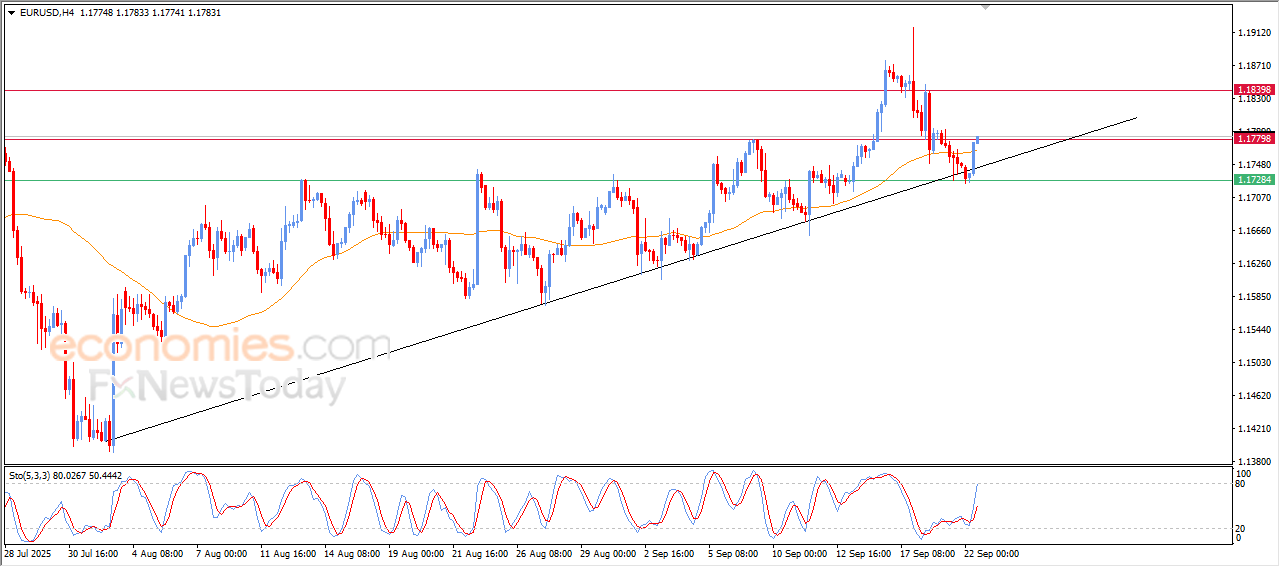
Following the bearish action seen in the second half of the previous week, EUR/USD corrects higher on Monday and trades above 1.1750. As investors await comments from central bank officials, the pair’s technical outlook doesn’t yet reflect a buildup of recovery momentum.
The table below shows the percentage change of Euro (EUR) against listed major currencies last 7 days. Euro was the weakest against the Swiss Franc.
| USD | EUR | GBP | JPY | CAD | AUD | NZD | CHF | |
|---|---|---|---|---|---|---|---|---|
| USD | -0.24% | 0.42% | 0.16% | -0.23% | 0.75% | 1.58% | -0.27% | |
| EUR | 0.24% | 0.69% | 0.35% | 0.00% | 1.03% | 1.78% | -0.04% | |
| GBP | -0.42% | -0.69% | -0.26% | -0.67% | 0.34% | 1.09% | -0.83% | |
| JPY | -0.16% | -0.35% | 0.26% | -0.41% | 0.63% | 1.41% | -0.43% | |
| CAD | 0.23% | -0.01% | 0.67% | 0.41% | 1.09% | 1.77% | -0.16% | |
| AUD | -0.75% | -1.03% | -0.34% | -0.63% | -1.09% | 0.75% | -1.09% | |
| NZD | -1.58% | -1.78% | -1.09% | -1.41% | -1.77% | -0.75% | -1.90% | |
| CHF | 0.27% | 0.04% | 0.83% | 0.43% | 0.16% | 1.09% | 1.90% |
The heat map shows percentage changes of major currencies against each other. The base currency is picked from the left column, while the quote currency is picked from the top row. For example, if you pick the Euro from the left column and move along the horizontal line to the US Dollar, the percentage change displayed in the box will represent EUR (base)/USD (quote).
EUR/USD registered losses for three consecutive days to end the week as the US Dollar (USD) benefited from the Federal Reserve’s cautious tone on aggressive policy easing moving further.
Assessing the Fed’s policy outlook and the USD’s futures, “despite Fed Chair Jerome Powell’s cautionary tone, the FOMC has clearly shifted to a dovish stance where it sees multiple cuts, and the focus is now firmly on the employment side of the mandate,” noted ING analysts and added:
“Our call is for two more 25 basis-points cuts this year, and we see the cheapening of the Dollar’s funding cost as driving more depreciation in an already seasonally weak end of the year for the greenback.”
The US economic calendar will not feature any high-tier data releases on Monday. Several Fed policymakers will be delivering speeches during the American trading hours. In case Fed officials reiterate that they will not commit to a steady easing of the policy, citing upside risks to inflation, the USD could stay resilient against its rivals and make it difficult for EUR/USD to gather bullish momentum.
European Central Bank (ECB) Chief Economist Philip Lane and Governing Council Member Joachim Nagel will also be speaking in the second half of the day. ECB policymaker Mario Centeno said on Friday that the ECB’s next move is likely to be a rate cut, noting that he still sees inflation risks to the downside. Similar remarks from ECB officials could be negative for the Euro with the immediate reaction.
The Fibonacci 23.6% retracement of the latest uptrend aligns as a pivot level at 1.1770. In case EUR/USD fails to clear this level, technical buyers could be discouraged. In this scenario, 1.1730 (100-period Simple Moving Average (SMA) on the 4-hour chart) could be seen as the first support level before 1.1690-1.1700 (Fibonacci 38.2% retracement, 200-period SMA) and 1.1640 (Fibonacci 50% retracement).
Looking north, resistance levels could be spotted at 1.1800 (static level, round level), 1.1850 (upper limit of the ascending channel) and 1.1870 (end-point of the uptrend).
The Euro is the currency for the 19 European Union countries that belong to the Eurozone. It is the second most heavily traded currency in the world behind the US Dollar. In 2022, it accounted for 31% of all foreign exchange transactions, with an average daily turnover of over $2.2 trillion a day.
EUR/USD is the most heavily traded currency pair in the world, accounting for an estimated 30% off all transactions, followed by EUR/JPY (4%), EUR/GBP (3%) and EUR/AUD (2%).
The European Central Bank (ECB) in Frankfurt, Germany, is the reserve bank for the Eurozone. The ECB sets interest rates and manages monetary policy.
The ECB’s primary mandate is to maintain price stability, which means either controlling inflation or stimulating growth. Its primary tool is the raising or lowering of interest rates. Relatively high interest rates – or the expectation of higher rates – will usually benefit the Euro and vice versa.
The ECB Governing Council makes monetary policy decisions at meetings held eight times a year. Decisions are made by heads of the Eurozone national banks and six permanent members, including the President of the ECB, Christine Lagarde.
Eurozone inflation data, measured by the Harmonized Index of Consumer Prices (HICP), is an important econometric for the Euro. If inflation rises more than expected, especially if above the ECB’s 2% target, it obliges the ECB to raise interest rates to bring it back under control.
Relatively high interest rates compared to its counterparts will usually benefit the Euro, as it makes the region more attractive as a place for global investors to park their money.
Data releases gauge the health of the economy and can impact on the Euro. Indicators such as GDP, Manufacturing and Services PMIs, employment, and consumer sentiment surveys can all influence the direction of the single currency.
A strong economy is good for the Euro. Not only does it attract more foreign investment but it may encourage the ECB to put up interest rates, which will directly strengthen the Euro. Otherwise, if economic data is weak, the Euro is likely to fall.
Economic data for the four largest economies in the euro area (Germany, France, Italy and Spain) are especially significant, as they account for 75% of the Eurozone’s economy.
Another significant data release for the Euro is the Trade Balance. This indicator measures the difference between what a country earns from its exports and what it spends on imports over a given period.
If a country produces highly sought after exports then its currency will gain in value purely from the extra demand created from foreign buyers seeking to purchase these goods. Therefore, a positive net Trade Balance strengthens a currency and vice versa for a negative balance.
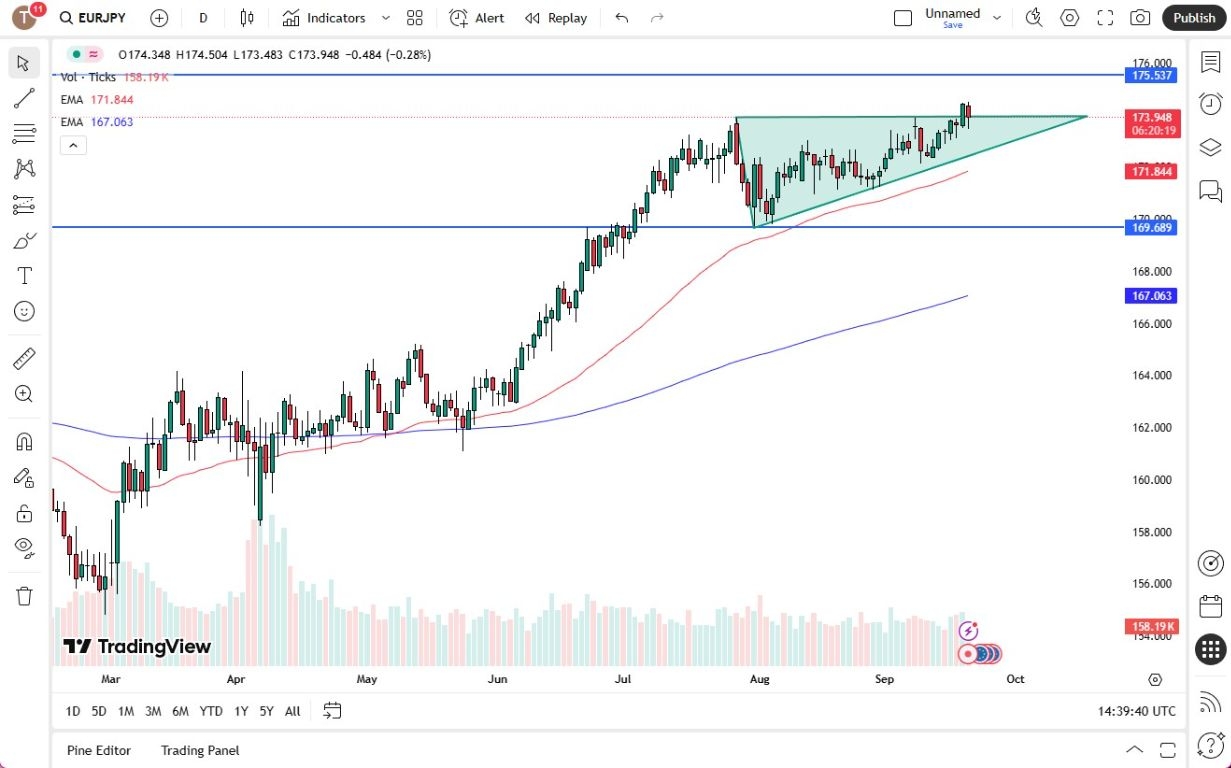
The Bank of Japan chose to hold interest rates stable, but they stopped buying ETF’s, which means they are not willing to help risk assets. That is in a roundabout way slightly tighter with monetary policy, but at the end of the day I think really what it comes down to is that the Bank of Japan is not going to be raising rates anytime soon, and therefore I think the market will continue to show the Japanese yen unless of course we get a major move to a “run to safety” type of attitude. Based on the ascending triangle, the potential target is going to be somewhere near the ¥177 level, but that doesn’t mean that we have to get there overnight.

Remember that the interest rate differential still favors the euro, although the euro isn’t the high yielding currency that I would choose based on swap to trade against the Japanese yen. From a technical analysis standpoint, it’s obvious that this is a market that is very bullish, and what I find interesting about the ascending triangle is that it not only has an up trending line but also has the 50 Day EMA sitting right at that line offering support as well. Ultimately, this is a market that I’m looking at dips as potential buying opportunities, and therefore I think it’s only a matter of time before we get involved in this market to the upside yet again.
Begin trading our daily forecasts and analysis. Here is a list of Forex brokers in Japan to work with.
Christopher Lewis has been trading Forex and has over 20 years experience in financial markets. Chris has been a regular contributor to Daily Forex since the early days of the site. He writes about Forex for several online publications, including FX Empire, Investing.com, and his own site, aptly named The Trader Guy. Chris favours technical analysis methods to identify his trades and likes to trade equity indices and commodities as well as Forex. He favours a longer-term trading style, and his trades often last for days or weeks.