The main category of Forex News.
You can use the search box below to find what you need.
[wd_asp id=1]
The main category of Forex News.
You can use the search box below to find what you need.
[wd_asp id=1]
Welcome, my fellow traders! I have prepared a price forecast for US Crude, XAUUSD, and EURUSD using a combination of the margin zones method and technical analysis. Based on the market analysis, I suggest entry signals for intraday traders.
The euro has broken through the support zone B at 1.1585–1.1572.
The article covers the following subjects:
The price of oil is trading within a short-term uptrend, rising from the support zone A at 96.45–96.01. The primary bullish target is the September 11 high.
If the price settles above the September 11 high, the rally may continue toward the Target Zone 3 at 103.27–102.40. Should the oil price decline and break below support A, the correction will extend toward support B at 94.27–93.61.
Hold part of the long trades opened at support A at 96.45–96.01. TakeProfit: 98.40, 100.75. StopLoss: at breakeven.
Yesterday, gold prices fell further. As a result, the metal reached the second bearish target set for the trades opened at resistance B at 4,451–4,436. This target was the September 2nd low of 4,282. Additionally, the price tested the Gold Zone of 4,286–4,276. If it breaks below this zone, the decline will likely continue to the Target Zone 2 at 4,158–4,135.
Consider short trades during pullbacks at resistance A at 4,373–4,362 or resistance B at 4,433–4,417.
Sell near resistance A at 4,373–4,362. TakeProfit: 4,313, 4,253. StopLoss: 4,400.
The euro has breached the support zone B at 1.1585–1.1572. As a result, the short-term trend has turned downward. The new bearish target is the lower Target Zone of 1.1459–1.1434.
Consider short trades during a pullback from resistance A at 1.1615–1.1607, with the first target at 1.1569 and the second at 1.1523.
Sell near resistance A at 1.1615–1.1607. TakeProfit: 1.1569, 1.1523. StopLoss: 1.1636.
Would you like to learn more about technical analysis methods and principles? Explore our comprehensive guide.
P.S. Did you like my article? Share it in social networks: it will be the best “thank you” 🙂
Useful links:
The content of this article reflects the author’s opinion and does not necessarily reflect the official position of LiteFinance broker. The material published on this page is provided for informational purposes only and should not be considered as the provision of investment advice for the purposes of Directive 2014/65/EU.
According to copyright law, this article is considered intellectual property, which includes a prohibition on copying and distributing it without consent.
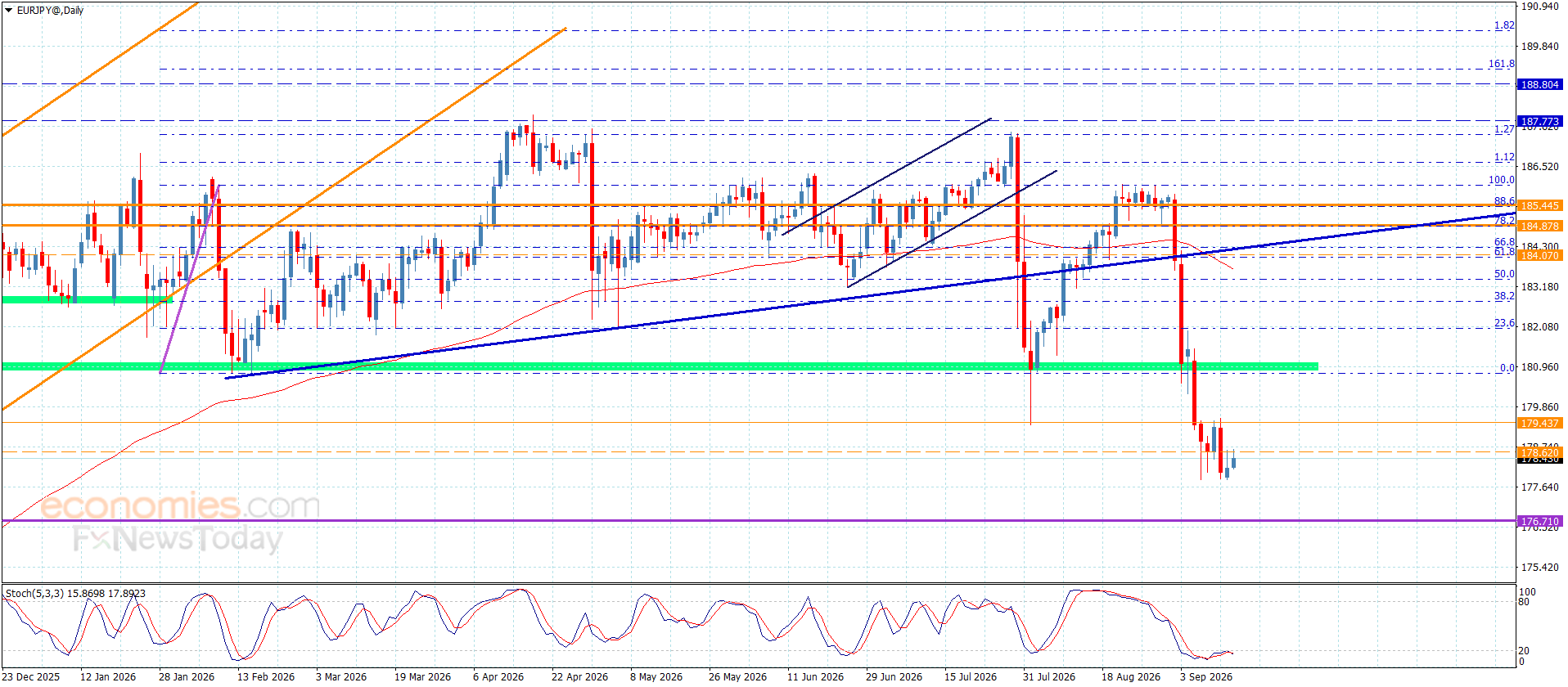
The pair attempted to benefit from the Stochastic indicator’s move out of oversold territory by forming some corrective bullish waves, with the price currently fluctuating near 178.55. This rebound does not pose any threat to the bearish scenario, supported by the stability of the key resistance at 180.80, in addition to the formation of 179.45 as an additional barrier against further bearish trading.
Accordingly, we will continue to wait for the price to gather additional bearish momentum, which would strengthen the chances of attacking 177.35 soon and then attempting to pressure the next support at 176.70.
The expected trading range for today is between 177.35 and 179.40
Trend forecast: Bearish
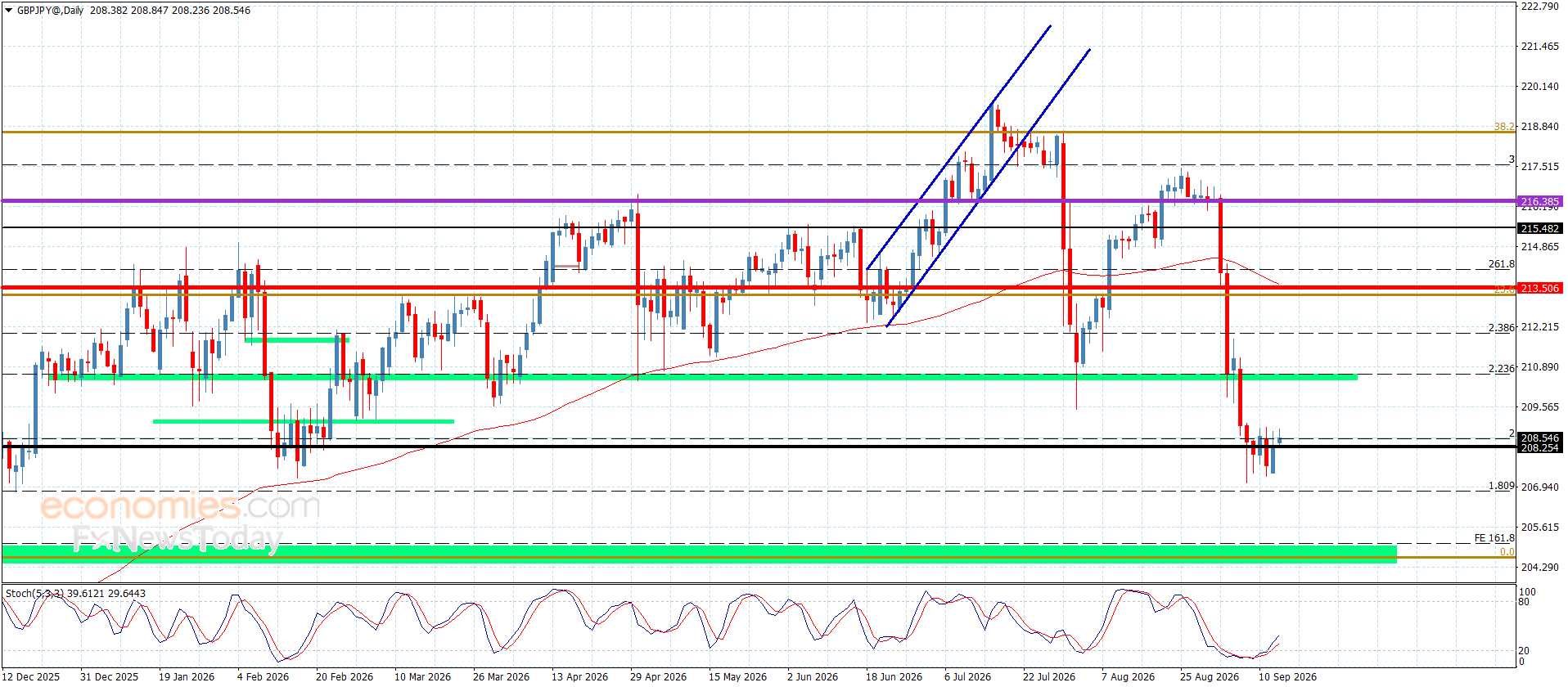
The pair’s bearish outlook remains unchanged despite forming some recent bullish waves and stabilizing near 205.60, as it continues to hold below the key resistance at 210.40. The conflicting signals from the main indicators may force the price to extend its mixed trading, with a possibility of retesting the resistance in the near term.
However, if the price succeeds in gathering bearish momentum, it could form strong bearish waves, breaking below 206.85 and then attempting to reach the main bearish targets at 205.90 and 205.10.
The expected trading range for today is between 207.80 and 209.45
Trend forecast: Fluctuating
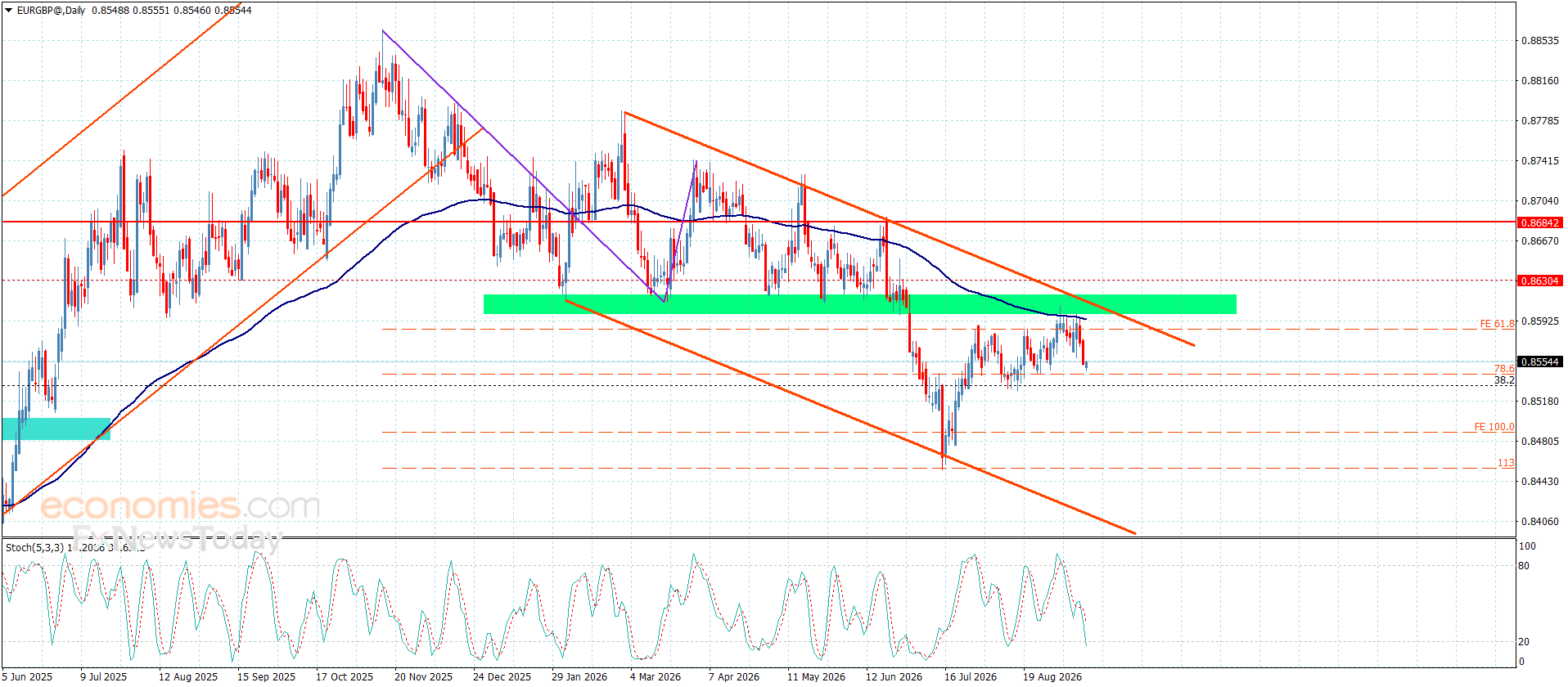
The pair ended its corrective bullish rebound after encountering resistance near 0.8605 and stabilizing below it, maintaining its overall movement within the bearish channel shown on the attached chart.
The main indicators have also started providing bearish momentum, supporting the continuation of the negative scenario. The price is currently stabilizing near 0.8550, and we expect it to resume its bearish attack soon, targeting 0.8520 and then 0.8480.
The expected trading range for today is between 0.8520 and 0.8575
Trend forecast: Bearish
The Silver price recovered to $64.48 an ounce on Friday, clawing back less than a third of Thursday’s losses.
The 1.64% rebound still left XAG/USD down 2.6% over the week, with the metal needing a sustained recovery to reach UBS’s forecasts.
The bank’s silver price forecast starts at $70 in December 2026, rises to $75 in March and June 2027, then reaches $80 that September.
UBS has retained its earlier September projections, with December’s $70 estimate around 8.6% above Friday’s close and September 2027’s $80 target 24% higher.

Silver prices gained despite US core inflation accelerating to 0.3% month-on-month in August from 0.2% in July.
UBS had already anticipated a rate rise before those figures arrived.
The bank said on 10 September: “Our economists’ base case is that the Fed will raise its policy rate by 25bps. Given current market expectations, the hike itself should have a relatively limited impact.”
Its focus was the accompanying message: “More important will be whether markets interpret the decision and the tone of the subsequent press conference as leaning hawkish or dovish.”
In its currency outlook, UBS added: “In our base case, we do not expect a hawkish hike that would provide broad support for the dollar.”
That leaves room, in our view, for silver to recover even if US rates rise, provided the dollar does not strengthen materially.
The Fed’s 15–16 September meeting will test that reading, with most of Thursday’s silver losses still unrecovered.
Our currency coverage draws on live market data, official economic releases and published bank research.
– Written by
Frank Davies
STORY LINK GBP/USD Forecast: Could Rising UK Unemployment Push Sterling Lower?
The Pound US Dollar (GBP/USD) exchange rate fell on Monday, with expectations of a Federal Reserve interest rate hike this week lending support to the ‘Greenback’.
At the time of writing, GBP/USD was trading at $1.3473, down 0.4% on the day.
The US Dollar (USD) gained ground on Monday as traders moved into the ‘Greenback’ ahead of the Federal Reserve’s interest rate announcement on Wednesday evening.
The prospect of an interest rate hike from the Fed, which markets widely anticipate at this week’s meeting, helped bolster demand for the US currency.
The safe-haven US Dollar also benefited from growing risk aversion.
Tensions in the Middle East intensified as Yemen’s Houthi rebels stepped up attacks on Saudi Arabian energy infrastructure, unsettling financial markets.
The Pound (GBP) struggled for direction on Monday, with Sterling traders keeping their powder dry ahead of a packed week of UK economic developments.
Get better rates and lower fees on your next international money transfer.
Compare TorFX with top UK banks in seconds and see how much you could save.
With few domestic releases expected to influence trading at the start of the week, focus shifted towards the heavier run of data and events ahead.
Among the key releases on the agenda were the latest UK labour market figures, consumer price index, Bank of England (BoE) interest rate decision and retail sales data.
With several potential catalysts approaching, GBP traders were reluctant to take sizeable positions.
This left the Pound subdued as the new trading week got underway.
Looking forward, Tuesday’s UK employment figures are set to give Sterling its first major test of the week, as traders assess what the data could reveal about the strength of the labour market.
UK unemployment is forecast to edge higher from 4.9% to 5% in the three months to July, while wage growth including bonuses is expected to have slowed over the same period.

Signs of a weakening jobs market could put further pressure on the Pound, particularly with the Bank of England’s interest rate decision due later in the week.
Across the Atlantic, the US economic calendar is relatively quiet on Tuesday.
This could leave USD more exposed to shifts in risk appetite, with a risk-off environment potentially providing support for the ‘Greenback’.
International Money Transfer? Ask our resident FX expert a money transfer question or try John’s new, free, no-obligation personal service! ,where he helps every step of the way,
ensuring you get the best exchange rates on your currency requirements.
TAGS: Pound Dollar Forecasts
Domestic coffee prices
Coffee prices today in the domestic market are trending sideways. According to giacaphe. com, coffee prices on September 14th averaged at 95. 200 VND/kg, anchored in the price range of 94. 700-95. 300 VND/kg.
In Gia Lai and Dak Lak, coffee prices are recorded at 95,200 VND/kg.
In Lam Dong, the listed coffee price is at 94,700 VND/kg.
The old Dak Nong area recorded a level of 95. 300 VND/kg.
The USD/VND exchange rate according to Vietcombank is recorded at 25,700 VND/USD.
World coffee prices
In the world market, coffee prices remained unchanged for all terms.
According to Barchart, the September 2026 Robusta contract is anchored at $3,495/ton. In the same direction, the November 2026 term is listed at $3,525/ton. The term from January 2027 to May 2027 is listed in the $3,482 – $3,508/ton price range.
Meanwhile, the September 2026 Arabica futures contract held at 313.65 cents/lb. The December 2026 futures were offered to the market at 285.70 cents/lb. Further forwards were anchored in the 272.20 – 277.20 cents/lb range.
Assessments and forecasts
Traders are planning to bring a large amount of Arabica coffee from Brazil – the world’s largest coffee producer – to certified warehouses of the Intercontinental Exchange (ICE), where inventories have fallen to their lowest level in 26 years, thereby pushing coffee prices up.
Arabica coffee contracts operated by ICE Futures U.S., acting as the global reference price for the coffee market, hit a 6-month high in July, exceeding 3.5 USD/pound. Prices remain around this level despite market forecasts that supply will be significantly surplus in the 2026/27 crop year.
Industry experts believe that the main reason why coffee prices remain high, currently around 3 USD/pound, is that Arabica coffee inventories on the ICE exchange are low. About 70% of these inventories are stored in Antwerp, Belgium.
The amount of coffee from Brazil brought to ICE warehouses is likely to cause certified inventory to increase more than 2 times. This is an indicator that has a major impact on coffee prices, because it clearly reflects the surplus of coffee ready to be delivered on the exchange.
Many investment funds use algorithms programmed to automatically sell when stocks on the exchange increase and buy when stocks decrease.
Brent oil moved above the $107.00 level as reports indicated that Saudi East-West pipeline will not work for several weeks after an attack. I’d note that oil prices pulled back from session highs after President Trump announced that Russia and Ukraine agreed not to attack energy facilities. Russia and Ukraine have not confirmed the existence of such a deal.
In case U.S. Dollar Index stays above the support level at 99.25 – 99.40, it will move towards the resistance level at 99.85 – 100.00. On the support side, a successful test of the support at 99.25 – 99.40 will open the way to the test of the next support, which is located in the 98.60 – 98.75 range.
One of the most important developments for the oil market is the temporary shutdown of Saudi Arabia’s East-West Pipeline.
The pipeline normally provides Saudi Arabia with an alternative route to export crude through the Red Sea, reducing its dependence on the Strait of Hormuz.
Following attacks, Saudi Arabia temporarily shut the pipeline while emergency teams assessed the damage. Reuters reported that the outage could threaten as much as 4% of global oil supply if it persists.
The importance of the pipeline has increased because shipping through the Strait of Hormuz has already been severely disrupted.
According to Reuters, Saudi crude production had fallen to around 6.2 million barrels per day in August, compared with 10.9 million barrels per day in February.
That leaves the market with less room to absorb another supply shock.
The Strait of Hormuz remains one of the most important variables for the oil market.
Shipping activity through the strait has fallen significantly, while a vessel was reportedly hit by a projectile during the weekend. Reuters reported that only four outbound and 10 inbound vessels were recorded over the weekend, compared with a recent 10-day average of around 14 daily transits.
Any further reduction in tanker traffic could increase the geopolitical premium embedded in crude prices.
For WTI traders, this means that headlines surrounding the Gulf can produce significant intraday volatility.
The market had been hoping that diplomatic discussions could provide a path towards reopening safer shipping routes.
However, Oman’s foreign minister confirmed that a planned meeting between Iran and Gulf countries had been postponed.
That reduces the probability of an immediate de-escalation and leaves the oil market focused on physical supply rather than diplomatic progress.
The risk is no longer limited to the Strait of Hormuz.
Houthi forces have intensified their activities around the Red Sea and Bab el-Mandeb, creating another obstacle for oil transportation.
Reuters reported that the Houthi advance along Yemen’s Red Sea coastline is increasing pressure on Saudi oil exports and global shipping routes.
This creates a dangerous scenario for the oil market: multiple export routes are facing simultaneous geopolitical risks.
– Written by
David Woodsmith
STORY LINK Euro to Dollar Forecast: September Fed Hike Could Decide USD Outlook
The Euro to Dollar exchange rate (EUR/USD) held close to 1.1600 last week despite another surge in US Treasury yields, with markets now focused squarely on Federal Reserve Chair Kevin Warsh and this week’s crucial policy decision.
A September rate hike is increasingly expected, but the bigger question for the Dollar is whether the Fed can ultimately deliver the tightening cycle already priced into markets.
SEB expects the dollar to hold steady in the short term and potentially advance slightly over the remainder of 2026, but the bank expects the Euro to Dollar (EUR/USD) exchange rate will strengthen to 1.23 by the end of 2027.
Goldman Sachs, however, has a 12-month EUR/USD forecast of 1.12.
The main feature during the week was a slide in US Treasuries with the 10-year yield jumping to near 5.00% and the highest level for over three years. Higher energy prices contributed to the fears with Brent hitting 4-month highs above $100 p/b.
Despite this volatility, EUR/USD was held in relatively tight ranges and settled close to 1.16.
Get better rates and lower fees on your next international money transfer.
Compare TorFX with top UK banks in seconds and see how much you could save.
The headline US inflation rate held at 3.4% for August with the core rate edging lower to 2.4% from 2.5% and in line with consensus forecasts.
Markets are now pricing in close to a 70% chance that the Federal Reserve will raise interest rates at this week’s meeting.
ING commented; “It is a close call, but after Kevin Warsh’s hawkish speech at Jackson Hole, we now see a 25bp Fed hike to 4.00% on 16 September.”
Markets also consider that the most likely outcome is three rate increases by March 2027.
According to SEB; “Rates have continued to rise during the summer and a sticky inflation scenario for the Fed now looks reflected in pricing. A question is if the Fed will be able to meet expectations – it is not obvious to us. Meanwhile Scott Bessent has begun a more activist approach via Yen intervention and increasing treasury buybacks, both having a negative Dollar impact.”
It added; “This is happening with a backdrop where the global positioning in the Dollar has only increased (via lower FX hedge ratios). Thus, the outlook would seem to be skewed towards Dollar weakness, triggered by an eventual global disinflation impulse (Hormuz reopening) – this is looking like a story for 2027 though.”
SEB did note Euro-Zone reservations; “French budget/election is a risk, but bias is that Euro can climb this wall of worry by avoiding the most negative market outcome.”
The ECB raised rates by 25 basis points at the latest policy meeting with the deposit rate hiked to 2.50%. There were also hints that a further increase is possible before year-end.
Euro-Zone energy prices continued to increase with natural gas prices at fresh 3-year highs.
Goldman Sachs commented; “On net, we see moderate risks of energy-driven EUR under-performance ahead.”
International Money Transfer? Ask our resident FX expert a money transfer question or try John’s new, free, no-obligation personal service! ,where he helps every step of the way,
ensuring you get the best exchange rates on your currency requirements.
TAGS: Euro Dollar Forecasts