The main category of Forex News.
You can use the search box below to find what you need.
[wd_asp id=1]
The main category of Forex News.
You can use the search box below to find what you need.
[wd_asp id=1]
Momentum has been building since last week’s bullish breakout from a falling wedge pattern. That advance was reinforced by a reclaim of several key resistance levels, including the 20-Day moving average. If today’s low of $3.02 is broken, natural gas could revisit support near the long-term anchored VWAP, now at $2.96, with further downside risk toward the 20-Day moving average at $2.89. For now, though, the market continues to trade well above those levels, suggesting that buyers remain in control.
The 50-Day moving average is a critical pivot. A sustained advance and daily close above this average would open the door for a rally through the July swing high of $3.19 and potentially toward the 200-Day average, now near $3.50. Conversely, another rejection here would not be surprising given the nearly 20% rally off the recent $2.62 low. A brief consolidation or pullback would provide a healthier setup for continuation, rather than a straight-line advance.
On the larger timeframe, natural gas continues to show signs of strength. Last week produced a wide-ranging bullish engulfing pattern on the weekly chart, supported by a bullish reversal confirmation this week. A weekly close above last week’s high of $3.02 would cement the breakout and bolster the case for a push through current resistance. That confirmation, coupled with strong price behavior above the AVWAP and 20-Day average, underscores improving demand.
For a look at all of today’s economic events, check out our economic calendar.
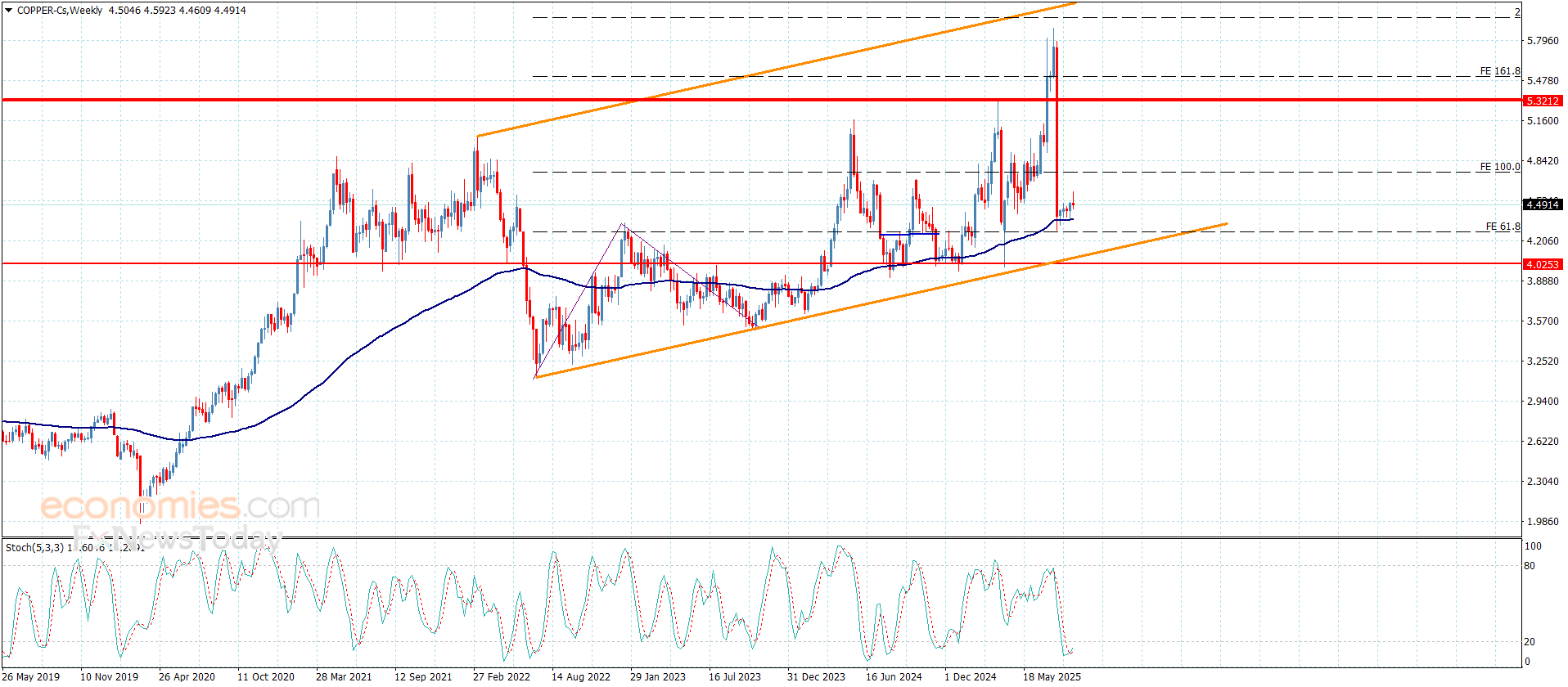
Copper price touched $4.5950 yesterday, to approach from the initial positive target, which forces it to form sideways fluctuation, due to its neediness to the positive momentum by the stability of stochastic with the oversold level.
While the stability of the price is within the bullish track, by moving away from the extra support at $4.2600, by providing positive momentum by the moving average 55, these factors make us keep the bullish suggestion, to expect surpassing $4.6200 level and reaching the next target near $4.7500.
The expected trading range for today is between $4.4200 and $4.7500
Trend forecast: Bullish
The USD/JPY pair has stabilized above the 148 handle, climbing to 148.75 with a 0.30% daily gain after wiping out yesterday’s decline. The rebound comes as U.S. data eased concerns about a stalling economy highlighted in the Beige Book, with traders repositioning ahead of Friday’s nonfarm payrolls. The pair’s price action since mid-August continues to confirm a sequence of higher lows and higher highs, reinforcing the short-term bullish channel that targets 149.00 and 150.75 if momentum persists.
U.S. economic data shows clear signs of cracks in the labor market. Job openings fell to 7.18 million in July from 7.36 million in June, the lowest in nearly a year. ADP reported private sector hiring of just 54,000 in August, down from July’s 104,000, while layoffs are ticking higher. The ISM Services survey showed employment stuck in contraction even as new orders remained firm. These signals highlight a cooling jobs market, bolstering expectations that the Federal Reserve will proceed with its widely anticipated 25 bps rate cut at the September 16–17 meeting. CME FedWatch places probability of the move above 95%, with a 53% chance of another cut on October 29. Fed’s John Williams reinforced the cautious easing stance, calling policy only “modestly restrictive” and leaving the door open for gradual rate reductions if inflation cools further.
The Bank of Japan remains cautious despite its first steps toward normalization earlier this year. Governor Kazuo Ueda has reiterated a gradual pace of rate hikes, contingent on inflation and growth alignment, but recent comments from Deputy Governor Ryuzo Himino stressed that uncertainty is too high to justify urgency. Current pricing assigns less than a 30% probability of a September hike. At the same time, Japan’s political backdrop is weakening the yen. Ruling party secretary-general Hiroshi Moriyama’s resignation, combined with speculation that Prime Minister Shigeru Ishiba may also step down, has fueled expectations that Sanae Takaichi—known for supporting ultra-low rates—could emerge as a successor. Political risk and the likelihood of continued accommodative BoJ policy underpin yen softness, helping drive USD/JPY back toward five-week highs near 149.14.
Technically, USD/JPY has been consolidating between the 147.85 support—coinciding with the 200-day EMA—and resistance near 149.10. A close above 149.12 would extend the rebound from 146.20 and retest the 150.90 zone, which represents both the prior high and the 61.8% Fibonacci retracement of the January–April downtrend. If bulls clear this hurdle, the path opens toward 151.22 and possibly 154.60. Momentum indicators support the bullish case: the MACD on the daily chart is preparing for a bullish crossover, and RSI remains in neutral territory with room to climb. On the downside, a break under 146.65 would end the bullish sequence, exposing 145.35 and the 23.6% Fibonacci retracement at 144.35 as deeper supports.
With USD/JPY pinned at 148.65–148.75 into Thursday’s U.S. close, traders are balancing Fed dovish expectations with BoJ’s cautious stance. Friday’s NFP will be decisive: consensus stands at 75,000 jobs added, barely above last month’s 73,000. A miss would accelerate dollar selling and test 147.85, while a stronger print could price out aggressive Fed cuts and propel the pair toward 151.00. Japanese household spending and labor earnings data due the same day will also provide insight into domestic demand, influencing how much leeway the BoJ has for policy shifts.
Gold (XAU/USD) is holding firm at $3,611 per ounce after opening futures at $3,619.80, marking a 0.7% rise from Wednesday’s close at $3,593.20. The metal has surged 45.3% year-over-year, climbing from $2,490 in September 2024, and is now up 36% year-to-date. Momentum was fueled by investors hedging against inflation, fiscal stress, and political intervention in central banking. The rally has firmly positioned bullion as one of the most aggressive outperformers in 2025, eclipsing major equity benchmarks and rivaling cryptocurrencies.
Strategists at Goldman Sachs argue that if President Trump’s pressure on the Federal Reserve erodes its independence, capital flight from Treasuries could ignite a historic move in XAU/USD. Their “tail-risk” model points to $4,500, with a 1% reallocation of Treasury holdings capable of driving gold toward $5,000 per ounce. At present, gold ETFs represent just 1% of the Treasury market’s size. If even a sliver of bond capital rotates into bullion, the demand shock could break records. Current spot stands at $3,596 on Comex, with traders placing a 98% probability on a September Fed rate cut, further enhancing the non-yielding asset’s appeal.
The rise is not retail-led alone. Global central banks have been net buyers, reducing exposure to dollar-denominated assets amid $37 trillion in U.S. government debt and an annual interest bill nearing $1 trillion. Gold now accounts for about 20% of global central bank reserves, surpassing the euro. The U.S. Dollar Index has slipped to 95.63, showing a –0.25 correlation with gold, its weakest in two years. This negative relationship amplifies bullion’s upside as the dollar weakens under debt concerns and tariff-driven inflation.
While the global narrative is bullish, gold miners are experiencing mixed results. Metals Exploration PLC (MTL), focused on operations in the Philippines and Nicaragua, reported interim revenue of $118.9 million, up 31% year-on-year, thanks to gold averaging $2,884 per ounce versus $2,190 last year. However, pretax profit plunged 71% to $16.8 million due to a sharp drop in impairment gains and a spike in other expenses to $18.8 million. Operating profit still more than doubled to $29.1 million, while free cash flow hit a record $70.7 million. Shares fell 2.1% to 12.64 pence in London trading, highlighting the volatility miners face even with bullion at historic highs.
Chart watchers view $3,500 as the critical support zone for XAU/USD, a level tested during Thursday’s session before rebounding. Analysts highlight $3,700 as the next breakout threshold, aligning with Goldman Sachs’ near-term year-end projection. RSI remains elevated, suggesting strong momentum but leaving room for corrective pullbacks. Traders are monitoring U.S. nonfarm payrolls closely, with weak labor data likely to provide the next impulse higher. Any breach below $3,500 could trigger quick tests of $3,450, but dips remain aggressively bought.
Local data shows how international bullion rallies ripple into emerging markets. In the Philippines, gold prices slipped slightly to PHP 6,495.52 per gram from PHP 6,544.82 the day before, translating international prices into peso terms. A troy ounce cost PHP 202,033.50, reflecting minor currency-driven fluctuations but broadly aligned with the global rise above $3,600.
U.S. government debt at 126% of GDP and political tension over the Fed have become primary catalysts for bullion demand. Trump’s firing of Fed Governor Lisa Cook and open criticism of Jerome Powell sparked renewed doubts about the Fed’s autonomy. Fiscal deficits—spending $7 trillion against $5 trillion in revenue—are forcing bond issuance at a time when investors are questioning Treasuries as reliable stores of value. Tariff battles have added further uncertainty, pushing global investors to diversify into gold.
Billionaire hedge fund managers like Ray Dalio argue that the U.S. is facing 1930s-style political and fiscal risks, making gold indispensable as a store of value. ETF assets are surging, and bullion now challenges Treasuries as a reserve hedge. Bridgewater and other funds have been reallocating capital toward metals, underscoring that this rally is not a speculative flash but a structural shift.
The GBP/USD pair trades around 1.3430, largely unchanged on the day, as market attention remains locked on diverging policy paths between the Federal Reserve and the Bank of England. U.S. labor data triggered volatility when August ADP numbers showed only 54,000 jobs added, far below July’s 104,000 and short of forecasts at 65,000. That miss deepened expectations that the Fed will be forced into multiple rate cuts, with CME FedWatch assigning a 95% probability of a September 17th cut and a 53% chance of another in October.
Sterling has found breathing space after the recent gilt turmoil eased. Yields on UK 30-year bonds dropped from a 27-year high of 5.75% to 5.58%, calming fears of a fiscal crunch that might have forced the Chancellor into harsher tax hikes and spending cuts. More importantly, BoE Governor Andrew Bailey reiterated that persistent inflation remains a concern, with CPI moving from 2.6% in March to 3.8% in July and possibly near 4% in August, well above the 2% target. This cautious tone reduced the likelihood of another immediate cut from the current 4.00% base rate, reinforcing GBP demand in contrast to a Fed leaning dovish.
Beyond ADP, U.S. ISM Services PMI rose to 50.9 in August from 50.1 in July, showing some resilience in the service sector. However, weekly jobless claims and Challenger job cuts highlight fragility in employment. The July trade deficit is expected to widen to $77.7 billion from $60.2 billion, underscoring external imbalances. Dollar flows remain mixed, with the greenback stabilizing after its sharp selloff earlier in the week. This left GBP/USD consolidating rather than breaking decisively higher, even with Fed cuts largely priced.
Cable remains in a narrow channel with support at 1.3350–1.3380, levels tested earlier in the week before buyers reclaimed 1.3400. Resistance emerges at 1.3458 intra-day highs and more significantly at 1.3579, a level that if breached would erase the bearish formation since July. Indicators are turning cautiously bullish: RSI has rebounded toward 50, MACD is near neutral, and price action continues to cling to the 50-day EMA around 1.3460. A sustained push above 1.3460 could open the way toward 1.36, while failure to hold 1.34 risks another slide toward 1.32, a floor last seen in early August.
Markets also factor in seasonality, as September often brings weaker performance for GBP/USD, similar to the “red September” effect observed in other assets. UK retail sales due Friday are expected to show contraction, potentially exposing consumer fragility. Fiscal risks remain a cap on upside; losses on UK debt from the BoE’s QE program are estimated at £100 billion, making future bond purchases contentious. These concerns limit Sterling’s ability to fully capitalize on dollar weakness.
With GBP/USD at 1.3430, fundamentals tilt in favor of Sterling in the near term given Fed cut probabilities above 95% and BoE caution against easing. Technicals show resilience above 1.34 but resistance at 1.3460–1.3579 looms. Fiscal pressures and weak UK consumer data could offset gains, but the policy divergence remains supportive. Based on current data, GBP/USD is positioned bullish in the short term, targeting 1.35–1.36, while a break under 1.3350 would shift bias back to bearish.
Storage levels remain robust across all regions, with the South Central posting a modest 4 Bcf increase. The East and Midwest both added 28 Bcf, while the Pacific region saw a rare draw of 4 Bcf. The Mountain region was flat. While the report didn’t surprise, it underlines that the supply-demand balance remains tilted toward surplus.
Recent gains in natural gas were driven by forecasts for above-normal temperatures in the Midwest and Northern U.S. during the September 8–17 period. However, the near-term forecast (Sep 2–8) shows mild conditions across key demand regions, including the Midwest and Southeast, capping electricity-driven gas demand this week.
U.S. power output, however, has been a supportive factor. According to the Edison Electric Institute, electricity generation rose 7.7% y/y for the week ending August 23, contributing to firm cooling demand. Even so, it’s unclear how much of this is already priced in given near-record gas production.
U.S. dry gas production remains near record highs, holding at 105.7 Bcf/day, up 3.3% y/y. LNG feedgas demand came in at 15.0 Bcf/day, slightly down week-over-week. Meanwhile, active U.S. natural gas rigs declined by three to 122 last week, just below the two-year high of 124 reached in early August. Although rig counts dipped, elevated output continues to weigh on any bullish momentum, especially as inventories remain healthy and demand has not spiked.
Following Tuesday’s sharp decline, GBP/USD staged a rebound and closed in positive territory on Wednesday. The pair trades in a narrow band at around 1.3450 in the European session on Thursday as market focus shifts to the next batch of macroeconomic data releases from the US.
The table below shows the percentage change of British Pound (GBP) against listed major currencies this week. British Pound was the weakest against the US Dollar.
| USD | EUR | GBP | JPY | CAD | AUD | NZD | CHF | |
|---|---|---|---|---|---|---|---|---|
| USD | 0.37% | 0.37% | 0.86% | 0.61% | 0.40% | 0.51% | 0.63% | |
| EUR | -0.37% | -0.00% | 0.41% | 0.24% | 0.03% | 0.13% | 0.26% | |
| GBP | -0.37% | 0.00% | 0.32% | 0.24% | 0.03% | 0.14% | 0.31% | |
| JPY | -0.86% | -0.41% | -0.32% | -0.20% | -0.45% | -0.32% | -0.20% | |
| CAD | -0.61% | -0.24% | -0.24% | 0.20% | -0.19% | -0.12% | 0.07% | |
| AUD | -0.40% | -0.03% | -0.03% | 0.45% | 0.19% | 0.11% | 0.28% | |
| NZD | -0.51% | -0.13% | -0.14% | 0.32% | 0.12% | -0.11% | 0.17% | |
| CHF | -0.63% | -0.26% | -0.31% | 0.20% | -0.07% | -0.28% | -0.17% |
The heat map shows percentage changes of major currencies against each other. The base currency is picked from the left column, while the quote currency is picked from the top row. For example, if you pick the British Pound from the left column and move along the horizontal line to the US Dollar, the percentage change displayed in the box will represent GBP (base)/USD (quote).
Yields on the long-dated UK gilts turned south on Wednesday and supported Pound Sterling’s recovery. In the second half of the day, the US Dollar (USD) came under bearish pressure and allowed GBP/USD to stretch higher.
The US Bureau of Labor Statistics (BLS) reported that JOLTS Job Openings declined to 7.18 million in July from 7.35 million in June., missing the market expectation of 7.4 million.
Early Thursday, the yield on the 30-year UK gilt declines nearly 1% after falling 1.7% on Wednesday, helping GBP/USD keep its footing. Chancellor of the Exchequer Rachel Reeves dismissed concerns from Britain’s National Institute of Economic and Social Research (NIESR) late Wednesday. The NIESR noted that the UK faces a £50 billion budget gap and that the government may need to dip into International Monetary Fund (IMF) funding pools in the future if Parliament can’t sort out its budget issues.
The US ADP Employment Change and the Institute for Supply Management’s (ISM) Services Purchasing Managers’ Index (PMI) data for August will be featured in the US economic calendar on Thursday.
Markets expect employment in the private sector to rise by 65,000 in August. A disappointing print at or below 50,000 could be seen as a sign of a weak Nonfarm Payrolls data on Friday and weigh on the USD with the immediate reaction. On the other hand, a reading above 75,000 could be supportive for the currency and limit GBP/USD’s potential gains.
Later in the session, the Institute for Supply Management will publish the Services Purchasing Managers’ Index (PMI) report for August. If the headline PMI drops below 50 unexpectedly, the USD could come under renewed selling pressure. Conversely, a print above 50, especially if combined with an increase in the Employment Index of the survey, could cause GBP/USD to edge lower.
The Relative Strength Index (RSI) indicator on the 4-hour chart recovered to 50, reflecting sellers’ hesitancy.
On the upside, 1.3440-1.3460, where the 200-period SMA, Fibonacci 50% retracement of the latest downtrend and the 100-day SMA are located, remains intact as resistance. In case GBP/USD clears that hurdle, 1.3490-1.3500 (round level, 100-period SMA) could be seen as the next resistance level before 1.3535 (Fibonacci 61.8% retracement).
Looking south, support levels could be seen at 1.3390-1.3400 (Fibonacci 38.2% retracement, round level), 1.3330 (static level) and 1.3300 (Fibonacci 23.6% retracement).
The Pound Sterling (GBP) is the oldest currency in the world (886 AD) and the official currency of the United Kingdom. It is the fourth most traded unit for foreign exchange (FX) in the world, accounting for 12% of all transactions, averaging $630 billion a day, according to 2022 data.
Its key trading pairs are GBP/USD, also known as ‘Cable’, which accounts for 11% of FX, GBP/JPY, or the ‘Dragon’ as it is known by traders (3%), and EUR/GBP (2%). The Pound Sterling is issued by the Bank of England (BoE).
The single most important factor influencing the value of the Pound Sterling is monetary policy decided by the Bank of England. The BoE bases its decisions on whether it has achieved its primary goal of “price stability” – a steady inflation rate of around 2%. Its primary tool for achieving this is the adjustment of interest rates.
When inflation is too high, the BoE will try to rein it in by raising interest rates, making it more expensive for people and businesses to access credit. This is generally positive for GBP, as higher interest rates make the UK a more attractive place for global investors to park their money.
When inflation falls too low it is a sign economic growth is slowing. In this scenario, the BoE will consider lowering interest rates to cheapen credit so businesses will borrow more to invest in growth-generating projects.
Data releases gauge the health of the economy and can impact the value of the Pound Sterling. Indicators such as GDP, Manufacturing and Services PMIs, and employment can all influence the direction of the GBP.
A strong economy is good for Sterling. Not only does it attract more foreign investment but it may encourage the BoE to put up interest rates, which will directly strengthen GBP. Otherwise, if economic data is weak, the Pound Sterling is likely to fall.
Another significant data release for the Pound Sterling is the Trade Balance. This indicator measures the difference between what a country earns from its exports and what it spends on imports over a given period.
If a country produces highly sought-after exports, its currency will benefit purely from the extra demand created from foreign buyers seeking to purchase these goods. Therefore, a positive net Trade Balance strengthens a currency and vice versa for a negative balance.
Silver (XAG/USD) is trimming losses during Thursday’s European session opening. The precious metal’s reversal from long-term highs at $41.45 has been contained at the $40.50 area, and the pair has returned to levels a few pips shy of $41.00. at the time of writing.
Precious metals are correcting lower on Thursday as dovish comments from Fed speakers eased market concerns about a global debt crisis. Nevertheless, investors’ appetite for risk remains subdued, which keeps XAG/USD’s downside attempts limited.
The technical picture shows a healthy downside correction, following a nearly 7% appreciation in a seven-day rally. The broader bullish trend remains in play, with the 4-hour RSI pulling back from overbought levels, but still above the key 50 line, and price action moving within an ascending channel.
Bears have been contained at the $40.55 level so far. Further down, the September 2 low, at 40.15, and the previous top, at $39.50, are seen as plausible targets for a corrective reversal.
Elliot Wave theorists would argue that the pair is on the fourth wave of a 5-wave bullish cycle. Immediate resistance is at Wednesday’s high, at the $41.45 area and the potential target of the fifth wave, at the confluence of the near-term channel top with the 127.2% Fibonacci extension of the early September rally, around $42.40.
Silver is a precious metal highly traded among investors. It has been historically used as a store of value and a medium of exchange. Although less popular than Gold, traders may turn to Silver to diversify their investment portfolio, for its intrinsic value or as a potential hedge during high-inflation periods. Investors can buy physical Silver, in coins or in bars, or trade it through vehicles such as Exchange Traded Funds, which track its price on international markets.
Silver prices can move due to a wide range of factors. Geopolitical instability or fears of a deep recession can make Silver price escalate due to its safe-haven status, although to a lesser extent than Gold’s. As a yieldless asset, Silver tends to rise with lower interest rates. Its moves also depend on how the US Dollar (USD) behaves as the asset is priced in dollars (XAG/USD). A strong Dollar tends to keep the price of Silver at bay, whereas a weaker Dollar is likely to propel prices up. Other factors such as investment demand, mining supply – Silver is much more abundant than Gold – and recycling rates can also affect prices.
Silver is widely used in industry, particularly in sectors such as electronics or solar energy, as it has one of the highest electric conductivity of all metals – more than Copper and Gold. A surge in demand can increase prices, while a decline tends to lower them. Dynamics in the US, Chinese and Indian economies can also contribute to price swings: for the US and particularly China, their big industrial sectors use Silver in various processes; in India, consumers’ demand for the precious metal for jewellery also plays a key role in setting prices.
Silver prices tend to follow Gold’s moves. When Gold prices rise, Silver typically follows suit, as their status as safe-haven assets is similar. The Gold/Silver ratio, which shows the number of ounces of Silver needed to equal the value of one ounce of Gold, may help to determine the relative valuation between both metals. Some investors may consider a high ratio as an indicator that Silver is undervalued, or Gold is overvalued. On the contrary, a low ratio might suggest that Gold is undervalued relative to Silver.
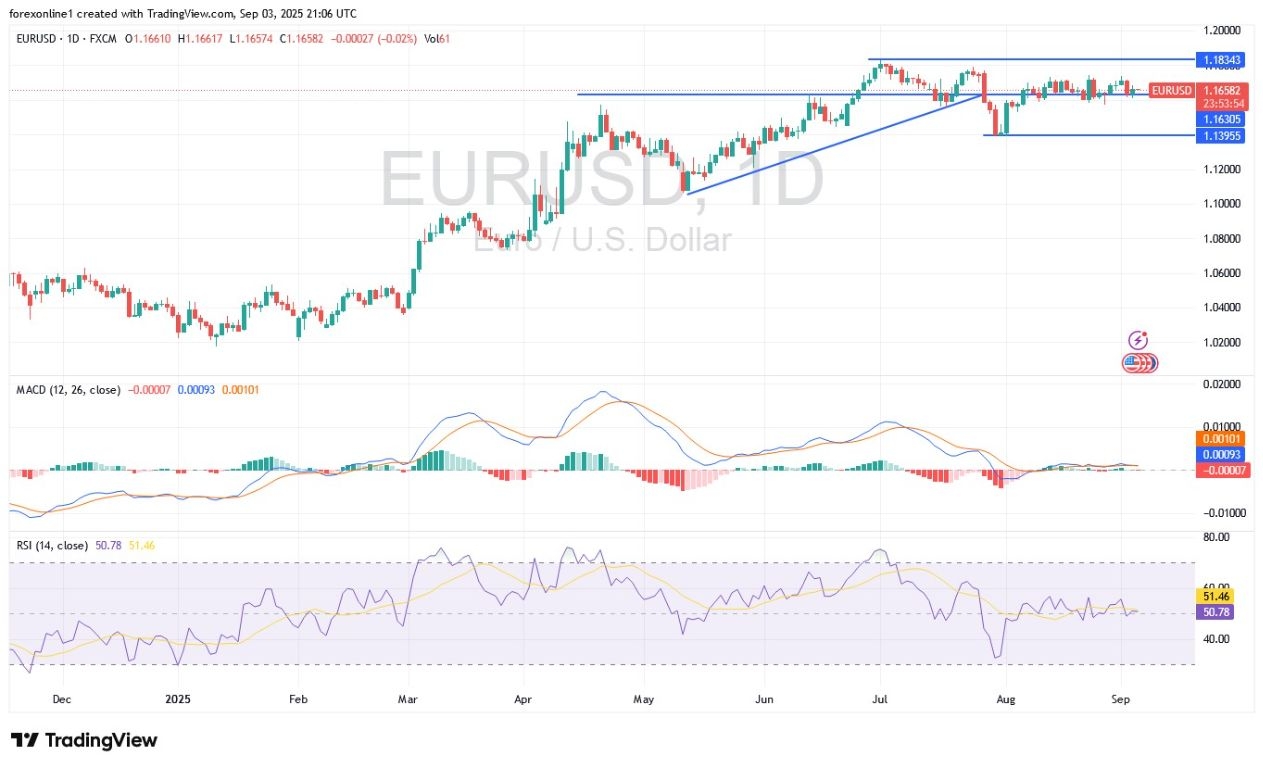
As expected, the EUR/USD pair will remain in a very tight range until financial markets and investors react to the US jobs data announced tomorrow, Friday. This data will heavily shape the future of the Federal Reserve’s decisions on interest rates this month. The EUR/USD is trading around 1.1660 at the time of writing, attempting to avoid a collapse below the 1.1600 support level to prevent a surge in sell orders for the most popular currency pair in the forex market.

Recently, according to reliable trading platforms, the EUR/USD exchange rate forecast has improved after the pair broke the 1.1700 resistance level, trading at around 1.1735, approaching its highest level in a month. However, the EUR/USD pair failed to complete its upward rebound despite continued weak US dollar sentiment, as traders assess risks of Federal Reserve independence, legal challenges regarding tariffs, and upcoming US labor market data.
Meanwhile, gains in the Chinese yuan are providing additional support for the euro, keeping the focus on whether the EUR/USD can head toward 1.1750 and test the resistance level near 1.1830.
According to forex trading, the EUR/USD exchange rate made a more successful break above the resistance level of 1.1700, trading around 1.1735 at the beginning of the week’s trading, amid a weaker US dollar and further gains in the Chinese yuan. According to trading experts, there is enough negativity in the US dollar for the EUR/USD pair to trade through the resistance level of 1.1750 and test its high this year at 1.1830. Experts believe that a breakout of the 1.1780 resistance level is necessary to signal sustainable progress.
The movement of technical indicators confirms neutral performance. The 14-day RSI is around 51, not far from the neutral midline, and the MACD lines are also in a neutral path, awaiting strong factors for bulls and bears to quickly take control. On the fundamental analysis front, the EUR/USD will be affected today by the announcement of Eurozone retail sales figures at 12:00 PM Cairo time. The most important announcement will be the ADP US non-farm payrolls at 3:15 PM Cairo time. The weekly jobless claims and US trade balance figures will be released at 3:30 PM Cairo time, concluding with the announcement of the ISM US services PMI.
Keep in mind that the main catalysts for the EUR/USD this week are US jobs data and Fed policy risks. The US labor market data will be crucial, culminating in Friday’s main employment report. Last month’s weak report, especially the significant downward revisions, was a key factor that triggered frenzied speculation about a shift in the Fed’s policy. The concerns surrounding this week’s release were exacerbated after President Trump’s decision to fire the head of the Bureau of Labor Statistics (BLS) following last month’s data.
In the forex market, the Chinese yuan has also continued to gain in global markets, which will support the EUR/USD pair. Recently, we have seen a rebound in demand for the yuan-denominated in dollars overseas, especially from hedge fund clients. By allowing the yuan to appreciate slightly ahead of the US trade talks in the fall, it could help create a more supportive environment for reaching an agreement.
Traders are advised to await the market’s reaction to the US jobs data to determine the most suitable EUR/USD trading positions.
Ready to trade our Forex EUR/USD forecast? We’ve shortlisted the best European brokers in the industry for you.
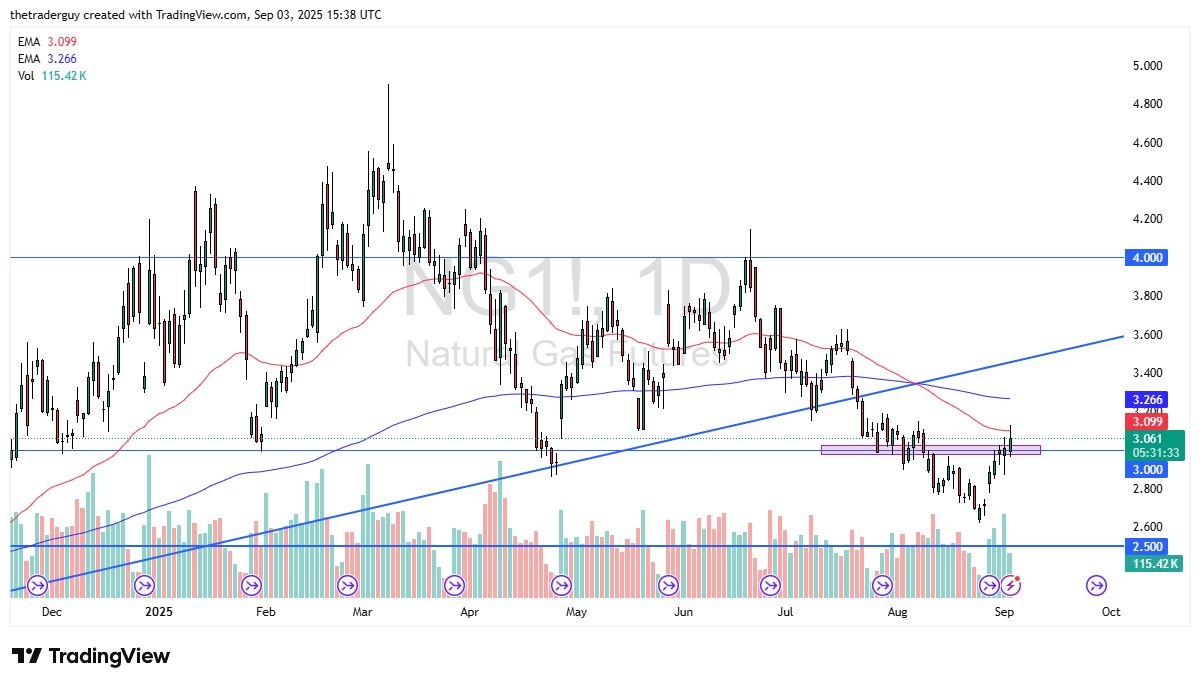
One of the most important things you need to learn about natural gas is that it most certainly has a season to it. What I mean by this is that it is the US contract, and therefore it will follow US weather patterns. At this point in time it’s very rare that it gets cold enough for heating to be a major driver of natural gas, which in the winter months most certainly is the case. It’s not necessarily that hot in the United States at the moment either, so producing electricity for air conditioning isn’t really a thought either. Because of this, I think there is still an argument to be made for this market being one that simply has no real reason to get strong at this point, and rallies could end up being selling opportunities.
If we were to break down below the $2.98 level, then I think you’ve would start to see a significant amount of downward pressure come into the picture. In that environment, I anticipate that natural gas could drop to the $2.80 level, perhaps even followed by the $2.60 level. An extraordinarily negative mood could even take natural gas down to the $2.50 level, but I think as we go deeper into the year, that’s less likely. I’m still looking for shorting opportunities and will love this bounce running out of momentum before taking advantage of the overall downtrend.
Ready to trade daily Forex analysis? We’ve shortlisted the best commodity brokers in the industry for you.
Christopher Lewis has been trading Forex and has over 20 years experience in financial markets. Chris has been a regular contributor to Daily Forex since the early days of the site. He writes about Forex for several online publications, including FX Empire, Investing.com, and his own site, aptly named The Trader Guy. Chris favours technical analysis methods to identify his trades and likes to trade equity indices and commodities as well as Forex. He favours a longer-term trading style, and his trades often last for days or weeks.