The main category of Forex News.
You can use the search box below to find what you need.
[wd_asp id=1]
The main category of Forex News.
You can use the search box below to find what you need.
[wd_asp id=1]

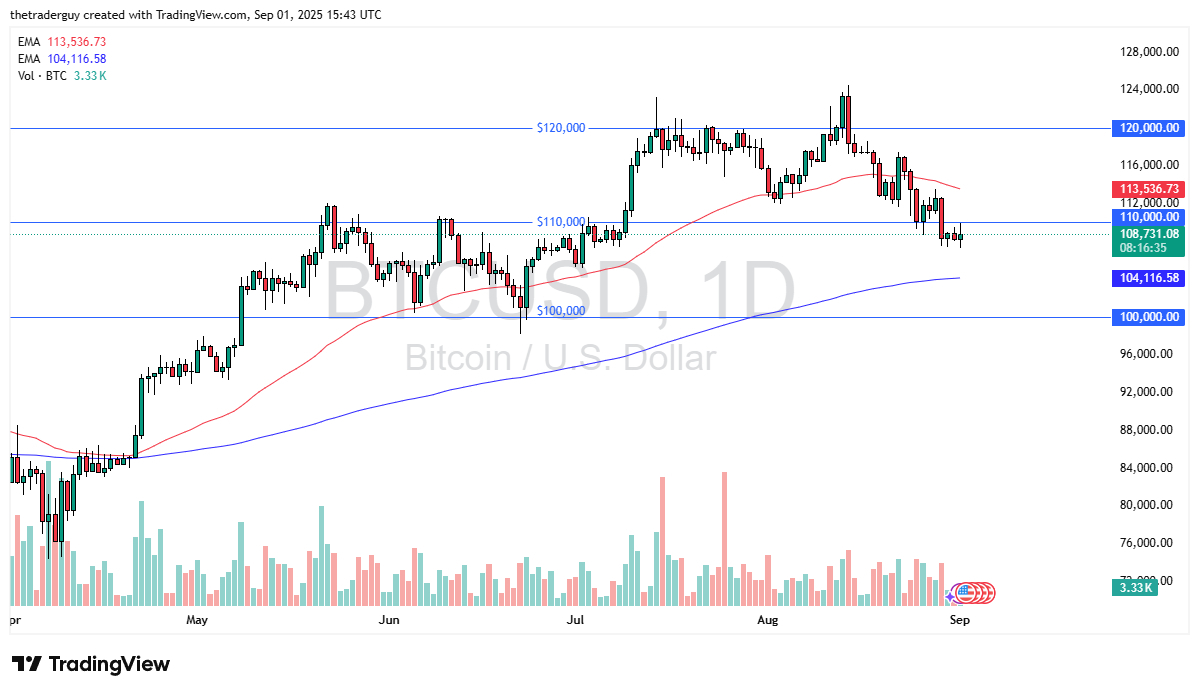
The technical analysis for Bitcoin is starting to shift a bit, as we are halfway between the 50 Day EMA and the 200 Day EMA which is sitting underneath price. We have been extraordinarily bullish, but recently we see the market pull back a bit as there are a lot of concerns about risk appetite overall. Keep in mind that the market sitting between these 2 moving averages, which are both fairly flat, suggest that we are starting to see a bit of a shift.
The question at this point in time will continue to be whether or not Bitcoin has peaked to, or if this was just a simple pullback. I think that can be said about a lot of markets around the world, as we are going to see more volume in the market after the holiday season ends, roughly about now. At that point, we would have to wait and see how the market will behave, but it certainly looks like we are sitting at a level that will attract a lot of attention. Quite frankly, I suspect that Bitcoin will behave very much like NASDAQ does, as they are both Wall Street assets at this point.
I think you have to be very cautious going forward, and really at this point in time a lot of how you analyze Bitcoin will come down to your timeframe. I know some people are “Bitcoin believers”, suggesting that it really doesn’t matter the price they get in, because they will hold onto Bitcoin for the rest of their lives. For those who are a little bit short-term inclined, I’d be very cautious at this point and wait to see some significant bounce to start buying again. As far as shorting is concerned, there is a ton of support underneath so that makes things dangerous as well.
Ready to trade Bitcoin forex forecast? Here’s a list of some of the best crypto brokers to check out.
Christopher Lewis has been trading Forex and has over 20 years experience in financial markets. Chris has been a regular contributor to Daily Forex since the early days of the site. He writes about Forex for several online publications, including FX Empire, Investing.com, and his own site, aptly named The Trader Guy. Chris favours technical analysis methods to identify his trades and likes to trade equity indices and commodities as well as Forex. He favours a longer-term trading style, and his trades often last for days or weeks.
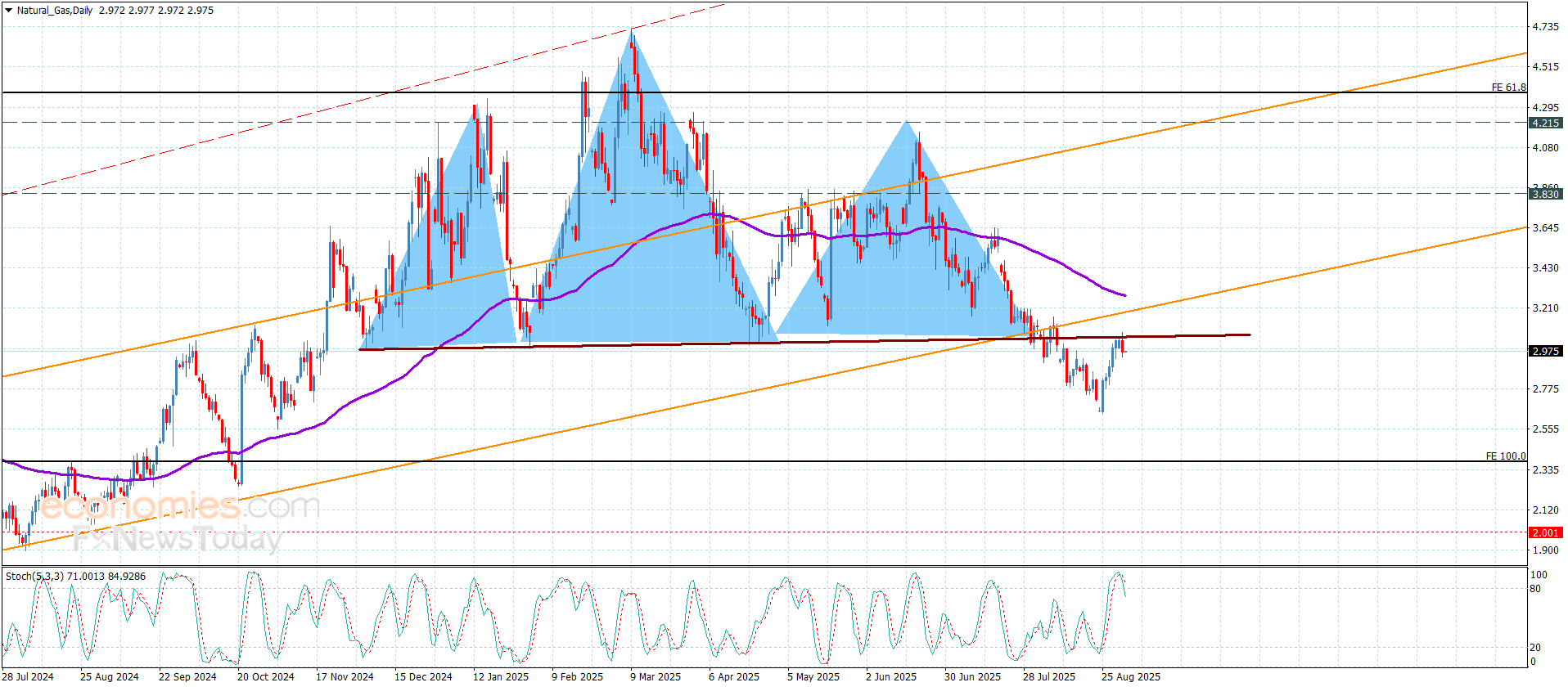
Natural gas price ended its bullish correctional rally by testing the neckline of the head and shoulders that is represented by $3.050 level, taking advantage of providing negative momentum by stochastic, reaching towards $2.950 level.
The main stability below the main resistance to $3.180 represents a main factor to confirm the bearish scenario, keeping our bearish expectation that might target $2.810 level reaching the barrier at $2.620.
The expected trading range for today is between $2.810 and $3.100
Trend forecast: Bearish
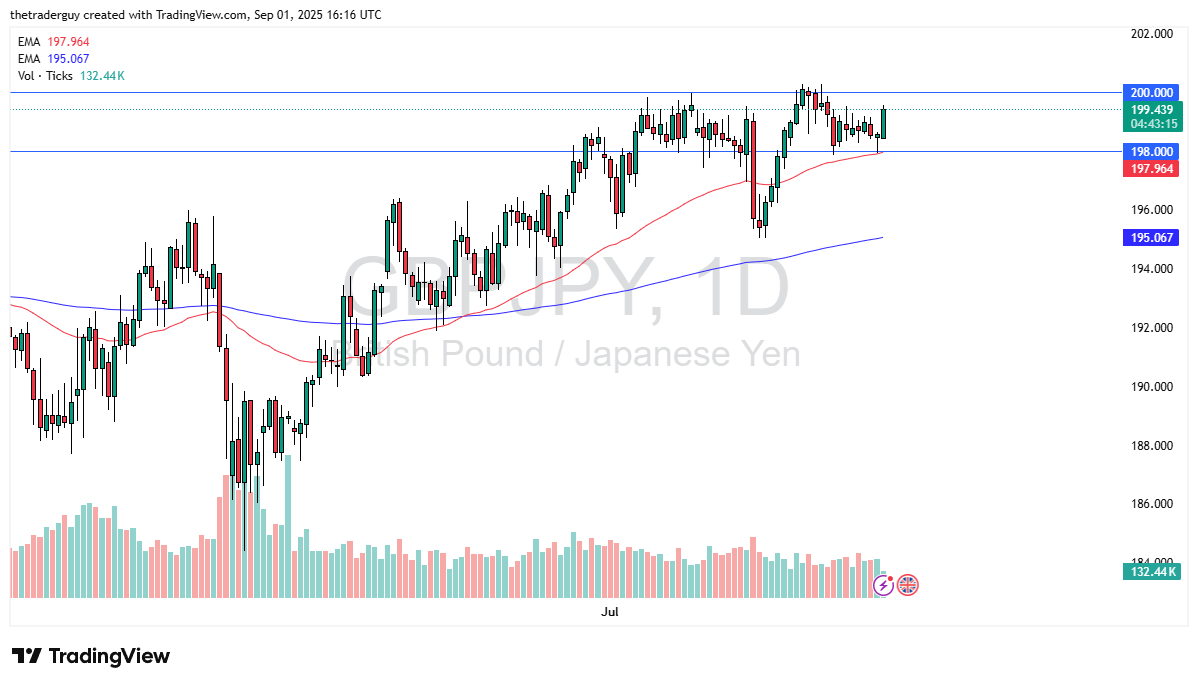
Short-term pullbacks should end up being buying opportunities with the 198 yen level offering support.
I would also point out that right there at the 198 yen level, have the 50 day EMA, which of course attracts a lot of attention in and of itself. If we broke down below there, then we could drop to the 200 day EMA, which is basically at the 195 yen level. The interest rate differential does pay you to hang on to a long position in this market. And it is worth paying close attention to.
The size of the candlestick is impressive, but like I said, the big barrier just above is still something that’s going to be difficult to overcome. This is the biggest candlestick that we’ve seen in the last two weeks or so, and that is worth paying close attention to.
The interest rate differential is going to continue to get you paid if you are patient, but I would not pile into the market, at least not get aggressive until we get above the 200 yen level. If and when we do, then you can start to build a longer term position. But in the short term, I prefer to buy dibs.
Begin trading our daily forecasts and analysis. Here is a list of Forex brokers in Japan to work with.
Christopher Lewis has been trading Forex and has over 20 years experience in financial markets. Chris has been a regular contributor to Daily Forex since the early days of the site. He writes about Forex for several online publications, including FX Empire, Investing.com, and his own site, aptly named The Trader Guy. Chris favours technical analysis methods to identify his trades and likes to trade equity indices and commodities as well as Forex. He favours a longer-term trading style, and his trades often last for days or weeks.
The (Brent) price rose in its last intraday trading, preparing to attack the critical resistance level at $68.50, amid the dominance of the bullish correctional trend on the short-term basis and its trading alongside a supportive bias line for this track, taking advantage of the dynamic support that is represented by its trading above EMA50, intensifying the bullish momentum, on the other hand, we notice that the (RSI) reached overbought levels, with the beginning of negative overlapping signals appearance from them, which might reduce its upcoming gains.
Get high-accuracy trading signals delivered directly to your Telegram. Subscribe to specialized packages tailored for the world’s top markets:
Full VIP signals performance report for August 25–29, 2025:
– Written by
Tim Boyer
STORY LINK Pound to Dollar Forecast: GBP to “Range Trade”, USD Outlook Under Pressure
The Pound to Dollar outlook (GBP/USD) has turned more positive, with the pair climbing to two-week highs around 1.3540 on Monday.
The latest exchange rate forecast suggests Sterling could test 1.36 as political turmoil, Fed independence fears, and uncertainty over Trump’s tariffs keep the dollar on the defensive. Investors are now focused on this week’s US jobs report and Bank of England commentary to set the next direction.
The Pound to Dollar exchange rate (GBP/USD) has strengthened to 2-week highs at 1.3540 in Europe on Monday.
The dollar remained firmly on the defensive on Monday amid underlying fears surrounding Fed independence and fresh uncertainty surrounding President Trump’s tariffs.
Gold strengthened to near record highs and the Chinese yuan also posted gains with both elements a symptom of dollar weakness.
Key GBP/USD resistance comes in around 1.3590.
Get better rates and lower fees on your next international money transfer.
Compare TorFX with top UK banks in seconds and see how much you could save.
According to UoB; “GBP is likely to continue to range-trade, but a narrower range of 1.3420/1.3560 is likely enough to contain the price movements for now.”
US developments are likely to dominate during the week, although comments from the Bank of England will be watched closely.
ING expects a hawkish BoE stance and added; “This could leave GBP/USD in a position to test 1.3600 this week. Still, a break above there may be hard to sustain since our house view remains for a 25bp rate cut in November.”
US economic data will certainly be a key element this week with a series of jobs-related data including the crucial employment report on Friday following last month’s bombshell release.
Consensus forecasts are for a headline increase in non-farm payrolls of around 75,000 for August with the unemployment rate ticking higher to 4.3% from 4.2%, equalling the highest reading since November 2021. Data revisions will also be important.
Markets are pricing in over an 85% chance of a September rate cut.
According to MUFG; “another much weaker than expected nonfarm payrolls report on Friday could encourage expectations for the Fed to resume rate cuts with a larger 50bps cut weighing more heavily on the US dollar.”

ING added; “ING’s call is for three Fed rate cuts this year versus just 56bp of easing currently priced. If we’re right, this week’s jobs data could add to downside for short-term US rates and the dollar.”
Very strong data could trigger fresh doubts over a September move, although there will inevitably be question marks over the data following the firing of the BLS head after last month’s data.
Commerzbank Head of FX and Commodity Research Thu Lan Nguyen considers that President Trump’s attempts to fire Fed Governor Cook pose a major threat to the dollar.
According to the bank; “For those already uncomfortable with the attacks and outbursts against the Fed Chair and his colleagues now, just imagine what the situation would look like if inflation rises and the central bank signals the need for rate hikes.”
Nguyen is surprised that there has not been a bigger market reaction and puts it down to optimism that the checks and balances in the US constitution will be maintained.
As far as the Bank of England is concerned, ING commented; “we hear from a group of BoE members this Wednesday, testifying to the Treasury Committee. Presumably, they will mostly repeat their hawkish position, which sees the market pricing only 10bp of BoE rate cuts this year.”
International Money Transfer? Ask our resident FX expert a money transfer question or try John’s new, free, no-obligation personal service! ,where he helps every step of the way,
ensuring you get the best exchange rates on your currency requirements.
TAGS: Pound Dollar Forecasts
Silver price (XAG/USD) trades near $40.85 per troy ounce, the highest since September 2011, which was marked during the Asian hours on Tuesday. The precious metals like Silver attract buyers amid increased safe-haven demand, driven by US Federal Reserve (Fed) independence concerns, uncertainty surrounding Fed policy outlook, and US President Donald Trump’s tariffs.
United States (US) July’s Personal Consumption Expenditures (PCE) Price Index signaled persistent inflationary pressures and heightened uncertainty over potential Fed rate cuts. However, traders are now pricing in more than 89% of a 25 basis points (bps) rate cut by the Fed at the September policy meeting, up from an 84% chance a week ago, according to the CME FedWatch tool.
Market participants are also awaiting upcoming employment figures due this week that could shape the US Federal Reserve’s (Fed) policy decision in September. Key reports include ADP Employment Change, Average Hourly Earnings, and Nonfarm Payrolls for August.
Safe-haven demand for Silver is further supported by ongoing concerns about the US central bank’s independence. Uncertainty persists over the legality of Trump’s dismissal of Fed Governor Lisa Cook, after a court hearing on Friday concluded without a decision on whether to temporarily halt the move.
US Treasury Secretary Scott Bessent acknowledged that the Federal Reserve should be politically independent, but offered little clarity on his vague claim that the Fed has “made a lot of mistakes”, outside of not obeying President Trump’s demands for lower interest rates.
Meanwhile, the US Court of Appeals for the Federal Circuit upheld a ruling that the sweeping tariffs the US President Donald Trump unilaterally imposed on most other countries were illegal. Trump blasted the decision as “highly partisan” and vowed to appeal to the US Supreme Court.
Silver is a precious metal highly traded among investors. It has been historically used as a store of value and a medium of exchange. Although less popular than Gold, traders may turn to Silver to diversify their investment portfolio, for its intrinsic value or as a potential hedge during high-inflation periods. Investors can buy physical Silver, in coins or in bars, or trade it through vehicles such as Exchange Traded Funds, which track its price on international markets.
Silver prices can move due to a wide range of factors. Geopolitical instability or fears of a deep recession can make Silver price escalate due to its safe-haven status, although to a lesser extent than Gold’s. As a yieldless asset, Silver tends to rise with lower interest rates. Its moves also depend on how the US Dollar (USD) behaves as the asset is priced in dollars (XAG/USD). A strong Dollar tends to keep the price of Silver at bay, whereas a weaker Dollar is likely to propel prices up. Other factors such as investment demand, mining supply – Silver is much more abundant than Gold – and recycling rates can also affect prices.
Silver is widely used in industry, particularly in sectors such as electronics or solar energy, as it has one of the highest electric conductivity of all metals – more than Copper and Gold. A surge in demand can increase prices, while a decline tends to lower them. Dynamics in the US, Chinese and Indian economies can also contribute to price swings: for the US and particularly China, their big industrial sectors use Silver in various processes; in India, consumers’ demand for the precious metal for jewellery also plays a key role in setting prices.
Silver prices tend to follow Gold’s moves. When Gold prices rise, Silver typically follows suit, as their status as safe-haven assets is similar. The Gold/Silver ratio, which shows the number of ounces of Silver needed to equal the value of one ounce of Gold, may help to determine the relative valuation between both metals. Some investors may consider a high ratio as an indicator that Silver is undervalued, or Gold is overvalued. On the contrary, a low ratio might suggest that Gold is undervalued relative to Silver.
The Natural Gas (NG=F) market opened September trading under pressure, failing to hold early gains above the $3.00 threshold and slipping back toward $2.90. Monday’s holiday session in the U.S. exposed how thin volumes magnified volatility, with prices briefly spiking to $3.06 before reversing sharply lower. That reversal pattern has now confirmed a closing price reversal top, signaling that near-term momentum has turned bearish. The market’s inability to sustain moves above $3 reflects both weak institutional conviction and an oversupply narrative that continues to weigh on sentiment.
Natural gas futures are trading within a tight band, with resistance forming near $3.17 and immediate support at $2.88–$2.83. The $3.09 50-day EMA adds further overhead pressure, reinforcing the ceiling that capped Monday’s move. Stochastic indicators now show overbought conditions easing, suggesting that negative momentum could accelerate toward $2.85 and potentially down to $2.65 if support levels crack. The $2.50 zone, which acted as a floor earlier in the summer, remains the key level where buyers are likely to step back in. As of Monday’s close, the market settled at $2.92, down 0.75% on the day, highlighting a decisive rejection of the $3.00 mark.
Fundamentals continue to lean against bulls. U.S. weather has been moderate, reducing electricity demand tied to air conditioning, while domestic production remains strong. Inventories remain well supplied heading into autumn, creating limited urgency for buyers. Without the support of extreme temperatures or sudden supply disruptions, the oversupply theme dominates. Traders are already shifting their focus toward the coming winter heating season, but until colder weather materializes, the bearish tone persists. Analysts suggest that only a sharp draw in storage data or early winter demand could lift NG=F materially above $3.10 in the short term.
In Europe, benchmark natural gas prices at the Dutch TTF hub steadied near €31.9 per MWh after four consecutive sessions of declines. Demand in northwestern Europe topped 100 gigawatt hours per day as softer wind generation cut renewable output, boosting gas burn. LNG imports into Europe are more than 50% higher year-to-date, with storage sites now 77% full and on pace to meet the EU’s 80% target by early November. However, uncertainty looms over Russian Arctic LNG 2 shipments, as potential U.S. objections could tighten supply. While European fundamentals look stable, the global LNG trade adds volatility that directly impacts U.S. natural gas pricing.
The broader commodity complex has also been pressured by currency dynamics. A weaker U.S. dollar usually provides relief for dollar-denominated commodities, but natural gas has struggled to capitalize, reflecting its own supply-heavy fundamentals. Traders note that the dollar index’s slide toward 97.70 offered little support for NG=F compared with oil and metals, where demand-side speculation is stronger. For gas, the heavy domestic production levels and muted near-term demand keep it trading more on storage and weather than macro liquidity shifts.
Cheap natural gas is having ripple effects in the U.S. economy. Louisiana, for example, is attracting new industrial investment, including fertilizer production, thanks to $3.00/MMBtu feedstock costs that undercut European competition. Meta’s $10 billion AI data center project in Richland Parish is expected to drive local job growth, while low natural gas prices keep U.S. petrochemical and ammonia plants globally competitive. This underscores the broader economic advantage of subdued NG=F pricing, even as traders lament its weak price performance.
Natural gas futures remain volatile, with volume spikes near $2.80 suggesting key positioning zones for both bulls and bears. Institutional liquidations have reduced speculative length, leaving more room for short covering rallies but also signaling caution. Traders are watching whether the $2.88–$2.83 retracement zone holds as a higher bottom; a defense of this level could launch NG=F back toward $3.06 and even $3.23. Failure to hold support, however, reopens the path to $2.70 and $2.65, erasing August’s gains. Market sentiment remains skeptical, and analysts warn that without an early seasonal demand catalyst, the bearish narrative will persist through September.
With NG=F trading at $2.92 and repeatedly failing to sustain rallies above $3.00, the technical and fundamental setup leans bearish. Oversupply, weak demand, and thin trading conditions reinforce downside risks toward $2.65, with the possibility of testing $2.50 if momentum accelerates. While longer-term dynamics tied to winter heating could eventually flip sentiment, in the current context natural gas remains a Sell until it establishes a stronger base above $2.90 with volume support.
Important DisclaimersThe content provided on the website includes general news and publications, our personal analysis and opinions, and contents provided by third parties, which are intended for educational and research purposes only. It does not constitute, and should not be read as, any recommendation or advice to take any action whatsoever, including to make any investment or buy any product. When making any financial decision, you should perform your own due diligence checks, apply your own discretion and consult your competent advisors. The content of the website is not personally directed to you, and we does not take into account your financial situation or needs.The information contained in this website is not necessarily provided in real-time nor is it necessarily accurate. Prices provided herein may be provided by market makers and not by exchanges.Any trading or other financial decision you make shall be at your full responsibility, and you must not rely on any information provided through the website. FX Empire does not provide any warranty regarding any of the information contained in the website, and shall bear no responsibility for any trading losses you might incur as a result of using any information contained in the website.The website may include advertisements and other promotional contents, and FX Empire may receive compensation from third parties in connection with the content. FX Empire does not endorse any third party or recommends using any third party’s services, and does not assume responsibility for your use of any such third party’s website or services.FX Empire and its employees, officers, subsidiaries and associates, are not liable nor shall they be held liable for any loss or damage resulting from your use of the website or reliance on the information provided on this website.Risk DisclaimersThis website includes information about cryptocurrencies, contracts for difference (CFDs) and other financial instruments, and about brokers, exchanges and other entities trading in such instruments. Both cryptocurrencies and CFDs are complex instruments and come with a high risk of losing money. You should carefully consider whether you understand how these instruments work and whether you can afford to take the high risk of losing your money.FX Empire encourages you to perform your own research before making any investment decision, and to avoid investing in any financial instrument which you do not fully understand how it works and what are the risks involved.
Silver (XAG/USD) kicks off the week on a strong footing, with spot prices extending their rally for a fifth consecutive session, breaking above the $40.00 mark to hit fresh 14-year highs — levels last seen in September 2011. At the time of writing, the metal is consolidating around $40.70, as thin trading conditions prevail due to the US Labor Day holiday.
The sustained rally in Silver comes on the back of broad US Dollar (USD) weakness and firm expectations of a Federal Reserve (Fed) interest rate cut in September, which continues to support demand for non-yielding assets. Market sentiment remains firmly bullish despite overbought technical signals, as traders weigh safe-haven demand amid mounting global uncertainty. A federal appeals court ruling on Friday declared most of US President Donald Trump’s global tariffs unlawful, casting fresh doubt over the future of US trade policy. Concerns over the Fed’s independence are also adding to market anxiety, further supporting the case for precious metals.
XAG/USD maintains a strong upward trajectory on the 4-hour chart, building on the bullish momentum that began in late July. After finding support near $36.00, the metal has been making higher highs and higher lows, indicating a clear uptrend with buyers consistently stepping in to defend dips and keep the bullish momentum intact.
The August close above the July 23 peak of $39.53 – a multi-year high – confirmed a significant breakout, supported by an 8.29% monthly gain. Price action has now decisively cleared the psychological $40.00 barrier, turning prior resistance at $39.50 into immediate support.
Silver is holding well above key short-term moving averages that continue to slope upward. Momentum indicators are elevated, with the Relative Strength Index (RSI) hovering near overbought territory, suggesting the potential for a brief consolidation or shallow pullback, though no clear signs of trend exhaustion are evident. The Moving Average Convergence Divergence (MACD) also signals strength, with expanding bullish histogram bars and the MACD line comfortably above the signal line.
Looking ahead, immediate resistance is seen at $41.00 and $42.00, with the next upside target at $43.40 — the high from September 5, 2011. On the downside, the $39.50-$39.00 zone remains a key support area, with any pullback toward this region likely to attract fresh buying interest. As long as broader macro and policy drivers remain aligned, XAG/USD appears poised to extend its rally toward new cycle highs.
Silver is a precious metal highly traded among investors. It has been historically used as a store of value and a medium of exchange. Although less popular than Gold, traders may turn to Silver to diversify their investment portfolio, for its intrinsic value or as a potential hedge during high-inflation periods. Investors can buy physical Silver, in coins or in bars, or trade it through vehicles such as Exchange Traded Funds, which track its price on international markets.
Silver prices can move due to a wide range of factors. Geopolitical instability or fears of a deep recession can make Silver price escalate due to its safe-haven status, although to a lesser extent than Gold’s. As a yieldless asset, Silver tends to rise with lower interest rates. Its moves also depend on how the US Dollar (USD) behaves as the asset is priced in dollars (XAG/USD). A strong Dollar tends to keep the price of Silver at bay, whereas a weaker Dollar is likely to propel prices up. Other factors such as investment demand, mining supply – Silver is much more abundant than Gold – and recycling rates can also affect prices.
Silver is widely used in industry, particularly in sectors such as electronics or solar energy, as it has one of the highest electric conductivity of all metals – more than Copper and Gold. A surge in demand can increase prices, while a decline tends to lower them. Dynamics in the US, Chinese and Indian economies can also contribute to price swings: for the US and particularly China, their big industrial sectors use Silver in various processes; in India, consumers’ demand for the precious metal for jewellery also plays a key role in setting prices.
Silver prices tend to follow Gold’s moves. When Gold prices rise, Silver typically follows suit, as their status as safe-haven assets is similar. The Gold/Silver ratio, which shows the number of ounces of Silver needed to equal the value of one ounce of Gold, may help to determine the relative valuation between both metals. Some investors may consider a high ratio as an indicator that Silver is undervalued, or Gold is overvalued. On the contrary, a low ratio might suggest that Gold is undervalued relative to Silver.
The Gold price (XAU/USD) continues its advance, holding at $3,473.77, up 0.83% on the session, after a strong August that lifted the metal nearly 5%. Futures for December delivery surged to $3,551.82, notching a new historical high above $3,550 per ounce, while spot prices climbed to $3,480.56, the strongest level since mid-April. The rally follows five consecutive days of gains, with investors flocking into bullion as a hedge against policy uncertainty, political tensions, and weakening U.S. dollar flows.
Markets are betting heavily on near-term easing. According to the CME FedWatch Tool, traders now price an 89% probability of a 25 bp rate cut at the Fed’s September 16–17 meeting, up from 85% before the latest inflation report. Notably, the U.S. GDP expanded at 3.3% in Q2, topping estimates of 3.1%, while the PCE index, the Fed’s preferred inflation gauge, remained above target. Despite resilient growth, the market is convinced the Fed will prioritize easing financial conditions as unemployment edges higher and labor demand cools. Lower yields reduce the opportunity cost of holding non-yielding gold, turning XAU/USD into a primary beneficiary.
The U.S. Dollar Index (DXY) slid to a five-week low, with particular weakness against the New Zealand dollar (−0.24%) and the euro (−0.05%). Yields on Treasuries softened as investors positioned for dovish policy. Gold has historically shown strong inverse correlation to the dollar, and the latest leg down in DXY has coincided with bullion’s push to record levels. The pricing of two possible cuts before year-end continues to underpin momentum, suggesting that dips in XAU/USD are seen as buying opportunities rather than risk signals.
Beyond U.S. monetary policy, gold is catching bids from global uncertainty. Escalation in the Gaza Strip, coupled with stalled peace efforts in Russia–Ukraine, has strengthened safe-haven flows. In the U.S., Trump’s attempt to remove Fed Governor Lisa Cook stirred fears of political interference in monetary policy, raising questions about central bank independence. Simultaneously, a federal appeals court ruled that most of Trump’s global tariffs are illegal, exposing billions in trade flows to legal uncertainty ahead of a Supreme Court review. Against this backdrop, bullion demand is not purely speculative — it reflects genuine hedging against systemic instability.
Gold’s technical chart shows a decisive breakout from an ascending triangle that had capped the metal since April. The move through $3,470–$3,500 unlocked a measured target near $3,800. Immediate support now lies at $3,450, followed by the 50-day EMA at $3,389. Momentum indicators show mixed signals: RSI remains elevated but not overbought, while MACD confirms bullish alignment. Short-term pullbacks toward $3,500 are likely to be met with buying interest, as traders who missed the breakout re-enter the market. If XAU/USD consolidates above $3,550, technical models suggest an extension toward $3,750–$3,800 in Q4.
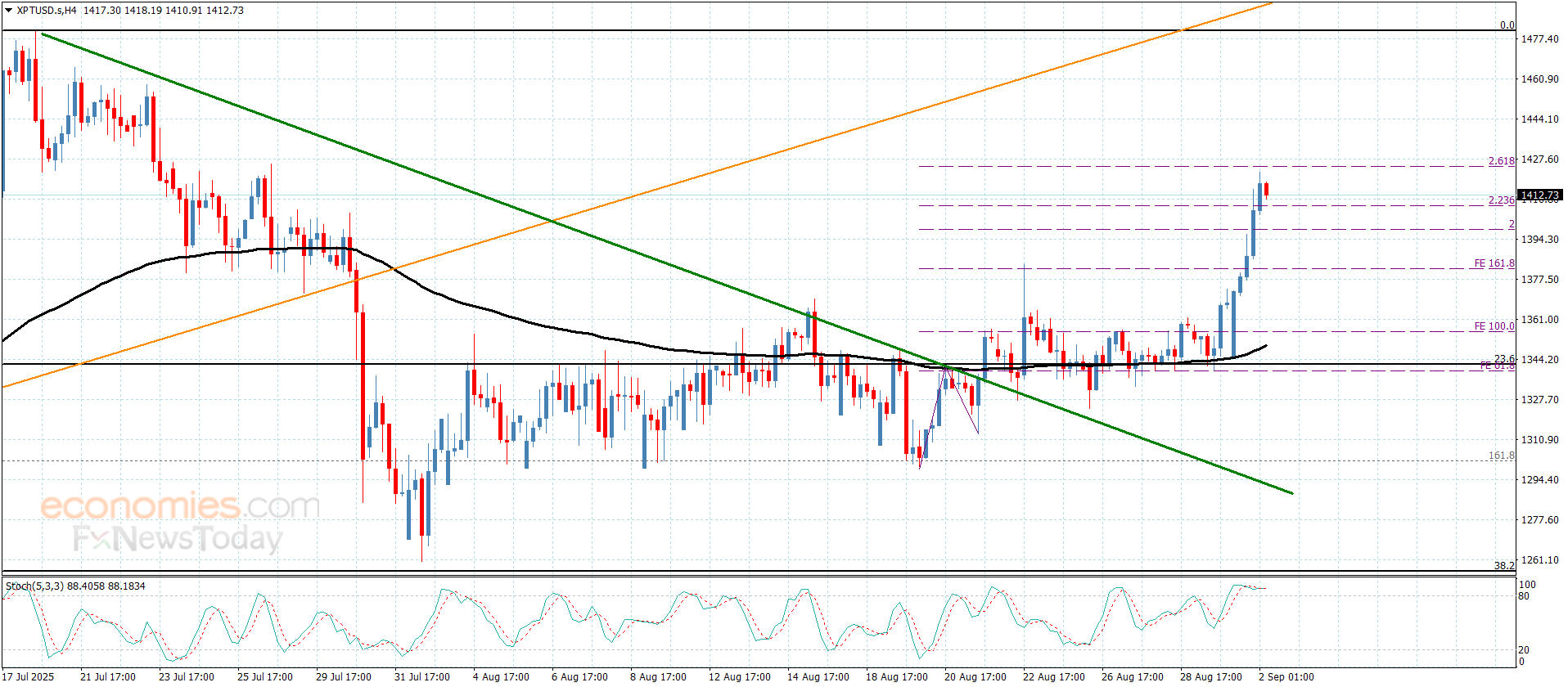
Gold’s strength is spilling over into the wider metals complex. Silver (XAG/USD) surged 1.5% to $41.32, its highest since 2011, extending a rally that could test $44 if momentum persists. Platinum futures gained 1.3% to $1,346.65, while copper on the LME held steady at $9,934.65 per tonne. U.S. copper futures dipped marginally to $4.60 per pound, but sentiment remains supported by Chinese data showing industrial activity growing at its fastest pace in five months. For investors, the simultaneous rise across gold, silver, and platinum highlights the broad strength in precious metals as portfolio hedges.
The move above $3,550 per ounce marks the fifth straight monthly advance for gold. In August alone, prices climbed nearly 5%, extending a bullish trend that began after April’s retracement. Safe-haven demand remains relentless — both from retail investors and central banks that continue diversifying reserves away from the dollar. Unlike previous cycles, the sustained rise is not only tied to inflation fears but also to geopolitical and policy instability, which has turned XAU/USD into a barometer of confidence in U.S. governance.
Gold is locked in a powerful trend with clear scenarios. If support at $3,450–$3,500 holds, bulls will target $3,800 as the next milestone. A decisive move above $3,570 would reinforce this breakout trajectory. Conversely, a pullback below $3,450 would shift focus to the 50-day EMA at $3,389 and deeper supports near $3,380. The bearish case is only confirmed under $3,380, which could trigger a slide back toward $3,300. However, given institutional positioning, ETF inflows, Fed rate-cut bets, and geopolitical tailwinds, the weight of evidence favors continued upside.
Based on all factors — macro, technical, and flows — XAU/USD remains bullish, with buy setups favored above $3,500 and long-term targets clustered near $3,750–$3,800.