The main category of Forex News.
You can use the search box below to find what you need.
[wd_asp id=1]
The main category of Forex News.
You can use the search box below to find what you need.
[wd_asp id=1]
In August, the RBA cut the cash rate by 25 basis points, to 3.6%. RBA Governor Michele Bullock hinted at further policy easing during the press conference. She stating that the RBA’s 2025 forecasts are assuming a couple more cuts. Notably, the RBA didn’t dismiss the possibility of back-to-back cuts, indicating that board members will assess the data at each meeting.
AMP Head of Investment Strategy and Chief Economist Shane Oliver remarked on the RBA’s Meeting Minutes, stating:
“RBA minutes reiterated dovish guidance, noting the cash rate is ‘still somewhat restrictive’ & ‘some further reduction in the cash rate over the coming year’ is likely required, with reference to the pace being gradual and data determined. We expect cuts in Nov, Feb & May to 2.85%.”
Today’s inflation numbers would have to be significantly lower than in June to pressure the RBA into a September cut.
AUD/USD: Key Scenarios to Watch
Explore our full AUD/USD analysis, including key trends and trade data, here.
While economists expect a November RBA rate cut, Fed Chair Powell’s hint of a near-term Fed rate cut sent AUD/USD to $0.65.
FOMC members’ support for a September rate cut and further policy easing in Q4 would narrow the US-Aussie rate differential in favor of the Aussie dollar. A narrowing rate differential may drive AUD/USD toward the $0.6550 level. A break above $0.6550 brings $0.66 into sight.
However, rising concerns about inflation over a cooling labor market could signal a less dovish Fed policy stance. Fewer rate cuts may widen the rate differential in favor of the US dollar. A wider differential could push AUD/USD below the 50-day EMA, exposing the 200-day EMA. If breached, $0.6400 would be the next support level.
– Written by
David Woodsmith
STORY LINK Euro to Dollar Forecast: Fed Turmoil Keeps EUR/USD at 1.1625 After Trump Fires Cook
The latest Euro to Dollar (EUR/USD) exchange rate forecast has been jolted by fresh political turmoil after President Trump moved to fire Fed Governor Lisa Cook, reviving concerns over Fed independence.
Despite Friday’s slide on Powell’s dovish Jackson Hole speech, the US Dollar has rebounded, keeping EUR/USD near 1.1625.
ING warns a break below 1.1580 could send the pair towards 1.15, though longer-term forecasts still point to gains back to 1.20.
After a slide on Friday following Fed Chair Powell’s speech, the dollar recovered ground on Monday.
The US currency dipped again in Asia on Tuesday as President Trump launched another assault on the Federal Reserve, but again bounced from lows with the Euro to Dollar (EUR/USD) exchange rate trading around 1.1625.
According to ING, the Euro is vulnerable to further near-term losses; “a break of support at 1.1580/90 could see follow-through to the 1.1500/1520 area – especially since investors probably added to EUR/USD longs on Friday’s dovish tilt from Powell.”
Get better rates and lower fees on your next international money transfer.
Compare TorFX with top UK banks in seconds and see how much you could save.
UoB is less bearish on the single currency; “The sharp decline appears to be running ahead of itself, and EUR is unlikely to weaken much further. Today, we expect EUR to trade in a range of 1.1600/1.1690.”
ING is still bearish on the dollar over the medium term with EUR/USD gains to 1.20.
A key issue will be whether there is durable damage to the dollar amid fears surrounding Fed independence.
Overnight, President Tump stated that he had dismissed Fed Governor Cook as a central bank governor.
According to Trump there was “sufficient reason” to believe Cook had made false statements on mortgage agreements, and cited constitutional powers which he said allowed him to remove her.
The allegations surround declarations of primary property residence.
Cook fought back aggressively; “President Trump purported to fire me ‘for cause’ when no cause exists under the law, and he has no authority to do so.”

She added; “I will not resign. I will continue to carry out my duties to help the American economy as I have been doing since 2022.”
Mizuho chief strategist Shoki Omori commented; “Powell as of now seems to be fighting back but whoever comes next may just listen to whatever the White House wants. Not looking good.”
According to Vasu Menon, managing director of investment strategy at OCBC; “Trump’s move to fire Lisa Cook will cast a pall on Fed independence and could weigh on the dollar and U.S. Treasuries.”
He added; “However, don’t expect major market moves as Trump’s action is somewhat unprecedented and may be challenged in U.S. courts.”
Charu Chanana, chief investment strategist at Saxo noted; “Markets aren’t panicking, but they are recalibrating, earlier rate cuts look more likely after Cook’s removal.”
She also looked at the wider perspective; “But this isn’t just about rate cuts, it’s about Fed independence and the growing institutional risks in the U.S.”
The Euro has also been hampered by the French government’s decision to call a confidence vote on September 8th.
ING commented; “The numbers don’t look good in that his centrist party has 210 seats in parliament, while the far left and the far right have a combined 330 seats and have already said they will vote no.”
International Money Transfer? Ask our resident FX expert a money transfer question or try John’s new, free, no-obligation personal service! ,where he helps every step of the way,
ensuring you get the best exchange rates on your currency requirements.
TAGS: Euro Dollar Forecasts
– Written by
David Woodsmith
STORY LINK Pound-to-Euro Week Ahead Forecast: GBP Set for EUR Drop to 1.12
The Pound to Euro exchange rate (GBP/EUR) outlook has turned increasingly negative after the single currency surged on Powell’s dovish Jackson Hole speech, pushing Sterling back under 1.1550.
Foreign exchange analysts warn the Pound Sterling forecast vs Euro looks increasingly fragile, with some institutions, such as Danske Bank, projecting GBP/EUR could slide to 1.1235 within 12 months.
Mixed UK data, stubborn 3.8% inflation, and doubts over Bank of England policy are keeping Sterling under pressure, while Euro resilience underscores the risk of deeper losses in the GBP/EUR outlook.
Danske Bank forecasts that the Pound to Euro (GBP/EUR) exchange rate will weaken to 1.1235 on a 6-12-month view.
Wells Fargo expects little GBP/EUR change by the end of 2025.
Get better rates and lower fees on your next international money transfer.
Compare TorFX with top UK banks in seconds and see how much you could save.
The Euro surged on Friday after Fed Chair Powell indicated that a September rate cut was likely and the Pound to Euro (GBP/EUR) exchange rate retreated to just below 1.1550.
The latest UK data recorded a better-than-expected figure for government borrowing with an increased tax take following the National Insurance changes.
PMI business confidence data was mixed but did represent a slight positive as stronger growth in the services sector offset another weak performance by the manufacturing sector.
The headline and core inflation rates both increased to 3.8% for July which will cause further difficulties in setting monetary policy.
The Bank of England (BoE) policy debate remains a very live and key issue.
Deutsche Bank commented; “For the hawks a more resilient economy will only raise the bar for further rate cuts this year, until there’s more evidence that underlying inflation is slowing further, and wage settlement data is receding towards more target-consistent levels.”
ING is more confident that the bank will cut again this year; “UK inflation’s up, and markets are becoming increasingly sceptical that the Bank of England will cut rates again this year. But we’re sticking with our view that they will cut again in November by 25 basis points.”
It added; “Although prices are rising strongly, we reckon some of the concerns are overblown. And the BoE will be looking at the deteriorating jobs situation, and that could well influence their decision.”
Danske Bank remains wary over the UK fundamentals; “We increasingly see domestic factors and the relative growth outlook between the UK and the euro area as becoming GBP negatives. This is further amplified by divergence in the fiscal policy outlook with UK fiscal policy set to be tightened in the Autumn.”
UBS pointed to the stagflation risks; “we also note that the UK is already (and has been for some time) in a stagflationary situation. While the latest GDP data was stronger, it’s still well below potential and the labor market has been deteriorating subsequently.”
Danske added; “The key risk to seeing EUR/GBP trade substantially higher than our forecast is a sharp sell-off in global risk and/or renewed focus on the UK’s fragile fiscal position.”
SocGen expects Pound selling on rallies; “As the UK Government prepares to increase taxes, inflation remains persistently higher than in the rest of Europe and growth remains anaemic, short GBP against the rest of Europe is an attractive long, medium and short-term trade.”
International Money Transfer? Ask our resident FX expert a money transfer question or try John’s new, free, no-obligation personal service! ,where he helps every step of the way,
ensuring you get the best exchange rates on your currency requirements.
TAGS: Pound Euro Forecasts
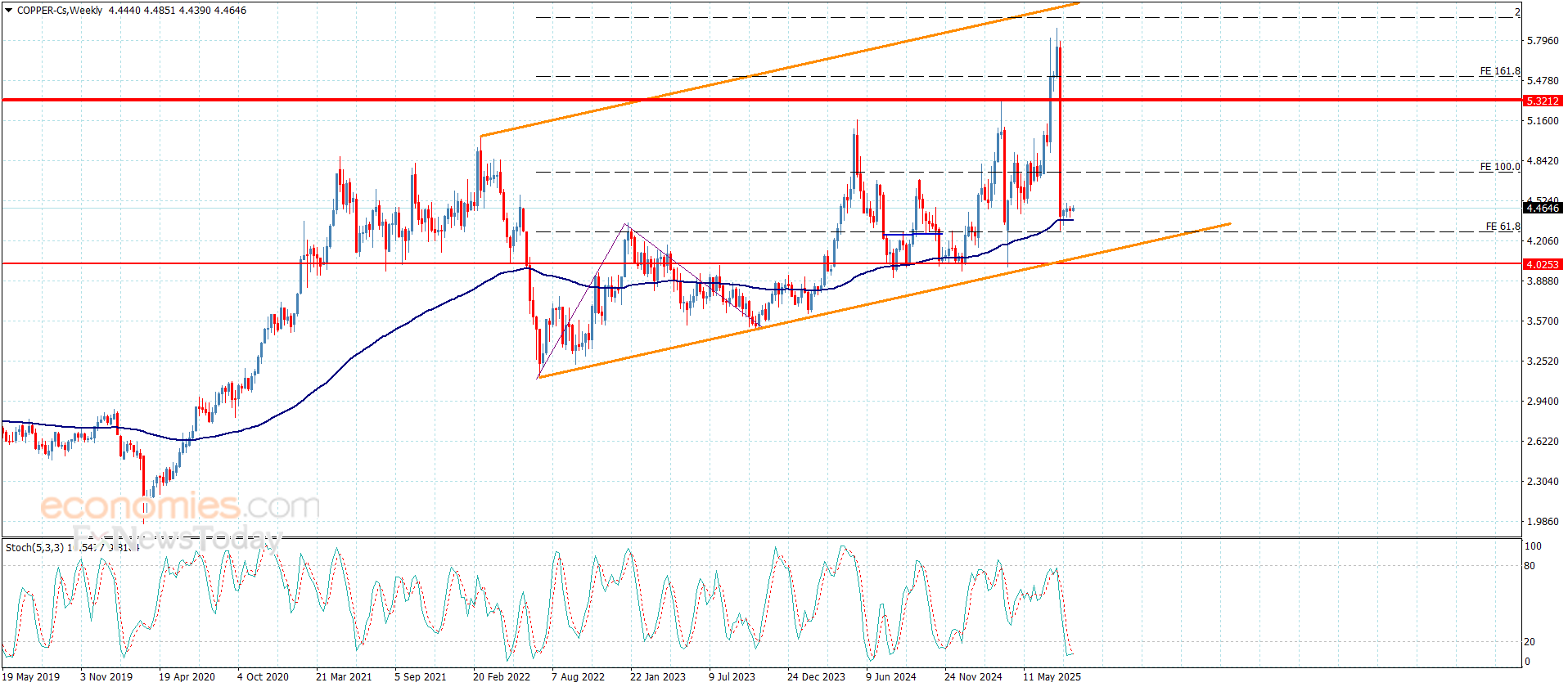
The current decline is unfolding within a falling wedge consolidation pattern, with the upper boundary aligning near the 10-Day moving average, now at $2.79. Just above that, potential resistance converges at the most recent interim swing high of $2.85 and the April swing low of $2.86. Together, they define a key resistance zone. A sustained rally above $2.86 would be required to signal that the bulls might be regaining control and the wedge breakout is showing signs of success. Until then, the path of least resistance remains lower.
If the bearish structure extends, the next potential support zone sits between $2.54 and $2.51. This area includes a 78.6% Fibonacci retracement at $2.54, along with a long-term trendline drawn from the 2023 peak. How effective that support becomes will depend on the timing and strength of any test.
Despite the bearish bias, the wedge pattern leaves room for a bullish reversal. If a confirmed breakout occurs, the standard target points back to the origin of the wedge around $3.15 to $3.19. Until that happens, the 10-Day moving average should be monitored closely as it has consistently acted as dynamic resistance since the decline that began on August 11.
For a look at all of today’s economic events, check out our economic calendar.
GBP/USD lose more than 0.5% on Monday and erased a large portion of the gains it recorded on Friday. After finding support near 1.3430, the pair staged a rebound and was last seen trading above 1.3450.
The table below shows the percentage change of British Pound (GBP) against listed major currencies last 7 days. British Pound was the weakest against the Japanese Yen.
| USD | EUR | GBP | JPY | CAD | AUD | NZD | CHF | |
|---|---|---|---|---|---|---|---|---|
| USD | 0.12% | 0.20% | -0.09% | 0.32% | 0.14% | 1.25% | -0.21% | |
| EUR | -0.12% | 0.08% | -0.31% | 0.20% | -0.08% | 1.12% | -0.32% | |
| GBP | -0.20% | -0.08% | -0.54% | 0.13% | -0.11% | 1.04% | -0.40% | |
| JPY | 0.09% | 0.31% | 0.54% | 0.48% | 0.30% | 1.36% | -0.05% | |
| CAD | -0.32% | -0.20% | -0.13% | -0.48% | -0.18% | 0.91% | -0.52% | |
| AUD | -0.14% | 0.08% | 0.11% | -0.30% | 0.18% | 1.16% | -0.28% | |
| NZD | -1.25% | -1.12% | -1.04% | -1.36% | -0.91% | -1.16% | -1.42% | |
| CHF | 0.21% | 0.32% | 0.40% | 0.05% | 0.52% | 0.28% | 1.42% |
The heat map shows percentage changes of major currencies against each other. The base currency is picked from the left column, while the quote currency is picked from the top row. For example, if you pick the British Pound from the left column and move along the horizontal line to the US Dollar, the percentage change displayed in the box will represent GBP (base)/USD (quote).
Safe-haven flows dominated the action in financial markets late Monday and early Tuesday after United States (US) President Donald Trump renewed his threats of imposing tariffs on countries that discriminate against US technology firms. Additionally, Trump said that they will have to charge China “200% tariff or something” if they don’t give them more magnets, referencing to rare earth metals.
In the second half of the day, July Durable Goods Orders and August Consumer Confidence Index data, published by the Conference Board, will be featured in the US economic calendar. The market reaction to these releases are likely to be straightforward and remain short-lived, with positive surprises supporting the USD and vice versa.
Meanwhile, investors will keep a close eye on fresh developments surrounding US President Trump’s feud with Federal Reserve (Fed) Governor Lisa Cook.
Trump announced on Truth Social late Monday that he has fired Fed Governor Cook. In response, Cook released a statement via her attorneys, noting that Trump has no authority to fire her and that she will carry out her duties. If markets grow increasingly concerned over the Fed losing its independence, the USD could come under renewed selling pressure and open the door for a leg higher in GBP/USD.
The Relative Strength Index (RSI) indicator stays slightly above 50 and GBP/USD trades above the 100-period and the 200-period Simple Moving Averages (SMAs), reflecting sellers’ hesitancy.
On the upside, 1.3500 (static level, round level, 50-period SMA) aligns as the immediate resistance level before 1.3540 (Fibonacci 61.8% retracement of the latest downtrend) and 1.3600 (static level, round level).
Looking south, support levels could be seen at 1.3460 (Fibonacci 50% retracement, 100-period SMA), 1.3430 (200-period SMA) and 1.3400-1.3390 (static level, Fibonacci 38.2% retracement).
The Pound Sterling (GBP) is the oldest currency in the world (886 AD) and the official currency of the United Kingdom. It is the fourth most traded unit for foreign exchange (FX) in the world, accounting for 12% of all transactions, averaging $630 billion a day, according to 2022 data.
Its key trading pairs are GBP/USD, also known as ‘Cable’, which accounts for 11% of FX, GBP/JPY, or the ‘Dragon’ as it is known by traders (3%), and EUR/GBP (2%). The Pound Sterling is issued by the Bank of England (BoE).
The single most important factor influencing the value of the Pound Sterling is monetary policy decided by the Bank of England. The BoE bases its decisions on whether it has achieved its primary goal of “price stability” – a steady inflation rate of around 2%. Its primary tool for achieving this is the adjustment of interest rates.
When inflation is too high, the BoE will try to rein it in by raising interest rates, making it more expensive for people and businesses to access credit. This is generally positive for GBP, as higher interest rates make the UK a more attractive place for global investors to park their money.
When inflation falls too low it is a sign economic growth is slowing. In this scenario, the BoE will consider lowering interest rates to cheapen credit so businesses will borrow more to invest in growth-generating projects.
Data releases gauge the health of the economy and can impact the value of the Pound Sterling. Indicators such as GDP, Manufacturing and Services PMIs, and employment can all influence the direction of the GBP.
A strong economy is good for Sterling. Not only does it attract more foreign investment but it may encourage the BoE to put up interest rates, which will directly strengthen GBP. Otherwise, if economic data is weak, the Pound Sterling is likely to fall.
Another significant data release for the Pound Sterling is the Trade Balance. This indicator measures the difference between what a country earns from its exports and what it spends on imports over a given period.
If a country produces highly sought-after exports, its currency will benefit purely from the extra demand created from foreign buyers seeking to purchase these goods. Therefore, a positive net Trade Balance strengthens a currency and vice versa for a negative balance.
The (Brent) price declined on its last intraday levels, amid the emergence of the negative signals on the (RSI), after reaching overbought levels, attempting to offload this overbought condition, gaining bullish momentum that might assist it to recover and rise again, amid the dominance of the bullish correctional trend on the short-term basis, with the continuation of the positive pressure that comes from its trading above EMA50, besides the price affection by positive technical formation on the short-term basis, which is represented by the double bottom pattern.
BestTradingSignal.com – Professional Trading Signals with high accuracy. Subscribe now to tailored packages for the world’s leading markets and receive signals instantly via Telegram from an expert team:
Check full VIP signals performance report for the week of August 18–22, 2025: Full Report
Important DisclaimersThe content provided on the website includes general news and publications, our personal analysis and opinions, and contents provided by third parties, which are intended for educational and research purposes only. It does not constitute, and should not be read as, any recommendation or advice to take any action whatsoever, including to make any investment or buy any product. When making any financial decision, you should perform your own due diligence checks, apply your own discretion and consult your competent advisors. The content of the website is not personally directed to you, and we does not take into account your financial situation or needs.The information contained in this website is not necessarily provided in real-time nor is it necessarily accurate. Prices provided herein may be provided by market makers and not by exchanges.Any trading or other financial decision you make shall be at your full responsibility, and you must not rely on any information provided through the website. FX Empire does not provide any warranty regarding any of the information contained in the website, and shall bear no responsibility for any trading losses you might incur as a result of using any information contained in the website.The website may include advertisements and other promotional contents, and FX Empire may receive compensation from third parties in connection with the content. FX Empire does not endorse any third party or recommends using any third party’s services, and does not assume responsibility for your use of any such third party’s website or services.FX Empire and its employees, officers, subsidiaries and associates, are not liable nor shall they be held liable for any loss or damage resulting from your use of the website or reliance on the information provided on this website.Risk DisclaimersThis website includes information about cryptocurrencies, contracts for difference (CFDs) and other financial instruments, and about brokers, exchanges and other entities trading in such instruments. Both cryptocurrencies and CFDs are complex instruments and come with a high risk of losing money. You should carefully consider whether you understand how these instruments work and whether you can afford to take the high risk of losing your money.FX Empire encourages you to perform your own research before making any investment decision, and to avoid investing in any financial instrument which you do not fully understand how it works and what are the risks involved.
Gold (XAU/USD $3,410.80, +1.1%) opened Tuesday above the $3,400 threshold, extending a rebound triggered by Fed Chair Jerome Powell’s Jackson Hole speech. Powell emphasized that tariffs’ inflationary impact was likely temporary and hinted at a September rate cut, sending Treasury yields lower and the dollar weaker. The move gave bullion a $50 surge to $3,380 late Friday and follow-through buying pushed it to Tuesday’s open at $3,410.80 per ounce, not far from the April 22 all-time high of $3,485.60. In euro terms, the rally was less pronounced, underscoring that the U.S. dollar’s weakness was the primary driver.
The removal of Fed Governor Lisa Cook by President Donald Trump jolted markets and deepened concerns over central bank independence. Such political moves suggest lower-for-longer rates, which historically bolster gold. Gold has already risen 35.9% year-over-year, from $2,509.90 in August 2024 to $3,410.80 today. The perception that the Fed is under pressure to ease aggressively raises the likelihood of further safe-haven flows into bullion. Traders are eyeing the core PCE index release on Friday, which could confirm or weaken the case for a September cut.
ETF flows, which had seen heavy outflows during the late July correction, have stabilized. Inflows into gold-backed ETFs in August resumed as global investors rotated back into safe-haven assets amid tariff risks and Fed turmoil. Central bank accumulation remains another critical driver: emerging market banks, particularly in Asia and the Middle East, continue diversifying away from the dollar. The World Gold Council reported that Q2 central bank demand hit record highs, supporting structural upside. Local currency moves are also highlighting demand: in the Philippines, gold rose to PHP 6,182.63 per gram and PHP 72,113.35 per tola, up from the previous day’s PHP 71,872.19 per tola, reflecting global price translation.
Exploration activity is accelerating with prices above $3,400. Legacy Minerals (ASX:LGM) secured approval for 4,500 meters of diamond drilling at Mt Carrington, a project with historical results of 12.82 meters at 48 g/t gold. The site, which closed in 1993 when gold was below $400, now looks viable with gold at nine times those levels. Legacy raised AU$7.75 million earlier this year, highlighting how elevated gold prices are revitalizing once-marginal projects. Additional assays at its Thomson project, showing long intersections of low-grade gold, point to broader exploration appetite underpinned by bullion strength.
Technically, gold is consolidating gains just below $3,420, with the 20- and 100-period moving averages clustering between $3,340–$3,355, forming a potential bullish crossover. If sustained, the setup favors a push toward the $3,500 level, where breakout targets extend to $3,800. On the downside, support rests at $3,370, followed by $3,300 and $3,260, with $3,200 seen as the hard floor aligning with the 200-day EMA. The RSI remains positive but not overbought, indicating room for continuation if macro catalysts align.
Markets await the U.S. Core PCE Index and the Q2 GDP revision later this week. A softer inflation print would validate rate cut bets and reinforce gold’s bid above $3,400. Stronger data could cool expectations, but geopolitical and political risks suggest downside is capped. Bond markets have already priced in a September cut almost fully, with additional easing in Q4, keeping pressure on the dollar and underpinning bullion.
Beyond short-term volatility, gold is in a powerful long-cycle uptrend. In the past month, futures gained 2% from $3,344 on July 25 to $3,410.80 today, while year-to-date performance exceeds +40%. Forecasts from major banks project prices reaching $3,700 by year-end 2025, citing record central bank demand and trade-war-induced dollar weakness. With legacy projects reopening and ETF inflows resuming, gold’s structural appeal remains strong, especially as political risks weigh on fiat credibility.
The US dollar initially fell during the trading session on Tuesday, but it has bounced enough to see the 50 day EMA provide support. And it also is now threatening the 200 day EMA. I think we’re in an area here where we’re just killing time. And I think a lot of retail traders are probably stuck because they expected the US dollar to get eviscerated and we basically haven’t seen it fall apart. This is the old adage, the market has already priced it in.
So, with an interest rate cut in September and possibly December, you still have an interest rate differential that favors the US dollar against the Japanese yen, thereby, I believe, putting a bit of a floor in it.
The Australian dollar has been slightly positive against the US dollar, but really, this is still a “fade the rally” type of situation. It’s very underwhelming and the 0.6550 level continues to be a major barrier. The 200 day EMA sits just below the 50 day EMA sits right here. We formed a shooting star during the trading session on Monday.
I think you continue to see a lot of lackluster sideways action here, especially this time of year, because most assets are going to be missing volume, and therefore, you have to be very cautious expecting big moves. Short-term back and forth range bound trading is probably where you’re going to be seeing the Australian dollar move.
For a look at all of today’s economic events, check out our economic calendar.
At 13:01 GMT, XAU/USD is trading $3372.01, up $6.29 or +0.19%.
The dismissal is widely seen as a political maneuver aimed at steering the Fed toward a more dovish stance. Analysts, including Swissquote’s Carlo Alberto De Casa, warned that this introduces deeper uncertainty around the Fed’s credibility and decision-making autonomy—conditions historically supportive of gold.
Bond markets also reacted sharply. The 2-year Treasury yield dropped 3 bps to 3.70%, while the 10-year yield held around 4.279% and the 30-year yield rose to 4.916%, steepening the yield curve. Traders are now betting on lower short-term rates but pricing in longer-term inflation risk, both favorable for non-yielding gold.
Adding to the bullish gold narrative, Fed Chair Jerome Powell hinted at a potential rate cut in September, citing softening labor market indicators, even as inflation remains a concern. Money markets are now pricing in an 82% chance of a 25 bps cut.
Investors are eyeing this Friday’s PCE price index data—seen as the Fed’s preferred inflation gauge—for confirmation. A cooler reading could solidify the rate-cut narrative and strengthen gold’s upside.
On the demand side, China’s net gold imports via Hong Kong jumped 126.81% in July compared to June, according to Hong Kong Census data. This marked a major rebound in physical demand, offering further support to bullion.