The main category of Forex News.
You can use the search box below to find what you need.
[wd_asp id=1]
The main category of Forex News.
You can use the search box below to find what you need.
[wd_asp id=1]
The U.S. dollar index edged up 0.1% to 98.71, near a two-week high, as markets reassessed the probability of a September rate cut. A firmer dollar makes gold more expensive for holders of other currencies, pressuring the metal lower. The euro and British pound both slipped to their weakest levels since early August, while the yen weakened to 148.56 per dollar.
UBS strategist Giovanni Staunovo attributed the dip in gold to the firmer dollar and increasing uncertainty around the Fed’s next move. Futures markets, using CME’s FedWatch tool, show a 71-73% chance of a 25-basis-point rate cut in September—down from 85.4% just one week ago.
Federal Reserve officials sent conflicting signals this week. Some expressed caution about easing policy too soon, while others left the door open for a rate cut. Chicago Fed President Austan Goolsbee referred to the upcoming FOMC meeting as “live,” while emphasizing mixed data and inflation concerns.
Labor market data remains soft, with last week’s jobless claims rising the most in nearly three months. But inflation remains above the Fed’s 2% target, adding to policy uncertainty. Powell’s speech at 10:00 a.m. EDT is expected to clarify how the Fed will balance inflation risks against a cooling labor market.
The GBPJPY pair provided temporary positive trading, attempting to recover some of its losses by its rally to 199.35, to begin declining affected by stochastic negativity, approaching from 20 level as appears in the above image.
The attempts of forming an extra barrier at 199.60 level confirms the price confinement within the bearish track, to keep preferring the negative attempts, that might target 198.20 reaching 197.45, to face 61.8%Fibonacci correctional level.
The expected trading range for today is between 198.20 and 199.40
Trend forecast: Bearish
The (ETHUSD) price rose in its last intraday trading, attempting to offload some of its clear oversold on the (RSI), especially with the emergence of the positive signals from there, amid the dominance of the bearish correctional trend on the short-term basis, and its trading alongside a supportive bias line for this track, with the continuation of the negative pressure that comes from its trading below EMA50, intensifying the negative pressure around the price, and prevents the price recovery on the near-term basis.
BestTradingSignal.com – Professional Trading Signals with high accuracy. Subscribe now to tailored packages for the world’s leading markets and receive signals instantly via Telegram from an expert team:
Check full VIP signals performance report for the week of August 11–15, 2025: Full Report
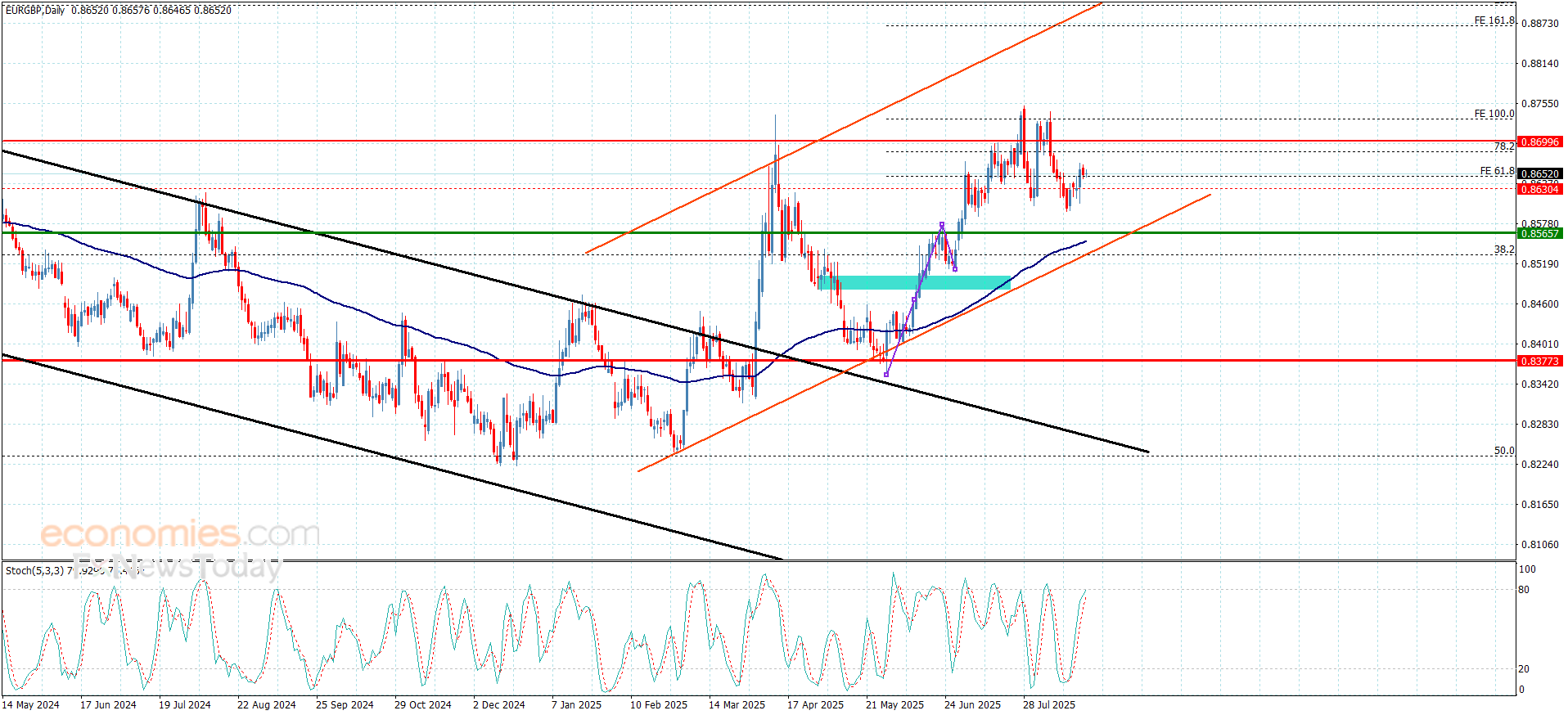
The EURGBP was affected by some negative factors, forming bearish correctional decline to 0.8595, forming extra support to allow it recover some of the losses by its rally to 0.8660.
Note that the stability of the price within the bullish channel’s levels might extend its main support level to 0.8545, besides providing positive momentum by stochastic, these factors confirm the price readiness to renew its bullish attempts, to expect targeting 0.8695 level, to press on 0.8735 resistance.
The expected trading range for today is between 00.8630 and 0.8695
Trend forecast: Bullish
Important DisclaimersThe content provided on the website includes general news and publications, our personal analysis and opinions, and contents provided by third parties, which are intended for educational and research purposes only. It does not constitute, and should not be read as, any recommendation or advice to take any action whatsoever, including to make any investment or buy any product. When making any financial decision, you should perform your own due diligence checks, apply your own discretion and consult your competent advisors. The content of the website is not personally directed to you, and we does not take into account your financial situation or needs.The information contained in this website is not necessarily provided in real-time nor is it necessarily accurate. Prices provided herein may be provided by market makers and not by exchanges.Any trading or other financial decision you make shall be at your full responsibility, and you must not rely on any information provided through the website. FX Empire does not provide any warranty regarding any of the information contained in the website, and shall bear no responsibility for any trading losses you might incur as a result of using any information contained in the website.The website may include advertisements and other promotional contents, and FX Empire may receive compensation from third parties in connection with the content. FX Empire does not endorse any third party or recommends using any third party’s services, and does not assume responsibility for your use of any such third party’s website or services.FX Empire and its employees, officers, subsidiaries and associates, are not liable nor shall they be held liable for any loss or damage resulting from your use of the website or reliance on the information provided on this website.Risk DisclaimersThis website includes information about cryptocurrencies, contracts for difference (CFDs) and other financial instruments, and about brokers, exchanges and other entities trading in such instruments. Both cryptocurrencies and CFDs are complex instruments and come with a high risk of losing money. You should carefully consider whether you understand how these instruments work and whether you can afford to take the high risk of losing your money.FX Empire encourages you to perform your own research before making any investment decision, and to avoid investing in any financial instrument which you do not fully understand how it works and what are the risks involved.
GBP/USD stabilizes slightly above 1.3400 in the European session on Friday after posting losses for four consecutive days and losing about 1% since the beginning of the week. Investors refrain from taking large positions ahead of Federal Reserve (Fed) Chair Jerome Powell’s speech at the annual Jackson Hole Symposium.
The table below shows the percentage change of British Pound (GBP) against listed major currencies this week. British Pound was the weakest against the US Dollar.
| USD | EUR | GBP | JPY | CAD | AUD | NZD | CHF | |
|---|---|---|---|---|---|---|---|---|
| USD | 0.98% | 1.03% | 0.98% | 0.69% | 1.31% | 1.98% | 0.46% | |
| EUR | -0.98% | 0.05% | -0.02% | -0.29% | 0.34% | 0.96% | -0.51% | |
| GBP | -1.03% | -0.05% | -0.14% | -0.33% | 0.29% | 0.91% | -0.60% | |
| JPY | -0.98% | 0.02% | 0.14% | -0.28% | 0.34% | 1.00% | -0.52% | |
| CAD | -0.69% | 0.29% | 0.33% | 0.28% | 0.60% | 1.28% | -0.26% | |
| AUD | -1.31% | -0.34% | -0.29% | -0.34% | -0.60% | 0.61% | -0.90% | |
| NZD | -1.98% | -0.96% | -0.91% | -1.00% | -1.28% | -0.61% | -1.52% | |
| CHF | -0.46% | 0.51% | 0.60% | 0.52% | 0.26% | 0.90% | 1.52% |
The heat map shows percentage changes of major currencies against each other. The base currency is picked from the left column, while the quote currency is picked from the top row. For example, if you pick the British Pound from the left column and move along the horizontal line to the US Dollar, the percentage change displayed in the box will represent GBP (base)/USD (quote).
The US Dollar (USD) benefited from the upbeat Purchasing Managers Index (PMI) data from the US and caused GBP/USD to push lower on Thursday. S&P Global Manufacturing PMI improved to 53.3 in August’s preliminary estimate from 49.8 in July and the Services PMI came in at 55.4, beating the market expectation of 54.2. Reflecting the broad-based USD strength, the USD Index climbed to its highest level in over two weeks near 99.00 early Friday.
In assessment of the findings of the survey, Chris Williamson, Chief Business Economist at S&P Global Market Intelligence, explained that the increase seen in selling prices for goods and services suggests that consumer price inflation will rise further in the coming months.
“Combined with the upturn in business activity and hiring, the rise in prices signaled by the survey puts the PMI data more into rate hiking, rather than cutting, territory according to the historical relationship between these economic indicators and FOMC policy changes,” Williamson added.
The odds of a 25 basis-points (bps) Fed rate cut at the next meeting declined to 73% from about 84% before the release of the PMI data, as per CME FedWatch Tool.
Fed Chair Powell’s speech, entitled “Economic Outlook and Framework Review,” will be scrutinized by market participants in the American session on Friday.
In case Powell repeats that they need more time to analyze the impact of tariffs on inflation before entering a policy-easing cycle, the USD could preserve its strength and force GBP/USD to stay on the back foot heading into the weekend.
Conversely, the USD could come under selling pressure if Powell hints at a September rate cut by acknowledging worsening conditions in the labor market. In this scenario, GBP/USD could erase some of its weekly losses in the second half of the day.
The Relative Strength Index (RSI) indicator on the 4-hour chart edges higher but remains below 40, suggesting that GBP/USD’s bearish bias remains intact despite the latest recovery attempt.
On the upside, the 100-period Simple Moving Average (SMA) and the 200-period SMA form a strong resistance area at 1.3425-1.3440 before 1.3460 (Fibonacci 50% retracement of the latest downtrend) and 1.3500 (static level, round level, 50-period SMA).
Looking south, support levels could be seen at 1.3400-1.3390 (static level, Fibonacci 38.2% retracement), 1.3330 (static level) and 1.3300 (Fibonacci 23.6% retracement).
Monetary policy in the US is shaped by the Federal Reserve (Fed). The Fed has two mandates: to achieve price stability and foster full employment. Its primary tool to achieve these goals is by adjusting interest rates.
When prices are rising too quickly and inflation is above the Fed’s 2% target, it raises interest rates, increasing borrowing costs throughout the economy. This results in a stronger US Dollar (USD) as it makes the US a more attractive place for international investors to park their money.
When inflation falls below 2% or the Unemployment Rate is too high, the Fed may lower interest rates to encourage borrowing, which weighs on the Greenback.
The Federal Reserve (Fed) holds eight policy meetings a year, where the Federal Open Market Committee (FOMC) assesses economic conditions and makes monetary policy decisions.
The FOMC is attended by twelve Fed officials – the seven members of the Board of Governors, the president of the Federal Reserve Bank of New York, and four of the remaining eleven regional Reserve Bank presidents, who serve one-year terms on a rotating basis.
In extreme situations, the Federal Reserve may resort to a policy named Quantitative Easing (QE). QE is the process by which the Fed substantially increases the flow of credit in a stuck financial system.
It is a non-standard policy measure used during crises or when inflation is extremely low. It was the Fed’s weapon of choice during the Great Financial Crisis in 2008. It involves the Fed printing more Dollars and using them to buy high grade bonds from financial institutions. QE usually weakens the US Dollar.
Quantitative tightening (QT) is the reverse process of QE, whereby the Federal Reserve stops buying bonds from financial institutions and does not reinvest the principal from the bonds it holds maturing, to purchase new bonds. It is usually positive for the value of the US Dollar.
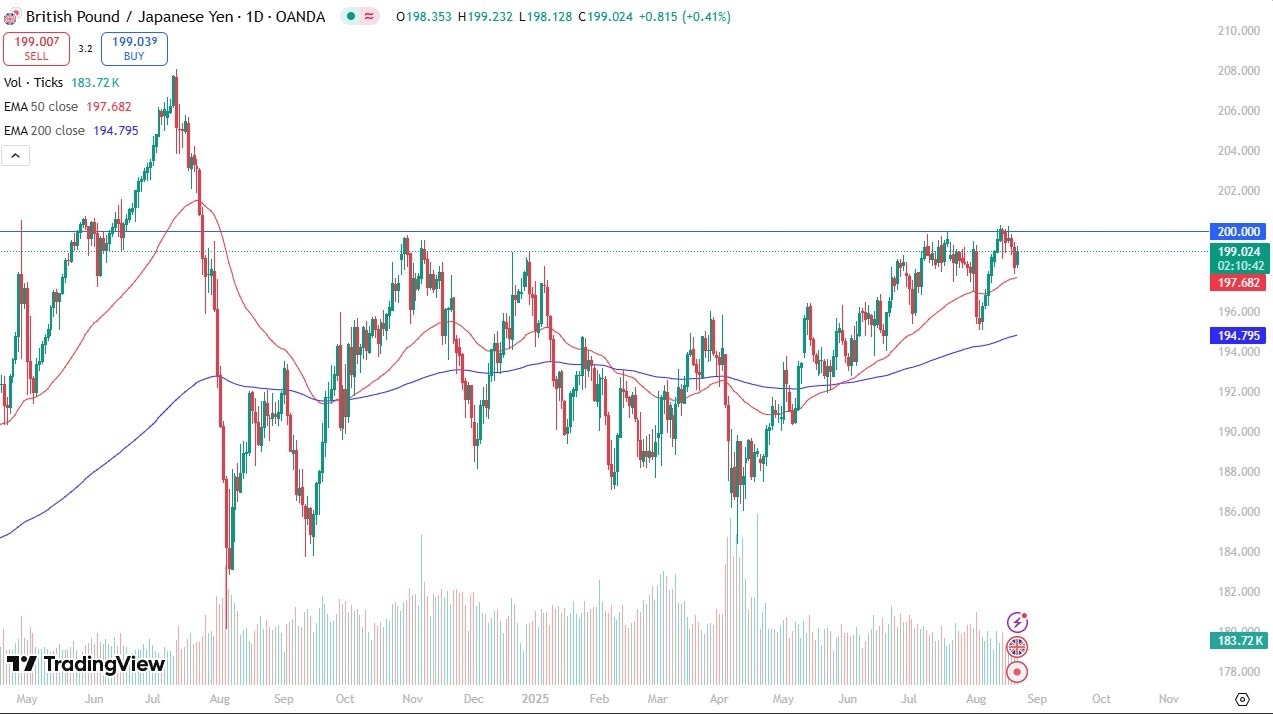
If we were to break down below the 50 day EMA that could send the British pound down to the 196 yen level, possibly even as low as the 200 day EMA which is underneath there. So that being said, I think you’ve got a situation where we are at an inflection point. But we are also in a bullish trend that is now pressuring a major barrier.

If we can get beyond that barrier, you will probably see the Japanese yen get eviscerated by almost everything else around the world as well. It probably won’t be just a British pound thing. That being said, Friday has the speech by Jerome Powell and that of course will make a certain amount of sense that it could cause some noise.
And with this, I think you have to understand that traders are looking for some type of clarity on what the Federal Reserve will do and therefore what risk appetite might be due to monetary policy.
Ultimately, this is a market that I think will be very volatile, but that’s typically the case here with this pair anyways. I still favor the upside, but we obviously have a huge mountain to climb just above at this big figure.
Begin trading our daily forecasts and analysis. Here is a list of Forex brokers in Japan to work with.
Christopher Lewis has been trading Forex and has over 20 years experience in financial markets. Chris has been a regular contributor to Daily Forex since the early days of the site. He writes about Forex for several online publications, including FX Empire, Investing.com, and his own site, aptly named The Trader Guy. Chris favours technical analysis methods to identify his trades and likes to trade equity indices and commodities as well as Forex. He favours a longer-term trading style, and his trades often last for days or weeks.
The wedge pattern formed within a broader consolidation formation rather than a clear uptrend, which helps explain the muted response. For the breakout to be validated, gold must show improving momentum and consistent buying interest. Otherwise, a slow drift higher could indicate the move was a false signal. Key resistance remains nearby, and failure to build on Thursday’s advance would leave gold vulnerable to renewed selling pressure.
A larger symmetrical triangle continues to frame the technical outlook, reflecting narrowing volatility as prices compress toward the apex. A decisive breakout above $3,435 would confirm the next bullish phase, while an earlier indication of strength could be seen on a move through $3,409. Adding to this structure is a rising ABCD pattern, with its 100% projection targeting $3,452 — just above the triangle’s bullish trigger zone. A breakout above these levels would mark a significant continuation of the broader uptrend.
On the broader monthly timeframe, August marks the fourth consecutive month where gold has traded within April’s wide range, when prices peaked near $3,500. Three of those months formed inside bars, highlighting reduced volatility and persistent indecision. Notably, closing prices for the past four months have clustered tightly between $3,288 and $3,303.
This narrow band has acted as a base of support, and a decisive monthly close above it would carry some technical weight. Such a move would align with the potential for an upside breakout from the ongoing triangle pattern, setting the stage for a test of higher resistance levels into September.
For a look at all of today’s economic events, check out our economic calendar.
See today’s full USD/JPY forecast with chart setups and trade ideas.
Turning to the AUD/USD pair, expectations of an additional RBA rate cut in November have weighed on Aussie dollar demand. However, recent economic indicators sent mixed signals. Total wages and salaries paid by employers increased 1.5% month-on-month in June, up from an increase of 0.9% in March. Year-on-year, wages and salaries rose 5.9% (March: +5.8%).
Higher wages and lower interest rates may fuel spending and inflation, complicating Q4 rate cut bets. Private sector PMIs also signaled an improving macroeconomic backdrop, potentially delaying further policy easing.
The S&P Global Australia Composite PMI rose from 53.8 in June to 54.9 in July as private sector output expanded at the sharpest pace since April 2022. New export business expanded across the private sector, leading to higher staffing levels. Notably, wage costs contributed to higher inflation. However, the rates of cost inflation softened across the manufacturing and services sectors.
Why do new export order trends matter?
Australia has a trade-GDP ratio of over 50%, with roughly 20% of its workforce in trade-related jobs.
AMP Head of Investment Strategy and Chief Economist Shane Oliver projected a November rate cut and further policy easing in H1 2026, stating:
“We continue to see the RBA cutting rates again in November, February and May taking the cash rate down to 2.85%.”
However, not all economists share this view, with some cautioning that rising wages could delay further easing.
AUD/USD: Key Scenarios to Watch
Explore our full AUD/USD analysis, including key trends and trade data, here.
While economists are betting on a November RBA rate cut, uncertainty lingers about the Fed’s policy outlook. Fed Chair Powell’s support for a September Fed rate cut and further policy easing would narrow the US-Aussie interest rate differential. A narrower rate differential could send AUD/USD toward $0.6450, bringing the 200-day EMA into view.
On the other hand, the pair could drop below $0.64, exposing the $0.63623 support level if Powell raises concerns about upside risks to inflation.
The next critical zone lies near $2.96–$2.97, where multiple indicators converge, including the 20-Day moving average and a long-term anchored volume-weighted average price (AVWAP) level. The AVWAP has historically acted as support and resistance since October, reinforcing this area as a potential barrier. Importantly, this zone will only become relevant if prices break decisively above Thursday’s $2.85 high, confirming a bullish wedge breakout. Until then, momentum toward $2.97 remains conditional.
Thursday’s high also coincided with resistance at April’s swing low (now resistance) and the upper boundary of a small falling wedge pattern. A decisive move above $2.85 would trigger a bullish breakout signal, initially projecting toward $3.15, the beginning of the wedge formation. Without that breakout, price is likely to remain contained below the wedge and 20-Day moving average and facing further selling pressure.
The current setup shows natural gas attempting to stabilize after recent weakness, but upside momentum is limited until the wedge breakout occurs. A move above $2.85 is required to shift short-term momentum toward higher targets. If that level fails to hold, price may remain in the current consolidation, with the wedge and AVWAP acting as key reference points for resistance. If the trend low of $2.73 is broken, then next downside target $2.63.
For a look at all of today’s economic events, check out our economic calendar.