The main category of Forex News.
You can use the search box below to find what you need.
[wd_asp id=1]
The main category of Forex News.
You can use the search box below to find what you need.
[wd_asp id=1]
The triangle pattern has formed near the top of gold’s long-term uptrend, generally signaling potential for an eventual upside breakout. Yet its clarity also means surprises are possible. A breakout that fails could quickly reverse, leading to a sharp swing in the opposite direction. Traders should remain aware of this scenario, as it has precedent. Last month, a smaller symmetrical triangle broke briefly before reversing, and then a breakdown also failed to follow through.
This led to the expanded current wider consolidation range. Patterns observed near major highs can lead to increased market volatility when false breakouts happen, highlighting the importance of effective risk management.
The triangle boundaries are defined by trendlines connecting recent swing highs and lows. An upside breakout would require a move above $3,409, followed by a push through $3,439. On the downside, a break below the lower boundary, confirmed by a drop beneath the recent higher swing low at $3,268, would show control of the bears and could lead to a deeper retracement.
If $3,268 fails as support, the next area of interest is the 38.2% Fibonacci retracement from the earlier $3,500 record high, which would act as a potential minimum downside target. While this level may hold, traders should be aware that failed breakouts or sudden reversals can push momentum further, making it important to monitor price action closely and adjust strategies as conditions evolve.
For a look at all of today’s economic events, check out our economic calendar.
Important DisclaimersThe content provided on the website includes general news and publications, our personal analysis and opinions, and contents provided by third parties, which are intended for educational and research purposes only. It does not constitute, and should not be read as, any recommendation or advice to take any action whatsoever, including to make any investment or buy any product. When making any financial decision, you should perform your own due diligence checks, apply your own discretion and consult your competent advisors. The content of the website is not personally directed to you, and we does not take into account your financial situation or needs.The information contained in this website is not necessarily provided in real-time nor is it necessarily accurate. Prices provided herein may be provided by market makers and not by exchanges.Any trading or other financial decision you make shall be at your full responsibility, and you must not rely on any information provided through the website. FX Empire does not provide any warranty regarding any of the information contained in the website, and shall bear no responsibility for any trading losses you might incur as a result of using any information contained in the website.The website may include advertisements and other promotional contents, and FX Empire may receive compensation from third parties in connection with the content. FX Empire does not endorse any third party or recommends using any third party’s services, and does not assume responsibility for your use of any such third party’s website or services.FX Empire and its employees, officers, subsidiaries and associates, are not liable nor shall they be held liable for any loss or damage resulting from your use of the website or reliance on the information provided on this website.Risk DisclaimersThis website includes information about cryptocurrencies, contracts for difference (CFDs) and other financial instruments, and about brokers, exchanges and other entities trading in such instruments. Both cryptocurrencies and CFDs are complex instruments and come with a high risk of losing money. You should carefully consider whether you understand how these instruments work and whether you can afford to take the high risk of losing your money.FX Empire encourages you to perform your own research before making any investment decision, and to avoid investing in any financial instrument which you do not fully understand how it works and what are the risks involved.
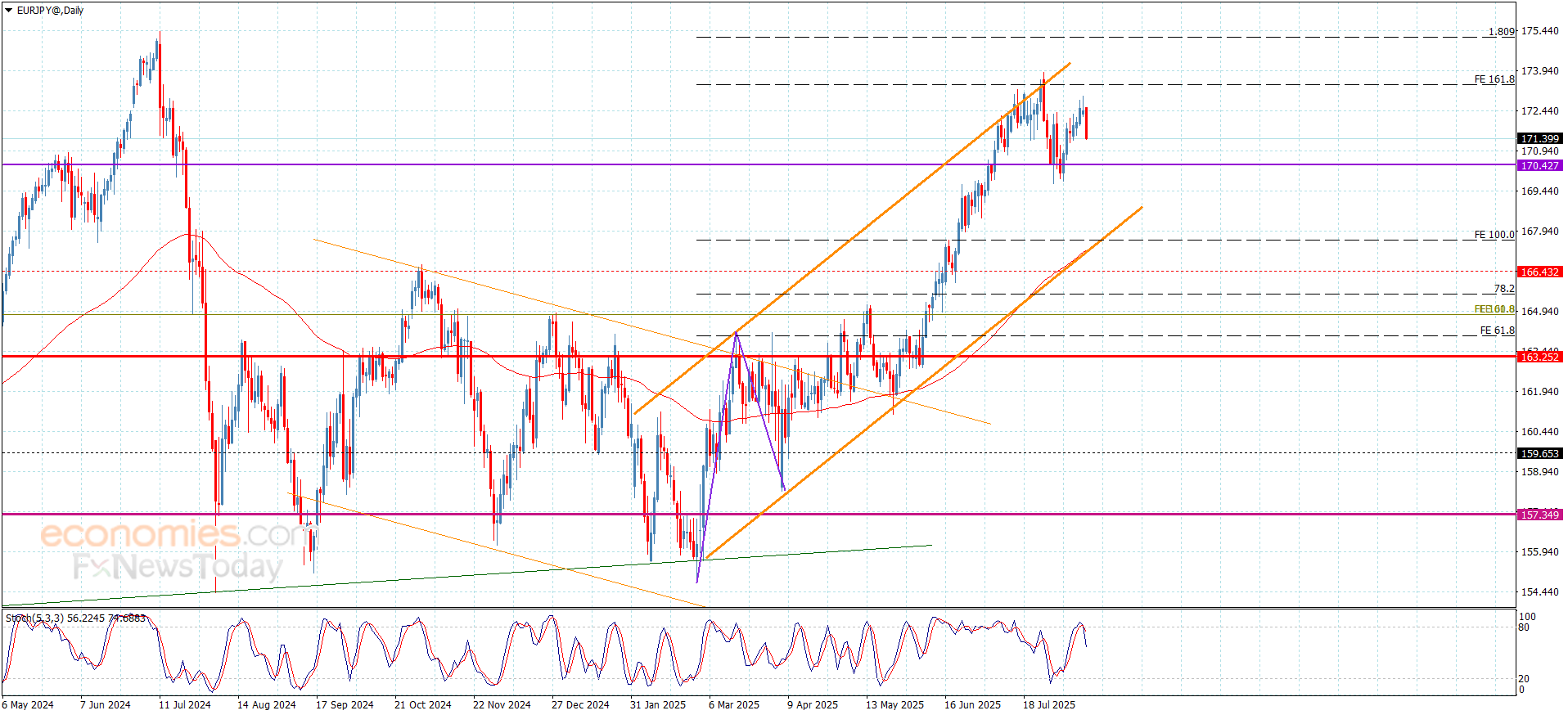
The EURJPY pair reacted with stochastic exit from the overbought level this morning, which forces it to delay the bullish attack to reach below 172.00, announcing its surrender to the bearish correctional scenario by its stability near 171.38.
The continuation of the negative pressure might force the price to suffer extra losses by reaching 170.90 followed by the extra support at 170.45, while the price return to settle above 172.00 will provide chances for renewing the bullish attempts and reaching 172.60.
The expected trading range for today is between 170.45 and 172.60
Trend forecast: Bearish temporarily
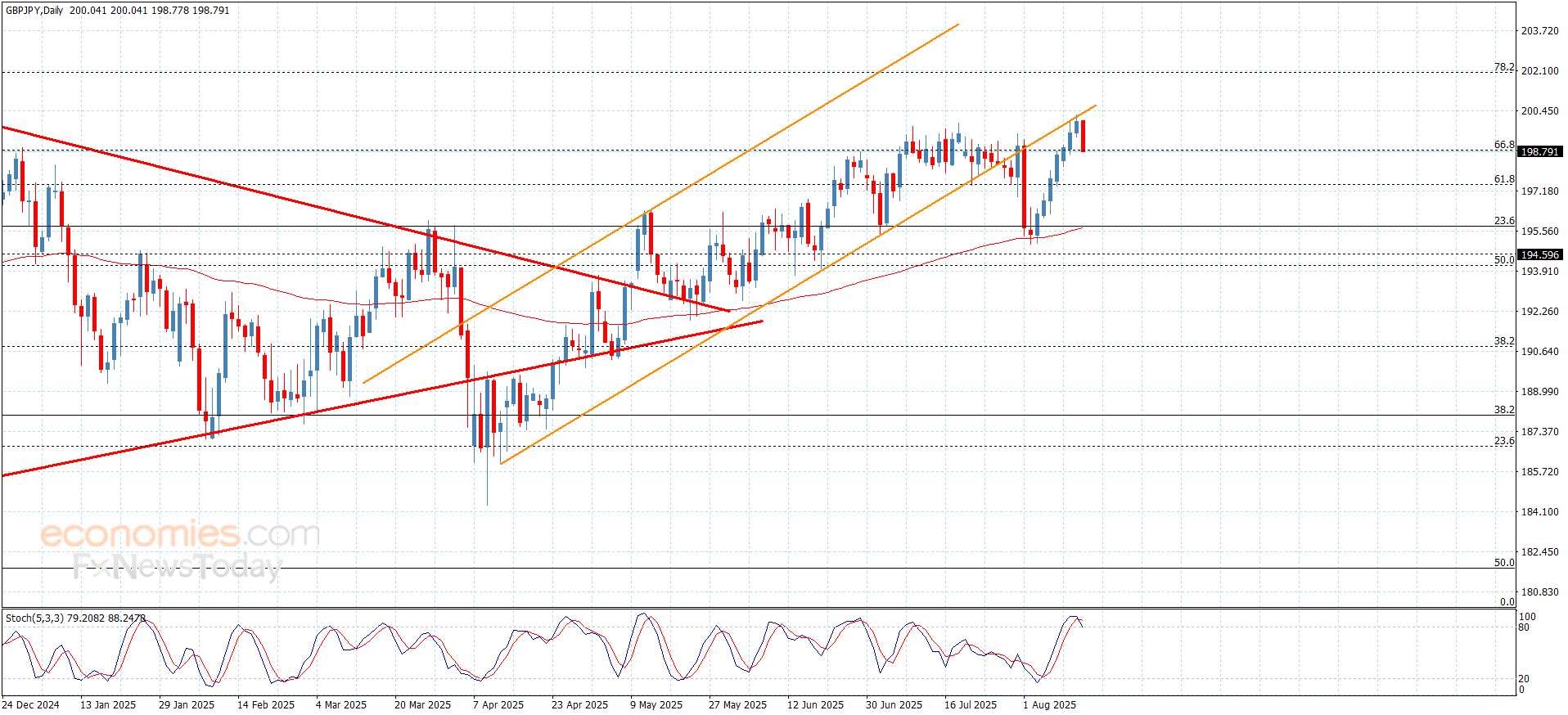
The GBPJPY pair surrendered this morning trading due to the stability of the resistance at 200.40, to form a strong obstacle against the attempt to return to the bullish channel’s levels, forming strong correctional decline and its stability near 198.77.
Stochastic attempt to exit the oversold level makes us expect renewing the correctional attempts, note that breaking 198.25 level will force it to suffer extra losses that might extend to 61.8%Fibonacci correction level at 197.55, while the stability above 198.25 will increase the chances for renewing the bullish attempts in the near period.
The expected trading range for today is between 198.25 and 199.60
Trend forecast: Bearish
Copper price kept its positive stability above the moving average 55 to keep the continuation of the suggested positivity that depends on the stability of the bullish channel’s support at $4.0500, to notice the weakness of the bullish attempts due to the continuation of stochastic contradiction that is fluctuating now within the oversold level.
Gaining the required extra positive momentum, to motivate the bullish attack, to expect attacking the initial positive target at $4.7400, and surpassing it will make it record several gains in the upcoming period trading.
The expected trading range for today is between $4.3700 and $4.6300
Trend forecast: Bullish
The EURJPY pair reacted with stochastic exit from the overbought level this morning, which forces it to delay the bullish attack to reach below 172.00, announcing its surrender to the bearish correctional scenario by its stability near 171.38.
The continuation of the negative pressure might force the price to suffer extra losses by reaching 170.90 followed by the extra support at 170.45, while the price return to settle above 172.00 will provide chances for renewing the bullish attempts and reaching 172.60.
The expected trading range for today is between 170.45 and 172.60
Trend forecast: Bearish temporarily
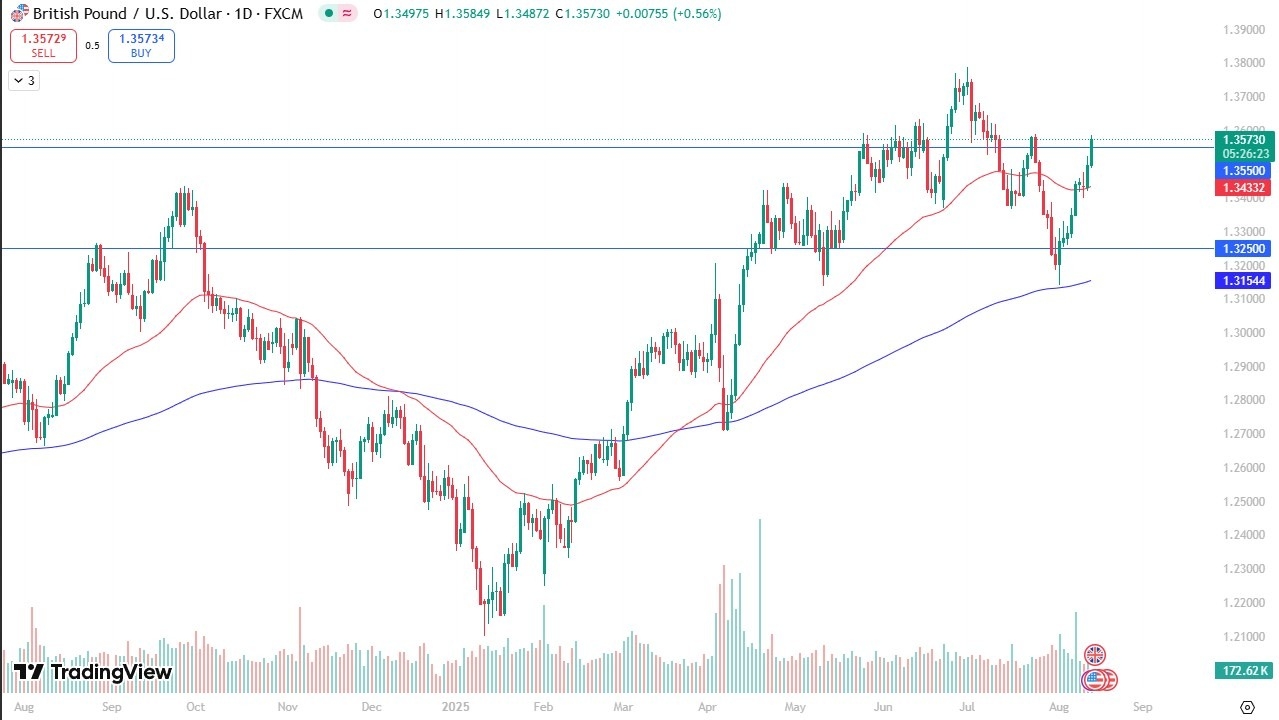
Anything below could open up a drop down to the 200 day EMA, but all things being equal, this is a situation where I think a lot of people are going to be looking at this as a harbinger of U S dollar weakness or strength. This is one of the favorite charts for me daily at the moment.

After all, even when the U S dollar was so strong during 2024, the British pound fared better than most of its competitors. Just as we’ve seen the same thing on the way back up. If this pair starts to fall apart, I still might not short it, but I probably will short other currencies like the Canadian dollar, the Euro, the Japanese yen, etc.
All things being equal though, this is a market that looks like it is trying to get to the upside and eventually break towards 1.38, a trade that I’m very comfortable with, but admittedly have to recognize that this V pattern is pretty aggressive. So, whether or not we can keep up the momentum is a completely different question, but either way, I’m at the very least not shorting this pair anytime soon. I look at it more of an indicator of the US dollar than anything else.
Ready to trade the Forex GBP/USD analysis and predictions? Here are the best forex trading platforms UK to choose from.
Christopher Lewis has been trading Forex and has over 20 years experience in financial markets. Chris has been a regular contributor to Daily Forex since the early days of the site. He writes about Forex for several online publications, including FX Empire, Investing.com, and his own site, aptly named The Trader Guy. Chris favours technical analysis methods to identify his trades and likes to trade equity indices and commodities as well as Forex. He favours a longer-term trading style, and his trades often last for days or weeks.
Today’s oil market presents a complex landscape of price movements, global dynamics, and shifting supply-demand fundamentals. For investors, traders, and industry observers, understanding these movements requires examining multiple factors across the energy spectrum. This guide breaks down the current state of crude oil prices today and what’s driving market movements.
Oil prices continue to show resilience despite market expectations of weakness. The two major global benchmarks are showing modest gains, while other energy commodities display varying performance.
WTI crude is currently trading at $68.57 per barrel, showing a modest increase of 0.18% in the last trading session. Meanwhile, Brent crude stands at $70.53, with a similarly modest gain of 0.24%. These two major benchmarks serve as global reference points for oil pricing and continue to reflect positive momentum despite earlier predictions of price declines.
The relative stability of these benchmarks suggests underlying market strength that has surprised many analysts who expected more significant price drops following recent production announcements. Recent oil price rally insights suggest that several fundamental factors are supporting the market despite bearish expectations.
Beyond the major benchmarks, other energy commodities are showing interesting price action:
Murban’s notable outperformance relative to WTI and Brent suggests particular strength in the Middle Eastern crude market, potentially reflecting stronger Asian demand for this grade specifically.
Several key factors are influencing today’s oil price movements, from production decisions to inventory levels and geopolitical tensions.
Recent OPEC+ announcements have significantly influenced market sentiment. The cartel’s decision to increase production by over 500,000 barrels daily surprised many analysts who expected prices to fall substantially as a result. Instead, prices have remained resilient, with Brent climbing above $70 per barrel following the announcement.
UAE Energy Minister Suhail al Mazrouei explained this unexpected price resilience, stating: “You can see that even with the increase in several months, we haven’t seen a major buildup in the inventories, which means the market needed those barrels.” This assessment from a key OPEC official confirms that global demand has been absorbing the additional supply without creating gluts.
The market’s reaction to OPEC+ decisions suggests a tighter supply-demand balance than many expected, with the additional barrels being readily absorbed by consumers. This dynamic has contributed to the stagnant oil price factors observed in recent trading sessions.
Current inventory data reveals significant tightness in key markets:
This tight inventory situation creates a bullish underpinning for prices. According to the International Energy Agency’s June 2025 Oil Market Report, these inventory levels represent one of the tightest market conditions in recent years despite increased production.
The diesel situation is particularly concerning for transportation costs. James Noel-Beswick from Sparta Commodities noted in a Wall Street Journal interview: “Because of those run cuts [refinery operations], we started this year with not enough diesel in storage.” This shortage creates potential ripple effects throughout global supply chains.
Recent escalations in the Middle East and developments in Russia continue to create market uncertainty. While no oil infrastructure has been directly targeted in recent conflicts, each flare-up in tensions has triggered price spikes of $2-3 per barrel before settling back.
These reactions demonstrate the market’s ongoing sensitivity to potential supply disruptions, despite current adequate global production capacity. The geopolitical risk premium remains embedded in current prices, particularly for Brent crude which is more exposed to Middle Eastern supply disruption risks.
Oil prices vary significantly by region due to quality differences, transportation constraints, and local supply-demand dynamics.
U.S. domestic crude varieties show varied performance across different regions:
The significant discount for Western Canadian Select ($14.35 below WTI) highlights the persistent challenges facing Canadian producers. This discount primarily stems from transportation constraints between Canadian production regions and U.S. refineries, along with quality differentials – WCS is a heavier, more sour crude that requires more complex refining processes.
Middle Eastern and African crude grades command different price points based on their quality characteristics and proximity to key markets:
African light sweet grades like Bonny Light typically command premium prices due to their favorable quality characteristics – they’re low in sulfur content and yield high proportions of valuable products like gasoline and diesel with less intensive refining.
The spread between various crude grades provides important market signals:
| Differential | Current Value | Historical Average | Significance |
|---|---|---|---|
| Brent-WTI | $2.00 | $4.50 | Narrower than historical average, suggesting improving U.S. export capabilities |
| WTI-WCS | $14.35 | $15.25 | Slightly narrower than average, but still reflecting Canadian transport constraints |
| Brent-Dubai | $1.85 | $2.40 | Narrowing spread indicates stronger Asian demand relative to European |
The currently narrow Brent-WTI spread of approximately $2.00 is particularly noteworthy, as it’s significantly tighter than historical averages. This compression reflects the improved export capabilities for U.S. crude and changing global trade patterns, with American oil increasingly flowing to Asian markets.
The interplay between supply and demand continues to shape market dynamics, with seasonal factors currently supporting prices.
On the supply side, key developments include:
The Saudi export increase, confirmed by official trade data, signals the kingdom’s willingness to meet growing demand as global economies continue to expand. Meanwhile, UAE Energy Minister Suhail al Mazrouei has stated that the market is “thirsty for more OPEC+ barrels,” justifying the group’s decision to raise production levels despite concerns about potential oversupply later in the year.
Recent Alaska drilling policy shift decisions could further influence North American production trends, potentially adding new supply sources to the market in coming years.
The northern hemisphere is currently in its peak demand season, creating strong support for prices, particularly for transportation fuels. Key seasonal factors include:
This seasonal strength is expected to fade later in the year, potentially creating a more balanced or even oversupplied market as production increases coincide with reduced seasonal consumption in the fourth quarter.
A critical but often overlooked factor in oil markets is refining capacity. Low refining margins in late 2024 led many facilities to reduce operating rates, creating downstream bottlenecks that continue to affect product markets today.
According to OPEC projections, the world will need an additional 19.5 million barrels per day of refining capacity by 2050 to meet growing demand. This long-term structural challenge in the downstream sector means that crude oil abundance doesn’t always translate to product abundance – a key reason why diesel prices have remained elevated despite relatively moderate crude prices.
Oil price movements have wide-ranging implications beyond the energy sector, affecting corporate profits, transportation costs, and broader economic indicators.
Major oil companies are adjusting their profit expectations in response to price movements. BP has specifically indicated that lower oil prices will negatively impact its Q2 profits, as noted in a recent earnings guidance update. This demonstrates how price volatility directly affects corporate performance across the energy sector.
For upstream producers, current price levels around $70 for Brent remain profitable for most operations, but represent a significant reduction from the $100+ levels seen during 2023’s peak. Companies with higher-cost production or significant debt loads face greater pressure in this environment.
Diesel supply tightness threatens to raise transportation costs, with potential ripple effects throughout supply chains. The 23% deficit in U.S. diesel inventories compared to five-year averages is particularly concerning given diesel’s critical role in commercial transportation.
As Dennis Kissler from BOK Financial notes: “I think [inventories] will recover at higher prices.” This assessment suggests continued pressure on transportation costs that could eventually filter through to consumer goods pricing if the situation persists.
Oil price movements continue to influence inflation metrics, currency values, and trade balances globally. Countries heavily dependent on oil imports, such as India, are actively diversifying their supply sources to mitigate price risks.
India has notably increased purchases from the United States and Brazil, as confirmed by trade data showing these nations becoming key suppliers alongside traditional Middle Eastern sources. This diversification strategy helps India reduce exposure to regional supply disruptions and potentially negotiate better terms with a broader supplier base.
Market Insight: While oil prices have historically correlated strongly with inflation rates, this relationship has weakened somewhat in recent years as economies become more service-oriented and energy-efficient. Nevertheless, transportation fuel costs remain a significant component of consumer price indices.
Market analysts offer varying perspectives on future price movements, with consensus building around near-term support but potential weakness later in the year.
Most market analysts expect continued tightness through the summer driving season, supporting current price levels through Q3 2025. As BOK Financial’s Dennis Kissler notes: “I think they’re going to be a little bit behind the curve, and there’s some catching up to do,” suggesting that inventory recovery will likely occur “at higher prices.”
The combination of seasonal demand strength, tight inventories, and persistent geopolitical risk premiums provides support for prices in the $65-75 range for WTI and $70-80 for Brent through the summer months. However, investors should remain vigilant for oil price crash signals that could indicate a market turning point.
Looking toward the end of 2025, the outlook becomes more bearish. ING commodity analysts Warren Patterson and Ewa Manthey predict that OPEC+ supply increases “should move the global market into a large surplus in the fourth quarter, intensifying downward pressure on prices.”
This assessment aligns with typical seasonal patterns, where demand weakens post-summer while production continues at steady or increasing rates. The projected surplus could push prices lower as markets rebalance, potentially testing the $60 level for WTI if OPEC+ maintains higher production levels.
OPEC has revised its 2026 demand projection downward to 106.3 million barrels daily from the previous forecast of 108 million bpd, primarily due to slowing Chinese demand growth. This adjustment reflects changing expectations about the pace of global energy transition and economic growth patterns.
Bob McNally from Rapidan Energy Group provides context for these shifting projections: “Right now, if you look out the window, the market is pretty tight.” This highlights the contrast between current market conditions and longer-term forecasts that suggest more abundant supply relative to demand.
The downward revision in OPEC’s demand outlook stems primarily from reassessments of Chinese consumption growth, which is expected to peak earlier than previously forecast due to economic restructuring and accelerated electric vehicle adoption.
For investors and market participants, oil price volatility presents both challenges and opportunities across different time horizons.
Investors should closely track several critical indicators to gauge market direction:
These indicators provide early signals of changing market dynamics that can impact price movements. For example, a series of inventory builds combined with weakening refining margins typically precedes price declines, while increasing geopolitical tensions often precede price spikes.
Energy market participants can utilize several approaches to manage price risk:
The current market structure, with its mix of short-term tightness and potential longer-term oversupply, creates opportunities for strategic hedging across different time horizons. Producers might consider locking in forward prices for 2026 production while leaving near-term output unhedged to benefit from current strength.
Exposure to various energy subsectors can help balance portfolio risk:
The divergent performance of crude oil versus natural gas highlights the benefits of maintaining diversified energy investments. While both are hydrocarbons, they respond to different seasonal patterns and supply-demand drivers.
The market appears tighter than previously expected, with global inventories significantly below historical averages. OECD inventories remain 97 million barrels below last year’s levels, creating a foundation of support for prices.
Additionally, current seasonal demand strength is absorbing the additional supply, as confirmed by UAE Energy Minister Suhail al Mazrouei who noted that despite production increases, “we haven’t seen a major buildup in the inventories, which means the market needed those barrels.“
Finally, geopolitical risk premiums continue to support prices despite increased production, with each flare-up in Middle Eastern tensions triggering price spikes that have been only partially reversed.
The current diesel supply tightness stems from multiple factors:
As Sparta Commodities analyst James Noel-Beswick explained: “Because of those run cuts, we started this year with not enough diesel in storage.” This shortage could lead to higher prices before the situation normalizes, particularly if summer demand for diesel remains strong.
China’s demand growth is slowing, prompting OPEC to revise its long-term forecasts downward. The organization now projects global demand at 106.3 million barrels daily by 2026, down from the previous forecast of 108 million bpd, with Chinese consumption patterns being the primary driver of this revision.
However, China remains a crucial market for global exporters. Saudi Arabia’s oil exports to China are expected to reach a two-year high in August, demonstrating the country’s continued importance despite changing growth patterns. The ongoing oil price trade war trends highlight the complex relationship between Chinese demand and global supply dynamics.
Chinese refinery purchasing
Discover why significant ASX mineral discoveries can lead to exceptional returns by exploring Discovery Alert’s dedicated discoveries page, where our proprietary Discovery IQ model instantly identifies high-potential opportunities before the broader market. Begin your 30-day free trial today to gain this crucial market advantage.
It may be significant that Wednesday’s low aligned with a lower boundary of a small falling channel, a level that also held during Tuesday’s session. A decisive move above today’s high could prompt a test of prior support levels, which may now serve as resistance. One such area is the anchored volume-weighted average price (AVWAP) line drawn from the 2024 bottom, currently near $2.96. This level coincides with potential resistance around a long-term uptrend line that was recently broken, now at around $3.03.
Despite the midweek bounce, the broader technical picture remains bearish. Natural gas confirmed a continuation of its short- and intermediate-term downtrends on Tuesday with a breakdown below the prior swing low at $2.86. While a rebound could develop in the short run, it is expected to face firm resistance within the prevailing downtrend structure. The 20-Day moving average, now at $3.10, represents the most critical dynamic resistance level, and a sustained rally above it would be required to shift sentiment meaningfully.
Should the market turn lower again and break below Wednesday’s $2.76 low, a fresh bearish signal would be triggered. This could set the stage for a decline toward $2.63, completing an initial target for a falling ABCD pattern (purple). Additional potential support sits near the $2.54 level, defined by another 78.6% Fibonacci retracement from a larger prior upswing. Between these levels, a long-term downtrend line may offer interim support as well, but the dominant trend remains to the downside.
For a look at all of today’s economic events, check out our economic calendar.
Broad US Dollar (USD) weakness helped Gold price advance on Wednesday, with the XAU/USD pair peaking at $3,370.80 early in the American session. In the absence of fresh news, financial markets keep revolving around the latest United States (US) headlines and mounting speculation that the Federal Reserve (Fed) will cut the benchmark interest rate when it meets in September. Speculative interest maintains the upbeat mood, as seen in Wall Street’s behaviour, with the three major indexes extending their weekly advances.
Gold shed some ground amid its safe-haven status, but the slide was limited by the lack of interest in the USD. As the American session unfolds, the XAU/USD pair hovers around $3,360, little changed for a second consecutive day.
Meanwhile, investors keep an eye on US political developments. On the one hand, Russian President Vladimir Putin will meet his American counterpart, Donald Trump, in Alaska next Friday to discuss the end of the Russia-Ukraine war. Putin has claimed the Donbas region as a condition for further progress, something Ukrainian President Volodymyr Zelenskyy said won’t happen.
On the other hand, President Trump is busy planning the Fed Chair’s replacement. According to people familiar with the matter, the White House is considering eleven candidates, including Jefferies Chief Market Strategist David Zervos, former Fed Governor Larry Lindsey and Rick Rieder, chief investment officer for global fixed income at BlackRock. The list also includes actual Fed members, such as Michelle Bowman, Chris Waller and Philip Jefferson.
The macroeconomic calendar had little to offer on Wednesday, but it will become a bit more interesting in the next 24 hours. Australia will release its monthly employment report, while the United Kingdom (UK) will publish Gross Domestic Product (GDP) updates. Later in the day, the Eurozone will publish a Q2 GDP estimate, while the US will release the July Producer Price Index (PPI).
The daily chart for the XAU/USD pair shows that the pair remains stuck around a flat 20 Simple Moving Average (SMA), unable to run past the level. At the same time, the 100 and 200 SMAs maintain their upward slopes within positive levels, limiting the downside potential of Gold. Finally, technical indicators aim modestly higher at around their midlines, not enough to confirm another leg north.
In the near term, and according to the 4-hour chart, XAU/USD was unable to maintain gains beyond a bearish 20 SMA, suggesting buyers remain sidelined. At the same time, the pair is stuck around a flat 100 SMA, while the 200 SMA is also directionless, well below the shorter ones. As it happens in the wider time frame, technical indicators fall short of giving directional clues, as they hold around their midlines without clear directional strength.
Support levels: 3,349.00 3,331.10 3,312.25
Resistance levels: 3,372.30 3,389.85 3,402.70