The main category of Forex News.
You can use the search box below to find what you need.
[wd_asp id=1]
The main category of Forex News.
You can use the search box below to find what you need.
[wd_asp id=1]
(Reuters) -Goldman Sachs raised its oil price forecasts for the second half of 2025 on Monday, citing the risk of supply disruption, lower oil inventories in Organisation for Economic Co-operation and Development countries and Russia’s production constraints.
The bank expects Brent crude to average $66 a barrel in the second half of 2025, up $5 from its previous forecast, and WTI at $63, up $6. Its 2026 forecasts remain unchanged at $56 for Brent and $52 for WTI.
“Our unchanged 2026 price forecast reflects an offset between a boost from higher long-dated prices and a hit from a wider 1.7 million barrels per day 2026 surplus,” the bank said. Previously, it expected a surplus of 1.5 mbpd.
Goldman Sachs now expects OPEC+, the Organization of the Petroleum Exporting Countries and allies, to unwind 2.2 mbpd of cuts by September, including a final 0.55 mbpd increase.
Goldman flagged a range of possible outcomes. A drop in Iranian supply could push Brent up to $90, while increased stockpiling by countries such as China could keep prices closer to $60 in 2026. A full unwinding of the 1.65 mbpd of OPEC+ cuts from April 2023, which would be additive to the ongoing 2.2 mbpd OPEC+ cut unwind, could drag prices below the bank’s baseline, potentially falling to $40 in a recession scenario by 2026.
“Reduced spare capacity increases our confidence that prices will rebound after 2026,” Goldman said.
It based its bullish long-term view on factors including falling investment, a lack of new non-OPEC projects beyond 2026, and growing demand over the next decade.
Goldman reiterated its cautious stance for 2026 and continues to recommend hedging against downside risk.
“We still recommend buying oil puts (or put spreads) and selling calls,” it said, suggesting investors sell a June 2026 $75 Brent call to fund buying a $55/45 put spread.
(Reporting by Noel John and Sherin Elizabeth Varghese in Bengaluru; Editing by Mark Porter and Barbara Lewis)
The US Energy Information Administration (EIA) has revised its 2025 Brent crude oil price forecast upward, citing increased geopolitical risk as a key driver.
Average Brent crude oil price for this year is projected at $68.89 per barrel, up by over $2.90 from the previous month’s estimate of $65.97, according to the EIA’s Short- Term Energy Outlook (STEO) released late Tuesday.
The EIA attributes the revision to a notable rise in geopolitical risk premiums following Israel’s June 13 attacks on multiple nuclear and military sites, as well as civilian areas, in several Iranian cities. The attacks occurred amid ongoing nuclear negotiations between Iran and the US.
Despite the elevated risk premium, the report notes that a significant build in global petroleum inventories is expected to cap further price increases. After averaging $75.83 per barrel in the first quarter of 2025, Brent prices are forecast to decline to $64.02 by the fourth quarter and average $58.48 in 2026.
The EIA also noted that its latest projections were finalized before OPEC+ announced its August production targets on July 5. It is also highlighted that the newly announced targets exceed the levels previously assumed in the preparation of the outlook.
In addition, falling oil prices have led US producers to slow drilling and well completion activity throughout the year.
As a result, US crude oil output is projected to decline slightly—from 13.28 million barrels per day (bpd) in the second quarter of 2025 to 13.26 million bpd by the end of 2026.
Thus, Brent crude is expected to average $68.89 per barrel this year, while the average price of West Texas Intermediate (WTI) crude is projected at $65.22 per barrel, compared to $62.33 in last month’s estimate.
The EIA reported that last year, Brent crude averaged $80.56 per barrel, while West Texas Intermediate (WTI) crude traded at an average of $76.60 per barrel.
– US crude production forecast revised up
The EIA projects that average daily crude oil production in the US will reach approximately 13.37 million bpd in 2025, higher than the previous year’s forecast of 13.21 million barrels.
On an annual basis, production is expected to average 13.4 million bpd in 2026.
On the other hand, global oil supply is expected to average 104.61 million bpd this year, while global oil consumption is expected to reach 103.54 million bpd.
In 2026, global supply is expected to average 105.72 million bpd, while consumption is expected to reach 104.59 million bpd.
By Humeyra Ayaz
Anadolu Agency
energy@aa.com.tr
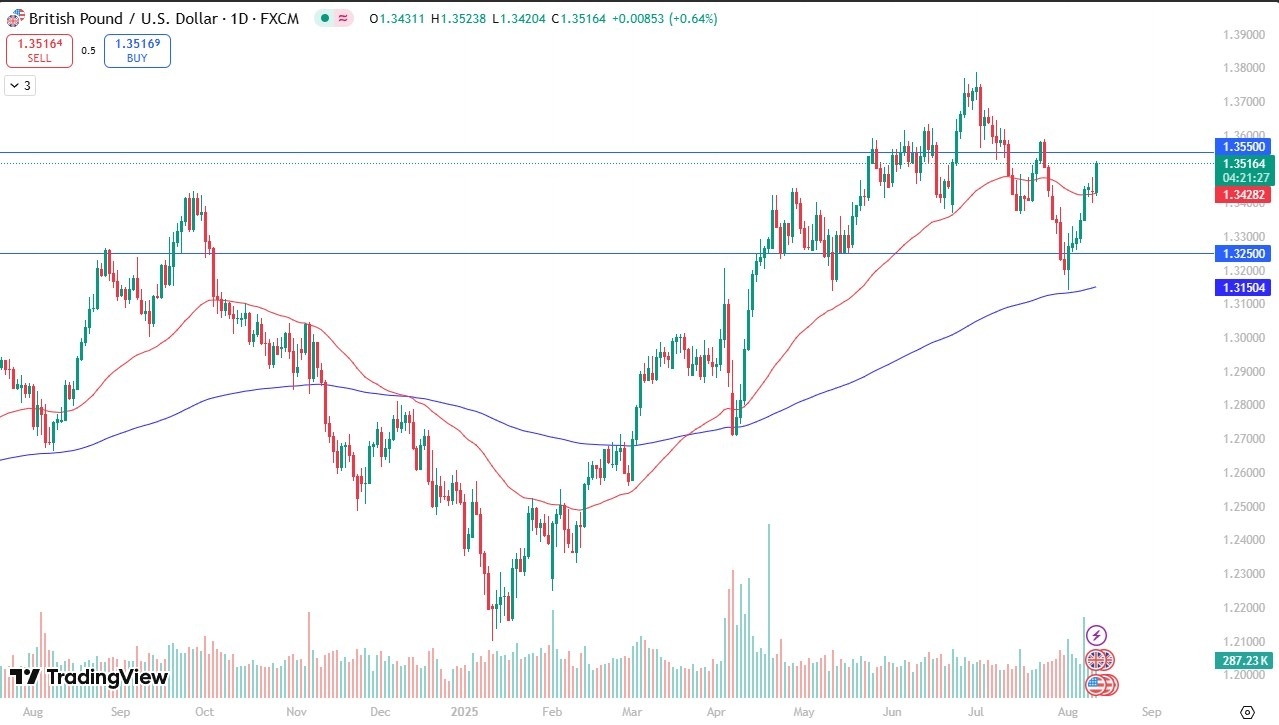
We’ll just have to wait and see. Either way, I think this is a scenario where you certainly don’t want to short this pair, but I watched this pair quite closely. And the main reason is that if the British Pound struggles against the US dollar, then it’s a sign that the US dollar is strengthening and the US dollar will absolutely pummel most other currencies that aren’t as vigorous as Sterling has been.

Think of the Canadian dollar or perhaps the Japanese yen. So even if you’re not trading in this market, it is a good indicator of US dollar strength as of late. When we sold off back at the end of last year and everybody was buying US dollars, the British pound, even though it did fall, it fell a lot less rapidly than many of its counterparts.
And as we’ve seen the US dollar sell off, the British pound was much quicker to rally than many of its counterparts. So, all things being equal, this is a market that’s worth paying attention to even if you don’t trade it. I continue to watch the Pound against many other currencies as well, as its strength is fairly widely distributed.
Ready to trade our GBP/USD daily forecast? We’ve shortlisted the best regulated forex brokers UK in the industry for you.
Christopher Lewis has been trading Forex and has over 20 years experience in financial markets. Chris has been a regular contributor to Daily Forex since the early days of the site. He writes about Forex for several online publications, including FX Empire, Investing.com, and his own site, aptly named The Trader Guy. Chris favours technical analysis methods to identify his trades and likes to trade equity indices and commodities as well as Forex. He favours a longer-term trading style, and his trades often last for days or weeks.
A lower swing high was established last week at $3,409, a minor bearish development that raises the probability of further weakness toward the triangle’s lower support zone. This lower swing high reinforces the view that sellers are gaining traction, though not yet strong enough to force a breakdown. Until gold breaks out of the formation, trading is expected to remain choppy, with limited follow-through in either direction as market participants await a decisive move.
An upside breakout would be signaled by a rally through the top boundary of the pattern, confirmed on a move above $3,439, while a close beneath the lower boundary would trigger a bearish breakdown signal, confirmed below the recent swing low of $3,268.
Despite short-term weakness, the broader technical structure continues to favor an eventual upside breakout of consolidation. This view is supported by the location of the symmetrical triangle near the highs of a long-term uptrend and generally bullish readings across multiple time frames. Moreover, the pattern has developed after a strong rally earlier this year, which often serves as a continuation formation. Still, a weekly bearish signal was triggered this week when gold fell below last week’s low of $3,345, keeping downside risks alive.
From a longer-term perspective, gold recently reversed higher after testing the 20-Week MA two weeks ago, forming a higher swing low on the daily chart. The 20-Week MA, now at $3,310, lies close to the lower boundary of the triangle, reinforcing it as a strong potential support area. A sustained hold above this zone would likely encourage renewed buying, while a decisive drop lower could shift the focus toward the recent swing low at $3,268. A move below that level would confirm a bearish breakdown and open the way for deeper retracements, possibly toward $3,210 – $3,200.
For a look at all of today’s economic events, check out our economic calendar.
Following Monday’s decline, EUR/USD reversed its direction and registered strong gains on Tuesday. The pair preserves its bullish momentum and trades in positive territory above 1.1700 in the European session on Wednesday.
The table below shows the percentage change of Euro (EUR) against listed major currencies this week. Euro was the strongest against the Canadian Dollar.
| USD | EUR | GBP | JPY | CAD | AUD | NZD | CHF | |
|---|---|---|---|---|---|---|---|---|
| USD | -0.60% | -0.83% | -0.24% | 0.06% | -0.42% | -0.44% | -0.71% | |
| EUR | 0.60% | -0.23% | 0.38% | 0.68% | 0.18% | 0.13% | -0.10% | |
| GBP | 0.83% | 0.23% | 0.58% | 0.91% | 0.41% | 0.36% | 0.13% | |
| JPY | 0.24% | -0.38% | -0.58% | 0.32% | -0.15% | -0.14% | -0.33% | |
| CAD | -0.06% | -0.68% | -0.91% | -0.32% | -0.47% | -0.55% | -0.79% | |
| AUD | 0.42% | -0.18% | -0.41% | 0.15% | 0.47% | -0.06% | -0.31% | |
| NZD | 0.44% | -0.13% | -0.36% | 0.14% | 0.55% | 0.06% | -0.22% | |
| CHF | 0.71% | 0.10% | -0.13% | 0.33% | 0.79% | 0.31% | 0.22% |
The heat map shows percentage changes of major currencies against each other. The base currency is picked from the left column, while the quote currency is picked from the top row. For example, if you pick the Euro from the left column and move along the horizontal line to the US Dollar, the percentage change displayed in the box will represent EUR (base)/USD (quote).
The US Dollar (USD) came under renewed selling pressure in the American session on Tuesday as July inflation data fed into expectations of a dovish Federal Reserve (Fed) policy outlook in the last quarter of the year.
The US Bureau of Labor Statistics announced that the annual inflation, as measured by the change in the Consumer Price Index (CPI), held steady at 2.7% in July. This reading came in below analysts’ estimate of 2.8%. On a monthly basis, the CPI and the core CPI increased by 0.2% and 0.3%, respectively, to match market expectations.
According to the CME FedWatch Tool, the probability of the Fed lowering the policy rate three times this year rose to 53% from about 43% before the inflation report was released.
Meanwhile, Wall Street’s main indexed registered strong gains after the opening bell on Tuesday, putting additional weight on the USD’s shoulder.
Early Wednesday, US stock index futures rise about 0.2% on the day. In the absence of high-impact data releases, the risk perception could impact EUR/USD’s action. The pair could continue to push higher in case risk flows continue to dominate the action in financial markets.
The Relative Strength Index (RSI) indicator on the 4-hour chart rose above 60 and EUR/USD cleared the 200-period Simple Moving Average (SMA), highlighting a buildup of bullish momentum.
On the upside, 1.1760 (static level) aligns as the next resistance level before 1.1800 (static level, round level) and 1.1830 (July 1 high). Looking south, support levels could be spotted at 1.1660-1.1650 (200-period SMA, Fibonacci 23.6% retracement of the latest uptrend), 1.1620 (100-period SMA, 50-period SMA) and 1.1540 (Fibonacci 38.2% retracement).
Inflation measures the rise in the price of a representative basket of goods and services. Headline inflation is usually expressed as a percentage change on a month-on-month (MoM) and year-on-year (YoY) basis. Core inflation excludes more volatile elements such as food and fuel which can fluctuate because of geopolitical and seasonal factors. Core inflation is the figure economists focus on and is the level targeted by central banks, which are mandated to keep inflation at a manageable level, usually around 2%.
The Consumer Price Index (CPI) measures the change in prices of a basket of goods and services over a period of time. It is usually expressed as a percentage change on a month-on-month (MoM) and year-on-year (YoY) basis. Core CPI is the figure targeted by central banks as it excludes volatile food and fuel inputs. When Core CPI rises above 2% it usually results in higher interest rates and vice versa when it falls below 2%. Since higher interest rates are positive for a currency, higher inflation usually results in a stronger currency. The opposite is true when inflation falls.
Although it may seem counter-intuitive, high inflation in a country pushes up the value of its currency and vice versa for lower inflation. This is because the central bank will normally raise interest rates to combat the higher inflation, which attract more global capital inflows from investors looking for a lucrative place to park their money.
Formerly, Gold was the asset investors turned to in times of high inflation because it preserved its value, and whilst investors will often still buy Gold for its safe-haven properties in times of extreme market turmoil, this is not the case most of the time. This is because when inflation is high, central banks will put up interest rates to combat it.
Higher interest rates are negative for Gold because they increase the opportunity-cost of holding Gold vis-a-vis an interest-bearing asset or placing the money in a cash deposit account. On the flipside, lower inflation tends to be positive for Gold as it brings interest rates down, making the bright metal a more viable investment alternative.
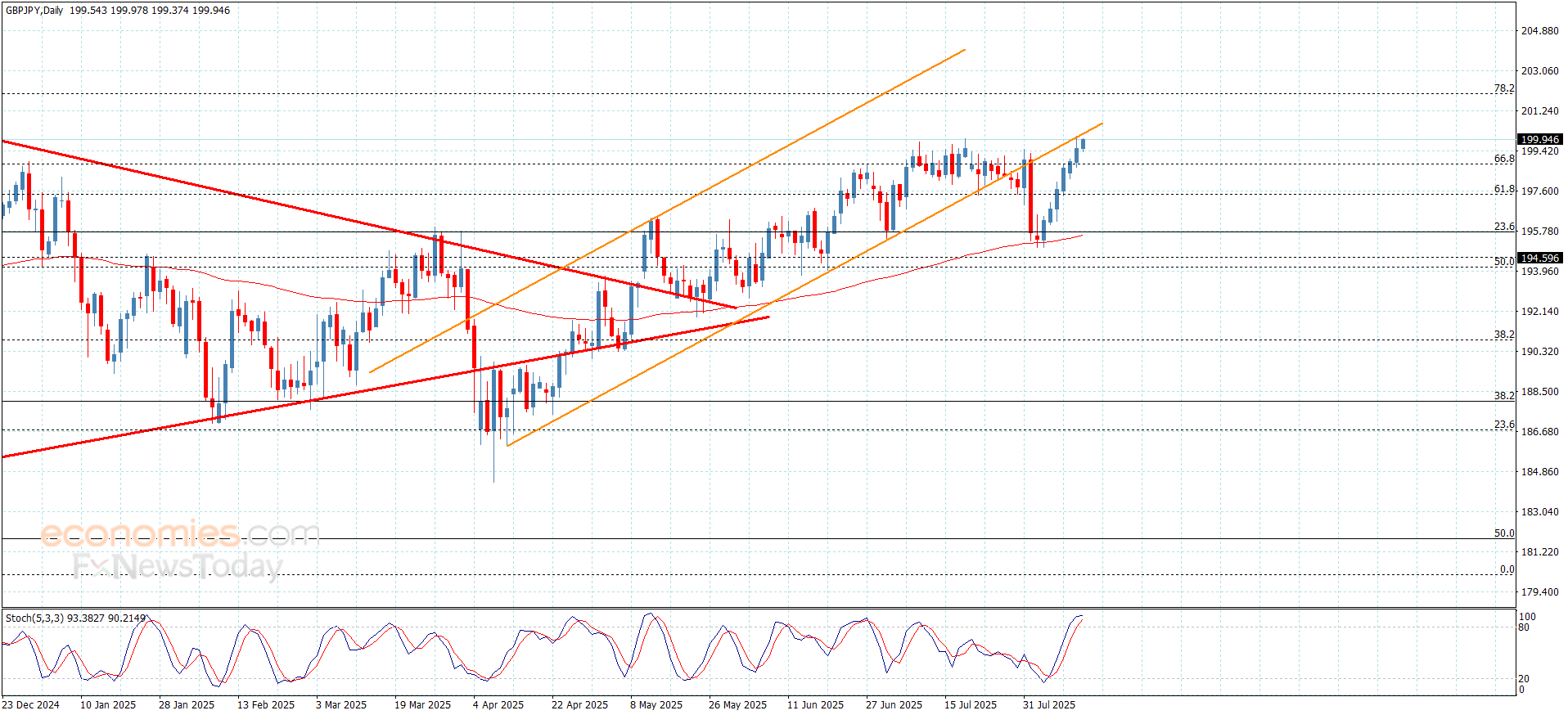
The GBPJPY pair succeeded in settling above 66%Fibonacci correction level at 198.85, reinforcing the continuation of the positivity, to face 200.10 resistance, achieving the extra waited target in the previous report.
Note that monitoring the price behavior as there is a chance for forming mixed trading until breaching the current resistance, to settle within the bullish channel’s levels again, increasing the chances for achieving extra gains that might begin at 200.85 reaching 78.2%Fibonacci correction level at 202.00.
The expected trading range for today is between 199.25 and 200.40
Trend forecast: Sideways
The GBPJPY pair succeeded in settling above 66%Fibonacci correction level at 198.85, reinforcing the continuation of the positivity, to face 200.10 resistance, achieving the extra waited target in the previous report.
Note that monitoring the price behavior as there is a chance for forming mixed trading until breaching the current resistance, to settle within the bullish channel’s levels again, increasing the chances for achieving extra gains that might begin at 200.85 reaching 78.2%Fibonacci correction level at 202.00.
The expected trading range for today is between 199.25 and 200.40
Trend forecast: Sideways
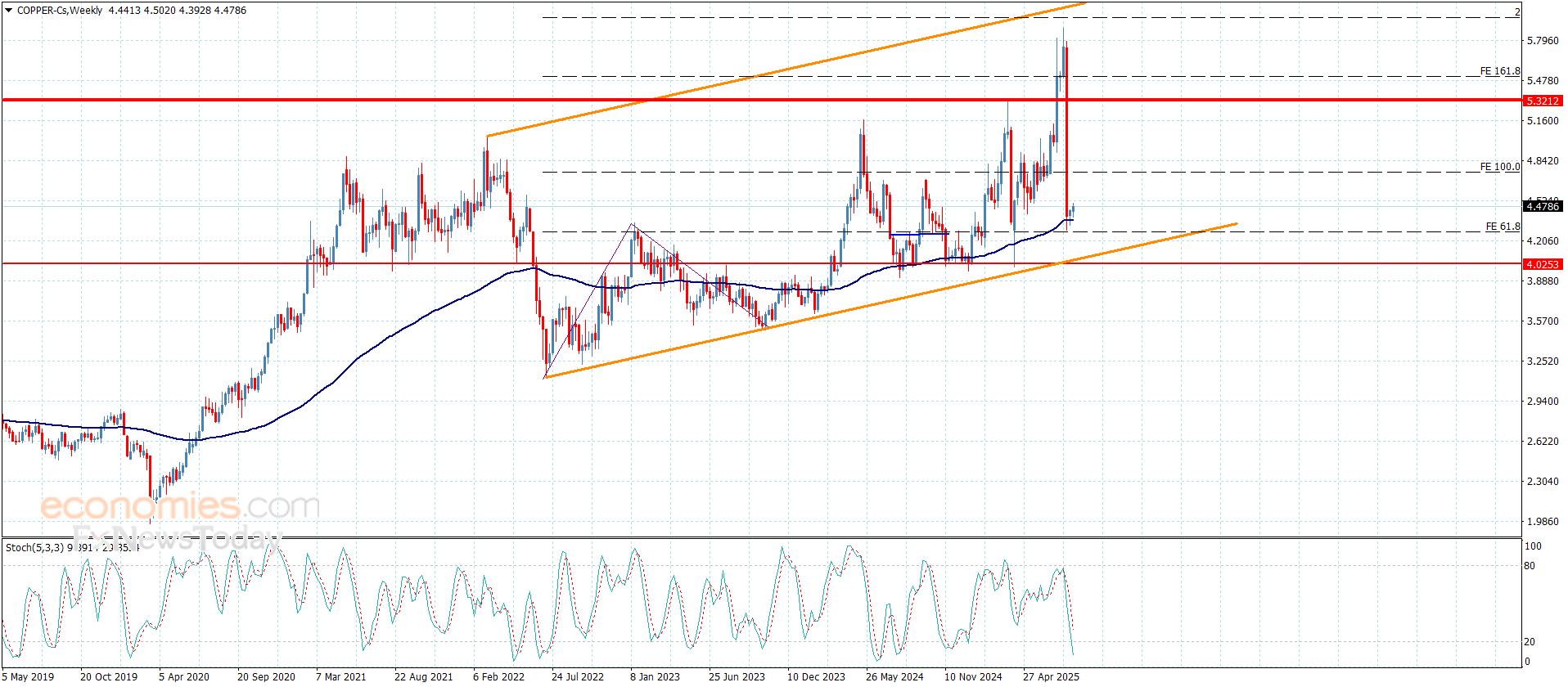
Copper price began forming slow bullish waves after stochastic reach to oversold level, to announce surpassing the negative pressure, to keep its main stability within the bullish track, which depends on the stability of the support level at $4.0500.
The price success in gaining positive momentum will ease the mission of recording positive stations, to keep waiting for reaching $4.6300, then press on the barrier at $4.7400, to monitor its behavior due to the importance of this level to detect the expected trend in the upcoming trading.
The expected trading range for today is between $4.330 and $4.6300
Trend forecast: Bullish
The GBPJPY pair succeeded in settling above 66%Fibonacci correction level at 198.85, reinforcing the continuation of the positivity, to face 200.10 resistance, achieving the extra waited target in the previous report.
Note that monitoring the price behavior as there is a chance for forming mixed trading until breaching the current resistance, to settle within the bullish channel’s levels again, increasing the chances for achieving extra gains that might begin at 200.85 reaching 78.2%Fibonacci correction level at 202.00.
The expected trading range for today is between 199.25 and 200.40
Trend forecast: Sideways
Copper price began forming slow bullish waves after stochastic reach to oversold level, to announce surpassing the negative pressure, to keep its main stability within the bullish track, which depends on the stability of the support level at $4.0500.
The price success in gaining positive momentum will ease the mission of recording positive stations, to keep waiting for reaching $4.6300, then press on the barrier at $4.7400, to monitor its behavior due to the importance of this level to detect the expected trend in the upcoming trading.
The expected trading range for today is between $4.330 and $4.6300
Trend forecast: Bullish