The main category of Forex News.
You can use the search box below to find what you need.
[wd_asp id=1]
The main category of Forex News.
You can use the search box below to find what you need.
[wd_asp id=1]
EUR/USD stays under modest bearish pressure and trades below 1.1650 in the European session on Friday, after closing virtually unchanged on Thursday. The pair’s near-term technical outlook highlights buyers’ hesitancy.
The table below shows the percentage change of Euro (EUR) against listed major currencies today. Euro was the weakest against the Canadian Dollar.
| USD | EUR | GBP | JPY | CAD | AUD | NZD | CHF | |
|---|---|---|---|---|---|---|---|---|
| USD | 0.27% | 0.00% | 0.37% | -0.12% | 0.00% | -0.07% | 0.26% | |
| EUR | -0.27% | -0.24% | 0.15% | -0.36% | -0.22% | -0.24% | 0.00% | |
| GBP | -0.00% | 0.24% | 0.40% | -0.12% | -0.07% | 0.13% | 0.18% | |
| JPY | -0.37% | -0.15% | -0.40% | -0.48% | -0.43% | -0.41% | -0.09% | |
| CAD | 0.12% | 0.36% | 0.12% | 0.48% | 0.14% | 0.23% | 0.34% | |
| AUD | -0.00% | 0.22% | 0.07% | 0.43% | -0.14% | 0.08% | 0.19% | |
| NZD | 0.07% | 0.24% | -0.13% | 0.41% | -0.23% | -0.08% | 0.18% | |
| CHF | -0.26% | 0.00% | -0.18% | 0.09% | -0.34% | -0.19% | -0.18% |
The heat map shows percentage changes of major currencies against each other. The base currency is picked from the left column, while the quote currency is picked from the top row. For example, if you pick the Euro from the left column and move along the horizontal line to the US Dollar, the percentage change displayed in the box will represent EUR (base)/USD (quote).
The US Dollar (USD) struggled to find demand on Thursday but EUR/USD found it difficult to gather bullish momentum. The sharp decline seen in the EUR/GBP cross, following the Bank of England’s (BoE) decision to cut the policy rate by a slim majority, showed that Pound Sterling captured capital outflows out of the Euro. Early Friday, EUR/GBP continues to stretch lower and loses about 0.3% on the day after falling 0.6% on Thursday, not allowing the Euro to gather strength.
The US economic calendar will not offer any macroeconomic data releases that could drive the USD’s valuation heading into the weekend. Hence, investors could pay close attention to comments from Federal Reserve officials and the risk perception.
At the time of press, US stock index futures were up between 0.2% and 0.3% on the day. A bullish action in Wall Street after the opening bell could limit the USD’s gains and help EUR/USD find support. On the flip side, the pair could stay on the back foot in case markets adopt a cautious stance in the second half of the day.
EUR/USD failed to stabilize above the 200-period Simple Moving Average (SMA) on the 4-hour chart and the Relative Strength Index (RSI) indicator retreated below 60, reflecting a loss of bullish momentum.
On the downside, 1.1620 (100-period SMA) aligns as the first support level before 1.1540-1.1550 (Fibonacci 38.2% retracement of the latest uptrend, 50-period SMA) and 1.1500 (static level, round level). Looking north, resistance levels could be spotted at 1.1650-1.1660 (Fibonacci 23.6% retracement, 200-period SMA), 1.1700 (static level, round level) and 1.1760 (static level).
The Euro is the currency for the 19 European Union countries that belong to the Eurozone. It is the second most heavily traded currency in the world behind the US Dollar. In 2022, it accounted for 31% of all foreign exchange transactions, with an average daily turnover of over $2.2 trillion a day.
EUR/USD is the most heavily traded currency pair in the world, accounting for an estimated 30% off all transactions, followed by EUR/JPY (4%), EUR/GBP (3%) and EUR/AUD (2%).
The European Central Bank (ECB) in Frankfurt, Germany, is the reserve bank for the Eurozone. The ECB sets interest rates and manages monetary policy.
The ECB’s primary mandate is to maintain price stability, which means either controlling inflation or stimulating growth. Its primary tool is the raising or lowering of interest rates. Relatively high interest rates – or the expectation of higher rates – will usually benefit the Euro and vice versa.
The ECB Governing Council makes monetary policy decisions at meetings held eight times a year. Decisions are made by heads of the Eurozone national banks and six permanent members, including the President of the ECB, Christine Lagarde.
Eurozone inflation data, measured by the Harmonized Index of Consumer Prices (HICP), is an important econometric for the Euro. If inflation rises more than expected, especially if above the ECB’s 2% target, it obliges the ECB to raise interest rates to bring it back under control.
Relatively high interest rates compared to its counterparts will usually benefit the Euro, as it makes the region more attractive as a place for global investors to park their money.
Data releases gauge the health of the economy and can impact on the Euro. Indicators such as GDP, Manufacturing and Services PMIs, employment, and consumer sentiment surveys can all influence the direction of the single currency.
A strong economy is good for the Euro. Not only does it attract more foreign investment but it may encourage the ECB to put up interest rates, which will directly strengthen the Euro. Otherwise, if economic data is weak, the Euro is likely to fall.
Economic data for the four largest economies in the euro area (Germany, France, Italy and Spain) are especially significant, as they account for 75% of the Eurozone’s economy.
Another significant data release for the Euro is the Trade Balance. This indicator measures the difference between what a country earns from its exports and what it spends on imports over a given period.
If a country produces highly sought after exports then its currency will gain in value purely from the extra demand created from foreign buyers seeking to purchase these goods. Therefore, a positive net Trade Balance strengthens a currency and vice versa for a negative balance.
– Written by
Frank Davies
STORY LINK Pound to Dollar Forecast: GBP/USD Eases on Fed Chair Speculation
The Pound to Dollar exchange rate (GBP/USD) posted 10-day highs just above 1.3435 following the Bank of England policy decision. The Pound overall held firm, but GBP/USD failed to hold its peak levels and edged lower as the US currency secured a tentative recovery in global markets.
Latest reports from the US suggest that current Federal Reserve Governor Waller is now the leading candidate to become the next Fed Chair to succeed Powell next year.
Waller had previously been a hawkish member on the Fed Board, but changed his stance this year and voted to cut rates at the July meeting.
There is little doubt that Waller would advocate for lower interest rates in the near term, but his appointment would ease fears of a very aggressive policy to cut rates.
There is, however, still the risk that Trump will not follow his team’s advice and he also still has to nominate a replacement for Governor Kugler who will leave her post on Friday.
As far as US data is concerned, initial jobless claims increased to 226,000 in the latest week from 219,000 previously while continuing claims increased to 1.97mn from a revised 1.94mn previously which suggests gradual labour-market deterioration.
Markets are pricing close to a 95% chance that the Federal Reserve will cut interest rates at the September meeting and the most likely outcome is for three rate cuts by the end of 2025.
The Pound overall has held firm in global markets following the relatively hawkish Bank of England rate cut.
Markets are no longer confident that there will be a further rate cut at the November meeting.
MUFG head of research for global markets Derek Halpenny commented; “Based on the voting composition in this MPC meeting (5-4 versus 5-2-2 in May) and other elements of today’s announcement this is obviously a more hawkish policy announcement and we have seen some of the expectations for a Nov rate cut taken out of the market.
It added; “It’s clear that the pick-up in the estimate of inflation peaking at 4.0% has made some uncomfortable with the idea of continued steady easing.”

International Money Transfer? Ask our resident FX expert a money transfer question or try John’s new, free, no-obligation personal service! ,where he helps every step of the way,
ensuring you get the best exchange rates on your currency requirements.
TAGS: Pound Dollar Forecasts
The EURJPY pair leaned clearly above the extra support at 170.45, activating with the main indicators, achieving some gains by its fluctuation above the intraday barrier at 171.90.
Noting that the stability of the trading above 171.90 level is important, to reinforce the chances for resuming the bullish attack, to expect the extension of the trading towards 172.65, then targeting the bullish channel’s resistance at 173.80, while the return below 171.90 will force it to form new bearish correctional trading before resuming the suggested targets.
The expected trading range for today is between 171.45 and 172.65
Trend forecast: Bullish
The current advance in the price of gold, beginning from the November swing low, shows an acceleration of bullish momentum. This can be seen by the rising slope of the trendlines. That may put the trend at greater risk as momentum becomes less sustainable, but the weekly chart shows the strong trend is intact. The recent decline that generated a new swing low at $3,268 found support and rallied from the 20-Week MA. That was the first test of support at that weekly moving average and gold responded in bullish fashion. A weekly bullish reversal triggered this week, and it will be confirmed on a weekly basis by a weekly close above last week’s high of $3,363.
An upside breakout of the triangle is indicated on a decisive rally above the recent swing high at $3,439. That would open the door to a challenge of the trend high at $3,500 and the potential for new record highs. However, given the distance to the apex of the triangle, consolidation could continue before a sustained breakout is attempted.
At the time, a vertical line on the chart shows August 21. That is a visual approximately of when 75% of the triangle has been filled. Typically, a breakout of a triangle will occur before that point is reached. And concurrently, the integrity of the pattern begins to weaken and therefore the potential response to a breakout, either up or down.
A key potential support area to watch would be around the 20-Day and 50-Day MA, currently at $3,353 and $3,347, respectively. Also, consider the possibility of a false breakdown through the bottom boundary line and then a quick recovery and rally.
For a look at all of today’s economic events, check out our economic calendar.
Important DisclaimersThe content provided on the website includes general news and publications, our personal analysis and opinions, and contents provided by third parties, which are intended for educational and research purposes only. It does not constitute, and should not be read as, any recommendation or advice to take any action whatsoever, including to make any investment or buy any product. When making any financial decision, you should perform your own due diligence checks, apply your own discretion and consult your competent advisors. The content of the website is not personally directed to you, and we does not take into account your financial situation or needs.The information contained in this website is not necessarily provided in real-time nor is it necessarily accurate. Prices provided herein may be provided by market makers and not by exchanges.Any trading or other financial decision you make shall be at your full responsibility, and you must not rely on any information provided through the website. FX Empire does not provide any warranty regarding any of the information contained in the website, and shall bear no responsibility for any trading losses you might incur as a result of using any information contained in the website.The website may include advertisements and other promotional contents, and FX Empire may receive compensation from third parties in connection with the content. FX Empire does not endorse any third party or recommends using any third party’s services, and does not assume responsibility for your use of any such third party’s website or services.FX Empire and its employees, officers, subsidiaries and associates, are not liable nor shall they be held liable for any loss or damage resulting from your use of the website or reliance on the information provided on this website.Risk DisclaimersThis website includes information about cryptocurrencies, contracts for difference (CFDs) and other financial instruments, and about brokers, exchanges and other entities trading in such instruments. Both cryptocurrencies and CFDs are complex instruments and come with a high risk of losing money. You should carefully consider whether you understand how these instruments work and whether you can afford to take the high risk of losing your money.FX Empire encourages you to perform your own research before making any investment decision, and to avoid investing in any financial instrument which you do not fully understand how it works and what are the risks involved.
Gold price remains stable on Thursday, having flirted with the $3,400 mark early in Asian hours but retreating afterwards. The FX board is all about the US Dollar (USD) and United States (US) President Donald Trump’s tariffs.
Late on Wednesday, Trump said he will impose a 100% tariff on imports of semiconductors and chips, but not for companies that are building in the US. Also, he stepped up pressure on Russia, saying he would impose additional 25% levies on Chinese goods over China’s purchases of Russian oil. Earlier in the week, Trump hit India with extra tariffs of up to 50% for the same reason. Trump also threatened additional 15% levies on Japanese imports.
Other than that, the Bank of England (BoE) announced its decision on monetary policy. As widely anticipated, the central bank delivered a 25-basis-point (bp) cut, leaving the benchmark interest rate at 4.0%. The decision, however, was considered hawkish, as four out of nine Monetary Policy Committee (MPC) members opted for a no-change. Additionally, one of the cut voters preferred a 50 bps trim. The central bank repeated that it will maintain a gradual and careful approach to further withdrawal of monetary policy restraint.
On Friday, Canada will publish its monthly employment report, expected to show the country added 13.5K new jobs in July. The Unemployment Rate is foreseen ticking higher to 7% from the current 6.9%.
Federal Reserve (Fed) speakers will also gather attention amid mounting speculation that the central bank may trim interest rates in September.
XAU/USD resumed its advance after the US opening and trades at around $3,390 a troy ounce. The daily chart shows gold surpassed its previous weekly peak, but there was no major breakout, with the pair still struggling to extend gains. A mildly bullish 20 Simple Moving Average (SMA) keeps acting as dynamic support at around $3,350, while the 100 and 200 SMAs maintain their upward slopes below the shorter one, supportive of a bullish extension. Finally, technical indicators turned marginally higher within positive levels, skewing the risk to the upside despite lacking momentum.
Bulls are in charge in the near term. The XAU/USD pair 4-hour chart shows technical indicators resumed their advances within positive levels, while buyers keep defending the downside around a bullish 20 SMA now at $3,374.50. The longer moving averages remain flat below the shorter one, failing to provide clear directional clues. The XAU/USD needs to run past $3,407 and settle above the level to be able to extend gains heading into the weekly close.
Support levels: 3,374.50 3,350.00 3.338.60
Resistance levels: 3,407.75 3,420.10 3,414.65
– Written by
Tim Boyer
STORY LINK Euro to US Dollar Forecast: “Upward Bias, for Now”
Fed Fears Continue to Drive the Dollar Lower, EUR/USD Nears 1.17 on Ukraine hopes
The dollar has remained firmly on the defensive while hope for progress in Ukraine ceasefire talks have underpinned the Euro with the Euro to Dollar (EUR/USD) exchange rate strengthening to 10-day highs near 1.1690.
According to UoB; “The increase in momentum suggests EUR is likely to trade with an upward bias for now. Currently, it is unclear whether if it can reach 1.1720. To sustain the momentum, EUR must hold above the ‘strong support’ level, currently at 1.1560.”
ING commented; “On EUR/USD, our call for today is neutral, but the balance of risks remains tilted to the upside, even beyond 1.170.”
Federal Reserve appointments will remain a key element for the dollar and wider markets.
President Trump has pledged to announce a replacement for Board member Kugler by the end of this week.
There is still uncertainty whether Trump will look to nominate someone to just serve the remainder of Kugler’s term until January or whether he will look to nominate the next Fed Chair with this pick.
National Australia Bank (NAB) head of FX research Ray Attrill commented; “if Trump is going to make an announcement about who he wants to fill the vacant board seat, depending on how credible (the markets) view that candidate to be, I think that has the potential to prompt some reaction across everything.”
He added; “For me, that’s potentially the biggest swing factor for the next sort of 48 hours or so.”
There are still important concerns over political interference in central bank policymaking.
According to IG market analyst Tony Sycamore; “All those things suggest that we’re seeing those political risks around the U.S. dollar increase, and on top of that you’ve got the weak data coming through.”
Markets remain very confident that the central bank will cut interest rates at the September meeting with markets pricing in around a 93% chance of a cut.
NAB’s Attrill injected a note of caution; “At the moment, I think we’re sort of the view that maybe there’s a bit too much confidence in the market about the certainty of a September move.”
On the Euro side of the equation some hopes for progress in peace talks surrounding the Russia/Ukraine war have provided an element of support for the single currency.
On ECB monetary policy ING commented; “It would appear that the bar for additional rate cuts in the eurozone has been raised.”
The latest German data, however, was weaker than expected with industrial production declining 1.9% for June compared with consensus forecasts of a 0.4% retreat.
According to ING; “tariffs will impact the eurozone just as their adverse effects will be seen in America, and the ECB may be premature in declaring any victory. In this global economic power play, eurozone monetary policy offers a rare moment of calm.”
International Money Transfer? Ask our resident FX expert a money transfer question or try John’s new, free, no-obligation personal service! ,where he helps every step of the way,
ensuring you get the best exchange rates on your currency requirements.
TAGS: Euro Dollar Forecasts
GBP/USD holds its ground and trades above 1.3350 after posting strong gains on Wednesday. Investors stay on the sidelines while waiting for the Bank of England (BoE) to announce monetary policy decisions.
The table below shows the percentage change of British Pound (GBP) against listed major currencies this week. British Pound was the strongest against the Swiss Franc.
| USD | EUR | GBP | JPY | CAD | AUD | NZD | CHF | |
|---|---|---|---|---|---|---|---|---|
| USD | -0.74% | -0.62% | -0.01% | -0.35% | -0.78% | -0.77% | 0.15% | |
| EUR | 0.74% | 0.16% | 0.74% | 0.40% | -0.17% | -0.04% | 0.88% | |
| GBP | 0.62% | -0.16% | 0.61% | 0.24% | -0.34% | -0.21% | 0.71% | |
| JPY | 0.01% | -0.74% | -0.61% | -0.34% | -0.91% | -0.77% | 0.31% | |
| CAD | 0.35% | -0.40% | -0.24% | 0.34% | -0.58% | -0.43% | 0.48% | |
| AUD | 0.78% | 0.17% | 0.34% | 0.91% | 0.58% | 0.14% | 1.06% | |
| NZD | 0.77% | 0.04% | 0.21% | 0.77% | 0.43% | -0.14% | 0.90% | |
| CHF | -0.15% | -0.88% | -0.71% | -0.31% | -0.48% | -1.06% | -0.90% |
The heat map shows percentage changes of major currencies against each other. The base currency is picked from the left column, while the quote currency is picked from the top row. For example, if you pick the British Pound from the left column and move along the horizontal line to the US Dollar, the percentage change displayed in the box will represent GBP (base)/USD (quote).
The renewed selling pressure surrounding the US Dollar (USD) allowed GBP/USD to gather bullish momentum on Wednesday. US President Donald Trump’s renewed tariff threats revived concerns over the US economic outlook and weighed on the USD.
Trump issued an executive order imposing an additional 25% tariff on Indian imports and said that he could impose an extra 25% tariff on Chinese goods over China’s purchases of Russian oil. Additionally, he said that he will impose a 100% tariff on semiconductors and chips, but not for companies that are building in the US.
Later in the day, the BoE is widely expected to cut the policy rate by 25 basis points (bps) to 4%. The vote-split could trigger an immediate market reaction ahead of BoE Governor Andrew Bailey’s press conference.
Previewing the BoE event, “given the resurgence in inflation, and the risk of second-order effects, we expect a couple of Monetary Policy Committee (MPC) members vote for a hold; at the same time, persistently weak labour-market data raises the risk of one or two members voting for a 50bps cut,” said Standard Chartered’s economist Christopher Graham and added: “A divided MPC would support our view of a gradual approach to further easing, with the quarterly pace of cuts (in play since the start of the easing cycle) continuing.”
In case the vote-split shows that three or four members preferred a hold, Pound Sterling could preserve its strength. Conversely, GBP/USD could turn south if two or more members of the MPC voted in favor of a bigger rate cut.
Meanwhile, the US economic calendar will feature weekly Initial Jobless Claims data. A noticeable decline could help the USD limit its losses in the near term. On the other hand, a significant increase, with a reading above 240K, could further weigh on the USD and allow GBP/USD to stretch higher.
The Relative Strength Index (RSI) indicator on the 4-hour chart holds above 60, suggesting that GBP/USD has more room on the upside before turning technically overbought.
On the upside, 1.3385-1.3400 (upper limit of the descending regression channel, 100-period Simple Moving Average (SMA), round level) forms a key resistance area before 1.3460 (Fibonacci 50% retracement of the latest downtrend) and 1.3500 (static level, round level).
Looking south, support levels could be seen at 1.3300 (50-period SMA, Fibonacci 23.6% retracement), 1.3250 (static level) and 1.3200 (static level, round level).
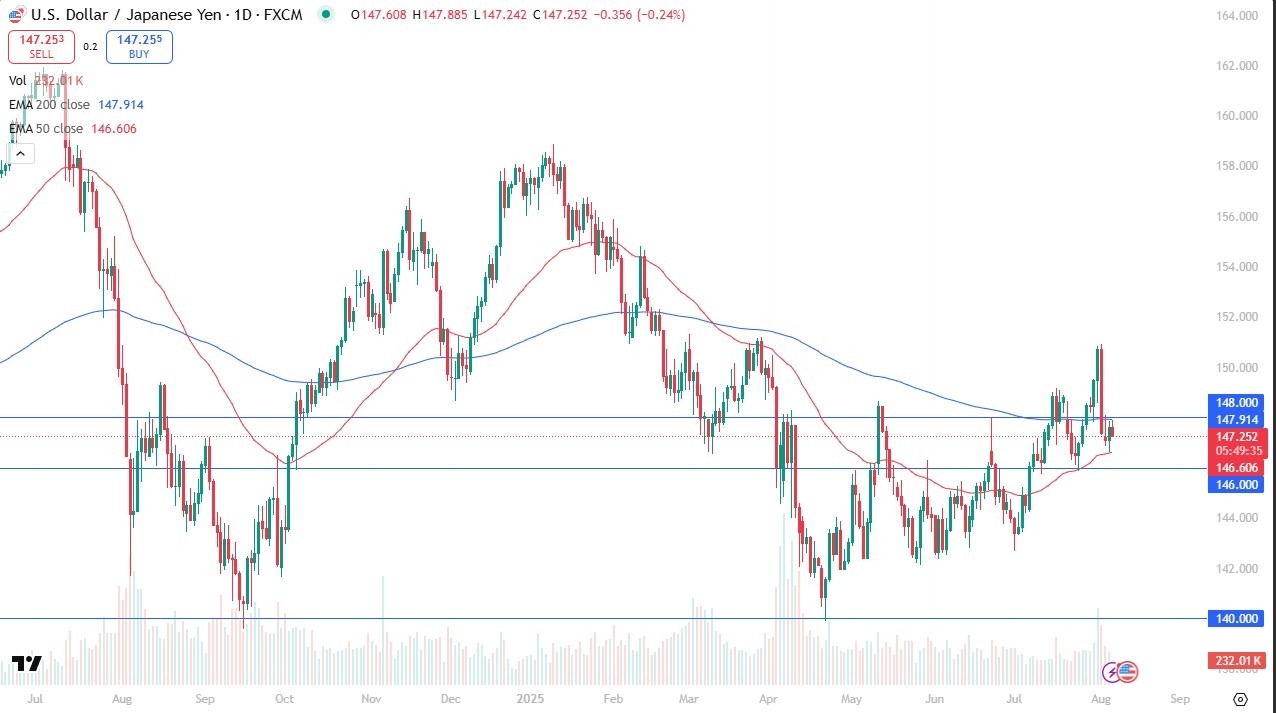
More importantly, I think what you need to keep in mind is that the 148 yen level above is an area that has been difficult to crack. And if we did do that, then I think you have a very real shot at this market going higher. Ultimately, the 151 yen level gets targeted. On the other hand, though, if we turn around and break down below the 50 day EMA, then it’s possible that we could look into the 146 yen level, opening up the possibility of even deeper corrections.

But I do think that the 146 yen level is an area where we would see a lot of support. If we break it, then that changes my opinion. But as things stand right now, we essentially have a scenario where the interest rate differential still favors the United States.
So, then I think you’ve got a situation where if you are willing to wait to get paid, you probably will. After all, you’ll be collecting swap at the end of every day. And I think a lot of institutional traders do prefer this. That being said, there are concerns about whether or not the Federal Reserve will have to cut multiple times. But right now, the economic numbers aren’t good for the United States, but they’re not horrible either.
That sets up the market for perhaps an ugly surprise later this year. We’ll just have to wait and see. This has been a brutal four or five days in the sense that we look like we were ready to go much higher and then just crash, but now we’re stable. And that’s generally the first sign of the market turning back around.
Want to trade our USD/JPY forex analysis and predictions? Here’s a list of forex brokers in Japan to check out.
Christopher Lewis has been trading Forex and has over 20 years experience in financial markets. Chris has been a regular contributor to Daily Forex since the early days of the site. He writes about Forex for several online publications, including FX Empire, Investing.com, and his own site, aptly named The Trader Guy. Chris favours technical analysis methods to identify his trades and likes to trade equity indices and commodities as well as Forex. He favours a longer-term trading style, and his trades often last for days or weeks.
Gold price (XAU/USD) struggles to break above the key level of $3,400.00 during the European trading session on Thursday. The precious metal hesitates to extend upside even as Federal Reserve (Fed) officials have shown support for interest rate cuts in the remainder of the year.
On Wednesday, Minneapolis Fed President Neel Kashkari, San Francisco Fed President Mary Daly and Fed Governor Lisa Cook argued in favor of reducing interest rates amid growing labor market concerns. “The economy is slowing and the Fed needs to respond to the slowing economy,” Kashkari said in an interview with CNBC. Kashkari added, “It may still be relevant in the near term to begin adjusting the policy rate, and two rate cuts this year still seem appropriate.”
The CME FedWatch tool showed that traders have almost fully priced in a 25 basis points (bps) interest rate reduction in the September policy meeting.
Theoretically, lower interest rates by the Fed bode well for non-yielding assets, such as Gold.
Meanwhile, resurfacing United States (US) President Donald Trump’s tariff fears are expected to improve the demand for safe-haven assets, such as Gold. On Wednesday, Trump stated that he could impose a penalty on China in the form of tariffs for buying Oil from Russia. The same day, Trump increased import duties on India by 25% for buying Russian Oil.
Gold price trades close to the upper boundary of the Symmetrical Triangle formation around $3,400, which is plotted from April’s high near $3,500. The lower boundary of the yellow metal is placed from the May’s low of $3,120.85.
The precious metal holds slightly above the 20-day Exponential Moving Average (EMA), which trades near $3,350, suggesting that the near-term trend is on the upside.
The 14-day Relative Strength Index (RSI) wobbles inside the 40.00-60.00, which indicates indecisiveness among market participants.
Looking down, the Gold price would fall towards the round-level support of $3,200 and the May 15 low at $3,121, if it breaks below the May 29 low of $3,245
Alternatively, the Gold price will enter uncharted territory if it breaks above the psychological level of $3,500 decisively. Potential resistances would be $3,550 and $3,600.
Gold has played a key role in human’s history as it has been widely used as a store of value and medium of exchange. Currently, apart from its shine and usage for jewelry, the precious metal is widely seen as a safe-haven asset, meaning that it is considered a good investment during turbulent times. Gold is also widely seen as a hedge against inflation and against depreciating currencies as it doesn’t rely on any specific issuer or government.
Central banks are the biggest Gold holders. In their aim to support their currencies in turbulent times, central banks tend to diversify their reserves and buy Gold to improve the perceived strength of the economy and the currency. High Gold reserves can be a source of trust for a country’s solvency. Central banks added 1,136 tonnes of Gold worth around $70 billion to their reserves in 2022, according to data from the World Gold Council. This is the highest yearly purchase since records began. Central banks from emerging economies such as China, India and Turkey are quickly increasing their Gold reserves.
Gold has an inverse correlation with the US Dollar and US Treasuries, which are both major reserve and safe-haven assets. When the Dollar depreciates, Gold tends to rise, enabling investors and central banks to diversify their assets in turbulent times. Gold is also inversely correlated with risk assets. A rally in the stock market tends to weaken Gold price, while sell-offs in riskier markets tend to favor the precious metal.
The price can move due to a wide range of factors. Geopolitical instability or fears of a deep recession can quickly make Gold price escalate due to its safe-haven status. As a yield-less asset, Gold tends to rise with lower interest rates, while higher cost of money usually weighs down on the yellow metal. Still, most moves depend on how the US Dollar (USD) behaves as the asset is priced in dollars (XAU/USD). A strong Dollar tends to keep the price of Gold controlled, whereas a weaker Dollar is likely to push Gold prices up.