The main category of Forex News.
You can use the search box below to find what you need.
[wd_asp id=1]
The main category of Forex News.
You can use the search box below to find what you need.
[wd_asp id=1]
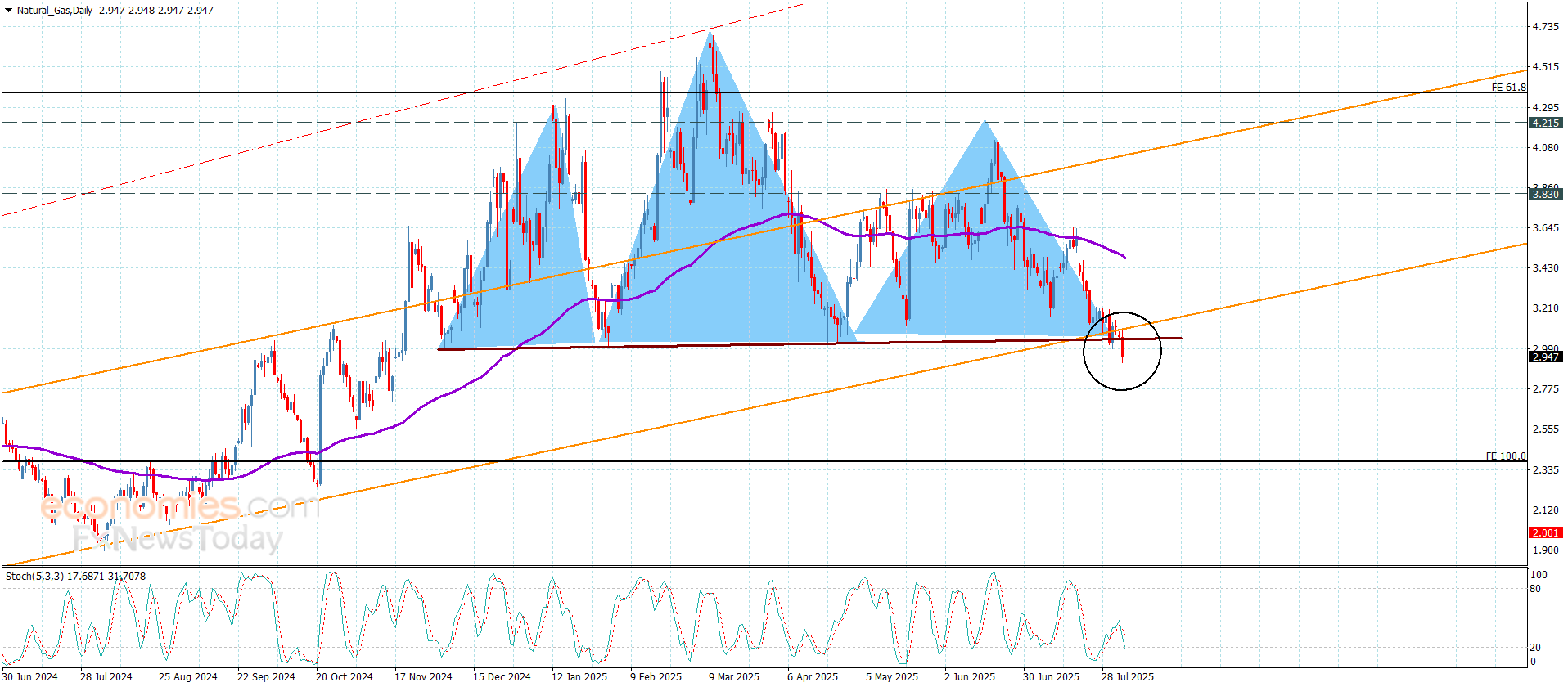
Notice that a downward sloping consolidation pattern formed recently, showing a small descending channel. Given its location further into a downtrend and at a key long-term support zone, this pattern might have an impact like a bullish falling wedge. It is too early to say but something to watch as it could help identify a potential bullish reversal signal. Currently, a bullish reversal would be indicated on a rally above Friday’s high of $3.13. While a rise above Monday’s high of $3.08 will show strength, not enough to indicate that the advance might be sustainable.
The more fight there is between buyers and sellers near the bottom, the greater the potential for a reversal when it comes. Although there are lower targets for natural gas that might be reached, if a low was going to be established, it is in the area to do it. The AVWAP line shows $2.97, and it should be seen as an area of price. If a bullish reversal follows before a new trend low, then a new high swing low will be completed. That would be a bullish sign if it occurs.
A swing low from April at $2.86 found support and reversed from the AVWAP line. That low is also a monthly low and confirmed by a 20-Month MA, now at $2.85. Therefore, it is potentially significant, either for a bullish reversal or a breakdown. Either way, if $2.86 is approached, a breakdown from two long-term trend indicators will be violated. That would indicate the potential for further downward pressure in prices.
For a look at all of today’s economic events, check out our economic calendar.
Gold price maintains its positive momentum on Wednesday, reaching a fresh weekly high in the $3,390 area during American trading hours. The bright metal surged following the release of the United States (US) ISM Services Purchasing Managers’ Index (PMI), as the indicator came in worse than anticipated, barely printing at 50.1 in July, below the 50.8 posted in June and missing expectations of 51.5.
Meanwhile, US President Donald Trump threatens tariffs left and right: following news on Monday indicating massive levies on India, Trump said it would hit the Eurozone with tariffs of 35% if they fail to fulfil their commitments.
Additionally, the personal war between the US President and Federal Reserve (Fed) Chair Jerome Powell continues. On the one hand, he said that Treasury Secretary Scott Bessent is not a candidate to lead the Fed, as he should remain in his current position. On the other hand, he is working on replacing Fed Governor Adriana Kugler, who unexpectedly resigned, effective on Friday, with a candidate who advocates for interest rate cuts.
The poor performance of Wall Street following dismal US data and higher US Treasury yields reflects the souring mood.
The American macroeconomic calendar has little to offer on Wednesday, while the upcoming Asian session will bring the New Zealand monthly employment report. Later in the day, the EU will publish June Retail Sales.
The daily chart for the XAU/USD pair shows it met buyers around a mildly bullish 20 Simple Moving Average (SMA) for a second consecutive day, with the indicator currently at around $3,347. The same chart shows the 100 and 200 SMAs maintain their bullish slopes below the shorter one, in line with the bulls’ dominance. Technical indicators, however, barely hold above their midlines, lacking directional strength. Overall, the risk skews to the upside, but the momentum is missing.
The near-term picture seems more encouraging for bulls. In the 4-hour chart, the XAU/USD pair bottomed around a flat 100 SMA, while a bullish 20 SMA aims to cross above it, usually a sign of directional continuation. Finally, technical indicators resumed their advances near overbought readings, hinting at persistent upward pressure.
Support levels: 3,362.10 3,347.00 3.338.60
Resistance levels: 3,396.90 3,407.75 3,420.10
Platinum price formed some bullish waves, to hit $1355.00 level, to bounce quickly to settle below the barrier at $1342.00 level, affected by stochastic negativity, which approaches from 50 level as appears in the above image.
The stability of this barrier will force the price to delay the bullish attempts, to increase the chances for forming new bearish correctional waves to target $1290.00 level reaching 38.2%Fibonacci correction level at $1255.00, while breaching it will open the way for activating the bullish attack to target $1366.00 level initially reaching the resistance at $1400.00.
The expected trading range for today is between $1290.00 and $1342.00
Trend forecast: Bearish
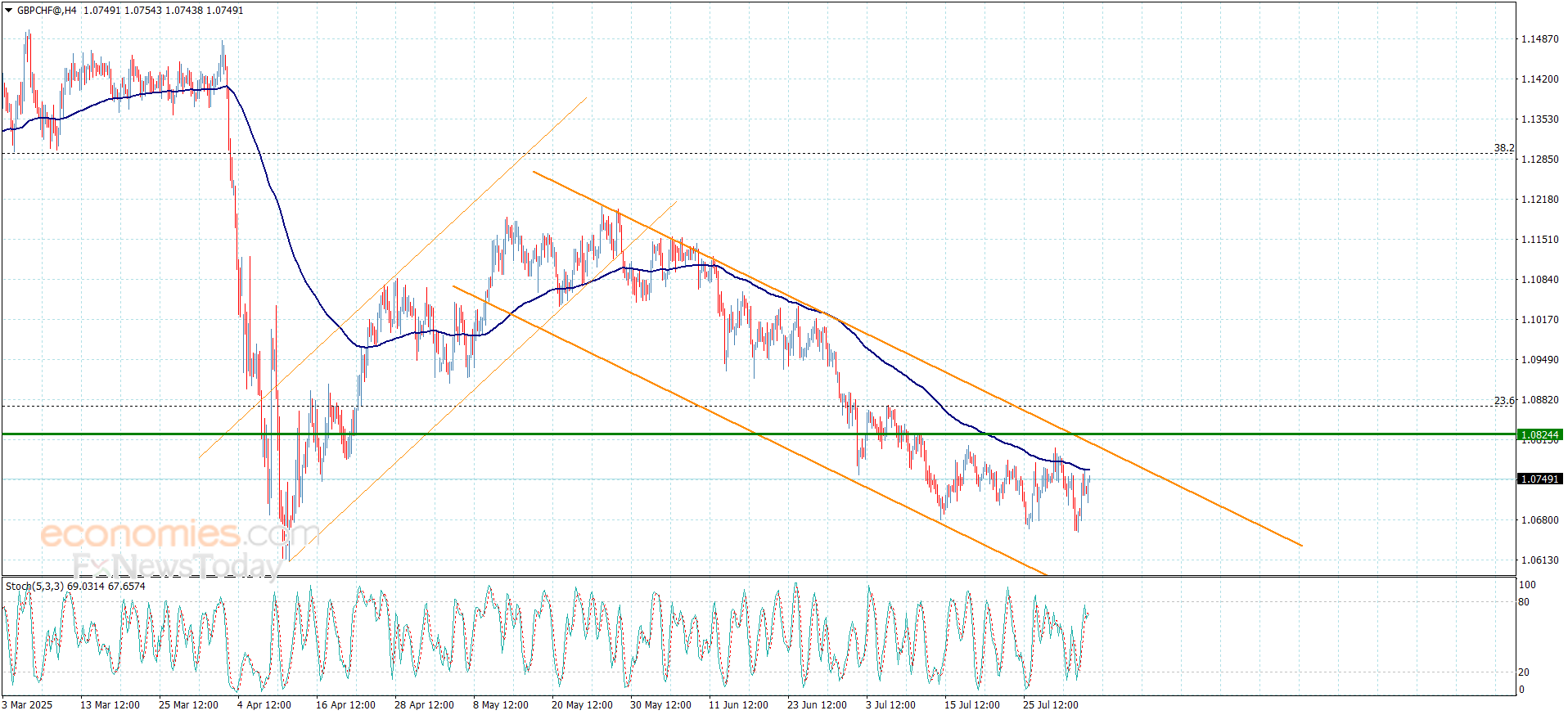
The GBPCHF price formed some bullish correctional trading, to approach from the moving average of 55 near 1.0765, taking advantage of providing positive momentum by stochastic, to retest an important barrier again.
The main stability within the bearish channel’s levels, which forms an extension for the main resistance at 1.0810 level besides forming an extra barrier at 1.0775 level, these factors make us wait for gathering the negative momentum, which allows it to renew the negative attempts that might target 1.0710 and 1.0660.
The expected trading range for today is between 1.0770 and 1.0710
Trend forecast: Bearish
Gold price is flirting with weekly highs near $3,380 in the Asian trading hours on Tuesday, with buyers looking forward to the US ISM Services PMI data for a fresh boost.
A surprisingly strong China’s Caixin Services PMI data, which came in at 52.6 in July, bolstered risk appetite.
Meanwhile, increased bets that the US Federal Reserve (Fed) will lower interest rates in September continue to underpin risk sentiment at the expense of the US Dollar (USD), keeping the non-yielding Gold price afloat.
Strong US labor data combined with San Francisco Fed President Mary Daly’s dovish remarks have almost sealed in a September Fed rate cut, with markets now pricing in a 90.5% probability of such a move, the CME Group’s FedWatch Tool shows.
The Bureau of Labor Statistics (BLS) reported Friday that the US economy added 73,000 jobs for July, above the June revision of 14,000 but below even the meagre estimate for a gain of 110,000. The Unemployment Rate ticked higher to 4.2% in the month, as expected.
Daly said on Monday, “we may do fewer than two cuts. The more likely thing is we need to do more.
“The job market is not precariously weak, but it is softening, and further softening would be unwelcome,” she added.
Additionally, concerns over the Fed’s independence and the credibility of economic data remain a drag on the Greenback.
US President Donald Trump fired the US Labor Department’s statistical leader, Erika L. McEntarfer, after the weak jobs report on Friday.
Markets believe that the dismissal of BLS Commissioner Erika McEntarfer may be part of a broader strategy to undermine the credibility of official inflation data, eventually impacting the Fed’s independence.
These factors render positive for the bright metal, supporting its recovery from monthly troughs.
The next leg higher in Gold price, however, depends on the US ISM Services PMI data for July, which is seen rising to 51.5 from 50.8 in June.
Strong ISM data could shake off some of the recent dovishness surrounding the Fed’s next policy, lifting the USD while fuelling a brief corrective decline in Gold price.
A slowdown in the services sector could intensify concerns over the US economic resilience amid weakening labor market conditions, which could trigger a fresh USD downtrend, boosting the bullion.
Gold traders will also closely scrutinize trade headlines and Fedspeak for fresh trading incentives.
The daily chart shows that the technical setup remains in favor of Gold buyers.
The 14-day Relative Strength Index (RSI) is sitting above the midline, currently near 55, suggesting that any dip could be quickly bought into.
Adding credence to the bullish potential, the 21-day is primed to cross the 50-day SMA for upside, which if materialized on a daily closing basis will confirm a Bull Cross.
Gold buyers need a daily candlestick closing above the rising trendline support at $3,380 to regain the $3,400 threshold. Further, the $3,440 static resistance will come into play once again.
Conversely, strong support is placed at the 21-day SMA and 50-day SMA confluence near $3,345. A sustained move below that level will open up further downside toward the $3,300 round figure. The last line of defense for Gold buyers is the 100-day SMA at $3,279.
The Institute for Supply Management (ISM) Services Purchasing Managers Index (PMI), released on a monthly basis, is a leading indicator gauging business activity in the US services sector, which makes up most of the economy. The indicator is obtained from a survey of supply executives across the US based on information they have collected within their respective organizations. Survey responses reflect the change, if any, in the current month compared to the previous month. A reading above 50 indicates that the services economy is generally expanding, a bullish sign for the US Dollar (USD). A reading below 50 signals that services sector activity is generally declining, which is seen as bearish for USD.
After failing to make a decisive move in either direction on Monday, GBP/USD extends its sideways grind on Tuesday and trades in a narrow band below 1.3300.
The table below shows the percentage change of British Pound (GBP) against listed major currencies last 7 days. British Pound was the weakest against the Japanese Yen.
| USD | EUR | GBP | JPY | CAD | AUD | NZD | CHF | |
|---|---|---|---|---|---|---|---|---|
| USD | 0.43% | 0.51% | -0.53% | 0.51% | 0.98% | 1.45% | 0.93% | |
| EUR | -0.43% | 0.07% | -0.99% | 0.07% | 0.57% | 0.90% | 0.51% | |
| GBP | -0.51% | -0.07% | -1.06% | 0.00% | 0.50% | 0.84% | 0.43% | |
| JPY | 0.53% | 0.99% | 1.06% | 1.02% | 1.51% | 1.91% | 1.57% | |
| CAD | -0.51% | -0.07% | -0.00% | -1.02% | 0.42% | 0.95% | 0.42% | |
| AUD | -0.98% | -0.57% | -0.50% | -1.51% | -0.42% | 0.35% | -0.07% | |
| NZD | -1.45% | -0.90% | -0.84% | -1.91% | -0.95% | -0.35% | -0.41% | |
| CHF | -0.93% | -0.51% | -0.43% | -1.57% | -0.42% | 0.07% | 0.41% |
The heat map shows percentage changes of major currencies against each other. The base currency is picked from the left column, while the quote currency is picked from the top row. For example, if you pick the British Pound from the left column and move along the horizontal line to the US Dollar, the percentage change displayed in the box will represent GBP (base)/USD (quote).
The US Dollar (USD) Index, which tracks the USD’s performance against a basket of six major currencies, registered marginal gains on Monday and made it difficult for GBP/USD to build on Friday’s rebound.
Early Tuesday, US stock index futures rise about 0.2% on the day and the UK’s FTSE 100 Index is up more than 0.3%, reflecting a risk-positive market atmosphere. In case the market mood remains upbeat in the second half of the day, GBP/USD is likely to hold its ground.
The US economic calendar will offer the Institute for Supply Management’s (ISM) Services Purchasing Managers Index (PMI) data for July in the American session. Markets expect the headline PMI to improve to 51.5 from 50.8 in June. A print below 50 could weigh on the USD with the immediate reaction, while a reading above analysts’ estimate could support the USD and drag GBP/USD lower.
Nevertheless, investors could refrain from taking large positions and allow GBP/USD to remain in a consolidation phase ahead of the Bank of England’s (BoE) monetary policy announcements on Thursday.
The Relative Strength Index (RSI) indicator on the 4-hour chart moves sideways near 50 and GBP/USD fluctuates between the 20-period and the 50-period Simple Moving Average (SMA), highlighting a neutral bias in the near term.
On the downside, the 20-period Simple Moving Average (SMA) aligns as interim support at 1.3250 ahead of 1.3200 (static level, round level) and 1.3130 (lower limit of the descending channel).
Looking north, resistance levels could be spotted at 1.3300 (static level, round level), 1.3330 (former support level, 50-period SMA) and 1.3400 (100-period SMA, upper limit of the ascending channel).
The Pound Sterling (GBP) is the oldest currency in the world (886 AD) and the official currency of the United Kingdom. It is the fourth most traded unit for foreign exchange (FX) in the world, accounting for 12% of all transactions, averaging $630 billion a day, according to 2022 data.
Its key trading pairs are GBP/USD, also known as ‘Cable’, which accounts for 11% of FX, GBP/JPY, or the ‘Dragon’ as it is known by traders (3%), and EUR/GBP (2%). The Pound Sterling is issued by the Bank of England (BoE).
The single most important factor influencing the value of the Pound Sterling is monetary policy decided by the Bank of England. The BoE bases its decisions on whether it has achieved its primary goal of “price stability” – a steady inflation rate of around 2%. Its primary tool for achieving this is the adjustment of interest rates.
When inflation is too high, the BoE will try to rein it in by raising interest rates, making it more expensive for people and businesses to access credit. This is generally positive for GBP, as higher interest rates make the UK a more attractive place for global investors to park their money.
When inflation falls too low it is a sign economic growth is slowing. In this scenario, the BoE will consider lowering interest rates to cheapen credit so businesses will borrow more to invest in growth-generating projects.
Data releases gauge the health of the economy and can impact the value of the Pound Sterling. Indicators such as GDP, Manufacturing and Services PMIs, and employment can all influence the direction of the GBP.
A strong economy is good for Sterling. Not only does it attract more foreign investment but it may encourage the BoE to put up interest rates, which will directly strengthen GBP. Otherwise, if economic data is weak, the Pound Sterling is likely to fall.
Another significant data release for the Pound Sterling is the Trade Balance. This indicator measures the difference between what a country earns from its exports and what it spends on imports over a given period.
If a country produces highly sought-after exports, its currency will benefit purely from the extra demand created from foreign buyers seeking to purchase these goods. Therefore, a positive net Trade Balance strengthens a currency and vice versa for a negative balance.
The GBPCHF price formed some bullish correctional trading, to approach from the moving average of 55 near 1.0765, taking advantage of providing positive momentum by stochastic, to retest an important barrier again.
The main stability within the bearish channel’s levels, which forms an extension for the main resistance at 1.0810 level besides forming an extra barrier at 1.0775 level, these factors make us wait for gathering the negative momentum, which allows it to renew the negative attempts that might target 1.0710 and 1.0660.
The expected trading range for today is between 1.0770 and 1.0710
Trend forecast: Bearish
This was a move towards safety, but quite frankly, the Federal Reserve is not going to suddenly be collapsing rates.

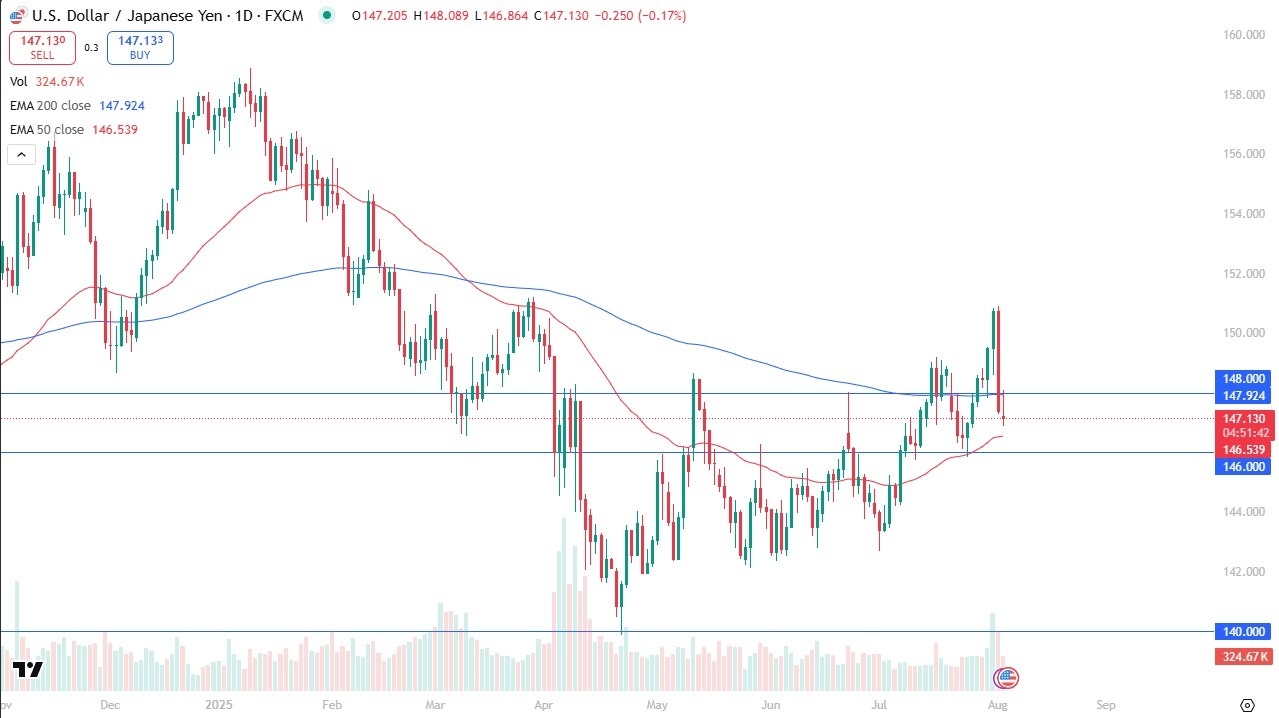
While the Japanese yen may put up a fight, it’s interesting that several of the other stronger currencies actually couldn’t hang on to the gains for the day against the yen. And with that being the case, the market could very well bounce from here, but I think it’s got a lot of effort that it’s going to need to do in order to truly send markets to the upside.
If we fall from here, then we could be looking at a move down to the 50 day EMA. Anything below the 50 day EMA then could send the S dollar down to the 146 yen level. That of course is an area that’s been important a couple of times and anything below there could open up a move down to the 143 yen level.
Ultimately, I think we’re in an area of somewhat balance. So, I think we probably see a little bit of back and forth, but ultimately, I still think the US dollar has a fair shot of rallying here, but we need a day or two of stabilization.
Want to trade our USD/JPY forex analysis and predictions? Here’s a list of forex brokers in Japan to check out.
Christopher Lewis has been trading Forex and has over 20 years experience in financial markets. Chris has been a regular contributor to Daily Forex since the early days of the site. He writes about Forex for several online publications, including FX Empire, Investing.com, and his own site, aptly named The Trader Guy. Chris favours technical analysis methods to identify his trades and likes to trade equity indices and commodities as well as Forex. He favours a longer-term trading style, and his trades often last for days or weeks.
Copper price forced to provide more of the sideways trading, delaying its bullish attempts due to the contradiction between the main indicators by stochastic reach below 50 level, the main stability above the bullish channel’s support at $4.0500, besides the attempt of forming an extra support at $4.2600 level, we will keep our bullish suggestion in the current period trading, to wait for achieving some gains by its rally to $4.6300 reaching the next barrier near $4.7500.
Note that breaking the extra support will confirm the chances for providing strong pressure on the mentioned bullish channel’s support, to keep monitoring the price behavior according to this level by detecting the main trend in the upcoming period trading.
The expected trading range for today is between $4.2600 and $4.6300
Trend forecast: Bullish
Platinum price formed some bullish waves, to hit $1355.00 level, to bounce quickly to settle below the barrier at $1342.00 level, affected by stochastic negativity, which approaches from 50 level as appears in the above image.
The stability of this barrier will force the price to delay the bullish attempts, to increase the chances for forming new bearish correctional waves to target $1290.00 level reaching 38.2%Fibonacci correction level at $1255.00, while breaching it will open the way for activating the bullish attack to target $1366.00 level initially reaching the resistance at $1400.00.
The expected trading range for today is between $1290.00 and $1342.00
Trend forecast: Bearish