The main category of Forex News.
You can use the search box below to find what you need.
[wd_asp id=1]
The main category of Forex News.
You can use the search box below to find what you need.
[wd_asp id=1]
GBP/USD finds it difficult to attract bulls in the European session on Monday and fluctuates below 1.3300. The pair’s near-term technical outlook doesn’t yet offer any convincing signs of a bullish reversal.
The table below shows the percentage change of British Pound (GBP) against listed major currencies last 7 days. British Pound was the weakest against the Japanese Yen.
| USD | EUR | GBP | JPY | CAD | AUD | NZD | CHF | |
|---|---|---|---|---|---|---|---|---|
| USD | 1.71% | 1.13% | 0.07% | 0.53% | 1.50% | 1.75% | 1.49% | |
| EUR | -1.71% | -0.60% | -1.57% | -1.16% | -0.20% | 0.04% | -0.22% | |
| GBP | -1.13% | 0.60% | -1.16% | -0.56% | 0.40% | 0.65% | 0.38% | |
| JPY | -0.07% | 1.57% | 1.16% | 0.46% | 1.37% | 1.65% | 1.54% | |
| CAD | -0.53% | 1.16% | 0.56% | -0.46% | 0.93% | 1.22% | 0.95% | |
| AUD | -1.50% | 0.20% | -0.40% | -1.37% | -0.93% | 0.24% | -0.02% | |
| NZD | -1.75% | -0.04% | -0.65% | -1.65% | -1.22% | -0.24% | -0.26% | |
| CHF | -1.49% | 0.22% | -0.38% | -1.54% | -0.95% | 0.02% | 0.26% |
The heat map shows percentage changes of major currencies against each other. The base currency is picked from the left column, while the quote currency is picked from the top row. For example, if you pick the British Pound from the left column and move along the horizontal line to the US Dollar, the percentage change displayed in the box will represent GBP (base)/USD (quote).
The broad-based selling pressure surrounding the US Dollar (USD) helped GBP/USD gain traction and allowed the pair to snap a six-day losing streak.
The monthly data published by the US Bureau of Labor Statistics (BLS) showed that Nonfarm Payrolls (NFP) rose by 73,000 in July, missing analysts’ estimate of 110,000, while the Unemployment Rate edged higher to 4.2% from 4.1%, as expected. More importantly, the BLS announced that it revised down May and June NFP increases, noting that NFP growth in this two-month period combined was 258,000 lower than previously reported.
The probability of a 25 basis points Federal Reserve (Fed) rate cut in September jumped above 70% from about 30% before the data, as per CME FedWatch Tool. In turn, the USD weakened sharply against its peers.
The economic calendar will not feature any high-tier macroeconomic data releases on Monday. Later in the week, the Bank of England (BoE) will announce monetary policy decisions.
In the meantime, market participants will keep a close eye on US politics. Following the dismal employment report, US President Donald Trump fired BLS Chief Erika McEntarfer, accusing her of manipulating the numbers for political purposes. Additionally, Fed Governor Adriana Kugler, whose term was scheduled to end on January 31, 2026, announced her resignation.
Investors could opt to stay away from the USD in case political developments feed into concerns over the Fed or the BLS losing independence.
The Relative Strength Index (RSI) indicator on the 4-hour chart stays below 50 and GBP/USD remains within the one-month-old descending regression channel, suggesting that the bearish bias remains intact following Friday’s rebound.
On the downside, the 20-period Simple Moving Average (SMA) aligns as interim support at 1.3250 ahead of 1.3200 (static level, round level) and 1.3140 (lower limit of the descending channel).
Looking north, resistance levels could be spotted at 1.3300 (static level, round level), 1.3330 (former support level) and 1.3370 (50-period SMA).
The Pound Sterling (GBP) is the oldest currency in the world (886 AD) and the official currency of the United Kingdom. It is the fourth most traded unit for foreign exchange (FX) in the world, accounting for 12% of all transactions, averaging $630 billion a day, according to 2022 data.
Its key trading pairs are GBP/USD, also known as ‘Cable’, which accounts for 11% of FX, GBP/JPY, or the ‘Dragon’ as it is known by traders (3%), and EUR/GBP (2%). The Pound Sterling is issued by the Bank of England (BoE).
The single most important factor influencing the value of the Pound Sterling is monetary policy decided by the Bank of England. The BoE bases its decisions on whether it has achieved its primary goal of “price stability” – a steady inflation rate of around 2%. Its primary tool for achieving this is the adjustment of interest rates.
When inflation is too high, the BoE will try to rein it in by raising interest rates, making it more expensive for people and businesses to access credit. This is generally positive for GBP, as higher interest rates make the UK a more attractive place for global investors to park their money.
When inflation falls too low it is a sign economic growth is slowing. In this scenario, the BoE will consider lowering interest rates to cheapen credit so businesses will borrow more to invest in growth-generating projects.
Data releases gauge the health of the economy and can impact the value of the Pound Sterling. Indicators such as GDP, Manufacturing and Services PMIs, and employment can all influence the direction of the GBP.
A strong economy is good for Sterling. Not only does it attract more foreign investment but it may encourage the BoE to put up interest rates, which will directly strengthen GBP. Otherwise, if economic data is weak, the Pound Sterling is likely to fall.
Another significant data release for the Pound Sterling is the Trade Balance. This indicator measures the difference between what a country earns from its exports and what it spends on imports over a given period.
If a country produces highly sought-after exports, its currency will benefit purely from the extra demand created from foreign buyers seeking to purchase these goods. Therefore, a positive net Trade Balance strengthens a currency and vice versa for a negative balance.
The (silver) price rose in its last intraday trading, but it remains under the dominance of the bearish correctional trend on the short-term basis, with the continuation of its trading alongside a bias line that indicates the negative pressures, and its stability below EMA50 reinforces this pressure and limits the strength of the current rise.
The (RSI) began showing negative overlapping signals after reaching overbought levels, indicating the weakness of the positive momentum and a potential return to the selling pressure on the near-term basis unless they breached the resistance levels.
Get high-accuracy trading signals delivered directly to your Telegram. Subscribe to specialized packages tailored for the world’s top markets:
To view the full performance report for this week, visit the following link:
The USD/JPY forecast indicates a slight recovery in the dollar after a steep decline in the previous session due to downbeat employment numbers. Meanwhile, the yen found support in talks of the BoJ continuing its monetary tightening.
–Are you interested in learning more about Bitcoin price prediction? Check our detailed guide-
The dollar had a bad end to the week after the US released a downbeat monthly employment report. The economy added only 73,000 jobs in July, missing the forecast of 106,000. At the same time, the unemployment rate increased to 4.2%. Meanwhile, figures for the previous two months were revised sharply lower. Consequently, market and expert expectations for a September rate cut jumped.
“We pull forward our baseline call for a 25 bps cut from the FOMC to September,” said David Doyle, head of economics at Macquarie Group.
“While we don’t see significant further weakness in the labour market, the results of this report are likely to shift the FOMC’s assessment of the balance of risks to the outlook.”
Meanwhile, since the US-Japan trade deal, the BoJ has been more confident in talks of resuming rate hikes. This has supported the yen. However, the timing for hikes remains a mystery.
Market participants do not expect high-impact releases from Japan or the US. Therefore, the pair might have a slow start to the week.
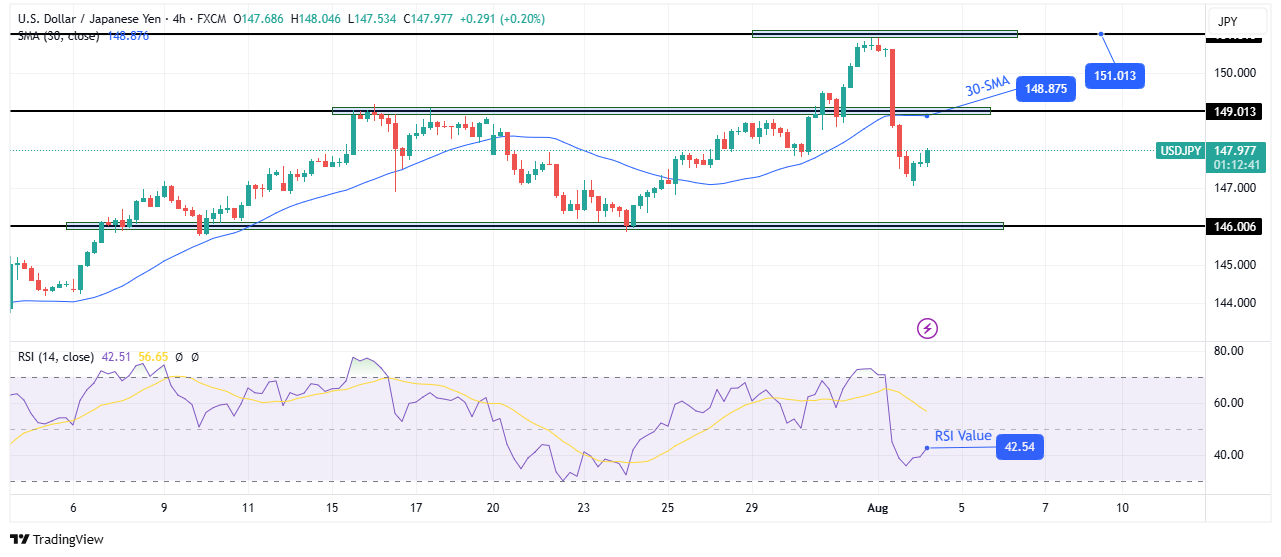
On the technical side, the USD/JPY price is recovering after a steep collapse on Friday. However, the price still trades far below the 30-SMA, showing bears are in the lead. At the same time, the RSI trades below 50, indicating solid bearish momentum.
–Are you interested in learning more about forex basics? Check our detailed guide-
Initially, bulls were in the lead, and the price had broken above the 149.01 key resistance level. However, bears appeared suddenly as the rally neared the 151.01 key level. The price made a solid bearish candle that broke back below the 149.01 level and the 30-SMA. This signaled a shift in sentiment. Since then, the price has made fresh lows below the SMA.
A pullback might retest the SMA and the 149.01 level before the new downtrend continues. In this case, USD/JPY might soon retest the 146.00 support level.
Looking to trade forex now? Invest at eToro!
68% of retail investor accounts lose money when trading CFDs with this provider. You should consider whether you can afford to take the high risk of losing your money.
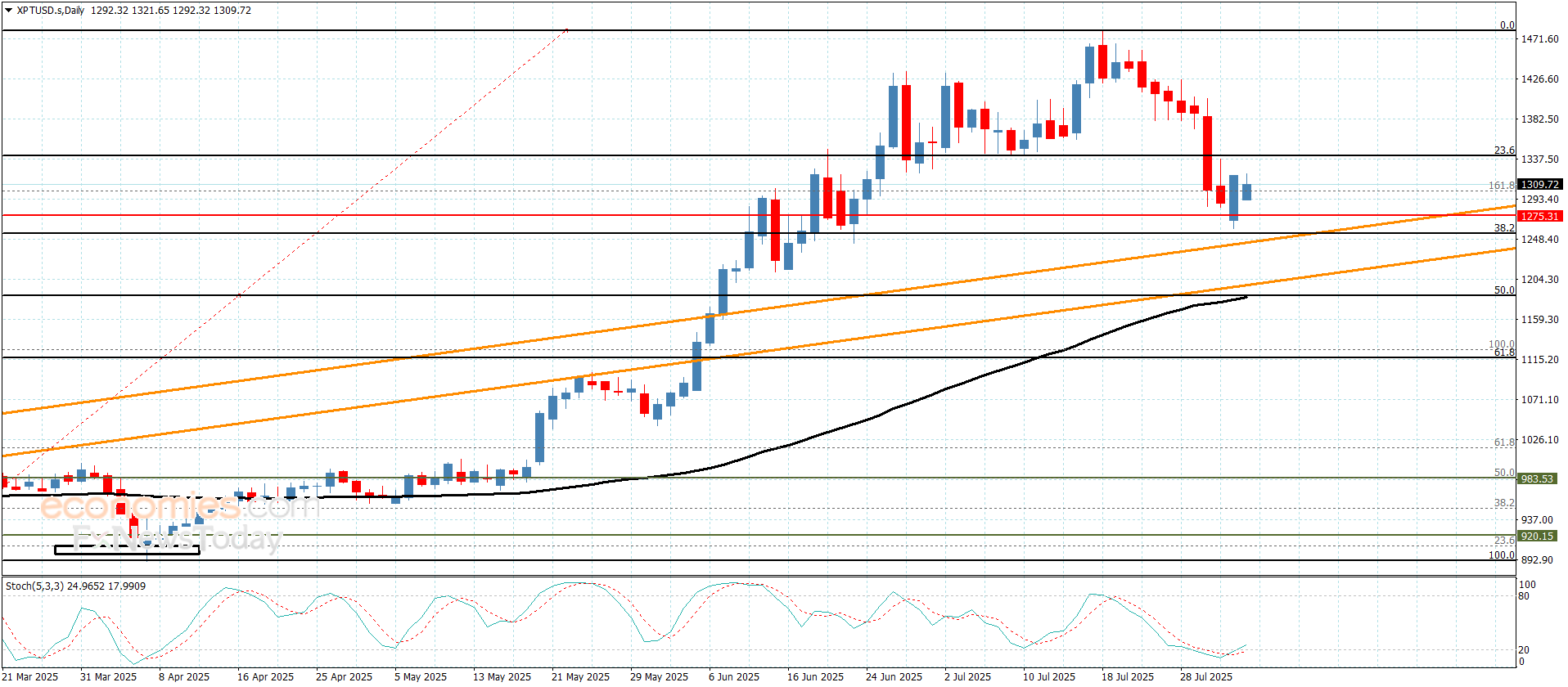
Platinum price ended its last bearish correctional attack by hitting $1260.40 level, approaching from the second correctional target, to notice forming some bullish waves, to settle near $1310.00.
Note that the continuation of forming main support at $1245.00 level against the current trading, beside stochastic attempt to provide positive momentum will increase the chances of activating the bullish attempts, to expect its rally towards $1342.00 and surpassing this barrier might extend the trading towards $1383.00, representing the initial main target for the bullish attempts.
The expected trading range for today is between $1270.00 and $1342.00
Trend forecast: Bullish
After spending the majority of the previous week under heavy selling pressure, EUR/USD gathered bullish momentum on Friday and gained about 1.5% on a daily basis. The pair stays in a consolidation phase below 1.1600 in the European morning on Monday.
The table below shows the percentage change of Euro (EUR) against listed major currencies last 7 days. Euro was the weakest against the Japanese Yen.
| USD | EUR | GBP | JPY | CAD | AUD | NZD | CHF | |
|---|---|---|---|---|---|---|---|---|
| USD | 1.59% | 1.08% | -0.07% | 0.44% | 1.43% | 1.70% | 1.30% | |
| EUR | -1.59% | -0.53% | -1.61% | -1.14% | -0.16% | 0.10% | -0.29% | |
| GBP | -1.08% | 0.53% | -1.26% | -0.61% | 0.37% | 0.64% | 0.24% | |
| JPY | 0.07% | 1.61% | 1.26% | 0.52% | 1.47% | 1.77% | 1.53% | |
| CAD | -0.44% | 1.14% | 0.61% | -0.52% | 0.96% | 1.26% | 0.86% | |
| AUD | -1.43% | 0.16% | -0.37% | -1.47% | -0.96% | 0.26% | -0.13% | |
| NZD | -1.70% | -0.10% | -0.64% | -1.77% | -1.26% | -0.26% | -0.39% | |
| CHF | -1.30% | 0.29% | -0.24% | -1.53% | -0.86% | 0.13% | 0.39% |
The heat map shows percentage changes of major currencies against each other. The base currency is picked from the left column, while the quote currency is picked from the top row. For example, if you pick the Euro from the left column and move along the horizontal line to the US Dollar, the percentage change displayed in the box will represent EUR (base)/USD (quote).
The dismal July employment report from the US triggered a US Dollar (USD) selloff ahead of the weekend, fuelling a rally in EUR/USD.
The US Bureau of Labor Statistics (BLS) announced that Nonfarm Payrolls (NFP) rose by 73,000 in July, missing analysts’ estimate of 110,000. On a more concerning note, the BSL revised down May and June NFP increases by 125,000 and 133,000, respectively.
In response, US President Donald Trump fired BLS Chief Erika McEntarfer, accusing her of manipulating the numbers for political purposes.
According to the CME FedWatch Tool, the probability of a 25 basis points Federal Reserve (Fed) rate cut in September jumped above 70% from about 30% before the data, weighing on US Treasury bond yields and the USD.
June Factory Orders will be the only data featured in the US economic calendar on Monday, which is unlikely to trigger a market reaction.
Meanwhile, investors will pay close attention to political developments in the US. US President Donald Trump is expected to announce a replacement for Fed Governor Adriana Kugler, who decided to resign. Kugler’s term was scheduled to end on January 31, 2026.
In case markets grown increasingly concerned about the Fed and the BLS losing independence, the USD could have a difficult time staying resilient against its rivals.
The Relative Strength Index (RSI) indicator on the 4-hour chart holds above 50, highlighting sellers’ hesitancy. However, EUR/USD remains below the 50-period, 100-period and the 200-period Simple Moving Averages (SMAs), suggesting that buyers are yet to be convinced of a steady rebound.
On the upside, 1.1630 (100-period SMA) aligns as the first resistance before 1.1650-1.1660 (Fibonacci 23.6% retracement, 200-period SMA) and 1.1700 (static level, round level). Looking south, support levels could be seen at 1.1540 (Fibonacci 38.2% retracement), 1.1500 (static level, round level) ad 1.1450 (Fibonacci 50% retracement).
Nonfarm Payrolls (NFP) are part of the US Bureau of Labor Statistics monthly jobs report. The Nonfarm Payrolls component specifically measures the change in the number of people employed in the US during the previous month, excluding the farming industry.
The Nonfarm Payrolls figure can influence the decisions of the Federal Reserve by providing a measure of how successfully the Fed is meeting its mandate of fostering full employment and 2% inflation.
A relatively high NFP figure means more people are in employment, earning more money and therefore probably spending more. A relatively low Nonfarm Payrolls’ result, on the either hand, could mean people are struggling to find work.
The Fed will typically raise interest rates to combat high inflation triggered by low unemployment, and lower them to stimulate a stagnant labor market.
Nonfarm Payrolls generally have a positive correlation with the US Dollar. This means when payrolls’ figures come out higher-than-expected the USD tends to rally and vice versa when they are lower.
NFPs influence the US Dollar by virtue of their impact on inflation, monetary policy expectations and interest rates. A higher NFP usually means the Federal Reserve will be more tight in its monetary policy, supporting the USD.
Nonfarm Payrolls are generally negatively-correlated with the price of Gold. This means a higher-than-expected payrolls’ figure will have a depressing effect on the Gold price and vice versa.
Higher NFP generally has a positive effect on the value of the USD, and like most major commodities Gold is priced in US Dollars. If the USD gains in value, therefore, it requires less Dollars to buy an ounce of Gold.
Also, higher interest rates (typically helped higher NFPs) also lessen the attractiveness of Gold as an investment compared to staying in cash, where the money will at least earn interest.
Nonfarm Payrolls is only one component within a bigger jobs report and it can be overshadowed by the other components.
At times, when NFP come out higher-than-forecast, but the Average Weekly Earnings is lower than expected, the market has ignored the potentially inflationary effect of the headline result and interpreted the fall in earnings as deflationary.
The Participation Rate and the Average Weekly Hours components can also influence the market reaction, but only in seldom events like the “Great Resignation” or the Global Financial Crisis.

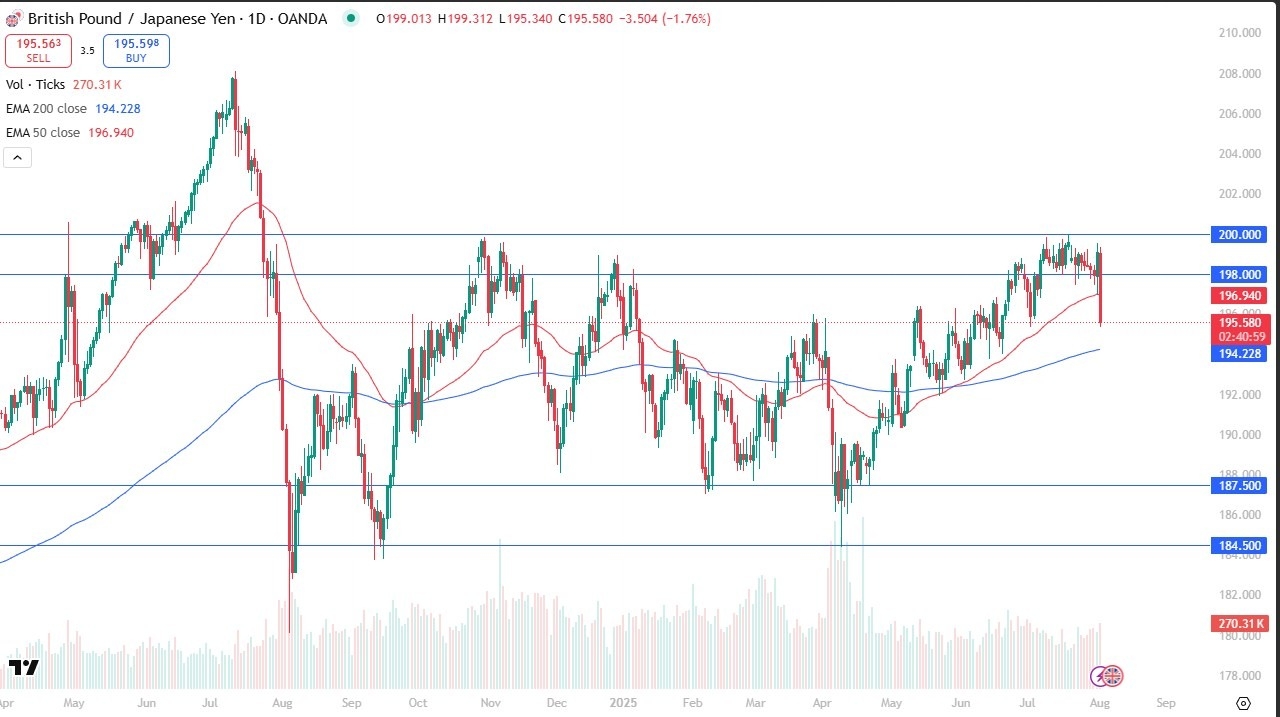
The technical analysis for this pair is obviously in a state of flux as we just printed a massive red candlestick. A nasty red candlestick for the trading session on Friday might be enough to entice buyers, but quite frankly I think it’s asking a lot for markets to suddenly turn around. It’s very possible that the British pound could drop to the 200 Day EMA which is at the ¥194.23 level, before bouncing again. It’ll be interesting to see if that actually plays out, but I also recognize that a lot of this comes down to risk appetite overall.
The ¥198 level above probably ends up being a major barrier, but if we can break above there then we will threaten the ¥200 level again. Keep in mind that the area in the 200 point range has been resistant a couple of times in the past, so one has to ask questions as to whether or not we just found the top of a longer-term consolidation area that might hold. If we break down below the 200 Day EMA, we could very well see this market drop down to the ¥187.50 level, maybe even as low as the ¥184.50 level. This will almost certainly have everything to do with risk appetite and the overall attitude of markets in general. After all, there are a lot of different things going on at the same time, and this does have a lot of traders somewhat concerned. Ultimately, I think we’ve got a situation where traders are looking at this through the prism of a wondering whether or not the markets are about to see a major shift in attitude.
Begin trading our daily forecasts and analysis. Here is a list of Forex brokers in Japan to work with.
Christopher Lewis has been trading Forex and has over 20 years experience in financial markets. Chris has been a regular contributor to Daily Forex since the early days of the site. He writes about Forex for several online publications, including FX Empire, Investing.com, and his own site, aptly named The Trader Guy. Chris favours technical analysis methods to identify his trades and likes to trade equity indices and commodities as well as Forex. He favours a longer-term trading style, and his trades often last for days or weeks.
Important DisclaimersThe content provided on the website includes general news and publications, our personal analysis and opinions, and contents provided by third parties, which are intended for educational and research purposes only. It does not constitute, and should not be read as, any recommendation or advice to take any action whatsoever, including to make any investment or buy any product. When making any financial decision, you should perform your own due diligence checks, apply your own discretion and consult your competent advisors. The content of the website is not personally directed to you, and we does not take into account your financial situation or needs.The information contained in this website is not necessarily provided in real-time nor is it necessarily accurate. Prices provided herein may be provided by market makers and not by exchanges.Any trading or other financial decision you make shall be at your full responsibility, and you must not rely on any information provided through the website. FX Empire does not provide any warranty regarding any of the information contained in the website, and shall bear no responsibility for any trading losses you might incur as a result of using any information contained in the website.The website may include advertisements and other promotional contents, and FX Empire may receive compensation from third parties in connection with the content. FX Empire does not endorse any third party or recommends using any third party’s services, and does not assume responsibility for your use of any such third party’s website or services.FX Empire and its employees, officers, subsidiaries and associates, are not liable nor shall they be held liable for any loss or damage resulting from your use of the website or reliance on the information provided on this website.Risk DisclaimersThis website includes information about cryptocurrencies, contracts for difference (CFDs) and other financial instruments, and about brokers, exchanges and other entities trading in such instruments. Both cryptocurrencies and CFDs are complex instruments and come with a high risk of losing money. You should carefully consider whether you understand how these instruments work and whether you can afford to take the high risk of losing your money.FX Empire encourages you to perform your own research before making any investment decision, and to avoid investing in any financial instrument which you do not fully understand how it works and what are the risks involved.
The GBP/USD weekly forecast suggests further downside as market participants prepare for a Bank of England rate cut.
The GBP/USD price had a bearish week as the dollar strengthened on upbeat data and higher tariffs. However, there was a pullback after the nonfarm payrolls report.
–Are you interested in learning more about Bitcoin price prediction? Check our detailed guide-
At the start of the week, data revealed solid private employment. At the same time, the economy grew by 3.0%, compared to the forecast of 2.5%. The data boosted the dollar. Moreover, Trump imposed higher tariffs on several countries, which sent Treasury yields and the dollar higher.
However, the dollar retreated on Friday after data revealed slower-than-expected job growth in July.
Next week’s calendar for GBP/USD is quite light. Market participants will focus on the Bank of England policy meeting, where the central bank might cut interest rates by 25-bps. The pound had a bad month in July as traders worried about the state of the UK economy.
Despite being among the first countries to sign a trade deal with the US, the UK’s currency has suffered amid poor economic data. The weak reports have led to an increase in expectations for Bank of England rate cuts.
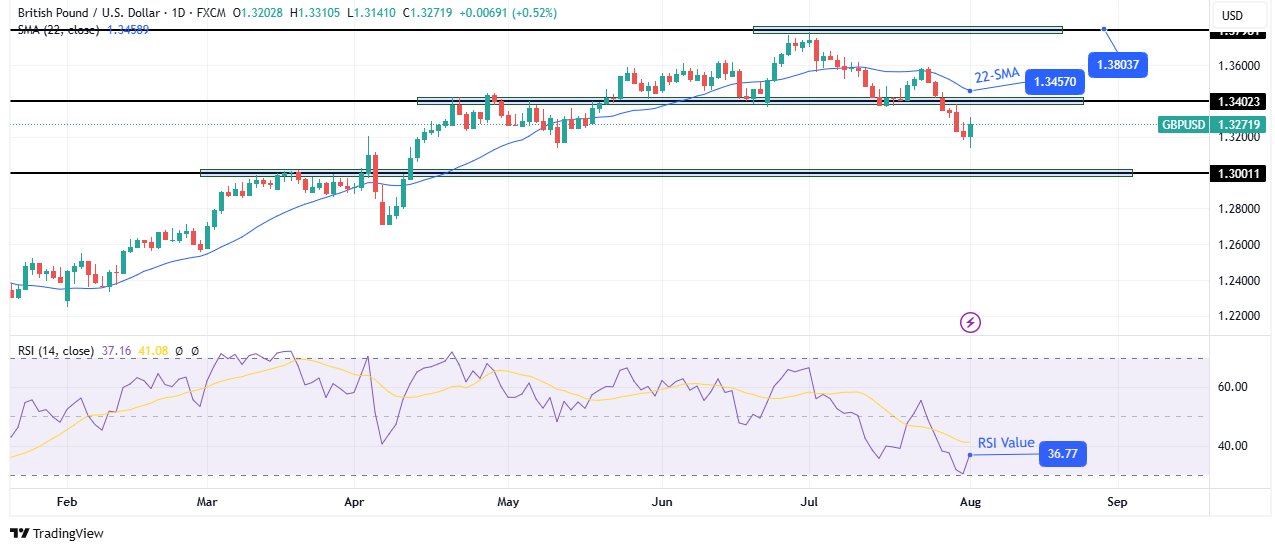
On the technical side, the GBP/USD price trades well below the 22-SMA, showing bears are in the lead. At the same time, the RSI trades below 50, indicating solid bearish momentum. At the same time, the price recently broke below the 1.3402 support level to form a lower low. This confirms a bearish trend.
–Are you interested in learning more about forex basics? Check our detailed guide-
Previously, the price was in a bullish trend that paused near the 1.3803 key level. Bears took charge by breaking below the 22-SMA and respecting it as resistance. The bearish bias is strong, especially since the price has confirmed a new downtrend.
Currently, the price has paused after making a lower low. It might pull back to retest the recently broken 1.3402 level before dropping to fresh lows. The next target for GBP/USD is at the 1.3001 key support level. A break below will strengthen the bearish bias.
Looking to trade forex now? Invest at eToro!
68% of retail investor accounts lose money when trading CFDs with this provider. You should consider whether you can afford to take the high risk of losing your money.
Silver (XAG/USD) continues to struggle under the weight of a stronger US Dollar, extending its decline from the 14-year high of $39.53 reached on July 23. At the time of writing, the white metal is trading near $36.50 during the American trading session, down nearly 4.5% so far this week, with traders turning cautious ahead of Friday’s key US Nonfarm Payrolls (NFP) report at 12:30 GMT.
Technically, on the daily chart, Silver has broken below the ascending channel that had supported its uptrend since early April, marking a clear shift in market structure. This breakdown suggests bullish momentum has faded and a deeper correction may be unfolding. The metal is now hovering just above the 50-day Exponential Moving Average (EMA) at $36.54, which acts as immediate support. A daily close below this zone could expose the next key downside target at the 100-day Simple Moving Average (SMA) near $34.65.
Momentum indicators reinforce the bearish case. On the daily chart, the Relative Strength Index (RSI) has slipped to 40, signaling weakening momentum and a slide toward oversold territory. Meanwhile, the MACD has turned negative, with a bearish crossover in place, signaling further downside risks.
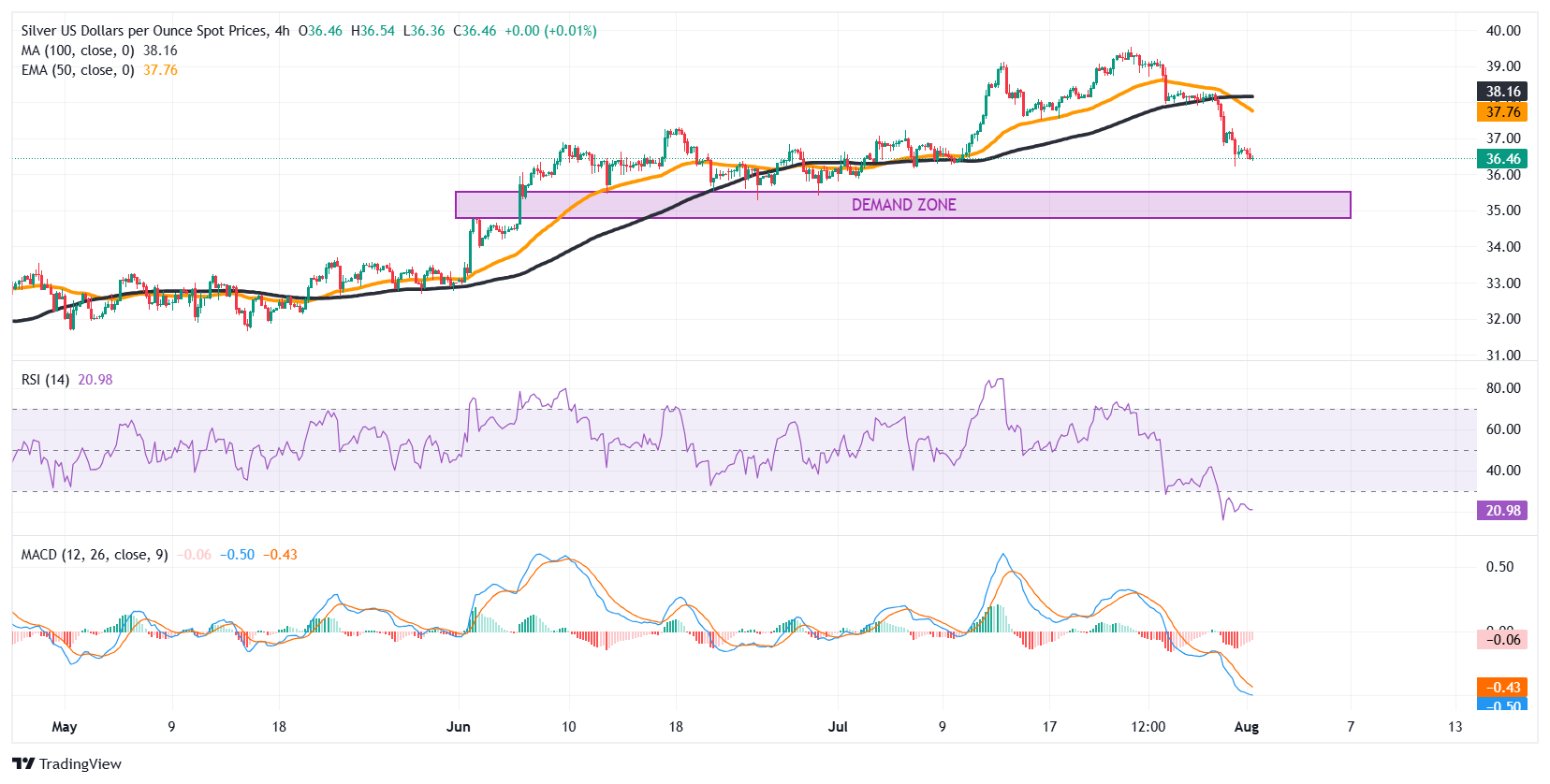
Zooming into the 4-hour timeframe, Silver has broken below both the 50-EMA and 100-SMA, underscoring persistent short-term selling pressure. Price is now approaching a key demand zone in the $35.30-$35.70 range, which could offer some near-term support. However, with the 4-hour RSI plunging to oversold levels near 21, a short-term bounce is possible. Still, the MACD remains deep in negative territory, suggesting the broader bias remains tilted to the downside — unless a softer-than-expected NFP print sparks a reversal.
Silver is a precious metal highly traded among investors. It has been historically used as a store of value and a medium of exchange. Although less popular than Gold, traders may turn to Silver to diversify their investment portfolio, for its intrinsic value or as a potential hedge during high-inflation periods. Investors can buy physical Silver, in coins or in bars, or trade it through vehicles such as Exchange Traded Funds, which track its price on international markets.
Silver prices can move due to a wide range of factors. Geopolitical instability or fears of a deep recession can make Silver price escalate due to its safe-haven status, although to a lesser extent than Gold’s. As a yieldless asset, Silver tends to rise with lower interest rates. Its moves also depend on how the US Dollar (USD) behaves as the asset is priced in dollars (XAG/USD). A strong Dollar tends to keep the price of Silver at bay, whereas a weaker Dollar is likely to propel prices up. Other factors such as investment demand, mining supply – Silver is much more abundant than Gold – and recycling rates can also affect prices.
Silver is widely used in industry, particularly in sectors such as electronics or solar energy, as it has one of the highest electric conductivity of all metals – more than Copper and Gold. A surge in demand can increase prices, while a decline tends to lower them. Dynamics in the US, Chinese and Indian economies can also contribute to price swings: for the US and particularly China, their big industrial sectors use Silver in various processes; in India, consumers’ demand for the precious metal for jewellery also plays a key role in setting prices.
Silver prices tend to follow Gold’s moves. When Gold prices rise, Silver typically follows suit, as their status as safe-haven assets is similar. The Gold/Silver ratio, which shows the number of ounces of Silver needed to equal the value of one ounce of Gold, may help to determine the relative valuation between both metals. Some investors may consider a high ratio as an indicator that Silver is undervalued, or Gold is overvalued. On the contrary, a low ratio might suggest that Gold is undervalued relative to Silver.
A decisive and sustained breakout above today’s high would put gold back into the pennant formation. Potential support would then be around the moving averages. If this scenario begins to unfold and momentum stays muted, the pennant pattern may be in the process of expanding its footprint as consolidation continues.
This week’s low establishes a higher swing low, which retains the pattern of recent higher swing lows. Moreover, the recent upside breakout of the pattern failed to follow-through and generated a lower swing high. New trendlines have been added to the expanded parameters of the pattern, while the initial boundary lines remain as dotted blue lines.
The new territory of the pennant shows that consolidation could continue for another month or so before a decisive breakout from the new parameter’s triggers, given the location of the pennant triangle apex. Key price levels are last week’s lower swing high of $3,349 and this week’s higher swing low at $3,268. Trendlines indicate a narrower price range but are less unreliable as a signal.
The weekly chart provides supporting evidence that strength could be maintained within the newly formed pennant boundaries. This week’s low found support near the long-term 20-Week MA. It was followed by a rally that looks likely to end the week in the green and near the highs for the week. Unless there is a sharp selloff before the closing of the session, gold will form a bullish hammer candlestick pattern. It is interesting to note that this bullish candlestick pattern will follow last week’s bearish shooting star pattern.
For a look at all of today’s economic events, check out our economic calendar.