The main category of Forex News.
You can use the search box below to find what you need.
[wd_asp id=1]
The main category of Forex News.
You can use the search box below to find what you need.
[wd_asp id=1]
July 17, 2025 – Written by David Woodsmith
STORY LINK Pound to Euro Forecast: Sell GBP/EUR Rallies says This Bank
The Pound to Euro exchange rate (GBP/EUR) spiked higher in response to the UK inflation data, but failed to hold the gains and traded around 1.1525, not far above the 3-month lows of 1.1500 posted on Tuesday.
Traders still expect a rate cut in August and are braced for a weak jobs report on Thursday while confidence in the UK bond market remains notably fragile.
ING commented; “A soft jobs print tomorrow should send EUR/GBP back above 0.870.” (GBP/EUR) sliding below 1.1500)
Goldman Sachs expects longer-term losses, but would prefer to sell GBP/EUR rallies rather than sell now; “we are more inclined to wait for better entry points before engaging with Sterling shorts.”
The headline UK inflation rate increased to 3.6% for June compared with consensus forecasts of an unchanged rate of 3.4% and the highest annual rate since January 2024.
From a global perspective, the inflation rate was also the highest in the G7 area.
Core inflation also increased to 3.7% from 3.5% and compared with expectations of no change.
The goods inflation rate increased to 2.4% from 2.0% with the services-sector rate unchanged at 4.7%.
There was upward pressure on transport prices for the month while food price inflation increased to 4.5%, the strongest reading since early 2024.
Paul Dales, chief UK economist at Capital Economics commented; “The UK does still have an inflation problem.”
Looking at trends in online data, Michael Metcalfe of State Street Markets is more confident over the outlook; “online prices suggest inflation pressures have already begun to subside in the first two weeks of July, which warns against reading too much into summer inflation strength seen so far.”
ING noted the persistence in services-sector inflation; “this latest data appears to set the bar fairly high for faster rate cuts. The fact that headline inflation is edging closer to 4% doesn’t help. BoE Chief Economist Huw Pill has recently spoken of internal research, which shows that inflation has a habit of becoming more entrenched when CPI reaches these levels.”
ING also noted that the position could still change quickly; “Thursday’s payroll data is absolutely key. If May’s shockingly bad figures aren’t revised up and/or if June’s numbers are as bad, that could be a catalyst for the Bank to rethink its current cautious approach to rate cuts. For now, though, we expect “gradual” cuts in August and November.”
According to Deutsche Bank’s chief UK economist Sanjay Raja; “Is an August rate cut in jeopardy? No, we don’t think so. There’s enough of a slowdown in GDP and the labour market to warrant a ‘gradual and careful’ easing of monetary policy.

He added; “But the onus now rests on the labour market to shape how far and how fast the MPC can cut this year and next.”
Reaction in the bond market will be monitored closely, especially as there has been upward pressure on long-term yields.
The 10-year yield increased to 4.68% in immediate reaction to the data before a retreat to 4.66%.
James Flintoft of AJ Bell commented; “The persistence of inflation above 3pc, well ahead of the Bank of England’s 2pc target, further highlights the risk that higher inflation is here to stay, and parts of the gilt market need to adjust.”
Higher yields could, in theory, underpin the Pound, but there will also be concerns that higher yields will be seen as a symptom of global markets losing confidence in UK bonds and undermine the Pound.
International Money Transfer? Ask our resident FX expert a money transfer question or try John’s new, free, no-obligation personal service! ,where he helps every step of the way,
ensuring you get the best exchange rates on your currency requirements.
TAGS: Pound Euro Forecasts
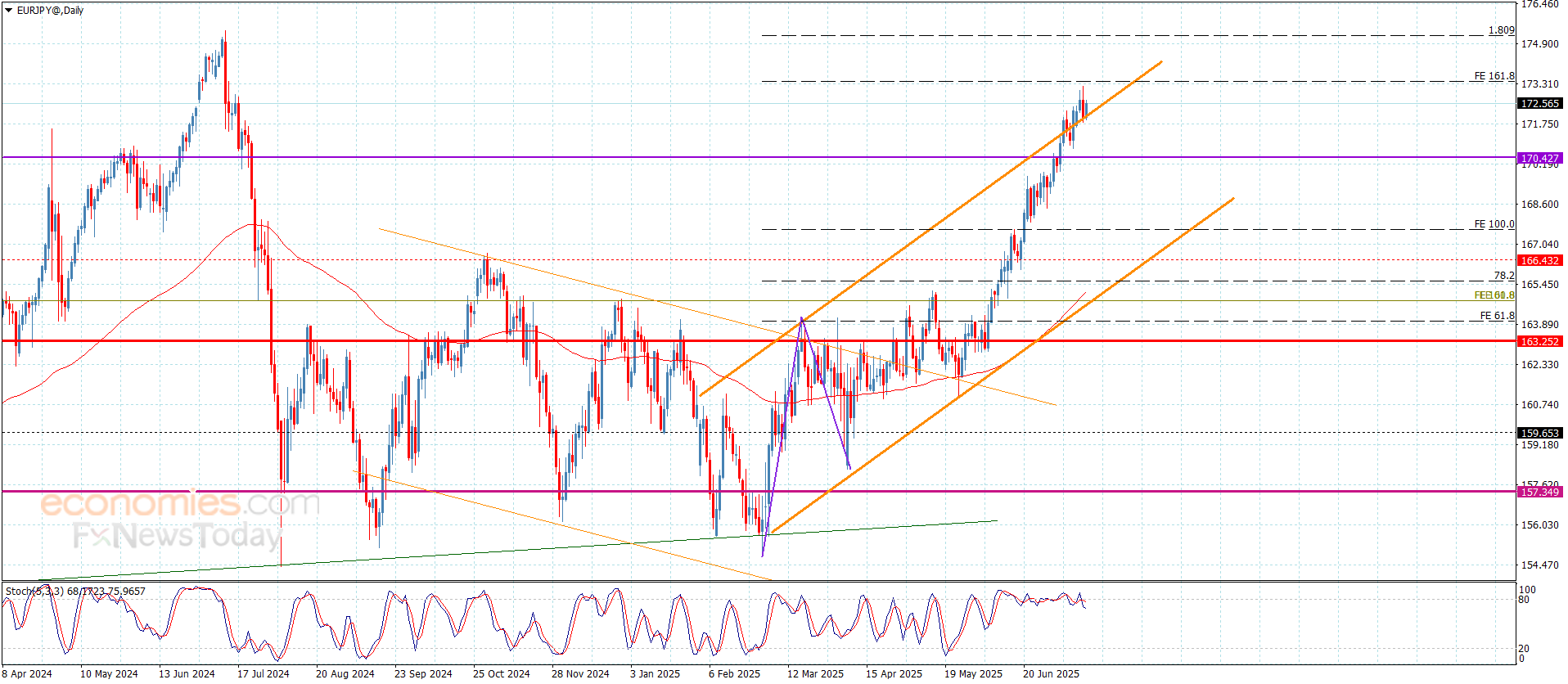
Despite the neediness of the EURJPY pair to positive momentum since yesterday, its positive stability above 171.75 confirms the stability of the bullish track, to increase the chances of reaching the initial main target at 173.40 and surpassing it will reinforce the chances for recording extra gains that might extend towards 173.85 and 174.40.
Notet that the price decline below 171.75 and providing bearish closes will increase the chances for activating the attempts of gathering the gains by forming bearish correctional waves, to expect targeting 171.10 level, reaching the support near 170.45.
The expected trading range for today is between 172.00 and 173.80
Trend forecast: Bullish
GBP/USD trades marginally lower on the day at around 1.3400 in the European session on Thursday. Although Pound Sterling gathers strength against other major currencies, GBP/USD’s technical outlook is yet to point to a buildup of recovery momentum.
The table below shows the percentage change of British Pound (GBP) against listed major currencies today. British Pound was the strongest against the Australian Dollar.
| USD | EUR | GBP | JPY | CAD | AUD | NZD | CHF | |
|---|---|---|---|---|---|---|---|---|
| USD | 0.44% | 0.13% | 0.55% | 0.52% | 0.91% | 0.46% | 0.42% | |
| EUR | -0.44% | -0.31% | 0.09% | 0.11% | 0.50% | 0.05% | 0.02% | |
| GBP | -0.13% | 0.31% | 0.44% | 0.39% | 0.78% | 0.34% | 0.30% | |
| JPY | -0.55% | -0.09% | -0.44% | -0.06% | 0.31% | -0.10% | -0.14% | |
| CAD | -0.52% | -0.11% | -0.39% | 0.06% | 0.47% | -0.06% | -0.09% | |
| AUD | -0.91% | -0.50% | -0.78% | -0.31% | -0.47% | -0.53% | -0.48% | |
| NZD | -0.46% | -0.05% | -0.34% | 0.10% | 0.06% | 0.53% | -0.03% | |
| CHF | -0.42% | -0.02% | -0.30% | 0.14% | 0.09% | 0.48% | 0.03% |
The heat map shows percentage changes of major currencies against each other. The base currency is picked from the left column, while the quote currency is picked from the top row. For example, if you pick the British Pound from the left column and move along the horizontal line to the US Dollar, the percentage change displayed in the box will represent GBP (base)/USD (quote).
The UK’s Office for National Statistics (ONS) reported early Thursday that the ILO Unemployment Rate edged higher to 4.7% in the three months to May from 4.6%. In this period, Employment Change rose by 134,000, following the 89,000 increase recorded previously. Finally, annual wage inflation, as measured by the change in Average Earnings Excluding Bonus, declined to 5%, coming in above the market expectation of 4.9%.
Reflecting the positive impact of the employment report on Pound Sterling, EUR/GBP was last seen losing 0.3%, while GBP/JPY was up nearly 0.5% on the day. Nevertheless, the US Dollar (USD) benefits from the cautious market mood and doesn’t allow GBP/USD to gain traction.
Later in the day, weekly Initial Jobless Claims and June Retail Sales data will be featured in the US economic calendar.
Markets expect the number of first-time applications for unemployment benefits to rise to 235,000 from 227,000 in the previous week. A reading below 220,000 could support the USD with the immediate reaction and make it difficult for GBP/USD to hold its ground. Conversely, a disappointing reading of 240,000 or above could open the door for a rebound in the pair.
The Relative Strength Index (RSI) indicator on the 4-hour chart stays below 40, reflecting bearish conditions for GBP/USD. The Fibonacci 61.8% retracement level of the latest uptrend seems to have formed a pivot level at 1.3400.
In case GBP/USD fails to stabilize above 1.3400, technical sellers could remain interested. In this scenario, 1.3300 (Fibonacci 78.6% retracement) and 1.3275 (100-day Simple Moving Average) could be seen as next support levels. On the upside, resistance levels could be spotted at 1.3470 (Fibonacci 50% retracement), 1.3500 (static level, round level) and 1.3540 (Fibonacci 38.2% retracement).
A country’s Gross Domestic Product (GDP) measures the rate of growth of its economy over a given period of time, usually a quarter. The most reliable figures are those that compare GDP to the previous quarter e.g Q2 of 2023 vs Q1 of 2023, or to the same period in the previous year, e.g Q2 of 2023 vs Q2 of 2022.
Annualized quarterly GDP figures extrapolate the growth rate of the quarter as if it were constant for the rest of the year. These can be misleading, however, if temporary shocks impact growth in one quarter but are unlikely to last all year – such as happened in the first quarter of 2020 at the outbreak of the covid pandemic, when growth plummeted.
A higher GDP result is generally positive for a nation’s currency as it reflects a growing economy, which is more likely to produce goods and services that can be exported, as well as attracting higher foreign investment. By the same token, when GDP falls it is usually negative for the currency.
When an economy grows people tend to spend more, which leads to inflation. The country’s central bank then has to put up interest rates to combat the inflation with the side effect of attracting more capital inflows from global investors, thus helping the local currency appreciate.
When an economy grows and GDP is rising, people tend to spend more which leads to inflation. The country’s central bank then has to put up interest rates to combat the inflation. Higher interest rates are negative for Gold because they increase the opportunity-cost of holding Gold versus placing the money in a cash deposit account. Therefore, a higher GDP growth rate is usually a bearish factor for Gold price.
July 17, 2025 – Written by Tim Boyer
STORY LINK Euro to Dollar Forecast: Multi-month Bull Trend “Not yet Been Broken”
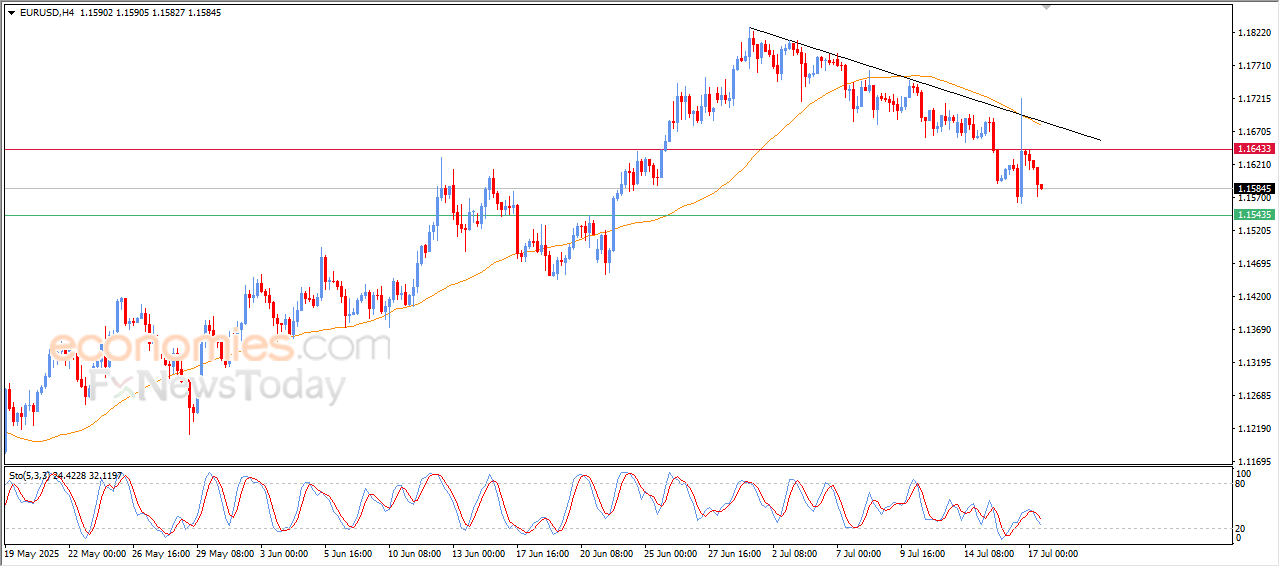
The Euro to Dollar exchange rate (EUR/USD) dipped to 3-week lows just below 1.16 on Tuesday before attempting to stabilise.
EUR/USD has again found some support below the 1.1600 level after the latest US data but has not been able to make any headway.
Fresh doubts over the potential for a September Federal Reserve rate cut and higher yields have underpinned the dollar while on-going reservations over Fed independence have been kept at bay for now.
According to Scotiabank; “The multi-month bull trend has not yet been broken but we are concerned about the near-term risk of further weakness as we look to potential support at the April 21 high (1.1573) and the 50 day MA (1.1484). Near-term resistance is expected in the 1.1680/1.1700 range.”
UoB added; “The price action continues to suggest downside risk in EUR, and the next level to monitor is 1.1550. On the upside, the ‘strong resistance’ is now at 1.1705 instead of 1.1735.”
ING commented; “We think 1.16 can be a good balance unless data adds much to the US macro story in the next days. Risks are, however, that the dollar gets a bit more support from hawkish repricing and EUR/USD starts looking at 1.15.”
Markets are now pricing in less than a 50% chance of a Fed September rate cut.
Commerzbank commented on the near-term outlook; “Fundamentally, the weakness of the USD looked like it has gone too far. It was unlikely that this trend would continue seamlessly. Short-term corrective movements are therefore not that surprising.”
ING added; “yesterday’s reality check on Fed cuts speculation could have a lasting effect by raising the bar for dovish repricing, and we therefore feel the risks remain skewed to a stronger dollar from here.”
US producer prices at the headline and core level were both unchanged on the month with the headline annual increase at 2.3% from 2.7% previously.
The issue of Fed independence and possible forced departure of Chair Powell remains a live story.
Scotiabank commented; “While it is highly unlikely that Fed Chair Powell will quit before his term ends, administration pressure on the Fed leadership is unlikely to relent.”
Scotiabank also noted reports that the Administration could use allegations of overspending surrounding Federal Reserve renovation.
It added; “The appearance of manoeuvring that could potentially lead to the removal of the Fed chair should be of more concern to markets than it apparently is. Such an eventuality would likely be disruptive for financial markets and undermine confidence in the Fed.”
The bank also noted that market inflation expectations have been drifting higher.
Commerzbank expects a 25 basis-point cut in September and added; “Even then, Trump’s attacks on the Fed’s independence are unlikely to stop. A 25-basis-point cut is unlikely to satisfy him given that he is demanding 300 basis points lower rates. Accordingly, the current [dollar] recovery phase is unlikely to last long as well.”
The French government proposed on Tuesday to scrap two bank holidays in order to help curb the budget deficit. There was strong criticism from opposition parties and National Rally leader Le Pen threatened to bring the government down. This could undermine the Euro.
ING commented; “The French deficit story has been very much in the background as of late, but yesterday probably served as a reminder that it is a ticking bomb for EU sentiment. And we could start seeing some FX spillovers in the coming months.”
International Money Transfer? Ask our resident FX expert a money transfer question or try John’s new, free, no-obligation personal service! ,where he helps every step of the way,
ensuring you get the best exchange rates on your currency requirements.
TAGS: Euro Dollar Forecasts
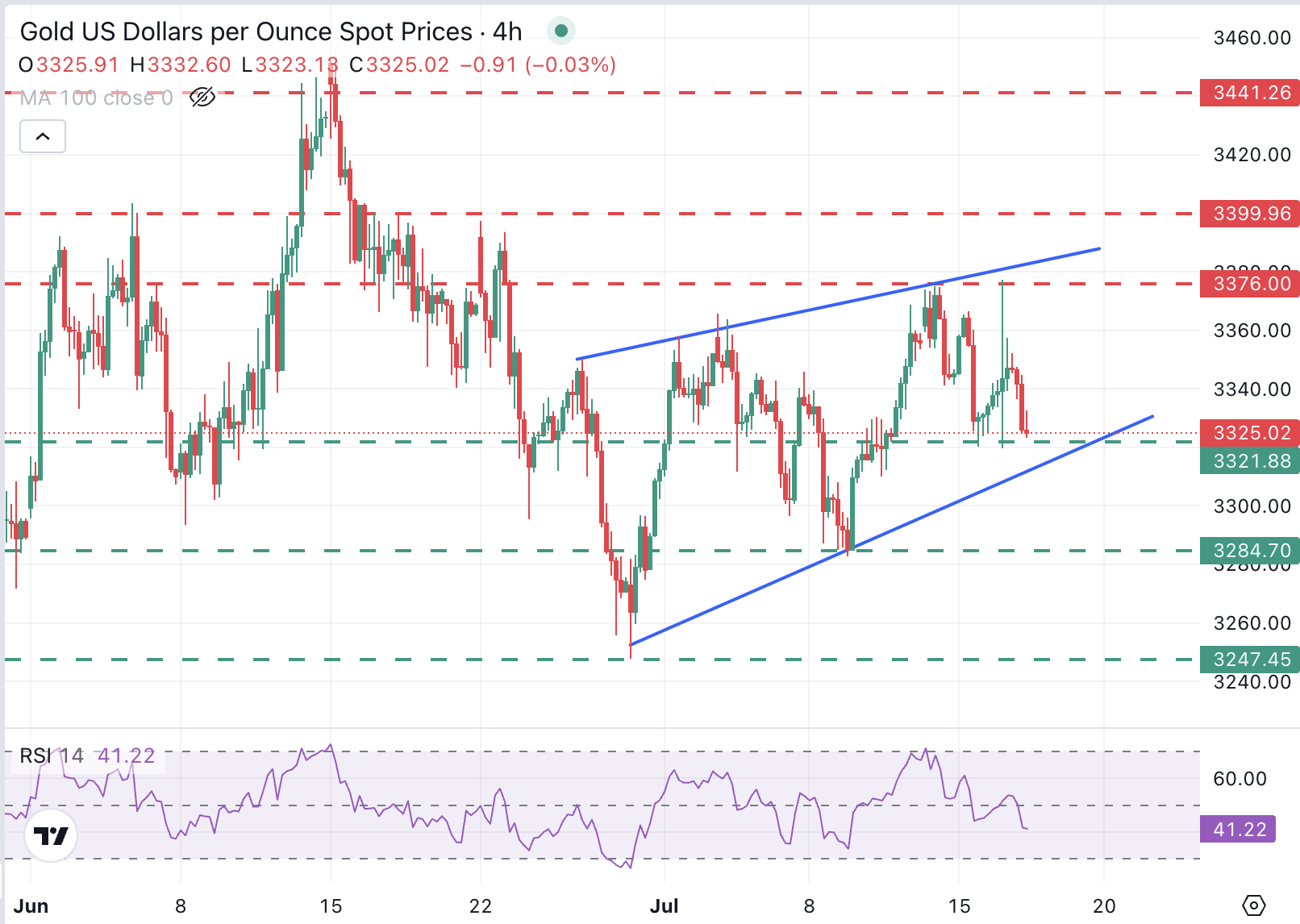
Gold (XAU/USD) is trading lower on Thursday, weighed by a stronger US Dollar, with risk appetite subdued amid ongoing uncertainty about global trade and rumours about the resignation of the Fed Chair Jerome Powell.
The precious metal retreats from Monday’s highs at $3,375, but price action remains contained within previous ranges. Later today, the release of the US June Retail Sales data and weekly Jobless Claims might give further clues about the impact of Trump’s tariffs on consumption and employment, and give more guidance for the pair.
The XAU/USD technical picture remains messy. The daily chart shows a lack of clear bias, with the RSI wavering back and forth around the 50 level, and price action halfway through the last few months’ trading range.
A look at the 4-hour chart, however, reveals increasing downside pressure, although the pair remains above the support area at $3,310-$3,320, which contains the neckline of a double top at $3,375 and the bottom of the ascending wedge. A confirmation below here would increase pressure towards the July 9 low at $3,285 ahead of the June 29 low, at $3,245
On the flip side, a rebound from current levels would find resistance at the mentioned $3,375 July 14, 16 highs, and the wedge top, at 3,380, ahead of the June 18 and 23 highs, at the $3,400 area.
Gold has played a key role in human’s history as it has been widely used as a store of value and medium of exchange. Currently, apart from its shine and usage for jewelry, the precious metal is widely seen as a safe-haven asset, meaning that it is considered a good investment during turbulent times. Gold is also widely seen as a hedge against inflation and against depreciating currencies as it doesn’t rely on any specific issuer or government.
Central banks are the biggest Gold holders. In their aim to support their currencies in turbulent times, central banks tend to diversify their reserves and buy Gold to improve the perceived strength of the economy and the currency. High Gold reserves can be a source of trust for a country’s solvency. Central banks added 1,136 tonnes of Gold worth around $70 billion to their reserves in 2022, according to data from the World Gold Council. This is the highest yearly purchase since records began. Central banks from emerging economies such as China, India and Turkey are quickly increasing their Gold reserves.
Gold has an inverse correlation with the US Dollar and US Treasuries, which are both major reserve and safe-haven assets. When the Dollar depreciates, Gold tends to rise, enabling investors and central banks to diversify their assets in turbulent times. Gold is also inversely correlated with risk assets. A rally in the stock market tends to weaken Gold price, while sell-offs in riskier markets tend to favor the precious metal.
The price can move due to a wide range of factors. Geopolitical instability or fears of a deep recession can quickly make Gold price escalate due to its safe-haven status. As a yield-less asset, Gold tends to rise with lower interest rates, while higher cost of money usually weighs down on the yellow metal. Still, most moves depend on how the US Dollar (USD) behaves as the asset is priced in dollars (XAU/USD). A strong Dollar tends to keep the price of Gold controlled, whereas a weaker Dollar is likely to push Gold prices up.
Disclaimer: For information purposes only. Past performance is not indicative of future results.
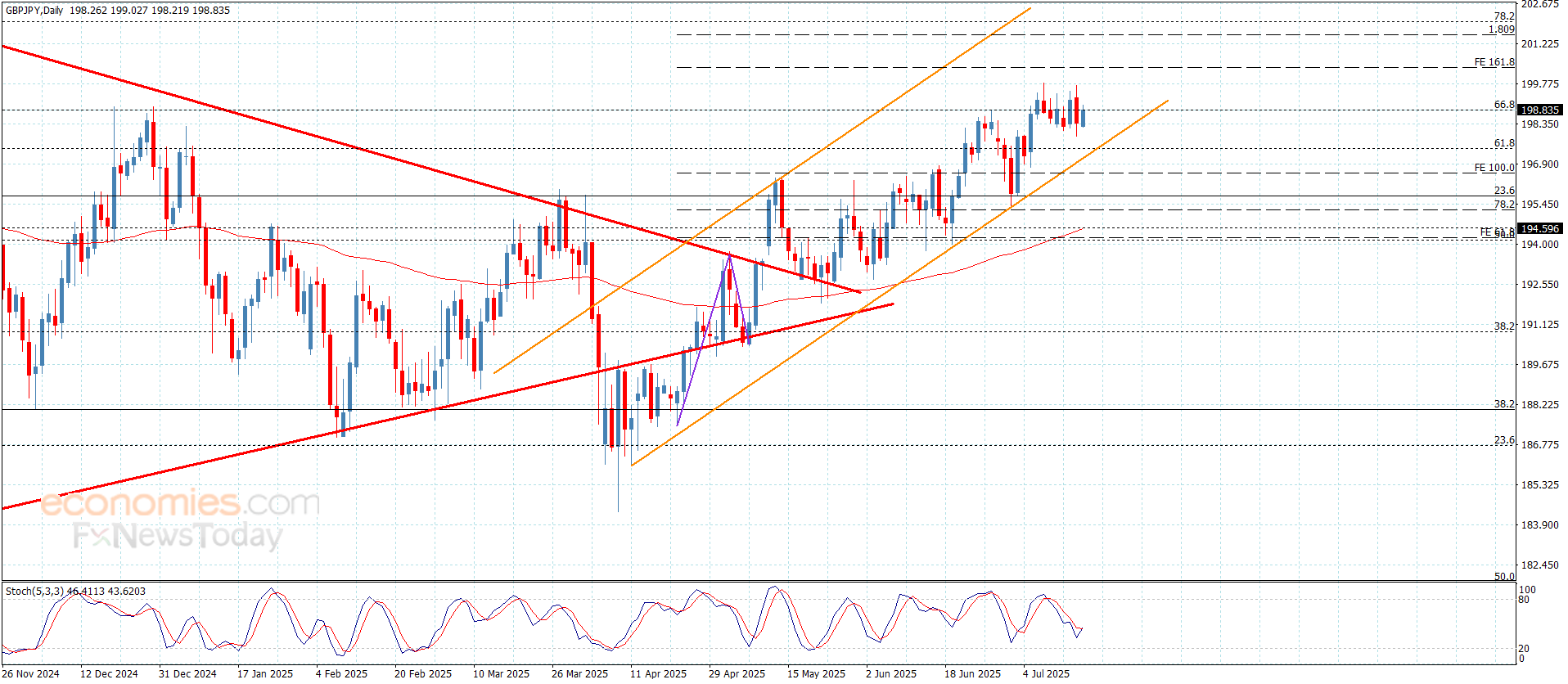
The GBPJPY pair lost the positive momentum by stochastic fluctuation near 50 level, which forces it to delay the bullish rally and forming intraday bearish wave, to test the extra support near 197.90 then begin this morning trading with a new positive action, due to its fluctuation near the barrier at 198.80.
We recommend waiting for confirming breaching the current obstacle to confirm its readiness to renew the bullish attempts, which might target 200.35 level, while the failure to breach might help renewing the bearish correctional attempts, forcing it to suffer some losses by reaching 197.45, then attempting to press on the bullish channel’s support at 197.15.
The expected trading range for today is between 198.00 and 200.35
Trend forecast: Bullish
The GBPJPY pair lost the positive momentum by stochastic fluctuation near 50 level, which forces it to delay the bullish rally and forming intraday bearish wave, to test the extra support near 197.90 then begin this morning trading with a new positive action, due to its fluctuation near the barrier at 198.80.
We recommend waiting for confirming breaching the current obstacle to confirm its readiness to renew the bullish attempts, which might target 200.35 level, while the failure to breach might help renewing the bearish correctional attempts, forcing it to suffer some losses by reaching 197.45, then attempting to press on the bullish channel’s support at 197.15.
The expected trading range for today is between 198.00 and 200.35
Trend forecast: Bullish
The GBPJPY pair lost the positive momentum by stochastic fluctuation near 50 level, which forces it to delay the bullish rally and forming intraday bearish wave, to test the extra support near 197.90 then begin this morning trading with a new positive action, due to its fluctuation near the barrier at 198.80.
We recommend waiting for confirming breaching the current obstacle to confirm its readiness to renew the bullish attempts, which might target 200.35 level, while the failure to breach might help renewing the bearish correctional attempts, forcing it to suffer some losses by reaching 197.45, then attempting to press on the bullish channel’s support at 197.15.
The expected trading range for today is between 198.00 and 200.35
Trend forecast: Bullish
No news for copper price, it remains confined between $5.3200 support and $5.5100 level which represents an extra barrier against the bullish attempts, and the contradiction between the main indicators confirming delaying the bullish attempts, to recommend neutrality and wait for surpassing these levels to detect the expected targets in the near trading.
Trading success in surpassing the barrier and holding above it will reinforce the dominance of the bullish bias, which might target $5.6700, while breaking the support will force it to form bearish correctional waves, to expect reaching $5.1500 and $4.9800.
The expected trading range for today is between $5.3100 and $5.5100
Trend forecast: Neutral

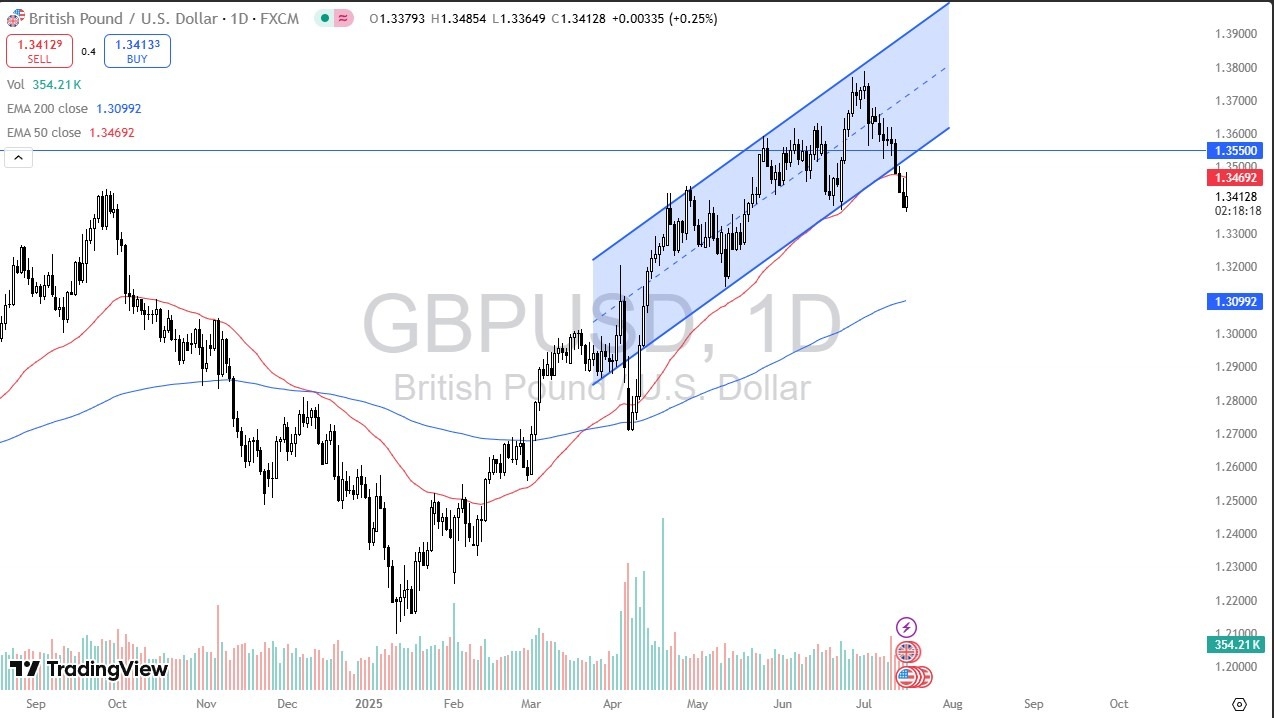
The technical analysis for this pair is starting to turn to the downside, as the rally ran into a lot of problems in the 50 Day EMA. Above there, we have the 1.3550 level, and of course the previous uptrend in general which now could offer quite a bit of resistance. In other words, I think we are about to see the fish pound fall significantly against the US dollar.
That being said, the reality is that the British pound has outperformed many other currencies against the US dollar for the better part of the year and a half, even when it’s falling. Because of this, I think that this could either end up being a nice shorting opportunity, where you can use it as a signal for shorting other currencies such as the euro and the Japanese yen against the US dollar. With that being said, I think we got a situation where short-term rallies probably get sold into, but if we were to see the British pound break above the 1.3550 level on a daily close, then I would have to rethink the entire situation here in Sterling.
As far as a target is concerned, we could be looking at the level 1.31, which is basically where the 200 Day EMA is currently hanging around. That would obviously attract a lot of attention, but we will have to see how quickly we get there, and of course whether or not the rest of the Forex market follows right along.
Ready to trade our GBP/USD Forex analysis? Here are the best regulated trading platforms UK to choose from.
Christopher Lewis has been trading Forex and has over 20 years experience in financial markets. Chris has been a regular contributor to Daily Forex since the early days of the site. He writes about Forex for several online publications, including FX Empire, Investing.com, and his own site, aptly named The Trader Guy. Chris favours technical analysis methods to identify his trades and likes to trade equity indices and commodities as well as Forex. He favours a longer-term trading style, and his trades often last for days or weeks.