The main category of Forex News.
You can use the search box below to find what you need.
[wd_asp id=1]
The main category of Forex News.
You can use the search box below to find what you need.
[wd_asp id=1]
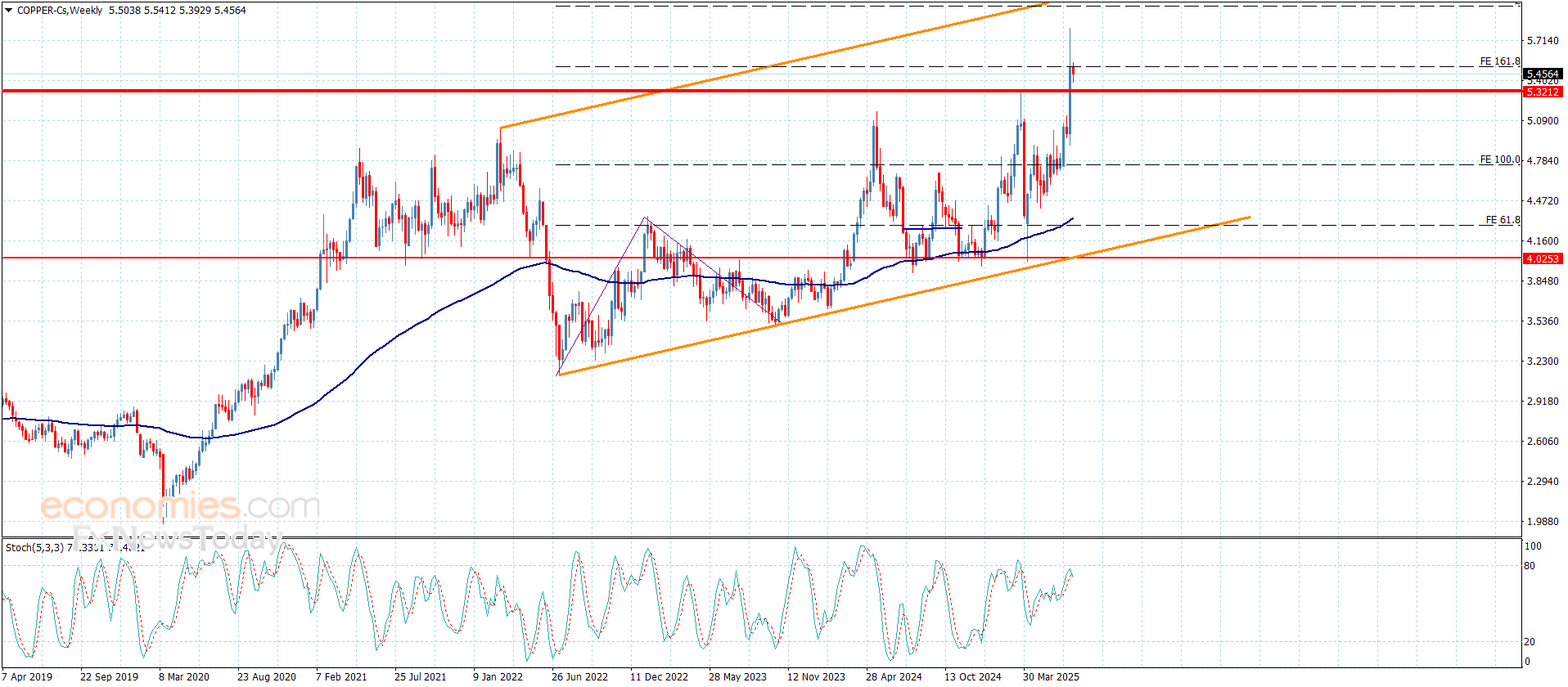
Copper price lost the positive momentum yesterday by stochastic stability below 80 level, which forces it to provide weak sideways trading by its fluctuation near $5.5000 level, without recording any new positive target.
Note that the price activated the attempts of gathering the gains by the continuation of facing negative pressures, which forces it to press on the support near $5.3200, and breaking it will force the price to decline towards $5.1500 and $4.9800, while renewing the bullish attempts requires forming a strong bullish rally, to settle above $5.600.
The expected trading range for today is between $5.1500 and $5.600
Trend forecast: Bearish
July 16, 2025 – Written by David Woodsmith
STORY LINK Pound to Euro Forecast: Towards 1.1365 “Over Coming Quarters”
British Pound Sterling rallies have continued to attract selling interest with the Pound to Euro exchange rate (GBP/EUR) sliding to fresh 3-month lows at 1.1500.
ING commented; “Our forecast preference had been for EUR/GBP to grind towards 0.88 over the coming quarters. (1.1365 for GBP/EUR)
It added; “That could come a lot sooner if the labour market weakens.”
Scotiabank commented; “The outlook for relative central bank policy is weighing on the pound as market participants consider dovish comments from BoE Gov. Bailey, with a specific focus on the labor market and the potential response to a greater than expected deterioration.”
It also noted an underlying market shift; “The options market reveals a continued erosion in sentiment as markets price greater premiums for protection against GBP weakness.”
In contrast, there was another positive German data release which helped support the Euro.
The Pound has been boosted by high yields, but if investors suddenly attempt to rush for the exit, the Pound could be subjected to significant selling.
As far as data is concerned, the British Retail Consortium (BRC) reported that like-for-like retail sales increased 2.7% in the year to June from 0.6% previously and above consensus forecasts of 1.2%.
BRC chief executive Helen Dickinson commented; “Retail sales heated up in June, with both food and non-food performing well.”
ING notes that there are significant underlying concerns surrounding the UK fiscal outlook, but the bank considers that monetary policy has been the key driver for recent losses.
The bank added; “the two-year EUR:GBP swap differential has narrowed back into 157bp as investors question whether the Bank of England will have to ease policy faster than once per quarter.”
In this context, the UK economic data will have an important impact over the next few days.
Inflation data will be released on Wednesday with consensus forecasts for the headline and core inflation rates to remain at 3.4% and 3.5% respectively.
On Thursday, the latest labour-market data is due. The number of people on payrolls will be a key area with markets also monitoring wages data.

Markets expect a slowdown in annual earnings growth to 5.0% from 5.3%.
The reaction to data will be driven to a significant extent by comments from Bank of England Governor Bailey later Tuesday at his Mansion House speech.
Bailey suggested over the weekend that there could be scope for a faster rate of interest rate cuts if there is evidence of notable labour-market deterioration.
If Bailey repeat these comments, there will potentially be a bigger reaction to weak labour-market data.
According to ING; “Should the May payroll release of -109k stay unrevised and should there be further payroll declines in June, UK rates and sterling could see another leg lower.”
The German ZEW economic sentiment index strengthened to 52.7 for July from 47.5 previously and above consensus forecasts of 50.8 and the strongest reading since February 2022.
There was also a stronger-than-expected improvement in the current conditions index to the highest level since June 2023. The data boost will provide net Euro support.
On Tuesday, the French government will announce measures to cut the 2026 budget deficit to 4.6% from 5.4%.
Danske Bank commented; “This is government’s current target, but the budget for 2026 is likely to slip. This could lead to another vote-of-confidence of the French government.”
A no-confidence vote would hamper the Euro.
International Money Transfer? Ask our resident FX expert a money transfer question or try John’s new, free, no-obligation personal service! ,where he helps every step of the way,
ensuring you get the best exchange rates on your currency requirements.
TAGS: Pound Euro Forecasts
Copper price lost the positive momentum yesterday by stochastic stability below 80 level, which forces it to provide weak sideways trading by its fluctuation near $5.5000 level, without recording any new positive target.
Note that the price activated the attempts of gathering the gains by the continuation of facing negative pressures, which forces it to press on the support near $5.3200, and breaking it will force the price to decline towards $5.1500 and $4.9800, while renewing the bullish attempts requires forming a strong bullish rally, to settle above $5.600.
The expected trading range for today is between $5.1500 and $5.600
Trend forecast: Bearish
Following a short-lasting recovery attempt in the early European session on Wednesday, GBP/USD struggles to hold its ground and trades below 1.3400. The near-term technical picture highlights oversold conditions for the pair.
The table below shows the percentage change of British Pound (GBP) against listed major currencies this week. British Pound was the weakest against the US Dollar.
| USD | EUR | GBP | JPY | CAD | AUD | NZD | CHF | |
|---|---|---|---|---|---|---|---|---|
| USD | 0.41% | 0.76% | 1.07% | 0.16% | 0.68% | 1.01% | 0.47% | |
| EUR | -0.41% | 0.32% | 0.66% | -0.26% | 0.25% | 0.59% | 0.05% | |
| GBP | -0.76% | -0.32% | 0.24% | -0.59% | -0.07% | 0.26% | -0.13% | |
| JPY | -1.07% | -0.66% | -0.24% | -0.77% | -0.38% | 0.01% | -0.52% | |
| CAD | -0.16% | 0.26% | 0.59% | 0.77% | 0.51% | 0.86% | 0.32% | |
| AUD | -0.68% | -0.25% | 0.07% | 0.38% | -0.51% | 0.31% | -0.20% | |
| NZD | -1.01% | -0.59% | -0.26% | -0.01% | -0.86% | -0.31% | -0.53% | |
| CHF | -0.47% | -0.05% | 0.13% | 0.52% | -0.32% | 0.20% | 0.53% |
The heat map shows percentage changes of major currencies against each other. The base currency is picked from the left column, while the quote currency is picked from the top row. For example, if you pick the British Pound from the left column and move along the horizontal line to the US Dollar, the percentage change displayed in the box will represent GBP (base)/USD (quote).
The data published by the UK’s Office for National Statistics (ONS) showed earlier in the day that the annual inflation in the UK, as measured by the change in the Consumer Price Index (CPI), climbed to 3.6% in June from 3.4% in May. This reading came in above the market expectation of 3.4%. In the same period, the core CPI, which excludes volatile food and energy prices, rose 3.7%, compared to the 3.5% increase recorded previously. With the immediate reaction, GBP/USD edged higher but failed to gather momentum.
The risk-averse market environment and the broad-based US Dollar (USD) strength following the June inflation readings from the US make it difficult for GBP/USD to attract buyers on Wednesday.
After the Bureau of Labor Statistics reported on Tuesday that the Consumer Price Index (CPI) rose by 2.7% on a yearly basis in June, up from 2.4% in May, the probability of the Federal Reserve (Fed) lowering the policy rate by 25 basis points in September declined toward 50% from nearly 70% in the previous week, as per CME FedWatch Tool.
In the second half of the day, June Producer Price Index and Industrial Production data will be featured in the US economic calendar. Additionally, several Fed policymakers will be delivering speeches. Meanwhile, US stock index futures trade marginally lower on the day after losing about 0.5% earlier in the European session. In case Wall Street’s main indexes gain traction after the opening bell and reflect an improving risk mood, the USD could lose its strength and allow GBP/USD to limit its losses.
The Relative Strength Index (RSI) indicator on the 4-hour chart stays below 30, pointing to oversold conditions for the pair.
In case the pair rises above 1.3400 (Fibonacci 61.8% retracement of the latest uptrend) and stabilizes there, the technical correction could extend toward 1.3440 (20-period Simple Moving Average) and 1.3470 (Fibonacci 50% retracement).
If 1.3400 is confirmed as resistance, investors could ignore oversold conditions in the near term. In this scenario, 1.3300 (Fibonacci 78.6% retracement) and 1.3270 (100-day Simple Moving Average) could be seen as next support levels.
The Pound Sterling (GBP) is the oldest currency in the world (886 AD) and the official currency of the United Kingdom. It is the fourth most traded unit for foreign exchange (FX) in the world, accounting for 12% of all transactions, averaging $630 billion a day, according to 2022 data.
Its key trading pairs are GBP/USD, also known as ‘Cable’, which accounts for 11% of FX, GBP/JPY, or the ‘Dragon’ as it is known by traders (3%), and EUR/GBP (2%). The Pound Sterling is issued by the Bank of England (BoE).
The single most important factor influencing the value of the Pound Sterling is monetary policy decided by the Bank of England. The BoE bases its decisions on whether it has achieved its primary goal of “price stability” – a steady inflation rate of around 2%. Its primary tool for achieving this is the adjustment of interest rates.
When inflation is too high, the BoE will try to rein it in by raising interest rates, making it more expensive for people and businesses to access credit. This is generally positive for GBP, as higher interest rates make the UK a more attractive place for global investors to park their money.
When inflation falls too low it is a sign economic growth is slowing. In this scenario, the BoE will consider lowering interest rates to cheapen credit so businesses will borrow more to invest in growth-generating projects.
Data releases gauge the health of the economy and can impact the value of the Pound Sterling. Indicators such as GDP, Manufacturing and Services PMIs, and employment can all influence the direction of the GBP.
A strong economy is good for Sterling. Not only does it attract more foreign investment but it may encourage the BoE to put up interest rates, which will directly strengthen GBP. Otherwise, if economic data is weak, the Pound Sterling is likely to fall.
Another significant data release for the Pound Sterling is the Trade Balance. This indicator measures the difference between what a country earns from its exports and what it spends on imports over a given period.
If a country produces highly sought-after exports, its currency will benefit purely from the extra demand created from foreign buyers seeking to purchase these goods. Therefore, a positive net Trade Balance strengthens a currency and vice versa for a negative balance.
Gold price is replicating the tepid recovery moves seen in the first half of Tuesday’s trading as buyers try their luck the third time early Wednesday, heading into the US Producer Price Index (PPI) inflation test.
Despite the latest uptick, Gold price appears to lack bullish conviction as the US Dollar (USD) remains in an upside consolidative mode against its major currency rivals, having risen for the seventh consecutive day on Tuesday.
The USD resumed its uptrend, capitalizing on the rally in the 10-year benchmark US Treasury bond yields after the US Consumer Price Index (CPI) accelerated in June, moving away from the Federal Reserve’s (Fed) 2% inflation target.
The June CPI increased 0.3% on the month, driving the 12-month inflation rate to 2.7%, in line with expectations. The core figures also rose 0.2% over the month and 2.9% annually, but undermined estimates.
The uptick in US inflation bolstered bets for an extended pause by the Fed for a longer period than initially expected, with the odds of a September Fed rate cut falling to about 52% from nearly 60% pre-data release, per the CME Group’s FedWatch Tool.
Hawkish Fed expectations combined with US President Donald Trump’s announcement of a trade deal with Indonesia helped the USD keep the upper hand, fuelling a fresh decline in the non-interest-bearing Gold price.
The US yields and the USD also tracked the advance in the Japanese government bond yields and the USD/JPY pair as the Asian nation’s bond market and the local currency suffered extensively on heightening fiscal and political concerns.
Citing a story from Asahi newspaper, Reuters reported that “Japan’s ruling coalition will likely lose its majority in the upper house election on July 20, heightening the risk of political instability at a time the country struggles to strike a trade deal with the US.”
However, America’s artificial intelligence (AI) pioneer’s, Nvidia, headlines-driven tech rally curbed the USD uptrend, offering some support to the bright metal.
In Wednesday’s trading so far, uncertainty over Trump’s trade policy and Jerome Powell’s tenure as a Fed Chairman act as headwind to the Greenback, allowing Gold price to come up for some air.
Looking ahead, it remains to be seen if Gold price can sustain the bounce as traders refrain from creating fresh positions ahead of the US PPI data.
If the June US PPI comes in hotter than the expected 2.5% print over the year, while the monthly PPI also above 0.2% forecast, a fresh leg higher in the USD cannot be ruled out at the expense of Gold price.
Meanwhile, developments on the trade front will continue to play a pivotal role in driving risk sentiment, especially after Trump announced late Tuesday that he will send letters notifying smaller countries of their US tariff rates, per Reuters.
As observed on the daily chart, Gold price is stuck between two key barriers, with the 21-day Simple Moving Average (SMA) support-turned-resistance at $3,335 checking the upside.
On the other hand, the 50-day SMA at $3,323 cushions the downside.
The 14-day Relative Strength Index (RSI) is sitting just above the midline, currently near 50.50, suggesting that buyers could retain control.
Acceptance above the 21-day SMA is critical to sustaining the renewed upside, above which the 23.6% Fibonacci Retracement (Fibo) level of the April record rally at $3377 will be put to the test once again.
Further north, the $3,400 round level will challenge bearish commitments.
In contrast, rejection at the 21-day SMA could attack the 50-day SMA support.
Sellers must find a strong foothold below the 50-day SMA on daily closing basis.
The next healthy support levels are located at the 38.2% Fibo level of the same rally at $3,297 and the July low of $3,283.
Gold has played a key role in human’s history as it has been widely used as a store of value and medium of exchange. Currently, apart from its shine and usage for jewelry, the precious metal is widely seen as a safe-haven asset, meaning that it is considered a good investment during turbulent times. Gold is also widely seen as a hedge against inflation and against depreciating currencies as it doesn’t rely on any specific issuer or government.
Central banks are the biggest Gold holders. In their aim to support their currencies in turbulent times, central banks tend to diversify their reserves and buy Gold to improve the perceived strength of the economy and the currency. High Gold reserves can be a source of trust for a country’s solvency. Central banks added 1,136 tonnes of Gold worth around $70 billion to their reserves in 2022, according to data from the World Gold Council. This is the highest yearly purchase since records began. Central banks from emerging economies such as China, India and Turkey are quickly increasing their Gold reserves.
Gold has an inverse correlation with the US Dollar and US Treasuries, which are both major reserve and safe-haven assets. When the Dollar depreciates, Gold tends to rise, enabling investors and central banks to diversify their assets in turbulent times. Gold is also inversely correlated with risk assets. A rally in the stock market tends to weaken Gold price, while sell-offs in riskier markets tend to favor the precious metal.
The price can move due to a wide range of factors. Geopolitical instability or fears of a deep recession can quickly make Gold price escalate due to its safe-haven status. As a yield-less asset, Gold tends to rise with lower interest rates, while higher cost of money usually weighs down on the yellow metal. Still, most moves depend on how the US Dollar (USD) behaves as the asset is priced in dollars (XAU/USD). A strong Dollar tends to keep the price of Gold controlled, whereas a weaker Dollar is likely to push Gold prices up.
The USD/JPY forecast indicates a decline in Fed rate cut expectations, which has dashed hopes of a narrowing rate gap between the US and Japan. As a result, US Treasury yields soared while the yen collapsed to fresh lows. At the same time, market participants are worried about a likely 25% tariff on Japanese exports to the US.
–Are you interested in learning more about Forex robots? Check our detailed guide-
Initially, market participants were optimistic about the yen. The Fed and the Bank of Japan were following different monetary paths that would lead to a smaller gap in rates between Japan and the US. The Fed was looking to lower borrowing costs while the BoJ was hiking.
However, all this paused when Trump started his aggressive tariffs campaign. The BoJ paused to assess the impact on Japan’s economy. Meanwhile, the Fed delayed cuts due to concerns about a potential spike in inflation.
Data on Tuesday confirmed some of the Fed’s fears about tariffs boosting inflation. The annual headline CPI accelerated from 2.4% to 2.7%. At the same time, the monthly figure jumped from 0.1% to 0.3%. The data led to a decline in Fed rate cut expectations.
At the same time, Trump has threatened to impose a 25% tariff on Japan. Such a move would pause the BoJ’s rate hike campaign.
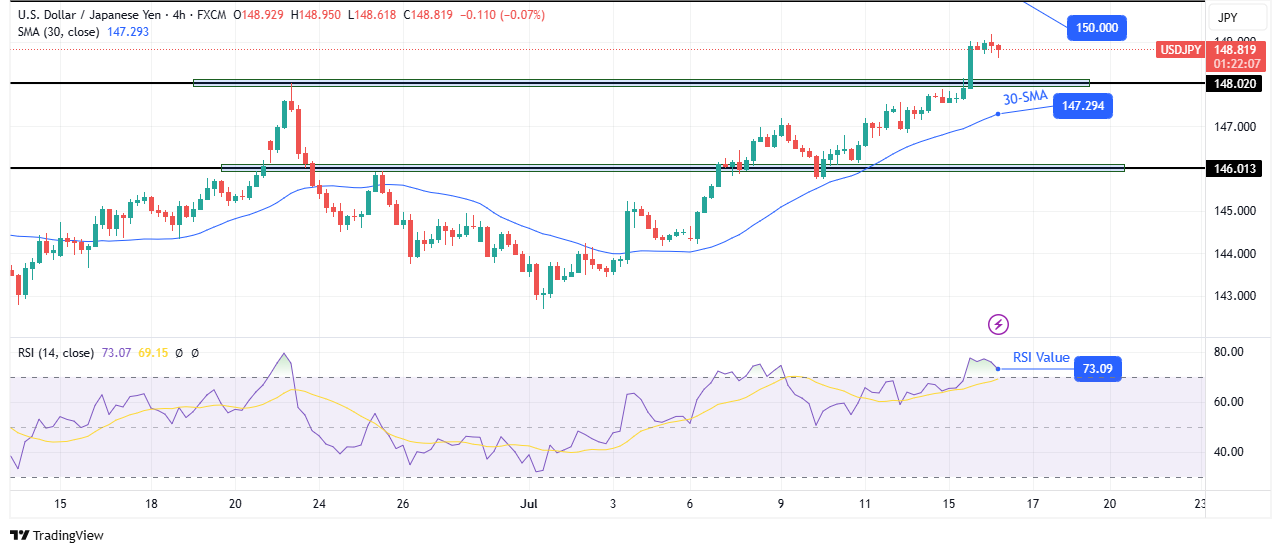
On the technical side, the USD/JPY price has reached a new high above the key 148.02 resistance level. This has solidified the bullish bias. The price now trades well above the 30-SMA, showing bulls have a strong lead. At the same time, the RSI trades in the overbought region, indicating solid momentum.
–Are you interested in learning more about XRP price prediction? Check our detailed guide-
The price has maintained a bullish trend since it broke above the 30-SMA. It has made a series of higher highs and lows, respecting the SMA as support. Given the strong bullish bias, the uptrend is likely to continue. However, after making a solid swing, bulls might need to pause before reaching new highs.
Therefore, the price might pull back to retest the 148.02 level as support. If it holds firm, the next target will be at the 150.00 key psychological level.
Looking to trade forex now? Invest at eToro!
68% of retail investor accounts lose money when trading CFDs with this provider. You should consider whether you can afford to take the high risk of losing your money.
Natural gas completed a 78.6% Fibonacci retracement last week, which was followed by a bullish reversal and rise into today’s high. Last week’s low at $3.15 certainly could be the end of the bearish correction. Although a lower trend support line was broken briefly, the line was quickly recovered and demand improved. Nonetheless, natural gas remains vulnerable to downward pressure until it sustained an advance above $3.57. That is the most recent lower swing high on the daily time frame, and a rise above will trigger a reversal of the very short-term downtrend structure beginning from the June 27 lower swing high at $3.75.
The bulls have the weekly pattern on their side as a one-week bullish reversal triggered yesterday. But it was not confirmed by a daily close above last week’s high of $3.47. However, that looks likely to happen today, and it will provide another piece of evidence supportive of an eventual continuation to the upside. A potentially solid resistance zone from $3.53 to $3.54 was approached today. It includes an AVWAP level from the April swing low and two moving averages, the 20-Day MA and 50-Day MA. They have converged to identify the same price level at $3.54.
The behavior of natural gas around this potentially significant resistance zone should provide clues about supply and demand. For example, a daily close above the 20-Day MA shows buyers retaining control. That would increase the chance for a sustainable breakout above $3.57. A daily close above that level will then put the $3.75 lower swing high at risk of being busted, which would trigger a new bullish reversal. Either way, weakness will be watched by traders for a potential upside continuation.
For a look at all of today’s economic events, check out our economic calendar.

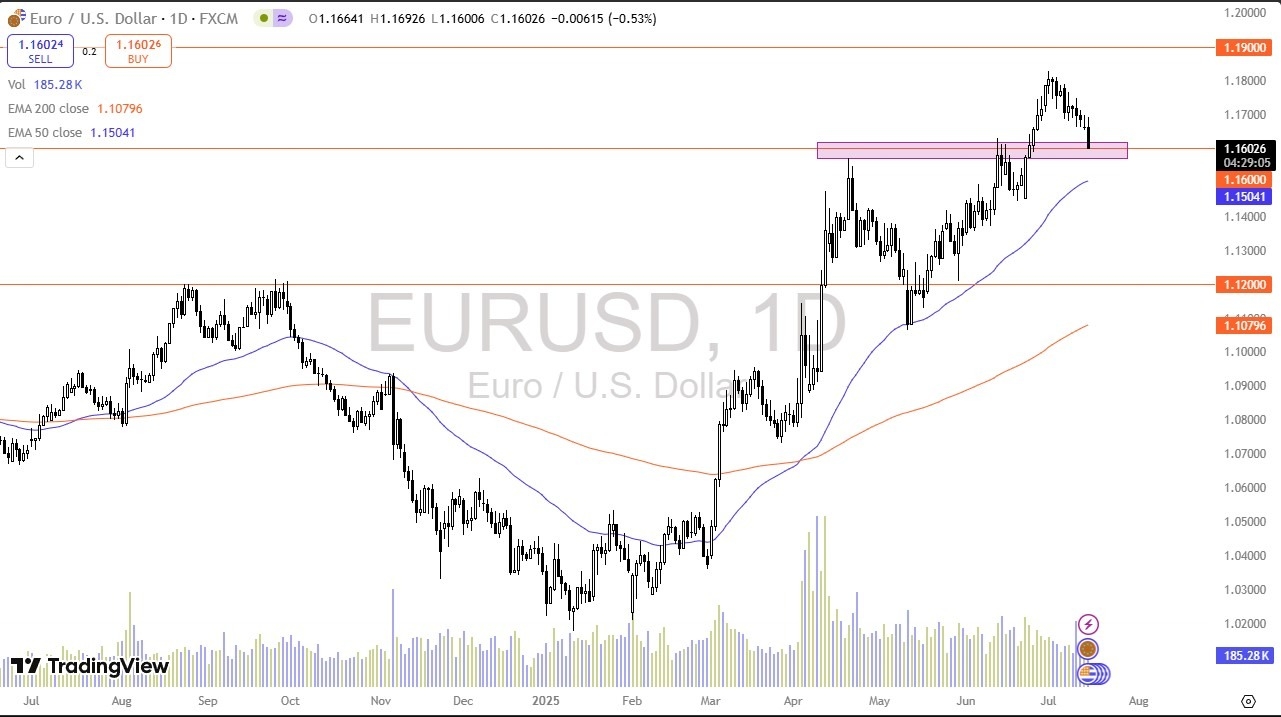
Despite the fact that I think the US dollar is oversold, especially considering that the Federal Reserve is likely to cut rates in the short term, the reality is that the trend is still to sell the US dollar. That has not changed during the trading session on Tuesday, despite the fact that the Euro has plunged toward a crucial support level.
That support level, the 1.16 level, has a certain amount of market memory priced into it due to the fact that it was previous resistance, so I do think this is an area that could cause a bit of a bounce. Even if we were to fall from here, the 1.15 level is even more important, as it is a large, round, psychologically significant figure, but also features the 50 Day EMA, which of course a lot of people will be watching for potential dynamic support.
If we were to turn around and bounce from the 1.16 level, which is where we are as I write this, we could make a bit of a move toward the 1.17 level, possibly even the 1.18 level. However, I think it’s going to take a lot for the euro to continue higher without some type of conflicting information. The euro has been overdone for a while, so I think you’ve got a situation where this might just be the excuse that the market needed to sell and start taking some of the gains that they have enjoyed over the last couple of months.
Ready to trade our EUR/USD analysis and predictions? Here are the best European brokers to choose from.
Christopher Lewis has been trading Forex and has over 20 years experience in financial markets. Chris has been a regular contributor to Daily Forex since the early days of the site. He writes about Forex for several online publications, including FX Empire, Investing.com, and his own site, aptly named The Trader Guy. Chris favours technical analysis methods to identify his trades and likes to trade equity indices and commodities as well as Forex. He favours a longer-term trading style, and his trades often last for days or weeks.
July 15, 2025 – Written by Ben Hughes
STORY LINK Pound to Dollar Rate Today: GBP/USD Sub 1.34 After Mixed US Inflation
Looking ahead, the focus for the Pound US Dollar exchange rate (GBP/USD) now turns to the release of the UK’s own CPI figures on Wednesday.
Economists predict inflation will have held at 3.4% last month. While this remains above the BoE’s target range, unless the figures deviate significantly from forecasts, their impact on the GBP/USD may be limited amid the BoE’s focus on the UK jobs market.
On the US side, the producer price figures for June could offer support to the US Dollar if they show rising input costs, which typically feed through to consumer prices in the months ahead.
DAILY RECAP:
The Pound‑to‑Dollar (GBP/USD) pair remained largely unchanged on Tuesday, hovering just below Monday’s three‑week low.
At the time of writing, it was trading near $1.3438. Almost unchanged from the start of Tuesday’s session.
The US Dollar (USD) showed limited movement on Tuesday as traders absorbed the latest US consumer price index report from the US Bureau of Labor Statistics.
US headline inflation rose from 2.4% to 2.7% in June, matching expectations and marking the highest reading since February.
In contrast, core inflation came in at 2.9%, slightly below consensus forecasts that it would reach 3%,
The slightly weaker-than-expected core inflation figures applied some pressure to the US dollar, as they are likely to be welcomed by the more dovish members of the Federal Reserve, and cement bets for a September interest rate cut.
Despite this, the USD selling pressure remained very modest in scope, with the unpredictability surrounding US President Donald Trump’s tariff policy continuing to cloud the US inflation outlook.
The Pound (GBP) remained mostly range‑bound on Tuesday as investors took a cautious stance ahead of key UK economic releases later in the week.
Attention has now shifted to Thursday’s UK jobs report, following recent commentary from Bank of England (BoE) Governor Andrew Bailey, who warned persistent labour-market weakness could warrant faster rate cuts.
Moreover, uncertainty surrounding UK fiscal policy, including speculation over autumn tax changes following the government’s reversal of welfare reforms, continues to weigh on Pound sentiment.
International Money Transfer? Ask our resident FX expert a money transfer question or try John’s new, free, no-obligation personal service! ,where he helps every step of the way,
ensuring you get the best exchange rates on your currency requirements.
TAGS: Pound Dollar Forecasts
Gold (XAU/USD) correction has been limited at $3,340, and the precious metal is retracing previous losses on Tuesday, approaching three-week highs at $3,380 as US Treasury yields and the US Dollar pull back from recent highs ahead of the US CPI release.
The US Dollar Index, which measures the value of the USD against six major currencies, is trading 0.15% lower on the day after a three-day rally. Investors are bracing for a significant increase in inflation amid pressure from US President Trump to cut interest rates, which might increase if the upside risks for inflation forecasted by the bank do not materialise.
The XAU/USD technical picture is cloudy, as the pair has been experiencing choppy and sideways trading for the last few months. Price action is currently hovering in the middle of the range, and technical indicators on the daily chart are indicating a lack of a clear trend.
The 4-hour chart shows a moderate positive stance, with the RSI steady above the 50 level and downside attempts finding buyers so far. Bulls are focusing on the July 14 high, at $3,375, which is closing the path towards the June 18 and 23 highs, at the $3,400 area, and the June 16 peak, at $3,450.
On the downside, a retreat below the July 14 low at $3,340 might find support at the July 10 low at $3,3120 and the July 9 low, at $3,285, ahead of the May 28 and June 30 lows, at $3,245.
Gold has played a key role in human’s history as it has been widely used as a store of value and medium of exchange. Currently, apart from its shine and usage for jewelry, the precious metal is widely seen as a safe-haven asset, meaning that it is considered a good investment during turbulent times. Gold is also widely seen as a hedge against inflation and against depreciating currencies as it doesn’t rely on any specific issuer or government.
Central banks are the biggest Gold holders. In their aim to support their currencies in turbulent times, central banks tend to diversify their reserves and buy Gold to improve the perceived strength of the economy and the currency. High Gold reserves can be a source of trust for a country’s solvency. Central banks added 1,136 tonnes of Gold worth around $70 billion to their reserves in 2022, according to data from the World Gold Council. This is the highest yearly purchase since records began. Central banks from emerging economies such as China, India and Turkey are quickly increasing their Gold reserves.
Gold has an inverse correlation with the US Dollar and US Treasuries, which are both major reserve and safe-haven assets. When the Dollar depreciates, Gold tends to rise, enabling investors and central banks to diversify their assets in turbulent times. Gold is also inversely correlated with risk assets. A rally in the stock market tends to weaken Gold price, while sell-offs in riskier markets tend to favor the precious metal.
The price can move due to a wide range of factors. Geopolitical instability or fears of a deep recession can quickly make Gold price escalate due to its safe-haven status. As a yield-less asset, Gold tends to rise with lower interest rates, while higher cost of money usually weighs down on the yellow metal. Still, most moves depend on how the US Dollar (USD) behaves as the asset is priced in dollars (XAU/USD). A strong Dollar tends to keep the price of Gold controlled, whereas a weaker Dollar is likely to push Gold prices up.