The main category of Forex News.
You can use the search box below to find what you need.
[wd_asp id=1]
The main category of Forex News.
You can use the search box below to find what you need.
[wd_asp id=1]
The EURJPY pair formed a new bullish attack, taking advantage of the repeated positive pressure, to attack the resistance of the bullish channel’s resistance at 170.60, achieving the suggested target in the previous report.
The price might be forced to provide mixed trading due to the strength of the current resistance besides stochastic attempt to exit the overbought level, to increase the chances of activating the attempts of gathering the gains by targeting 169.20 and 168.60 level, while breaching the resistance and holding above it will open the way for recording new gains that might extend to 171.10 and 171.60.
The expected trading range for today is between 169.20 and 170.60
Trend forecast: Fluctuated within the bullish track
Silver price traded sideways on Friday, remaining virtually unchanged at $36.84, due to thin trading volumes as US markets were closed for a holiday. The market mood turned slightly sour as headlines surrounding the US trade war, with its trading patterns taking center stage, following the approval of the One Big Beautiful Bill.
From a technical standpoint, the grey metal is pausing its advance, although it remains upwardly biased as it has formed a double-bottom chart pattern. Nevertheless, the formation of a doji suggests that a pause is underway, as traders eye key resistance levels, such as the year-to-date (YTD) high of $37.31.
Momentum is bullish as depicted by the Relative Strength Index (RSI). That said, the path of least resistance is upwards.
Silver key resistance level to watch would be $37.00, the YTD high, and the February 29, 2012, at $37.49. Once cleared, the next stop is $38.00. On the other hand, if XAG/USD falls below $36.00, it clears the path for testing $35.82. Once hurdled, the next stop would be $35.00, before challenging the 50-day Simple Moving Average (SMA) at $34.39.
Silver is a precious metal highly traded among investors. It has been historically used as a store of value and a medium of exchange. Although less popular than Gold, traders may turn to Silver to diversify their investment portfolio, for its intrinsic value or as a potential hedge during high-inflation periods. Investors can buy physical Silver, in coins or in bars, or trade it through vehicles such as Exchange Traded Funds, which track its price on international markets.
Silver prices can move due to a wide range of factors. Geopolitical instability or fears of a deep recession can make Silver price escalate due to its safe-haven status, although to a lesser extent than Gold’s. As a yieldless asset, Silver tends to rise with lower interest rates. Its moves also depend on how the US Dollar (USD) behaves as the asset is priced in dollars (XAG/USD). A strong Dollar tends to keep the price of Silver at bay, whereas a weaker Dollar is likely to propel prices up. Other factors such as investment demand, mining supply – Silver is much more abundant than Gold – and recycling rates can also affect prices.
Silver is widely used in industry, particularly in sectors such as electronics or solar energy, as it has one of the highest electric conductivity of all metals – more than Copper and Gold. A surge in demand can increase prices, while a decline tends to lower them. Dynamics in the US, Chinese and Indian economies can also contribute to price swings: for the US and particularly China, their big industrial sectors use Silver in various processes; in India, consumers’ demand for the precious metal for jewellery also plays a key role in setting prices.
Silver prices tend to follow Gold’s moves. When Gold prices rise, Silver typically follows suit, as their status as safe-haven assets is similar. The Gold/Silver ratio, which shows the number of ounces of Silver needed to equal the value of one ounce of Gold, may help to determine the relative valuation between both metals. Some investors may consider a high ratio as an indicator that Silver is undervalued, or Gold is overvalued. On the contrary, a low ratio might suggest that Gold is undervalued relative to Silver.
Analysts remained divided in 2025 on the near-term EUR forecast, with monetary policy divergence and growth differentials driving sentiment.
Wells Fargo expected the Fed to begin easing in September with 75 bps of total cuts by year-end, citing a likely slowdown in growth and labour market cooling. By contrast, the ECB has already cut 200 bps since late 2024 and may be nearing the end of its cycle. ‘We see just one final 25 bps ECB rate cut, to 1.75%, in September,’ the bank noted.
Trading Economics saw signs of stabilisation in the eurozone, with inflation expectations falling and 2025 GDP forecast at 0.9%. The June PMI rose to 40.5 – the slowest decline in nearly three years – and business confidence hit a three-year high.
In the US, the Fed held rates steady at 4.25%-4.50% for a fourth meeting in June. Growth is now seen at 1.4% for 2025, with PCE inflation forecast at 3.0%. Trading Economics noted a cautious stance as policymakers assess the economic impact of President Trump’s policies on tariffs, immigration, and taxation.
Meanwhile, S&P Global’s US Manufacturing PMI held at 52 in June, signalling modest growth, though some analysts warned the recent strength may be short-lived. “Such a boost is likely to unwind in the coming months,” said S&P Global’s Chris Williamson.
On 1 July, Capital.com analyst Daniela Hathorn said the euro is expected to stay ‘moderately bullish’ in the second half of 2025, supported by signs of eurozone resilience. With ECB rates at 2% as of June, she noted that the bank can now take ‘a more conservative approach going forward’. This front-loaded stance, she said, had been ‘widely celebrated by euro traders’, giving the currency an extra boost.
At the same time, she highlighted that the US dollar had come under ‘significant downside pressure’ due to President Trump’s trade policies, helping lift EUR/USD above 1.17 – its highest level since September 2021.
‘A recovery in European industrial output or improved risk sentiment from continued easing geopolitical tensions could bolster the pair above the 1.18 level,’ Hathorn added. But she warned of lingering risks tied to US trade talks and ‘fragile peace dynamics in the Middle East and Eastern Europe’.
Forecasts remain subject to change and should not be used as a substitute for your own market research. Always consider your risk tolerance and trading strategy before trading or investing.
The bull trend pattern got a lift on Tuesday as an uptrend line, a downtrend line, and the 50-Day MA were all broken through. Confirmation came with a daily close above all three lines. Resistance was seen around the 20-Day MA, which has continued since then along with a slightly higher price of $3,366.
Given this week’s bullish price action the expectation is for gold to continue to advance higher, but it first needs a signal. A decisive rally above this week’s high of $3,366 indicates a continuation of the near-term bull trend. That will also trigger a weekly upside breakout and surpass the 20-Day MA, which currently shows dynamic resistance.
On the weekly timeframe, gold ended the week showing gains and in a relatively bullish position, in the top third of the week’s trading range. Furthermore, this follows a short-lived decline below last week’s low of $3,256 before a lower weekly low of $3,247 was reached. In other words, an undercut and run bullish reversal triggered. Last week’s lows broke, leading to stops being triggered and weak holders getting flushed out.
Subsequently, buyers quickly took back control following a short time below last week’s low. And the switch to bullish sentiment was indicated by a daily close above last week’s high on the breakdown day of June 30. That showed a failed breakdown. Once a breakout fails in one direction, there is potential for a clear move in the opposite direction. For gold that would point to higher prices.
For a look at all of today’s economic events, check out our economic calendar.

The Japan Coffee Bean Market is poised for robust growth, projected to surge to US$ 2.51 billion by 2033 from US$ 1.60 billion in 2024, with a compound annual growth rate (CAGR) of 5.11% from 2025 to 2033. Driven primarily by advancements in coffee cultivation and eco-friendly processing methods, Japan’s industry is thriving on the back of rising specialty coffee culture, urbanization, and increasing disposable incomes. Key products include Arabica and Robusta beans, distributed online and offline, catering to diverse end users such as personal care, food, and pharmaceuticals. Major players like Starbucks and Nescafe are innovating to meet evolving consumer demands for quality and sustainability in coffee.
Japanese Coffee Bean Market

Dublin, July 04, 2025 (GLOBE NEWSWIRE) — The “Japan Coffee Bean Market – Consumption Trends & Forecast 2025-2033” report has been added to ResearchAndMarkets.com’s offering.
Japan Coffee Bean Market is expected to reach US$ 2.51 billion by 2033 from US$ 1.60 billion in 2024, with a CAGR of 5.11% from 2025 to 2033. The industry is mostly being driven by growing developments in coffee cultivation and processing methods that can boost productivity, enhance quality, and affect bean supply.
The seeds of the Coffea plant, known as coffee beans, are gathered and processed to make the popular beverage. Usually found inside the coffee plant’s fruit, also known as coffee cherries, are these beans. Freshly picked green beans go through a number of processes to become the fragrant brown beans used in brewing. The cherries are first dried, and then their outer coats are removed by hulling, exposing the green coffee beans.
The next important process that gives coffee its distinct flavor, fragrance, and color is roasting these green beans. High temperatures are applied to the beans during roasting, which results in chemical changes that give coffee its distinctive flavor and aroma. The ultimate flavor profile, which ranges from light to dark roasts, depends on the roast’s duration and temperature. After roasting, the beans can be ground and brewed to make drip coffee or espresso, among other varieties.
The Japanese market for coffee beans is significantly impacted by a number of important factors, each of which is essential in determining the market’s future course. First off, there is no denying that the increase in coffee consumption, particularly among millennials, has spurred industry expansion. Furthermore, this need has been further increased by the rise of specialty coffees and the growing influence of cafe culture in Japan. Furthermore, improvements in coffee brewing equipment and techniques have increased the ways that customers may enjoy their drinks, increasing market potential.
The EURJPY pair formed a new bullish attack, taking advantage of the repeated positive pressure, to attack the resistance of the bullish channel’s resistance at 170.60, achieving the suggested target in the previous report.
The price might be forced to provide mixed trading due to the strength of the current resistance besides stochastic attempt to exit the overbought level, to increase the chances of activating the attempts of gathering the gains by targeting 169.20 and 168.60 level, while breaching the resistance and holding above it will open the way for recording new gains that might extend to 171.10 and 171.60.
The expected trading range for today is between 169.20 and 170.60
Trend forecast: Fluctuated within the bullish track
You’ll also notice that over the last couple of months, we’ve gradually seen higher levels. So, it’ll be interesting to see if we can build up enough pressure to finally break out as the interest rate differential continues to favor the United States.
The Australian dollar has dropped a bit as we continue to sit just above that crucial 0.6550 level, which is an area that I’ve been talking about for what seems like a lifetime now. This is a market that just simply doesn’t have anywhere to be, but it is slowly grinding higher. And that’s probably what you need to pay the most attention to.
If we do break down below the 0.6550 level, then we could see this market drop down to the 50-day EMA. But really, I think at that point, you’d just be looking at a value play. We’ve been in this very tight channel that’s been ascending since the middle of April. At this point, there’s nothing on this chart that tells me things are changing.
For a look at all of today’s economic events, check out our economic calendar.
Silver (XAG/USD) holds steady below the $37.00 mark during the Asian session on Friday and remains within striking distance of over a two-week high touched the previous day. Meanwhile, the constructive technical setup suggests that the path of least resistance for the white metal remains to the upside.
The daily Relative Strength Index (RSI, 14) remains above 50 and validates the positive outlook for the XAG/USD. However, the Moving Average Convergence Divergence (MACD) histogram and the signal line on the daily chart are yet to confirm bullish bias, suggesting that any subsequent move up could stall near the $37.30-$37.35 region, or the highest level since February 2012 touched earlier this month. Some follow-through buying, however, would set the stage for an extension of a nearly three-month-old uptrend.
On the flip side, the $36.50-$36.45 area now seems to protect the immediate downside, below which the XAG/USD could slide to the $36.15-$36.10 region. A further decline below the $36.00 mark could extend towards the $35.50-$35.40 horizontal zone. The latter should act as a key pivotal point and a convincing break below would shift the near-term bias back in favor of bearish traders. The white metal might then accelerate the corrective fall towards the next relevant support near the $35.00 psychological mark.
Some follow-through selling below the latter should pave the way for deeper losses and drag the XAG/USD to an intermediate support near the $34.75 en route to the $34.45 region.
Silver is a precious metal highly traded among investors. It has been historically used as a store of value and a medium of exchange. Although less popular than Gold, traders may turn to Silver to diversify their investment portfolio, for its intrinsic value or as a potential hedge during high-inflation periods. Investors can buy physical Silver, in coins or in bars, or trade it through vehicles such as Exchange Traded Funds, which track its price on international markets.
Silver prices can move due to a wide range of factors. Geopolitical instability or fears of a deep recession can make Silver price escalate due to its safe-haven status, although to a lesser extent than Gold’s. As a yieldless asset, Silver tends to rise with lower interest rates. Its moves also depend on how the US Dollar (USD) behaves as the asset is priced in dollars (XAG/USD). A strong Dollar tends to keep the price of Silver at bay, whereas a weaker Dollar is likely to propel prices up. Other factors such as investment demand, mining supply – Silver is much more abundant than Gold – and recycling rates can also affect prices.
Silver is widely used in industry, particularly in sectors such as electronics or solar energy, as it has one of the highest electric conductivity of all metals – more than Copper and Gold. A surge in demand can increase prices, while a decline tends to lower them. Dynamics in the US, Chinese and Indian economies can also contribute to price swings: for the US and particularly China, their big industrial sectors use Silver in various processes; in India, consumers’ demand for the precious metal for jewellery also plays a key role in setting prices.
Silver prices tend to follow Gold’s moves. When Gold prices rise, Silver typically follows suit, as their status as safe-haven assets is similar. The Gold/Silver ratio, which shows the number of ounces of Silver needed to equal the value of one ounce of Gold, may help to determine the relative valuation between both metals. Some investors may consider a high ratio as an indicator that Silver is undervalued, or Gold is overvalued. On the contrary, a low ratio might suggest that Gold is undervalued relative to Silver.
Following the sharp decline seen on Wednesday, GBP/USD found support on Thursday and closed the day marginally higher. The pair, however, struggles to extend its rebound and trades in a narrow band at around 1.3650 in the European session on Friday.
The table below shows the percentage change of British Pound (GBP) against listed major currencies this week. British Pound was the weakest against the Canadian Dollar.
| USD | EUR | GBP | JPY | CAD | AUD | NZD | CHF | |
|---|---|---|---|---|---|---|---|---|
| USD | -0.41% | 0.39% | -0.01% | -0.76% | -0.34% | -0.20% | -0.67% | |
| EUR | 0.41% | 0.77% | 0.43% | -0.36% | 0.05% | 0.22% | -0.26% | |
| GBP | -0.39% | -0.77% | -0.55% | -1.10% | -0.71% | -0.58% | -1.03% | |
| JPY | 0.01% | -0.43% | 0.55% | -0.75% | -0.27% | -0.15% | -0.61% | |
| CAD | 0.76% | 0.36% | 1.10% | 0.75% | 0.38% | 0.56% | 0.09% | |
| AUD | 0.34% | -0.05% | 0.71% | 0.27% | -0.38% | 0.15% | -0.32% | |
| NZD | 0.20% | -0.22% | 0.58% | 0.15% | -0.56% | -0.15% | -0.47% | |
| CHF | 0.67% | 0.26% | 1.03% | 0.61% | -0.09% | 0.32% | 0.47% |
The heat map shows percentage changes of major currencies against each other. The base currency is picked from the left column, while the quote currency is picked from the top row. For example, if you pick the British Pound from the left column and move along the horizontal line to the US Dollar, the percentage change displayed in the box will represent GBP (base)/USD (quote).
Easing geopolitical concerns in the UK helped Pound Sterling hold its ground early Thursday after British Prime Minister Keir Starmer reassured that finance minister Rachel Reeves will remain in her position.
Later in the day, the US Dollar (USD) gathered strength on upbeat macroeconomic data releases and capped GBP/USD’s upside. The US Bureau of Labor Statistics reported that Nonfarm Payrolls (NFP) rose by 147,000 in June. This reading came in better than the market expectation of 110,000. Furthermore, the Unemployment Rate edged lower to 4.1% from 4.2% in May. Finally, the Institute for Supply Management’s (ISM) Services Purchasing Managers’ Index (PMI) rose to 50.8 in June from 49.9, showing that the business activity in the service sector expanded following May’s contraction.
Early Friday, the UK’s FTSE 100 Index loses about 0.4% on the day, reflecting a cautious market mood. In a report published on Friday, S&P Global said that the UK’s inability to make modest cuts to welfare spending underscores the government’s very limited budgetary room for maneuver.
Financial markets in the US will remain closed in observance of the July 5 holiday on Friday. Hence, GBP/USD could continue to move sideways heading into the weekend.
GBP/USD remains below the 20-period and the 50-period Simple Moving Averages (SMA) on the 4-hour chart and the Relative Strength Index (RSI) indicator stays below 50, pointing to a lack of buyer interest.
On the downside, 1.3630 (static level) aligns as an intermediate support level before 1.3600 (100-period SMA) and 1.3555 (200-period SMA). Looking north, resistance levels could be seen at 1.3680 (20-period SMA, 50-period SMA, mid-point of the ascending channel),1.3710 (static level) and 1.3770 (static level).
The Pound Sterling (GBP) is the oldest currency in the world (886 AD) and the official currency of the United Kingdom. It is the fourth most traded unit for foreign exchange (FX) in the world, accounting for 12% of all transactions, averaging $630 billion a day, according to 2022 data.
Its key trading pairs are GBP/USD, also known as ‘Cable’, which accounts for 11% of FX, GBP/JPY, or the ‘Dragon’ as it is known by traders (3%), and EUR/GBP (2%). The Pound Sterling is issued by the Bank of England (BoE).
The single most important factor influencing the value of the Pound Sterling is monetary policy decided by the Bank of England. The BoE bases its decisions on whether it has achieved its primary goal of “price stability” – a steady inflation rate of around 2%. Its primary tool for achieving this is the adjustment of interest rates.
When inflation is too high, the BoE will try to rein it in by raising interest rates, making it more expensive for people and businesses to access credit. This is generally positive for GBP, as higher interest rates make the UK a more attractive place for global investors to park their money.
When inflation falls too low it is a sign economic growth is slowing. In this scenario, the BoE will consider lowering interest rates to cheapen credit so businesses will borrow more to invest in growth-generating projects.
Data releases gauge the health of the economy and can impact the value of the Pound Sterling. Indicators such as GDP, Manufacturing and Services PMIs, and employment can all influence the direction of the GBP.
A strong economy is good for Sterling. Not only does it attract more foreign investment but it may encourage the BoE to put up interest rates, which will directly strengthen GBP. Otherwise, if economic data is weak, the Pound Sterling is likely to fall.
Another significant data release for the Pound Sterling is the Trade Balance. This indicator measures the difference between what a country earns from its exports and what it spends on imports over a given period.
If a country produces highly sought-after exports, its currency will benefit purely from the extra demand created from foreign buyers seeking to purchase these goods. Therefore, a positive net Trade Balance strengthens a currency and vice versa for a negative balance.
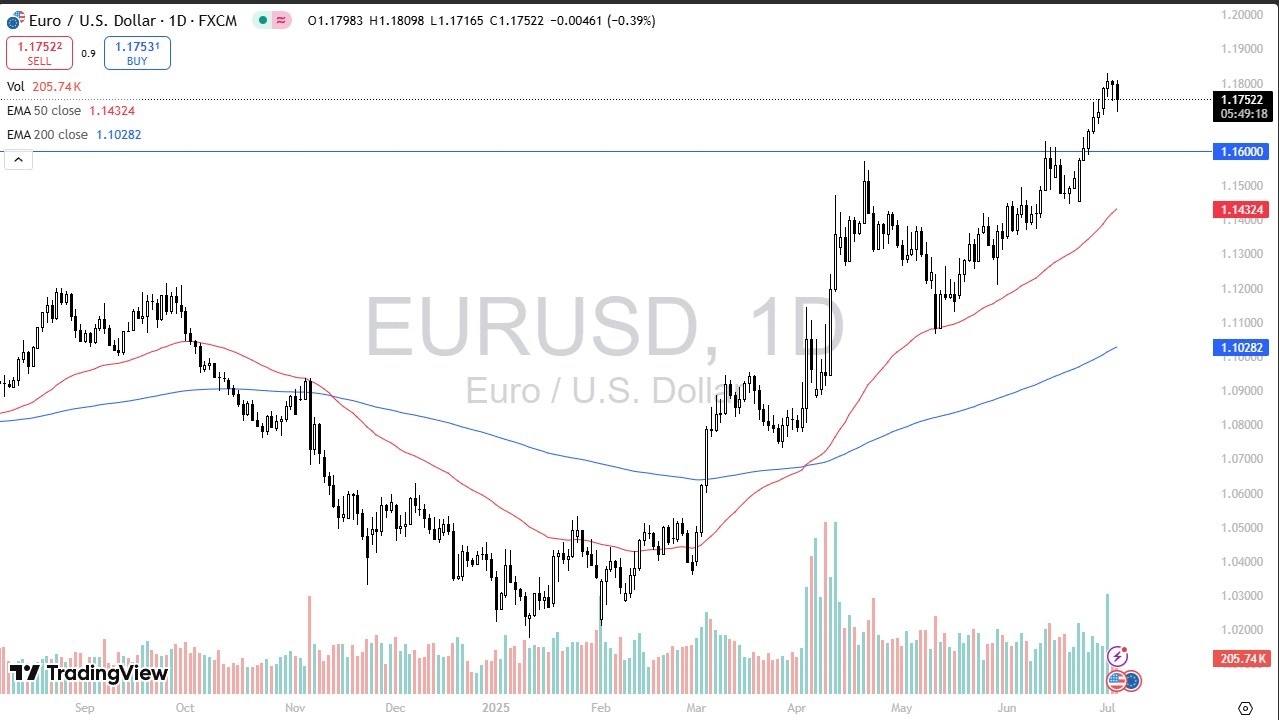
The situation in September, I think, is really going to be a situation where traders kind of already know this. So now they want to pay attention to the Federal Reserve and what they say between now and then. If they make it clear that they will not cut in September, that will be the end of this trend.

On the other hand, if they do, that could be a “sell on the event” type of situation. We’ll just have to wait and see. But in the short term, this looks like a market where traders are still willing to step into the market and take advantage of any value that they get with the 1.16 level being of particular interest as it was previous resistance and now it should be support.
The 50-day EMA is about 150 pips below there but it is racing towards that area so I could envision a world where we drift a little lower and then meet up with the 50-day EMA again. On the other hand, though if we break above the 1.1850 level it’s possible that the euro goes screaming to the upside and looking for the 1.20 level, which of course is the next large round figure. And really that wouldn’t be a surprise either. The one thing that you haven’t heard me say is that I’m going to short this market.
Ready to trade our Forex daily forecast? We’ve shortlisted the top forex brokers in the industry for you.
Christopher Lewis has been trading Forex and has over 20 years experience in financial markets. Chris has been a regular contributor to Daily Forex since the early days of the site. He writes about Forex for several online publications, including FX Empire, Investing.com, and his own site, aptly named The Trader Guy. Chris favours technical analysis methods to identify his trades and likes to trade equity indices and commodities as well as Forex. He favours a longer-term trading style, and his trades often last for days or weeks.