The main category of Forex News.
You can use the search box below to find what you need.
[wd_asp id=1]
The main category of Forex News.
You can use the search box below to find what you need.
[wd_asp id=1]
June 30, 2025 – Written by Tim Boyer
STORY LINK GBP/USD Forecast: Pound Steady vs Dollar as UK GDP in line with Expectations
The Pound Sterling trended mostly flat against the US Dollar on Monday despite the release of some optimistic UK GDP data.
The Pound (GBP) began the week on the back foot, weakening against several major peers despite the release of stronger-than-expected UK GDP figures.
According to the Office for National Statistics (ONS), the British economy expanded by 0.7% in the first quarter of 2025, a notable improvement from the previous 0.1% reading and in line with forecasts.
However, the Pound struggled to gain traction.
Markets appeared cautious in their response, with investors questioning whether the momentum can be sustained amid ongoing consumer spending pressures and signs of labour market weakness.
As a result, GBP was unable to fully capitalise on the economic rebound.
The US Dollar (USD) was largely directionless on Monday, trading in a narrow range against most major peers as a lack of high-impact US data left markets without a clear catalyst.
With little on the domestic economic calendar to drive movement, investors appeared hesitant to make bold moves on the ‘Greenback’ ahead of key releases due on Tuesday.
These include May’s JOLTs job openings and the ISM manufacturing PMI for June, both of which could significantly influence market sentiment if they deviate from expectations.
In the meantime, the absence of fresh drivers kept USD exchange rates mostly flat through Monday’s European session.
Looking ahead to Thursday’s European session, movement in the Pound to US Dollar (GBP/USD) exchange rate is likely to be driven by a mix of UK and US economic releases.
In the US, the spotlight will fall on the latest JOLTs job openings and ISM manufacturing PMI.
Job openings are forecast to decline, while the manufacturing index is expected to remain unchanged.
If both figures meet expectations or disappoint, the US Dollar could come under renewed pressure as signs of a cooling labour market and stagnant factory activity may weigh on Federal Reserve rate expectations.

Meanwhile, the UK will publish its finalised manufacturing PMI for June.
The index is set to be revised slightly higher, from 46.4 to 47.7. However, as the reading remains firmly below the 50 threshold that separates growth from contraction, the revision is unlikely to offer much meaningful support to Sterling.
International Money Transfer? Ask our resident FX expert a money transfer question or try John’s new, free, no-obligation personal service! ,where he helps every step of the way,
ensuring you get the best exchange rates on your currency requirements.
TAGS: Pound Dollar Forecasts
At 12:34 GMT, Natural Gas futures are trading $3.582, down $0.157 or -4.20%.
Last week, forecasts from NatGasWeather and Atmospheric G2 pointed to strong heat across the southern two-thirds of the U.S., with highs in the 80s to 100s across major East Coast cities and strong cooling demand into early July.
However, the current price retreat suggests traders are reassessing whether the heat will translate into sustained demand pressure, especially as lighter demand persists across the northern third of the country with milder temperatures.
Thursday’s EIA report added to bearish undertones, showing a +96 bcf injection, well above the consensus of +88 bcf and the five-year average of +79 bcf, signaling ample supply with inventories now 6.6% above the five-year seasonal average.
Additionally, easing geopolitical tensions, including the Israel-Iran ceasefire, have reduced near-term LNG disruption risks via the Strait of Hormuz, removing a bullish tailwind from the market.
Lower-48 dry gas production remains solid at 105.2 bcf/day (+1.7% y/y), while gas demand sits at 74.3 bcf/day (+1.0% y/y). LNG net flows to export terminals remain firm at 14.8 bcf/day (+7.4% w/w).
Tariffs bite, budget cracks widen, bets surge—pressure’s building and the technicals aren’t offering much relief.
With weakening through Q2 and falling correlations with traditional macro drivers, markets are clearly responding to a different set of influences. Once a pair heavily dictated by U.S.–Japan rate differentials and risk sentiment, that relationship has broken down, raising the prospect that political developments—especially those linked to U.S. trade and fiscal policy—may now be playing a greater role in driving price action.
This piece explores the fundamental backdrop heading into H2 2025, including the apparent correlation breakdown, the growing political overhang weighing on the , and what’s currently priced for both the Fed and BoJ in the second half of the year.
Source: TradingView
What stands out from the recent data is the clear deterioration in correlation strength between USD/JPY and its traditional macro inputs. Looking across one-month and one-quarter rolling periods, there’s been little to no sustained relationship between the pair and major variables including U.S. Treasury yields, yield differentials, and broader risk appetite proxies like the and .
This divergence suggests markets are no longer trading the pair in a textbook fashion. Despite notable moves in both and yields over Q2, the pair has largely ignored these developments. Even front-end spread changes, typically a reliable driver of JPY flows, have failed to generate a lasting directional pull. , often used as a barometer for inflation and demand dynamics, has also shown negligible influence.
Instead, what seems to be playing a larger role is a rotation out of the triggered by growing political unease. The turning point appears to have been the announcement of reciprocal tariffs on U.S. goods during U.S. ‘Liberation Day’ in early April. Since then, longer-dated U.S. Treasury yields have risen relative to short-dated yields, pointing to an increase in term premium—a concept that refers to the additional yield investors demand to hold longer-term bonds given uncertainty around inflation, growth, and fiscal stability.

Source: TradingView
Importantly, this lift in term premium hasn’t supported the dollar. If anything, it’s coincided with growing distrust from offshore buyers and rising concerns around the sustainability of the U.S. fiscal trajectory. Charts of real (inflation-adjusted) yields on 10 (blue line, 20 (red line), and (black line) show the shift clearly. With 20 and 30-year TIPS now well above levels seen for most of the past decade, it suggests investors are demanding greater compensation for long-term risk.
Given U.S. potential growth is broadly seen at around 1.8%, current real yields imply markets are not only reacting to fiscal slippage but also pricing in more structural uncertainty, likely tied to concerns about governance and trade under the Trump administration.
While real yields at the long end of the curve remain elevated, the front end has moved in the opposite direction. Softer inflation prints and patchy consumer data through Q2 have led to a modest dovish repricing for the Fed, with markets now assigning a decent chance to three rate cuts before the end of the year.
The bigger risk factor, though, stems from politics. Reports suggest President Trump may name a shadow Federal Reserve chair well in advance of Jerome Powell’s term expiring in May 2026.
The move could effectively undermine the independence of monetary policy in the near term, especially if the nominee signals a preference for materially lower interest rates. While Powell remains in place for now, markets are increasingly sensitive to any commentary suggesting a new policy direction is already taking shape behind the scenes.
In short, artificially low interest rates are no longer a hypothetical—they’re a growing market concern. For now, , , and remain key for the Fed outlook, but the political backdrop could start to exert more weight on rate expectations as H2 progresses.
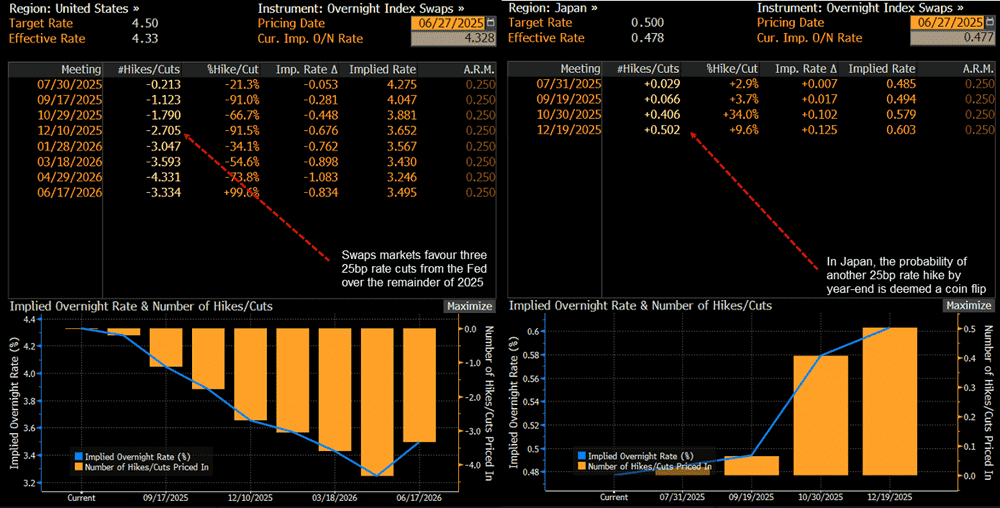
Source: Bloomberg
The BoJ remains in a difficult position. Had it not been for growing trade-related uncertainty, there’s a strong case it would already have hiked beyond the 25bp move delivered in January. Inflation pressures remain firm, with annual core readings still sitting well above target. Domestic wage growth has also remained robust, supported by another round of sizeable increases struck earlier this year.
Despite that, markets remain hesitant to price in a meaningful tightening cycle, reflecting the cloud hanging over Japanese export prospects. With the reciprocal tariff extension set to expire on July 9, the key variable may be whether Japan can extract a deal from the U.S. that limits the damage to its auto sector.
At this stage, 25% tariffs on Japanese car imports remain in place, and without movement there, the BoJ may be reluctant to hike again. A global slowdown triggered by retaliatory trade actions would quickly reverse progress made on domestic inflation.
Still, markets remain split, with current pricing assigning roughly a 50/50 chance of a second rate hike before year-end. Should the trade overhang lift—or a deal be struck that shields Japan’s key export sectors—the BoJ may feel more confident acting again. That could reintroduce rate differentials as a driver of USD/JPY, but we’re not there yet.
Source: TradingView
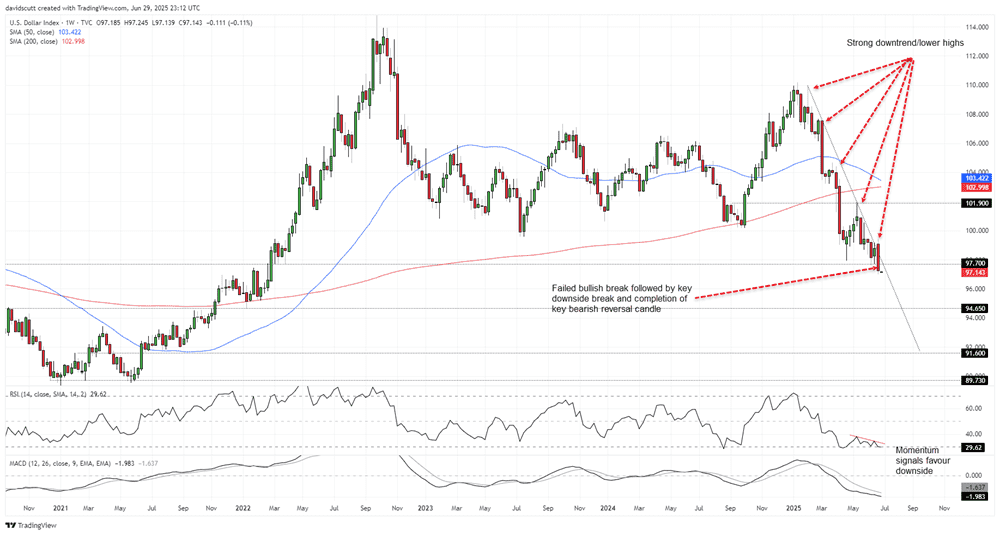
The (DXY) has been under sustained pressure since reciprocal tariff rates were announced on U.S. Liberation Day, printing a string of lower highs and lower lows within a broader downtrend on the weekly timeframe. With a bearish key reversal candle printing in the last full week of Q2—sending the DXY tumbling through support at 97.70—it signals the dollar could lose even more ground in the early stages of H2.
Momentum indicators bolster this view with RSI (14) trending lower while sitting in deeply negative territory. MACD is doing the same, confirming the overwhelming bearish signal that favours downside over upside.
With the DXY trading below 97.70, the next downside levels to watch include 94.65 and 91.60. 97.70 may now revert to acting as resistance, with 100 and 101.90 other topside levels of note.
Source: TradingView
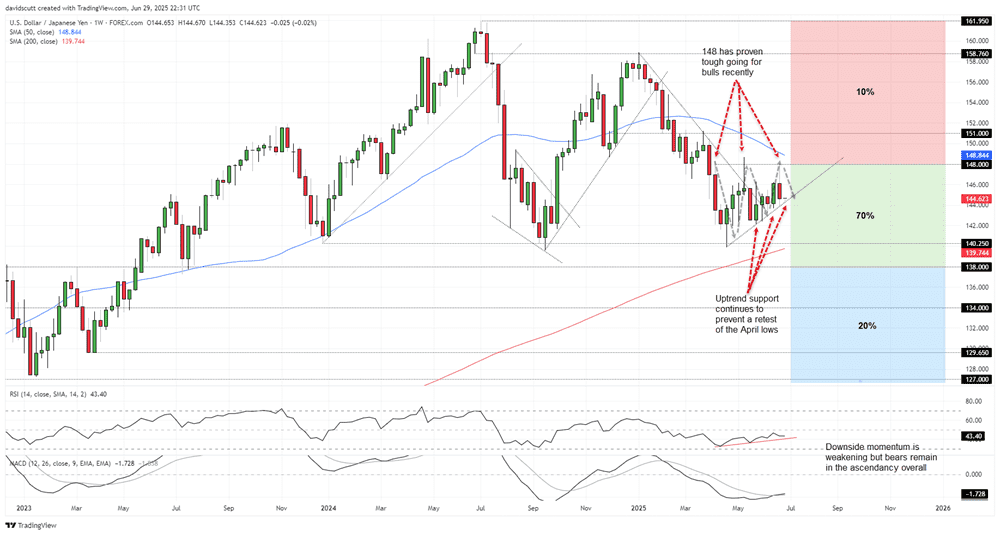
While USD/JPY trades lower than when the Q2 outlook was completed, the story over recent months has been one of modest upside with support running from the April lows continuing to repel bearish moves in May and June. On the topside, sellers have been parked above 148, resulting in violent downside moves, including in late June. That price action may be informative as to what direction USD/JPY is likely to break from the ascending triangle it trades in.
Even though momentum indicators like RSI (14) and MACD are signalling that selling pressure is ebbing—not increasing—downside risks remain tilted lower entering H2, keeping the risk of a potential retest of support starting from 140.25 on the table.
Should we see a weekly close beneath 140.25, it would increase the risk of a move towards major support at 138.00. Below, 134.00, 129.65 and 127.00 are the levels to watch. Should sellers parked between 148.00–70 be eventually overrun, resistance levels of note include 151.00 and 153.38.
The colour-coding signifies the potential ranges where USD/JPY may finish 2025, along with an assigned probability of each occurring as marked. The green zone between 148.00 on the topside and 138.00 on the downside is favoured at 70%, underpinned by the belief that while broader USD pressure is likely to persist, in the absence of a major U.S. market meltdown that sparks major carry trade unwind or significant economic downturn (both of which screen as unlikely over the medium term), a venture into the blue zone is deemed low probability at just 20%.
The implied probability of a push above 148 is even lower at just 10%, likely requiring a combination of policy inertia from the Fed, a positive resolution to trade and geopolitical risks, along with booming financial markets. Such a backdrop comes across as more akin to wishful thinking rather than plausible.
Important DisclaimersThe content provided on the website includes general news and publications, our personal analysis and opinions, and contents provided by third parties, which are intended for educational and research purposes only. It does not constitute, and should not be read as, any recommendation or advice to take any action whatsoever, including to make any investment or buy any product. When making any financial decision, you should perform your own due diligence checks, apply your own discretion and consult your competent advisors. The content of the website is not personally directed to you, and we does not take into account your financial situation or needs.The information contained in this website is not necessarily provided in real-time nor is it necessarily accurate. Prices provided herein may be provided by market makers and not by exchanges.Any trading or other financial decision you make shall be at your full responsibility, and you must not rely on any information provided through the website. FX Empire does not provide any warranty regarding any of the information contained in the website, and shall bear no responsibility for any trading losses you might incur as a result of using any information contained in the website.The website may include advertisements and other promotional contents, and FX Empire may receive compensation from third parties in connection with the content. FX Empire does not endorse any third party or recommends using any third party’s services, and does not assume responsibility for your use of any such third party’s website or services.FX Empire and its employees, officers, subsidiaries and associates, are not liable nor shall they be held liable for any loss or damage resulting from your use of the website or reliance on the information provided on this website.Risk DisclaimersThis website includes information about cryptocurrencies, contracts for difference (CFDs) and other financial instruments, and about brokers, exchanges and other entities trading in such instruments. Both cryptocurrencies and CFDs are complex instruments and come with a high risk of losing money. You should carefully consider whether you understand how these instruments work and whether you can afford to take the high risk of losing your money.FX Empire encourages you to perform your own research before making any investment decision, and to avoid investing in any financial instrument which you do not fully understand how it works and what are the risks involved.
But if we can get above this 50 day EMA, perhaps we go climbing to the 148 yen level again, which is where the 200 day EMA sits, which is typically thought of as a major support resistance area. If we do break down below here, I see a somewhat important area in the range of 142 yen, but we’ll just have to see how that plays out. I still favor the upside simply because you get paid to wait.
And finally, taking a look at the Australian dollar, we continue to struggle with 0.6550. We’ve pulled back from there, yet again. We just cannot really take off to the upside and go looking to maybe 0.67 yet, despite the fact that the US dollar is weakening against multiple other currencies. But it appears to me that Pacific currencies, for example, the yen, the Australian dollar, the New Zealand dollar are all in the same boat, they just can’t launch against the greenback. So that tells me that most of what we’re seeing anti US dollar is a pro Europe, pro-UK type of situation.
For a look at all of today’s economic events, check out our economic calendar.
Coffee price continued forming strong negative trading, to face 50%Fibonacci correctional level, which forms a strong support at 292.85, then bounces quickly towards 302.05 as appears in the above image.
We expect forming some mixed trading, but its repeated stability above the current support will reinforce the chances for gathering the positive momentum and begin recovering the losses by targeting 313.60 level, reaching the barrier at 327.05.
The expected trading range for today is between 395.00 and 313.60
Trend forecast: Bullish
EUR/USD seems to have entered a consolidation phase above 1.1700 on Monday following the previous week’s impressive rally.
The table below shows the percentage change of Euro (EUR) against listed major currencies this month. Euro was the strongest against the Japanese Yen.
| USD | EUR | GBP | JPY | CAD | AUD | NZD | CHF | |
|---|---|---|---|---|---|---|---|---|
| USD | -2.95% | -1.39% | 0.13% | -0.98% | -1.46% | -1.66% | -3.11% | |
| EUR | 2.95% | 1.64% | 3.15% | 2.04% | 1.58% | 1.66% | -0.16% | |
| GBP | 1.39% | -1.64% | 1.50% | 0.40% | -0.05% | -0.15% | -1.76% | |
| JPY | -0.13% | -3.15% | -1.50% | -1.12% | -1.52% | -1.66% | -3.19% | |
| CAD | 0.98% | -2.04% | -0.40% | 1.12% | -0.41% | -0.56% | -2.15% | |
| AUD | 1.46% | -1.58% | 0.05% | 1.52% | 0.41% | 0.08% | -1.71% | |
| NZD | 1.66% | -1.66% | 0.15% | 1.66% | 0.56% | -0.08% | -1.79% | |
| CHF | 3.11% | 0.16% | 1.76% | 3.19% | 2.15% | 1.71% | 1.79% |
The heat map shows percentage changes of major currencies against each other. The base currency is picked from the left column, while the quote currency is picked from the top row. For example, if you pick the Euro from the left column and move along the horizontal line to the US Dollar, the percentage change displayed in the box will represent EUR (base)/USD (quote).
While the technical outlook remains bullish in the near term, investors could refrain from taking large positions ahead of European Central Bank (ECB) President Christine Lagarde’s and Federal Reserve (Fed) Chairman Jerome Powell’s speeches at the ECB Forum on Central Banking on Tuesday.
Lagarde and Powell will participate in a policy panel. According to the CME FedWatch Tool, markets are currently pricing in about a 20% probability of the Fed lowering the policy rate by 25 basis points at the July meeting. This market positioning suggests that the US Dollar (USD) could stay resilient against its peers in case Powell reaffirms that they are unlikely to ease the policy until September.
The data from Germany showed on Monday that annual inflation, as measured by the change in the Consumer Price Index (CPI), edged lower to 2% in June’s preliminary estimate from 2.1% in May. On a monthly basis, the CPI remained unchanged. This reading came in below the market expectation for an increase of 0.2% and made it difficult for the Euro to gather strength.
Meanwhile, Wall Street’s main indexes started the day in positive territory, not allowing the USD to gather recovery momentum and helping EUR/USD limit its downside.
Later in the day, EUR/USD’s could experience heightened volatility due to position adjustments and profit-taking on the last day of the second quarter.
EUR/USD fluctuates within the upper half of the ascending regression channel and the Relative Strength Index (RSI) indicator on the 4-hour chart holds above 60, despite retreating slightly in the first half of the day. On the upside, 1.1730 (static level) aligns as an interim resistance level before 1.1760 (upper limit of the ascending channel) and 1.1800 (static level, round level).
In case EUR/USD fails to hold above 1.1700 (static level, 20-period Simple Moving Average) and flips that level into resistance, 1.1660 (mid-point of the ascending channel) and 1.1620 (static level) could be seen as next support levels.
The Euro is the currency for the 19 European Union countries that belong to the Eurozone. It is the second most heavily traded currency in the world behind the US Dollar. In 2022, it accounted for 31% of all foreign exchange transactions, with an average daily turnover of over $2.2 trillion a day.
EUR/USD is the most heavily traded currency pair in the world, accounting for an estimated 30% off all transactions, followed by EUR/JPY (4%), EUR/GBP (3%) and EUR/AUD (2%).
The European Central Bank (ECB) in Frankfurt, Germany, is the reserve bank for the Eurozone. The ECB sets interest rates and manages monetary policy.
The ECB’s primary mandate is to maintain price stability, which means either controlling inflation or stimulating growth. Its primary tool is the raising or lowering of interest rates. Relatively high interest rates – or the expectation of higher rates – will usually benefit the Euro and vice versa.
The ECB Governing Council makes monetary policy decisions at meetings held eight times a year. Decisions are made by heads of the Eurozone national banks and six permanent members, including the President of the ECB, Christine Lagarde.
Eurozone inflation data, measured by the Harmonized Index of Consumer Prices (HICP), is an important econometric for the Euro. If inflation rises more than expected, especially if above the ECB’s 2% target, it obliges the ECB to raise interest rates to bring it back under control.
Relatively high interest rates compared to its counterparts will usually benefit the Euro, as it makes the region more attractive as a place for global investors to park their money.
Data releases gauge the health of the economy and can impact on the Euro. Indicators such as GDP, Manufacturing and Services PMIs, employment, and consumer sentiment surveys can all influence the direction of the single currency.
A strong economy is good for the Euro. Not only does it attract more foreign investment but it may encourage the ECB to put up interest rates, which will directly strengthen the Euro. Otherwise, if economic data is weak, the Euro is likely to fall.
Economic data for the four largest economies in the euro area (Germany, France, Italy and Spain) are especially significant, as they account for 75% of the Eurozone’s economy.
Another significant data release for the Euro is the Trade Balance. This indicator measures the difference between what a country earns from its exports and what it spends on imports over a given period.
If a country produces highly sought after exports then its currency will gain in value purely from the extra demand created from foreign buyers seeking to purchase these goods. Therefore, a positive net Trade Balance strengthens a currency and vice versa for a negative balance.
The global oil market remains one of the most closely watched economic indicators worldwide. With prices constantly fluctuating due to a complex interplay of supply, demand, geopolitical tensions, and market sentiment, staying informed about current crude oil prices today is essential for investors, businesses, and consumers alike.
West Texas Intermediate (WTI) crude, the U.S. benchmark, is currently trading at $65.52 per barrel, showing a modest increase of 0.43% (+$0.28). This light, sweet crude oil is primarily traded on the New York Mercantile Exchange and serves as a key reference point for North American oil markets.
WTI crude typically has an API gravity between 39-41 degrees and sulfur content below 0.5%, making it particularly valuable for refining into gasoline and diesel fuel.
Brent crude, the international benchmark, is currently priced at $67.77 per barrel, with a slight increase of 0.06% (+$0.04). Extracted from the North Sea, Brent crude is used to price approximately two-thirds of internationally traded crude oil supplies.
With an API gravity of 38 degrees and 0.37% sulfur content, Brent represents a slightly heavier grade than WTI, creating natural price differentials based on quality characteristics alone.
The significant price variation between benchmarks highlights the fragmented nature of global oil markets, with Bonny Light’s premium reflecting both quality advantages and supply risk factors.
OPEC+ is set to make crucial production decisions during their upcoming July 6 meeting. Eight OPEC+ nations—including Saudi Arabia, Russia, Iraq, and the UAE—have been gradually unwinding 2.2 million barrels per day of voluntary cuts since April, with monthly increases of 411,000 bpd.
Recent statements from Russian Deputy Prime Minister Alexander Novak indicate that August production decisions will be made during the meeting itself rather than through pre-negotiations: “We’ll review it during the meeting, as is traditional.” This suggests a potentially more dynamic and unpredictable outcome.
Technical analysts note that OPEC+ compliance rates with previously announced cuts have averaged 164% in recent months, indicating that actual production remains well below announced targets—a factor that could significantly impact market expectations.
According to industry analysts, the combination of inventory draws and production constraints is creating a complex supply picture that would typically support higher prices if not for countervailing demand concerns.
Market Analysis:
“The divergence between physical market tightness and futures market weakness suggests substantial financial positioning is overriding fundamentals in the short term. This disconnection typically doesn’t last beyond 4-6 weeks before reconciling with physical reality.”
The ongoing Israel-Iran conflict has created significant price volatility. Brent crude briefly topped $77 amid heightened tensions but has since fallen to around $68 as ceasefire headlines reduced the geopolitical risk premium.
The risk of Middle East oil supply disruptions has reportedly decreased to approximately 4%, contributing to the recent price stabilization. This risk assessment, calculated based on insurance market data and shipping rates through key chokepoints like the Strait of Hormuz, represents a significant decline from the 12% disruption risk priced in during April’s peak tensions.
Energy security analysts note that each percentage point of disruption risk typically equates to a $1.20-1.50 premium in crude prices, explaining much of the recent $9 price swing.
These localized disruptions create a complex patchwork of supply risks that collectively contribute to market uncertainty, even as headline Middle East tensions have eased.
Oil tanker rates have retreated as Middle East tensions cool, reducing the risk premium for maritime transportation. This development has helped stabilize global oil prices by reducing logistics costs.
Very Large Crude Carrier (VLCC) rates for the benchmark Middle East-to-Asia route have fallen to approximately $25,000 per day, down over 40% from peak rates of $42,000 in April when maritime insurance premiums spiked amid attack concerns.
According to shipping data providers, tanker tracking shows a 12% reduction in “dark fleet” activity (vessels operating with reduced transparency), suggesting improved compliance with international shipping regulations.
Industry experts point out that the global pipeline infrastructure is reaching a critical inflection point, with aging systems requiring over $380 billion in maintenance and upgrades over the next decade while simultaneously facing energy transition pressures.
The April oil price crash factors dragged Saudi Arabia’s oil revenues to a 4-year low, putting pressure on the kingdom’s fiscal position and potentially influencing its stance on production cuts.
Saudi oil revenues fell to approximately $17.8 billion in April 2025, representing a 22% decline from the previous year and significantly below the $25.6 billion monthly average needed to balance the kingdom’s ambitious budget. This shortfall explains recent Saudi reluctance to accelerate production increases despite pressure from consuming nations.
The Saudi economy’s oil dependency has declined from 42% of GDP in 2016 to 33% today, showing progress in diversification efforts, but remains vulnerable to price volatility.
Russia is considering alternative uses for its natural gas, including AI data centers, as collapsing gas sales create a supply glut. The country is also boosting exports of crude oil to China in July.
The Russian Ministry of Energy has approved plans to increase ESPO blend crude exports to China by 14% in July, reaching 840,000 barrels per day as Western markets remain largely closed due to sanctions.
Russia’s innovative approach to gas utilization includes proposals for 12 new data centers powered directly by stranded gas assets, potentially consuming the equivalent of 4.2 billion cubic meters annually—a creative solution to market access challenges.
Oil-rich Alberta has forecast an unexpected budget surplus, demonstrating how current price levels are still beneficial for some producing regions despite recent volatility.
The provincial government projects a C$5.5 billion ($4.1 billion) surplus for fiscal year 2025/26, significantly higher than initial estimates, due to production efficiency gains that have lowered breakeven costs to an average of $52 per barrel for existing projects.
Economic Analysis:
“The divergence in producer responses to $65-70 oil highlights the dramatically different fiscal breakeven points across major exporters. What represents budget pressure for Saudi Arabia and fiscal stress for Russia translates to surplus territory for efficient North American producers.”
Light crude futures are hovering just above the 200-day moving average at $65.15—a critical technical pivot point. Market analysts suggest:
Volume analysis shows participation increasing on down days while decreasing on rebounds, typically a bearish indicator suggesting limited buying conviction despite the significant price decline.
The recent price slump has occurred despite some bullish fundamental indicators, suggesting market sentiment may be overriding supply-demand fundamentals in the short term.
The Commitment of Traders report shows hedge funds have reduced their net long positions by 42% over the past six weeks, representing the largest positioning shift since March 2020. This substantial liquidation of speculative positions has created a potential coiled spring effect if fundamentals reassert themselves.
Options market data reveals a significant skew toward put contracts, with the put/call ratio reaching 1.87—its highest level in 14 months and a contrarian indicator suggesting extreme pessimism that often precedes market reversals.
All eyes are on the July 6 OPEC+ meeting, with market participants watching not just the production decision but also the group’s unity and messaging. Saudi Arabia is reportedly pushing to maintain the accelerated pace of unwinding production cuts, while Russia has shifted from a cautious stance to a more open position.
Analysts project a trading range of $64-72 for WTI and $67-75 for Brent through Q3 2025, with volatility expected to remain elevated due to geopolitical uncertainties and diverging economic indicators across major consuming regions.
Saudi Energy Minister Warning:
“Those who bet against OPEC+ cohesion will be disappointed again. The alliance has demonstrated its ability to act decisively when market conditions warrant.”
OPEC Secretary-General Haitham Al Ghais recently reaffirmed that “there is no peak in oil demand on the horizon,” projecting growth of 1.3 million bpd in both 2025 and 2026. This contrasts with the IEA’s position, which continues to forecast peak oil demand occurring before 2030.
Long-term price forecasts show a bifurcation of expert opinion:
This divergence creates significant uncertainty for long-term investment decisions, particularly for projects with 20+ year horizons and high capital requirements.
Current prices around $65-68 per barrel represent a significant drop from recent highs but remain well above the pandemic-era lows of 2020. When adjusted for inflation, today’s prices are moderate by historical standards, sitting below the peaks seen during the 2008 financial crisis ($147/barrel, or $198 in today’s dollars) and the 2011-2014 period (sustained $100+ pricing).
From a long-term perspective, current prices sit almost exactly at the 25-year inflation-adjusted average of $64.78 per barrel, suggesting neither extreme value nor excessive premium when viewed historically.
The following table provides context for today’s pricing environment:
| Period | Nominal High | Inflation-Adjusted (2025$) | Current vs. Period |
|---|---|---|---|
| 2008 Peak | $147.27 | $198.40 | 67% lower |
| 2011-2014 Avg | $103.67 | $126.89 | 47% lower |
| 2020 Pandemic Low | $16.94 | $19.80 | 232% higher |
| 25-Year Average | $52.15 | $64.78 | 1% higher |
Oil prices typically exhibit seasonal patterns, with demand often increasing during summer driving seasons in the Northern Hemisphere. Current price movements should be evaluated within this seasonal context.
Analysis of the past decade shows that WTI prices typically gain an average of 7.2% between June and August, suggesting current weakness runs counter to normal seasonal strength—a potentially concerning signal about underlying demand fundamentals.
The historical pattern of building inventories in Q1, drawing in Q2-Q3, and rebuilding in Q4 remains broadly intact, though climate change has begun to alter some seasonal consumption patterns, particularly in natural gas markets.
Investors should note that market reactions to these events often follow a pattern: initial volatility based on headlines, followed by more measured responses as details emerge and are analyzed.
Investment Strategy Note:
“Commodity markets often exhibit asymmetric risk-reward profiles during periods of high uncertainty. Current options market pricing suggests downside protection costs are at 18-month lows relative to upside exposure, creating potential opportunities for structured positions with favorable risk/reward characteristics.”
The price differential between WTI and Brent crude (currently about $2.25) reflects differences in quality, transportation costs, and regional supply-demand dynamics. Brent is typically priced higher due to its easier access to global shipping routes compared to landlocked WTI production areas.
This “Brent-WTI spread” has ranged from negative values (WTI premium) to over $25 (Brent premium) in the past decade, driven by infrastructure constraints, export policies, and regional supply shocks. The current moderate spread suggests relatively balanced global markets with efficient transportation links.
While crude oil prices are a major component of retail gasoline prices, the relationship isn’t always immediate or proportional. Factors such as refining costs, distribution expenses, local taxes, and retail competition also influence the final price consumers pay at the pump.
Typically, a $10 change in crude oil prices translates to approximately $0.25 per gallon at the retail level over 2-4 weeks, though regional factors can accelerate or delay this pass-through effect. Current national average gasoline prices of $3.46 per gallon represent approximately 52% crude oil cost, 18% refining costs, 16% taxes
Discover potential market-leading investment opportunities in the resources sector with Discovery Alert’s proprietary Discovery IQ model, delivering instant notifications on significant ASX mineral discoveries across 30+ commodities. Begin your 30-day free trial today at Discovery Alert to gain your competitive edge.
June 30, 2025 – Written by David Woodsmith
STORY LINK Pound to Euro Week Ahead Forecast: 1.17 Today, 1.19 Next Target
Foreign exchange analysts at MUFG forecast that the Pound to Euro exchange rate (GBP/EUR) will hit selling interest on any gains to 1.19 and retreat to 1.1560 by the end of 2025.
In contrast, Credit Agricole still backs GBP/EUR gains to 1.2050 by the end of the year.
GBP/EUR secured marginal gains during the week, although it failed to hold 2-week highs just above 1.1750 and settled just above 1,1700.
The Pound and Euro both gained net support in global markets from an easing of Middle East tensions and a sustained improvement in risk appetite, liming moves on the cross.
Credit Agricole sees scope for Pound gains on valuation grounds; “We continue to think that EUR/GBP is looking quite overvalued compared to fair value metrics that we estimate based on EUR-GBP rate spread among other drivers. We therefore think that the cross should continue to drift lower in the very near term, especially if risk sentiment continues to recover.
It did, however, add; “That being said, we are also conscious of the risk that a more dovish BoE rhetoric in particular could remain a key downside risk for the GBP.”
Many investment banks have continued to focus on fiscal policy with Germany planning a EUR500bn boost over the next few years.
Deutsche Bank commented; “In the short term, the planned ramp-up in debt-financed spending is remarkably ambitious. The government plans a deficit of more than 3% of GDP as early as this year and almost 4% next year. In light of the front-loading of the fiscal expansion, we raise our growth forecast for 2025 to 0.5%.”
It added; “Not only is the fiscal impulse over this period likely to be more positive than we previously assumed, but the economy is also heading into this fiscal expansion with greater momentum than expected. It would now take a serious exogenous shock or escalation in the trade conflict to scupper the recovery this year.”
The UK, however, is still struggling with fiscal policy with a government U-turn on welfare reform adding to long-term reservations and the risk of further tax increases later in the year.
Monetary policy developments will also remain a key area, especially given the Euro-Zone fiscal boost.
There are strong expectations that the Bank of England will cut rates in August with a further cut before year-end.
Nordea commented; “we think the ECB is done in terms of rate cuts.”
It added; “We do think risks remain tilted towards another cut for now, as many downside risks remain, not least due to trade policy uncertainty. However, trade policy is only part of the story and there are upside risks as well.”
In this context, Nordea also commented on fiscal policy; “A looming boost to growth from public spending and investment due to higher German infrastructure and EU defence spending limits downside risks, but we think also higher energy prices have the potential to reduce the odds of the ECB cutting rates further in the current circumstances.”
According to ING; “We are not major subscribers to the view that the ECB will stay on hold until December (a September cut is underpriced in our view), but admit that the latest hawkish communication means market pricing may not be revised significantly to the dovish side at least for some weeks.”
International Money Transfer? Ask our resident FX expert a money transfer question or try John’s new, free, no-obligation personal service! ,where he helps every step of the way,
ensuring you get the best exchange rates on your currency requirements.
TAGS: Pound Euro Forecasts
Coffee price continued forming strong negative trading, to face 50%Fibonacci correctional level, which forms a strong support at 292.85, then bounces quickly towards 302.05 as appears in the above image.
We expect forming some mixed trading, but its repeated stability above the current support will reinforce the chances for gathering the positive momentum and begin recovering the losses by targeting 313.60 level, reaching the barrier at 327.05.
The expected trading range for today is between 395.00 and 313.60
Trend forecast: Bullish