The main category of Forex News.
You can use the search box below to find what you need.
[wd_asp id=1]
The main category of Forex News.
You can use the search box below to find what you need.
[wd_asp id=1]
The Iran-Israel ceasefire brokered by President Trump earlier this week remains intact, reducing a significant geopolitical premium that previously supported gold.
Meanwhile, a White House official confirmed an agreement with China to expedite rare earth shipments, reducing concerns over supply disruptions ahead of the July 9 reciprocal tariff deadline. The dollar’s recent weakness has provided no support, underscoring gold’s current vulnerability as safe-haven demand continues to fade.
Today’s release of the U.S. Personal Consumption Expenditures (PCE) data will be critical for traders assessing the Federal Reserve’s policy path. Richmond Fed President Thomas Barkin noted tariffs are likely to push inflation higher over the coming months, but recent reports indicate muted inflation pressures so far.
April’s headline PCE rose 2.1% year over year, while core PCE increased 2.5%. For May, Wells Fargo expects headline PCE to print at 2.3% YoY and core PCE at 2.6%, signaling a modest uptick.
A hotter-than-expected PCE print could reinforce the Fed’s higher-for-longer stance, potentially driving Treasury yields higher and adding downside pressure to gold, which remains unattractive in a high-rate environment due to its zero-yield nature. A softer print, however, may trigger dollar weakness and a relief bid in gold, but the loss of safe-haven flows will limit any sharp upside unless accompanied by new geopolitical tensions or a shift in Fed rhetoric.
Gold is down more than 2% this week, extending a decline of over $200 from its record highs in April. Analysts at City Index and FOREX.com note that while the current pullback helps unwind overbought technical conditions, the absence of strong catalysts and firm real yields continue to weigh on gold’s upside potential. Market participants are focusing on the interplay between inflation data and Fed commentary to gauge timing for potential rate adjustments.
Copper price took advantage of the positive factors by confirming the obstacle at $4.8900, to notice by the above image, forming a strong bullish rally achieving the main targets by reaching $5.0700 level and settles around it.
By the above image, we notice forming $5.1000 level to previous liquidity grab zones, to form an extra barrier against the bullish trading in the current period, to expect the price affection by the domination of the sideways bias domination temporarily, while the continuation of the fluctuation below this barrier might increase the chance for activating the bearish correctional track, which might target $4.9100 level.
The expected trading range for today is between $4.9600 and $5.1000
Trend forecast: Fluctuated with the bullish track
Despite the neediness of the GBPJPY pair to the positive momentum, but the main stability within the bullish channel’s levels that pushed it to form a new positive move, to hit the target at 198.80, facing 66.8%Fibonacci correction level as appears in the above image.
The current trading scenario depends on the strength of 198.80 level, if it settles we expect forming bearish correctional trading that might push it to suffer some losses by reaching 197.40 and 169.85, while the price success in achieving the breach and providing a positive close above it, will reinforce the chances for recording extra gains by its rally to 199.55.
The expected trading range for today is between 197.40 and 198.80
Trend forecast: Bearish
Copper price took advantage of the positive factors by confirming the obstacle at $4.8900, to notice by the above image, forming a strong bullish rally achieving the main targets by reaching $5.0700 level and settles around it.
By the above image, we notice forming $5.1000 level to previous liquidity grab zones, to form an extra barrier against the bullish trading in the current period, to expect the price affection by the domination of the sideways bias domination temporarily, while the continuation of the fluctuation below this barrier might increase the chance for activating the bearish correctional track, which might target $4.9100 level.
The expected trading range for today is between $4.9600 and $5.1000
Trend forecast: Fluctuated with the bullish track
Copper price took advantage of the positive factors by confirming the obstacle at $4.8900, to notice by the above image, forming a strong bullish rally achieving the main targets by reaching $5.0700 level and settles around it.
By the above image, we notice forming $5.1000 level to previous liquidity grab zones, to form an extra barrier against the bullish trading in the current period, to expect the price affection by the domination of the sideways bias domination temporarily, while the continuation of the fluctuation below this barrier might increase the chance for activating the bearish correctional track, which might target $4.9100 level.
The expected trading range for today is between $4.9600 and $5.1000
Trend forecast: Fluctuated with the bullish track
Despite the neediness of the GBPJPY pair to the positive momentum, but the main stability within the bullish channel’s levels that pushed it to form a new positive move, to hit the target at 198.80, facing 66.8%Fibonacci correction level as appears in the above image.
The current trading scenario depends on the strength of 198.80 level, if it settles we expect forming bearish correctional trading that might push it to suffer some losses by reaching 197.40 and 169.85, while the price success in achieving the breach and providing a positive close above it, will reinforce the chances for recording extra gains by its rally to 199.55.
The expected trading range for today is between 197.40 and 198.80
Trend forecast: Bearish
June 27, 2025 – Written by James Fuller
STORY LINK Pound to US Dollar Forecast: GBP must hold above 1.3595
The easing of immediate Middle East fears has put the focus firmly back on underlying fundamentals with the dollar sliding amid fresh fears that Fed independence will be compromised.
Following the latest salvo against Fed Chair Powell from President Trump, there has been increased speculation that there will be an early nomination of the next chair and fresh talk that Powell could be dismissed by Trump.
The dollar index has slumped to the lowest level since February 2022 while the Pound to Dollar (GBP/USD) exchange rate has surged to 44-month highs above 1.3750.
MUFG commented; “Broad-based US dollar weakness helped to lift EUR/USD and cable overnight as they continue to move back closer towards the highs set back in late 2020/early 2021 when they peaked at just above 1.2000 and 1.4000.”
Markets will be looking to attack 1.40 in GBP/USD, although there is tough resistance close to current levels and the dollar is potentially oversold.
ING commented; “Downside risks for the dollar persist, but another 1-2% plunge in DXY will look stretched without any dovish repricing in Fed expectations or tariff/deficit concerns resurfacing.”
UoB noted resistance near 1.3750 and added; “To sustain the buildup in momentum, GBP must hold above the ‘strong support’ level, currently at 1.3595.”
Fed Chair Powell maintained a cautious stance in his second round of testimony to Congress. The rejection of a near-term rate cut has triggered another blast of criticism from President Trump who has again threatened to fire Powell and name a successor quickly.
MUFG noted a Wall Street Journal report that a successor to Powell could be named by September at the latest and potentially next month.
The bank added; “It highlights how an early pick could be used as way to try to undermine the Fed’s policymaking under Chair Powell providing a further potential trigger for a loss of investor confidence in the US dollar.”
There have been reports that Trump is considering former Fed governor Kevin Warsh, National Economic Council director Kevin Hassett and Treasury Secretary Scott Bessent as potential candidates.
According to MUFG; “Other contenders include former World Bank President David Malpass and Fed governor Christopher Waller.”
The bank summarised; “A candidate who is perceived as being more open to lowering rates in line with President Trump’s demands would reinforce the US dollar’s current weakening trend.”
IG market analyst Tony Sycamore commented; “I think it’s a given that Trump’s pick to succeed Powell, when it comes, will be one that sits at the highly dovish end of the spectrum and will support Trump’s agenda of lowering interest rates.”

He added; “The issue with this is it will resurface questions from earlier in the year around the Fed’s independence, which, as we saw, undermines confidence in the Fed and the USD.”
There has been a shift in market pricing with a rate cut by September now seen as inevitable with markets also seeing the most likely outcome as three rate cuts by the end of 2025.
In contrast, markets are pricing in two Bank of England rate cuts by the end of 2025 which would help underpin the Pound on yield grounds.
International Money Transfer? Ask our resident FX expert a money transfer question or try John’s new, free, no-obligation personal service! ,where he helps every step of the way,
ensuring you get the best exchange rates on your currency requirements.
TAGS: Pound Dollar Forecasts
Gold price is nursing weekly losses early Friday, with fresh downside risks emerging ahead of the US Personal Consumption Expenditures (PCE) Price Index data release.
As the US Dollar (USD) consolidates its overnight rebound from over three-year highs, Gold price challenges a critical daily support line.
Traders refrain from placing any directional positions in the Greenback and Gold price before the release of the Fed’s preferred inflation measure, the core PCE Price Index, due later this Friday.
Markets are expecting the annual core PCE Price Index to advance by 2.3% in May, following a 2.1% growth in April, while on a monthly basis, the gauge is seen rising 0.1% in May, at the same pace as in April.
Hotter-than-expected core PCE readings could re-kindle expectations of the US Federal Reserve (Fed) lowering interest rates as early as July.
Markets are currently pricing in a 21% chance of a July Fed rate cut, while for a September reduction, the odds stand at 75%, the CME Group’s Fed WatchTool showed.
Therefore, the data will hold key to determining the timing of the next Fed rate cut, significantly impacting the USD-denominated and non-yielding Gold price.
The USD experienced good two-way businesses, falling to the lowest level since March 2022, following the Wall Street Journal (WSJ) report that US President Trump is considering selecting and announcing a successor for Fed Chair Jerome Powell earlier by September or October.
Markets speculated that Trump’s attack threatening the Fed’s credibility could lead to the selection of a dovish successor, a so-called ‘lame duck’. This narrative weighed heavily on the buck.
However, the Greenback found its feet after a person familiar with the White House’s deliberations told Reuters on Thursday, “Trump has not decided on a replacement for Powell and a decision is not imminent.”
Further, hopes of US trade deals with the European Union (EU) and China before the July 9 deadline helped the US Dollar recover earlier losses.
A WSJ report cited late Thursday that EU officials are weighing lowering tariffs on US imports to woo Trump.
Meanwhile, a White House official said that the US has reached an understanding with China on how to expedite rare earth shipments to the US.
Having defended the strong support of the 50-day Simple Moving Average (SMA) at $3,325 so far this week, Gold price is yet again testing bids below that level at the press time.
The 14-day Relative Strength Index (RSI) is pointing south below the midline, currently trading near 46, suggesting that downside potential remains in place.
A weekly closing below the 50-day SMA support could validate a fresh downtrend, with the door opening for a test of the 50% Fibonacci Retracement (Fibo) level of the April record rally at $3,232.
Ahead of that, the $3,295 demand area will be retested, which is the intersection of the weekly low and the 38.2% Fibo level of the same ascent.
On the flip side, the immediate resistance is seen at the 50-day SMA, above which the 21-day SMA hurdle at $3,354 will be put to test.
Recapturing the 21-day SMA is critical for resuming the recovery from two-week troughs.
The next upside hurdle is aligned at the 23.6% Fibo level at $3,377.
Gold buyers will then target the $3,400 threshold once the 23.6% Fibo resistance is decisively taken out.
The Core Personal Consumption Expenditures (PCE), released by the US Bureau of Economic Analysis on a monthly basis, measures the changes in the prices of goods and services purchased by consumers in the United States (US). The PCE Price Index is also the Federal Reserve’s (Fed) preferred gauge of inflation. The YoY reading compares the prices of goods in the reference month to the same month a year earlier. The core reading excludes the so-called more volatile food and energy components to give a more accurate measurement of price pressures.” Generally, a high reading is bullish for the US Dollar (USD), while a low reading is bearish.
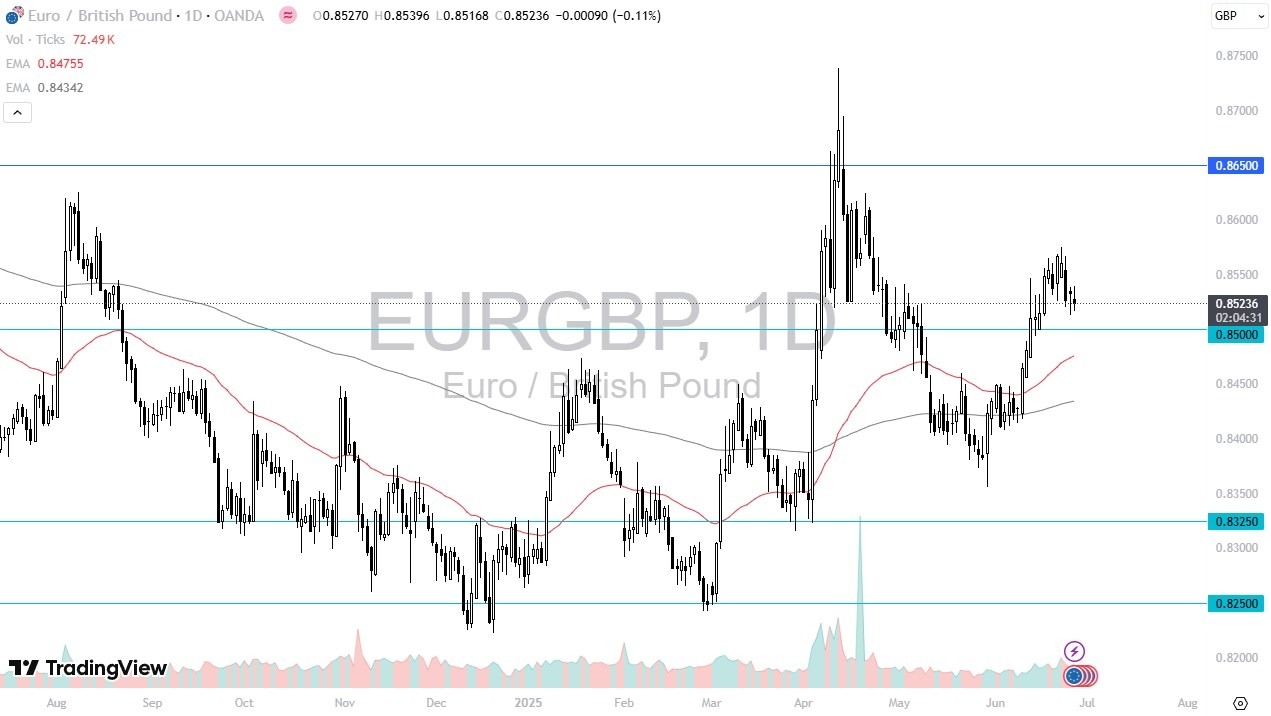
I tend to use this pair as a measuring stick, and as a relative strength meter for these 2 currencies. If we get a stronger currency in this pair, typically that currency will do better against the US dollar. This is a great way to triangulate what should be happening in the EUR/USD or GBP/USD pairs, and it’s a trick I use all the time. Ultimately, it comes down to whether or not the US dollar is strong or weak and then picking which one of these 2 currencies are heading in the opposite direction and will give you the most “bang for your buck.” It’s not that both currencies can’t rise against the US dollar, but over the last couple of weeks, you can see that the euro rose against the British pound, and it’s no big surprise that arose against the US dollar simultaneously.

The technical analysis for this market is a bit interesting at the moment, because we broke so much higher than the 50 Day EMA, and now look like we are trying to do everything we can to form some type of bullish flag. Whether or not that holds up remains to be seen, because it is a little bit early to call it that, but if we can break out to the upside, it’s worth noting that the “measured move” of the bullish flag as to the 0.8650 level, an area that’s been important multiple times in the past and I do believe would be resistance. On the other hand, if we were to break down below the 0.85 level, we do have the 50 Day EMA sitting just below there to offer even more support.
Ready to trade our daily forecast and analysis? Here’s a list of some of the top forex brokers UK to check out.
Christopher Lewis has been trading Forex and has over 20 years experience in financial markets. Chris has been a regular contributor to Daily Forex since the early days of the site. He writes about Forex for several online publications, including FX Empire, Investing.com, and his own site, aptly named The Trader Guy. Chris favours technical analysis methods to identify his trades and likes to trade equity indices and commodities as well as Forex. He favours a longer-term trading style, and his trades often last for days or weeks.
Silver price turns flat as Friday’s Asian session begins, trades near $36.60, virtually unchanged, compared to Thursday’s June 26 daily close. The XAG/USD appears poised to close the week with gains of over 1.80%.
Silver remains upward biased as Friday’s Asian session begins, posting back-to-back bullish days, which pushed the grey metal towards a weekly high of $36.83. XAG/USD has achieved a successive series of higher highs and higher lows, hinting that the grey metal is headed upwards.
The Relative Strength Index (RSI) turned flatlines after edging higher for three consecutive days, in bullish territory. This indicates that buyers are taking a respite ahead of testing higher prices.
If XAG/USD climbs past $37.00, look for the next resistance at the yearly peak of $37.31. A breach of the latter will expose the $38.00 figure. Conversely, if Silver slides below $36.50, expect a test of $36.00. Further downside lies in the June 24 daily low of $35.68, followed by the latest cycle low of $35.29.
Silver is a precious metal highly traded among investors. It has been historically used as a store of value and a medium of exchange. Although less popular than Gold, traders may turn to Silver to diversify their investment portfolio, for its intrinsic value or as a potential hedge during high-inflation periods. Investors can buy physical Silver, in coins or in bars, or trade it through vehicles such as Exchange Traded Funds, which track its price on international markets.
Silver prices can move due to a wide range of factors. Geopolitical instability or fears of a deep recession can make Silver price escalate due to its safe-haven status, although to a lesser extent than Gold’s. As a yieldless asset, Silver tends to rise with lower interest rates. Its moves also depend on how the US Dollar (USD) behaves as the asset is priced in dollars (XAG/USD). A strong Dollar tends to keep the price of Silver at bay, whereas a weaker Dollar is likely to propel prices up. Other factors such as investment demand, mining supply – Silver is much more abundant than Gold – and recycling rates can also affect prices.
Silver is widely used in industry, particularly in sectors such as electronics or solar energy, as it has one of the highest electric conductivity of all metals – more than Copper and Gold. A surge in demand can increase prices, while a decline tends to lower them. Dynamics in the US, Chinese and Indian economies can also contribute to price swings: for the US and particularly China, their big industrial sectors use Silver in various processes; in India, consumers’ demand for the precious metal for jewellery also plays a key role in setting prices.
Silver prices tend to follow Gold’s moves. When Gold prices rise, Silver typically follows suit, as their status as safe-haven assets is similar. The Gold/Silver ratio, which shows the number of ounces of Silver needed to equal the value of one ounce of Gold, may help to determine the relative valuation between both metals. Some investors may consider a high ratio as an indicator that Silver is undervalued, or Gold is overvalued. On the contrary, a low ratio might suggest that Gold is undervalued relative to Silver.