The main category of Forex News.
You can use the search box below to find what you need.
[wd_asp id=1]
The main category of Forex News.
You can use the search box below to find what you need.
[wd_asp id=1]
The GBP/USD pair attracts heavy selling during the early part of the European session on Tuesday and drops to mid-1.3200s, or its lowest level since early August, in reaction to the disappointing UK labor market report. Data published by the Office for National Statistics (ONS) showed that the UK ILO Unemployment Rate edged up to 4.8% in the three months to August, compared to 4.7% recorded in the previous month and consensus estimates. Further details revealed that the number of people claiming jobless benefits rose 25.8K in September, against a revised fall of 2.0K in August.
Meanwhile, Average Earnings, including Bonus, increased by 5.0% during the quarter through August, beating expectations and the previous reading of 4.7%. That said, regular pay growth, excluding Bonus, eased to 4.7% during the reported period, down slightly from 4.8% previously and marking the weakest pace since March–May 2022. The data fuels speculations that the Bank of England (BoE) could continue cutting interest rates gradually and weighs heavily on the British Pound (GBP). This, along with renewed US Dollar (USD) buying, is seen exerting pressure on the GBP/USD pair. Read more…
GBP/USD is diving toward the two-month low of 1.3260 following the release of disappointing UK labor market figures. The unemployment rate unexpectedly rose to 4.8% in the three months to August, up from 4.7% in the previous quarter, while employment levels declined, adding pressure to the British pound.
The pair is nearing a medium-term ascending trendline, which may act as a support level. A potential rebound from this area could shift attention toward the 23.6% Fibonacci retracement level at 1.3370, followed by resistance at the mid-level of the Bollinger Band and the 50-day simple moving average (SMA) in the 1.3435–1.3475 zone. Read more…
Silver price (XAG/USD) maintains its position after retreating from a fresh record high of $53.77, currently trading around $52.40 per troy ounce during the European hours on Tuesday. Silver prices climbed as a historic short squeeze in London intensified a rally driven by soaring demand for safe-haven assets.
The price of the grey metal surged amid growing concerns over liquidity shortages in London, prompting some traders to secure cargo space on transatlantic flights for Silver bars, an unusually costly transport method typically reserved for Gold, in a bid to capitalize on higher prices in the London market, according to a Bloomberg report.
Meanwhile, Silver is trading at a significant premium in India compared to global prices, facing a surge in domestic demand from millions of investors. The premium has risen to as much as 10% above international rates, forcing physically backed exchange-traded funds to halt new subscriptions. Meanwhile, jewelers are struggling to keep up with strong festive demand ahead of Diwali.
The safe-haven demand for Silver surged amid renewed United States (US)-China trade tensions. The United States (US) and China decided to impose additional port fees on ocean shipping companies. The US is scheduled to start collecting fees on Tuesday.
China also started to collect the special taxes on US-owned, operated, built, or flagged vessels, but stated that Chinese-built ships would be exempted from the levies. However, China’s Commerce Ministry said in a statement on Tuesday that Beijing “hopes to resolve concerns through dialogue.”
Silver is a precious metal highly traded among investors. It has been historically used as a store of value and a medium of exchange. Although less popular than Gold, traders may turn to Silver to diversify their investment portfolio, for its intrinsic value or as a potential hedge during high-inflation periods. Investors can buy physical Silver, in coins or in bars, or trade it through vehicles such as Exchange Traded Funds, which track its price on international markets.
Silver prices can move due to a wide range of factors. Geopolitical instability or fears of a deep recession can make Silver price escalate due to its safe-haven status, although to a lesser extent than Gold’s. As a yieldless asset, Silver tends to rise with lower interest rates. Its moves also depend on how the US Dollar (USD) behaves as the asset is priced in dollars (XAG/USD). A strong Dollar tends to keep the price of Silver at bay, whereas a weaker Dollar is likely to propel prices up. Other factors such as investment demand, mining supply – Silver is much more abundant than Gold – and recycling rates can also affect prices.
Silver is widely used in industry, particularly in sectors such as electronics or solar energy, as it has one of the highest electric conductivity of all metals – more than Copper and Gold. A surge in demand can increase prices, while a decline tends to lower them. Dynamics in the US, Chinese and Indian economies can also contribute to price swings: for the US and particularly China, their big industrial sectors use Silver in various processes; in India, consumers’ demand for the precious metal for jewellery also plays a key role in setting prices.
Silver prices tend to follow Gold’s moves. When Gold prices rise, Silver typically follows suit, as their status as safe-haven assets is similar. The Gold/Silver ratio, which shows the number of ounces of Silver needed to equal the value of one ounce of Gold, may help to determine the relative valuation between both metals. Some investors may consider a high ratio as an indicator that Silver is undervalued, or Gold is overvalued. On the contrary, a low ratio might suggest that Gold is undervalued relative to Silver.
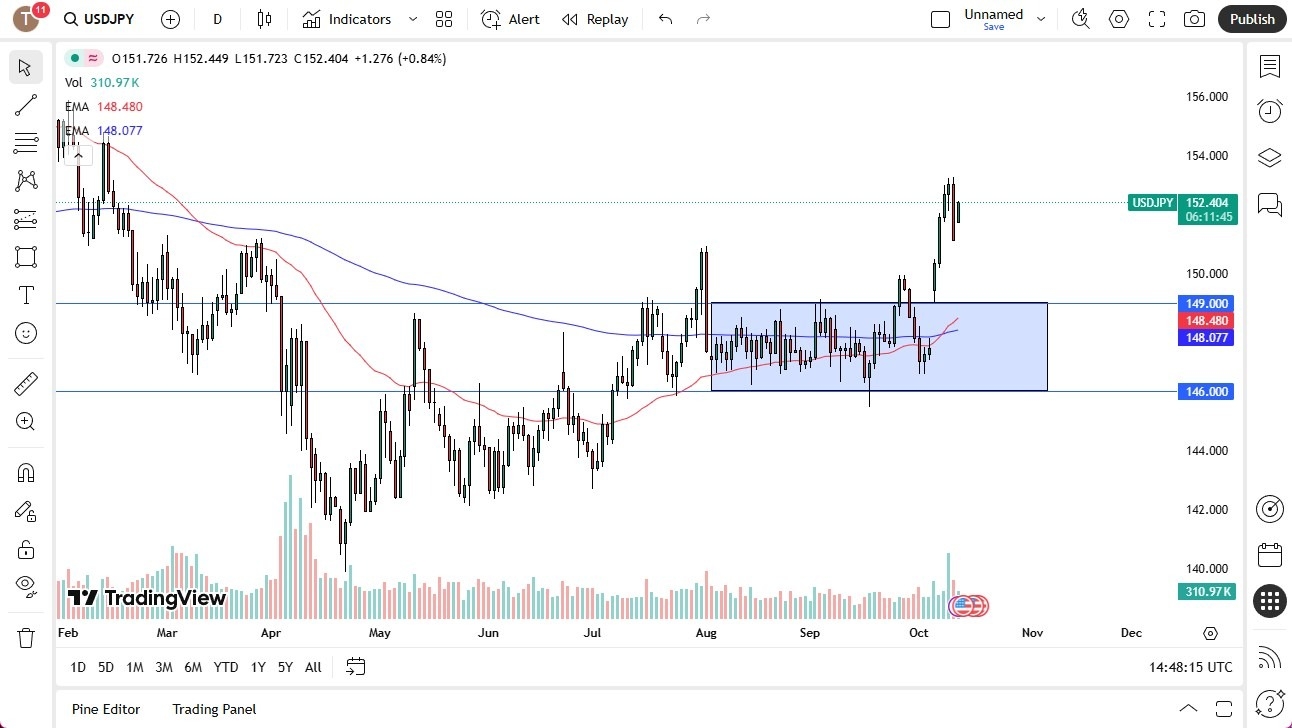
This is a market that I think continues to go much higher. But what I’m worried about is the massive stop loss you may have to take into account in order to protect against this gap getting filled because gaps typically get filled eventually. That being said, we have gapped basically 130. Well, we gapped to open up right around 70 pips and then we’re up about 130 at this point.
So, all things being equal, this is a market that I think remains by on the dips, but I was hoping to get a little bit more of a dip than we got on Friday, to be honest with you. Longer term, we go higher. I just don’t see how that changes. I’ve been saying that for a while from somewhere around here in July, I think, and I’ve been buying dips and collecting swap. The gap, of course, is a completely different animal that you have to deal with, but it’s still the same strategy. You just look for cheaper dollars if you get that opportunity.

Want to trade our USD/JPY forex analysis and predictions? Here’s a list of forex brokers in Japan to check out.
Christopher Lewis has been trading Forex and has over 20 years experience in financial markets. Chris has been a regular contributor to Daily Forex since the early days of the site. He writes about Forex for several online publications, including FX Empire, Investing.com, and his own site, aptly named The Trader Guy. Chris favours technical analysis methods to identify his trades and likes to trade equity indices and commodities as well as Forex. He favours a longer-term trading style, and his trades often last for days or weeks.
Occidental Petroleum Corporation (OXY) rose slightly in its latest intraday trading, attempting to recover part of its previous losses. However, the stock remains pressured after breaking a short-term corrective uptrend line earlier, while continuing to trade below the 50-day simple moving average, which reinforces the prevailing bearish momentum. In addition, the RSI shows ongoing negative signals despite reaching heavily oversold areas.
Therefore, we expect the stock to decline in upcoming trading sessions, especially if it breaks below the key support level of 42.35, targeting the next support at 40.15.
Today’s price forecast: Bearish.
Tuesday, October 14, 2025: Analysis of euro price against the dollar EUR/USD
EUR/USD Trading Signals:
Amid heightened interest from forex traders in the future of US Federal Reserve policies and the ongoing dispute between Trump and bank officials over pressure to continue cutting interest rates, the main focus during today’s trading session will be on the reaction to remarks from US Federal Reserve Chair Jerome Powell at 19:30 Egypt time. Prior to that, during the European session, the Euro’s price will be influenced by the release of the German ZEW Indicator, which measures confidence in the Eurozone’s largest economy, at 12:00 Egypt time.
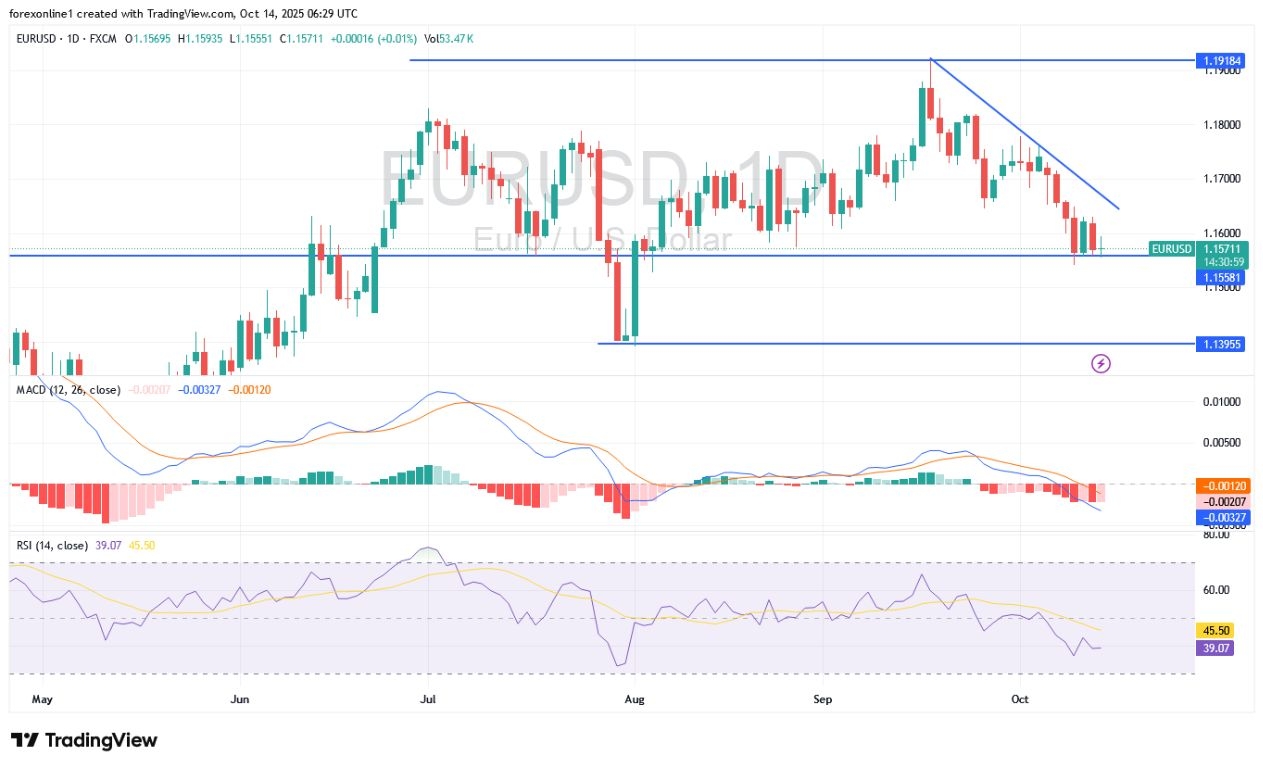
Previously, according to reliable trading platforms, the euro-dollar price is stabilizing around the 1.1555 support level, the lowest level for the currency pair in more than two months.
According to the insights of forex trading experts, the Euro is not benefiting from the renewed trade tensions between China and the United States. At the end of last week, the EUR/USD exchange rate rose on news that US President Donald Trump would respond to new Chinese export controls by imposing 100% tariffs on Chinese goods, set to take effect in November.
Consequently, the market responded by reviewing the 2025 trade rules and adhering to instructions to buy the euro as concerns about the US economy increased. Furthemore, the euro-dollar rose to resistance at 1.1630 following Trump’s unexpected move. Also, bulls hoped for continued price action at the start of the new week until the exchange rate’s technical outlook reversed from negative to positive in the near term.
Unfortunately for these bulls, the Euro was unable to capitalize on its sudden rise on Friday, putting it in a position that warns of further weakness in the coming days and weeks.
Over the weekend, both the United States and China indicated a willingness for dialogue, suggesting some back-channel communications are underway. We see these recent developments as strengthening both sides’ positions ahead of the expected meeting between Trump and Xi at the Asia-Pacific Economic Cooperation (APEC) forum in South Korea, held from October 27 to November 1. If the market agrees, stocks and the US dollar could recover from Friday’s weakness, which would keep the Euro under pressure in the near term.
Technically, the daily chart of the EUR/USD pair shows that the current level in the spot market is below the nine-day exponential moving average (EMA), which is consistent with a near-term downtrend. Our base case is that the EUR/USD pair may see some stability in the coming days, benefiting from Friday’s decline and increased attention on trade-related headlines. However, when the pair returns to its current trajectory, we will look for further declines, as this is consistent with its pre-stabilization trajectory. Therefore, a return to 1.1550, and then lower, is likely over the next two weeks. Technically, the single currency is at risk of a further decline to the 1.14 support level.
Dear TradersUp trader, the EUR/USD price will remain in its bearish range until technical indicators reach strong oversold levels or a sudden technical correction occurs amid a change in the current factors affecting the EUR/USD decline.
Away from trade headlines, we finally have an opportunity to look at some real US economic data, something that has been absent from the forex market since the partial US government shutdown began earlier this month. The US Department of Labor has reportedly recalled some of its staff to prepare for the release of the September Consumer Price Index (CPI) report, scheduled for October 15. In this context, US inflation is expected to rise by 0.4% month-on-month, with the annual rate increasing to 3.1% from 1.9%. Any reading below this rate will lead to a weaker US dollar, as it would push markets to increase their expectations of a rate cut by the Federal Reserve.
Ultimitaly, the market expects more US interest rate cuts in the coming months, but its conviction is wavering as the economy continues to perform with strong confidence, reducing the demand for rate cuts.
Ready to trade our daily Forex forecast? Here’s a list of some of the best regulated forex brokers to check out.
Gold’s reversal from all-time highs near $4,180 found support at $4,090 earlier on Tuesday. The precious metal trimmed losses in risk-off markets amid simmering tensions between the US and China, returning to the $4,125 area during the European trading session.
News that the US and China were rolling out new fees for cargo vessels entering their ports has shattered expectations of a de-escalation of the trade rift between the world’s two major economies, and provided fresh demand to traditional safe-havens like Gold.
The 4-hour chart shows the RSI coming down from oversold levels, although, in the current fundamental context, downside attempts are likely to remain limited.
Bears have been contained at $4,090 (intraday low) on Tuesday. Further down, the previous all-time high, at $4.050 area (October 8, 9 highs is likely to challenge bears ahead of the $4,000 psychological level, and the October 7 and 10 lows, at the $3,940 area.
To the upside, the intraday high at $4,080 is the closest resistance, although the $4,200 round level might attract bulls. Beyond here, a Fibonacci extension tool shows the 461.8% extension of the mid-September rally, at $4,278.
Gold has played a key role in human’s history as it has been widely used as a store of value and medium of exchange. Currently, apart from its shine and usage for jewelry, the precious metal is widely seen as a safe-haven asset, meaning that it is considered a good investment during turbulent times. Gold is also widely seen as a hedge against inflation and against depreciating currencies as it doesn’t rely on any specific issuer or government.
Central banks are the biggest Gold holders. In their aim to support their currencies in turbulent times, central banks tend to diversify their reserves and buy Gold to improve the perceived strength of the economy and the currency. High Gold reserves can be a source of trust for a country’s solvency. Central banks added 1,136 tonnes of Gold worth around $70 billion to their reserves in 2022, according to data from the World Gold Council. This is the highest yearly purchase since records began. Central banks from emerging economies such as China, India and Turkey are quickly increasing their Gold reserves.
Gold has an inverse correlation with the US Dollar and US Treasuries, which are both major reserve and safe-haven assets. When the Dollar depreciates, Gold tends to rise, enabling investors and central banks to diversify their assets in turbulent times. Gold is also inversely correlated with risk assets. A rally in the stock market tends to weaken Gold price, while sell-offs in riskier markets tend to favor the precious metal.
The price can move due to a wide range of factors. Geopolitical instability or fears of a deep recession can quickly make Gold price escalate due to its safe-haven status. As a yield-less asset, Gold tends to rise with lower interest rates, while higher cost of money usually weighs down on the yellow metal. Still, most moves depend on how the US Dollar (USD) behaves as the asset is priced in dollars (XAU/USD). A strong Dollar tends to keep the price of Gold controlled, whereas a weaker Dollar is likely to push Gold prices up.
Pound’s reversal against the Yen extended to fresh one-week lows at 201.34, hammered by a downbeat UK employment report and the risk-averse sentiment stemming from a new chapter of the Sino-US trade feud.
Data from the UK released earlier on Tuesday revealed an unexpected increase in the jobless rate to 4.8% for the three months up to August, up from 4.7% in July, while net employment increased by 91K, down from 232K in July.
From a technical perspective, the impulsive reversal from 203.50 keeps the downside trend from the early October highs at 205.33 in play. The 4-hour RSI remains below the 40.00 level, highlighting the bearish momentum.
Price action remains close to the weekly lows at 201.35. Further down, the 200.40 level (September 26 highs and October 6 low) emerges as the next target ahead of Monday’s gap opening level, at 198.85.
On the upside, previous support, at the 202.00 level (October 10 low), has now turned into resistance. Above here, the daily high at the 203.50 area is closing the path towards the October 8 high, at 206.35.
The table below shows the percentage change of British Pound (GBP) against listed major currencies today. British Pound was the strongest against the Australian Dollar.
| USD | EUR | GBP | JPY | CAD | AUD | NZD | CHF | |
|---|---|---|---|---|---|---|---|---|
| USD | 0.16% | 0.53% | -0.12% | 0.24% | 0.96% | 0.67% | 0.05% | |
| EUR | -0.16% | 0.38% | -0.26% | 0.07% | 0.85% | 0.51% | -0.10% | |
| GBP | -0.53% | -0.38% | -0.65% | -0.29% | 0.46% | 0.18% | -0.48% | |
| JPY | 0.12% | 0.26% | 0.65% | 0.37% | 1.07% | 0.76% | 0.13% | |
| CAD | -0.24% | -0.07% | 0.29% | -0.37% | 0.77% | 0.43% | -0.19% | |
| AUD | -0.96% | -0.85% | -0.46% | -1.07% | -0.77% | -0.33% | -0.94% | |
| NZD | -0.67% | -0.51% | -0.18% | -0.76% | -0.43% | 0.33% | -0.62% | |
| CHF | -0.05% | 0.10% | 0.48% | -0.13% | 0.19% | 0.94% | 0.62% |
The heat map shows percentage changes of major currencies against each other. The base currency is picked from the left column, while the quote currency is picked from the top row. For example, if you pick the British Pound from the left column and move along the horizontal line to the US Dollar, the percentage change displayed in the box will represent GBP (base)/USD (quote).
The EURJPY pair continued providing temporary trading, affected by the stability of the barrier at 177.05 to reach 175.95 again, to announce delaying the bullish attack in the current period.
Stochastic reach below 50 level might force the price to provide more of the corrective trading, to test the extra support at 175.20 to confirm monitoring the price behavior, as monitoring the price behavior is important due to the importance of the support by detecting the expected targets in the near and medium period trading.
The expected trading range for today is between 175.20 and 176.50
Trend forecast: Fluctuated within the bullish track
EUR/JPY extends its losing streak for the fourth consecutive session, trading around 175.60 during the European hours on Tuesday. The technical analysis of the daily chart indicates a potential for a bearish shift as the currency cross is positioned below the ascending channel pattern.
Additionally, the short-term price momentum is weaker as the EUR/JPY cross has moved below the nine-day Exponential Moving Average (EMA). However, the 14-day Relative Strength Index (RSI) is still positioned above the 50 mark, suggesting that bullish bias is in play. Further movements will likely offer a clear directional trend.
On the downside, the EUR/JPY cross may navigate the region around the 50-day EMA at 173.47. A break below this level would weaken the medium-term price momentum and put downward pressure on the currency cross to test the six-week low of 172.14, which was recorded on September 9.
The EUR/JPY cross may test the immediate barrier at the nine-day EMA of 175.72. A break above the level would improve the short-term price momentum and support the pair to return within the ascending channel. This rebound would revive the bullish bias and lead the currency cross to approach the record high of 177.94, which was recorded on October 9. Further advances would prompt the currency cross to test the upper boundary of the ascending channel around 180.60.
The table below shows the percentage change of Euro (EUR) against listed major currencies today. Euro was the weakest against the Japanese Yen.
| USD | EUR | GBP | JPY | CAD | AUD | NZD | CHF | |
|---|---|---|---|---|---|---|---|---|
| USD | 0.12% | 0.46% | -0.17% | 0.18% | 0.93% | 0.65% | -0.05% | |
| EUR | -0.12% | 0.34% | -0.28% | 0.05% | 0.84% | 0.53% | -0.17% | |
| GBP | -0.46% | -0.34% | -0.61% | -0.28% | 0.49% | 0.22% | -0.51% | |
| JPY | 0.17% | 0.28% | 0.61% | 0.35% | 1.07% | 0.77% | 0.07% | |
| CAD | -0.18% | -0.05% | 0.28% | -0.35% | 0.78% | 0.46% | -0.23% | |
| AUD | -0.93% | -0.84% | -0.49% | -1.07% | -0.78% | -0.31% | -1.00% | |
| NZD | -0.65% | -0.53% | -0.22% | -0.77% | -0.46% | 0.31% | -0.69% | |
| CHF | 0.05% | 0.17% | 0.51% | -0.07% | 0.23% | 1.00% | 0.69% |
The heat map shows percentage changes of major currencies against each other. The base currency is picked from the left column, while the quote currency is picked from the top row. For example, if you pick the Euro from the left column and move along the horizontal line to the US Dollar, the percentage change displayed in the box will represent EUR (base)/USD (quote).
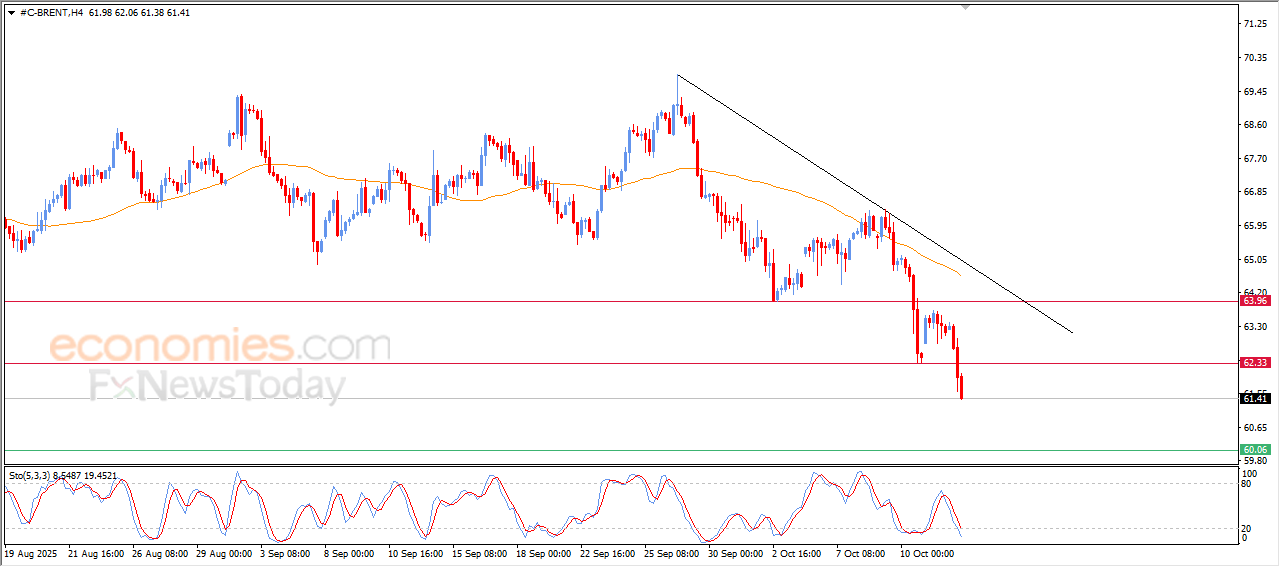
The (Brent) price witnessed fluctuated trading on its last intraday trading, amid the dominance of the main bearish trend on the short-term basis and its trading alongside steep bearish trendline that supports this track, with the continuation of the negative pressure due to its trading below EMA50, reducing the chances of the price’s recover on the near-term basis, besides the emergence of the negative signals on the relative strength indicators, after offloading its oversold conditions, opening the way for recording more of the losses in the upcoming period.
Get high-accuracy trading signals delivered directly to your Telegram. Subscribe to specialized packages tailored for the world’s top markets:
Full VIP signals performance report for 6-10, October 2025: