The main category of Forex News.
You can use the search box below to find what you need.
[wd_asp id=1]
The main category of Forex News.
You can use the search box below to find what you need.
[wd_asp id=1]
The GBPCHF affected by stochastic rally to the overbought level, forming some bullish correctional waves, recording 1.1015 level, but the main stability within the bearish channel’s levels, which represents 1.1055 level for the extension of the extra main resistance for the stability of the moving average 55 above the current trading, these factors makes us wait for preferring the bearish bias domination, which might target 1.0975 and 1.0955.
Note that the price rally above the bearish channel’s resistance and provides a positive close, will confirm its move to the bullish track, to begin targeting several positive stations by reaching 1.1095 initially.
The expected trading range for today is between 1.0955 and 1.1040
Trend forecast: Bearish
The GBPJPY pair ended its last bullish rally by providing a negative close below 66% Fibonacci correction level at198.80, to form an extra obstacle against the bullish attempts, which forces it to form a temporary correctional rebound at 197.85, attempting to catch its breath before resuming the main bullish attack.
Reminding you that the main stability within the bullish channel’s levels and its main support is located near 195.70, by forming extra support at 197.30 represented by 61.8%Fibonacci correction level, these factors make us wait for gathering new positive momentum that allows it to press on the mentioned obstacle and surpassing it will reinforce the chances of reaching the next target near 199.55.
The expected trading range for today is between 197.65 and 198.80
Trend forecast: Bullish
Silver (XAG/USD) is showing muted price action on Wednesday, slipping modestly lower but staying within Tuesday’s range. At the time of writing, the metal is trading around $35.75 during the American session, down roughly 0.46% on the day. The subdued movement reflects fading safe-haven demand, as signs of easing geopolitical tensions — particularly the truce between Iran and Israel — have cooled the recent risk premium that helped drive Silver to multi-year highs.
Silver is showing early signs of technical fatigue after a strong multi-week uptrend that saw the metal climb from sub-$30 levels to 13-year highs near $37.00. One of the key red flags came from a bearish divergence between price action and the Relative Strength Index (RSI). While spot Silver pushed to fresh multi-year highs last week, the RSI peaked earlier and has since trended lower. With RSI now easing toward 56, the bullish momentum appears to be moderating, inviting cautious profit-taking from short-term traders
Today’s price action sees XAG/USD trading near $35.75, modestly lower on the day, as it currently tests the lower boundary of a well-defined ascending channel. This structure has underpinned bullish momentum since mid-April. This support zone aligns closely with the middle Bollinger Band (20-day SMA), currently around $35.71. A decisive daily close below this confluence area could be the first concrete signal that bulls are losing grip.
The Bollinger Bands have started to contract after widening sharply during Silver’s rally. Such narrowing typically precedes a significant directional move. If the lower channel support around $35.60–$35.70 gives way, it could open the door toward deeper retracements near $34.00.
Volatility, as captured by the Average True Range (ATR 14), has also tapered off to 0.78, suggesting that the explosive moves of early June are giving way to more measured price action. This could mean that the market is entering a consolidation phase or preparing for a breakout reversal.
That said, the broader trend remains bullish unless a confirmed breakdown occurs. Traders will be watching whether bulls can defend this technical inflection zone and bounce back toward $37.00, or if the weight of profit-taking and reduced safe-haven flows forces a steeper correction.
Silver is a precious metal highly traded among investors. It has been historically used as a store of value and a medium of exchange. Although less popular than Gold, traders may turn to Silver to diversify their investment portfolio, for its intrinsic value or as a potential hedge during high-inflation periods. Investors can buy physical Silver, in coins or in bars, or trade it through vehicles such as Exchange Traded Funds, which track its price on international markets.
Silver prices can move due to a wide range of factors. Geopolitical instability or fears of a deep recession can make Silver price escalate due to its safe-haven status, although to a lesser extent than Gold’s. As a yieldless asset, Silver tends to rise with lower interest rates. Its moves also depend on how the US Dollar (USD) behaves as the asset is priced in dollars (XAG/USD). A strong Dollar tends to keep the price of Silver at bay, whereas a weaker Dollar is likely to propel prices up. Other factors such as investment demand, mining supply – Silver is much more abundant than Gold – and recycling rates can also affect prices.
Silver is widely used in industry, particularly in sectors such as electronics or solar energy, as it has one of the highest electric conductivity of all metals – more than Copper and Gold. A surge in demand can increase prices, while a decline tends to lower them. Dynamics in the US, Chinese and Indian economies can also contribute to price swings: for the US and particularly China, their big industrial sectors use Silver in various processes; in India, consumers’ demand for the precious metal for jewellery also plays a key role in setting prices.
Silver prices tend to follow Gold’s moves. When Gold prices rise, Silver typically follows suit, as their status as safe-haven assets is similar. The Gold/Silver ratio, which shows the number of ounces of Silver needed to equal the value of one ounce of Gold, may help to determine the relative valuation between both metals. Some investors may consider a high ratio as an indicator that Silver is undervalued, or Gold is overvalued. On the contrary, a low ratio might suggest that Gold is undervalued relative to Silver.
The EURJPY pair confirmed its surrender to the dominance of the temporary sideways bias, to notice its move between the extra support near 167.60 and the top of the last wave that is represented by 169.30 level, attempting to face stochastic negativity and keeping positive stability.
Therefore, we will keep waiting for the extra positive momentum, which allows it to settle above 169.30 then attack the resistance of the bullish channel at 170.00, to find an exit to move to a new positive station, while the price decline below the extra support that might force it to activate the bearish correctional track before any attempt to record any of the suggested positive targets.
The expected trading range for today is between 168.30 and 170.00
Trend forecast: Bullish
Gold (XAU/USD) has not yet given any confirmation of momentum to the upside, stuck between the $3,450 and $3,300 levels as traders weigh opposing forces. After a strong rebound from last week’s lows near $3,300, the yellow metal has struggled to sustain momentum. The upside has been capped as inflation data cooled and Treasury yields steadied.
Currently, Gold is hovering at the discount level of the overall range, signaling a bearish environment. Though Gold is in a bearish territory, this is still not yet a confirmed reversal to the downside, most especially, the tensions in the middle east, Israel and Iran, has not yet fully de-escalated, giving Gold reason to push up.
Gold’s price action now reflects indecision, with neither bulls nor bears taking full control ahead of high-impact events and amidst geopolitical tensions.
This scenario was also outlined in my latest article on Gold, Gold stalls despite war headlines: Bullish and bearish scenarios to watch & Dollar, majors, indices and Gold gameplan for this week.
Before:
After:
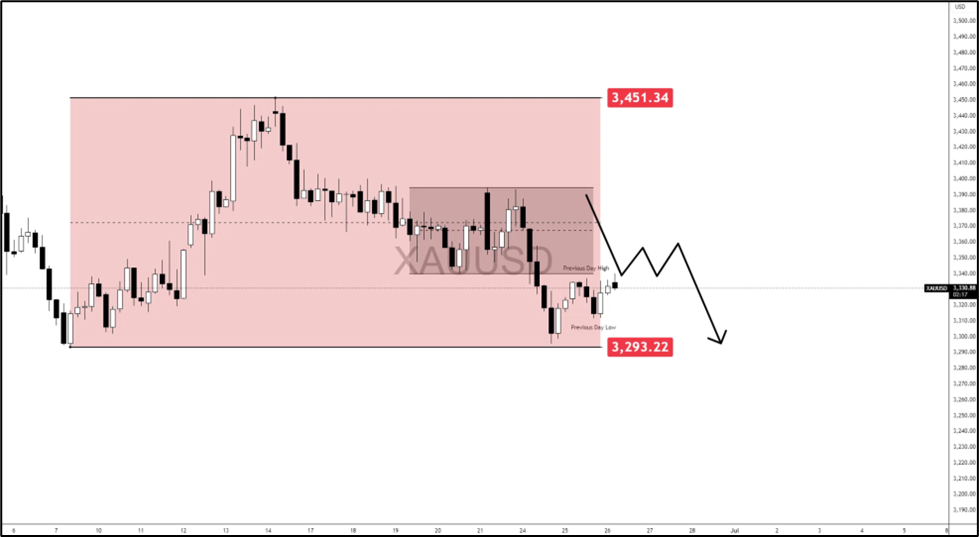
The narrative behind this is that if the ceasefire gains traction and Iran steps back and opens door to diplomacy, risk appetite may rebound, dragging gold down. A clean break and close below $3,300 would open downside potential to the $3,250 level or even $3,200. Also, the rejection of the midrange acted as a technical catalyst that weighs Gold down.
U.S.-Iran Talks On The Way Trump announced U.S.–Iran talks scheduled for next week and mediated with Qatar’s help, focusing on nuclear and broader peace matters.
Qatar’s mediation was pivotal in securing Iran’s support for the ceasefire after discussing terms with both Tehran and President Trump.
Both sides acknowledged the truce, but initial violations were reported: Iran fired missiles at Beersheba and Israel responded with strikes on Iranian facilities – each accusing the other of breach.
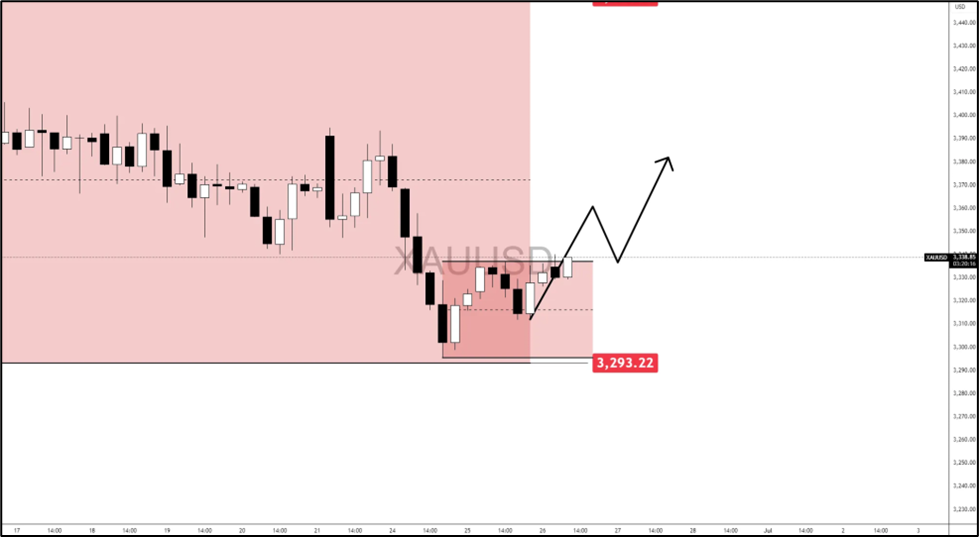
If Gold gains ground above the $3,330 level and a push through above the previous mid-range or equilibrium level, we might see further traction on Gold.
Another confluence that could lift Gold is if the tensions between Israel & Iran escalates and oil gets affect, this could raise safe-haven inflow on Gold.
Targets:
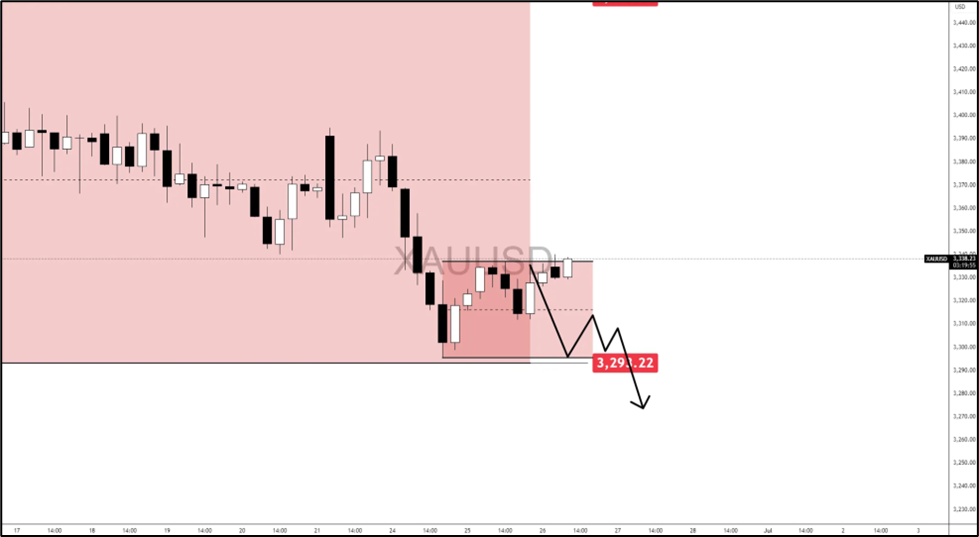
If Gold does not get an upside follow-through with a series of bullish candles above $3,340, Dollar gains traction, which is unlikely for now, and Gold breaks below $3,310 – $3,300 level, this could send the bullion for a renewed downside.
Targets:
While Gold remains fundamentally supported by long-term macro themes like central bank buying and inflation uncertainty, near-term direction will be decided by upcoming U.S. data and the Fed’s policy signals.
A breakout from the current range could provide a cleaner directional bias. Until then, patience is key.
A confirmed break on either side will likely invite strong momentum. Bias remains neutral to bullish unless $3,300-$3,400 is broken convincingly.
June 26, 2025 – Written by Tim Boyer
STORY LINK GBP/USD Forecast: Pound Sterling Price Ticks Higher to 1.371
The Pound US Dollar exchange rate (GBPUSD) traded without a clear direction on Wednesday amid a lack of both UK and US data releases.
The US Dollar (USD) regained some ground on Wednesday, recovering from losses earlier in the week that followed a ceasefire between Israel and Iran, a development that initially weighed on the safe-haven currency.
As market sentiment turned more neutral midweek, this helped stabilise demand for the ‘Greenback’.
Additional support came from Federal Reserve Chair Jerome Powell, who delivered testimony to Congress reaffirming the Fed’s cautious stance on interest rate cuts.
His pushback against political pressure to ease policy bolstered expectations that rates will remain higher for longer, offering a lift to USD exchange rates during Wednesday’s European session.
The Pound (GBP) lacked clear direction on Wednesday, trading sideways against the majority of its peers as a lull in UK economic data left markets with little to go on.
After benefiting earlier in the week from improved risk appetite, Sterling ran out of steam as sentiment cooled.
With no major UK releases to drive movement, investors showed little enthusiasm for extending positions in GBP.
As a result, the Pound remained stuck in a tight range, with limited momentum to break higher or lower during Wednesday’s European session.
Looking to Thursday’s European session, movement in the GBP/USD exchange rate is likely to be influenced by a flurry of key US economic releases.
Markets will dissect the latest US durable goods orders for May alongside the final estimate of Q1 GDP.
Orders for durable goods are expected to show a strong rebound, jumping from a sharp -6.3% to a robust 8.5% increase, potentially lending support to the US Dollar.
However, this may be offset by a disappointing GDP revision, with growth in the first quarter projected to be downgraded from 2.4% to -0.2%.
If these figures meet expectations, USD exchange rate movement could be choppy as traders weigh the conflicting signals.

On the UK side, attention will fall on the latest CBI distributive trades survey.
Although not typically a major market mover, a stronger-than-expected reading could help Sterling find some traction.
Additionally, remarks from Bank of England (BoE) policymakers, including Governor Andrew Bailey, could inject fresh volatility into GBP exchange rates.
Any hints that the BoE remains cautious about near-term rate cuts may provide a further lift to the Pound.
International Money Transfer? Ask our resident FX expert a money transfer question or try John’s new, free, no-obligation personal service! ,where he helps every step of the way,
ensuring you get the best exchange rates on your currency requirements.
TAGS: Pound Dollar Forecasts
Silver price advances by nearly 1% on Wednesday, as the US Dollar depreciates due to month-end flows, along with expectations of falling US Treasury yields. At the time of writing, XAG/USD trades at $36.25, after bouncing off daily lows of $35.68.
Even though Silver dipped to a new two-week low of $35.29 last Friday, the grey metal found bids, which pushed the spot price above $36.00 and formed a ‘morning star’ three-candle chart bullish pattern. Despite this, the Relative Strength Index (RSI) remained flat in bullish territory, suggesting that the pair is neutral to upwardly biased. If XAG/USD clears key resistance levels, then the uptrend could resume.
The first key area of interest will be the June 20 high of $36.42. Once surpassed, the next stop would be $37.00, followed by the multi-year high of $37.31.
On the flip side, if XAG/USD tumbles below the June 24 low of $35.29, expect a pullback all the way towards the 50-day Simple Moving Average (SMA) at $33.95.
Silver is a precious metal highly traded among investors. It has been historically used as a store of value and a medium of exchange. Although less popular than Gold, traders may turn to Silver to diversify their investment portfolio, for its intrinsic value or as a potential hedge during high-inflation periods. Investors can buy physical Silver, in coins or in bars, or trade it through vehicles such as Exchange Traded Funds, which track its price on international markets.
Silver prices can move due to a wide range of factors. Geopolitical instability or fears of a deep recession can make Silver price escalate due to its safe-haven status, although to a lesser extent than Gold’s. As a yieldless asset, Silver tends to rise with lower interest rates. Its moves also depend on how the US Dollar (USD) behaves as the asset is priced in dollars (XAG/USD). A strong Dollar tends to keep the price of Silver at bay, whereas a weaker Dollar is likely to propel prices up. Other factors such as investment demand, mining supply – Silver is much more abundant than Gold – and recycling rates can also affect prices.
Silver is widely used in industry, particularly in sectors such as electronics or solar energy, as it has one of the highest electric conductivity of all metals – more than Copper and Gold. A surge in demand can increase prices, while a decline tends to lower them. Dynamics in the US, Chinese and Indian economies can also contribute to price swings: for the US and particularly China, their big industrial sectors use Silver in various processes; in India, consumers’ demand for the precious metal for jewellery also plays a key role in setting prices.
Silver prices tend to follow Gold’s moves. When Gold prices rise, Silver typically follows suit, as their status as safe-haven assets is similar. The Gold/Silver ratio, which shows the number of ounces of Silver needed to equal the value of one ounce of Gold, may help to determine the relative valuation between both metals. Some investors may consider a high ratio as an indicator that Silver is undervalued, or Gold is overvalued. On the contrary, a low ratio might suggest that Gold is undervalued relative to Silver.
Pfizer’s stock price (PFE) rose in latest intraday trading and tackled the pivotal resistance of $24.50, amid the dominance of the upward correctional wave in the short term, with ongoing positive pressure due to trading above the 50-day SMA, coupled with positive divergence from the Stochastic after reaching oversold levels compared to the stock’s movements.
Therefore we expect the stock to rise as long as it breaches the aforementioned resistance of $24.50, targeting the next one at $26.50.
Today’s price forecast: Bullish
Nevertheless, what happens next will be more revealing. Dynamic support for the intermediate uptrend, beginning from January, is being tested. Gold needs to recover from support around the 50-Day MA if it is to retain the current trajectory. A decline below Tuesday’s low of $3,295 puts it at risk of dropping below an interim swing low at $3,293, which is part of the near-term uptrend that began following a test of support at the 50-Day MA. Other lower price levels that subsequently could see signs of support include the intersection of an uptrend and downtrend line (blue) around $3,272. There is also a top rising trend channel line (purple) crossing at the same point. Then, a little lower is a prior interim swing low at $3,245.
The purple rising channel represents the upswing that began from the October 2023 lows. A decisive bull breakout of the channel triggered on April 10, followed by a retracement that successfully tested the price area around the line as support. The current pullback is a second test of support near the top purple channel line.
It represents a longer trend than a shorter rising trend channel (blue) that began from the January lows. The point of highlighting where the three lines meet is that a decline below $3,272 will mean that both a downtrend line and top channel line have been broken. If price then stays below that price level, it will confirm the bearish sentiment.
Alternatively, support around the 50-Day MA holds and leads to a bullish reversal. An early sign of strength would be seen on a rally above today’s high, however, that would not be convincing enough to confirm a bullish reversal. Rather, a decisive rally above Tuesday’s high of $3,370 would be needed.
For a look at all of today’s economic events, check out our economic calendar.
On a weekly basis, this week’s decline put the price of natural gas at a four-week low, confirming a bearish reversal following last week’s trend high of $4.15. The decline below the lower uptrend line shows the potential for a bearish continuation as the current uptrend shows early signs of possible failure. However, there is also a good chance that support will be seen around the 200-Day MA and lead to a bullish reversal. Today is the fourth consecutive day of declines and bearish momentum started near last week’s high. So, there is a chance that selling momentum will decline. Although there is no sign of it yet.
It is also interesting to note that the prior bearish correction that followed the initial rally from the April swing low saw the price of natural gas decline by $0.74 (or 19.3%). That puts the current decline close to a match as it has led to a drop of as much as $0.78 (or 18.9%). When comparing price, the current decline exceeded the previous decline, but natural gas is now very close to matching on a percentage basis. Once there are similar swings, there is the potential for support to be seen.
Since there are only two more trading days for the week, there is a risk that natural gas confirms the recent bearish signals on a weekly basis. As noted above, support for the past several weeks was broken this week. The lower and therefore more significant weekly low was at $3.45, while last week’s low was $3.63.
For a look at all of today’s economic events, check out our economic calendar.