The main category of Forex News.
You can use the search box below to find what you need.
[wd_asp id=1]
The main category of Forex News.
You can use the search box below to find what you need.
[wd_asp id=1]

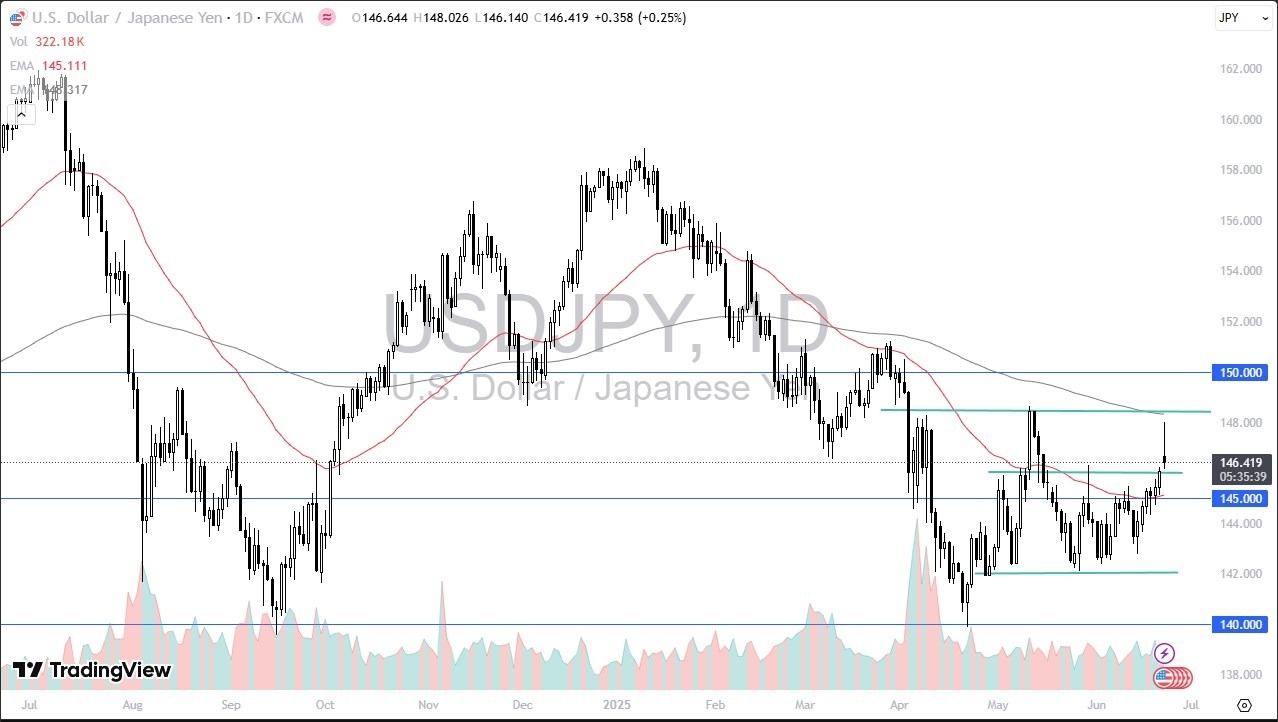
At this point in time, we have to ask whether or not there is a ceiling above, as the ¥148 level is an area that has caused resistance previously, and we have the 200 Day EMA hanging around in the same region. Because of this, I think you have a situation where it would take a lot to get above there, and the concern that we had over the weekend with the airstrike probably wasn’t enough to sustainably cause panic in the market.
Nonetheless, the Japanese yen has a lot of problems in and of itself, as the Bank of Japan has a major problem with the Japanese Government Bond markets, as there have been several days where there were no bids or buyers. Because of this, the Japanese yen is still a currency that I’m not a huge fan of, although of course in a panic we could see people running to it.
All things being equal, this is a market that will continue to be very noisy, but that’s nothing new for the Japanese yen. The ¥146 level is an area that has been important multiple times, so the question now is whether or not it will hold as support? That is a level that I would be watching the most right now, as it could determine whether or not we truly fall apart, or if we start to build another range in this market.
Want to trade our USD/JPY forex analysis and predictions? Here’s a list of forex brokers in Japan to check out.
Christopher Lewis has been trading Forex and has over 20 years experience in financial markets. Chris has been a regular contributor to Daily Forex since the early days of the site. He writes about Forex for several online publications, including FX Empire, Investing.com, and his own site, aptly named The Trader Guy. Chris favours technical analysis methods to identify his trades and likes to trade equity indices and commodities as well as Forex. He favours a longer-term trading style, and his trades often last for days or weeks.
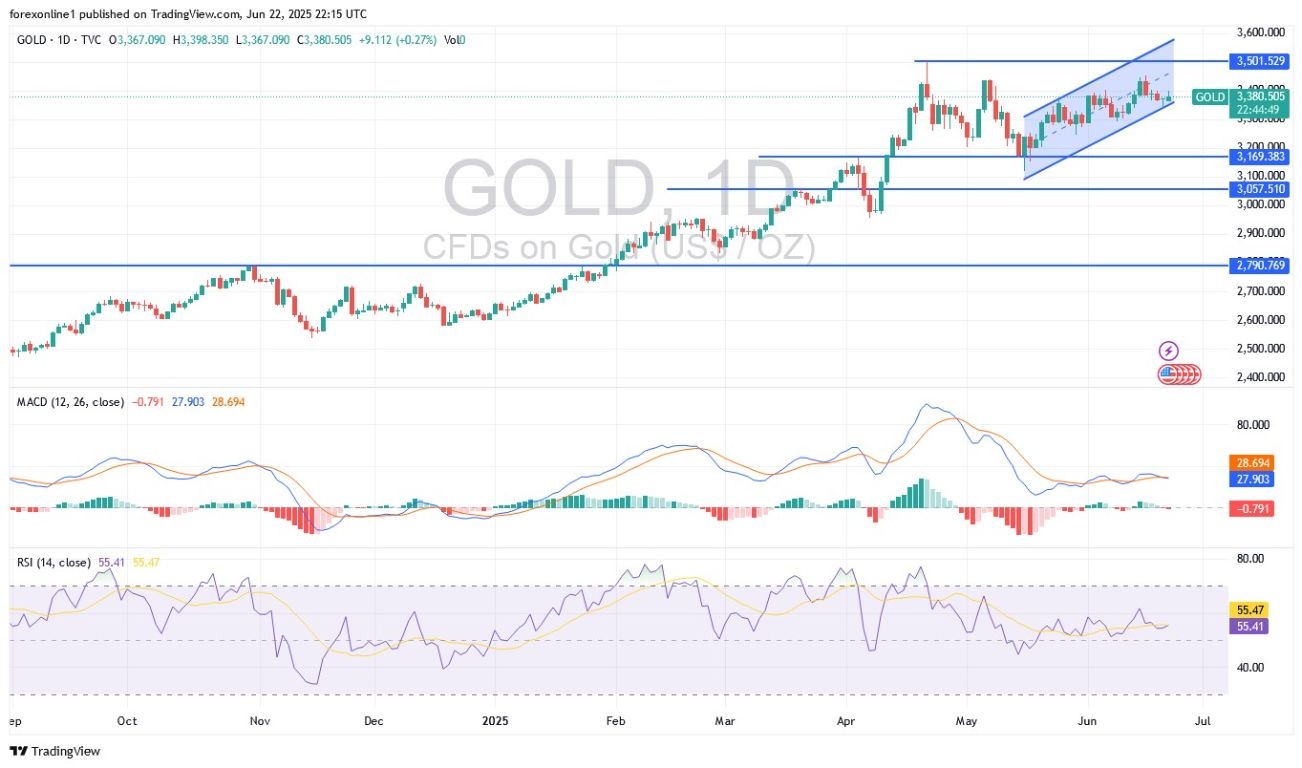
The selling pressure that gold prices experienced last week, which pushed them down to the $3340 per ounce support level before closing the week stable around the $3367 per ounce resistance, has not derailed gold’s upward trajectory. As mentioned before, the $3300 per ounce resistance will remain a strong catalyst for bulls to advance technically.
According to gold analysts’ forecasts, spot gold prices are expected to see a sharp increase due to escalating geopolitical tensions in the Middle East, ignited by news of a US airstrike on Iranian nuclear facilities. This development is driving strong demand for safe-haven gold bullion. Consequently, analysts now expect gold prices to range between $3500 and $3700 per ounce, as investors hedge against geopolitical instability and inflation risks.
On the other hand, there is a catalyst for the gold market. Global central bank reserves continue to accumulate. According to the World Gold Council, central banks added a total of 290 metric tons in the first quarter of 2025, the strongest first quarter on record. This follows record annual purchases in 2022, 2023, and 2024, driven by purchases from China, India, and other emerging economies seeking to reduce their dependence on the US dollar.
We still advise following the strategy of buying gold on every dip, but without taking risks and distributing entry percentages across multiple trades from different areas.
According to performance across gold trading platforms, gold prices have gained over 25% so far in 2025, underscoring growing investor demand for precious metals amidst increasing uncertainty. Overall, gold remains the world’s second-largest reserve asset, serving as a safe haven for over $21 trillion. Under current conditions, gold is expected to see a sharp rise. While gold benefits from its safe-haven appeal, silver – 60% of whose demand is linked to the industrial and renewable sectors – may lag. Analysts warn that a worsening conflict could raise recession fears, putting pressure on silver in the medium term.
In this regard, Goldman Sachs has reaffirmed its structurally optimistic forecasts for the future path of gold prices, citing strong demand from global central banks as a key factor in raising the gold-to-silver ratio. The bank does not expect silver to match gold’s pace and anticipates gold to outperform. Goldman Sachs’ base forecast predicts gold reaching $3700 per ounce by the end of 2025 and the $4000 per ounce resistance level by mid-2026.
In a recessionary scenario, accelerated ETF inflows could push gold to $3880 by the end of 2025. Under extreme risk conditions – such as concerns about the Federal Reserve’s independence or shifts in US Federal Reserve policy – gold prices could surge to $4500.
Ready to trade our Gold daily analysis and predictions? We’ve made a list of the best Gold trading platforms worth trading with.
Spot Gold trades around $3,900, nearing its early peak at $3,397.33 in the mid-American session. The bright metal gapped north at the weekly opening amid the escalation of the Iran-Israel crisis after the involvement of the United States (US). President Donald Trump announced on Saturday that his country successfully destroyed Iranian nuclear facilities in three locations, Fordow, Natanz and Isfahan, pushing investors into safety.
The US Dollar (USD) found some near-term demand during European trading hours, resulting in XAU/USD pulling back sharply towards the $3340 region. Still, the American opening brought another round of risk aversion, amid market talks indicating Iran launched a missile attack on US military bases in Doha, Qatar.
Meanwhile, speculative interest read beyond encouraging US data. S&P Global reported higher-than-anticipated preliminary June Purchasing Managers’ Indexes (PMIs). The manufacturing index posted 52, matching the May reading but above the expected 51. The Services PMI eased from the previous 53.7 to 53.1, which is above the anticipated 52.9. As a result, the Composite PMI printed at 52, slightly above the 51 expected.
Middle East headlines will likely overshadow everything else in the upcoming days, although it is worth mentioning that US Federal Reserve (Fed) Chairman Jerome Powell is due to testify about the Semiannual Monetary Policy Report before Congress on Tuesday. Given the recent developments, there are rising odds that Powell will be asked to explain what the Fed plans to do if tariffs come into effect and the Middle East conflict escalates.
The daily chart for XAU/USD shows it bounced sharply from a directionless 20 Simple Moving Average (SMA), which, anyway, develops far above bullish 100 and 200 SMAs. The shorter moving average currently provides dynamic support at around $3,352.70. Other than that, technical indicators bounced from around their midlines, but lack enough strength to support another leg north.
In the near term, and according to the 4-hour chart, XAU/USD is losing its bullish impetus. The pair is developing above all its moving averages, which lack clear directional strength. Technical indicators in the meantime, turned flat after crossing their midlines into positive territory.
Support levels: 3,366.10 3,352.70 3,340.20
Resistance levels: 3,406.90 3,414.60 3,431.10
Natural gas price activated the bearish correctional track after recording $4.160 level, affected by stochastic exit from the overbought level, activating the attempts of gathering gains by reaching $3.900.
Depending on forming extra support at $3.830 level, to reduce the risk of suffering extra losses, to keep waiting for gathering the positive momentum, which allows it to renew the bullish attempts and reaching $4.050 and $4.220.
The expected trading range for today is between $3.850 and $4.050
Trend forecast: Bullish
Less than two weeks ago, the U.S. was discussing a new nuclear deal with Iran, the International Energy Agency was forecasting an oil market oversupply, and commodity analysts were reiterating their expectations of an average Brent price around $60. Now, Brent is heading towards $80.
And it may be just the beginning.
Oil prices rose after Israel started bombing Iran, which was little surprise, and then they stopped rising as traders saw there was no direct threat of supply disruption. The wild card this time turned out to be President Trump. In a matter of days, Trump first imposed new sanctions on Iran, which made most market players think he’d stick with non-violent methods of dealmaking. Then, on Saturday, the United States bombed Iran’s nuclear facilities—and Iran said it’s shutting the Strait of Hormuz.
Interestingly, the early reactions from Middle Eastern stock markets were rather optimistic, at least according to a Reuters report that came out Sunday. The report said trader behavior suggested most expected a “benign outcome” of the bombing campaign. The report also quoted traders as saying they expected a selloff today and a run on safe haven assets such as the U.S. dollar.
Also on Sunday, Iran’s Press TV reported that the country’s parliament had approved the move to close the Strait of Hormuz in retaliation for the U.S. attack on the nuclear sites—for which the Interntional Atomic Energy Agency had said did not feature weapons-grade uranium but U.S. intelligence has disputed this.
The threat of Iran closing off the chokepoint that handles a third of global maritime oil trade, amounting to over 20 million barrels daily, has been there forever. Until now, however, Iran had never moved to actually close it, which highlights the special nature of this latest Middle Eastern war. The final decision is not hard to predict. And this means that Brent at $80 is only the beginning.
Goldman Sachs already threw its latest oil price forecast out the window, now expecting Brent at $110 per barrel in case of a Hormuz shutdown, noting this scenario could materialize if oil flows via the strait were halved for a month. ING, for its part, wrote that “an effective blocking of the Hormuz would lead to a dramatic shift in the outlook for oil, pushing the market into deep deficit”—again, days after all forecasts appeared in agreement that the market for crude oil is oversupplied, including ING’s own outlook.
It appears, then, that the oil market’s balance is a fragile thing. It can so easily be tipped into a deficit—even with the U.S. Fifth Fleet stationed in Bahrain, and ready to respond to any move by Iran to close off the Strait of Hormuz, as already pointed out by commentators such as Reuters’ Ron Bousso. There have been disruptions to the flow of oil via the Strait of Hormuz before, but they have never lasted long, Bousso pointed out, adding that war-driven oil price rallies never last long.
Of course, this would depend on one’s interpretation of “long”. In 2022, oil soared for months, which, at least in Europe, did not really feel like a very short time. And this time, there is also LNG to consider. Most of Qatar’s LNG flows pass via the Strait of Hormuz. If Iran mines the chokepoint, LNG prices will surge as well—whether for weeks or months, but they will surge. This is very bad news for countries that need to refill their wintertime reserve—which is most of them.
Some point out OPEC’s spare capacity as a guarantee for market stability. The problem with that spare capacity is that, as ING pointed out in its Sunday note, most of it is in the Persian Gulf, which makes it unusable in case of fighting in the area, which is what is going to happen if Iran shuts off the Strait of Hormuz and the U.S. Fifth Fleet responds. This, in turn, means that prices may rise and stay high for a while yet. This is inconvenient for the U.S., as suggested by reports that Secretary of State Marco Rubio had approached China to try and “dissuade” Iran from shutting off Hormuz, noting Iran itself was heavily dependent on oil exports via that chokepoint.
However, Iran has been loading tankers like there’s no tomorrow in the past week or so. Iran, in other words, has been preparing for a certain eventuality involving a disruption to oil exports. Granted, it won’t be able to keep going for very long without oil exports, but, as all those commentators say, a Hormuz blockade would not last very long—unless it somehow does, because right now, all bets seem to be off when it comes to the Middle East. There is only one thing that is certain: the oil market is not oversupplied, and Brent is not going to average $60 this year.
By Irina Slav for Oilprice.com
More Top Reads From Oilprice.com
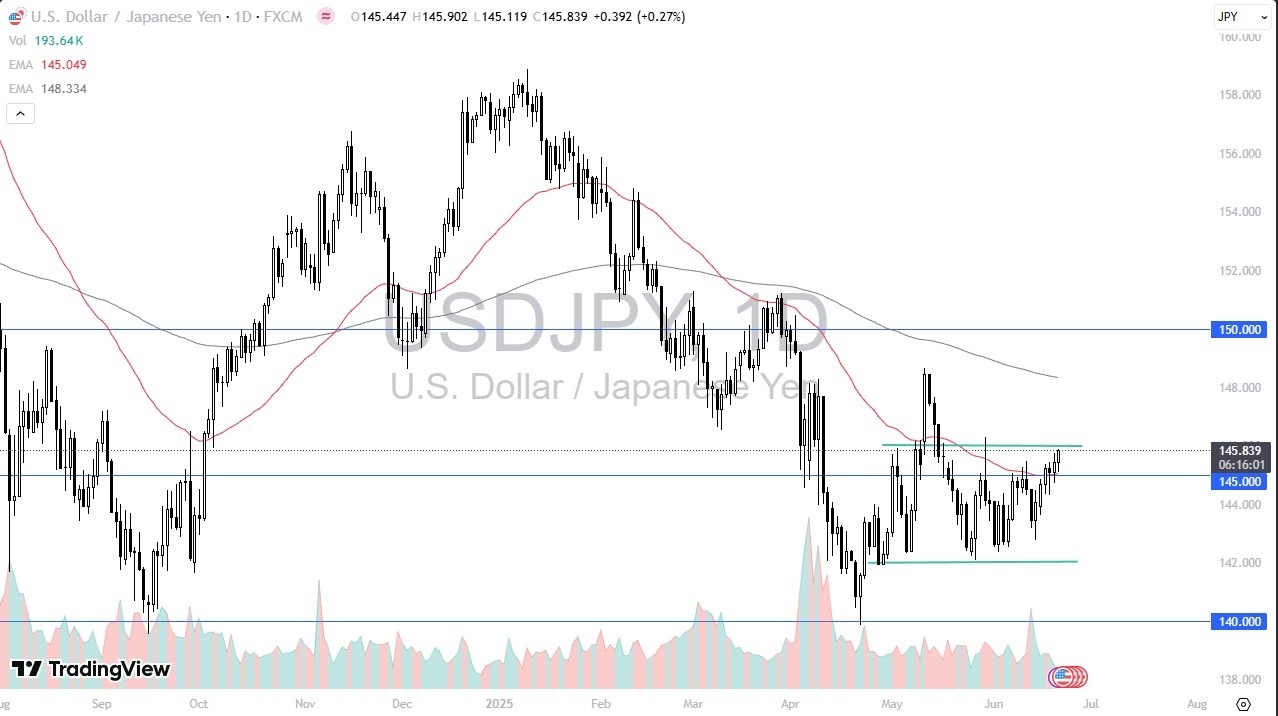
I think were in the middle of a bottoming process, but I don’t necessarily think that we are just going to sliced through ¥146 level easily. The fact that we have been bouncing around in this range for a while now makes a certain amount of sense, with the ¥142 level is a major support level, and has offered a bit of a bottom for the market. Ultimately, I think short-term pullbacks are likely, but I also think they are more likely than not going to be bought into, because that is what we have seen over the last several weeks. Ultimately, the interest rate differential continues to favor the US dollar, so I think that as a little bit of a buffer anyway.
If we were to break down below the ¥142 level, then it opens up the possibility of a move down to the ¥140 level, which of course is an area that has been supported previously, and it is a large, round, psychologically significant figure, and an area where we see a lot of interest in this area. That being said, the market continues to be very noisy, so look for some type of value in order to take advantage of it on dips, but I’m starting to like the upside much more than I did just a few weeks ago.
Want to trade our USD/JPY forex analysis and predictions? Here’s a list of forex brokers in Japan to check out.
Christopher Lewis has been trading Forex and has over 20 years experience in financial markets. Chris has been a regular contributor to Daily Forex since the early days of the site. He writes about Forex for several online publications, including FX Empire, Investing.com, and his own site, aptly named The Trader Guy. Chris favours technical analysis methods to identify his trades and likes to trade equity indices and commodities as well as Forex. He favours a longer-term trading style, and his trades often last for days or weeks.
Important DisclaimersThe content provided on the website includes general news and publications, our personal analysis and opinions, and contents provided by third parties, which are intended for educational and research purposes only. It does not constitute, and should not be read as, any recommendation or advice to take any action whatsoever, including to make any investment or buy any product. When making any financial decision, you should perform your own due diligence checks, apply your own discretion and consult your competent advisors. The content of the website is not personally directed to you, and we does not take into account your financial situation or needs.The information contained in this website is not necessarily provided in real-time nor is it necessarily accurate. Prices provided herein may be provided by market makers and not by exchanges.Any trading or other financial decision you make shall be at your full responsibility, and you must not rely on any information provided through the website. FX Empire does not provide any warranty regarding any of the information contained in the website, and shall bear no responsibility for any trading losses you might incur as a result of using any information contained in the website.The website may include advertisements and other promotional contents, and FX Empire may receive compensation from third parties in connection with the content. FX Empire does not endorse any third party or recommends using any third party’s services, and does not assume responsibility for your use of any such third party’s website or services.FX Empire and its employees, officers, subsidiaries and associates, are not liable nor shall they be held liable for any loss or damage resulting from your use of the website or reliance on the information provided on this website.Risk DisclaimersThis website includes information about cryptocurrencies, contracts for difference (CFDs) and other financial instruments, and about brokers, exchanges and other entities trading in such instruments. Both cryptocurrencies and CFDs are complex instruments and come with a high risk of losing money. You should carefully consider whether you understand how these instruments work and whether you can afford to take the high risk of losing your money.FX Empire encourages you to perform your own research before making any investment decision, and to avoid investing in any financial instrument which you do not fully understand how it works and what are the risks involved.
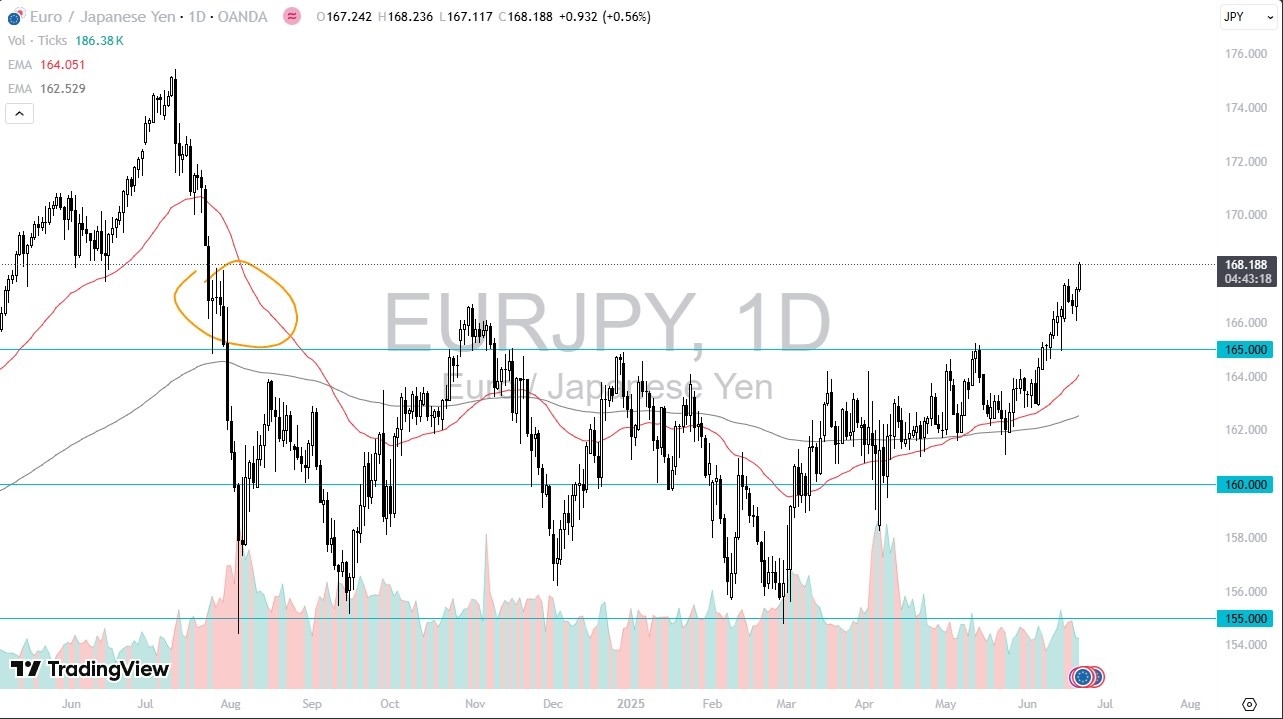
So, you either let the debt go to massive losses in the banking sector or you have to buy it yourself if you’re the Bank of Japan. History tells us they tend to buy it themselves and therefore I think that’s part of what’s going on because even the US dollar is starting to tear up the Japanese yen at this point. Now that we have cleared the 168 yen level, I do think that we are free to go higher, probably as high as 172 yen.
But it doesn’t necessarily mean that we get there in a straight line. This is also a risk on move as it were, but I think this probably has more to do with the yen itself, at least at the moment. If we pull back, the 165 yen level would be your floor. And although it is 300 points away as I record this, I understand that you’re going to need a lot of pips as far as a stop loss is concerned in order to absorb the potential volatility here.
Markets have been extraordinarily volatile due to basically everything that’s going on in the world. So that translates to smaller sizes and to positions and larger ranges of stop losses. It’s the only thing you can control. With this, think short-term pullbacks continue to be buying opportunities and I do think we will go higher.
Begin trading our daily forecasts and analysis. Here is a list of Forex brokers in Japan to work with.
Christopher Lewis has been trading Forex and has over 20 years experience in financial markets. Chris has been a regular contributor to Daily Forex since the early days of the site. He writes about Forex for several online publications, including FX Empire, Investing.com, and his own site, aptly named The Trader Guy. Chris favours technical analysis methods to identify his trades and likes to trade equity indices and commodities as well as Forex. He favours a longer-term trading style, and his trades often last for days or weeks.
Natural gas price activated the bearish correctional track after recording $4.160 level, affected by stochastic exit from the overbought level, activating the attempts of gathering gains by reaching $3.900.
Depending on forming extra support at $3.830 level, to reduce the risk of suffering extra losses, to keep waiting for gathering the positive momentum, which allows it to renew the bullish attempts and reaching $4.050 and $4.220.
The expected trading range for today is between $3.850 and $4.050
Trend forecast: Bullish
After losing nearly 1% in the previous week, GBP/USD stays under bearish pressure on Monday and trades at its lowest level in a month below 1.3400. In case safe-haven flows continue to dominate the action in financial markets in the second half of the day, the pair could continue to stretch lower.
The table below shows the percentage change of British Pound (GBP) against listed major currencies today. British Pound was the weakest against the Euro.
| USD | EUR | GBP | JPY | CAD | AUD | NZD | CHF | |
|---|---|---|---|---|---|---|---|---|
| USD | -0.08% | 0.16% | 0.83% | 0.24% | 0.77% | 1.00% | 0.12% | |
| EUR | 0.08% | 0.23% | 0.93% | 0.33% | 0.80% | 1.07% | 0.16% | |
| GBP | -0.16% | -0.23% | 0.77% | 0.13% | 0.58% | 0.86% | -0.06% | |
| JPY | -0.83% | -0.93% | -0.77% | -0.60% | -0.09% | 0.23% | -0.78% | |
| CAD | -0.24% | -0.33% | -0.13% | 0.60% | 0.57% | 0.75% | -0.16% | |
| AUD | -0.77% | -0.80% | -0.58% | 0.09% | -0.57% | 0.26% | -0.66% | |
| NZD | -1.00% | -1.07% | -0.86% | -0.23% | -0.75% | -0.26% | -0.91% | |
| CHF | -0.12% | -0.16% | 0.06% | 0.78% | 0.16% | 0.66% | 0.91% |
The heat map shows percentage changes of major currencies against each other. The base currency is picked from the left column, while the quote currency is picked from the top row. For example, if you pick the British Pound from the left column and move along the horizontal line to the US Dollar, the percentage change displayed in the box will represent GBP (base)/USD (quote).
The negative shift seen in risk sentiment helps the US Dollar (USD) outperform its rivals and weighs on GBP/USD on Monday. Market participants grow increasingly worried about a widening and deepening conflict in the Middle East following the United States’ decision to strike three nuclear facilities in Iran over the weekend.
Meanwhile, the data from the UK showed that the business activity in the private sector expanded at an accelerating pace in June, with the S&P Global Composite Purchasing Managers Index (PMI) improving to 50.7 from 50.3 in May. This reading, however, failed to support Pound Sterling.
Later in the day, the US economic calendar will feature S&P Global PMI data for June. Markets expect the Manufacturing PMI to edge lower to 51 from 52 in May and see the Services PMI retreating to 52.9 from 53.7. In case either of these PMIs come in below 50, the USD could come under selling pressure. Nevertheless, the market reaction could remain short-lived in the current market environment, with investors staying focused on geopolitics. A further escalation in the Iran-Israel crisis could boost the USD and cause GBP/USD to extend its slide in the near term.
The Relative Strength Index (RSI) indicator on the 4-hour chart declines toward 30 and GBP/USD continues to pull away from the 200-period Simple Moving Average (SMA), reflecting a buildup of bearish momentum.
On the downside, 1.3340 (Fibonacci 61.8% retracement of the latest uptrend) aligns as the next support level before 1.3300 (round level, static level) and 1.3260 (Fibonacci 78.6 retracement). Looking north, resistance levels could be spotted at 1.3400 (Fibonacci 50% retracement), 1.3450 (Fibonacci 38.2% retracement, 200-period SMA) and 1.3500 (static level, round level).
The Pound Sterling (GBP) is the oldest currency in the world (886 AD) and the official currency of the United Kingdom. It is the fourth most traded unit for foreign exchange (FX) in the world, accounting for 12% of all transactions, averaging $630 billion a day, according to 2022 data.
Its key trading pairs are GBP/USD, also known as ‘Cable’, which accounts for 11% of FX, GBP/JPY, or the ‘Dragon’ as it is known by traders (3%), and EUR/GBP (2%). The Pound Sterling is issued by the Bank of England (BoE).
The single most important factor influencing the value of the Pound Sterling is monetary policy decided by the Bank of England. The BoE bases its decisions on whether it has achieved its primary goal of “price stability” – a steady inflation rate of around 2%. Its primary tool for achieving this is the adjustment of interest rates.
When inflation is too high, the BoE will try to rein it in by raising interest rates, making it more expensive for people and businesses to access credit. This is generally positive for GBP, as higher interest rates make the UK a more attractive place for global investors to park their money.
When inflation falls too low it is a sign economic growth is slowing. In this scenario, the BoE will consider lowering interest rates to cheapen credit so businesses will borrow more to invest in growth-generating projects.
Data releases gauge the health of the economy and can impact the value of the Pound Sterling. Indicators such as GDP, Manufacturing and Services PMIs, and employment can all influence the direction of the GBP.
A strong economy is good for Sterling. Not only does it attract more foreign investment but it may encourage the BoE to put up interest rates, which will directly strengthen GBP. Otherwise, if economic data is weak, the Pound Sterling is likely to fall.
Another significant data release for the Pound Sterling is the Trade Balance. This indicator measures the difference between what a country earns from its exports and what it spends on imports over a given period.
If a country produces highly sought-after exports, its currency will benefit purely from the extra demand created from foreign buyers seeking to purchase these goods. Therefore, a positive net Trade Balance strengthens a currency and vice versa for a negative balance.