The main category of Forex News.
You can use the search box below to find what you need.
[wd_asp id=1]
The main category of Forex News.
You can use the search box below to find what you need.
[wd_asp id=1]
Important DisclaimersThe content provided on the website includes general news and publications, our personal analysis and opinions, and contents provided by third parties, which are intended for educational and research purposes only. It does not constitute, and should not be read as, any recommendation or advice to take any action whatsoever, including to make any investment or buy any product. When making any financial decision, you should perform your own due diligence checks, apply your own discretion and consult your competent advisors. The content of the website is not personally directed to you, and we does not take into account your financial situation or needs.The information contained in this website is not necessarily provided in real-time nor is it necessarily accurate. Prices provided herein may be provided by market makers and not by exchanges.Any trading or other financial decision you make shall be at your full responsibility, and you must not rely on any information provided through the website. FX Empire does not provide any warranty regarding any of the information contained in the website, and shall bear no responsibility for any trading losses you might incur as a result of using any information contained in the website.The website may include advertisements and other promotional contents, and FX Empire may receive compensation from third parties in connection with the content. FX Empire does not endorse any third party or recommends using any third party’s services, and does not assume responsibility for your use of any such third party’s website or services.FX Empire and its employees, officers, subsidiaries and associates, are not liable nor shall they be held liable for any loss or damage resulting from your use of the website or reliance on the information provided on this website.Risk DisclaimersThis website includes information about cryptocurrencies, contracts for difference (CFDs) and other financial instruments, and about brokers, exchanges and other entities trading in such instruments. Both cryptocurrencies and CFDs are complex instruments and come with a high risk of losing money. You should carefully consider whether you understand how these instruments work and whether you can afford to take the high risk of losing your money.FX Empire encourages you to perform your own research before making any investment decision, and to avoid investing in any financial instrument which you do not fully understand how it works and what are the risks involved.
Platinum price began forming some correctional trading after recording $1348.00 level, attempting to gather the gains by reaching $1275.00, which forms an extra support for the bullish scenario.
The price might be forced to form temporary sideways fluctuation until gathering the extra positive momentum, to ease the mission of reaching $1330.00, then wait to hit the next target near $1368.00, while the risk of changing the main trend will depend on the attempt of the price to decline below 1225.00 and providing repeated negative closes.
The expected trading range for today is between $1255.00 and $1330.00
Trend forecast: Bullish
The GBPJPY pair provided some positive signals by its stability above the extra support at 194.00 and its rally above the support of the bullish channel near 194.50, which allows it to achieve some gains by reaching 196.32.
Stochastic begin to provide positive momentum will increase the chances for forming new bullish waves, to expect targeting 196.65 level, reaching 61.8%Fibonacci correction level near 197.45, forming the next main target of the current trading.
The expected trading range for today is between 195.20 and 196.60
Trend forecast: Bullish
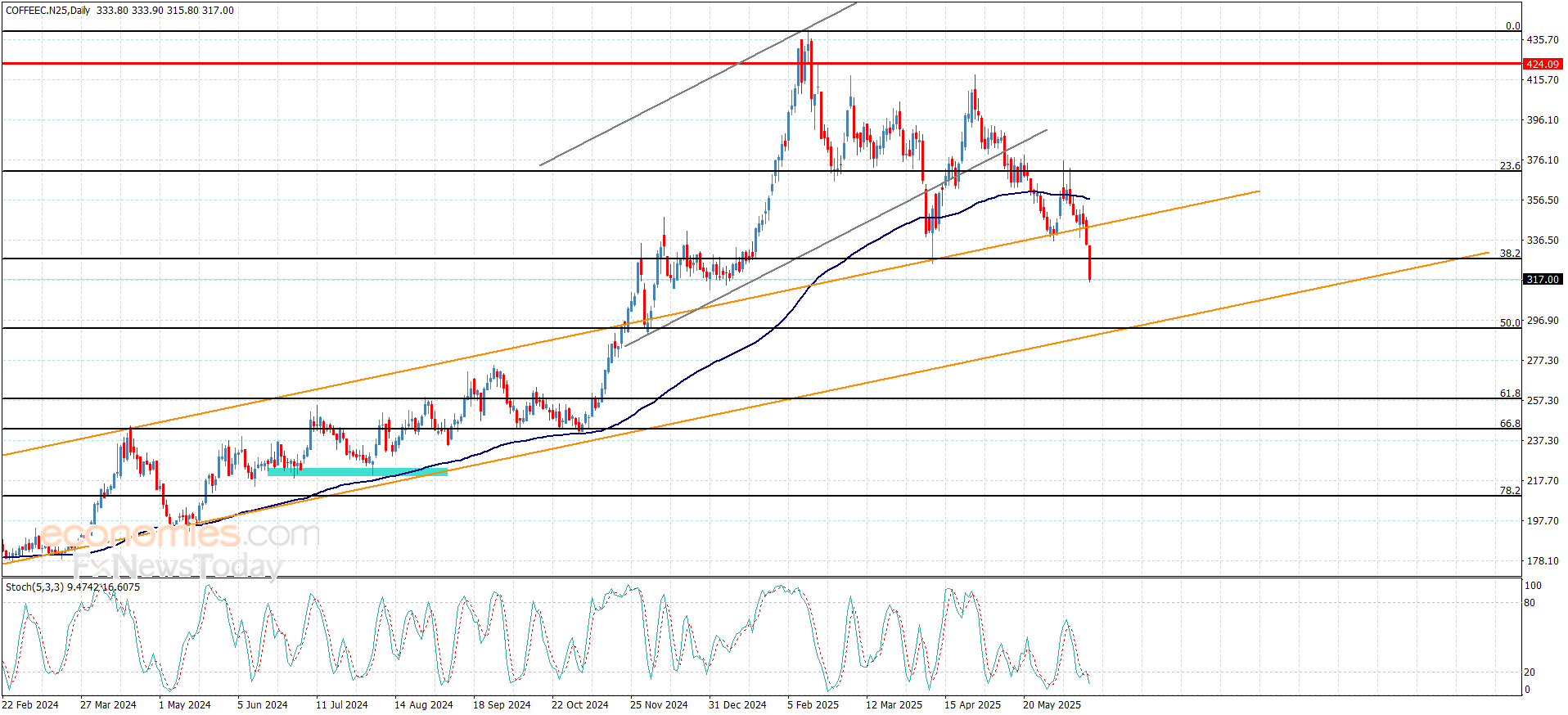
Coffee prices confirmed their surrender to the bearish bias domination yesterday below the extra support at 345.00, forming a sharp decline, and breaking 38.2%Fionacci correction level at 326.60 to settle near 317.00.
Stochastic attempts to reach the oversold levels will increase the chances for gathering the negative momentum, which makes us prefer more of the negative attempts that target 309.60 level, reaching the next support at 293.50.
The expected trading range for today is between 309.60 and 330.00
Trend forecast: Bearish
The EURJPY pair ended its rally above 166.40 level, to notice recording some extra gains by hitting 167.70 level, taking advantage of its main stability with the bullish channel’s levels besides stochastic attempt to provide extra positive momentum by its fluctuation near 80 level.
Therefore, we will keep our bullish scenario, which targets 168.20 level reaching to the resistance of the bullish channel at 169.45, to form the main target of the current period trading.
The expected trading range for today is between 166.75 and 168.20
Trend forecast: Bullish
This “higher-for-longer” stance dampens demand for non-yielding assets, such as gold. “The Fed remains committed to keeping policy tight until inflation is sustainably at 2%,” the FOMC noted. This shift in tone pushed real yields higher and pressured precious metals across the board.
Silver (XAG/USD) mirrored gold’s weakness, dipping to an intraday low of $35.66 before stabilizing near $35.63. Despite the Fed-driven pressure, silver’s downside was limited by broader risk aversion and continued demand for safe-haven assets.
Technical structure remains supported by the 50-day EMA and higher-low formations, while buyers appear to be stepping in at key levels, anticipating a rebound should uncertainty deepen across global markets.
Despite monetary policy headwinds, gold and silver continue to benefit from global uncertainty. Geopolitical tensions in key regions and trade policy risks—especially the potential for new U.S. tariffs ahead of the July 9 deadline—are fueling cautious positioning across equities and commodities.
Investors remain sensitive to any escalation in global tensions or disruptions in trade flows, which could reignite demand for metals. “We’re in a holding pattern, but safe-haven appetite could return quickly if headlines worsen,” noted a Hong Kong-based metals trader.
The U.S. Dollar Index slipped modestly following the Fed’s policy announcement, offering minor support to gold and silver. A weaker greenback typically benefits dollar-denominated assets, especially when paired with a broad risk-off tone seen in global equities.
June 20, 2025 – Written by Ben Hughes
STORY LINK Pound Rate Today: Short Covering Underpins GBP vs EUR, USD
The British Pound (GBP) dipped against the Euro (EUR) and US Dollar (USD) in immediate response to the Bank of England (BoE) interest rate decision, but found solid support on dips with an element of short covering after the currency failed to extend losses.
Global markets were subdued amid a US market holiday, but conditions were still very tense given speculation over a US military strike on Iran’s nuclear infrastructure.
The Pound to Euro (GBP/EUR) exchange rate dipped to 1.1685 before a recovery to 1.1710 and marginal gains on the day
According to ING; “We retain a short-term target in EUR/GBP at 0.860. (1.1630 for GBP/EUR). It added; “Geopolitical risks and a potential return of trade-induced market volatility in July argue that the balance of risks remains tilted to the upside for the pair despite the recent rally.”
The Pound to Dollar (GBP/USD) exchange rate hit lows near 1.3400 before a rebound to near 1.3450.
Scotiabank commented; “The multi-month trend is intact, for now, as GBPUSD tests the important medium-term 50 day MA (1.3390) support level. A break from here would call for a more decisive call in the trend shift. The latest pair of doji candles signals uncertainty, and we expect the near-term range to be defined by support below 1.3380 and resistance above 1.3480.”
The Monetary Policy Committee (MPC) held interest rates at 4.25%, in line with strong consensus forecasts with the chances of a cut seen at below 5%.
There was no updated Monetary Policy Report at this meeting and, therefore, no fresh macroeconomic forecasts.
There was a 6-3 vote split for the decision with Dhingra, Taylor and Ramsden dissenting and calling for a further 25 basis-point cut to 4.00% at this meeting.
According to Handelsbanken UK economist Daniel Mahoney; “The central bank’s decision was slightly more dovish than expected.”
He added; “I think most people in the markets thought there would be a 7-2 so I think that’s interesting, but I think those three members are obviously focusing on some of those domestic indicators.”
The key theme was uncertainty, especially given important trade and Middle East tensions.
The bank maintained its overall guidance; “Given the outlook, and continued disinflation, a gradual and careful approach to the further withdrawal of monetary policy restraint remained appropriate.”
It added; “The Committee would continue to monitor closely the risks of inflation persistence and what the evidence might reveal about the balance between aggregate supply and demand in the economy.”

It noted that wages growth has slowed and expects this process will continue, but it was still not willing to sound the “all clear” on wages or inflation.
In this context, it stated that further progress is needed to reach the 2% target.
The majority was confident that disinflation was continuing but commented that; “there was not a strong case for a further easing of monetary policy at this meeting.”
Governor Bailey commented; “The world is highly unpredictable. In the UK we are seeing signs of softening in the labour market. We will be looking carefully at the extent to which those signs feed through to consumer price inflation.”
There will also be concerns over any further increase in energy prices.
ING commented; “The hawks, meanwhile, will also have a beady eye on oil prices. Though the rise so far won’t make much difference to the inflation outlook we know some at the Bank are wary of a repeat of 2022, where a rise in energy prices turned into a much wider and more persistent services-driven inflation episode.
PwC chief economist Barret Kupelian also noted geopolitical uncertainty and the threat of a surge in oil prices.
He added; “If that rally embeds itself into wage setting or in household bills, the upside risk to inflation could well push any rate cut further down the calendar. In these murky waters, patience is the Bank’s best compass, steering a steady course between hawkish overreach and premature relief.”
Handelsbanken’s Mahoney considered that comments that the bank is not on a pre-set path was a “critical point.”
In this context, a major spike in oil prices could force the bank to consider a rate hike.
According to the minority, policy was too restrictive at the current time and a further cut was needed at this time to avoid inflation falling too far below 2%.
Markets are now pricing in an 80% chance that rates will be lowered to 4.00% at the August meeting.
Traders also expect that there will be at least one further cut before the end of 2025.
ING added; “our base case is that the BoE cuts rates in August and November, and twice more in 2026.”
Simon Dangoor, head of fixed income macro strategies at Goldman Sachs added; “We continue to expect the bank to resume rate cuts in August, followed by a shift to consecutive reductions starting in November, ultimately bringing the bank rate down to 3.25%.”
Berenberg is not expecting further cuts this year due to upward pressure on costs; “As companies pass those costs on, inflation is likely to prove too stubborn for the Bank to cut again this year.”
International Money Transfer? Ask our resident FX expert a money transfer question or try John’s new, free, no-obligation personal service! ,where he helps every step of the way,
ensuring you get the best exchange rates on your currency requirements.
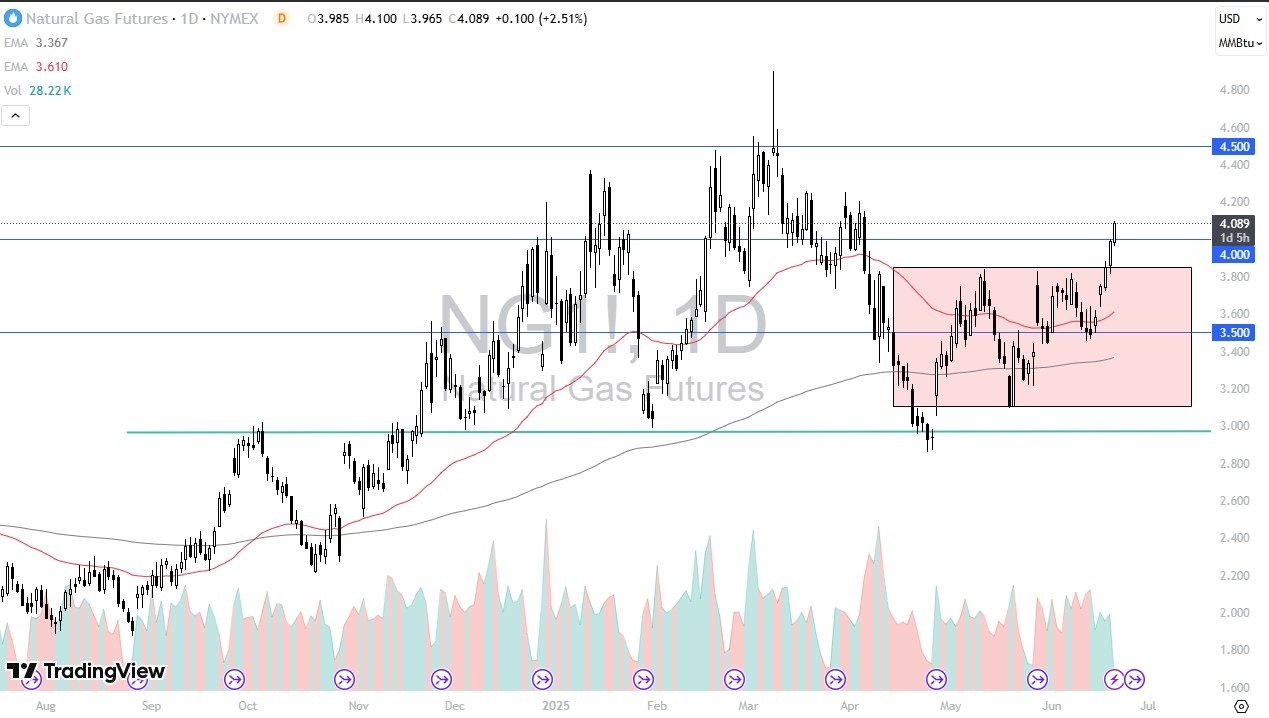
Natural gas is a major producer of electricity in this country. So again, this time of year typically isn’t this positive for natural gas, but external factors such as that and the concerns about natural gas production in Iran has led to a breakout. Now, I still favor longer term the downside. And I certainly don’t know if I want to chase natural gas in this environment. I suspect as soon as the forecast in the eastern part of the United States start to cool off, which could be a week or so away, this thing will turn right back around and start dropping.

So now I’m looking for signs of the market trying to get ahead of that. Unfortunately, natural gas is highly driven by weather forecast in basically about 15 states in the United States. That is a bulk of what moves price. This is a US contract, and a lot of my friends overseas don’t really pay too much attention to that at their own peril. So, you’ll have to stay advised of the temperatures in places like Boston or New York. But really at this point, I think you may have missed the move unless you’re a short term momentum trader. Now you’re looking for exhaustion to start shorting. It’s going to be a difficult market. Natural gas always is. It’s probably one of the hardest markets to trade in because it’s so highly specialized and it can get very thin. So, keep that in mind. But I also like the idea of if you’re patient enough, you can get pretty heavily rewarded when we come back to a more normal temperature.
Ready to trade daily Forex forecast? Here’s a list of some of the best commodities brokers to check out.
Christopher Lewis has been trading Forex and has over 20 years experience in financial markets. Chris has been a regular contributor to Daily Forex since the early days of the site. He writes about Forex for several online publications, including FX Empire, Investing.com, and his own site, aptly named The Trader Guy. Chris favours technical analysis methods to identify his trades and likes to trade equity indices and commodities as well as Forex. He favours a longer-term trading style, and his trades often last for days or weeks.
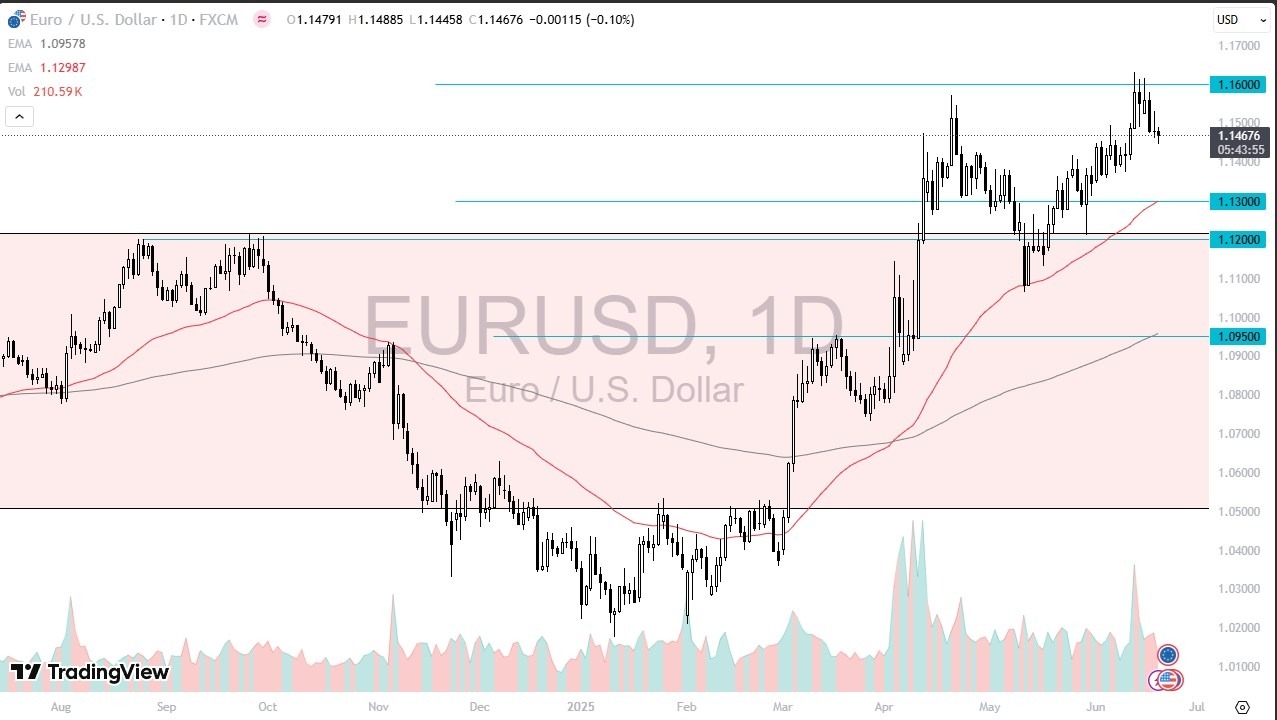
The technical analysis for this market is still bullish overall, but the fact that we ended up forming a shooting star on Wednesday, breaking down below the bottom of the candlestick opens up the possibility of a move down to the 1.14 level. The 1.14 level being broken to the downside of course opens up the possibility of a move to the 1.13 level, where we currently see the 50 Day EMA residing.
On the upside, the 1.16 level is a major barrier, and therefore we will have to watch that very closely. If the market were to break above there, then the Euro would really start to take off to the upside. I think at this point in time though, we are more or less in a consolidation area, and we are trying to sort out where to go next. This is a pair that will be mainly driven by the overall attitude of the US dollar, which of course is considered to be a “safety currency”, and therefore the fact that we have so much going on in the Middle East in Ukraine at the moment, as well as all of the trade war rhetoric, makes it very likely that the US dollar will continue to be a big mover over the next foreseeable trading sessions.
When you look at the area that we are in right now, the 1.13 level being the floor in the 1.16 level being the ceiling, we are fairly close to the middle. Because of this, I feel that we are essentially “killing time” waiting for some type of clarity. I also am fully cognizant of the fact that it’s probably easier for this pair to rise and fall, but whether or not there is any real conviction is a completely different question.
Ready to trade our EUR/USD analysis and predictions? Here are the best European brokers to choose from.
Christopher Lewis has been trading Forex and has over 20 years experience in financial markets. Chris has been a regular contributor to Daily Forex since the early days of the site. He writes about Forex for several online publications, including FX Empire, Investing.com, and his own site, aptly named The Trader Guy. Chris favours technical analysis methods to identify his trades and likes to trade equity indices and commodities as well as Forex. He favours a longer-term trading style, and his trades often last for days or weeks.
Gold price is back in the red early Friday, following a mixed close amid holiday-thinned trading on Thursday.
Traders continue to keep a close on the Middle East geopolitical developments and US Federal Reserve (Fed) commentaries for fresh trading incentives.
In the absence of top-tier economic data releases from the United States (US) on Friday, Gold price will likely remain at the mercy of the US Dollar (USD) dynamics, fuelled by the broader market sentiment, in the face of the ongoing geopolitical upheaval in the Middle East.
There has been no bad news on the Iran-Israel conflict front so far this Friday, rendering positive for markets and reviving risk flows.
US President Donald Trump reportedly said that he will give Iran a last chance to make a deal to end its nuclear program. Trump noted on Thursday that he would delay his final decision on launching strikes for up to two weeks.
Reports of the US easing its aggression on Iran are lifting higher-yielding assets at the expense of safe havens such as Gold price and the USD.
However, the end-of-the-week flows and the markets’ repositioning in the aftermath of the Fed’s policy announcements could influence the Gold price action as US traders return after the Juneteenth holiday break. Geopolitics will continue to lead the sentiment, primarily.
Technically, Gold buyers remain hopeful so long as the 14-day Relative Strength Index (RSI) holds above the midline. The leading indicator is currently pointing south, near 52.
Gold price must defend the critical short-term support of the 21-day Simple Moving Average (SMA) at $3,350 on a daily or weekly closing basis to reinforce buying interest.
If that fails, the 50-day SMA at $3,318 will be put to test. The next downside cap is aligned at $3,297, the 38.2% Fibonacci Retracement (Fibo) level of the April record rally,
Alternatively, Gold price recovery will need a clear break of $3,377, the 23.6% Fibo level of the same ascent to revisit the $3,400 supply zone.
Further upside will challenge the static resistance at $3,440 will be tested.
Buyers will then take on the two-month highs of $3,453.
In the world of financial jargon the two widely used terms “risk-on” and “risk off” refer to the level of risk that investors are willing to stomach during the period referenced. In a “risk-on” market, investors are optimistic about the future and more willing to buy risky assets. In a “risk-off” market investors start to ‘play it safe’ because they are worried about the future, and therefore buy less risky assets that are more certain of bringing a return, even if it is relatively modest.
Typically, during periods of “risk-on”, stock markets will rise, most commodities – except Gold – will also gain in value, since they benefit from a positive growth outlook. The currencies of nations that are heavy commodity exporters strengthen because of increased demand, and Cryptocurrencies rise. In a “risk-off” market, Bonds go up – especially major government Bonds – Gold shines, and safe-haven currencies such as the Japanese Yen, Swiss Franc and US Dollar all benefit.
The Australian Dollar (AUD), the Canadian Dollar (CAD), the New Zealand Dollar (NZD) and minor FX like the Ruble (RUB) and the South African Rand (ZAR), all tend to rise in markets that are “risk-on”. This is because the economies of these currencies are heavily reliant on commodity exports for growth, and commodities tend to rise in price during risk-on periods. This is because investors foresee greater demand for raw materials in the future due to heightened economic activity.
The major currencies that tend to rise during periods of “risk-off” are the US Dollar (USD), the Japanese Yen (JPY) and the Swiss Franc (CHF). The US Dollar, because it is the world’s reserve currency, and because in times of crisis investors buy US government debt, which is seen as safe because the largest economy in the world is unlikely to default. The Yen, from increased demand for Japanese government bonds, because a high proportion are held by domestic investors who are unlikely to dump them – even in a crisis. The Swiss Franc, because strict Swiss banking laws offer investors enhanced capital protection.