The main category of Forex News.
You can use the search box below to find what you need.
[wd_asp id=1]
The main category of Forex News.
You can use the search box below to find what you need.
[wd_asp id=1]
Copper price neediness to the momentum in the last trading led to delay the bullish attempts, to notice its fluctuations below the barrier near $4.8100, and providing an intraday negative rebound at $4.7100.
Note that the price success to settle above 50% Fibonacci correction level at $4.6600 will assist to reinforce the chances for activating the bullish track until breaching the mentioned barrier, while breaking this support will increase the negative pressure on the current trading, which force it to suffer extra losses by reaching $4.6000 and $4.5300.
The expected trading range for today is between $4.6600 and $4.8100
Trend forecast: Fluctuated within the bullish track
He noted that the demand for gold is being bolstered by “a blend of risk aversion and a recalibration of monetary policy expectations.”
The Producer Price Index (PPI) rose just 0.1% in May, down from a 0.2% decline in April, signaling persistent disinflationary trends.
Combined with soft consumer price data, markets are now pricing in a 55-basis-point rate cut by the Federal Reserve in 2025, likely starting in September.
U.S. Treasury yields retreated, and the Dollar Index (DXY) hovered near a three-month low, supporting non-yielding gold.
Silver (XAG/USD) is trading at $36.30, having slipped to an intraday low of $35.98. The metal is consolidating within a symmetrical triangle pattern, suggesting price compression as traders await a directional breakout.
While gold has surged on haven flows, silver’s upside remains capped by lingering concerns around industrial demand and global manufacturing trends.
Gold price is gaining roughly 1.50% in Asian trading on Friday, underpinned by intense flight to safety amid escalating geopolitical tensions between Israel and Iran.
Israel said earlier on that it attacked Iranian nuclear targets to block Tehran from developing atomic weapons.
Several Iranian media outlets now claim that Iran will declare a war on Israel and retaliate “soon.”
Iran’s Armed Forces General staff responded on Friday, warning that Israel and the US will “pay a very heavy price”.
Against this backdrop, US President Donald Trump has convened a meeting of the National Security Council in the White House situation room later in the day at 15 GMT.
Investors run for cover in the traditional safe-haven assets such as Gold price, the US Treasury bonds and the Japanese Yen (JPY) in times of market panic and uncertainty.
Therefore, the ultimate store of value, Gold price, is seeing unabated demand as it extends its winning streak into a third consecutive day on Friday, sitting at the highest level in seven weeks.
Gold buyers now aim for the record high of $3,500 if the Mid East conflict intensifies, with Iran initiating a harsh response to the Israeli pre-emptive strikes on Iran’s main enrichment facility in Natanz.
However, the strengthening haven demand for the US Dollar (USD) could impede Gold price rally.
Markets shrug off the latest trade headlines as geopolitics dominate alongside risk-off flows.
Reuters reported that tariffs on a range of imported household appliances, which are currently at 50% for most countries, would take effect on an additional range of “steel derivative products” on June 23.
Looking ahead, all eyes will remain on Iran’s probable retaliation to the Israeli strikes and the US’ response to the Middle East conflict.
The University of Michigan (UoM) Consumer Sentiment and Inflation Expectations could play second fiddle to the geopolitical headlines.
Markets ramp up odds for a US Federal Reserve (Fed) interest rate cut in September following softer-than-expected US Consumer Price Index (CPI) and Producer Price Index (PPI) data released earlier in the week.
Having closed Thursday above the critical resistance at $3,377, the 23.6% Fibonacci Retracement (Fibo) level of the April record rally, Gold price solidified its bullish momentum on Friday.
The 14-day Relative Strength Index (RSI) holds firm above the midline, currently near 62, suggesting that there is more room for the upside.
The next stiff resistance is spotted at the $3,450 psychological level, above which the lifetime high of $3,500 will be threatened.
On the downside, the immediate support is aligned at the $3,400 threshold, below which the resistance-turned-support of the 23.6% Fibo level at $3,377 will come into play.
Deeper declines will likely challenge the 21-day Simple Moving Average (SMA) of $3,325.

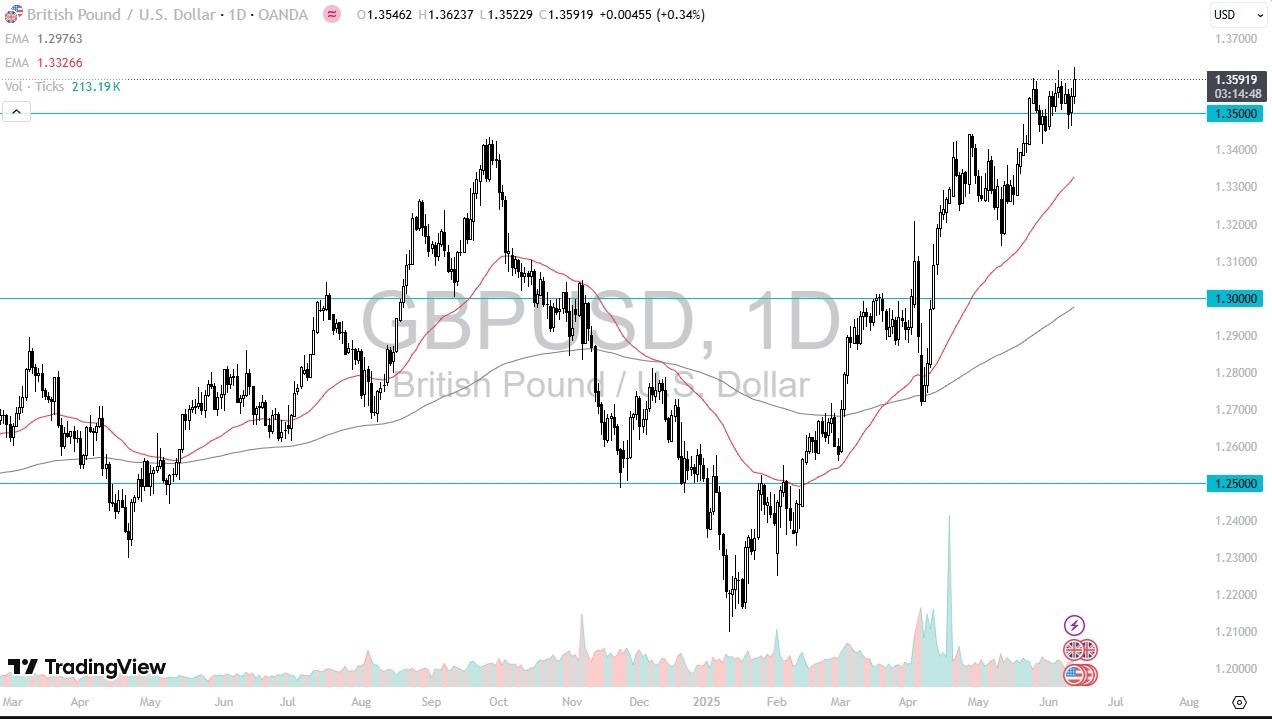
So, the question now is, can we continue to go higher? We are right here at an area that previously had been a bit of a headache. So, I think short-term pullbacks probably attract attention that people are willing to pay to the British pound. It’s been a fairly decent mover against the US dollar for some time now, even though it was falling, it was falling less than other currencies.
So, I would anticipate that the British pound probably continues to be a currency that should outperform the US dollar and outperform other currencies against the US dollar. That being said, we are a little stretched and it does look like we are going a little bit sideways more than anything else. So do keep that in mind. In this environment, I think the 1.35 level offers support down to the 1.34 level.
Underneath there you have the 50 day EMA. I don’t really have any interest in shorting this market, although I’m the first one to say that we are oversold in the US dollar. But the reality here is that we definitely see a bullish market, so drops have to be thought of as potential value.
Ready to trade the GBP/USD Forex analysis? Check out the best forex trading company in UK worth using.
Christopher Lewis has been trading Forex and has over 20 years experience in financial markets. Chris has been a regular contributor to Daily Forex since the early days of the site. He writes about Forex for several online publications, including FX Empire, Investing.com, and his own site, aptly named The Trader Guy. Chris favours technical analysis methods to identify his trades and likes to trade equity indices and commodities as well as Forex. He favours a longer-term trading style, and his trades often last for days or weeks.
Fears pushed Gold towards the $3,400 level on Thursday, its highest for the week. Demand for the bright metal surged amid US Dollar’s (USD) sell-off, which dominated financial boards for most of the day.
The Greenback declined on Wednesday after the United States (US) President, Donald Trump, anticipated a trade deal with China was “done,” clarifying it was still subject to Chinese President Xi Jinping’s approval. Additionally, the country released the May Consumer Price Index (CPI), which resulted in softer than anticipated, fueling optimism about the state of the US economy.
The USD kept falling on Thursday amid rising Middle East tensions between Israel and Iran. Israel is preparing an operation against Iran, with the US expecting retaliatory measures, according to sources familiar with the matter. Additionally, nuclear talks between the US and Iran appeared to have halted. Trump used Truth Social to report that an Israeli strike could “very well happen,” adding that he would love to avoid conflict, but also that Iran has to negotiate toughly. He ended his post saying that there’s a chance of a massive conflict in the region.
Trade-war-related headlines added fuel to the fire: Trump said that he was willing to extend the July 8 deadline for completing trade talks, but also added that he is ready to impose unilateral tariffs within two weeks, to multiple trading counterparts.
On Friday, the focus will be on the preliminary estimate of the June University of Michigan’s (UoM) Consumer Sentiment Index. Market players will pay special attention to the one-year and five-year inflation expectations.
Technically speaking, the XAU/USD pair has room to extend its advance beyond the $3,400 mark, which should lead to a rest of record highs in the near term. The daily chart shows the pair advanced at a moderate pace, with technical indicators aiming marginally higher within positive levels. At the same time, the 20 Simple Moving Average (SMA) gains upward traction above also bullish 100 and 200 SMAs, while providing dynamic support at around $3,318.
In the near term, and according to the 4-hour chart, the XAU/USD pair is losing its bullish momentum. Technical indicators turned lower, easing within positive levels, as a result of the ongoing retracement. Additional losses, however, seem unlikely, given that moving averages extend their upward slopes below the current level, and with the 20 SMA accelerating north above the longer ones.
Support levels: 3,362.40 3,348.35 3,310.00
Resistance levels: 3,402.50 3,414.60 3,437.85
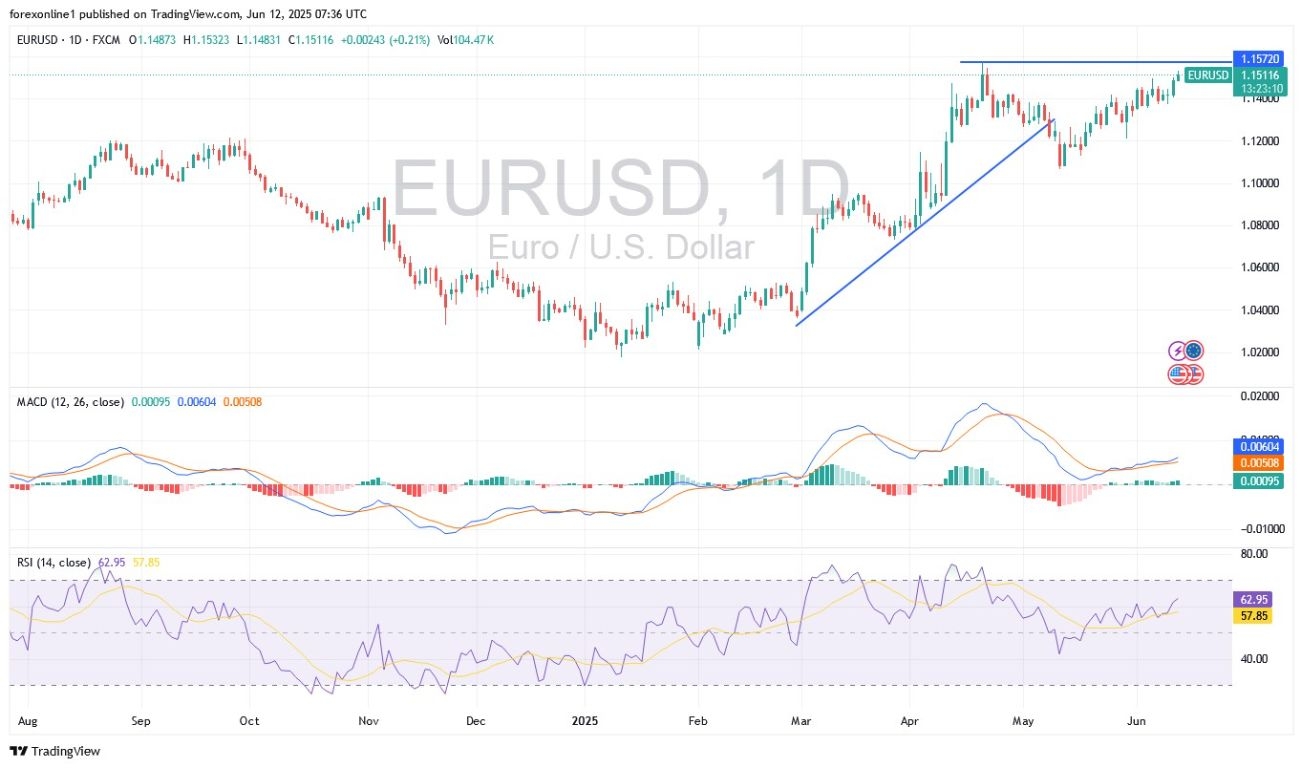
Following the release of US inflation figures, the EUR/USD currency pair surged to the doorstep of the 1.1500 resistance, nearing its highest levels since June 2021. The Euro’s gains against the US Dollar intensified as investors assessed the growing divergence in monetary policy expectations between the European Central Bank (ECB) and the US Federal Reserve. Recent statements from ECB officials have reinforced expectations that the central bank may soon pause its monetary easing cycle, adopting a wait-and-see approach to evaluate the economic impact of new US tariffs. In May, Eurozone inflation fell to 1.9%, while the ECB cut its interest rate for the eighth consecutive time, bringing the deposit facility rate down to 2%.
Meanwhile, the European bloc’s economy has shown resilience, growing by 0.6% in the first quarter, the strongest pace since the third quarter of 2022.
Conversely, weaker-than-expected US inflation data weighed on the dollar, reinforcing speculation that the Federal Reserve could begin cutting interest rates as early as September. However, uncertainty remains, as inflation and the labour market remain relatively resilient, while headwinds to growth from tariffs continue to mount.
Dear reader, according to forex market experts, overall market volatility has decreased with narrower trading ranges, but financial markets remain highly cautious that underlying tensions could quickly ignite a new round of turmoil. On another note, trade negotiations will continue, and another important US Treasury bond auction is scheduled for later today following the latest inflation data. Markets are also monitoring political developments, including the US administration’s reaction to the Los Angeles protests and potential threats to the Federal Reserve’s independence.
We still recommend selling the Euro against the US Dollar on every upward rebound, while continuously monitoring market influencing factors and avoiding risk, regardless of how strong the trading opportunities may seem.
Amidst these factors, the EUR/USD pair appears to have entered a trading range, likely between 1.1330 and 1.1495. Generally, the US Dollar will largely determine the EUR/USD’s direction today, with some potential support near 1.1400. There’s a possibility for it to rise above 1.1500 if pressure on the US Dollar continues. The next key resistance will be 1.1575, which would push technical indicators towards strong overbought levels, particularly the 14-day RSI (Relative Strength Index) and the MACD (Moving Average Convergence Divergence) indicator. The EUR/USD pair will be influenced by remaining US inflation figures, weekly US jobless claims data (all due at 3:30 PM Egypt time), and the future of US-China trade negotiations.
According to the insights and forecasts of global currency market experts, the Euro is expected to rise to its highest level against the US Dollar since 2021 this year. This conclusion comes from analysts at two major investment banks who have revised their mid-year currency market forecasts. Looking ahead to the second half of 2025, Nomura anticipates that the Euro will benefit from shifts in asset allocation and divergences in fiscal, monetary, and foreign exchange policies. This call comes amid a significant re-evaluation of US economic prospects by international investors, who have become more cautious under a potential second Trump presidency.
At the same time, questions regarding the Federal Reserve’s independence have been raised following repeated attacks from Trump. Meanwhile, his new spending and tax bill – the “Big, Beautiful Bill” – promises to increase the US debt burden, including a provision for special taxes on foreign investors. And of course, there is significant uncertainty on the trade front, with a sharp increase in tariffs. Accordingly, Morgan Stanley predicts that US trade and increasing fiscal policy uncertainty will keep the US Dollar risk premium elevated, and the steepening or flattening of the US yield curve contributes to the weakening of the US Dollar against its counterparts like the Euro.
On another note, Relative stability in Europe, coupled with Germany’s commitment to infrastructure and defence investments, is making the euro an alternative destination for foreign investors. Accordingly, Morgan Stanley added, “We maintain our bullish recommendation on the EUR/USD pair.”
Ready to trade our Forex daily forecast? We’ve shortlisted the best forex broker list for you to check out.
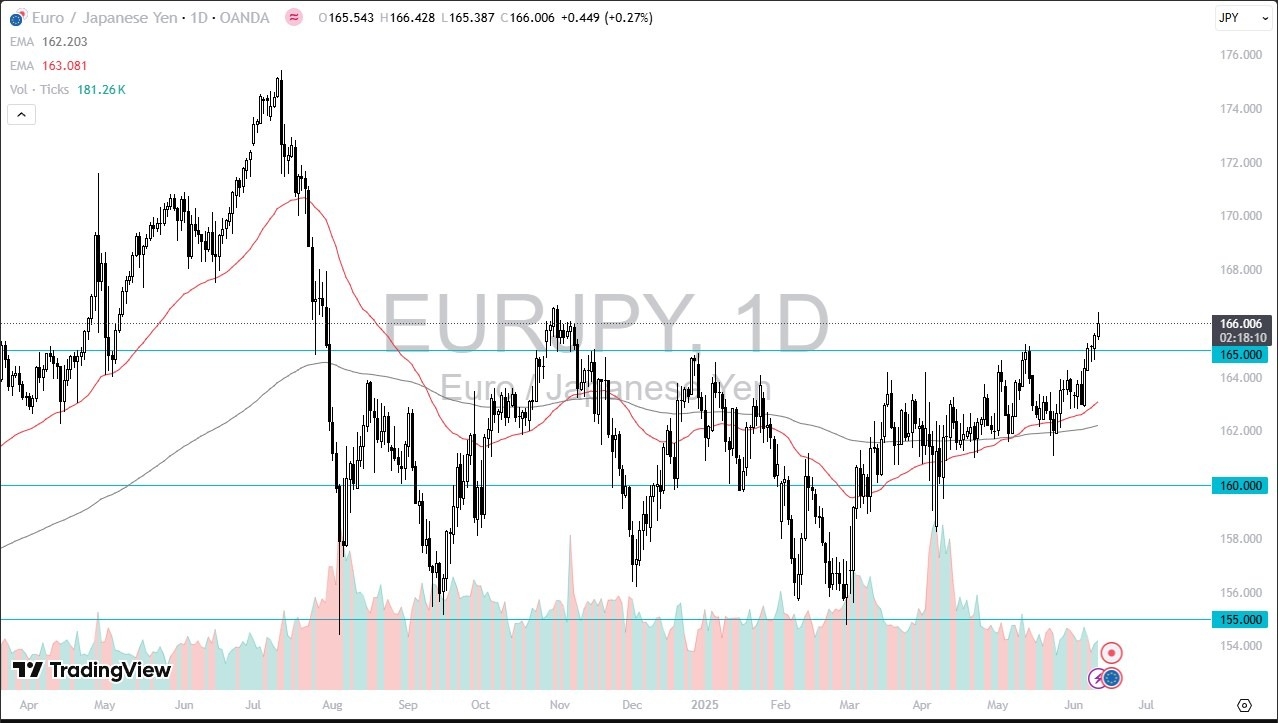
In other words, if we start to see more risk taken in the market, then it makes a certain amount of sense that this market would take off from here. All things being equal, this is a situation where traders will continue to pay close attention to the trade war, and of course the normally is around tariffs. Ultimately, we had seen a comment on social media by Donald Trump that the United States and China may have come to an agreement, and that may have helped this trade peripherally.
The technical analysis for this pair is bullish, and I look at the ¥165 level as a potential support level. The ¥165 level is an area that has been rather important as resistance previously, so I think you’ve got a situation where there should be a certain amount of value hunting in this general vicinity, and I think that will continue to support the market. On a breakdown below the ¥165 level, then I would be looking at the 50 Day EMA near the ¥163.11 level as the next major support level.
Ultimately, I think one of the things that traders will be paying attention to is the fact that the Bank of Japan has to keep monetary policy rather loose, and therefore the Japanese yen will continue to be somewhat damaged. Ultimately, I think this is a market that remains very much “buy on the pullbacks.”
Begin trading our daily forecasts and analysis. Here is a list of Forex brokers in Japan to work with.
Christopher Lewis has been trading Forex and has over 20 years experience in financial markets. Chris has been a regular contributor to Daily Forex since the early days of the site. He writes about Forex for several online publications, including FX Empire, Investing.com, and his own site, aptly named The Trader Guy. Chris favours technical analysis methods to identify his trades and likes to trade equity indices and commodities as well as Forex. He favours a longer-term trading style, and his trades often last for days or weeks.
The Silver price (XAG/USD) attracts some buyers to around $36.30, snapping the two-day losing streak during the Asian trading hours on Thursday. The weaker US Dollar (USD) and escalating geopolitical tensions in the Middle East provide some support to the white metal. Traders will keep an eye on the US Producer Price Index (PPI) and weekly Initial Jobless Claims, which will be released later on Thursday.
Softer-than-expected US inflation in May has prompted traders to raise their bets on a Federal Reserve (Fed) rate cut. This, in turn, drags the Greenback lower and lifts the USD-denominated commodity price. The CME FedWatch tool showed the markets have priced in nearly a 68% possibility that the US central bank would cut rates by 25 basis points (bps) by September, compared with 57% before the US CPI data. They now also see a still small but rising chance of an earlier rate cut, putting about an 18% odds of that happening in July versus about 13% earlier on Wednesday.
Reuters reported on Wednesday that the United States (US) is planning a partial evacuation of its Iraqi embassy and will allow military dependents to depart places around the Middle East, citing security risks in the region. Geopolitical risks could underpin the Silver price as investors seek more holdings in safe-haven assets.
On the other hand, White House envoy Steve Witkoff is scheduled to meet Iranian Foreign Minister Abbas Araghchi in Muscat on Sunday and discuss the Iranian response to the recent US proposal, per Axios. Any positive developments surrounding a deal over the nuclear program between the US and Iran might cap the upside for the Silver.
Silver is a precious metal highly traded among investors. It has been historically used as a store of value and a medium of exchange. Although less popular than Gold, traders may turn to Silver to diversify their investment portfolio, for its intrinsic value or as a potential hedge during high-inflation periods. Investors can buy physical Silver, in coins or in bars, or trade it through vehicles such as Exchange Traded Funds, which track its price on international markets.
Silver prices can move due to a wide range of factors. Geopolitical instability or fears of a deep recession can make Silver price escalate due to its safe-haven status, although to a lesser extent than Gold’s. As a yieldless asset, Silver tends to rise with lower interest rates. Its moves also depend on how the US Dollar (USD) behaves as the asset is priced in dollars (XAG/USD). A strong Dollar tends to keep the price of Silver at bay, whereas a weaker Dollar is likely to propel prices up. Other factors such as investment demand, mining supply – Silver is much more abundant than Gold – and recycling rates can also affect prices.
Silver is widely used in industry, particularly in sectors such as electronics or solar energy, as it has one of the highest electric conductivity of all metals – more than Copper and Gold. A surge in demand can increase prices, while a decline tends to lower them. Dynamics in the US, Chinese and Indian economies can also contribute to price swings: for the US and particularly China, their big industrial sectors use Silver in various processes; in India, consumers’ demand for the precious metal for jewellery also plays a key role in setting prices.
Silver prices tend to follow Gold’s moves. When Gold prices rise, Silver typically follows suit, as their status as safe-haven assets is similar. The Gold/Silver ratio, which shows the number of ounces of Silver needed to equal the value of one ounce of Gold, may help to determine the relative valuation between both metals. Some investors may consider a high ratio as an indicator that Silver is undervalued, or Gold is overvalued. On the contrary, a low ratio might suggest that Gold is undervalued relative to Silver.
The GBP/USD forecast remains broadly bullish amid the dollar’s weakness. However, today’s UK GDP data reported by the ONS showed economic contraction faster than expected. On Wednesday, the price saw a significant rise near 1.3600 as the US CPI reported softer-than-expected, raising concerns for the Fed’s “higher for longer” policy.
–Are you interested to learn more about crypto signals? Check our detailed guide-
The British pound slipped from the daily highs above 1.3580 towards the 1.3525 area before finding a renewed strength. The pair is trading at 1.3580 at the time of writing.
The UK GDP was expected to shrink -0.1% against the previous reading of 0.2% for March. However, the figures came at -0.3% for April, missing estimate, putting the pound under pressure. The ONS reported that the sharp fall in the GDP is attributed to the reduced goods exports to the US. The last four months reported consecutive rises in the economy, while April saw the largest monthly fall.
The higher-than-projected decline in the UK economy combined with the rising unemployment may force the Bank of England to continue with easing policy. In May, the bank had opted for the gradual and careful easing by slashing the rates by 25 bps to 4.5%. These economic shocks may increase the speculation of BoE’s more rate cuts.
On the other side of the equation, the US dollar remains weak on Thursday as President Trump threatened to send the letters to the countries not negotiating in good faith to accept his imposed tariffs.
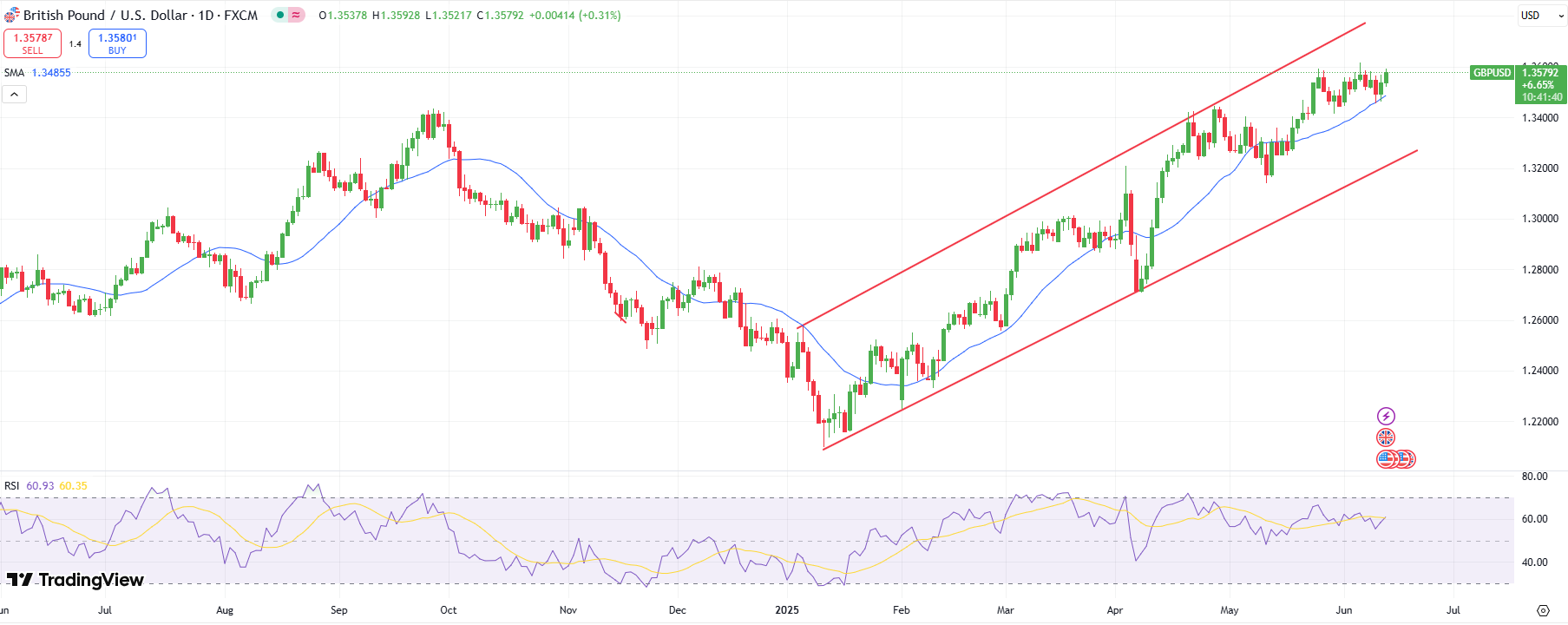
The GBP/USD daily chart shows a strong bullish trend as the price moves north within the uptrend. The pair remains strongly supported by the 20-day SMA. However, the pair shows consolidation within the range of 1.3480 to 1.3616. The 14-day RSI is at 60.0, which shows the pair is not overbought yet and has a tendency to gain further.
–Are you interested to learn more about forex robots? Check our detailed guide-
Alternatively, breaking the 20-day SMA may gather strong selling traction, and the price may slip towards the lower boundary of the channel at 1.3270 ahead of 1.3200.
Looking to trade forex now? Invest at eToro!
67% of retail investor accounts lose money when trading CFDs with this provider. You should consider whether you can afford to take the high risk of losing your money.
Wednesday’s U.S. Consumer Price Index (CPI) showed inflation rose just 0.1% in May, below the 0.2% forecast. On a year-over-year basis, CPI increased 2.5%. The softer-than-expected data pushed the dollar index (DXY) down 0.3% to a two-month low, making gold more attractive to foreign buyers.
Markets are now pricing in at least 50 basis points of rate cuts this year, with traders assigning a 68% probability of a cut by September. Declining Treasury yields added fuel to gold’s rally, with the 10-year yield falling to 4.387% and the 2-year at 3.926%. Lower yields reduce the opportunity cost of holding non-yielding assets like gold.
Geopolitical risk remains a supportive factor. U.S. President Donald Trump said U.S. personnel were being repositioned in the Middle East due to growing tensions with Iran, reaffirming that Iran would not be allowed to develop nuclear weapons. In parallel, U.S.-China trade negotiations made headlines after Trump confirmed a finalized deal that includes China supplying rare earth materials and the U.S. easing restrictions on Chinese students.
The trade agreement helped stabilize market sentiment, but underlying risks remain. Comments from Goldman Sachs suggested that if inflation remains subdued or the job market weakens, the Fed may be forced to ease monetary policy sooner than planned.
Traders now await U.S. Producer Price Index (PPI) data for confirmation of disinflation trends. A weaker-than-expected print could reinforce bets on Fed easing and push gold through key resistance.