The main category of Forex News.
You can use the search box below to find what you need.
[wd_asp id=1]
The main category of Forex News.
You can use the search box below to find what you need.
[wd_asp id=1]
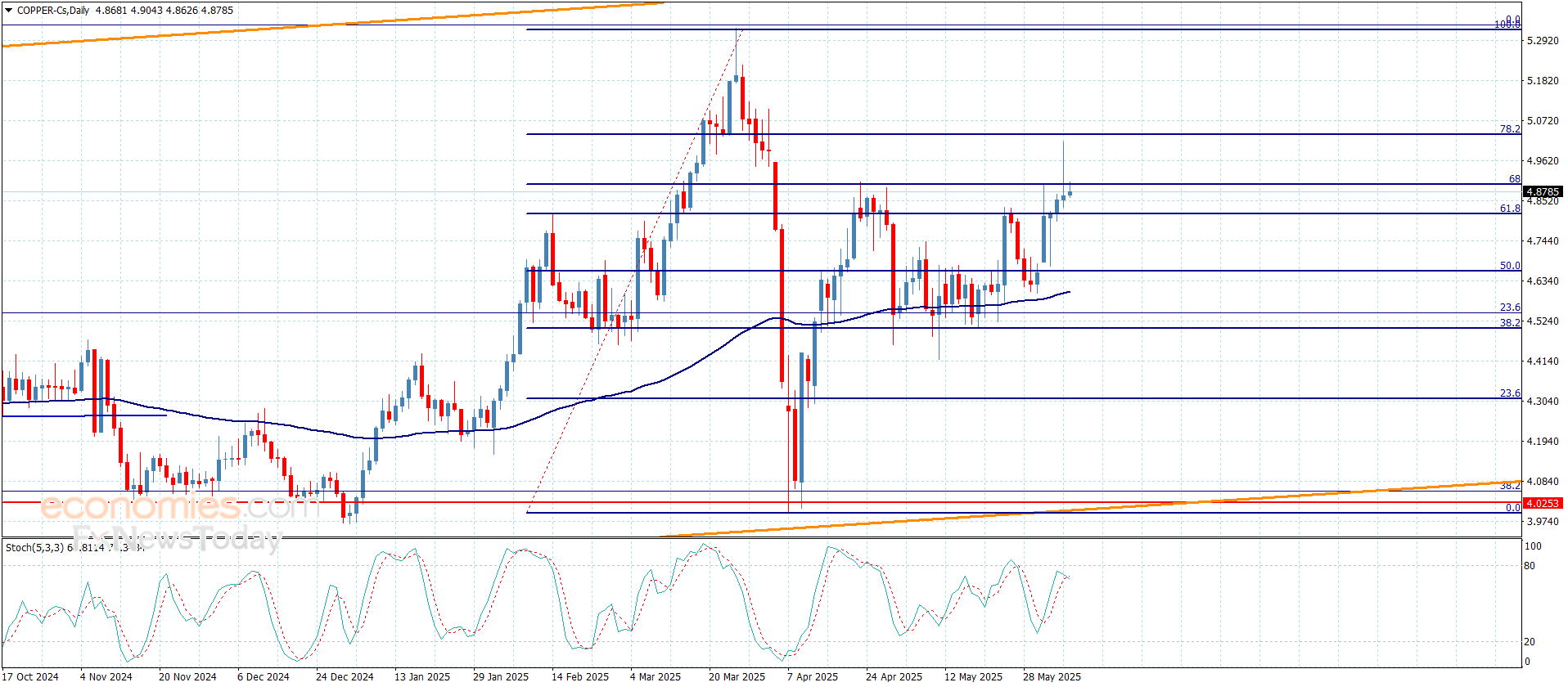
Copper price formed temporary negative rebound after reaching $5.01000 level and recording the waited targets, to fluctuate near 38.1%Fiboancci correctional level at $4.8900.
The current negative rebound won’t represent any threat to the chances of resuming the bullish attack, as there are several bullish factors such as forming a new support at $4.8000 level, to provide the positive momentum for the main indicators, therefore, we will keep waiting for renewing the bullish attempts to target $5.0300 level reaching $5.1000 level.
The expected trading range for today is between $4.8500 and $5.030
Trend forecast: Bullish
June 6, 2025 – Written by David Woodsmith
STORY LINK Pound to Dollar Forecast: GBP Sterling Slides on US Jobs USD Relief
The dollar managed to secure tentative gains on Friday following the latest US jobs release. The data certainly had important weaknesses, but markets were braced for an even weaker report and the figures triggered an element of short covering.
Markets were also monitoring the Trump-Musk row given the potential impact on the Budget Bill in the Senate.
After failing to make a fresh attack on 1.3600 earlier in the day, the Pound to Dollar (GBP/USD) exchange rate dipped to lows at 1.3520.
According to Scotiabank the outlook is still bullish; “the September/April highs around 1.34 are likely to provide meaningful support from here. An extension of gains above 1.36 should find limited resistance ahead of the early 2022 high around 1.3750.”
ING noted market positioning; “With a market seemingly positioned for a soft number today, we think it will take a figure substantially under +100k and a rise in the unemployment rate (currently a low 4.2%) to trigger another leg lower in the dollar.”
The US employment report registered an increase in non-farm payrolls of 139,000 for May, above consensus forecasts of around 125,000, although the April increase was revised down to 147,000 from the original estimate of 177,000.
There were monthly job losses in manufacturing, retail and professional services while there was also a marginal decline in government jobs.
The unemployment rate held at 4.2% which was in line with expectations.
There was, however, a substantial decline in the labour force of 625,000 and the number of people reported as being employed plunged close to 700,000 on the month.
According to Annex Wealth Management Chief Economist Brian Jacobsen; “On its face, this shows an economy that’s holding up under the weight of a trade war, but the details show plenty of cracks forming.”
Ray Attrill, head of FX research at National Australia Bank commented; “Within all the noise the softness that we’ve seen in the data this week has probably been more responsible for rejuvenating the bearish U.S. dollar narrative than anything else that’s gone on.”
He added; “We’ve always taken the view that once it becomes clear that the U.S. economy is no longer exceptional, and that the policy actions that we’ve seen to date, together with the relative tightness of Fed policy, will start to show through particularly in a weakening labour market.”
Thursday’s data recorded a huge decline the monthly goods trade deficit to $61.6bn for April from a record $138.3bn the previous month as imports plunged.

Wells Fargo commented; “The temporary surge in imports as businesses pulled-forward demand to get ahead of tariffs has run its course. The U.S. international trade deficit narrowed sharply in April as a result and suggests a big boost to Q2 growth from net exports.”
Scotiabank commented; “With broader market sentiment still quite fragile, a new front of worry has opened up between President Trump and Elon Musk. Yesterday’s social media fisticuffs are one thing but Musk could muster support against the president’s tax bill, adding to broader market uncertainty.”
It added; “The overall downtrend remains intact and the USD has a lot of work to do in order to display any real strength. It does, however, see scope for a short-term bottom for the dollar index.
There were no major UK developments on Friday with traders looking ahead to next week. Scotiabank commented; “The near-term domestic release calendar offers some risk as we look to next week’s employment, industrial production, and trade figures.”
International Money Transfer? Ask our resident FX expert a money transfer question or try John’s new, free, no-obligation personal service! ,where he helps every step of the way,
ensuring you get the best exchange rates on your currency requirements.
TAGS: Pound Dollar Forecasts
June 6, 2025 – Written by Tim Boyer
STORY LINK Euro to Dollar Forecast: EUR Dips to 1.1370 on USD Short-Covering
The Euro to Dollar (EUR/USD) exchange posted net losses after the latest US jobs data, although the dollar still struggled for sustained support.
After stalling above 1.1450, EUR/USD dipped to lows at 1.1370 before a rebound back to just above 1.1400.
Markets were braced for a very weak US labour-market report and the actual data provided an element of dollar relief with some closing of short positions into the weekend even though there were clear signs of weakness in the details.
Traders were also monitoring the fallout between Trump and Musk, especially as there could be significant implications for the Budget Bill which is due to be debated in the Senate next week.
Scotiabank maintains a positive outlook on EUR/USD; “the trend is bullish, with a clear sequence of higher lows and higher highs.”
It added; “The 50 day MA (1.1259) is an important medium-term support level. In the near-term, we look to support around 1.1380 and resistance above 1.1480.”
ING commented; “We suspect 1.1330/1350 may be the limit of the EUR/USD sell-off should US data not be as weak as the market is positioned for.”
According to the latest US employment report, non-farm payrolls increased 139,000 for May compared with consensus forecasts of around 125,000, but there was a notable downward revision for the April increase to 147,000 from the 177,000 reported previously.
There were losses in manufacturing, retail sales and professional services jobs for the month with government jobs also marginally lower.
ING commented; “Traditional sectors that typically signify a strong US economy have not been adding jobs in any meaningful way – think tech, business services, transport & logistics, construction, financial services etc.”
The unemployment rate was unchanged at 4.2% for the month, in line with expectations. There were, however, big changes in the underlying data with a decline in employment of close to 700,000 for the month as the civilian labour force declined by 625,000 on the month.
ING added; “A respectable jobs market in May with firm employment growth and stable unemployment, but the risks are skewed toward more weakness in coming months as trade uncertainty and concerns for consumer spending lead firms to become much more cautious on hiring.”
According to Commerzbank; “to put pressure on the greenback, the labor market would probably have to be significantly worse than expected.”
MUFG commented; “We probably need to see a print below the 100k to get the market moving and for pricing on a July FOMC rate cut to increase further.”
Following the data, markets were pricing in less than a 20% chance of a Fed rate cut at the end-July meeting.
Markets were also continuing to analyse Thursday’s ECB policy meeting with the 25 basis-point cut in the discount rate to 2.00% with hawkish rhetoric helping to underpin the Euro.
According to Rabobank; “President Lagarde was a bit more outspoken than we had expected. All in all, Lagarde did not give any reason to expect another rate cut, unless there is a significant escalation of trade tensions.”
Danske Bank added; “ECB President Lagarde’s remarks during the press conference were to the hawkish side, indicating the rate cutting cycle may be nearing its conclusion. Following today’s hawkish communication, we have revised our forecast, removing the July cut and targeting a final cut in September with a terminal rate at 1.75% (prior: 1.50%).”
International Money Transfer? Ask our resident FX expert a money transfer question or try John’s new, free, no-obligation personal service! ,where he helps every step of the way,
ensuring you get the best exchange rates on your currency requirements.
TAGS: Euro Dollar Forecasts
Gold prices are extending losses against the US Dollar (USD) on Friday, falling below prior psychological support, now resistance, at $3,350, after the US Nonfarm Payrolls (NFP) report showed a resilient labour market.
After a week of data suggesting a softening US labor market, the Nonfarm Payrolls (NFP) report for May surprised to the upside. The US economy added 139,000 new jobs, beating analysts’ expectations of a 130,000 increase.
Meanwhile, the Unemployment Rate remained unchanged at 4.2%, offering a mixed but slightly more optimistic view of labor market conditions. The stronger-than-expected headline figure has provided temporary relief for the US Dollar, easing concerns that the Federal Reserve (Fed) may need to act quickly with rate cuts. However, underlying softness in other employment metrics earlier in the week continues to warrant caution in the broader policy outlook.
According to the CME FedWatch Tool, the probability of a July rate cut has dropped sharply to 16.5%, down from 33.9% prior to the release. The data has temporarily eased pressure on the Fed to act swiftly, suggesting that policymakers may adopt a more patient stance in the near term.
Although Thursday’s phone call between Chinese and US presidents helped ease immediate fears of an escalating trade war, tariff uncertainties and broader trade tensions remain a key concern for global investors.
The US decision to double tariffs on steel and aluminum imports to 50%, which was enforced on Wednesday, has drawn sharp criticism from key trade partners, including India, Canada, the European Union and Mexico, all of whom have threatened retaliatory measures.
With trade negotiations expected to continue into next week, the risk of prolonged disputes looms. Should talks break down or tensions escalate further, the global economy could face renewed headwinds, potentially weakening equity markets and driving demand for safe-haven assets such as Gold.
Gold has broken below the $3,350 psychological level of support on Friday, with prices testing $3,330 at the time of writing. With prices still confined to a narrow range that has been building over the past four days, the whipsaw price action and broader geopolitical developments leave Gold prices vulnerable to any fundamental shifts that could impact the direction of prices next week.
With the $3,350 level now providing near-term resistance, short-term support is seen at the $3,300 psychological level, resting just above the 20-day Simple Moving Average (SMA) at $3,291.
The pullback in prices has also pushed the Relative Strength Index (RSI) lower, with a reading of 52 suggesting that bulls may be losing steam.
For the upside to prevail, a move above $3,350 and above the $3,370, which provided resistance for Friday’s move, could see prices recover, bringing the $3,400 psychological level back into play.
Gold daily chart
For an upside move, the Gold price has a few technical hurdles to clear. The $3,392 resistance level has limited the bullish potential throughout the week, followed by the $3,400 psychological level. If bulls clear this zone and bullish momentum gains traction, a move toward the April all-time high at $3,500 may be possible.
Gold has played a key role in human’s history as it has been widely used as a store of value and medium of exchange. Currently, apart from its shine and usage for jewelry, the precious metal is widely seen as a safe-haven asset, meaning that it is considered a good investment during turbulent times. Gold is also widely seen as a hedge against inflation and against depreciating currencies as it doesn’t rely on any specific issuer or government.
Central banks are the biggest Gold holders. In their aim to support their currencies in turbulent times, central banks tend to diversify their reserves and buy Gold to improve the perceived strength of the economy and the currency. High Gold reserves can be a source of trust for a country’s solvency. Central banks added 1,136 tonnes of Gold worth around $70 billion to their reserves in 2022, according to data from the World Gold Council. This is the highest yearly purchase since records began. Central banks from emerging economies such as China, India and Turkey are quickly increasing their Gold reserves.
Gold has an inverse correlation with the US Dollar and US Treasuries, which are both major reserve and safe-haven assets. When the Dollar depreciates, Gold tends to rise, enabling investors and central banks to diversify their assets in turbulent times. Gold is also inversely correlated with risk assets. A rally in the stock market tends to weaken Gold price, while sell-offs in riskier markets tend to favor the precious metal.
The price can move due to a wide range of factors. Geopolitical instability or fears of a deep recession can quickly make Gold price escalate due to its safe-haven status. As a yield-less asset, Gold tends to rise with lower interest rates, while higher cost of money usually weighs down on the yellow metal. Still, most moves depend on how the US Dollar (USD) behaves as the asset is priced in dollars (XAU/USD). A strong Dollar tends to keep the price of Gold controlled, whereas a weaker Dollar is likely to push Gold prices up.
The Japanese Yen (JPY) continues to weaken against the British Pound (GBP) on Friday, with the GBP/JPY pair edging up to near 195.20 at the time of writing.
This move marks a continuation of bullish momentum that began earlier in the week, as the pair broke above the 20-day Simple Moving Average (SMA), signaling a shift in near-term sentiment. Despite this strength, GBP/JPY is now testing a significant resistance level that may determine the next directional bias.
The pair has encountered firm resistance at 195.29, which corresponds with the 78.6% Fibonacci retracement of the decline observed between January and April. This level has consistently limited bullish advances since early May, making it a critical technical barrier. Momentum indicators, however, suggest that bulls still have control.
The Relative Strength Index (RSI) is hovering around 60, showing that while the pair isn’t overbought, there is still upward momentum supporting further gains, provided the resistance can be decisively broken.
GBP/JPY daily chart
Should GBP/JPY manage a daily close above 195.29, the path could open toward the psychological 196.00 mark, with the next potential resistance levels near 197.30, which aligns with previous swing highs. However, failure to breach the current resistance could trigger a short-term pullback.
On the downside, the 194.00 psychological level offers initial support. This level is reinforced by the 20-day SMA, which now acts as a dynamic support zone. A break below this area could expose deeper corrective targets near 193.00, which is aligned with the 61.8% Fibonacci retracement at 192.97. Further bearish pressure could bring the 200-day SMA near 192.80 into focus, a level that may serve as a more significant support zone.
The Pound Sterling (GBP) is the oldest currency in the world (886 AD) and the official currency of the United Kingdom. It is the fourth most traded unit for foreign exchange (FX) in the world, accounting for 12% of all transactions, averaging $630 billion a day, according to 2022 data.
Its key trading pairs are GBP/USD, also known as ‘Cable’, which accounts for 11% of FX, GBP/JPY, or the ‘Dragon’ as it is known by traders (3%), and EUR/GBP (2%). The Pound Sterling is issued by the Bank of England (BoE).
The single most important factor influencing the value of the Pound Sterling is monetary policy decided by the Bank of England. The BoE bases its decisions on whether it has achieved its primary goal of “price stability” – a steady inflation rate of around 2%. Its primary tool for achieving this is the adjustment of interest rates.
When inflation is too high, the BoE will try to rein it in by raising interest rates, making it more expensive for people and businesses to access credit. This is generally positive for GBP, as higher interest rates make the UK a more attractive place for global investors to park their money.
When inflation falls too low it is a sign economic growth is slowing. In this scenario, the BoE will consider lowering interest rates to cheapen credit so businesses will borrow more to invest in growth-generating projects.
Data releases gauge the health of the economy and can impact the value of the Pound Sterling. Indicators such as GDP, Manufacturing and Services PMIs, and employment can all influence the direction of the GBP.
A strong economy is good for Sterling. Not only does it attract more foreign investment but it may encourage the BoE to put up interest rates, which will directly strengthen GBP. Otherwise, if economic data is weak, the Pound Sterling is likely to fall.
Another significant data release for the Pound Sterling is the Trade Balance. This indicator measures the difference between what a country earns from its exports and what it spends on imports over a given period.
If a country produces highly sought-after exports, its currency will benefit purely from the extra demand created from foreign buyers seeking to purchase these goods. Therefore, a positive net Trade Balance strengthens a currency and vice versa for a negative balance.
The GBPJPY pair renewed the bullish attempts by its rally above 194.55 level, attempting to confirm the suggested bullish scenario, achieving some gains by hitting 195.30 level.
Note that the beginning of providing positive momentum will reinforce the chances for forming strong bullish waves, to expect attacking 195.70 level, and surpassing it will make it target new bullish stations, by reaching 61.8%Fibonacci correction level at 197.35, while the decline below 194.00 will force it to delay the rise and provide mixed trading again.
The expected trading range for today is between 194.45 and 195.70
Trend forecast: Bullish
The GBPJPY pair renewed the bullish attempts by its rally above 194.55 level, attempting to confirm the suggested bullish scenario, achieving some gains by hitting 195.30 level.
Note that the beginning of providing positive momentum will reinforce the chances for forming strong bullish waves, to expect attacking 195.70 level, and surpassing it will make it target new bullish stations, by reaching 61.8%Fibonacci correction level at 197.35, while the decline below 194.00 will force it to delay the rise and provide mixed trading again.
The expected trading range for today is between 194.45 and 195.70
Trend forecast: Bullish
Copper price formed temporary negative rebound after reaching $5.01000 level and recording the waited targets, to fluctuate near 38.1%Fiboancci correctional level at $4.8900.
The current negative rebound won’t represent any threat to the chances of resuming the bullish attack, as there are several bullish factors such as forming a new support at $4.8000 level, to provide the positive momentum for the main indicators, therefore, we will keep waiting for renewing the bullish attempts to target $5.0300 level reaching $5.1000 level.
The expected trading range for today is between $4.8500 and $5.030
Trend forecast: Bullish
June 6, 2025 – Written by Frank Davies
STORY LINK Pound to Euro Forecast: Near-Term GBP/EUR Gains Capped Near 1.19
The Pound to Euro (GBP/EUR) exchange rate dipped after Thursday’s ECB rate cut was accompanied by hawkish rhetoric and a recovery faded quickly with the pair trading close to 1.1850 on Friday.
The US jobs report could spark choppy trading later in the session.
Although Pound sentiment remains relatively firm and the currency now holds a wider yield premium, a shift in Euro interest rate expectations has supported the Euro with greater doubts whether there will be further rate cuts.
UBS maintains a constructive Pound outlook, but expects GBP/EUR resistance close to 1.19.
MUFG also expects any near-term GBP/EUR gains will be capped near 1.19.
President Lagarde noted that the ECB is currently “well-positioned” to deal with the uncertain outlook and confirmed that the ECB is near the end of the current policy cycle.
Unofficial rhetoric from ECB sources following the meeting indicated that a further rate cut was unlikely at the July meeting.
Nordea commented; “We hold onto to our forecast that no further cuts will be seen, though risks remain tilted to the downside.”
It added; “We think the ECB is done cutting rates now, but this view is contingent on no major negative surprises surfacing and economic outlook to gradually become more robust in line with the ECB’s forecasts. Such negative surprises could stem for example from a collapse in the trade talks between the EU and the US, the imposition of further major tariffs, a more notable fall in sentiment data or further downside surprises in the inflation data.”
Danske Bank also pointed to Lagarde’s rhetoric; “Lagarde’s repeated emphasis on the ECB’s ‘good position’ was striking and suggests a significantly higher threshold for additional rate cuts.”
Ihe considers that hawkish voices have secured greater influence and added; “We remove a July cut from our forecast, now assuming a final 25bp cut in September to 1.75%, with risks tilted towards one additional cut in Q4.”
Rabobank We still believe that today’s rate cut marks the end of the cutting cycle, unless trade tensions escalate.
According to Nick Rees, head of macro research at Monex Europe; “We are inclined to treat Lagarde’s hawkishness with a degree of caution, albeit given this shift in tone, we no longer see our previous forecast for a 1.50% terminal rate as the most likely outcome.”
He now expects a low point at 1.75%
There will be a heavier UK calendar next week with the latest labour-market and GDP data.
The government is also scheduled to release its spending review which will outline departmental spending limits for the remainder of this parliament.
ING remains uneasy over the fiscal policy outlook and commented; “It’s not a budget, and doesn’t come with a forecast from the Office for Budget Responsibility, a prerequisite for making major changes to tax and spending. But tax increases are inevitable later this year, we think. And not just because of departmental spending pressures.”
Unease over tax hikes would tend to hamper the Pound while the UK bond market will be watched very closely.
UBS focussed on the yield spreads and remains broadly positive on the Pound; “the latest UK growth-inflation data mix speaks against swift policy easing by the Bank of England (BoE), which should help preserve the GBP’s attractive carry in the near term.”
Elsewhere, the Halifax reported that UK house prices declined 0.4% for May with the annual increase slowing to 2.5% from 3.2%.
International Money Transfer? Ask our resident FX expert a money transfer question or try John’s new, free, no-obligation personal service! ,where he helps every step of the way,
ensuring you get the best exchange rates on your currency requirements.
TAGS: Pound Euro Forecasts
Silver prices (XAG/USD) maintain their bullish structure intact, with bulls aiming for the $34.60-$34.80 resistance area, with downside attempts contained above the $34.00 support level.
A US Dollar on its back foot is contributing to keeping the precious metal buoyed. US ISM Services PMI data showed an unexpected contraction in the sector’s activity in May, and the ADP Employment report posted a poor increase in payrolls, which revived fears of an economic recession.
Beyond that, the global trade scenario remains highly uncertain. The negotiations between the US and its trade partners are failing to yield any significant breakthrough, and Trump has complained about the difficulties of cutting a deal with China’s President, Xi, revealing that the world’s two major economies are far from reaching a trade agreement.
The technical picture shows a bullish structure in place, from mid-May lows at $31.75, with price action testing the top of an ascending triangle pattern, which points to an eventual bullish outcome.
Prices are about to test the top of the triangle, at the lower limit of the $34.60-34-80 resistance area, which has been holding the pair over the last few days. Above here, a 261.8% Fibonacci extension awaits at the $36.10 area.
On the downside, a breach of $34.00 would invalidate this view, and add pressure towards the previous top, at $33.65 ahead of the $32.70 level.
Silver is a precious metal highly traded among investors. It has been historically used as a store of value and a medium of exchange. Although less popular than Gold, traders may turn to Silver to diversify their investment portfolio, for its intrinsic value or as a potential hedge during high-inflation periods. Investors can buy physical Silver, in coins or in bars, or trade it through vehicles such as Exchange Traded Funds, which track its price on international markets.
Silver prices can move due to a wide range of factors. Geopolitical instability or fears of a deep recession can make Silver price escalate due to its safe-haven status, although to a lesser extent than Gold’s. As a yieldless asset, Silver tends to rise with lower interest rates. Its moves also depend on how the US Dollar (USD) behaves as the asset is priced in dollars (XAG/USD). A strong Dollar tends to keep the price of Silver at bay, whereas a weaker Dollar is likely to propel prices up. Other factors such as investment demand, mining supply – Silver is much more abundant than Gold – and recycling rates can also affect prices.
Silver is widely used in industry, particularly in sectors such as electronics or solar energy, as it has one of the highest electric conductivity of all metals – more than Copper and Gold. A surge in demand can increase prices, while a decline tends to lower them. Dynamics in the US, Chinese and Indian economies can also contribute to price swings: for the US and particularly China, their big industrial sectors use Silver in various processes; in India, consumers’ demand for the precious metal for jewellery also plays a key role in setting prices.
Silver prices tend to follow Gold’s moves. When Gold prices rise, Silver typically follows suit, as their status as safe-haven assets is similar. The Gold/Silver ratio, which shows the number of ounces of Silver needed to equal the value of one ounce of Gold, may help to determine the relative valuation between both metals. Some investors may consider a high ratio as an indicator that Silver is undervalued, or Gold is overvalued. On the contrary, a low ratio might suggest that Gold is undervalued relative to Silver.